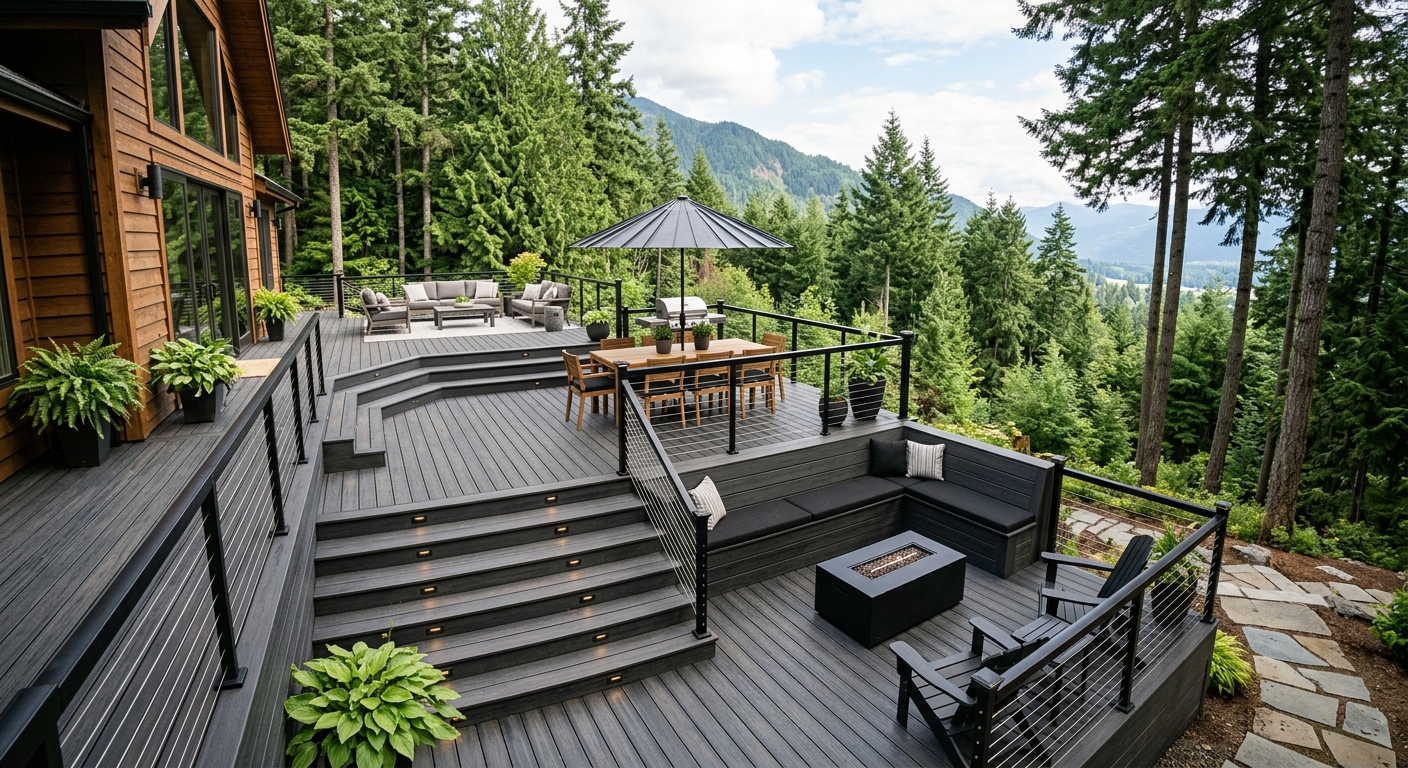
Railings are the most visible element on an elevated deck — they define the aesthetic, determine how much of your view you keep, and are among the most heavily regulated components under Washington State building code. In Seattle-area neighborhoods where hillside lots are common and Lake Washington or Puget Sound views are worth protecting, the railing decision matters as much as the decking material itself. Get it right and your railing preserves sightlines for thirty years. Get it wrong — wrong grade stainless near salt water, wrong cable tension at inspection, wrong HOA color at permit submittal — and you're looking at costly remediation on a component that's already installed.
This guide covers the four main railing systems we install across King and Snohomish County: cable, glass, cedar, and aluminum. We'll compare them on installed cost in the 2025 Seattle market, maintenance burden in our specific climate, code compliance under Washington State residential code, HOA approval patterns across Eastside communities, and the real 20-year total cost of ownership for each. We'll also cover stair railings, permit requirements, mixed-system strategies, and the neighborhood-by-neighborhood railing patterns we see most often — because what works on a Lake Washington view deck in Houghton is a different answer than what belongs on a flat-lot family deck in Woodinville.
Whether you're building new, replacing an aging cedar system, or upgrading from spindles to cable for a view you want back, this is the decision framework that comes from installing hundreds of railing systems across the Seattle metro.
Why Railing Matters More in Seattle Than Almost Anywhere Else
Seattle's topography makes elevated decks the norm rather than the exception. Newport Hills in Bellevue, Education Hill in Redmond, Norway Hill in Bothell, Kennydale in Renton, Queen Anne and Capitol Hill in Seattle itself — these are communities where a flat backyard is genuinely uncommon. Once your deck surface exceeds 30 inches above grade, Seattle SDCI and Washington State residential code mandate a guardrail on all open sides. On elevated decks with views, your railing choice either preserves those sightlines or permanently blocks them.
Beyond aesthetics, railings in the Pacific Northwest face structural demands that don't exist in most of the country. Wind loads from Lake Washington, salt air near Puget Sound, and 38+ inches of annual rainfall mean hardware must be specified for our climate — 316-grade marine stainless for waterfront applications, properly engineered cable tension systems, and tempered safety glass per code. Getting those specifications right is the difference between a railing that lasts 30 years and one that starts failing in 8–10.
The cost implications are significant. Railing is consistently the most underestimated line item in Seattle deck budgeting. On a large deck with significant perimeter — say an 18×24 deck on a steep Bellevue hillside with three open sides — railing can represent 20–35% of total project cost. A homeowner who budgets $45,000 for a deck and rough-estimates "maybe $5,000 for railings" may be looking at $12,000–$18,000 when the actual cable system is priced out with engineering, 316-grade hardware, and steel end posts capable of handling proper cable tension loads. Understanding what each system actually costs before committing to a design prevents the most common mid-project budget shock we see.
What Washington State Code Actually Requires
Washington State residential code (WAC 51-51-0507) sets the baseline guardrail requirements that apply across King County:
- When required: Any deck surface more than 30 inches above adjacent grade on any open side
- Minimum height: 36 inches for decks under 30 inches above grade; 42 inches for decks over 30 inches (measured from deck surface to top of rail, not post cap)
- Opening limitations: No gap that allows a 4-inch sphere to pass through — applies to baluster spacing, cable spacing, and bottom rail clearance
- Lateral load resistance: Guardrail systems must resist 200 lbs applied horizontally at the top rail
- Stair guardrails: Required on any stair with 4 or more risers; minimum 34 inches height measured from stair nosing
Seattle SDCI may impose additional or more specific requirements through local amendments — verify with your permit application if you're building within Seattle city limits versus unincorporated King County. Both jurisdictions require inspection of the completed railing before the permit closes.
Important
Cable Railing: Maximum View Preservation
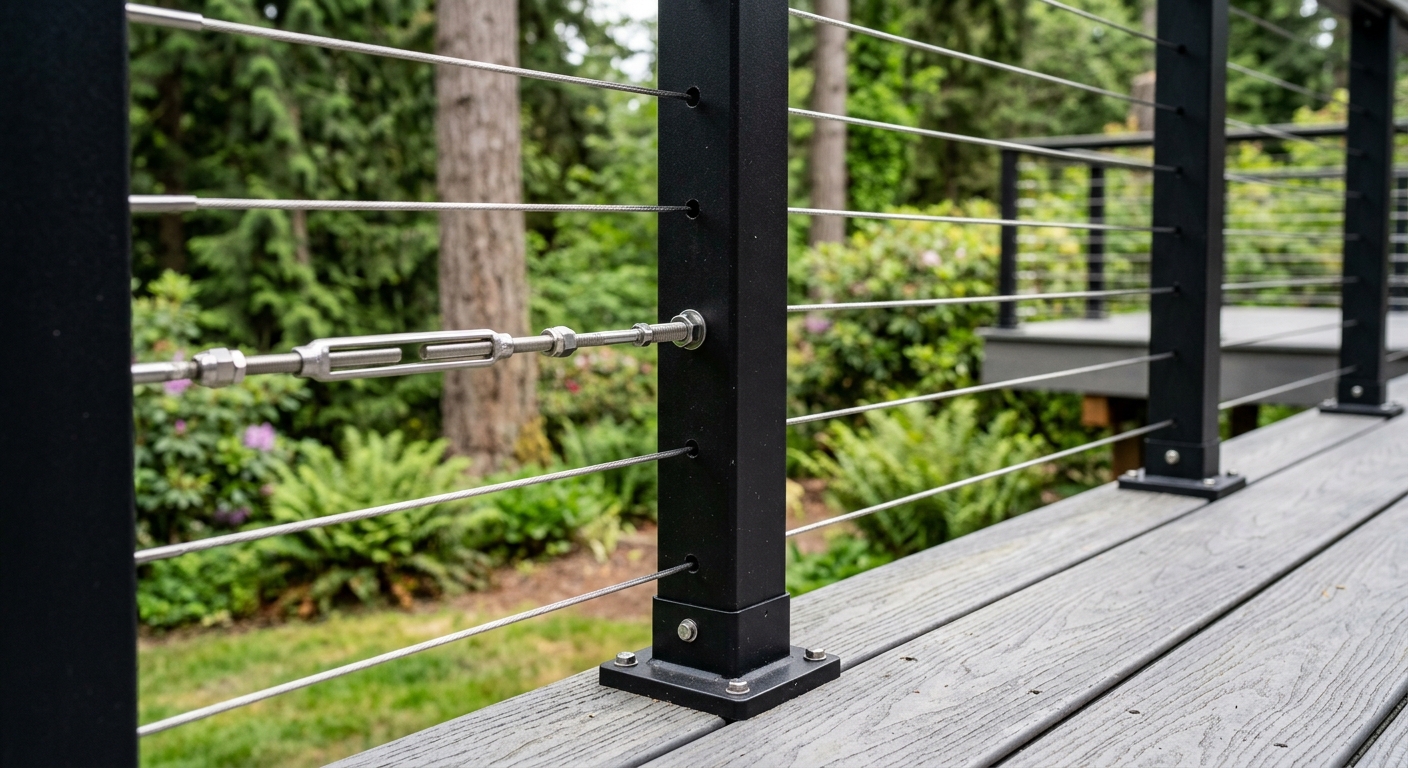
Cable railing is the most popular upgrade we install in Seattle-area view locations — and for good reason. Horizontal stainless steel cables run between vertical posts, preserving sightlines while meeting Washington State code when properly engineered. It's the dominant choice wherever a lake view, Sound view, or hillside panorama is worth protecting, and in a market where view properties carry significant premiums over non-view properties, the investment in cable over wood spindles typically recovers well at resale.
Installed cost in King County (2025): $150–$250 per linear foot. A 60-linear-foot run — typical for a 16×20 deck with three open sides — runs $9,000–$15,000 installed. The range reflects post material (steel vs. wood), cable grade, stair complexity, and corner configurations.
Cable Grade: 316 vs. 304 Stainless — Why It Matters in Seattle
This is where most cable railing failures in the Pacific Northwest originate. 304-grade stainless is widely used inland and is perfectly adequate in most climates. In Seattle, it's acceptable for inland Eastside locations — Woodinville, Bothell, Sammamish — away from saltwater influence. But for any project within a mile of Puget Sound, Lake Washington, or Lake Sammamish, we specify 316-grade marine stainless exclusively.
The difference is molybdenum content. 316 stainless contains 2–3% molybdenum, which dramatically improves chloride corrosion resistance. In salt-adjacent environments, 304 stainless develops pitting and fretting at ferrule connections within 5–10 years. 316 resists this essentially indefinitely with basic maintenance. The per-foot material cost difference between 304 and 316 cable is roughly $2–$5 — a trivial increment on a $12,000 system that makes a major difference in 15-year performance.
Post Systems: Wood vs. Steel
Cable railing posts must handle significant tension loads — each run of cables exerts hundreds of pounds of cumulative force on the end posts. This structural reality limits your post material options more than most homeowners realize.
Steel posts (square tube, typically 1.5"–2" wall): Most structurally capable option for cable tension. Required for most end-post and corner-post applications. Available powder-coated in black, bronze, silver, and custom colors. Cost more than wood posts — expect $200–$450 per post installed for steel versus $80–$200 for wood.
Wood posts (4×4 or 6×6 cedar or composite): Can be used for intermediate posts (between end posts) in most cable systems. Cannot adequately handle end-post tension loads in most configurations without significant structural reinforcement. Some systems use a wood-clad steel insert at end posts for aesthetic continuity.
Composite and aluminum posts: Available from manufacturers like Trex and TimberTech for their cable system integrations. Typically appropriate for intermediate posts; verify manufacturer engineering documentation for end-post applications.
Washington State Code Requirements for Cable Railing
Per WAC 51-51-0507 and Seattle SDCI common projects guidelines:
- Top rail minimum height: 36 inches for decks under 30 inches above grade; 42 inches for decks over 30 inches
- Cable spacing: tensioned and spaced so a 4-inch sphere cannot pass through — typically 3 inches on center
- Cable tension: minimum 50 lbs per cable (less causes mid-span sag that fails the 4-inch sphere test at inspection)
- Post spacing: no more than 42–48 inches apart to maintain tension and prevent deflection under lateral load
- Top and bottom rails required: cables alone cannot carry the load without a structural top rail
Inspection reality: Cable railings fail inspection more often than any other system — almost always on cable tension or post spacing, not cable grade. An inspector who applies lateral force to the mid-span of a cable run should not be able to deflect it more than 4 inches. Low-tension installations that look fine visually will fail this test. Get cable tension engineered properly, and have the installer document the final tension readings at permit closeout.
Key insight
Cable Railing Maintenance in Seattle
Cable railing is not maintenance-free, though it's far less demanding than cedar. The annual maintenance protocol we recommend for Seattle-area cable systems:
- Tension check (annual): Walk each run and check mid-span deflection. Any cable that deflects more than 4 inches needs retensioning. This is a 30-minute job for a homeowner once you know how.
- Hardware inspection (annual): Check ferrules and turnbuckles at end posts for fretting or corrosion. Wipe with marine-grade stainless cleaner and protectant.
- Cable wipe-down: For locations within a mile of saltwater, a soap-and-water wipe-down of cables every 6 months prevents chloride buildup. Takes 15 minutes on a standard deck.
Where cable is most popular across King County: Newport Hills and West Bellevue for hillside view decks, Kennydale in Renton for Lake Washington views, Houghton and Juanita in Kirkland, Magnolia and Queen Anne in Seattle for city or Sound views, and Mercer Island throughout.
Glass Railing: Maximum Visual Openness
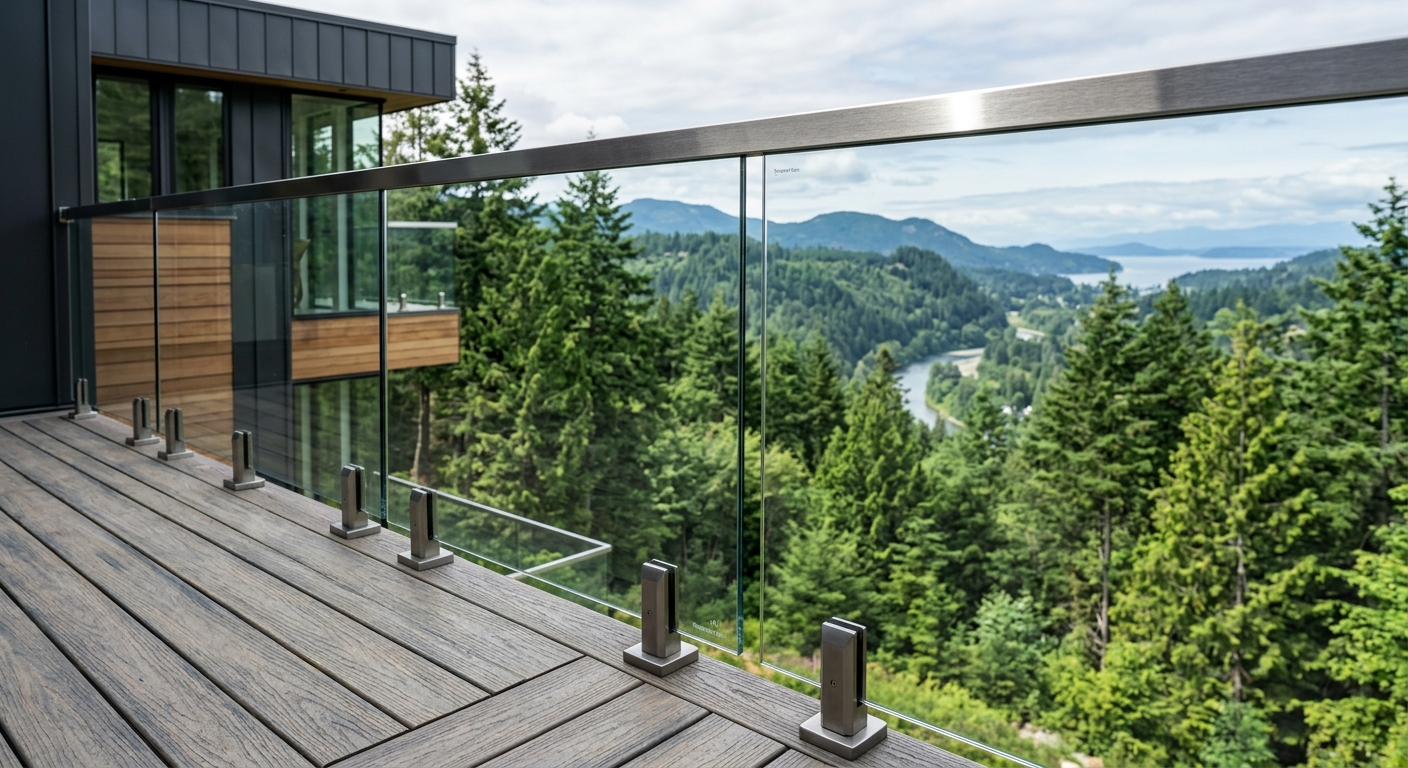
Glass panel railing provides a completely unobstructed sightline — no horizontal cables, no spindles, just a continuous clear barrier. It's the highest-cost railing option we install and the preferred choice for waterfront properties and premium view situations where visual openness is the absolute priority. On a truly spectacular viewscape — a Lake Washington shoreline in Hunts Point, a Puget Sound panorama from a West Seattle bluff — frameless glass disappears from your field of vision in a way that no other system can match.
Installed cost in King County (2025): $250–$500 per linear foot. A 60-linear-foot system runs $15,000–$30,000. The wide range reflects framing type (channel-framed vs. semi-frameless vs. fully frameless point-fixed systems), glass thickness, hardware grade, and site complexity.
Glass System Types and Their Cost Implications
Channel-framed systems: Glass panels slide into an aluminum or stainless base channel anchored to the deck framing. Easiest to permit (no engineering stamp required in most King County jurisdictions), most cost-effective glass option, available in standard panel sizes that reduce fabrication cost. Typical installed cost: $250–$350/LF.
Semi-frameless systems: Stainless or aluminum posts at panel joints with no top or bottom rail visible — panels appear to float between posts. More architectural appearance than channel systems. Typical installed cost: $300–$400/LF.
Fully frameless (point-fixed): Glass panels are anchored directly through holes in the glass using stainless fittings — no visible posts, no channel, truly minimal appearance. Requires a structural engineering stamp in most jurisdictions. Most expensive option. Typical installed cost: $400–$500+ LF.
Glass Specifications That Matter in Seattle
Washington State code requires tempered safety glass for deck guardrail applications — standard annealed glass is not code-compliant and is a structural hazard under lateral load. Panel thickness is specified at 3/8 inch or 1/2 inch depending on span length and site-specific wind load engineering.
For exposed waterfront locations on Lake Washington, Puget Sound, or the Sound-adjacent communities of West Seattle, Magnolia, and Edmonds:
- Specify 1/2-inch tempered for exposed, high-wind locations — 3/8 inch is appropriate for sheltered inland applications but undersized for waterfront wind load
- 316-grade marine stainless hardware throughout — aluminum hardware corrodes measurably in salt-adjacent Pacific Northwest environments within 5–7 years, and aluminum corrosion on glass channels is expensive to remediate
- Frameless systems require a structural engineer's stamp; budget $500–$1,200 for the engineering document on top of installation cost
Glass Maintenance Reality
Glass delivers the best visual performance but the most demanding cleaning schedule. In Seattle's wet climate:
- Water spots and mineral deposits from rain dry on glass panels and require cleaning every 2–4 weeks during high-rainfall periods to maintain clarity
- Fingerprints and pollen accumulate visibly — particularly noticeable in spring when alder, birch, and cedar pollen coat everything in the PNW
- Bird droppings require immediate cleaning — dried on glass is harder to remove and can etch the surface over time
The annual time investment is low. The cleaning frequency (not effort per cleaning) is what catches homeowners off guard. A glass railing that goes 8 weeks without cleaning in Seattle looks significantly worse than cable or aluminum left to the same schedule. If you choose glass, build a regular cleaning habit or budget for quarterly professional cleaning ($150–$300 per session for a standard deck perimeter).
Tip
HOA considerations: Glass railing is generally HOA-friendly where permitted, but some Sammamish and Issaquah HOAs require specific frame finishes (most commonly black powder-coat or brushed aluminum) or prohibit frameless systems that lack visible posts. Verify before ordering — glass panels are non-returnable once cut to size, and an HOA rejection after ordering a custom glass system is genuinely expensive.
Cedar Railing: Classic Northwest Aesthetic, Active Maintenance Required
Cedar railing is the traditional choice on Pacific Northwest decks and fits naturally with cedar decking installations and craftsman-style architecture. It's the most customizable option — spindle profiles, top cap designs, bottom rail configurations, and post sizes can be built to match nearly any architectural vocabulary from Craftsman to contemporary to farmhouse. And at $60–$120 per linear foot installed, it's meaningfully less expensive than cable or glass upfront.
Installed cost in King County (2025): $60–$120 per linear foot. A 60-foot run costs $3,600–$7,200 installed. The range reflects spindle density, top cap profile complexity, post size (4×4 vs. 6×6), and stair section complexity.
The Maintenance Reality in Seattle's Climate
Cedar railing needs staining or sealing every 2–3 years in Seattle's wet climate — without exception. This isn't a recommendation; it's structural reality. Unstained cedar in Seattle begins surface checking within one to two seasons as moisture cycles through the wood. By year 3–4 without maintenance, surface fibers are degrading and spindles show visible gray weathering and splitting. Cedar railings in Seattle show neglect faster than cedar decking because railings have more total exposed surface area per linear foot and are often in more exposed positions.
The maintenance math over 20 years: a 60-LF cedar railing system stained every 3 years by a professional costs roughly $600–$900 per treatment, or $4,000–$6,000 in staining costs over the life of the railing. Add that to the initial installation cost and the 20-year total cost of ownership for cedar railing is not dramatically lower than aluminum — and aluminum requires essentially no ongoing maintenance.
Oil-based penetrating stains outperform film-forming stains in our wet climate. Film formers (the opaque, painted-look products) trap moisture and peel in high-rainfall environments; penetrating oils move with the wood and allow vapor transmission. For Seattle cedar railings, we recommend products from Armstrong Clark, TWP (Total Wood Preservative), or Defy Extreme — all penetrating oil-based products that hold up well in Pacific Northwest conditions.
Fastener Specification: The Mistake That Ruins Cedar Railings
This is the most common construction defect we remediate on cedar railing systems installed by other contractors. Standard galvanized screws leave rust streaks on cedar within 2–3 years in Seattle's wet climate — the zinc coating is insufficient for the sustained moisture exposure our railings face. By year 5, galvanized fasteners in a Seattle cedar railing are actively corroding and staining the wood they hold.
We specify stainless steel fasteners (305 or 316 grade) on all cedar railing installations — screws, bolts, post base hardware, and any metal connector. The material cost premium over galvanized is modest; the appearance and longevity benefit is significant.
Additional cedar-specific details:
- Post bases: Specify stainless post bases and keep posts isolated from direct water pooling. Post-to-deck connections are the highest rot-risk point on any cedar railing
- Bottom rail clearance: Keep bottom rails at least 1/2 inch above the deck surface to reduce moisture contact and allow drainage
- Pre-drilling: All fastener holes should be pre-drilled to prevent splitting — especially at post bases and top cap connections
Note
Where Cedar Railing Makes Sense
Cedar railing is the right choice when: views are not the priority; the architectural style calls for traditional Northwest wood character; you're matching or complementing an existing cedar system; the application is at or near grade level; or the project is a covered or semi-covered space where UV and rain exposure are reduced.
For high-elevation view decks where preserving sightlines matters — cable or glass is the right call. Cedar railings at 42 inches effectively block horizontal sightlines from deck-level seating. This is a fundamental aesthetic reality, not a quality judgment.
Aluminum Railing: Best Long-Term Value, Lowest Maintenance
Aluminum pre-engineered railing systems — sold under brands like Trex, TimberTech, Fiberon, and Fortress Building Products — are the lowest-maintenance railing option we install. Not the most visually dramatic choice, but practical, code-compliant, and requiring essentially no ongoing attention once installed.
Installed cost in King County (2025): $80–$150 per linear foot. A 60-foot run costs $4,800–$9,000 installed. The range covers standard versus premium profiles, post cap styles, baluster configurations, and stair section complexity.
Why Aluminum Performs Well in Seattle
Aluminum's durability profile aligns well with Seattle's climate challenges:
- No rust, no rot: Aluminum doesn't corrode in rain exposure and doesn't absorb moisture. The structural members remain sound for the life of the system
- Powder-coat finish longevity: Quality aluminum railing systems use powder-coat finishes rated for 15+ years before showing visible fading or chalking — far exceeding paint or stain longevity on wood
- No re-tensioning: Unlike cable systems, aluminum baluster systems have no tension that relaxes or changes seasonally
- Stainless fasteners: We specify stainless post bases and fasteners on all aluminum installations — aluminum hardware corrodes on the screws and anchors even if the structural members don't
Over a 20-year total cost of ownership analysis, aluminum is typically the most economical railing option of the four. Initial cost is comparable to cedar; ongoing maintenance cost is essentially zero versus $4,000–$6,000 in cedar staining. The total delta is significant.
Aluminum Brand Comparison
| Brand | System | Profile Options | Color Options | Notable Feature |
|---|---|---|---|---|
| Trex | Transcend Railing | Classic, contemporary | Black, white, bronze, charcoal | Integrates with Trex decking warranty |
| TimberTech | Impression Rail | Classic, contemporary | Black, white, bronze | Compatible with TimberTech decking |
| Fiberon | ArmorGuard, Symmetry Rail | Classic, contemporary, cable-ready | Black, white, bronze | Cable-infill compatible |
| Fortress | Evolution Steel | Contemporary, industrial | Black, slate gray, white | Steel (not aluminum) — heavier, more commercial feel |
The aesthetic trade-off: Pre-engineered aluminum systems have a consistent, manufactured look that suits contemporary and transitional deck designs but can feel less architectural than custom cedar or view-focused cable. Color options — typically black, white, bronze, or silver — are limited versus custom cedar profiles. If visual openness or significant architectural distinction is the primary goal, aluminum isn't the right tool. If long-term practicality, HOA approval, and total cost of ownership are the priority, it's hard to beat.
HOA standing: Aluminum is almost universally HOA-approvable across King County communities. Many Sammamish and Eastside HOAs specifically list aluminum pre-engineered systems as a permitted option in their architectural standards — it's the lowest-friction choice in heavily HOA-governed communities.
Full System Cost Comparison
Midpoint installed cost per linear foot. Cedar lowest upfront; aluminum best 20-yr total; cable and glass for view preservation. Costs reflect standard configurations — stair sections, corners, and custom features add cost.
| Category | Value |
|---|---|
| Cedar (standard) | $90 |
| Aluminum (pre-engineered) | $115 |
| Cable (316 SS, steel posts) | $200 |
| Glass (channel-framed) | $300 |
| Glass (frameless) | $450 |
| Cable | Glass (framed) | Cedar | Aluminum | |
|---|---|---|---|---|
| Installed cost (60 LF) | $9K–$15K | $15K–$21K | $3.6K–$7.2K | $4.8K–$9K |
| 20-yr maintenance cost | $800–$2K | $3K–$6K (cleaning) | $4K–$6K (staining) | $200–$500 |
| 20-yr total cost (60 LF) | $10K–$17K | $18K–$27K | $7.6K–$13K | $5K–$9.5K |
| View preservation | High | Highest | Low | Low |
| Seattle weather durability | Excellent (316 SS) | Excellent (tempered) | Moderate | Excellent |
| Code compliance complexity | Moderate (tension) | Moderate (glass spec) | Easy | Very easy |
| HOA approval likelihood | High | High (verify finish) | High | Very high |
| Annual maintenance time | 2–3 hours | 8–15 hours (cleaning) | 8–15 hours (staining) | 30 min inspection |
| Best application | Hillside/lake views | Waterfront premium | Traditional/covered | Budget, practical, HOA-safe |
Stair Railing: The Often-Overlooked Component
Stair railing is required on any stair with 4 or more risers — which means virtually any elevated deck with stairs in Seattle has a stair railing requirement. Stair railings introduce complexity that doesn't exist on flat deck runs, and they're where mixed-system approaches often make the most sense.
Code requirements for stair guardrails (WAC 51-51-0507):
- Height: minimum 34 inches measured from stair nosing to top of rail (not from the tread, not from grade)
- Graspability: the top rail of stair guardrails must be graspable — circular or oval profiles; flat-top rails require a secondary graspable rail
- Cable systems on stairs: cables must be tensioned horizontally OR angled such that a 4-inch sphere still cannot pass through at any point — stair geometry makes this more complex than flat deck runs
- Glass on stairs: panel cuts must match the stair angle precisely — custom cuts for every stair application, which adds fabrication cost
Cable railing on stairs is technically achievable but more expensive than flat runs — expect $250–$350 per linear foot on stair sections versus $150–$250 on flat deck runs. The tension geometry is more complex, and post positioning must account for both the horizontal guardrail requirement and the stair nosing measurement.
Aluminum on stairs is the simplest code-compliance path — pre-engineered stair kits are available from all major brands and install with standard adjustable shoe connectors that accommodate most stair angles without custom fabrication. This is why we often recommend aluminum for stair sections even on decks where the main rail run is cable or glass.
Tip
HOA Navigation: What You Need to Know Before Ordering Anything
HOA restrictions on deck railings are more detailed and more strictly enforced in King County than most homeowners anticipate. The communities where HOA rules are most specific and most actively enforced include Sammamish, Bellevue (particularly Bridle Trails, Eastgate, and Wilburton), Issaquah Highlands, Newcastle, and Woodridge in Woodinville.
What HOA architectural standards typically govern:
- Material type: Some HOAs prohibit cable, some require cable for view-facing railings, some permit only specific materials
- Color and finish: Powder-coat color for aluminum and steel; frame color for glass channel systems; stain color range for cedar
- Post height and profile: Some HOAs specify maximum post height above top rail or require specific post profiles
- Brand or product line: Rare but not unheard of — some HOA documents reference specific product lines as "pre-approved"
How to get HOA approval:
- Pull your HOA's CC&Rs and the separate Architectural Standards document — these are typically available from your HOA management company or on the HOA's owner portal. The CC&Rs give general rules; the Architectural Standards document has the specific railing provisions.
- If your system is not explicitly listed, submit an Architectural Review Request (ARR) with the product specs, photos, and color samples before ordering. Standard ARR review in most Eastside HOAs runs 2–4 weeks.
- Do not order glass panels or cable before HOA approval is in writing — these components are non-returnable once cut to specification.
We handle HOA documentation on all our projects — product specs, color swatches, installation drawings — and have navigated ARR submissions across dozens of King County communities. If you're unsure about your HOA's railing requirements, we can review your governing documents before we finalize system selection.
Important
Mixed-System Approaches: Getting the Best of Both
Mixed-railing systems — different materials on different runs of the same deck — are more common than most homeowners realize and are often the most practical solution for Seattle's varied deck geometries.
The View-Side / Non-View-Side Split
The most popular mixed approach in Seattle: cable on view-facing sides, aluminum or composite balusters on house-adjacent sides. The view-facing runs are typically 30–50% of total perimeter on a rectangular deck; the house-adjacent run is the balance. This approach saves $70–$130 per linear foot on the non-view runs while capturing the visual benefit of cable where it matters.
Example on a 60-LF total perimeter deck:
- 36 LF view-facing cable at $200/LF = $7,200
- 24 LF house-side aluminum at $115/LF = $2,760
- Total: $9,960 vs. all-cable ($12,000) or all-cedar ($5,400)
The Stair Section Approach
As described above: cable on flat perimeter runs, aluminum on stair sections. Standard approach for maximizing cable's aesthetic benefit while controlling cost and complexity on stair geometry.
The Grade Change Strategy
On decks with significant grade change — where one side is close to grade (under 30 inches) and another side is high above grade — railings may only be legally required on the high side. Concentrating the premium cable or glass budget on the required and most-visible elevated side while using a simpler or no-railing approach on the grade-level side is a legitimate cost strategy.
Verify with King County permit requirements — some jurisdictions require railings on all open sides regardless of height differential on multi-level decks.
The Permit and Inspection Process for Railings in King County
Deck permits in King County and Seattle SDCI cover railing as an integrated component of the deck structure — there's no separate railing permit, but railing specifications must be included in the permit application drawings.
What the permit application needs for railing:
- Railing type and material noted on the deck plan
- Post spacing and attachment method
- For cable systems: engineering documentation of cable tension design and post sizing for end-post loads
- For glass systems: panel specifications (thickness, tempering) and, for frameless systems, an engineer's stamp
- For all systems: confirmation of guardrail height (42 inches for elevated decks) and baluster/cable spacing
Required inspections:
- Footing inspection: Before concrete is poured — inspects hole depth, diameter, and reinforcement
- Framing inspection: After framing but before decking — inspects beam sizing, joist hangers, ledger attachment
- Final inspection: After all work including railing is complete — inspects railing height, cable tension, baluster spacing, stair guardrail graspability
Cable railing inspections at final have the highest failure rate of any deck component we've tracked. Most failures are on cable tension (mid-span deflection too great) or post spacing (exceeds 42 inches between posts). Both are easily avoided with proper engineering and installation sequence.
We manage all permit and inspection coordination on our projects — drawings, submittal, scheduling inspections, and being present at inspection to address any questions. Permit management is included in our contracts.
Seattle Neighborhood Railing Patterns
Capitol Hill, Queen Anne, Magnolia, West Seattle: Hillside lots with city and Sound views dominate. Cable is the overwhelming choice — homeowners invest significantly to preserve the views that drove their home purchase. Most HOAs in these neighborhoods permit cable. Glass is common in premium Magnolia waterfront applications.
Newport Hills (Bellevue), Kennydale (Renton), Houghton (Kirkland): Lake Washington view decks with strong appetite for cable and glass. King County permit requirements for elevated applications often require engineering sign-off for cable tension systems at these heights. Glass is particularly popular in Mercer Island lakefront applications.
Sammamish, Issaquah, Newcastle (Eastside suburban HOAs): HOA rules are strictest here. Verify architectural standards before selecting any system. Aluminum is the lowest-friction option; cable and glass may require specific frame finishes or product approvals. Issaquah Highlands HOA has detailed architectural standards worth reviewing before project initiation.
Bothell, Kenmore, Woodinville (North End): Mix of flat-lot decks (aluminum and cedar common) and view properties along the Sammamish River corridor and Norway Hill (cable). Generally more permissive HOA environments than the south Eastside.
Mercer Island: High percentage of lakefront and view properties. Premium cable and glass installations dominate. Budget expectations reflect the highest-end market in the region — $250–$350/LF for cable is not unusual here due to site complexity and premium hardware expectations.
Renton, Kent, Auburn, Federal Way: More flat topography with lower prevalence of view decks. Aluminum and cedar are common. When elevated decks exist on hill lots (Kennydale in Renton, Lea Hill in Auburn), cable is the preference.
The NAR Remodeling Impact Report notes that outdoor living upgrades in strong real estate markets like King County recover well at resale — for decks with genuine views, cable and glass investments recover more fully than cedar or aluminum because buyers in view-property markets expect view-preserving railing.
Choosing the Right System: A Decision Framework
Use this framework to narrow from four options to the right one for your project:
Step 1 — Is view preservation the priority?
- Yes, significant view: cable or glass. Go to Step 2.
- No significant view, or view is not the priority: aluminum or cedar. Go to Step 3.
Step 2 — View-deck system selection:
- Waterfront location (within 1 mile of saltwater): glass with 316 stainless hardware, or cable with 316-grade cable — specify marine hardware explicitly
- Non-waterfront hillside view: cable (most popular, best cost/view ratio in King County)
- Premium application, maximum visual openness: glass (frameless for highest impact, channel-framed for budget-conscious premium)
- Budget-constrained view deck: cable with wood posts on intermediate sections, steel on end posts
Step 3 — Non-view system selection:
- Lowest 20-year total cost: aluminum
- Traditional Northwest aesthetic, architectural match to existing wood: cedar (commit to maintenance schedule)
- HOA-safe, easiest approval path: aluminum
Step 4 — Consider the stair sections:
- If selecting cable or glass for flat runs: evaluate whether aluminum stair sections make sense for cost and complexity
- If selecting cedar or aluminum throughout: match stair sections to primary system
Call (425) 675-6259 or request a free consultation to walk through this framework for your specific site. We'll review your HOA documents, assess your view geometry, and give you a budget estimate for the systems that make sense for your project — before you commit to any material selection.
Frequently Asked Questions
What is the code requirement for deck railing height in Washington State?
How much does cable railing cost in Seattle?
Is glass railing worth the cost in Seattle?
How often does cedar railing need maintenance in Seattle?
Do HOAs in Sammamish and Bellevue restrict deck railing types?
What is the best railing for a view deck in Seattle?
Can I mix cable and aluminum railing on the same deck?
What grade stainless steel should I specify for Seattle cable railing?
Do I need an engineer for cable or glass railing in King County?
Why do cable railings fail inspection in Seattle?
What's the 20-year total cost of each railing system?
How long does railing installation take?
Planning a deck in the Seattle area?
Get an onsite design review and a clear, itemized quote from a licensed local builder.
Request a Free Quote