
Deck Repair & Resurfacing Seattle
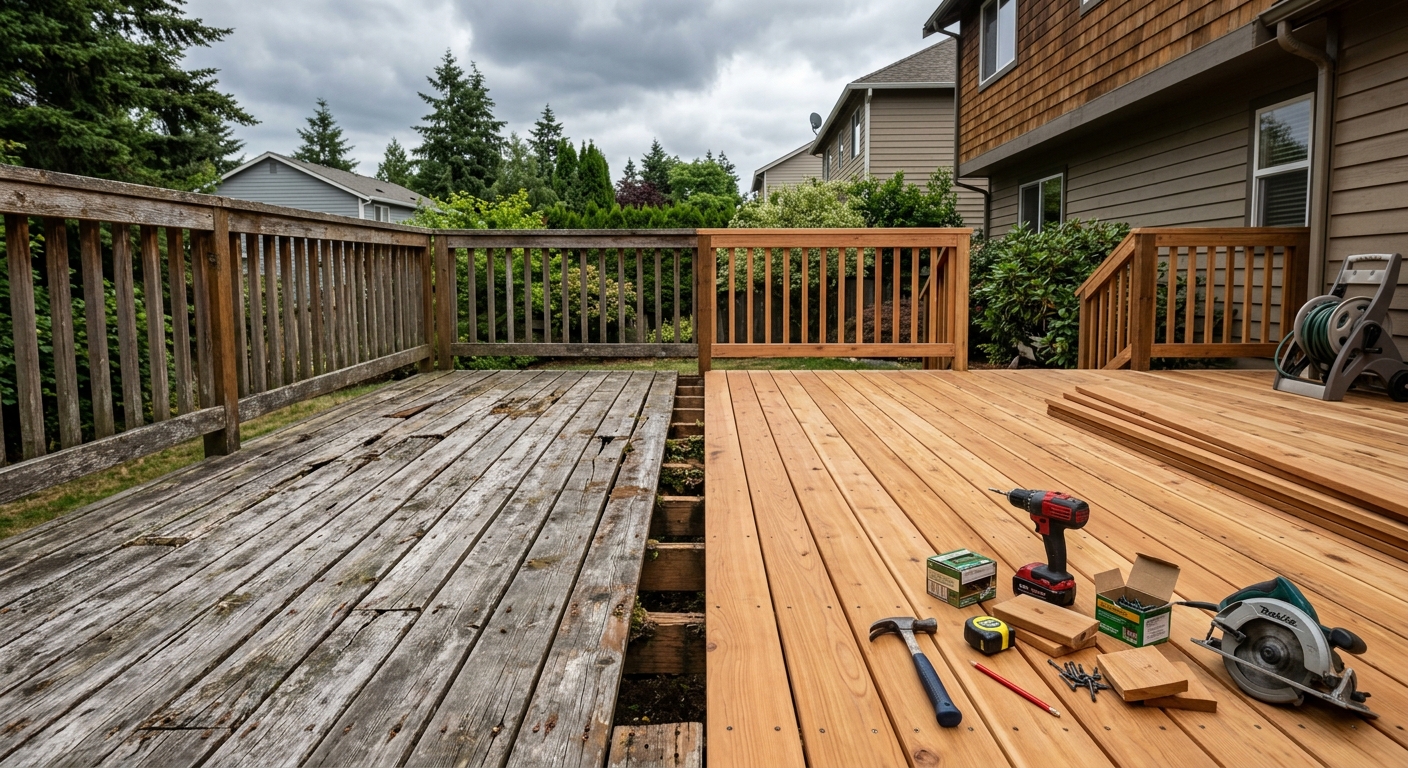
Most aging King County decks don't need full replacement — they need an honest assessment. We inspect the ledger, posts, joists, and hardware before recommending anything. If the structure is sound, resurfacing with composite boards over your existing frame saves $7,000–$15,000 and adds 25+ years.
callOr call us now: (425) 675-6259Summer assessment slots are filling — book your free structural inspection today.
Assessment First — We Won't Push Replacement If Repair Is Right
Free Deck Inspections
Our comprehensive deck inspection identifies safety hazards, structural issues, and the most cost-effective repair strategy.
Board & Joist Replacement
We replace damaged boards, rotted joists, and failing hardware to restore your deck's structural integrity.
Deck Resurfacing
Transform your existing deck frame with new composite or PVC surface boards for a fraction of full replacement cost.
Surface boards looking soft or discolored doesn't mean the frame below is compromised — and the frame is what determines structural safety. We do a full assessment before quoting anything: ledger attachment, post bases, joist condition, hardware corrosion, and flashing integrity. If your ledger and main posts are sound, resurfacing with composite decking over the existing frame is almost always the right call — and it saves $7,000–$15,000 compared to a full teardown and rebuild. If you have an existing concrete patio, we also build decks over concrete using sleeper systems.
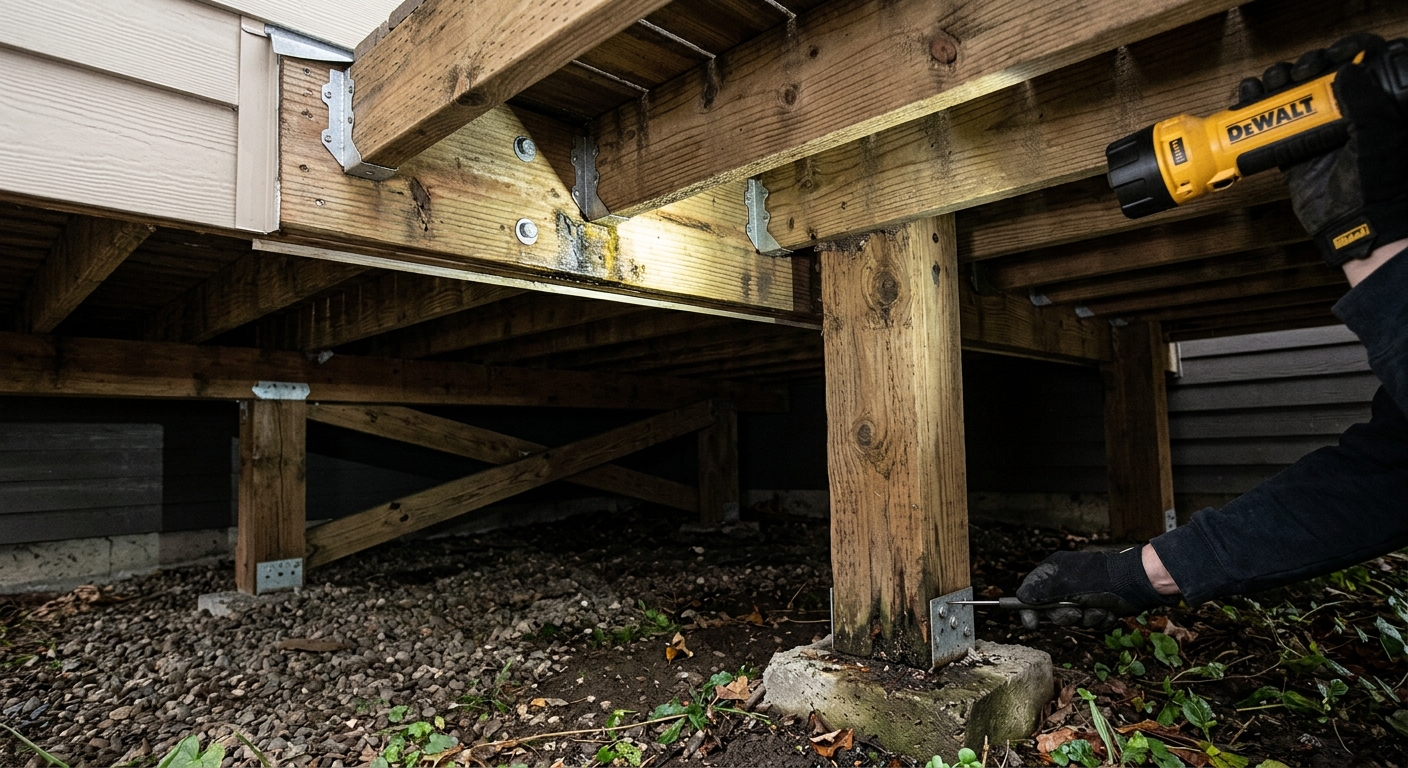
- warningLedger rot — the hidden failure: Common on 1990s pressure-treated decks, especially in the Green River valley and Kent where soil moisture is high. The ledger is the highest-stakes repair — structural detachment from the house is the worst-case failure scenario, and it develops silently behind siding.
- foundationPost base rot: The second most common repair need, often discovered during inspection when surface resurfacing was originally quoted. Post bases in direct soil contact or sitting in pooled water are vulnerable regardless of lumber treatment grade.
- buildJoist sistering: Add new joists alongside compromised ones without full tear-down. When individual joists show rot or deflection, sistering restores structural integrity and extends frame life by 15–20 years at a fraction of replacement cost.
- layersSurface resurfacing over a sound frame: Install composite or PVC boards over existing framing when the structure passes inspection. Saves $7,000–$15,000 vs full replacement and delivers 25+ years of low-maintenance performance.
The Structural Assessment Comes First
Surface boards get all the attention but the frame is what determines whether you repair or replace. We inspect ledger attachment (the most common failure point — improper flashing causes rot that isn't visible from above), joist condition at bearing points, post bases and concrete footings, and beam-to-post connections. A deck with a failed ledger needs a rebuild, not new boards. We provide a written structural assessment before recommending anything.
Deck Repair Cost Guide — King County
Repair costs vary significantly based on what's actually failing. Frame condition determines whether you repair or replace — surface boards are almost never the deciding factor.
| Repair Type | Typical Cost | When Needed | Result |
|---|---|---|---|
| Board resurfacing only | $7,000–$14,000 | Sound frame, worn boards | New composite/PVC surface, 25+ yr life |
| Joist sistering | $1,500–$4,500 | Soft joists, deflection | Structural integrity restored, 15-20 yr extension |
| Ledger replacement | $2,500–$6,000 | Ledger rot, hardware corrosion | Eliminates detachment risk, permits required |
| Post base replacement | $800–$2,000/post | Post rot, failing anchors | Eliminates settling and lean risk |
| Partial rebuild + resurface | $9,000–$20,000 | Mixed: some structure sound, some failed | Hybrid approach, significant savings vs full replacement |
| Full replacement | $18,000–$55,000 | Frame structurally compromised | Complete demo and rebuild, new 25-50 yr lifespan |
Repair Projects We've Completed
Kent East Hill — Ledger + Resurface
22-year-old PT deck. Surface boards looked acceptable but structural inspection found 60% ledger decay behind the siding. New ACQ ledger installed with correct flashing, then resurfaced with TimberTech Terrain composite. $11,400 total vs. $24,000 for full replacement.
Renton Kennydale — Joist Sister + Boards
Waterfront composite deck with 4 joists showing rot at end grain due to inadequate ledger flashing. Sistered 4 joists with LVL, corrected flashing, replaced 40% of boards that were cupping. Structural frame extended 15+ years. $7,800 total.
Bothell Canyon Park — Cedar Assessment
17-year-old cedar deck. Homeowner expected replacement — our assessment found sound ledger, solid posts, and only 2 failing joists. We sistered the joists, replaced surface boards with new cedar (CVG), and restained. Saved homeowner $16,000 vs. rebuild they didn't need. $7,200 total.
Federal Way — Post Base Failures
3 of 6 posts on a 1996 elevated deck had failed post bases — settlement and lean visible. Demo'd and replaced 3 posts and anchors, sister-framed 2 joists, replaced surface boards with Trex Select. Deck railing upgraded to aluminum balusters to meet current 4" spacing code. $13,500 total.
Deck Repair FAQs
Q: How do I know if I need repair or full replacement?
Start with the ledger and posts, not the surface boards. If the ledger connection to the house is solid, the post bases are intact, and the main joists don't show significant rot or deflection, resurfacing with composite boards over your existing frame is almost certainly the right approach — saving $7,000–$15,000 over a full teardown. We won't recommend full replacement when repair is the correct call. Schedule a free structural assessment and we'll give you an honest evaluation before any quote.
Q: What are the warning signs my deck needs an assessment right now?
Seven signs to take seriously: (1) Spongy or bouncy feel underfoot — joist deflection or rot; (2) Visible lean or settlement in posts; (3) Discoloration or staining on the house siding above the ledger connection — moisture intrusion; (4) Surface boards with significant cupping, checking, or cracking; (5) Rust staining at hardware and fastener locations; (6) Deck over 20 years old with no prior structural assessment; (7) Any deck that feels unstable when multiple people stand on it. If you notice any of these, don't walk on the deck until it's assessed — especially elevated decks.
Q: Does a deck repair or resurfacing require a permit?
In most King County cities: resurfacing-only (replacing boards over an intact, unchanged structural frame) typically does NOT require a permit. Any structural work — ledger replacement, post replacement, joist sistering, or any change to the structural system — DOES require a permit. Permit fees for repair projects run $150–$450 depending on scope and city. We always confirm permit requirements before starting structural work. Never do structural deck repairs without pulling the required permits — it creates liability for unpermitted work when you sell your home.
Q: My deck is cedar — should I resurface with composite or cedar?
If the frame is PT lumber (treated posts, beams, joists), resurfacing with composite is the most common choice: lower maintenance, 25-year warranty, and composite boards are dimensionally stable over PT lumber frames. Cedar decking-over-cedar resurfacing makes sense when the homeowner wants to preserve the natural wood look and commits to the maintenance schedule. Composite installed over a PT frame has no compatibility issues — the boards attach to the joists normally. We bring material samples to every assessment appointment so you can see and feel the options.
Q: How long does deck repair typically take?
Resurfacing-only projects (boards only, no structural work, no permit) typically take 2–5 days on-site for 300–450 sq ft. Structural repairs with permits (ledger work, joist replacement, post replacement) typically run 1–2 weeks total — including 2–4 weeks for permit review before construction starts. We provide a written scope and timeline at your estimate appointment so you can plan around the project. We always protect the area below elevated decks during construction and clean up completely at the end of every workday.
We perform deck assessments and repairs throughout South King County — Kent East Hill and West Hill PT replacements, Renton Kennydale waterfront repairs, Federal Way Dash Point saltwater hardware, and Bothell Canyon Park cedar replacements.
Why Deck Repairs Last — and What Causes Them to Fail — in Seattle's Climate
Seattle receives 38 inches of rain annually — more than New York City, more than Miami. That sustained moisture is the root cause of almost every deck repair we perform in King County. Understanding how the climate works on your deck structure determines whether a repair holds for 5 years or 25 years.
Freeze-thaw cycles accelerate every failure mode. King County averages 15–25 freeze-thaw events per year, concentrated between November and February. Water that infiltrates ledger connections, post bases, and joist end grain expands when it freezes, opening microscopic cracks in the wood fiber. Those cracks let more water in the next wet season, which expands again the following winter. This is why King County decks from the 1990s — built to standards that didn't account for this cycle — show ledger and joist rot on a predictable 20–25 year timeline even when they were correctly installed at the time.
Moss and algae — the slow structural threat. Seattle's combination of rainfall, moderate temperatures, and canopy shade creates near-ideal conditions for moss growth on deck surfaces. Moss isn't just cosmetic: its root system holds moisture against the board surface continuously, accelerating rot in wood decks and softening the cap layer on lower-grade composite products. When moss grows into the gaps between boards and reaches the joists below, it establishes a moisture reservoir directly against your structural framing. Our repair assessment always checks joist tops in moss-prone areas — this is where rot begins invisibly before it shows on the surface.
Why the resurfacing material you choose changes the repair's longevity. When we resurface a structurally sound frame with new boards, the material choice directly affects how long the repair holds in King County conditions. Uncapped composite — the lower-cost option many contractors default to — has a wood-fiber core that absorbs moisture through cut ends and fastener holes. In Seattle's climate, that moisture absorption causes board swelling, mold growth between boards, and gradual cap delamination within 5–10 years. Fully capped composite (4-sided polymer shell) and PVC eliminate moisture absorption entirely. We specify only capped products for resurfacing work — not as an upsell, but because uncapped composite fails predictably in this rainfall environment.
UV fade at Seattle's latitude. At 47°N, Seattle's lower solar angle still delivers meaningful cumulative UV over a decade. Entry-level composite and PVC products without UV inhibitors fade noticeably within 7–10 years, creating mismatched color between original and replacement boards on partial-repair projects. We source replacement boards from the same manufacturer lines — Trex Transcend, TimberTech Terrain, AZEK — that carry 30-year fade and stain warranties, so the repaired sections match the original surface for the life of the product.
The materials and techniques we use on every repair are chosen specifically for King County's climate. See our Seattle deck cost guide for honest price ranges on repair vs. replacement — or schedule a free structural assessment and we'll give you a straight answer on what your deck actually needs.
Get Your Free Structural
Deck Assessment
We inspect the ledger, posts, joists, and hardware before recommending anything — repair or replace. Honest assessment, written estimate, no pressure.
No obligation. We walk your deck, assess the structure, and send a written estimate within 48 hours.