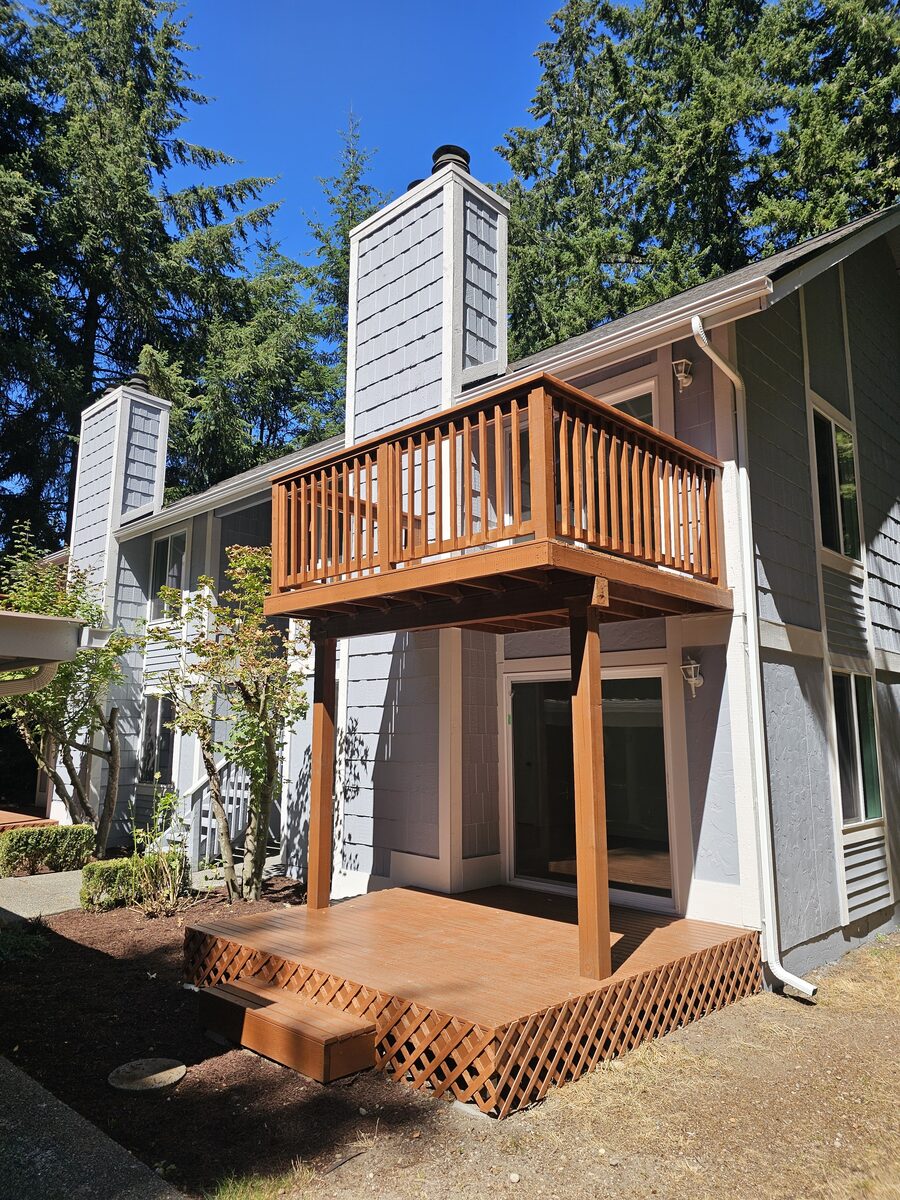
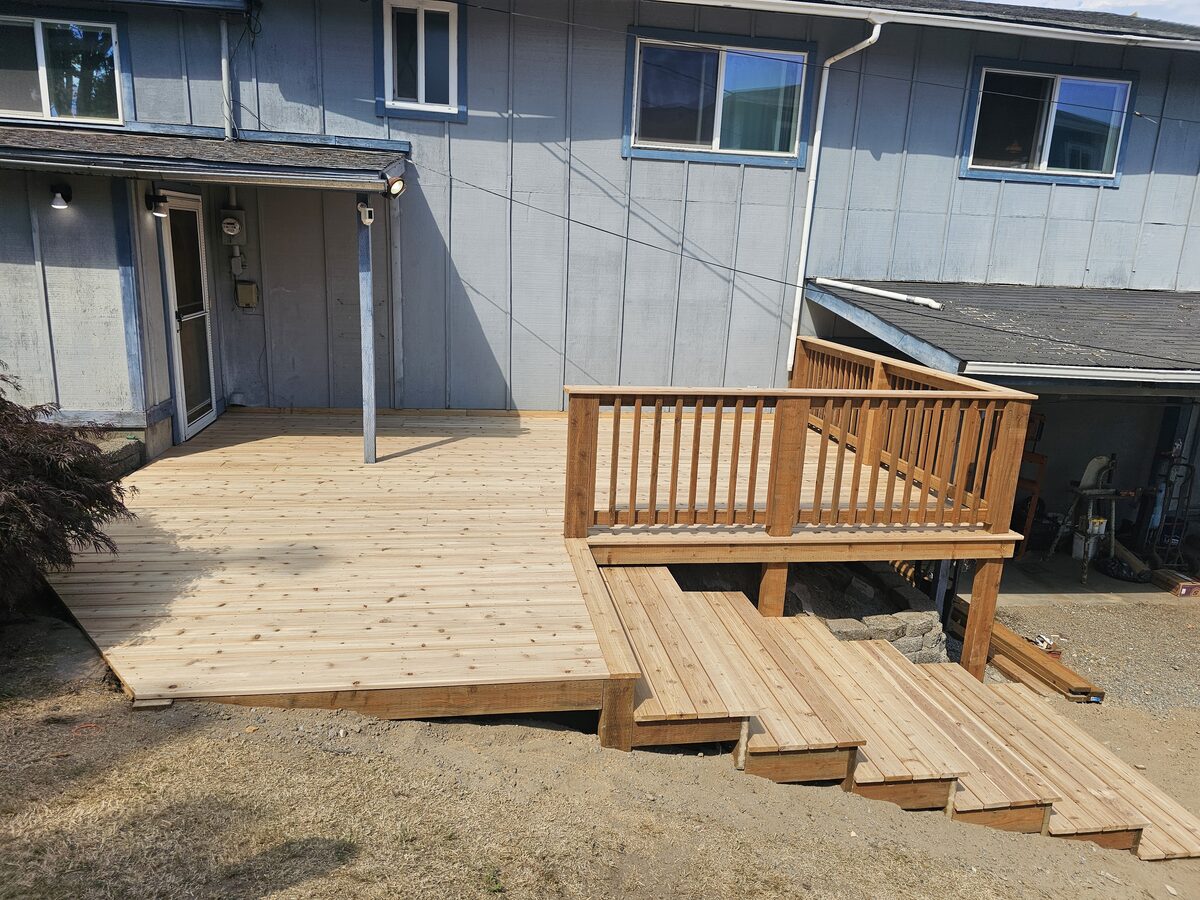
Cedar Decking Seattle
Clear vertical grain Western Red Cedar — the Pacific Northwest's native material. Beautiful when sealed, requires commitment in our climate. We'll tell you honestly whether cedar is the right call for your site or whether the maintenance math points to composite.
Western Red Cedar: Natural Beauty for Pacific Northwest Homes
Natural Rot Resistance
Western Red Cedar contains natural oils and tannins that resist decay and insect damage — nature's own preservative.
Rich Natural Grain
Every cedar board has unique grain patterns and warm tones that age gracefully, developing a beautiful silver patina over time.
Easy to Work With
Cedar is lightweight and easy to cut, shape, and fasten — ideal for custom curved deck designs and intricate patterns.
Western Red Cedar is the original Pacific Northwest decking material — and on the right lot, with the right maintenance commitment, it remains a beautiful and legitimate choice. Clear vertical grain (CVG) Western Red Cedar is the grade we specify: tighter grain means better dimensional stability, fewer knots, and longer life. On open, sun-exposed lots in Renton, Kent, or Federal Way, properly maintained cedar delivers 20–25 years of service. On shaded, forested lots in Issaquah or Canyon Park Bothell, that timeline compresses significantly.
- paymentsCost in King County: $18–$28/sqft installed for clear vertical grain Western Red Cedar — the most affordable premium decking option upfront. Factor in $800–$1,500 in staining and cleaning every 2–3 years when comparing total cost against composite over the deck's lifetime.
- location_onBest applications: Sun-exposed lots in Renton Highlands, Kent East Hill, and Federal Way where natural wood aesthetics are the priority and the maintenance schedule will be followed; projects pairing with pergola structures where cedar's warm tone is the design intent; homeowners who actively enjoy wood maintenance and want to preserve an authentic Pacific Northwest look.
- verifiedWood grades: Clear vertical grain (CVG) Western Red Cedar is the top specification — minimal knots, tight grain, best dimensional stability. No. 1 Clear is also acceptable for most residential applications. Avoid knotty cedar for decking; knots create moisture entry points that accelerate rot in Seattle's wet climate.
- cleaningMaintenance reality in Seattle: With 38 inches of annual rainfall, cedar requires staining or sealing every 2–3 years on sunny lots — every 12–18 months on shaded or north-facing lots. Most of the 1990s cedar decks on East Hill Kent and Canyon Park Bothell are at or past end-of-life precisely because this maintenance schedule wasn't maintained.
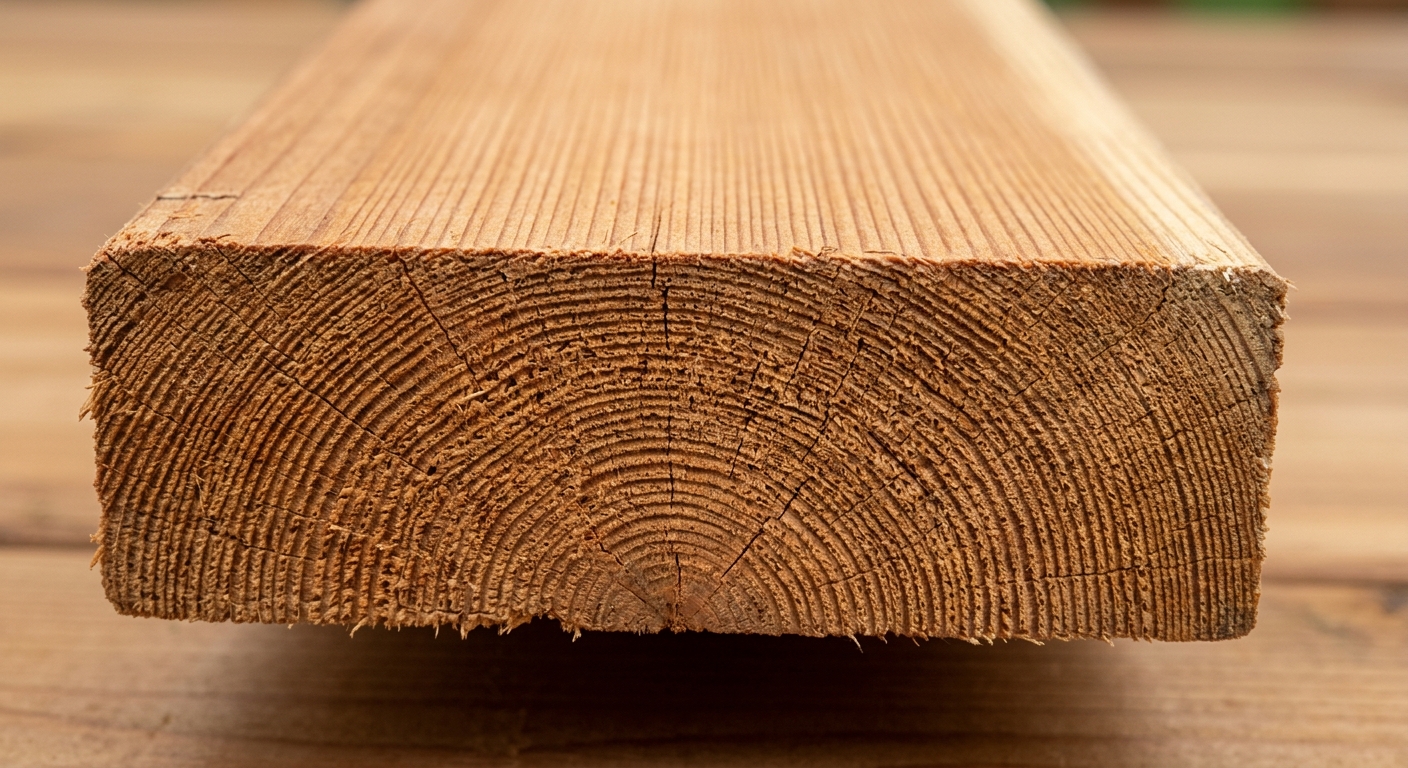
Why We Specify Clear Vertical Grain (CVG)
CVG cedar has the tightest grain of any cedar specification — annual rings run nearly parallel to the face of the board. The board shrinks and swells uniformly, resists cupping, and holds a stain longer than flat-sawn or knotty cedar. Knots are moisture entry points that accelerate rot in Seattle's wet climate. We specify CVG or No. 1 Clear only — never knotty cedar for decking.
Cedar vs. Composite: An Honest Comparison
Most contractors pitch you whatever they build most. We build both — and we'll tell you which one actually makes sense for your property.
Cedar wins when…
- ✓The deck is covered — pergola or roof overhead limits UV and rain exposure, which are cedar's two biggest maintenance drivers
- ✓The homeowner genuinely values natural wood and is realistic about committing to a 2–3 year sealing schedule
- ✓Budget is tight upfront and the homeowner plans to DIY maintenance — cedar's lower day-one cost is real
- ✓The lot is sun-exposed (south or west facing) — cedar dries between rain events and lasts significantly longer in open sun
Cedar loses when…
- ✗The lot is shaded by trees or north-facing — cedar in persistent shade in the PNW develops serious moss and checking in 5–8 years
- ✗Busy families who are honest that they won't maintain the staining schedule — neglected cedar fails faster than any other material
- ✗You're doing 20-year cost math — on most King County lots the composite crossover arrives at year 10–14
- ✗HOA communities requiring consistent appearance — cedar weathers and grays unevenly, sometimes triggering violation notices
| Metric (400 sq ft deck) | Cedar (sunny lot) | Cedar (shaded lot) | Capped Composite |
|---|---|---|---|
| Initial Cost | $18K–$24K | $18K–$24K | $22K–$35K |
| 5-Year Total Cost | $21K–$28K | $23K–$32K | $22.5K–$35.5K |
| 20-Year Total Cost | $34K–$52K | $48K–$70K | $23K–$37K |
| Maintenance Hrs/Year | 12–20 hrs | 20–35 hrs | 1–2 hrs |
Cedar Decking Cost Guide — King County
Cedar's lower upfront cost is real — but the 25-year picture matters. Compare before deciding.
| Option | Install Cost (400 sq ft) | 25-yr Maintenance | 25-yr Total |
|---|---|---|---|
| Cedar (sunny lot) | $18,000–$24,000 | $8,000–$12,000 | $26,000–$36,000 |
| Cedar (shaded lot) | $18,000–$24,000 | $15,000–$22,000 | $33,000–$46,000 |
| Mid composite (Trex Select) | $22,000–$30,000 | $1,500–$3,000 | $23,500–$33,000 |
| PVC decking (AZEK) | $32,000–$45,000 | $0–$500 | $32,000–$45,500 |
The PNW Cedar Maintenance Reality
Seattle gets 38+ inches of rainfall per year, most of it October through May. Cedar sealed properly looks stunning for decades. Unsealed cedar in the PNW goes gray within 2–3 years and starts checking (cracking along the grain) and cupping in 5. The surface degradation is cosmetic at first — but moisture that enters checking works into end cuts and penetrates to the core over time. See our complete guide to cedar deck sealing in Seattle for product picks and timing.
- scheduleSealing schedule for new cedar: First seal at 6 months (let the wood “breathe” and dry after installation). Then every 1–2 years depending on sun exposure: annually on shaded north-facing lots, every 2 years on well-exposed south or west-facing surfaces.
- paymentsCost of professional maintenance: $800–$2,000 per cycle for power wash + brightener + staining on a 400 sq ft deck, depending on the stain product and labor rates. On a 2-year cycle, that's $400–$1,000 per year. Over 20 years: $8,000–$20,000 in maintenance cost alone — often exceeding the original price difference between cedar and composite.
- warningWhat happens when maintenance is skipped: One missed cycle on a shaded lot accelerates moss colonization. Two missed cycles leads to surface checking deep enough to require board replacement. Three missed cycles on a north-facing Issaquah or Bothell lot and the deck is often beyond economic repair. We've assessed hundreds of these — the pattern is consistent.
Materials We Use: Clear VG Only
Not all cedar is equal. The grade of cedar board determines how well it performs in the PNW — and most of the cedar failures we assess were built with lower grades than the site required.
- verifiedClear Vertical Grain (CVG) — our only specification: CVG cedar has tight, straight grain running the full length of the board with minimal or no knots. The tight grain resists moisture absorption, checks less under temperature cycling, and accepts stain more evenly. It's the only grade we specify for deck boards. Not #2 grade. Not knotty cedar. Knots are moisture entry points that rot from the inside out regardless of surface treatment.
- local_shippingSources: We source CVG Western Red Cedar from Dunn Lumber and Pacific Coast Cedar — both supply consistent clear-grade stock with documented provenance. We don't use big-box lumber yard cedar, which is typically lower and inconsistently graded.
- straightenBoard dimensions: Standard residential deck boards are 5/4×6 (finished to approximately 1" thick). We use 2×6 for heavy-use applications, commercial decks, or any surface that will see concentrated load (built-in benches, heavy furniture zones, entry areas).
Where Cedar Is Still the Right Call
Mercer Island — Purist Build
350 sq ft CVG cedar deck with cedar pergola attached. Homeowner wanted authentic PNW natural wood. Open east-facing lot with full sun. Pre-treated with Defy Extreme semi-transparent stain at installation; maintenance schedule agreed up front. $26,500 installed.
Kirkland — Cedar + Pergola Combo
280 sq ft deck plus matching cedar pergola with cedar privacy panels — the tone match was the design intent. CVG grade throughout. Juanita neighborhood, west-facing, moderate shade. Owner opted for annual maintenance contract with local pressure wash company. $31,200 installed.
Kent East Hill — Value Replacement
Replaced failed 1994 PT deck with new No. 1 Clear cedar on existing concrete footings (sound). 380 sq ft, south-facing open lot. Homeowner chose cedar to minimize upfront cost and plans to maintain it themselves. $19,800 installed.
Redmond — Repair & Restain
10-year-old cedar deck in good structural shape but badly weathered surface. Replaced 12 surface boards, sister-framed two soft joists, pressure-washed and applied Cabot Australian Timber Oil full coverage. Extended deck life by 8–12 years. $4,800 repair + restain.
Cedar Project Case Studies
Kirkland — Covered Porch + Pergola
240 sq ft covered deck with an integrated pergola on a Kirkland lot. Cedar is the right call here — the overhead structure shields the deck surface from direct rain and UV, which are the two primary drivers of cedar degradation. Clear VG throughout: deck boards, pergola beams, and cedar privacy panels on the east side. Natural finish applied at installation; UV exposure is limited enough that the maintenance interval extends to 3+ years. $38,000 installed.
Issaquah — Mid-Slope Lot, Client Chose Cedar for Aesthetics
420 sq ft deck on a mid-slope Issaquah lot — moderate shade from adjacent trees, southwest-facing. Client had seen our cedar work and specifically wanted natural wood despite our honest maintenance conversation. We agreed on a maintenance plan upfront: professional stain every 18 months by a local pressure-washing company. Clear VG 5/4×6 boards, cedar railing to match. $42,000 installed. Two years in, deck looks excellent — the maintenance plan is being followed.
What the Maintenance Cycle Actually Looks Like
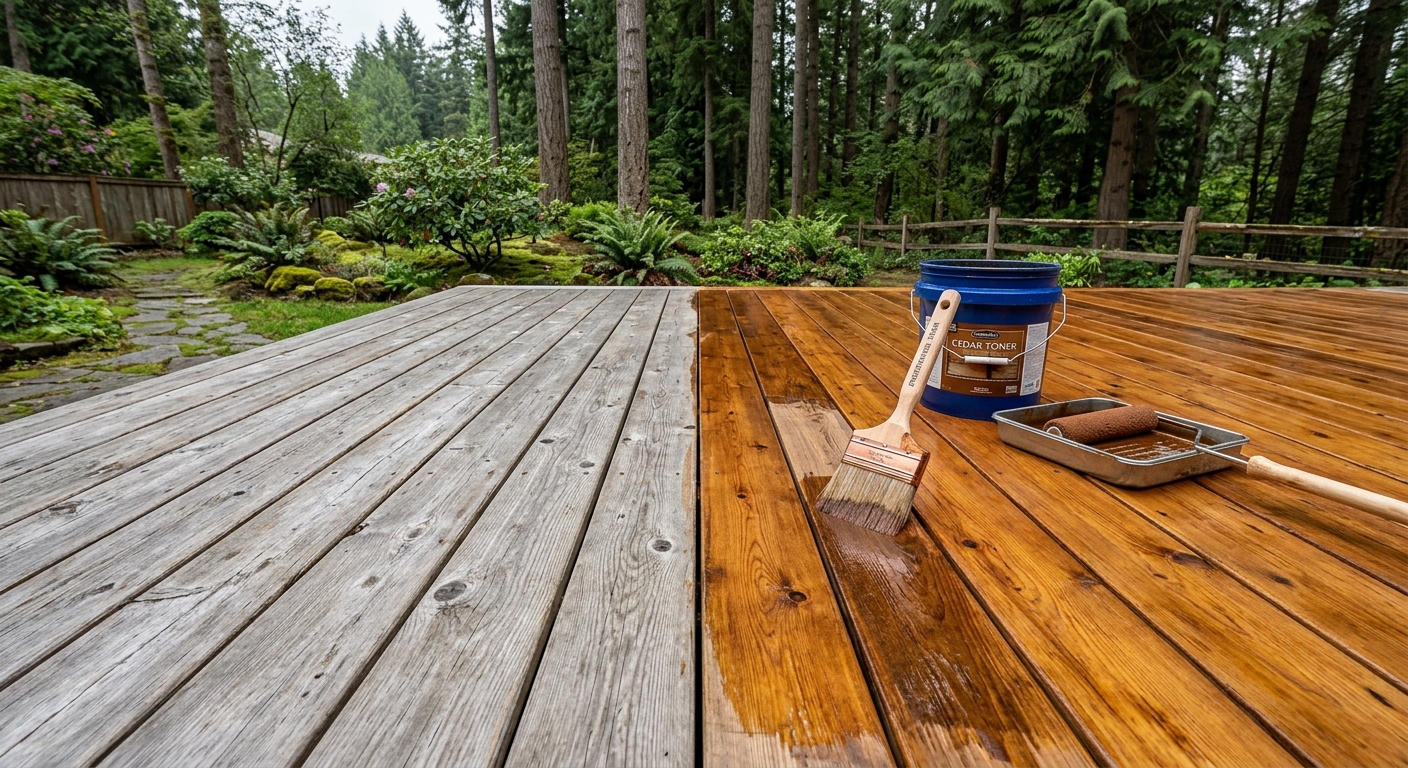
A quality penetrating oil stain applied every 2–3 years transforms weathered gray cedar back to rich warm color in a single session. The key is a semi-transparent oil-based product — it penetrates the fiber rather than film-forming on top. Film-forming stains crack in Seattle's rain and require stripping at recoat. Penetrating stains just need a clean surface and a brush. On shaded north-facing lots, plan for annual attention.
Cedar Decking FAQs
Q: How much does it cost to maintain a cedar deck in Seattle over 25 years?
On a sunny Renton or Kent lot with a 400 sq ft cedar deck, plan for deck wash and stain every 2–3 years. Professional staining runs $600–$1,200 per application — roughly $900 average every 2.5 years, or $9,000 over 25 years in maintenance cost alone, on top of the original installation. On a shaded Issaquah or Bothell lot where staining is needed annually to biennially, that number climbs to $15,000–$20,000 over the same period. We respect cedar and will build it when it's the right choice — but we give every client the honest 25-year cost picture before they decide.
Q: What cedar grade should I specify for a Seattle-area deck?
Clear Vertical Grain (CVG) Western Red Cedar is the premium specification — tight grain, minimal knots, best dimensional stability. If CVG is outside budget, No. 1 Clear (tight grain, some pin knots) is acceptable for most residential applications. Avoid knotty cedar for decking: knots create moisture entry points that accelerate rot in Seattle's wet climate, regardless of stain maintenance. We specify CVG or No. 1 Clear only — never knotty grades for deck boards.
Q: My cedar deck is 15 years old — should I repair or replace?
The answer depends on the structure, not the surface. A 15-year-old cedar deck with sound ledger, posts, beams, and joists but worn surface boards can often be resurfaced at significant savings — $4,000–$9,000 vs. $18,000–$26,000 for a full rebuild. The structural elements we check: ledger-to-house connection (moisture at lag bolts), post base condition, beam midpoint, and joist end grain. We provide a free written assessment — if the frame scores well, resurfacing is the smart call. If it's compromised, we tell you clearly and show you the evidence.
Q: What stain or sealer works best on cedar in Seattle's climate?
Semi-transparent oil-based stains penetrate cedar fiber better than film-forming (solid-color) stains and are easier to re-apply without stripping. Our preferred products: Defy Extreme Wood Stain (durable, UV-resistant, easy recoat), Cabot Australian Timber Oil (deep penetration, natural tone preservation), and Armstrong Clark Semi-Transparent (excellent mildew resistance for shaded PNW decks). Avoid water-based acrylics on horizontal decking in Seattle — they film-form and trap moisture when they crack, accelerating decay. Apply annually on shaded north-facing lots, every 2–3 years on sunny exposures.
Q: How long does cedar installation take, and do I need a permit?
City of Seattle, Bellevue, Kirkland, Renton, Kent, and all King County cities require permits for new deck construction and structural replacements. Permit timeline varies by city: 2–3 weeks in Kirkland and Redmond, 3–5 weeks in Kent and Federal Way, 6–10 weeks in Bellevue for elevated or complex builds. On-site construction for a cedar deck typically runs 5–10 days for 300–450 sq ft. We handle the full permit process — drawings, application, fee payment, and inspection scheduling — as part of every project.
Q: Does cedar hold up in Seattle's rain?
Yes — when sealed properly and on the right lot. Clear vertical grain cedar with a quality penetrating oil stain, maintained on schedule, holds up well for 20–25 years on a sun-exposed lot in Seattle's climate. The honest answer for shaded lots is different: cedar in persistent shade without maintenance degrades significantly faster — surface checking within 5 years, structural moisture intrusion risk after 10–15 without attention. Site exposure is the determining variable, not the material.
Q: How often do I need to seal a cedar deck in the PNW?
New cedar: first seal at 6 months (allow the wood to dry after installation before the first application). After that: every 1–2 years depending on sun exposure. Sun-exposed south or west-facing decks typically get 2–3 years from a quality penetrating oil stain. North-facing, shaded, or heavily canopied lots need annual attention — moss will establish between cycles otherwise. The easy tell: pour water on the deck boards. If it beads, the sealant is working. If it absorbs, it's time to reseal.
Q: Is cedar cheaper than composite?
Upfront: yes. Cedar installs at $18–$28/sq ft vs. $22–$38/sq ft for capped composite decking — a real difference on a 400 sq ft deck. Over 20 years: often no. The maintenance cycle (professional wash + stain every 1–2 years) runs $800–$2,000 per application. On a 2-year cycle, that's $8,000–$20,000 over 20 years in maintenance cost alone, on top of the installation. Composite's maintenance cost over the same period is essentially zero. The crossover for most King County lots arrives at year 10–14. We run this comparison at every cedar estimate — we'd rather you make the decision with the right numbers.
Q: Can I stain cedar any color?
Yes. Cedar accepts a wide range of finish options: clear sealers (let the natural wood tone show), semi-transparent stains (color tint while wood grain remains visible — most popular in PNW, best for recoat cycles), and solid-color stains (full coverage, hides grain, most paint-like). For horizontal decking in Seattle's climate, we recommend semi-transparent oil-based stains: they penetrate the fiber rather than film-forming on top, which means they don't peel when they fail — they just wear away and are easy to recoat without stripping. Solid stains peel and require more prep work at recoat time.
Cedar is still the right choice on some King County properties — we build new cedar decks in Mercer Island, Kirkland, and Redmond. For older cedar decks in Kent, Bothell, and Issaquah, we assess whether resurfacing or full replacement makes more sense.