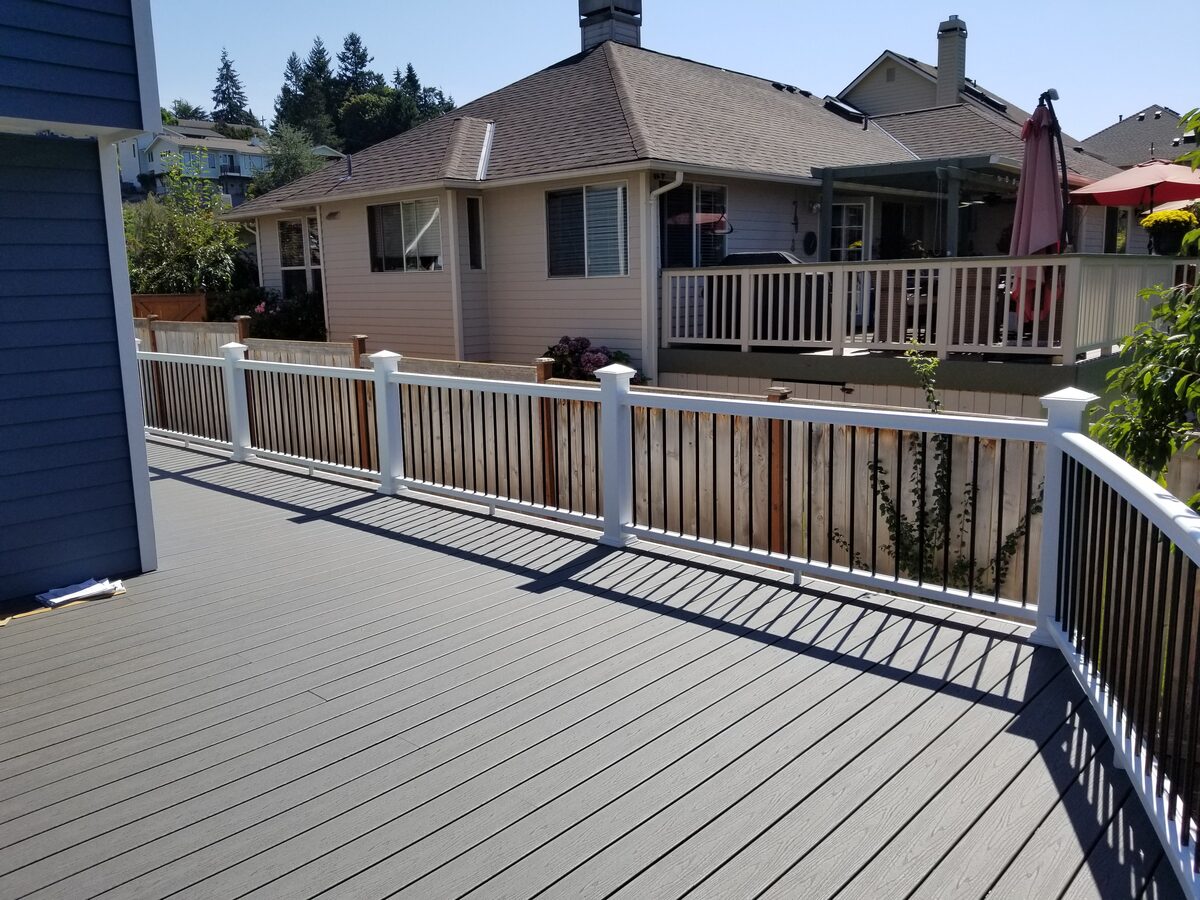
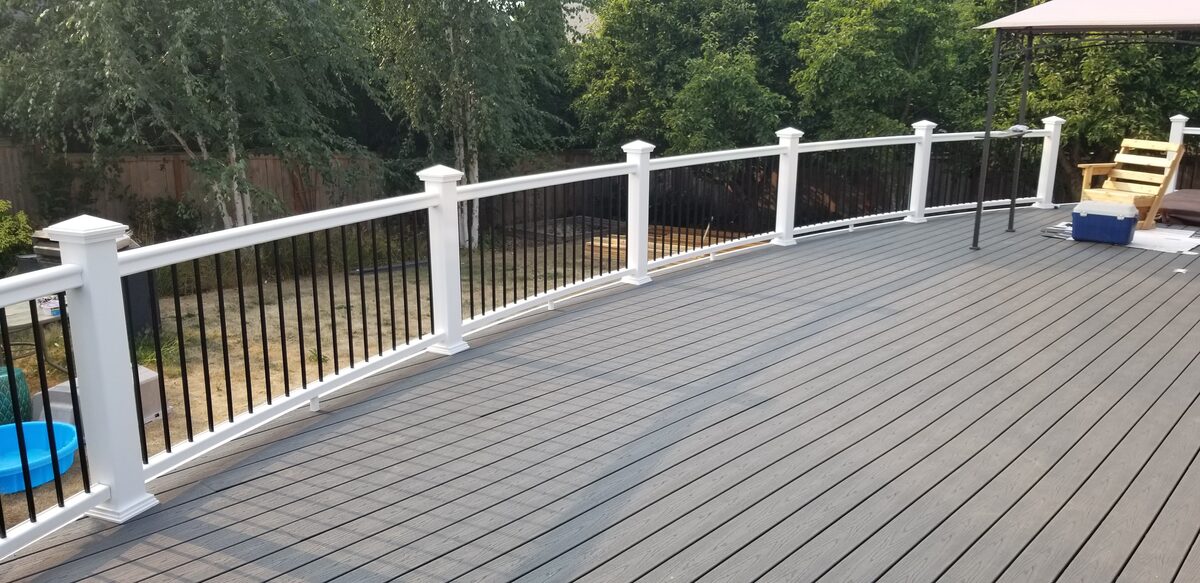
What Makes Curved Decks Different — and Why Few Builders Offer Them
Precision Heat Bending
Our specialized equipment bends composite and PVC boards into smooth, flowing curves that are impossible with standard techniques.
Custom Design Process
Every curved deck begins with a detailed 3D design consultation to ensure the curves complement your home and landscape.
Award-Winning Craft
Our curved deck projects have been featured in Pacific Northwest design publications for their innovative use of materials.
A curved deck isn't just a shape — it's a structural and material challenge that most King County deck builders decline to take on. True curved perimeter decks require kerfed or laminated rim joists to hold the radius, and edge boards must be heat-formed or saw-kerfed to follow the curve cleanly. It adds 25–40% to the cost of a comparable rectangular build, but the result is a deck that no cookie-cutter contractor can replicate.
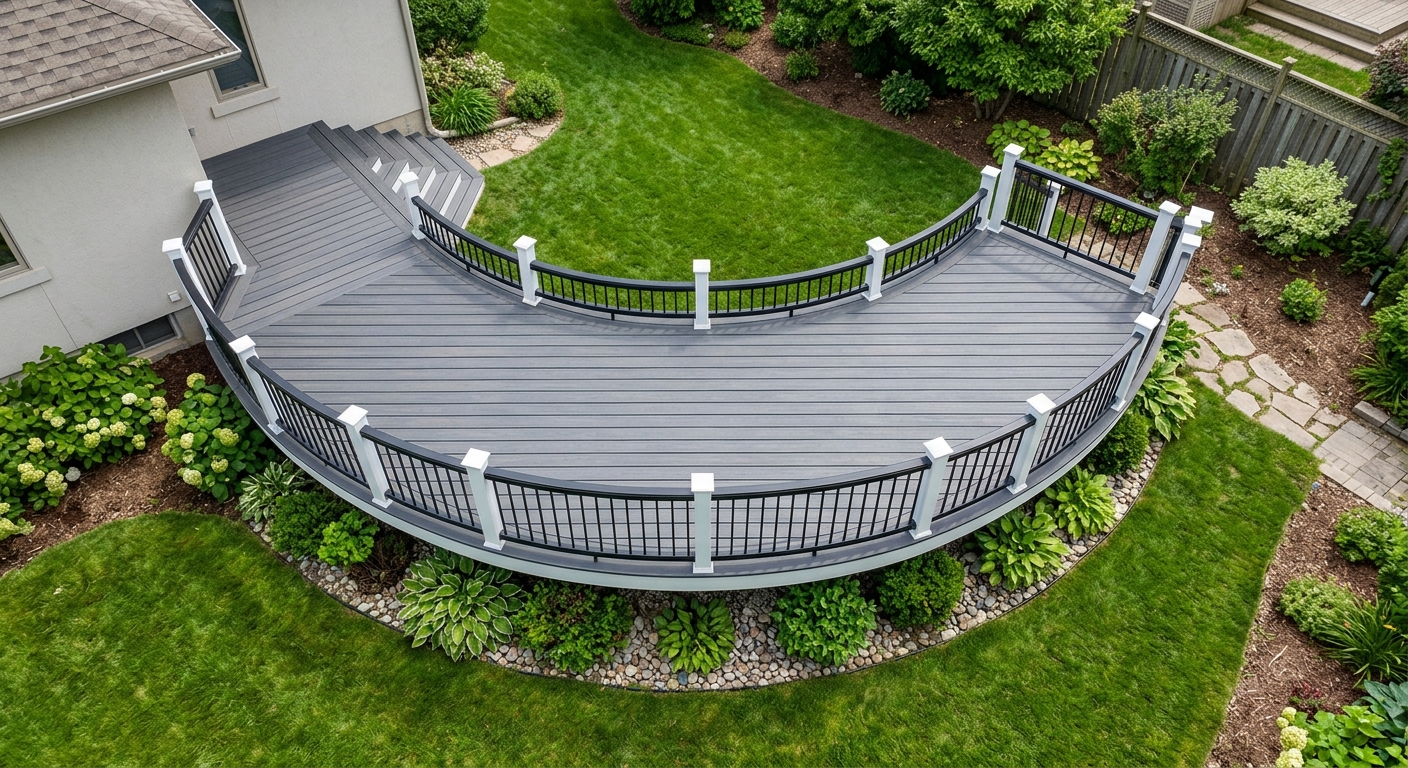
The Geometry Is in the Framing
A curved deck isn't just curved boards — it's a curved framing layout with angled blocking cut to achieve the arc, kerfed or steamed fascia boards bent to the radius, and a matching curved railing system. Every cut angle is calculated from the center point of the curve. This is why curved decks cost more: they require significantly more layout time and skilled cutting than a rectangular build.
In the Seattle area, curved decks are most popular in Mercer Island, Bellevue waterfront neighborhoods, and Renton's Kennydale — where homeowners have the budget and the lot to do something genuinely distinctive.
- straightenKerfed & laminated rim joists: The structural backbone of any curved deck. We cut kerfs or laminate thin strips to achieve tight radii — a step that requires the right equipment and experience to execute without compromising structural integrity.
- local_fire_departmentPVC for curved edges: AZEK and TimberTech Edge PVC can be heat-formed on-site to follow curved rim joists cleanly. This is the best material for curved perimeter boards — composite boards can't be heat-bent and require kerfing, which affects the cut face appearance.
- attach_moneyRealistic cost range: A 400–500 sq ft curved PVC deck in Seattle runs $30,000–$55,000 installed, depending on radius complexity, railing type, and site access. Budget 25–40% more than a rectangular deck of the same footprint.
- scheduleTimeline: Curved builds typically run 1–2 weeks longer than a comparable rectangular deck due to the precision framing required. We build this into the project schedule from day one.
Q: Why do curved decks cost more than rectangular decks of the same square footage?
Three reasons: the rim joist has to be custom-built (kerfed or laminated in strips), the edge boards require heat-forming or precision kerfing rather than standard cuts, and the layout process is more labor-intensive — every joist angle must be calculated and cut individually rather than using repetitive cuts. On a 400–500 sq ft deck, this specialized work adds 25–40% over a comparable rectangular build. The result is a deck that will outlast its straight-edged neighbors and look completely one-of-a-kind.
We build custom curved decks throughout King County. Mercer Island and Sammamish Plateau hillside lots are where curved designs perform best — the geometry follows the grade. Kirkland lakefront properties frequently request curved wraparound decks. Bellevue and Redmond modern homes use curved decks to complement contemporary architecture.
Why Curved Decks Work — and What Fails — in Seattle's Climate
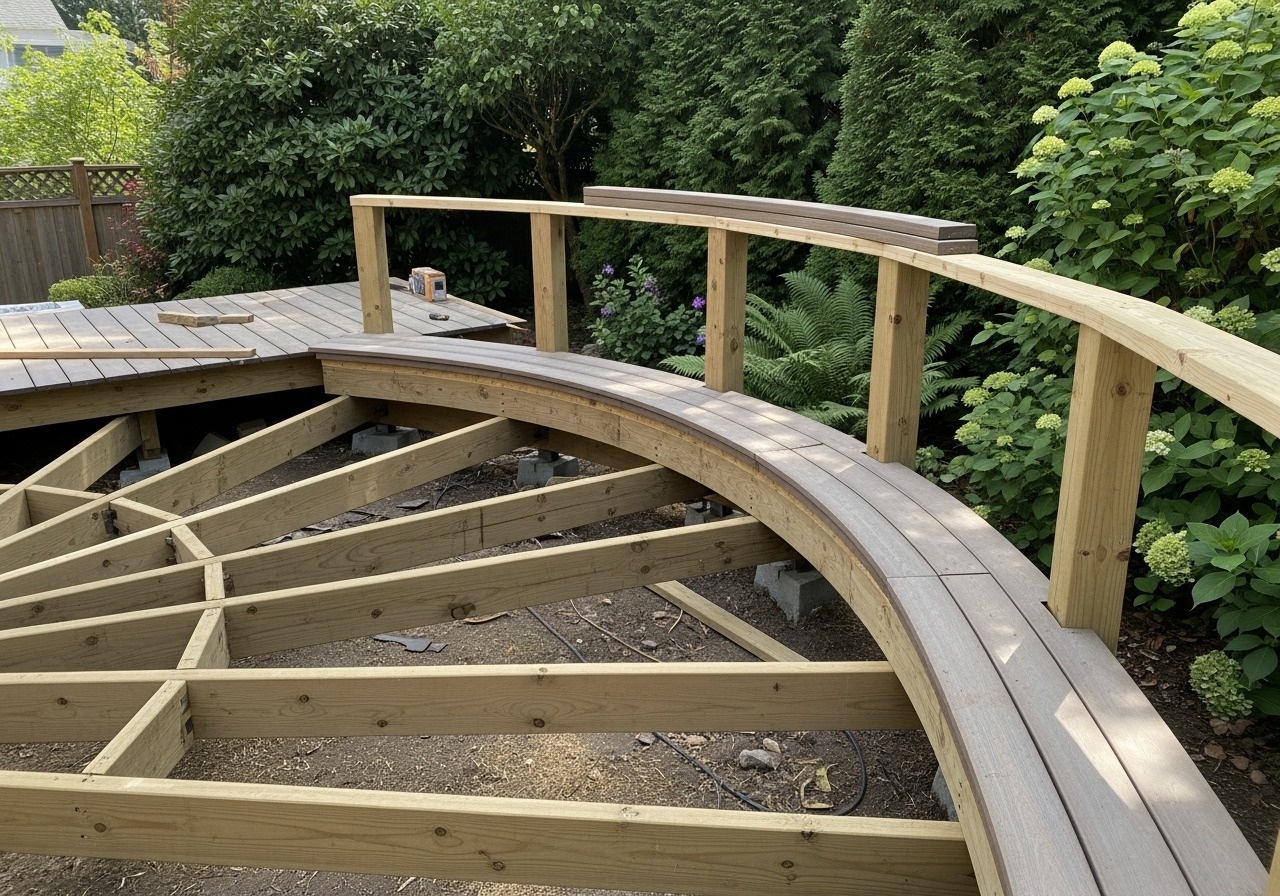
The Curved Framing — Built Before a Single Board Goes Down
The curve is established in the framing, not in the decking. A standard rectangular rim joist can't bend to a radius — instead we use kerfed pressure-treated lumber (saw cuts on the back face allow it to flex to the curve) or laminated thin strips built up to the full depth. Once the curved rim is set and braced, the composite boards lay across the frame in straight runs — the curve appears at the edge. This is why curved decks take longer: the framing layout requires continuous measurement from a center point.
Seattle receives 38 inches of rain per year — more than New York, more than Miami. For a curved deck, that rainfall creates challenges that a standard rectangular build doesn't face in the same way. Curved perimeter boards trap water where straight boards shed it cleanly. Every material and construction decision we make on a curved build accounts for this directly.
Freeze-thaw cycles and curved rim joists. King County experiences 15–25 freeze-thaw events per year, concentrated between November and February. For curved decks specifically, laminated or kerfed rim joists are vulnerable if built with the wrong species or adhesive — moisture infiltrates lamination layers, freezes, and causes delamination from the inside out. We use exterior-rated structural adhesives throughout and specify materials rated for wet, freeze-thaw conditions. This is a construction detail that matters acutely in Seattle and rarely appears in builder specs adapted from drier Sun Belt climates.
Why PVC edge boards outperform all alternatives here. AZEK and TimberTech Edge PVC are not just easier to heat-form for curved work — they're the correct material for King County's climate. Wood-core products, including uncapped composite and cedar, absorb moisture through end cuts and curved saw kerfs. In a curved perimeter board, there are significantly more exposed cut faces per linear foot than in a straight board. PVC has zero moisture absorption, meaning no swelling, no mold incubation, and no structural degradation from the annual rainfall cycle. In Seattle, that's not a preference — it's a performance requirement.
Moss, algae, and the drainage problem on curved surfaces. Curved decks are architecturally beautiful — and they're structurally complex to drain. Inside curves, flat compound angles, and transitions between curved and straight sections can collect standing water if drainage slope isn't engineered from the start. We slope all curved decks a minimum of 1/8" per foot away from the structure and specify gapped hidden fasteners to allow airflow beneath boards. In King County's wet climate, a curved deck without drainage planning is a deck with a 3–5 year moss and algae problem that no pressure wash will permanently fix.
UV fade at Seattle's latitude. At 47°N, Seattle's solar angle is lower than inland cities, but cumulative UV exposure over 10–15 years still causes measurable color fading in lower-grade PVC products. We specify UV-inhibited PVC from AZEK and TimberTech — both lines carry 30-year limited warranties covering fade and stain. The curved perimeter sections of your deck receive the same cumulative sun as the main field boards, and a cheaper edge board will fade noticeably faster, creating a two-tone appearance within a decade.
Curved decks in King County require both structural expertise and climate-specific material knowledge. See our Seattle deck cost guide for honest price ranges on curved builds — including what drives costs up or down — or contact us directly to discuss your specific project, lot conditions, and design goals with a specialist.