Deck Builder Auburn WA
Auburn Hill. Lea Hill. Lakeland Hills. South King County's largest city has a mix of flat valley-floor lots and elevated hillside properties with real views — and we build for both. Pressure-treated and composite are the standard here, and elevated decks on Auburn Hill deliver some of the best South King sightlines in the county.
Why Auburn Homeowners Choose Us
Hillside Deck Specialists
Auburn Hill and Lea Hill's elevation changes create elevated deck opportunities — and engineering requirements. We assess every hillside site before quoting: deeper footings, taller post systems, lateral bracing. No surprises after you sign.
South King County Pricing
Auburn is a more affordable market than Eastside cities — and our pricing reflects that. Standard PT and composite builds run $18,000–$38,000 for most Auburn projects. Fully itemized estimates so you can compare accurately.
City of Auburn Permits
We handle all permit documentation and submission through Auburn.wa.gov. Auburn's plan review typically runs 3–5 weeks for standard residential decks. We manage every step — you don't deal with the permit office.
Auburn's Valley Floor & Hillside Mix — Built for Both
Auburn sits in the Green River valley with flat residential lots near the valley floor and elevated hillside neighborhoods — Auburn Hill, Lea Hill, Lakeland Hills — that step up dramatically from the valley. The valley lots are straightforward builds: standard footings, modest grades, pressure-treated or composite surfaces. The hillside lots are a different project: elevated post systems, engineered cross-bracing, and the payoff of real views over South King County. We build both types regularly and price each one based on the actual site conditions.
Auburn is South King County's largest city at around 85,000 residents, and it's historically been a more value-driven market than the Eastside. We don't inflate estimates to Bellevue pricing for Auburn projects. Pressure-treated framing with composite surface is the most common build here — practical, durable, and priced right for this market.
85K+
Auburn Residents
PT + Composite
Most Common Build
3–5 wks
Auburn Permit Timeline
4.9★
Google Rating
Auburn is South King County's largest city — a mix of suburban residential neighborhoods, a significant industrial and commercial corridor, and Green River riverfront areas. The residential character varies widely: flat valley-floor subdivisions near Auburn Way, and the elevated hillside neighborhoods of Auburn Hill, Lea Hill, and Lakeland Hills that step up from the valley with meaningful elevation changes and valley-floor views. Permits run through the City of Auburn building department at Auburn.wa.gov. Petra Decks is the primary local competitor in this market.
terrainAuburn Hill & Lea Hill: Elevated Deck Opportunities
The hillside neighborhoods above Auburn's valley floor — Auburn Hill, Lea Hill, Lakeland Hills — offer some of the most compelling elevated deck opportunities in South King County. Lots here step up significantly from the valley, and a well-positioned deck on these properties can capture views over the Green River valley, toward the Cascades on clear days, or over the surrounding residential landscape.
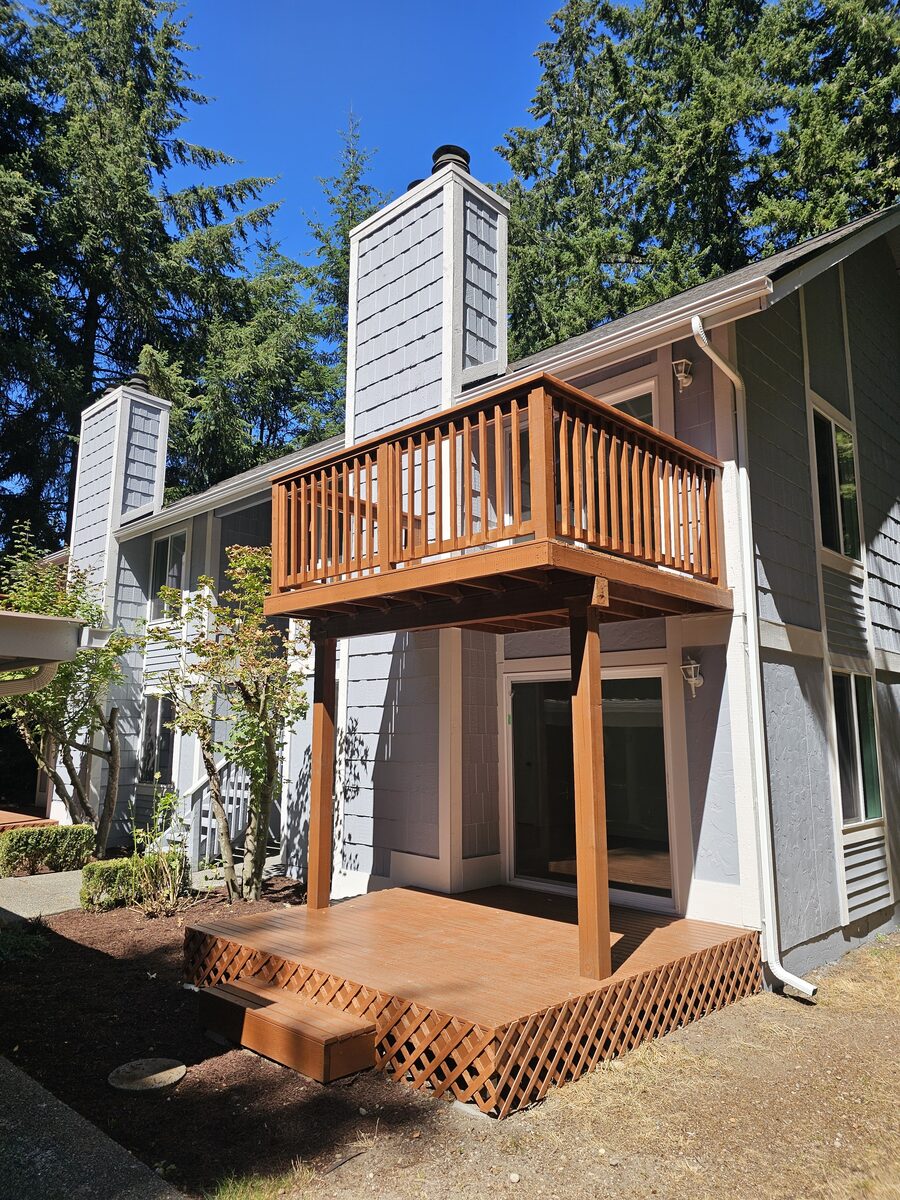
Hillside lots on Auburn Hill and Lea Hill require more engineering than the flat valley-floor builds: deeper concrete footings, taller post systems (often 6–10 feet), and lateral cross-bracing to meet seismic load requirements. We assess every Auburn hillside site before quoting — the footing and post requirements on a steep lot can shift project cost by $6,000–$12,000, and we won't give you a flat estimate without seeing the grade.
For flat valley-floor lots near the Auburn Way corridor, Terrace Drive, or the Green River neighborhoods, the builds are more straightforward: standard footings, modest elevation, pressure-treated framing with composite or PT surface. These projects run $18,000–$30,000 for a typical 280–380 sq ft deck — at the more accessible end of King County deck pricing.
categoryWhat Auburn Homeowners Are Building
Auburn's market trends toward practical, value-conscious builds. Pressure-treated framing (standard on every project) with a composite surface is the most common request — it delivers low maintenance and a clean appearance without the premium price of PVC. Mid-range composites like Trex Select, TimberTech Terrain, and Fiberon Symmetry are the most frequently specified products here.
| Material | Lifespan | Maintenance | Best For |
|---|---|---|---|
| Pressure-Treated | 15–20 yrs | Seal every 2–3 yrs | Budget builds, covered areas |
| Capped Composite | 25–30 yrs | Annual wash only | Most Auburn builds |
| PVC (AZEK, TimberTech Pro) | 30+ yrs | Minimal — hose off | Shaded or wet microclimate lots |
Cedar is a less common choice in Auburn's newer subdivisions — the low-maintenance case for composite is straightforward, and most Auburn homeowners don't want a staining project every 2–3 years. We do install cedar when it's the right fit for the project and homeowner.
Auburn Deck Cost Guide
| Project Type | Material | Typical Size | Installed Cost |
|---|---|---|---|
| Valley-floor ground-level build | PT frame + composite surface | 250–350 sq ft | $18,000–$26,000 |
| Standard elevated composite build | Trex Select / TimberTech Terrain | 280–380 sq ft | $22,000–$34,000 |
| Auburn Hill / Lea Hill hillside build | Composite + engineered posts | 260–360 sq ft | $30,000–$48,000 |
| Lakeland Hills premium build | Trex Transcend / cable rail | 320–420 sq ft | $36,000–$54,000 |
| Deck + pergola addition | Composite + cedar pergola | 350 sq ft + pergola | $38,000–$58,000 |
Prices include permit, demolition (where applicable), and all labor. Hillside lots require individual site assessment — grade and soil conditions affect footing costs. Free itemized estimates — no obligation.
Did You Know?
Auburn is the largest city in South King County by population — roughly 85,000 residents — and sits at the convergence of the Green River and White River valleys. The city's mix of flat industrial corridor, suburban valley-floor residential, and elevated hillside neighborhoods means deck projects span a wide range of site conditions. The Green River trail system runs through Auburn's valley floor, and river-adjacent properties in the Lakeland Hills and West Hill neighborhoods occasionally have shoreline setback requirements — we check on every project near the river corridor.
Planning a deck in Auburn?
Free estimates · Licensed & insured · South King County deck builder
gavelDeck Permits in Auburn — What to Expect
City of Auburn requires a building permit for any new deck, any addition over 200 sq ft, any deck over 30 inches above grade, and any structural repair modifying the framing. Resurfacing-only projects over an intact frame typically don't require a permit if no structural work is involved — we confirm this at your estimate visit.
Standard Auburn permit review: 3–5 weeks. Hillside decks on Auburn Hill or Lea Hill requiring engineered drawings: 4–6 weeks. Properties near the Green River with shoreline setback requirements may require additional coordination before permit submission. We manage all permit documentation, City of Auburn coordination, and inspection scheduling. Permit fees typically run $400–$750 depending on project valuation and are included as a line item in our estimate.
Recent Auburn Projects
Auburn Hill — Elevated Composite Build, Valley Views
300 sq ft elevated deck on a hillside lot with significant rear grade. Posts at 8 feet required concrete piers and cross-bracing for seismic compliance. TimberTech Terrain composite surface, cable railing for unobstructed sightlines over the Green River valley. City of Auburn permit: 4 weeks. $39,400 installed.
Lea Hill — New Composite Deck, Ground-Level
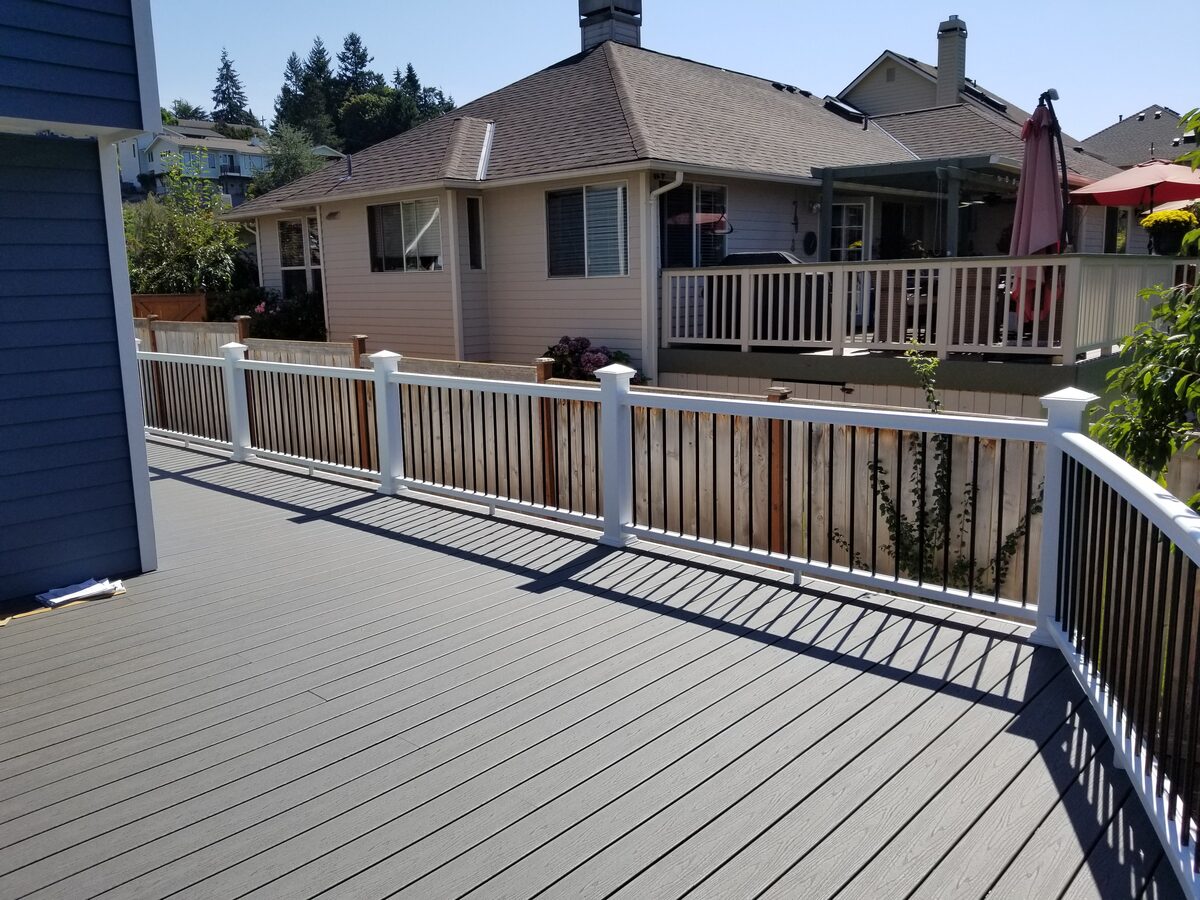
340 sq ft ground-level composite deck on a flat Lea Hill lot. Trex Select in Pebble Gray — the most practical choice for this market. PT framing, aluminum balusters to meet current code spacing. City of Auburn permit: 3 weeks. $24,800 installed.
Lakeland Hills — Premium Composite + Pergola
380 sq ft deck with attached cedar pergola on a Lakeland Hills lot with hillside position. Trex Transcend composite surface, stainless cable railing, cedar pergola with integrated LED lighting. One of Auburn's premium builds — homeowners wanted a full outdoor room. $54,200 installed.
Valley Floor — PT Resurface + New Railing
260 sq ft older PT deck near Auburn Way — frame assessed as sound, surface boards replaced with Trex Select composite over existing structure. New aluminum balusters to meet current code. Saved $7,200 vs. full rebuild. City of Auburn permit: 3 weeks. $14,600 installed.
Q: What's the typical cost range for a deck in Auburn?
Most Auburn deck projects run $18,000–$40,000 for a 250–380 sq ft composite build. Valley-floor lots on the lower end; Auburn Hill and Lea Hill hillside builds on the higher end due to footing and post engineering. We provide fully itemized estimates so you can see exactly what you're paying for.
Q: Do you handle hillside lots in Auburn Hill and Lea Hill?
Yes — hillside builds are a regular part of our Auburn work. We assess every hillside site individually before quoting, since the footing depth, post height, and bracing requirements vary significantly by grade. Auburn Hill and Lea Hill lots often require 7–10 foot post systems with engineered footings. We include all site assessment in the free estimate visit.
Q: Is composite the right choice for Auburn, or should I consider PT?
Composite is almost always the better long-term value. PT surfaces require sealing every 2–3 years to prevent checking, warping, and discoloration in Auburn's wet winters. Mid-range composite (Trex Select, TimberTech Terrain) adds $3,000–$5,000 at install over a PT surface but eliminates that maintenance cycle for 25+ years. For most Auburn homeowners, composite is the right call. PT framing is standard on all builds — that's structural, not a surface choice.
Q: How long does the Auburn permit process take?
City of Auburn permit review typically runs 3–5 weeks for a standard deck. Hillside builds requiring engineered drawings add 1–2 weeks. We handle all permit documentation and coordinate with Auburn's building department — you don't deal with the permit office directly. Permit fees are included as a line item in our estimate.
Q: Do you build year-round in Auburn?
Yes — we build year-round. Concrete footings cure in cold weather; composite and PVC install fine in rain. We schedule framing around hard rain events when possible. Winter builds in Auburn have a real advantage: permit times are shorter, material availability is better, and crew schedules are more flexible for a faster build window.
mapAuburn Neighborhoods: Where We Build and What to Expect
Auburn Hill is the elevated hillside neighborhood northeast of downtown Auburn — lots here step up from the valley with meaningful grade changes and views toward the Cascades and Green River corridor. Projects here are our most engineering-intensive Auburn work: hillside footings, tall post systems, and the reward of elevated sightlines. Lea Hill, east of Auburn's valley floor, has a similar hillside character with large forested lots and residential streets that wind up from the valley.
Lakeland Hills is the planned community in Auburn's southwest — a newer (1990s–2010s) development on a hill above the White River valley. Lots here are generally well-maintained newer homes with moderate grades; the demographic trends toward families and move-up buyers. Deck builds here lean toward mid-range to premium composite — Trex Enhance or Transcend — often with pergola additions.
The valley-floor neighborhoods around Auburn Way N, Auburn Way S, and the Green River corridor are the most affordable Auburn market — flat lots, standard grades, straightforward builds. These projects are typically 250–320 sq ft composite builds at $18,000–$26,000. All Auburn residential permits file with the City of Auburn Community Development Department at Auburn.wa.gov.
Terminal Park — the neighborhood south of downtown Auburn along the SR-18 corridor — has compact lots with 1980s–1990s housing stock and cedar decks well into their replacement cycle. Lots here are typically 5,000–7,500 sq ft, flat to gently sloping, with straightforward crew access. Mid-range composite resurfacing over a sound frame (starting $13,000–$16,000) is the right recommendation for many Terminal Park projects where the existing frame is structurally intact. The West Main Street corridor and neighborhoods around the Auburn–Black Diamond Road share a similar profile: modest working-class lots where homeowners want honest frame assessments and South King County pricing — not the premium quotes they'd get from Eastside contractors.
East Hill, straddling the Auburn–Renton border along the plateau east of the Green River valley, has newer subdivisions (1995–2015) with moderate lot grades and family homes whose decks are now 10–15 years old — ready for upgrade rather than emergency replacement. Trex Select or TimberTech Terrain composite on a complete rebuild is the standard product here: 25-year warranty, low maintenance, and priced right for this market. The City of Auburn Building Division is located at 1 E Main St, Auburn WA 98001 — all residential permit applications submit through Auburn.wa.gov, and permit fees run $400–$750 for typical residential deck projects. We handle permit preparation, submittal, and inspection coordination on every Auburn project. For properties near the north end of our Auburn service area, see our Renton page — East Hill shares a border with Renton's southern neighborhoods, and we serve both markets with the same crew.
South Auburn and the SE Auburn corridor — the subdivisions along Auburn-Black Diamond Road SE and the Kersey Way SE and Oravetz Road areas approaching the Covington and Maple Valley plateau — represent a fourth zone that often gets overlooked. Newer developments from the 1990s and 2000s in this corridor sit on lots averaging 7,000–12,000 sq ft, mostly flat to gently sloped, with cedar decks now entering their first replacement cycle. Properties within 200 feet of the White River or adjacent wetlands in this southern zone fall under Shoreline Management Act review — we verify shoreline and ECA buffer status at every south Auburn estimate appointment to avoid mid-permit delays. For homeowners in Lakeland Hills (southwest Auburn), the Lakeland Hills Homeowners Association requires Architectural Review Committee approval before a City of Auburn permit can be submitted; the ARC typically reviews and responds within 3–4 weeks when the submission includes a complete package — site plan, material spec sheet, and color samples — which we prepare as standard pre-permit practice. Rural parcels along Auburn-Black Diamond Road SE outside the city limits submit to King County DPER rather than City of Auburn; we identify the correct jurisdiction on the first site visit. Homeowners in the Covington and Maple Valley areas just east of Auburn's city limits fall within our service area — our neighboring Kent deck builder page covers the connecting SE Kent-Kangley Road corridor where our service areas overlap.
We build throughout South and East King County. Kent is our closest neighbor to the north — similar valley-floor and hillside mix. Federal Way covers South King County's western corridor. For Eastside premium builds, see Bellevue or Sammamish.
Auburn Outdoor Living: Landmarks & Local Connections
water Green River Trail
The Green River Trail runs through Auburn's valley floor — a popular multiuse trail connecting Auburn to Kent and Tukwila to the north. River-adjacent residential properties near the trail corridor occasionally have shoreline setback requirements. Lots with riverfront or trail-facing positions are among Auburn's most desirable deck sites.
landscape Auburn Hill
The elevated hillside neighborhood northeast of downtown — Auburn's best elevated deck territory. Lots here step up from the valley floor with 20–40 foot grade changes in some cases. A properly positioned elevated deck on Auburn Hill can see the Green River valley, the White River corridor, and the Cascade foothills on clear days.
location_city Lakeland Hills
Planned community in Auburn's southwest — well-maintained homes, moderate hillside grades, active HOA. HOA approval is required for deck additions in Lakeland Hills before permit submission. We coordinate with HOA submittal requirements as part of our project management scope. Lakeland Hills is Auburn's premium residential market.
forest Lea Hill
East of Auburn's valley floor, Lea Hill has large forested lots and a more rural character than other Auburn neighborhoods. Lots here often have mature tree canopy — a factor in material choice (shaded lots benefit from composite over cedar) and in deck positioning to maximize sun access. Steep grade in some sections requires individual site assessment.
directions_walk Interurban Trail
The Interurban Trail runs along the west side of Auburn's valley, connecting through Kent to the north. Adjacent residential streets in West Auburn have flat lots near the trail corridor. Easy access for project estimates and crew, and a trail-adjacent setting that makes outdoor living investment meaningful.
sports_motorsports Auburn Supermall / Outlet Collection
The Outlet Collection at Seattle (formerly Auburn Supermall) anchors Auburn's commercial core off SR-167. Adjacent residential neighborhoods to the east and south are the most active part of Auburn's residential deck market — established subdivisions with homeowners investing in outdoor living.
PNW Build Window
Auburn's build window runs April through October for most projects. Valley-floor lots dry out faster than shaded hillside lots on Lea Hill. Green River adjacent projects require shoreline setback verification on the first site visit. Auburn city permits run 3–5 weeks — start the permit process before you want to build, not after.