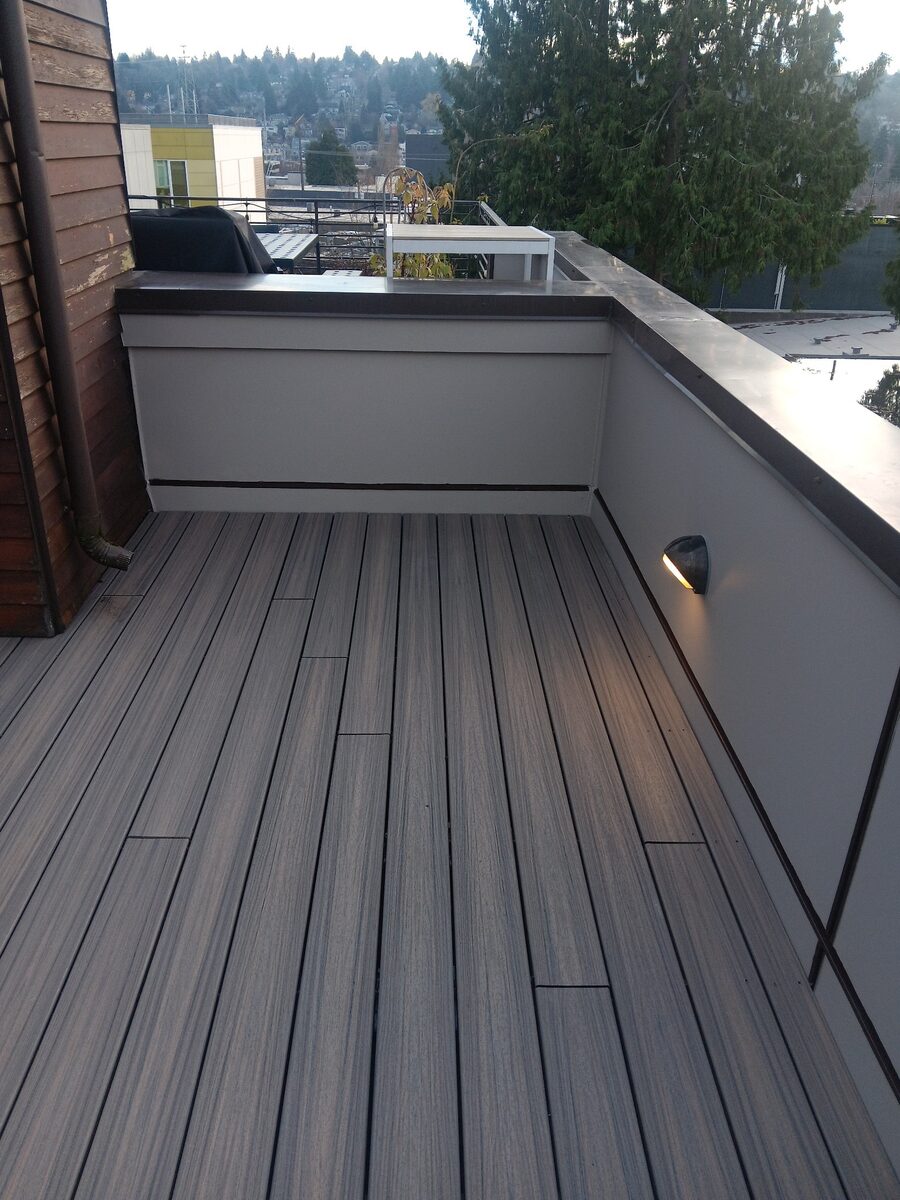
Deck Builder Bellevue WA
Bellevue's hillside lots in Newport Hills, Eastgate, and Somerset demand engineered footings and lateral bracing that most contractors don't deliver by default — we provide structural drawings on every elevated build as standard practice. Cable and glass railings for Cascade and Lake Washington views, HOA submissions for West Bellevue and Clyde Hill, permits through MyBuildingPermit.com — this is our routine Bellevue workflow.
Why Bellevue Homeowners Choose Us
Hillside Engineering Specialists
Newport Hills, Somerset, and Eastgate sit on slopes that require engineering most deck contractors don't deliver. We provide stamped structural drawings for every elevated Bellevue deck — footing depths calculated for Eastside soil, lateral bracing to current seismic standards, and cable or glass railing for view preservation.
Eastside-Tier Premium Materials
Bellevue projects run $35K–$65K for standard builds. The most requested products in this market: TimberTech Vintage Collection, Trex Transcend, and AZEK PVC for highest-end installs. Glass and cable railing systems are routine here. We stock and install the full Eastside-tier range — no special orders, no markup surprises.
Permit & HOA Package Ready
City of Bellevue permits are filed through mybuildingpermit.com — 3–6 weeks standard. West Bellevue and Clyde Hill planned communities require HOA architectural review before permit application. We prepare and submit both. You sign off; we handle the paperwork.
Hillside Lots Are Our Default in Bellevue
Newport Hills, Somerset, and Eastgate are among Bellevue's most desirable neighborhoods — and they sit on slopes that require engineering most deck contractors don't deliver. We provide stamped structural drawings for every elevated Bellevue deck, with footing depths calculated for Eastside soil conditions and lateral bracing designed to current seismic standards. Cable and glass railing systems for view preservation are a routine part of our Bellevue project mix.
Full-Service Bellevue Deck Building
We build composite, PVC, cedar, and custom railing decks — along with pergola structures and outdoor living spaces — across all Bellevue neighborhoods. Every project includes permit handling through City of Bellevue Development Services, HOA submission packages for planned communities in West Bellevue and Clyde Hill, and engineered drawings for elevated installations. Licensed under Complete Consulting and Construction (CC# COMPLCC882Q5).
Know Your Bellevue Neighborhood Before You Build
Newport Hills & Somerset
Newport Hills and Somerset are Bellevue's south plateau neighborhoods — desirable, established, and built on grades that make most deck contractors uncomfortable. Lots typically run 9,000–14,000 sq ft with 15–30% slopes. On the downhill side, those slopes translate to 8–16 feet of air between the main floor and grade.
Almost every deck project here involves structural engineering. Footing depths go deeper, post systems are taller, and the permit drawings include stamped lateral-load calculations that City of Bellevue Development Services specifically reviews. A standard Newport Hills build: 400–550 sq ft composite deck with cable railing, engineered footings, and a full structural package submitted to mybuildingpermit.com.
The good news: once the engineering is done, these elevated decks become the defining outdoor living space of the home and often add more usable square footage than any interior renovation could. Budget $45,000–$75,000 including engineering; permit timeline is typically 4–7 weeks.
9,000–14,000 sq ft
15–30%
$45K–$75K
4–7 weeks
Did You Know?
Newport Hills and Somerset sit on Bellevue's south plateau at 400–550 feet elevation — and the view from these hillside decks on a clear day spans from Mount Rainier south to the Olympic Mountains west. The elevation also means more sun exposure and less canopy shade than Eastside lowlands, which makes UV inhibitor ratings in composite decking more important here than in Seattle's shadier neighborhoods.
West Bellevue & Clyde Hill
West Bellevue, Clyde Hill, and the lake-adjacent neighborhoods represent Bellevue's highest residential tier. Property values routinely exceed $2M, and the expectations that come with them extend to outdoor construction. Material specifications here start at TimberTech Vintage Collection or Trex Transcend — entry composite is not appropriate. Many projects specify AZEK PVC for longevity and premium finish.
What most contractors miss: many West Bellevue and Clyde Hill properties carry recorded CC&Rs (Covenants, Conditions & Restrictions) in the title report — architectural restrictions that exist even without a formal HOA. These CC&Rs may require notification of neighbors, prohibit specific materials, or mandate design review. We read title reports before finalizing designs in these neighborhoods. Skipping this step leads to neighbor disputes after construction starts.
Cable and glass railing systems are expected for view preservation — not optional. Most West Bellevue builds exceed $65,000; lake-adjacent and Clyde Hill projects routinely reach $100,000+. Plan for 5–8 weeks of permit review and CC&R notification period.
TimberTech Vintage / PVC
Often required
$65K–$100K+
5–8 weeks
Eastgate & Factoria
Eastgate and Factoria sit along the I-90 corridor on Bellevue's south and east edge — established single-family neighborhoods with a mix of flat and moderately sloped lots, mature tree canopy, and homes largely built in the 1970s–1990s. Less premium than West Bellevue, more upscale than East Hill. This is Bellevue at its most accessible entry point for deck construction.
Many lots here have deck-ready conditions: existing concrete pads, level back yards, or gentle slopes that don't require full structural engineering. Standard composite — TimberTech Terrain Collection or Trex Transcend — is the material of choice. Most projects run 300–450 sq ft at $28,000–$45,000. Permit timelines are shorter: 3–5 weeks via mybuildingpermit.com, and engineering is only required if the deck exceeds 30 inches above grade.
Factoria specifically has good access for material delivery and homeowners who are value-focused — they want quality composite that lasts, not the lowest-bid pressure-treated lumber. We match material specifications to the neighborhood standard without overselling.
TimberTech Terrain / Trex Transcend
Only if 30+ in above grade
$28K–$45K
3–5 weeks
Bellevue Permit Reality: mybuildingpermit.com
City of Bellevue processes all residential permits through the mybuildingpermit.com regional portal — the same system used by Kirkland, Redmond, and most Eastside cities. For a standard residential deck (under 30 inches above grade, no HOA, no engineering): expect 3–6 weeks from submission to permit issuance. Fee is based on project valuation: typically $500–$1,500.
Elevated decks over 30 inches above grade trigger the engineering requirement — stamped drawings from a licensed structural PE, reviewed by Bellevue Development Services. This adds 1–3 weeks to review time. For West Bellevue projects with CC&R review or HOA submissions: add another 3–5 weeks before the permit application can even be submitted. Complex Bellevue projects — hillside, engineering, HOA, near a shoreline — can run 6–12 weeks from engagement to permit in hand.
We attend pre-application meetings with City of Bellevue Development Services for complex projects and submit complete applications on first attempt. Incomplete submissions are the primary cause of permit delays — we eliminate that variable.
3–6 wks
Standard
Permit
$500–$1,500
Permit
Fee Range
30 in
Engineering
Threshold
5–8 wks
West Bellevue
Complex
Bellevue Outdoor Living Landmarks & Why They Matter for Deck Builders
local_florist Bellevue Botanical Garden — Wilburton
53 acres of formal and naturalistic gardens adjacent to the Wilburton neighborhood. Elevated decks on surrounding streets overlook this greenspace. The city's investment in civic outdoor quality sets a high aesthetic standard — premium material specs are expected in this area, not optional.
water Meydenbauer Bay Park — Downtown Lakefront
Bellevue's downtown waterfront on Lake Washington. The adjacent Meydenbauer neighborhood is one of the highest-spec waterfront deck markets on the Eastside — AZEK PVC, cable railing, glass panels, and integrated lighting are standard asks from these homeowners.
park Bellevue Downtown Park
21-acre central park in the heart of downtown. Adjacent Bellevue residential properties benefit from the city's commitment to quality outdoor space — homeowner aesthetic standards in surrounding streets are high, reinforcing premium composite and railing specification as the expected baseline.
computer Crossroads Community Park — East Bellevue
East Bellevue's neighborhood hub serving the Grasslawn/Microsoft corridor. Properties here are research-focused buyers who want genuine value and quality — mid-grade capped composite (Trex Select, TimberTech Terrain) is the dominant spec. Budget-conscious but quality-conscious: they read warranties.
waves Chism Beach Park — West Bellevue Lakefront
West Bellevue's lakefront access point. Adjacent Beaux Arts and Enatai neighborhood properties represent the highest-spec market on Bellevue's lake shore. Material expectations here mirror Mercer Island waterfront: AZEK PVC or TimberTech Vintage, cable or glass railing, stainless hardware throughout.
forest Weowna Park — Eastgate Urban Forest
Large urban forest preserve adjacent to Eastgate. Lots bordering Weowna Park have significant canopy cover — the moss and shade conditions that make composite board spacing critical. We add 1/4" spacing between boards (vs. the standard 1/8") on north-facing lots in this area to improve drainage and prevent moisture pooling.
Bellevue Outdoor Living Season — Build Timing Strategy
Elevation advantage for spring starts
South-facing slopes in Newport Hills and Somerset dry out 2–3 weeks earlier in spring than Seattle neighborhoods. This means Bellevue hillside projects can start in late April when Seattle lots are still too wet for footing work. Take advantage of this window by submitting permits in January or February.
Permit timing strategy
Submit in January/February for a March/April permit review, May construction start. City of Bellevue permit timelines run faster January–February than March–May (spring peak adds 1–2 weeks). The January submission window is the best-value timing for Bellevue homeowners targeting a summer deck.
HOA timing matters
West Bellevue and Clyde Hill HOA architectural committees typically meet monthly. Miss a meeting cycle and you wait 4 more weeks before the ARC can review. We track committee meeting schedules and time submissions to land in the correct review window. For a May start date with HOA review required, the submission needs to be in by February at the latest.
Fall build advantage
September–October is Bellevue's sweet spot for build quality and contractor availability. Permits move faster (post-summer backlog clears), crews are available after the summer rush, and cedar surfaces dry better for staining in the cooler fall air. Composite installs are indifferent to season — but if you're doing a cedar build, fall is the best time to apply a fresh seal coat.
PNW Build Window — Bellevue Specifics
Bellevue's optimal project start window is May through September. Hillside lots in Newport Hills and Somerset dry out faster than lower-elevation sites after spring rains. Pre-HOA submission timing: if your community has an HOA, submit 8–10 weeks before your target start date. For a May 1 start, that means a late-February HOA submission.
Did You Know?
Bellevue processes more residential deck permits per capita than any other city in King County — the Eastside's tech wealth, design-conscious homeowner base, and premium outdoor living culture drive higher per-project budgets than anywhere else in the region. Average Bellevue deck spend (including railing and electrical): $54,000. King County average: $31,000.
Bellevue homeowners live at the intersection of technology wealth and Pacific Northwest outdoor culture — and their decks reflect it. From elevated view decks in Newport Hills to HOA-approved composite installations in West Bellevue's planned neighborhoods, we build decks that match the standard Eastside homeowners expect. If you're on a hillside lot, we've engineered that grade before.
50+
Bellevue Decks
Completed
$1M+
Average Property
Value Served
3–5 Wks
Bellevue Permit
Timeline
Why Bellevue Homeowners Choose The Seattle Decking Company
- terrainHillside & elevated deck specialists: Newport Hills, Eastgate, and Somerset lots require deeper footings, taller post systems, and lateral bracing calculations — we provide engineered drawings as standard practice on all elevated Bellevue decks, which satisfies Bellevue Development Services review requirements without back-and-forth.
- fenceCable & glass railing expertise: View preservation matters in Bellevue. We engineer and install cable and glass railing systems regularly in Newport Hills and West Bellevue — posts spaced to code, cables tensioned to 4-inch sphere spacing, fully compliant with Bellevue Development Services requirements.
- holiday_villageHOA navigation experience: West Bellevue and Clyde Hill planned communities have detailed architectural review requirements. We prepare complete HOA submission packages — site plan, elevations, material specifications, color samples — and are familiar with each committee's preferences and typical timelines.
Recent Bellevue Projects
Newport Hills Hillside — 480 sq ft, Trex Transcend + Cable Railing
Engineered footings on a 22% grade lot with Cascade Mountain views. Homeowner specified cable railing for unobstructed sightlines — powder-coated steel posts, stainless cable at 4-inch spacing. Permit drawings included stamped lateral-load calculations. Build completed in 11 days after permit issuance.
West Bellevue HOA-Approved — 360 sq ft, TimberTech Legacy Composite
Clyde Hill HOA required an approved earth-tone composite, adherence to max deck footprint ratio, and specific railing height. We submitted the HOA architectural package five weeks before the permit application. Approved on first review with no revision requests. Build: 9 days.
Somerset Elevated View Deck — 520 sq ft, Composite + Glass Railing
Second-story deck above a walk-out lower level with Lake Washington views. Glass panel railing system for unobstructed sight lines. Structural posts to grade at 14-foot height — full permit set included soils report and engineer stamp. Completed in 14 days after permit issuance.
Permit & HOA Process in Bellevue
- descriptionPermit authority: City of Bellevue Development Services — applications through MyBuildingPermit.com. Standard residential deck permits run 3–5 weeks; spring peak (March–May) adds 1–2 weeks. We submit complete applications with structural calculations to minimize review cycles.
- holiday_villageHOA submission: For West Bellevue and Clyde Hill planned communities, HOA Architectural Review typically precedes the permit application by 3–5 weeks. We prepare the full submission package and track committee response — permit application follows approval.
- engineeringEngineering drawings: Elevated decks in Bellevue — any deck with posts over 8 feet, significant grade change, or complex lateral loads — require stamped engineering. We provide this as a standard line item, not an add-on surprise.
Bellevue Deck Cost Guide (Eastside Premium Market)
| Build Type | Typical Cost | Best Fit |
|---|---|---|
| Entry Composite (Trex Select) | $25K–$38K | Eastgate, Factoria, budget Bellevue |
| Mid Composite (Trex Transcend / TimberTech Legacy) | $35K–$52K | Newport Hills, Somerset mid-tier |
| Premium Composite (TimberTech Vintage) | $45K–$68K | West Bellevue, HOA / CC&R lots |
| PVC (AZEK / TimberTech Pro) | $55K–$80K | Clyde Hill, lake-adjacent, premium tier |
| Elevated / Engineered Add | +$8K–$20K | Newport Hills drop-offs, Somerset slopes |
| Hillside Cable Railing | +$8K–$15K per 100 LF | View preservation, Newport Hills / West Bellevue |
Planning a deck in Bellevue?
Free estimates · Licensed & insured · King County's #1 deck builder
Q: Do Bellevue decks need special engineering for hillside lots?
Yes. Many Bellevue properties — particularly in Newport Hills, Eastgate, and Somerset — sit on sloped terrain requiring deeper footings, taller post systems, and lateral bracing calculations. We provide engineered drawings for all elevated Bellevue decks as standard practice, which also satisfies Bellevue Development Services review requirements.
Q: How long does a deck permit take in Bellevue?
Bellevue processes residential deck permits through MyBuildingPermit.com. Standard residential permits typically run 3–5 weeks. During spring peak season (March–May), add 1–2 weeks. We submit complete applications with structural calculations to minimize review cycles.
Q: Are cable railings popular in Bellevue and do they meet code?
Very popular — especially on hillside lots with Cascade or Lake Washington views. Cable railings are fully code-compliant in Bellevue when posts are spaced correctly (max 42 inches apart) and cables are tensioned to 4-inch sphere spacing. We engineer and install cable systems regularly in Newport Hills and West Bellevue.
Q: Do West Bellevue and Clyde Hill CC&Rs restrict deck design?
Many West Bellevue and Clyde Hill properties carry recorded CC&Rs (Covenants, Conditions & Restrictions) that govern architectural changes — including decks — even without a formal HOA. These CC&Rs may require notification of neighboring property owners, prohibit certain materials, or require review by an architectural committee. Unlike HOAs, CC&R enforcement is neighbor-to-neighbor. We review the title report for CC&R language before finalizing deck designs in these neighborhoods — a step many contractors skip that leads to neighbor disputes after construction.
Q: My Newport Hills property has a 20-foot grade drop to the back of the yard — can I build a deck at main-floor level?
Yes, and it's one of our specialties. Newport Hills and Somerset properties frequently have 12–20 foot grade drops that create an elevated deck opportunity off the main floor. Decks over 30 inches above grade require structural engineering drawings — stamped footing plans, post sizing, beam calculations, and cross-bracing specifications. We work with a licensed structural PE to produce permit-ready drawings that City of Bellevue accepts on first submission. Engineering typically adds $1,500–$3,000 to the project, and the resulting elevated deck often defines the entire outdoor living space of the home.
Q: What's the typical timeline for a Bellevue deck project from estimate to completion?
For a standard Bellevue build (350–450 sq ft, no engineering required): 8–12 weeks total — 1–2 weeks for estimate and contract, 3–6 weeks for City of Bellevue permit review, and 8–14 days of on-site construction. For West Bellevue projects with CC&R review or Newport Hills elevated builds requiring engineering: add 3–6 weeks for the additional review process. We provide a realistic timeline projection at your estimate appointment — including any CC&R notification periods — so you can plan accordingly.
We build across all of King County's Eastside. Kirkland and Mercer Island are our closest neighbors in the premium tier. Redmond and Sammamish tech-area homeowners share similar material preferences. For South King County projects, see Renton and Kent.
Bellevue Deck FAQs
How much does a deck cost in Bellevue?
Bellevue is the highest-average-spend deck market in King County. Standard 350–500 sq ft composite deck: $38,000–$65,000. Hillside builds (Newport Hills, Somerset, Eastgate) with structural engineering: $48,000–$85,000. West Bellevue and Clyde Hill premium builds: $65,000–$120,000+. Lake Washington waterfront (Meydenbauer, Chism Beach area): $75,000–$150,000. Factors that move price: slope, HOA materials requirements, railing type (cable/glass vs. composite), electrical and lighting integration.
Does Bellevue require a permit for a deck?
Yes. City of Bellevue processes all residential permits through mybuildingpermit.com. Standard residential deck: 3–6 weeks. Decks over 30 inches above grade require stamped structural engineering drawings — add 1–3 weeks. West Bellevue and Clyde Hill HOA communities require ARC approval before permit submission: add 3–5 weeks. Spring peak (March–May) adds 1–2 weeks to all review timelines.
What is the best decking material for Bellevue hillside lots?
For elevated hillside builds in Newport Hills, Somerset, and Eastgate: composite (TimberTech Vintage or Trex Transcend) with stainless-steel hidden fasteners and aluminum framing systems that handle the moisture differential between shaded under-deck and sun-exposed surface. On West Bellevue and Clyde Hill lots with view corridors: PVC or premium composite with cable or glass railing — material selection is also an HOA compliance question in these neighborhoods.
Do I need HOA approval for a new deck in Bellevue?
Only if your property is in a planned community with an active HOA or recorded CC&Rs. West Bellevue, Clyde Hill, and several Somerset subdivisions have active HOAs or CC&Rs. We check your title report before design — CC&Rs can impose restrictions even without a formal HOA committee. If HOA approval is needed, we prepare the full Architectural Review submission and track committee response timelines.
Does my Bellevue deck project require structural engineering?
Any deck with a finished floor more than 30 inches above grade requires stamped structural drawings from a licensed PE — required by both City of Bellevue and the International Building Code. Newport Hills and Somerset hillside lots frequently exceed this threshold. Engineering adds $1,200–$2,500 to the project cost and 1–3 weeks to permit review. We manage the engineering coordination as part of our service.
How long does a Bellevue deck project take?
Free estimate: same week. Design and engineering (if needed): 2–3 weeks. Permit review: 3–6 weeks (standard) or 6–10 weeks (hillside + engineering + HOA). Active construction: 8–14 days for a standard build, 12–18 days for elevated hillside. Total from first call to final inspection: 8–14 weeks standard; 12–20 weeks for complex hillside or HOA projects.
Can I build a rooftop or second-story deck in Bellevue?
Yes — second-story and elevated decks above walkout lower levels are common in Newport Hills, Somerset, and West Bellevue. These require structural engineering (PE stamp), specific lateral bracing calculations for seismic loading, and in some cases a soils report. We've built numerous second-story decks in Bellevue and have a PE relationship that handles the engineering efficiently. Budget 20–30% more than an at-grade build for second-story elevation costs.
Did You Know?
The Bellevue Botanical Garden — 53 acres of formal and naturalistic gardens in the heart of the city — is visible from elevated decks in the Wilburton neighborhood. The city's investment in civic green space reflects a homeowner culture that takes outdoor living seriously. This is the market where material selection, railing design, and finish quality genuinely matter.