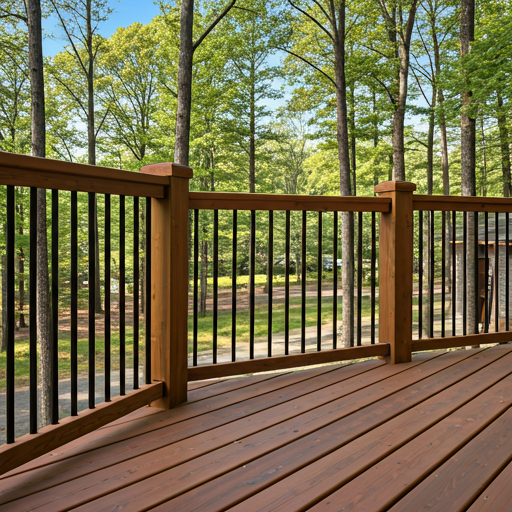
Deck Railing Installation Seattle
The right railing depends on your view, your HOA, and your budget. We install cable, glass, aluminum, and cedar railing systems throughout King County — and we know which options require 316-grade stainless near salt water, which HOAs restrict, and which view lots demand frameless glass.
Four Systems for Every View, Budget, and HOA
Glass Railings
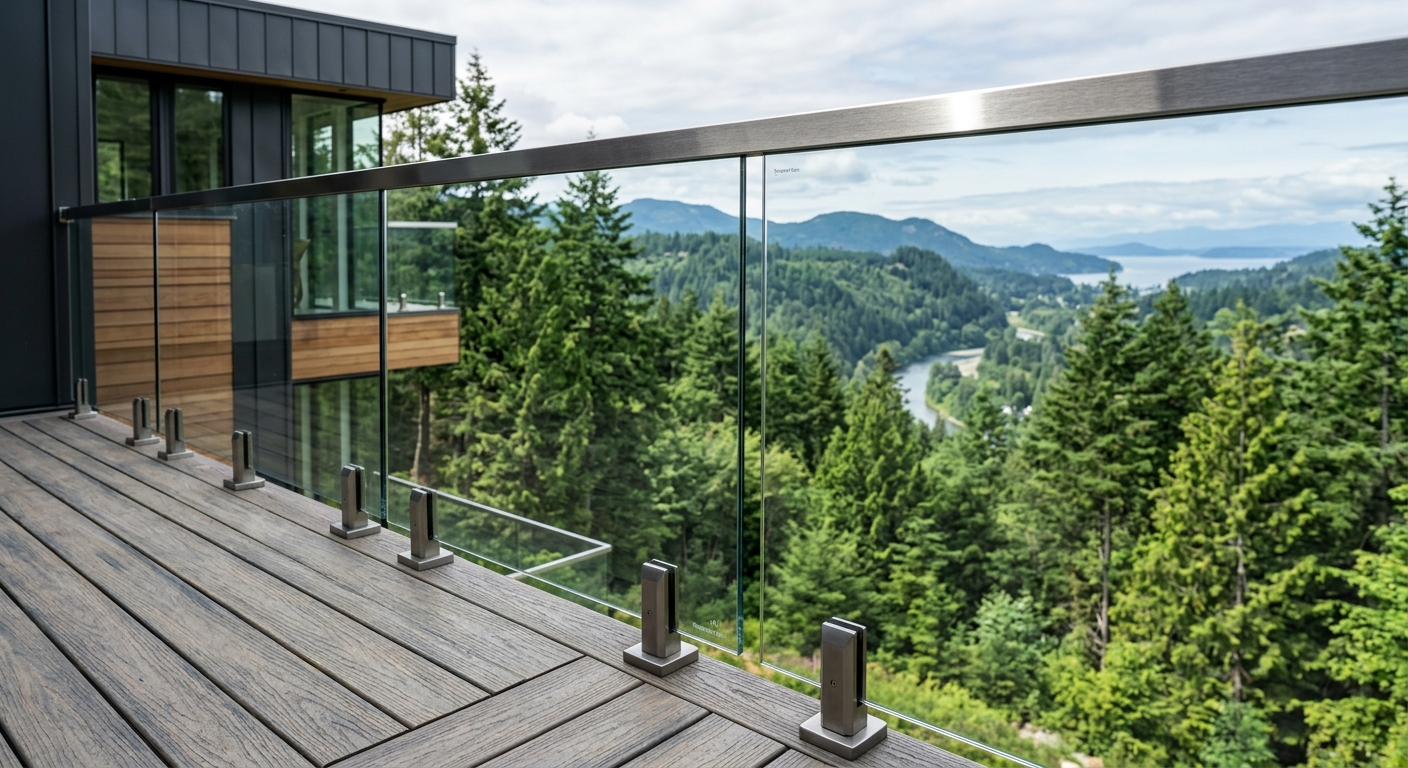
Tempered glass panels provide unobstructed views while meeting all building code requirements. Perfect for decks with mountain or water views.
Cable Railings
Sleek stainless steel cable railings offer a modern, minimalist look with excellent visibility and low maintenance.
Traditional & Cedar
Classic wood railing systems in cedar and treated lumber for a timeless Pacific Northwest aesthetic.
Railing choice in King County comes down to three factors: the view you want to preserve, the HOA requirements you have to meet, and the budget you're working with. Cable and glass dominate view lots — Kennydale in Renton, Houghton in Kirkland, Newport Hills in Bellevue — where preserving sightlines is worth the premium. Cedar and aluminum are the standard in planned communities where HOA design guidelines govern approved options.
- cableCable railing — $150–$250/LF: Stainless steel cable at maximum 3-inch spacing per Washington State code. 316-grade stainless required on waterfront and salt-air sites. Clean, modern look with minimal view obstruction and low maintenance.
- visibilityGlass railing — $200–$350/LF: Frameless tempered glass panels with maximum view clearance. Requires wind engineering on exposed sites. The highest-cost option, but delivers the cleanest sightline for Lake Washington and Puget Sound views.
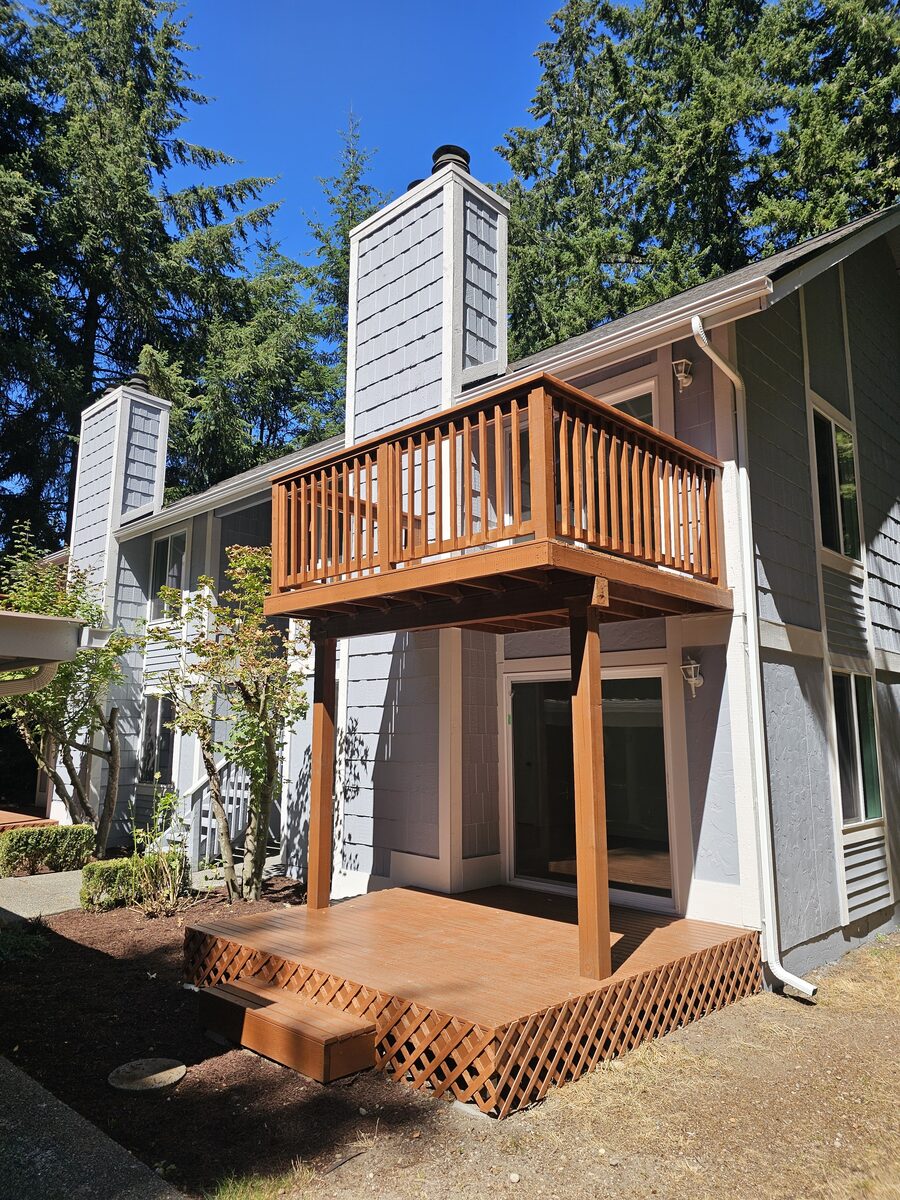
- parkCedar railing — $60–$120/LF: Classic Pacific Northwest look. Requires sealing every 2–3 years in our climate. Common where HOAs specify natural wood aesthetics or where budget is the primary constraint.
- buildAluminum railing — $80–$150/LF: Powder-coated aluminum with zero maintenance requirements. Common in Sammamish, Issaquah, and Bellevue planned communities where HOAs specify low-maintenance materials and consistent visual standards.
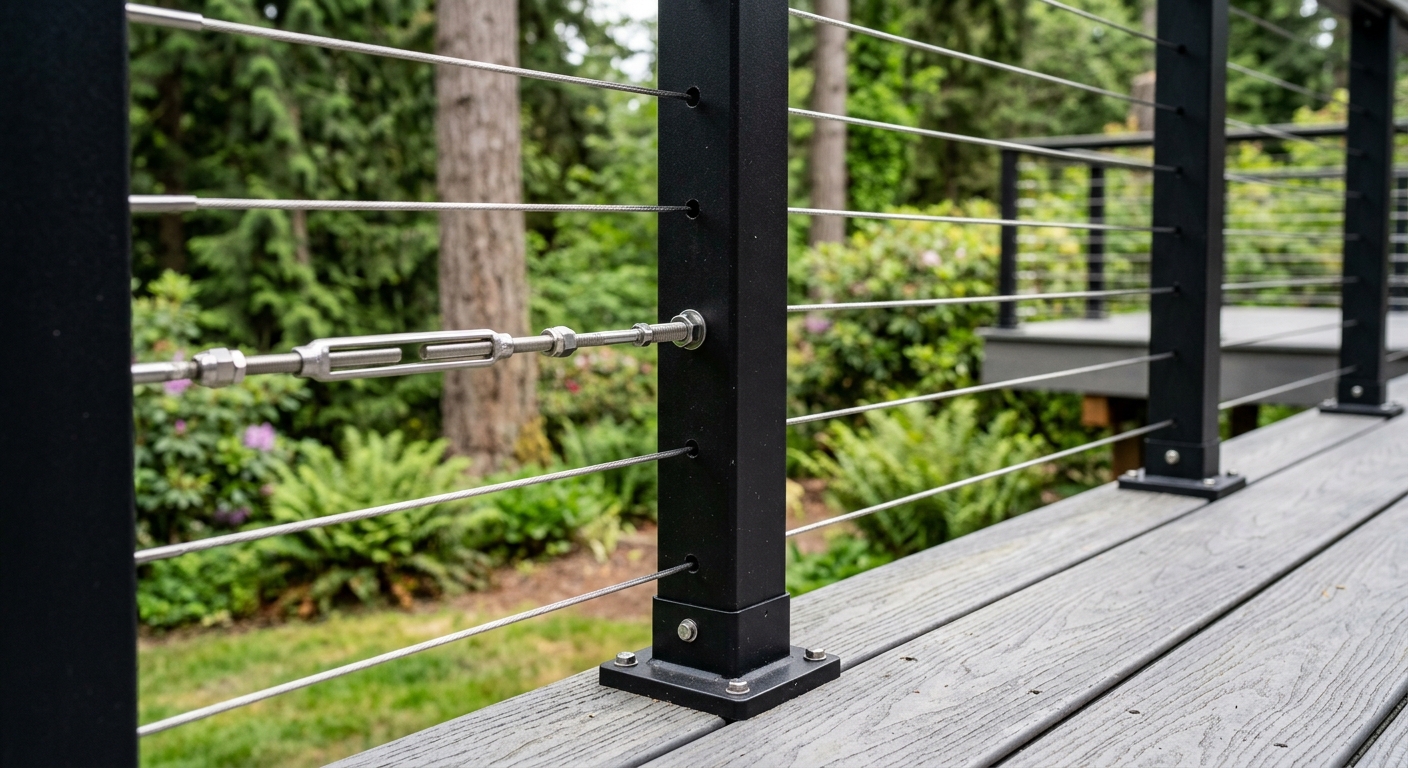
Cable Railing — The Most Popular Choice in King County
Horizontal stainless steel cable runs through black aluminum or steel posts — the dominant railing style on elevated hillside and view decks in Bellevue, Mercer Island, and Kirkland. Cable preserves sightlines and reads as modern-minimal. The tradeoff: posts must be spaced closer than baluster systems to maintain cable tension and meet 200 lb lateral load requirements. We spec 1x19 316-grade stainless cable on all cable railing projects.
Deck Railing Materials Comparison — King County Guide
| Material | Cost / Linear Ft (installed) | Maintenance | Lifespan | Best For |
|---|---|---|---|---|
| Aluminum (powder-coated) | $30–$55/lft | None — repaint if scratched | 30–40 years | Standard residential, HOA communities |
| Cable (stainless 316) + aluminum posts | $90–$140/lft | Annual cable tension check | 25–35 years | View-preserving — Mercer Island, West Hill Kent, Newport Hills Bellevue |
| Glass (tempered) frameless | $120–$180/lft | Monthly clean for clarity | 20–30 years | Premium view decks, Clyde Hill, lake-adjacent |
| Composite / vinyl | $45–$70/lft | Rinse annually | 20–25 years | Value builds, Federal Way, Kent |
| Cedar (wood) | $40–$65/lft | Stain every 2–3 yrs | 15–20 years | Matching cedar deck builds, natural look |
| Wrought iron (powder-coated) | $65–$95/lft | Touch up rust spots every 5–7 yrs | 30+ years | Traditional homes, classic aesthetic |
Where Each Railing Type Wins in King County
Cable Railing — View Properties
Mercer Island lots, Newport Hills Bellevue, West Hill Kent, and Dash Point Federal Way all have view corridors that solid railing destroys. Cable railing (7×19 strand, stainless 316 wire, tensioned to 75+ lbs per cable) preserves sightlines while meeting code. IBC requires cable spacing to prevent a 4-inch sphere from passing — typically 3-inch cable spacing on residential builds. Posts are aluminum or stainless steel; wood posts are not recommended in Seattle's climate. Typical: $90–$140/lft installed. Cost example: 80 linear ft = $7,200–$11,200.
Glass Railing — Premium Tier
West Bellevue, Clyde Hill, and Mercer Island waterfront properties frequently request frameless glass railing — either standoff-mounted tempered glass panels or a continuous channel base system. Glass railing creates a truly open view while providing full wind break for the deck. Requires quarterly cleaning in Seattle's dusty fall season. Tempered safety glass must meet 200 lb/sq ft lateral load requirement. Typical: $120–$180/lft installed. Cost example: 60 linear ft = $7,200–$10,800.
Aluminum Railing — Standard Residential
Powder-coated aluminum is the most common railing spec in King County for a simple reason: zero maintenance, 30+ year finish life, and pricing 30–50% below cable or glass. Brands we install: Fortress Evolution, Westbury Tuscany, TimberTech RadianceRail. Comes in flat-top and arched profiles; balusters in square, round, or basket-weave patterns. Standard color range includes black, bronze, white, and clear. Typical: $30–$55/lft installed. Code max: 4 inches between balusters.
Code and Permit Requirements
Washington State Residential Code (R312) requires guardrails on any deck surface 30 inches or more above grade. Required height: 36 inches for decks under 30 inches above grade, 42 inches for decks 30+ inches above. Maximum baluster/cable spacing: 4 inches (tested to reject a 4-inch sphere). Top rail must support a 200-lb point load. Every railing system we install is designed and inspected to WA code — we never cut corners on railing safety.
Recent Railing Projects
Mercer Island — 90 lft Cable, Stainless 316 Posts — $9,400
Replaced old wood balusters on a 420 sq ft AZEK deck. Stainless 316 posts and cables at 3-inch spacing. View: Lake Washington east toward Bellevue. Cable tensioned to WA code, inspected and signed off by City of Mercer Island at final inspection.
Newport Hills Bellevue — 65 lft Cable, Aluminum Posts — $6,200
Cable railing on an elevated composite deck with a 14-foot drop on the valley side. Aluminum posts in black, engineered connection hardware at each post. Corner posts calculated for multi-directional load. Permit included railing engineering drawings.
Kirkland Juanita — 75 lft Aluminum (Fortress Evolution) — $3,900
Powder-coated aluminum railing in black on a Trex Transcend deck. Code-compliant 42-inch height on the elevated section. Clean and low-maintenance — homeowner specifically wanted zero ongoing railing work.
West Bellevue — 45 lft Frameless Glass, Standoff-Mounted — $7,100
Standoff-mounted tempered glass panels on a premium lake-view deck. Glass meets 200 lb/sq ft lateral load requirement. Quarterly cleaning service included in the first year. Homeowner briefed on Rain-X application for reduced spotting in rainy season.
Glass Panel Railing — Maximum View, Maximum Light
Frameless tempered glass panels in aluminum channels deliver a near-invisible railing that maximizes views and natural light — the right choice for west-facing Seattle view decks where cable even creates visual interruption. Glass panels are 3/8" or 1/2" tempered safety glass. They scratch-resist well but require cleaning to prevent hard water spotting in Seattle's rain. Best suited to elevated, exposed decks where the view justifies the premium.
Q: Does my HOA govern what railing type I can install?
In many King County planned communities — particularly in Sammamish, Issaquah, and parts of Bellevue — yes. Some HOAs specify approved railing styles, restrict cable systems, or require specific materials. Washington State code requires a minimum 36-inch railing height for decks 30 inches or less above grade, and 42 inches for higher decks. We review HOA architectural guidelines as part of every railing project and handle any required AMR submissions on your behalf.
Q: What's the code requirement for deck railing height in Washington State?
Washington State Residential Code (R312) requires guards on any deck 30 inches or more above grade. Required height: 36 inches for decks under 30 inches above adjacent grade; 42 inches for decks 30 inches or more above grade. Maximum opening between balusters, cables, or panels: 4 inches (must reject a 4-inch sphere). Top rail must resist a 200-lb point load. We design every railing system to current WA code — the permit inspection covers railing height, spacing, and connection strength.
Q: How much does cable railing cost in King County?
Installed cable railing in King County typically runs $90–$140 per linear foot — posts, cables, hardware, and labor. A standard 80 linear foot railing (typical for a 400 sq ft deck) runs $7,200–$11,200. Variables: post material (aluminum vs. stainless steel — SS adds $15–$25/lft), post spacing, lot access, and whether you're adding to an existing deck or a new build. We provide fully itemized cable railing quotes so you can compare options accurately.
Q: Does cable railing meet code in Washington State?
Yes, when properly specified. Key requirements for cable railing in WA: cables must be tensioned to reject a 4-inch sphere under a 200-lb lateral load, maximum post spacing of 4 feet on straight runs, corner posts must be engineered for multi-directional load. We use 1×19 or 7×19 strand Type 316 stainless cable and aluminum or stainless steel posts — never wood posts for cable systems. Our cable installations are inspected and approved by the City building department as part of the deck permit.
Q: Can I add railing to an existing deck without a permit?
In most King County cities, adding or replacing railing on an existing deck does require a permit if the deck itself is 30+ inches above grade (because railing is a life-safety component). Some cities (Kent, Federal Way) have a simplified process for railing-only permits with shorter review times. Permit fees for railing-only projects run $150–$350. We handle the permit process for every railing project — it's not worth the liability risk to skip safety documentation on elevated railing work.
Q: How does glass railing perform in Seattle's rain and moss?
Tempered glass railing develops a white mineral film in Seattle's wet climate from water spots and dissolved minerals. This is purely aesthetic — it doesn't affect structural performance. The solution is regular cleaning with a glass cleaner and squeegee every 4–6 weeks on heavily rained-on exposures. Some clients use Rain-X on horizontal glass surfaces to reduce spotting. Frameless glass is the highest-maintenance railing option in Seattle — beautiful, but worth understanding the upkeep before specifying. We always discuss maintenance expectations at the estimate.
Q: Can I DIY my own deck railing installation?
Technically yes for low-level decks, but we don't recommend it for elevated decks. Railing is a life-safety system — an incorrectly installed post connection or undertensioned cable that fails under load can seriously injure someone. Washington State requires permits and inspections for railing on elevated decks (30+ inches above grade), and the inspection covers post anchorage, cable tension, baluster spacing, and rail height — not just visual appearance. The permit process exists specifically to catch installation errors before the structure is occupied. For low-level ground decks where guardrails aren't required by code, DIY aluminum railing is more reasonable. For anything elevated, the liability exposure — and the real safety consequence of a failure — makes professional installation the right call. Cable and glass systems especially require specialized tensioning tools and engineering knowledge that DIY installations almost never meet correctly.
Q: How long does railing installation take?
Aluminum railing installation on a standard deck (80–100 linear feet) typically takes 1–2 days of on-site work. Cable railing systems take 2–3 days due to post installation, cable threading, and the tensioning process — each cable must be tensioned individually and the system re-checked after all cables are set. Frameless glass railing typically takes 2–3 days as well — the glass panels require precise standoff layout before panels can be set, and each panel is tested after installation. If the project is railing-only on an existing deck, we can usually mobilize within 1–2 weeks of permit approval. If railing is part of a new deck build, it's sequenced into the final 2–3 days of the construction timeline. Permit inspection for railing work in King County cities typically happens within 2–3 days of requesting an inspection.
Q: Glass vs. cable — which is better for a view deck?
Both preserve views far better than solid balusters, but they have important differences. Glass provides the cleaner, more open sightline — especially from a seated position where cable wires at eye level can still interrupt the view. Glass also blocks wind, which matters on exposed lakefront decks where cable railing does nothing to reduce the wind on the deck surface. Cable railing costs significantly less ($90–$140/lft vs. $120–$180/lft for glass) and requires less maintenance — cable tension checks annually vs. monthly glass cleaning in Seattle's wet climate. On Mercer Island and Lake Washington properties, our recommendation depends on the specific exposure: glass on fully exposed west-facing sites for wind protection and maximum view clarity; cable on more sheltered lots where budget is a factor. We walk through both options at every estimate on view properties.
Q: Can my HOA restrict what railing style I install?
Yes, in many King County planned communities HOA Architectural Review Committees (ARCs) have specific authority over railing style, material, and color. Common restrictions we encounter: Sammamish Trossachs and Plateau communities that require aluminum or composite decking (not cedar) for consistent color finish; Bellevue and Kirkland HOAs that restrict cable railing on grounds that it creates a “ladder effect” for children; and communities that require color approval for all visible exterior elements. We review HOA architectural guidelines as part of our pre-estimate process for any project in a planned community. If your HOA requires an Architectural Modification Request (AMR) before construction, we prepare and submit that documentation on your behalf and wait for approval before scheduling the permit application. This keeps the project on a single track rather than having permit and HOA approval running on conflicting timelines.
We install cable, glass, aluminum, and cedar railing throughout King County — Kirkland waterfront glass and cable railings, Renton Kennydale view decks, Bellevue hillside cable systems, and Federal Way Dash Point stainless hardware for saltwater environments. We also design accessible decks with ramps and wide landings for aging-in-place homeowners.
gavelKing County Deck Railing Code Requirements
Washington State Residential Code (WSRC R312) adopts IBC requirements for guards and handrails. Every railing we install is engineered and inspected to these standards. Here's what you need to know before choosing a railing system for your King County deck.
straightenHeight Requirements
- 36 inches minimum — deck surfaces under 30 inches above adjacent grade
- 42 inches minimum — deck surfaces 30 inches or more above grade (elevated decks, second stories)
- Measured vertically from the deck surface to the top of the rail
- Applies to all railing materials — no exceptions for cable or glass systems
grid_onBaluster & Cable Spacing
- 4 inches maximum — between balusters, cables, or glass panel gaps
- Tested via the “4-inch sphere test” — no opening may allow a 4-inch sphere to pass
- Cable systems: must remain tensioned under 200-lb lateral load and still reject a 4-inch sphere
- Horizontal cable runs have additional restrictions to prevent use as a climbing ladder
pan_toolGraspable Handrail Requirements
- Required on stairways with 4 or more risers
- Circular handrail: 1.25–2 inches in diameter
- Non-circular: perimeter of 4–6.25 inches, max cross-section of 2.25 inches
- Must be continuous from top riser to bottom riser
- Flat 2×6 cap rails do NOT qualify — a separate graspable element is required on stairs
engineeringStructural Load Requirements
- Top rail must resist a 200-lb concentrated load applied in any direction
- Post connections engineered for moment loads — critical for cable and glass systems
- Corner posts on cable systems require multi-directional load calculations
- Waterfront and exposed sites require wind engineering — especially for glass panel systems on Lake Washington
Permit note: In all King County cities, replacing or adding railing on a deck 30+ inches above grade requires a permit — even if you're not changing the deck itself. Railing is a life-safety component. The permit inspection covers height, spacing, post anchorage, and structural load compliance. We handle permitting for all railing-only projects. Permit fees in Renton, Kirkland, Bellevue, and Sammamish typically run $150–$350 for railing-only scope.
waterCase Study: Mercer Island Waterfront Cable Railing — $8,000
The situation: A west-facing Lake Washington waterfront lot on Mercer Island. Existing deck had solid 2×2 cedar balusters at 3.5-inch spacing — technically code-compliant but visually blocking most of the water view. The homeowners wanted the view back without a full deck rebuild.
What we installed: 70 linear feet of cable railing using marine-grade 316 stainless steel cable and aluminum posts powder-coated in Textured Black. The 316-grade stainless spec is required at Lake Washington exposure — 304 stainless develops surface rust within 2–3 years in that moisture environment. Posts at 4 feet on center; cables at 3-inch spacing tensioned to exceed the 200-lb lateral load requirement. The existing cedar cap rail was replaced with a new 2×6 cedar cap to match the deck aesthetic.
Permit: Filed with the City of Mercer Island Building Division — railing-only permit on an elevated deck. Approved in 3 weeks. Final inspection passed on the first visit.
Result: Open views preserved completely. Project total: $8,000 installed — including posts, cables, hardware, cap rail, permit, and inspection. The homeowners described it as the best improvement they had made to the property without touching the deck itself.
For cable railing on waterfront properties throughout King County, 316-grade stainless is the correct hardware specification — not 304. We specify this on every lakefront and Puget Sound-adjacent project. Learn more about our Mercer Island deck and railing work.
Why Deck Railing Works — and What Fails — in Seattle's Climate
Seattle receives 38 inches of rain per year — and unlike a storm-heavy climate, King County's rainfall falls in sustained soaking patterns from October through May that test surface finishes, fastener integrity, and post bases in ways a weekend storm never would. Every railing material we specify is evaluated against this reality, not adapted from a drier climate standard.
Cedar posts fail faster than homeowners expect. Western red cedar railing is beautiful in the first two years. Without staining or sealing every 1–2 years in King County's sustained moisture, cedar develops surface checks, then end-grain cracking, then structural decay in the post base — even when the post base is pressure-treated lumber. We recommend cedar railing only when the deck field is cedar and the aesthetic match justifies a committed maintenance plan. Homeowners who want zero railing maintenance should specify aluminum or cable systems.
Freeze-thaw cycles attack cable tension. King County experiences 15–25 freeze-thaw events per year, concentrated November through February. Stainless steel cable contracts measurably in cold temperatures — a 100-foot run loses approximately 0.1–0.15 inches of length per 10°F drop. We account for seasonal tension changes by setting cable in cold conditions or specifying inline adjusters on longer runs. A cable system tensioned only in summer will feel loose by January. Washington State code requires that a cable system reject a 4-inch sphere under 200-lb lateral load in all seasons, not just warm ones.
Moss and mineral film on glass. Frameless glass railing in Seattle accumulates a visible white mineral film within one rainy season from dissolved silicates in King County's water supply. Moss spores also colonize horizontal channel bases and ledger surfaces on north-facing exposures that receive minimal direct sun. The maintenance requirement is quarterly cleaning with a glass cleaner and squeegee — monthly on north-facing installations. We brief every glass railing client on this schedule before installation so expectations are set correctly. Glass railing is the right choice for maximum view and wind protection; it requires the most ongoing maintenance of any railing type in Seattle's wet climate.
316 vs. 304 stainless — why it matters near water. At lakefront and coastal sites throughout King County — Mercer Island, the Lake Washington shoreline in Renton and Kirkland, and Dash Point in Federal Way — 304 stainless cable and hardware begins surface-rusting within 2–3 years from salt spray and dissolved mineral exposure. Type 316 stainless has a higher molybdenum content that resists chloride-driven corrosion. We specify 316 for all projects within half a mile of salt or fresh water. The cost difference is modest per linear foot; the structural difference over a 25–35 year cable life is significant.
UV fade at Seattle's latitude. At 47°N, Seattle's lower-angle UV still accumulates meaningful exposure on south and west-facing deck surfaces over 10–15 years. Powder-coated aluminum railing from quality manufacturers (Fortress Evolution, Westbury Tuscany) carries a 20–30 year finish warranty. Cedar's UV-driven silvering is accelerated by Seattle's long overcast seasons; without UV-blocking sealant applied regularly, cedar grays noticeably within 2–3 years. Composite railing systems with UV inhibitors hold color longer — matching the same UV-rated composite used on the deck field.
Choosing the right railing for a King County deck means matching material to climate exposure, not just aesthetics. See our Seattle deck cost guide for transparent railing price ranges and what drives cost up or down — or contact us directly to discuss the right railing specification for your specific lot, view conditions, and HOA requirements.