
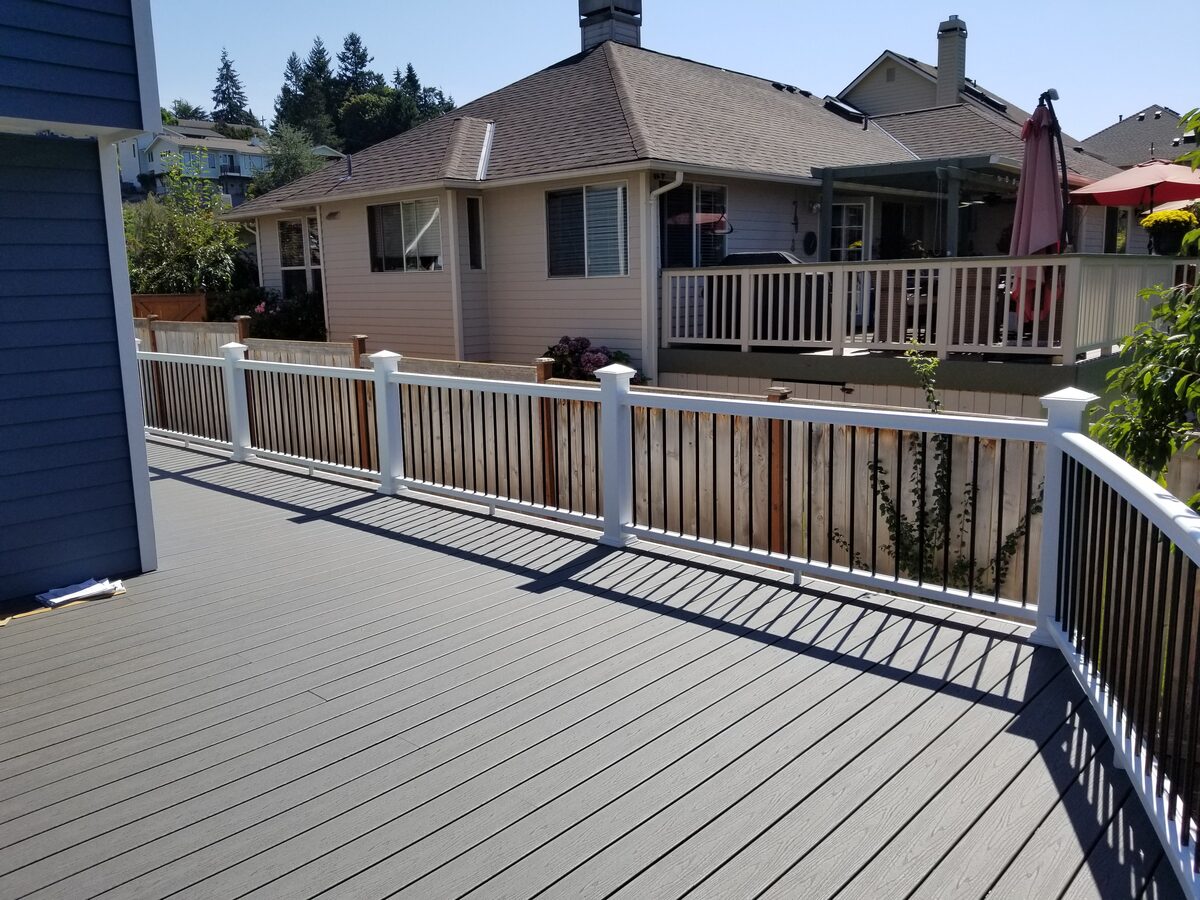
How to Hire a Licensed Deck Contractor in Seattle, WA (And Why It Matters)
Hiring the wrong deck contractor in King County is one of the most expensive mistakes a homeowner can make — and it's not just about quality. When a contractor builds your deck without a valid Washington State L&I registration, you're not just at risk of a poorly built structure. You're looking at a deck that fails inspection, a permit that can't be closed, and liability exposure that falls directly on you as the property owner. The Washington State Department of Labor and Industries exists precisely to prevent this situation, and the verification process takes less than three minutes.
We've been building decks in King County for over 15 years. In that time, we've been called to assess dozens of projects built by unlicensed contractors — structures that passed visual inspection until someone actually looked at the ledger attachment, the footing depth, or the beam-to-post connections. The pattern is consistent: the homeowner got a low bid, skipped the license check, and is now facing a rebuild that costs more than the original project would have cost done right.
This guide is for homeowners who want to avoid that outcome. We'll cover exactly what Washington State requires, how to verify a contractor before you hand over a deposit, what the unlicensed contractor problem looks like in King County specifically, what a professional estimate actually looks like, and the red flags that should stop the conversation before it starts.
This guide is for homeowners who want to avoid that outcome. We'll cover exactly what Washington State requires, how to verify a contractor before you hand over a deposit, what a professional estimate actually looks like, and the red flags that should stop the conversation before it starts.
What Washington State Requires for Deck Contractors
Washington's contractor licensing system is administered by the Department of Labor and Industries. Any contractor performing construction work valued at more than $500 on residential property must hold a current contractor registration. For deck builders specifically, this means meeting three distinct requirements — not one.
Contractor Registration
The business must be registered with L&I under the name of the entity performing the work. This is important: a contractor who tells you "my license is under my cousin's company" or "I use my partner's registration" is already out of compliance. The registration must match the business name on the contract you're signing.
Registration is renewed annually. An expired registration is not a technicality — it means the contractor's bond and insurance are no longer verified by L&I. Always confirm the expiration date is current.
Surety Bond
Washington State requires all general contractors to carry a minimum $12,000 surety bond. The bond protects you if a contractor fails to complete the project or causes property damage. It's not a large amount — it doesn't come close to covering a full deck replacement — but it signals that the contractor has met the minimum threshold of financial accountability required by the state.
Some contractors carry higher bond amounts, particularly those working on larger commercial or high-value residential projects. Ask what bond amount they carry and confirm it matches what L&I shows in their registration record.
Liability Insurance
L&I requires registered contractors to maintain general liability insurance with minimum coverage of $200,000 per occurrence for property damage and $200,000 for bodily injury. These minimums haven't changed in years and are widely considered insufficient for larger residential projects. Reputable deck contractors in King County typically carry $1M per occurrence.
Ask for the Certificate of Insurance directly — not a verbal assurance, not a statement on their website. A legitimate contractor can email you their certificate in minutes. If a contractor balks at providing it, that tells you something important about how the rest of the relationship will go.
Workers' Compensation
Any contractor who has employees — not just the owner working alone — must carry workers' compensation coverage through L&I or an approved self-insured plan. This matters to you personally as the homeowner: if a worker is injured on your property and the contractor doesn't have active workers' comp coverage, you may have liability exposure depending on the circumstances. This is not a hypothetical scenario — it happens across King County every year.
Important
How to Verify a Contractor's License in Under 3 Minutes
Washington L&I provides a free, public contractor lookup at secure.lni.wa.gov/verify. You need only the contractor's business name or their UBI (Unified Business Identifier) number.
Here's exactly what to look for:
Registration status: Must show "Active." Not Expired, Suspended, or Revoked. Active means current.
Bond: The lookup shows whether a current surety bond is on file. Confirm it shows a bond amount and that the bond carrier is listed.
Insurance: L&I verifies that the contractor's liability insurance is current. If the field shows no insurance or an expired policy, stop here.
Registration expiration date: This should be a future date. Many homeowners miss this step and call a contractor whose registration expired two months ago.
Business name match: The name in L&I's system should match the name on the contract and on the contractor's business materials exactly. Variations may indicate the contractor is operating under a different entity than the one registered.
Do this lookup before you schedule a site visit — not after you've received an estimate you like. The psychology of the selection process works against you later. By the time you've had a positive meeting, seen their portfolio, and been given a price you find reasonable, it's harder to walk away when the license check reveals a problem. Verify first.
A secondary check worth making: the contractor's UBI number can be cross-referenced at the Washington Secretary of State's business entity search to confirm the business entity is in good standing at the state level.
Tip
What Licensing Doesn't Guarantee
A valid L&I registration means the contractor met the minimum legal threshold. It does not mean they build good decks, pull permits correctly, manage projects professionally, or have experience with the materials and design complexity your project requires.
These are the factors that separate a competent, reliable deck contractor from one who is registered but mediocre:
Permit History
King County and the City of Seattle maintain searchable permit databases. You can look up a contractor's permit history — how many permits they've pulled, what types of projects, and whether any have flagged failed inspections or been put on hold. A deck contractor who has pulled no permits in their name in the past two years despite claiming to do 20 projects annually is worth questioning directly.
For Seattle projects, permit records are searchable at the Seattle SDCI portal. For King County projects outside city limits, use the King County permit portal.
Manufacturer Certifications
The major composite and PVC decking brands — Trex, TimberTech/AZEK, and Fiberon — offer contractor certification programs. A Trex Pro or TimberTech PRO contractor has completed product-specific training and typically has access to extended warranty periods unavailable to uncertified installers.
This isn't a hard requirement, but it's a signal of investment in the category. A contractor who installs composite decking frequently enough to seek manufacturer certification is more likely to install it correctly.
Industry Association Membership
The North American Deck and Railing Association (NADRA) is the primary trade organization for professional deck builders. Membership isn't a guarantee of quality either, but it indicates the contractor is engaged enough in their profession to participate in industry standards and training.
Subcontractor Transparency
Larger deck projects routinely involve concrete work, licensed electricians for deck lighting, and licensed plumbers for outdoor kitchen gas lines. Ask upfront whether the contractor uses licensed subcontractors for specialty trades and whether they pull the permits for that work or expect you to coordinate separately. A contractor who expects you to arrange your own electrical permit is a contractor you'll be managing, not hiring.
The Real Cost of Unlicensed Deck Work
The most common argument homeowners make for hiring an unlicensed contractor: the bid was 20–30% lower. Here's what that discount actually buys.
Failed Permits and Forced Deconstruction
In King County, building permit applications for decks over 30 inches above grade (or 18 inches in Seattle) require the work to be inspected by the jurisdiction's building department. If inspections reveal code violations — inadequate footing depth, improper ledger attachment, undersized beam span — the inspector issues a correction notice. Minor corrections are remediable. Fundamental structural deficiencies sometimes require partial or complete deconstruction and rebuild.
We've seen homeowners spend more on correcting unpermitted or failed-inspection work than the original project cost. The inspector doesn't negotiate on structural code compliance.
Resale Impact
Unpermitted decks — structures built without permits or with open (unclosed) permits — create direct problems at resale. In Washington State, a real estate disclosure form requires sellers to disclose known unpermitted structures. An unpermitted deck discovered during buyer inspection either kills the sale, reduces the purchase price, or forces the seller to either demolish the structure or pursue an after-the-fact permit — which requires bringing the structure into full current code compliance.
The after-the-fact permit process is often more expensive than doing it right initially, because it typically requires exposing hidden connections for inspection.
Personal Liability
We've mentioned the workers' comp issue. There's also the question of property damage. If an unlicensed contractor with no liability insurance damages your home — a ledger improperly attached that causes water infiltration, a post that fails and damages a vehicle or injures a neighbor — you have no recourse against their insurance because there isn't any. The claim goes to your homeowner's policy, which may cover it or may not, depending on your policy terms.
| Category | Value |
|---|---|
| Licensed contractor (initial) | $42,000 |
| Unlicensed contractor (initial) | $31,000 |
| Permit correction / rebuild | $18,000 |
| After-fact permit process | $9,000 |
| Resale price reduction | $15,000 |
Red Flags That Should Stop the Conversation
These are specific behaviors and statements that indicate a contractor is either unqualified or operating in bad faith. Each one warrants walking away.
"We Don't Need a Permit for This"
In King County, any deck with a walking surface more than 30 inches above grade, or any deck attached to the structure, requires a building permit. In the City of Seattle, the threshold is 18 inches. There are narrow exceptions — ground-level patios, detached platforms under specific size thresholds — but an attached, elevated deck is not in that category. A contractor who says otherwise is either wrong or steering you toward unpermitted work deliberately.
Large Upfront Payment Demands
The standard payment structure for a legitimate deck contractor in this market is three stages: a deposit at contract signing (typically 10–20%), a progress payment at framing completion (30–40%), and a final payment at project completion and inspection sign-off. Requests for 50% or more upfront should raise immediate concern. The contractor's incentive to complete the project correctly diminishes proportionally with how much of your money they have before the work is done.
No Written Contract
Every deck project over $10,000 in value should have a written contract specifying: scope of work with material specifications, payment schedule with milestone dates, timeline with start and completion dates, change order process and pricing, and warranty terms for both labor and materials. A verbal agreement or a single-page email quote is not a contract. It provides no protection when disputes arise.
Same-Day Pressure
Quality contractors in Seattle are typically booked 4–8 weeks out and have no genuine need to pressure homeowners into same-day decisions. "This price is only good today" is a sales technique, not a reflection of market reality. A contractor who applies closing pressure at the first meeting is more interested in your signature than in whether the project is right for you.
No Verifiable Physical Address
A legitimate deck contractor has a verifiable business address — not just a cell phone and a Gmail account. Check Google Maps, the Better Business Bureau, and their own website. A contractor without a traceable address has no physical accountability.
Note
What a Professional Estimate Actually Looks Like
A complete estimate from a licensed, professional deck contractor is a written document with line-item specificity. Here's what it must include and why each element matters.
Material Specifications
Every major component should be listed by brand, product line, color/finish, and quantity. "Composite decking" is not a specification. "Trex Transcend, Tiki Torch, 20-ft boards, 480 linear feet" is a specification. The difference matters at delivery and at the job site — and it matters if you ever need to add boards for a repair, because you'll know exactly what product is on your deck.
Labor Breakdown
Foundation work, framing, decking installation, railing installation, and specialty work (lighting, built-ins) should be separate line items. This breakdown lets you understand what each phase costs and gives you a basis for evaluating if the scope changes.
Permit Fees
Listed as a pass-through cost with the contractor managing the permit application and inspection scheduling. You should never need to interact directly with the permit office. Permit fees in King County range from $800–$2,500 for a standard elevated deck project.
Timeline
Start date, major milestone dates (framing complete, decking complete, railing complete), and projected completion date. Not "3–4 weeks from contract signing" — specific calendar dates, or a clear explanation of what triggers the start.
Exclusions
What the estimate explicitly does not cover. This is as important as what it does cover. Common exclusions include: demolition of existing structures, landscaping restoration, tree removal, and underground utility locates. Knowing the exclusions prevents the "but I thought that was included" conversation after you've signed.
Key insight
How the Permit Process Protects You
The building permit process is often framed as a bureaucratic hurdle. It isn't. It's the mechanism by which an independent, third-party professional — the building inspector — verifies that the deck being built on your property is structurally sound, correctly attached, and code compliant.
The inspection sequence for a standard elevated deck in King County typically includes:
Footing inspection: Before concrete is poured, the inspector verifies hole depth, diameter, and reinforcement. This is the inspection that protects against footings that shift in Seattle's clay-heavy soils during wet winters.
Framing inspection: After the structural frame is built but before decking is installed, the inspector verifies beam sizing, joist spacing, post-to-beam connections, and ledger attachment. The ledger inspection is critical — this connection is responsible for the majority of deck collapses when done incorrectly.
Final inspection: With all work complete, the inspector verifies railing height and graspability, stair dimensions, hardware, and any electrical or gas connections. A closed permit is your documentation that the work was inspected and approved.
We pull all required permits on every project. Homeowners never need to navigate SDCI or King County permitting offices directly — we handle applications, plan sets, and inspection scheduling.
Contractor vs. Owner-Builder Permits in Washington
Washington State allows homeowners to pull their own "owner-builder" permits for projects on their primary residence. This means technically, as the homeowner, you can act as your own general contractor, pull the permits, hire specialty subcontractors, and build a deck without a licensed GC involved.
In practice, this is rarely the right call for a deck project for several reasons:
Liability: An owner-builder permit makes you personally responsible for all code compliance. If a structural failure occurs, you have no contractor to hold accountable.
Resale: Owner-built structures sometimes face additional scrutiny at resale, particularly if the construction quality doesn't match what a professional would produce.
Complexity: Managing the permit application, structural drawings, inspections, and subcontractor coordination requires knowledge of the building process that most homeowners don't have.
Owner-builder permits make more sense for simple interior projects. For an elevated deck with structural complexity, the licensed contractor route provides protection that the cost differential doesn't justify skipping.
Workmanship Warranties in Washington State
Washington law does not mandate a specific workmanship warranty term for residential construction. This means the warranty on your deck is whatever the contractor puts in writing.
What to look for:
Labor warranty: Minimum 1 year, better contractors offer 2–5 years on workmanship. This covers defects in how the work was done — loose fasteners, inadequate connections, installation errors — not normal wear.
Material warranties: Separate from the contractor's labor warranty. Major composite decking brands offer 25–50 year limited warranties against fading, staining, and material defects. These warranties are between you and the manufacturer, not the contractor — but they're only valid if the product was installed by an authorized contractor following manufacturer guidelines.
What voids warranties: DIY modifications, unauthorized product changes, use of incompatible fasteners. Read the terms before selecting your decking brand.
At The Seattle Decking Company, our labor warranty is 3 years on all workmanship. We carry a current L&I registration, $1M liability insurance, workers' compensation for all crew members, and manufacturer certifications for Trex, TimberTech, and Fiberon products. Every project includes a written contract, line-item estimate, and permit management.
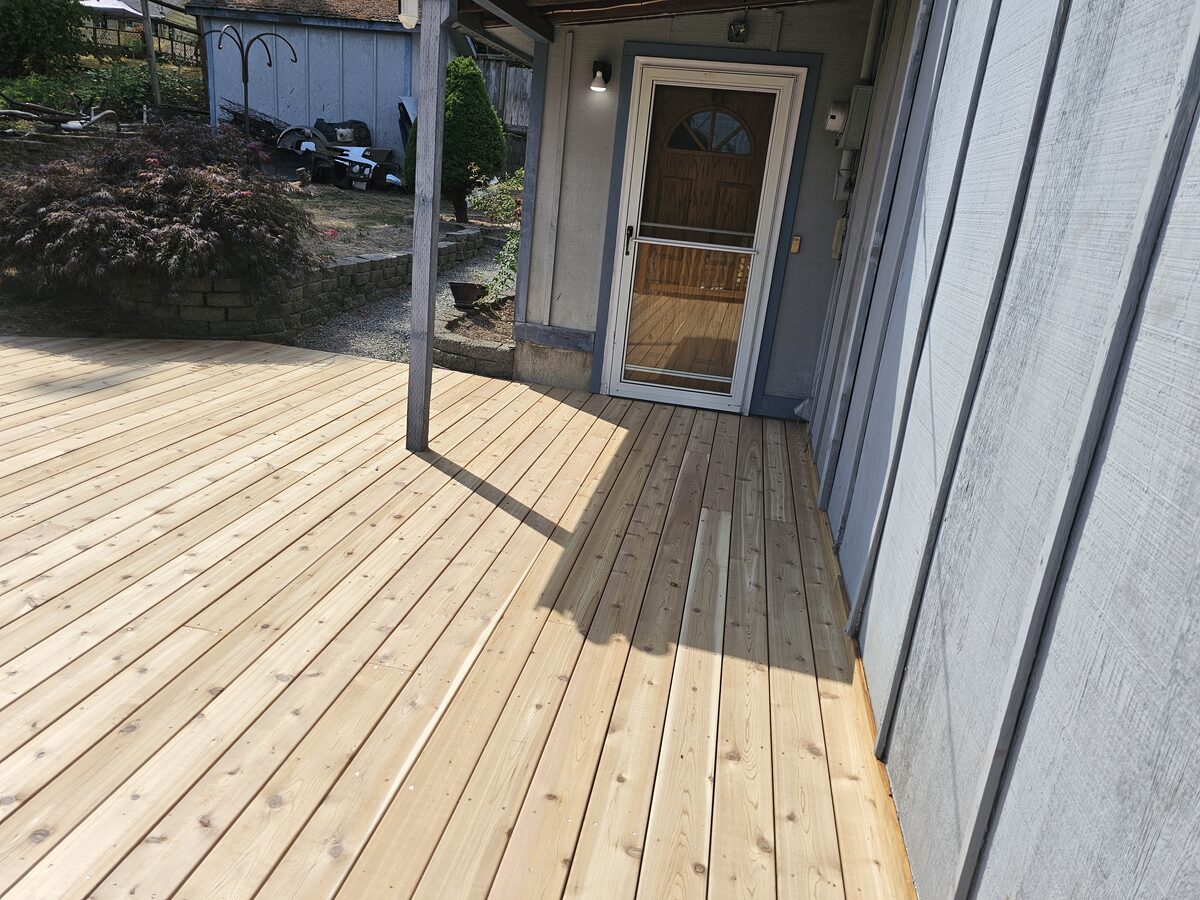
Materials and Warranties: What Licensed Contractors Access
One practical advantage of working with a licensed, manufacturer-certified contractor: access to extended warranty terms that aren't available through standard purchase channels.
| Material | Standard Warranty | Contractor-Installed Extended Warranty |
|---|---|---|
| Trex Transcend | 25-yr fade/stain | Same — installation must be by Trex Pro installer |
| TimberTech Legacy | 30-yr limited | 50-yr with PRO-certified installer |
| Fiberon Symmetry | 25-yr fade/stain | Enhanced warranty with certified installer |
| AZEK PVC | 30-yr limited | 50-yr with authorized installer |
| Western Red Cedar | No manufacturer warranty | Contractor workmanship warranty only |
These extended terms matter in practice: a board that begins showing premature fading or moisture absorption within 5 years of installation is replaceable under warranty — but only if it was installed by a certified contractor using the correct fastening system.
Frequently Asked Questions
Frequently Asked Questions
How do I verify a deck contractor's license in Washington State?
What is the minimum bond required for a Washington State contractor?
What insurance should a deck contractor carry in King County?
Do I need a permit for a deck in Seattle?
What happens if a deck is built without a permit?
Can a homeowner pull their own deck permit in Washington?
What is a reasonable payment schedule for a deck project?
What workmanship warranty should I expect from a deck contractor?
What is the difference between contractor registration and a contractor license in Washington?
How long does a deck permit take in King County?
What does L&I workers' compensation mean for me as a homeowner?
Are manufacturer warranties affected by which contractor installs the deck?
How to Compare Multiple Contractor Proposals
Collecting multiple estimates is the right approach — but comparing them correctly is harder than it looks. Most homeowners compare the bottom-line total. That's the least informative number in the document.
Here's the framework we recommend:
Confirm the Material Specifications Are Identical
Before comparing prices, verify that each proposal is specifying the same materials. "Composite decking" in Proposal A might mean Trex Transcend. In Proposal B, it might mean an uncapped composite product that costs 30% less and performs significantly worse in Seattle's climate.
Request that each contractor add specific brand and product line to their proposal if it isn't already there. A legitimate contractor specifies materials exactly. A contractor whose proposal doesn't name specific materials is leaving themselves flexibility you don't want them to have.
Verify the Permit Is Included
Every proposal should include permit fees as a line item. If it doesn't, ask explicitly: "Is permit management included in this price?" A proposal that excludes the permit is understating the total project cost by $800–$2,500 and transferring permit management responsibility to you.
More importantly: a contractor who doesn't proactively include the permit in their scope is either not planning to pull one, or assumes the homeowner won't notice the omission. Neither is a contractor you want building your deck.
Look at the Payment Schedule
The payment schedule in a proposal tells you how the contractor manages risk. Balanced payment schedules (deposit at signing, progress at framing, balance at completion) align the contractor's financial interest with your project completion. Front-loaded schedules (50%+ due at signing or before work begins) shift risk entirely to you.
Ask About Insurance Specifically
"Are you licensed and insured?" is an incomplete question. Ask: "Can you send me your certificate of insurance showing your current general liability and workers' comp coverage?" The answer to that specific question — and how quickly and comfortably they respond — tells you whether the coverage is real.
Evaluate Communication Speed and Professionalism
How quickly did the contractor follow up after your initial inquiry? How professional was the proposal document? Did they show up on time for the site visit? These signals are early indicators of how the contractor manages the project communication from permit submission through final inspection.
A contractor who takes three days to respond to an email before you've paid them anything will not improve their communication speed after you've handed over a deposit.
Seasonal Timing and Scheduling in King County
Understanding the seasonal dynamics of deck building in Seattle helps you plan more effectively and get better value from the process.
When Contractors Are Busiest
The peak demand season for King County deck contractors runs from March through July, peaking in April and May when homeowners realize they want a finished deck for summer entertaining. During this period:
- Booking lead times extend to 8–16 weeks
- Some contractors overschedule and miss promised start dates
- Material supply from lumber yards and composite decking distributors can run constrained on popular products
If you want a July deck, the conversation with contractors needs to start in February or March at the latest. By April, most quality contractors in this market are booking June or July start dates.
Off-Season Advantages
August through February is the counter-season for deck planning and construction. Quality contractors are more available, lead times for material delivery are shorter, and some contractors offer off-peak pricing. The rain doesn't prevent deck construction — composite decking and framing lumber are typically installed in any weather. Concrete pours for footings require above-freezing temperatures (generally not a problem in Seattle below 1,000 feet elevation) and dry conditions for 24 hours.
The off-peak season is actually an excellent time to plan and permit a deck, even if construction will start in spring. Permit processing at Seattle SDCI and most King County cities is faster in fall and winter. Submitting a complete permit application in November means having permits in hand in December or January — ready to build the moment your contractor's spring schedule opens.
How We Manage Project Scheduling
At The Seattle Decking Company, we give clients honest schedule dates based on our current booking. We don't accept projects we can't start within a timeframe that works for the client, and we communicate schedule changes promptly if they occur. We don't use the "we're starting next week" line to get a contract signed and then delay by three months.
Questions to Ask Every Deck Contractor
Before signing with any contractor, these questions will help you separate the professional from the problematic:
1. Can I see your L&I registration number? A licensed contractor has this memorized or can provide it in 30 seconds. It should be on their truck, their business card, and their estimates. Run it at lni.wa.gov before you schedule the site visit.
2. Who pulls the permit? The answer should be "we do, and it's included in the estimate." If the answer is "the homeowner needs to handle the permit," that's a project management responsibility you don't want.
3. Have you built similar projects in King County? Ask for references from projects of comparable scope and material — specifically in the jurisdiction where your project will be built. Permit experience in Bellevue transfers to Bellevue projects. Knowing Sammamish's permit office matters for a Sammamish project.
4. Who does the concrete work and any specialty trades? On projects involving electrical, gas, or concrete footings, ask who performs that work and whether they're licensed for those trades.
5. What does your warranty cover? The answer should be specific: duration, what's covered (workmanship vs. materials), what voids it, and the process for making a claim. Vague answers ("we stand behind our work") aren't warranties.
6. Can I see a completed project similar to mine? A contractor who has done your project type before should be able to show you a reference project — ideally one you can visit in person, not just photographs.
Understanding the Inspection Process: What Happens After the Permit Is Issued
Many homeowners assume the permit is the end of the bureaucratic process. It isn't — it's the beginning of the inspection sequence that protects you. Understanding what inspectors look for at each stage helps you ensure your contractor is scheduling inspections properly.
Footing Inspection
The footing inspection happens before concrete is poured into the excavated holes. The building inspector visits the site and verifies:
- Hole depth (must reach below the frost line or to stable bearing soil per the engineering drawings)
- Hole diameter (matches the engineer's specification)
- Rebar placement (if required by the engineering drawings)
- Hole cleanliness (no loose soil or standing water in the hole at pour time)
If the inspector finds a hole that doesn't meet specification — too shallow, too small, or improperly located — the concrete is not poured until corrections are made. This inspection is the most important one on the project: once the concrete is in the ground, you can't see whether it was done right.
A licensed contractor schedules this inspection and is present for it. A contractor who pours concrete before the footing inspection is scheduled — or who tells you "we already passed footings" without an inspection record — is a serious red flag.
Framing Inspection
After the structural frame is built but before decking boards are installed, the framing inspection verifies:
- Beam sizing matches the structural drawings
- Joist sizing and spacing matches the structural drawings
- Post-to-beam connections use the correct hardware
- Ledger connection has proper flashing installed
- Lateral bracing (if required) is in place
The ledger inspection is particularly important. The inspector looks at whether the ledger is fastened directly through appropriate flashing to the rim joist with code-compliant through-bolts or structural screws at the correct spacing. A ledger that's toe-nailed into siding rather than properly flashed and connected to the structural rim joist will not pass inspection.
If any element doesn't pass, a correction notice is issued and re-inspection is required after corrections are made. This process protects you — not the contractor.
Final Inspection
After all work is complete, the final inspection covers:
- Railing height (minimum 36 inches for decks under 30 inches above grade; 42 inches above that height under Washington residential code)
- Baluster spacing (maximum 4-inch opening between balusters)
- Stair dimensions (tread depth, riser height, and consistency)
- Graspability of handrails on stair runs
- Any electrical connections for deck lighting
- Any gas connections for outdoor kitchens or fire features
A closed final inspection creates a public record — searchable through the permit authority's database — that the work on your property was inspected and approved. This record has value at resale and protects you from liability disputes if anyone questions the structure's compliance later.
What Happens If a Contractor Doesn't Schedule Inspections
Contractors who skip permit inspections — either because they pulled a permit and ignored the inspection process, or because they never pulled a permit at all — leave you with a structure that has no official record of code compliance. If the structure later fails and someone is injured, the absence of inspection records creates liability exposure. If the structure fails inspection when you sell the home, the cost of bringing it into compliance falls on you.
King County vs. City of Seattle vs. Suburban Cities: Permit Jurisdiction Matters
A common point of confusion for King County homeowners: which authority issues the deck permit? The answer depends on where your property sits.
Within Seattle city limits: Seattle's Department of Construction and Inspections (SDCI) issues all residential permits. This covers all Seattle neighborhoods — Ballard, Fremont, Capitol Hill, Queen Anne, Magnolia, Rainier Valley, etc.
Within incorporated suburban cities: Each incorporated city has its own building department. Bellevue, Kirkland, Redmond, Renton, Bothell, Sammamish, Issaquah, Kenmore, Shoreline — all have their own permitting offices with separate application processes, fee schedules, and processing timelines.
Within unincorporated King County: Properties in unincorporated areas (outside any city boundary) permit through King County's Department of Local Services, Permitting Division.
This matters because each jurisdiction has its own:
- Permit application form and submittal requirements
- Fee schedule
- Processing timeline (these vary from 3 weeks to 8+ weeks)
- Specific code amendments to the base IRC
A contractor who tells you they "know the permit process" without specifying which jurisdiction they're familiar with may be applying Bellevue knowledge to a Seattle project, or Sammamish experience to an unincorporated King County property. These are meaningfully different processes.
We pull permits in all King County jurisdictions and have established relationships with plan reviewers at SDCI, Bellevue, Kirkland, Sammamish, Bothell, Kenmore, Shoreline, Renton, and Federal Way, among others. The nuances of each jurisdiction's review process are part of what we bring to every project.
Common Questions About Insurance and Liability
The insurance questions homeowners most often forget to ask — and wish they had:
Does My Homeowner's Insurance Cover Deck Construction?
Your homeowner's insurance policy covers your property, not work being done on it. If a contractor damages your roof while staging material, your homeowner's insurance may cover the damage (subject to deductible and policy terms), but you'll then pursue the contractor for reimbursement. That pursuit is much easier if the contractor has verifiable liability insurance.
If the contractor has no liability insurance, you've already paid your deductible and absorbed any gap between the deductible and the damage amount. The contractor's surety bond ($12,000 minimum) may provide some recovery, but it's not a substitute for adequate liability coverage.
What If Someone Else Is Injured on My Property During Construction?
Workers injured on your property are typically covered by the contractor's workers' compensation coverage. The contractor's WC policy, not your homeowner's policy, is the primary coverage vehicle for workers' injuries. When the contractor doesn't have active WC coverage, the coverage question becomes more complex and your homeowner's policy's liability coverage may be invoked — with consequences for your policy history and premiums.
A visitor (neighbor, utility worker, delivery person) injured on your property during construction falls under your homeowner's liability coverage as the property owner. The contractor's general liability policy should be the responsible party if the injury results from their work activities, but the liability resolution process is cleaner when the contractor has adequate coverage to assume it.
Is the Contractor's Coverage Current at the Time of My Project?
L&I's verification tool shows the coverage status as of the date you look it up. Coverage can lapse after your lookup if the contractor's insurance payment fails. For larger projects, we recommend requesting a certificate of insurance that names you as an additional insured — this gives you the right to receive notice directly from the insurer if the coverage lapses or is canceled during your project. Reputable contractors can arrange this with their insurance carrier with a simple request.
Why We Document Everything
At The Seattle Decking Company, every project starts with a written scope document before any pricing discussion. We are registered with Washington L&I, carry $1M general liability insurance, maintain active workers' compensation coverage for every crew member, and hold manufacturer certifications with Trex, TimberTech, and Fiberon.
Our estimates are line-item specific — you know exactly what you're getting before you sign anything. We pull all required permits for every project, coordinate all inspections, and deliver a final packet that includes closed permit documentation, material warranty registration, and care instructions.
We build throughout King County: Seattle, Bellevue, Kirkland, Redmond, Renton, Bothell, Sammamish, Issaquah, Federal Way, Mercer Island, and surrounding communities.
If you're in the research phase, our FAQ addresses the questions we hear most often from homeowners comparing proposals. When you're ready to compare licensed contractors, request a free estimate online or call us at (425) 675-6259 — we'll walk through every line item before you make a decision.
Planning a deck in the Seattle area?
Get an onsite design review and a clear, itemized quote from a licensed local builder.
Request a Free Quote