Deck Materials Guide: Choosing the Right Decking for the Pacific Northwest
Seattle gets 38 inches of rain per year — more than New York, Chicago, or Miami. That makes material choice more consequential here than almost anywhere else in the United States. The wrong material on a shaded lot fails in 7–10 years. The right one lasts 30+. Here's how to choose.
The Short Answer: What Is the Best Decking Material for Seattle Rain?
Capped composite (Trex, TimberTech, Fiberon) is the best material for most Seattle homeowners. It resists mold and moisture by design, requires no sealing, and outperforms cedar on shaded north-facing lots — the most common failure scenario in the PNW. A premium composite deck (Trex Transcend, TimberTech Vintage) carries a 25-year fade and stain warranty at $40–$60/sqft installed.
Read on for when cedar, PVC, or membrane is the better choice — your lot orientation, budget, and maintenance preferences all shift the answer. The table in Section 8 gives you a side-by-side comparison in under two minutes.
Why PNW Weather Demands Different Material Thinking
Most decking manufacturers test their products in standard environments. The Pacific Northwest isn't standard. Six climate factors distinguish Seattle from every other major U.S. decking market — and each one affects materials differently.
38 inches of annual rainfall
Seattle averages 38" of rain per year — but the distribution matters as much as the volume. Rain falls steadily October through May with few extended dry periods. Wood that never fully dries between rain events stays in a perpetual high-moisture state, accelerating checking, cupping, and mold colonization. Composite and PVC are unaffected by sustained moisture cycles because they don't absorb water in the first place.
200+ cloudy days per year
Seattle averages 226 cloudy days annually. North-facing and partially shaded deck surfaces can go 60–90 consecutive days without sufficient UV exposure to inhibit mold and algae growth. Untreated or improperly sealed cedar on a shaded lot develops visible mold within 1–2 rainy seasons. Capped composite physically prevents mold from rooting in the board surface.
Freeze/thaw cycles October–March
Seattle doesn't get hard winters, but freeze/thaw cycling from October through March is real and damaging. Water infiltrates wood grain cracks, freezes, expands, and widens the crack — a cycle called checking. PNW cedar decks that skip the annual seal coat show accelerated checking within 3–5 years. Composite and PVC have no grain structure to infiltrate.
Summer UV and surface heat
PNW summers run hot and sunny from July through September. Composite deck surfaces in direct sun reach 125–145°F — noticeably hotter than wood. This is the one area where cedar has a seasonal performance advantage: it stays cooler underfoot in direct July sun. If your deck faces south and has no shade cover, composite color choice matters (lighter colors = cooler surface).
Moss and algae on north-facing surfaces
North-facing decks in Seattle are a moss and algae incubator. Standard cedar without annual treatment develops green algae patches in 1–2 years and thick moss in 3–4. Capped composite (with its non-porous cap layer) inhibits biological growth by denying moisture and organic material a foothold. Even composite decks on north-facing lots benefit from an annual wash with a composite-safe cleaner.
Elevated ambient humidity
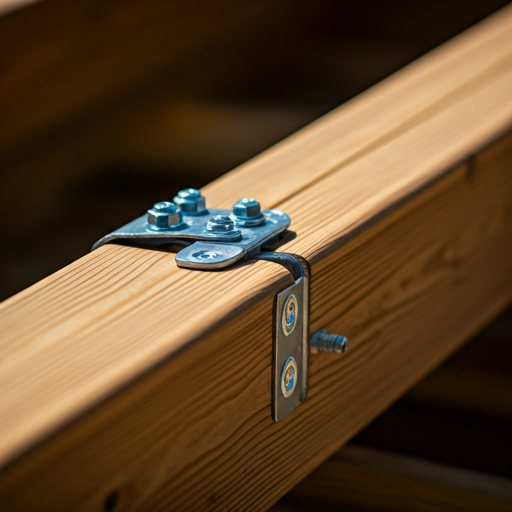
Average relative humidity in Seattle runs 70–80% year-round — the highest sustained humidity of any major West Coast city. This matters for substructure: pressure-treated lumber for joists and beams holds up well, but hardware choice is critical. Standard galvanized screws corrode in 5–8 years in sustained high-humidity environments. Hot-dipped galvanized (ASTM A153) or stainless steel hardware is the correct spec for any PNW deck regardless of material.
Cedar Decking
Natural Beauty, Active Maintenance
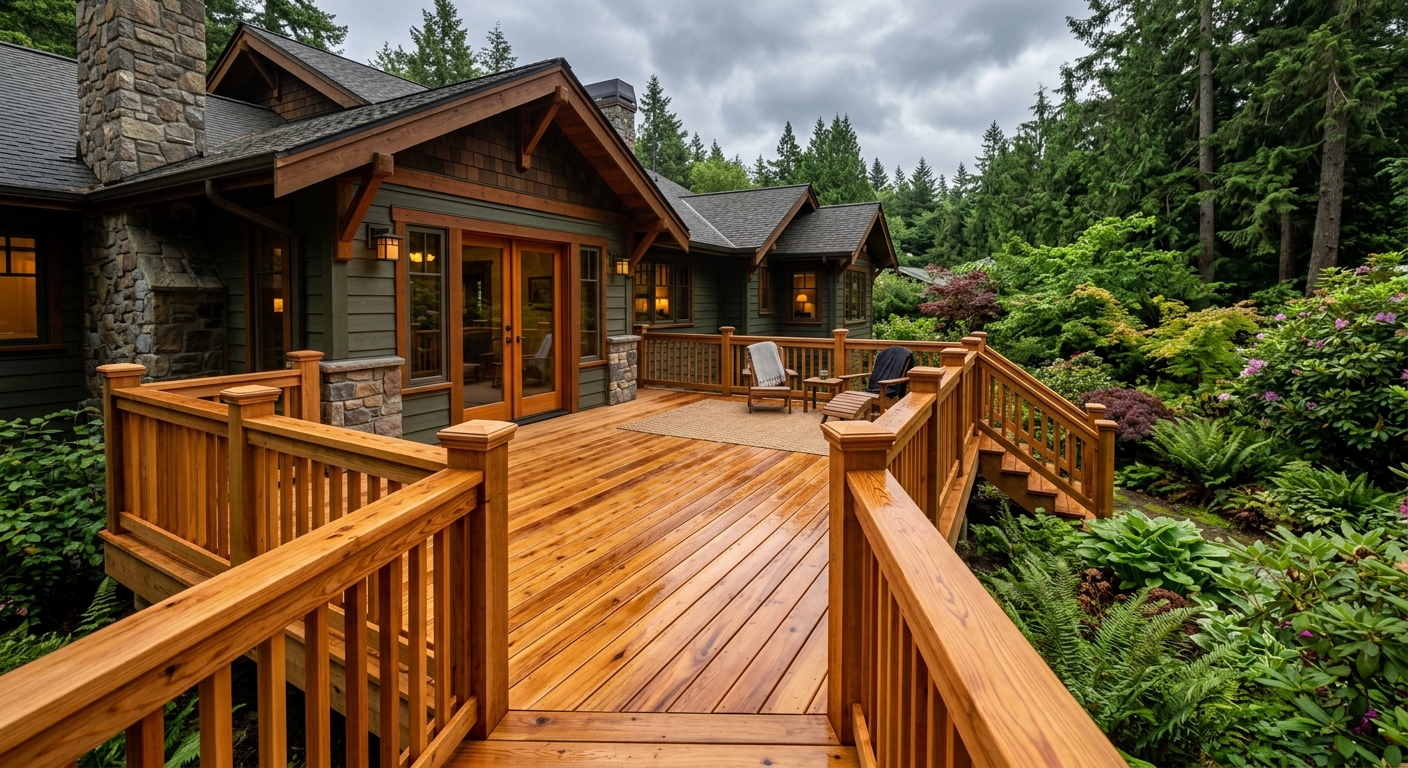
Western Red Cedar is the only natural wood we build with in King County. The warm honey grain and natural rot oils make it the choice for homeowners who want real wood character and are willing to maintain it — a semi-transparent oil stain every 2–3 years on sun-exposed lots, annually on shaded north-facing sites. CVG (Clear Vertical Grain) only — no knotty cedar for decking.
thumb_up Pros
- ✓ Lower installed cost: $18–$28/sqft for Western Red Cedar
- ✓ Natural warmth and appearance — uniquely hard to replicate
- ✓ Cooler underfoot in direct summer sun
- ✓ Easy to cut, sand, and refinish
- ✓ Naturally insect-resistant (Western Red Cedar)
- ✓ Repair-friendly — damaged boards are cheap to replace
thumb_down Cons
- ✗ Seal every 2 years: $400–$600/application
- ✗ 20-year maintenance cost: $3,000–$5,000 in sealing alone
- ✗ Mold, algae, and moss on shaded lots within 1–2 seasons
- ✗ Checking and cupping from PNW freeze/thaw cycling
- ✗ Splinter risk over time without regular sanding
- ✗ 15–20 year practical lifespan vs 25–30+ for composite
The Real 20-Year Cost of Cedar in Seattle
Cedar is cheaper to install but more expensive to own. A 350 sq ft cedar deck installed at $22/sqft = $7,700. Sealing every two years at $500/application = $4,500 over 18 years. Plus periodic board replacement and sanding: add $800–$2,000. Total 20-year cost: $13,000–$14,200 — comparable to a composite deck that requires almost no maintenance budget.
Cedar Failure Modes Specific to the PNW
Surface cracks along the wood grain caused by repeated moisture absorption and drying. Accelerated by PNW freeze/thaw cycling. Cosmetic at first, structural if deep.
Boards bow across their width as one face expands more than the other under moisture cycling. Common on north-facing lots where the underside stays wetter than the surface.
Green or black mold establishes on boards within 1–2 rainy seasons without proper sealing. Common in shaded areas, especially under overhanging trees.
Cut ends absorb moisture readily and begin rotting before face surfaces. End-grain sealing at install is often skipped, accelerating rot at board ends and around fastener holes.
When Cedar IS the Right Choice
- → Budget-first projects where lower installed cost is the primary constraint
- → South-facing or west-facing lots with substantial direct sun exposure (mold risk drops significantly)
- → Homeowners who genuinely enjoy outdoor maintenance and will follow through on the sealing schedule
- → Projects where the natural wood aesthetic is non-negotiable and no composite approximation is acceptable
Cedar Species Compared
| Species | Cost/sqft | Rot Resistance | PNW Notes |
|---|---|---|---|
| Western Red Cedar | $6–$9/board ft | Excellent | Most common PNW choice. Natural oils resist rot but not mold on shaded lots. |
| Alaskan Yellow Cedar | $9–$14/board ft | Superior | Denser grain, higher oil content, better moisture resistance. Premium pricing, harder to source. |
| Pressure-Treated Fir | $3–$5/board ft | Good (treated) | Lowest cost. Chemical treatment resists rot but surface requires staining. Tends to warp more than cedar. |
Composite Decking
The Low-Maintenance Standard
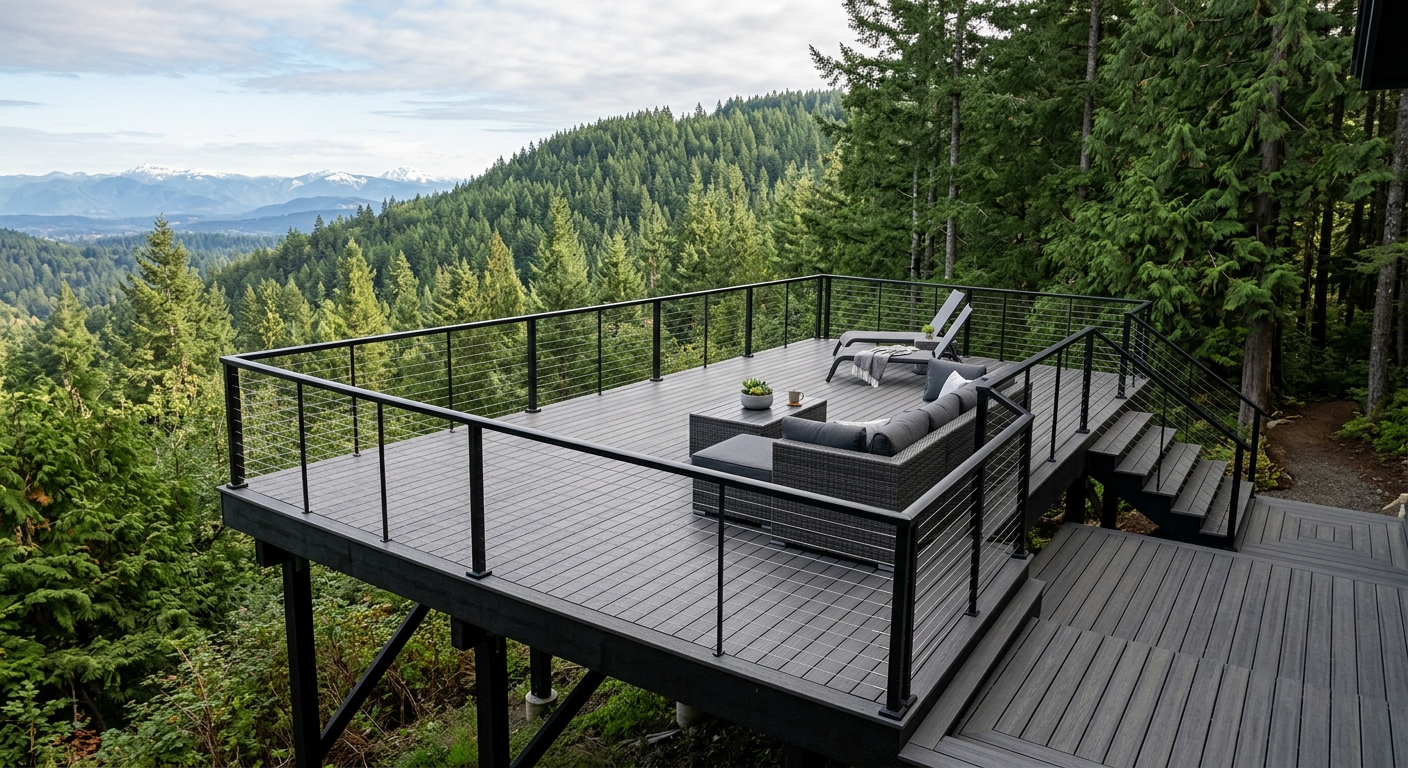
Capped composite is the most common recommendation we make. A polymer shell on all four sides seals the wood-fiber core from moisture — no staining, no sealing, no sanding. Specify fully capped lines only (Trex Transcend, TimberTech Legacy, Fiberon Paramount). 25-year to lifetime warranties. The right choice for the majority of King County lots.
Critical distinction: Capped vs. Uncapped Composite
Early composite decking (pre-2010) was uncapped — wood fiber and plastic mixed together, exposed on all surfaces. These products failed dramatically in the PNW, developing mold and swelling within 5 years. Modern capped composite is a completely different product. A polymer cap layer wraps the board on 3–4 sides, physically blocking moisture and mold from penetrating the wood fiber core. If you had a bad experience with composite 15+ years ago, current capped products are not comparable.
Brand Breakdown: Trex, TimberTech, Fiberon
Trex — Three Tiers
Select
$35–$42/sqft installed
25-yr fade+stain
Value tier. Good mold resistance. Most popular mid-market choice in King County.
Enhance
$38–$48/sqft installed
25-yr fade+stain
Mid tier with enhanced grain texture. Better aesthetics than Select, same core protection.
Transcend
$48–$62/sqft installed
25-yr fade+stain
Premium. Deepest grain replication. Heat-mitigating cap. Top HOA and Eastside choice.
TimberTech — Three Tiers
Terrain
$35–$44/sqft installed
25-yr fade+stain
Entry capped composite. Solid PNW performer, especially on drier lots.
Legacy
$42–$52/sqft installed
30-yr fade+stain
Mid tier. Multi-width board availability. Strong mold resistance ratings.
Vintage
$52–$65/sqft installed
30-yr fade+stain
Premium. 4-sided cap, best-in-class moisture protection. Bellevue and Sammamish premium choice.
Fiberon — Three Tiers
Symmetry
$34–$42/sqft installed
25-yr fade+stain
Strong value option. Good color selection. Competitive with Trex Select.
Concordia
$40–$50/sqft installed
25-yr fade+stain
Mid tier. Hardwood-look collections. Consistent performer in PNW installs.
Promenade
$50–$60/sqft installed
Lifetime fade+stain
Premium PVC-composite hybrid. Lifetime warranty. Very low heat absorption.
We also have a dedicated Trex decking page with full product line details, installed pricing, and King County project examples.
Performance in PNW Shade: Why It Matters
Mold resistance in modern capped composite works because the cap layer is hydrophobic — water beads off rather than absorbing. Even on north-facing lots with zero UV exposure from November through March, mold cannot colonize a properly capped surface. The wood fiber core is irrelevant because moisture never reaches it. This is the single most important material advantage for Seattle homeowners with shaded lots.
Note: composite decking still benefits from an annual rinse with a composite-safe deck cleaner (oxygen bleach formula, no chlorine bleach). Pollen, leaf tannins, and organic debris can stain the cap surface even if they can't penetrate it. A spring wash takes an hour and maintains the appearance over the full warranty term.
PVC Decking
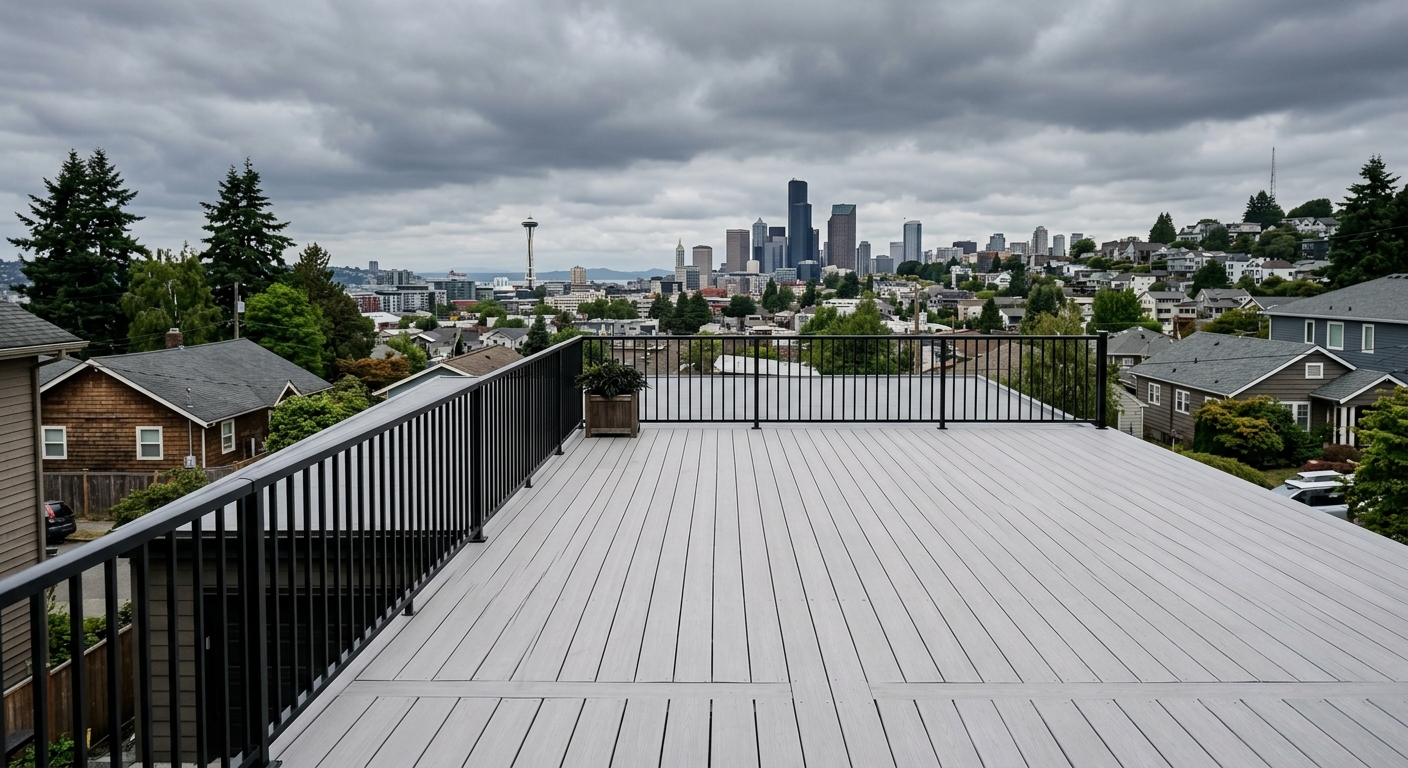
Zero Organic Content — Best for Shade
PVC (AZEK, TimberTech Pro) contains no wood fiber at all — the board is 100% extruded polymer. Mold and moss have nothing to feed on. This is why we specify PVC on fully shaded Mercer Island and North Bellevue lots where even the best composite develops surface algae. Higher upfront cost; lowest lifetime maintenance.
PVC (polyvinyl chloride) decking contains no wood fiber at all — it is 100% cellular PVC throughout. This gives it properties composite cannot match: true zero water absorption (0.1% vs. wood's 25%+ and composite's 1–3%). It is the correct material for high-moisture microclimates, rooftop applications, and buyers who want the best possible no-maintenance outcome.
AZEK (formerly TimberTech Pro)
- → True cellular PVC, 0.1% water absorption
- → Lifetime limited warranty (fade, stain, mold)
- → $50–$68/sqft installed
- → Widest color selection in PVC category
- → Best-in-class for rooftop and wet microclimate use
TimberTech Pro
- → Full cellular PVC with Alloy Armour Technology
- → 30-year fade and stain warranty
- → $52–$70/sqft installed
- → Slightly cooler surface temps vs dark composite
- → Compatible with TimberTech railing systems
When PVC Wins in the PNW
North Creek lots and wet microclimates
Areas near creeks, wetland buffers, or in canyon terrain receive dramatically less sunlight and more ambient moisture than standard suburban lots. PVC is the correct choice for these extreme-shade, high-moisture scenarios.
Rooftop and elevated balcony applications
Though membrane decking (Section 7) is required for waterproofing elevated balconies with living space below, PVC boards are frequently used as the walking surface over membrane systems for their dimensional stability and zero water retention.
Premium no-maintenance buyers
Buyers who have a firm 'never seal, never treat, never sand' requirement are best served by PVC. The lifetime warranty covers mold, fade, and stain — and the warranty claim rate on properly installed PVC is extremely low.
High-humidity microenvironments
Covered patios, areas under deck overhangs with limited airflow, and spaces adjacent to hot tubs all create elevated humidity zones. PVC's zero water absorption makes it indifferent to humidity levels that would accelerate composite degradation.
Price premium context: PVC runs $50–$75/sqft installed vs. $35–$65 for composite. On a 350 sq ft deck, that's a $5,250–$10,500 premium at the midpoint. For buyers choosing between composite and PVC, the question is whether the absolute zero-maintenance performance justifies that premium for your specific lot conditions and ownership timeline. For high-moisture lots and buyers planning to stay 15+ years, it typically does.
Membrane / Vinyl Decking
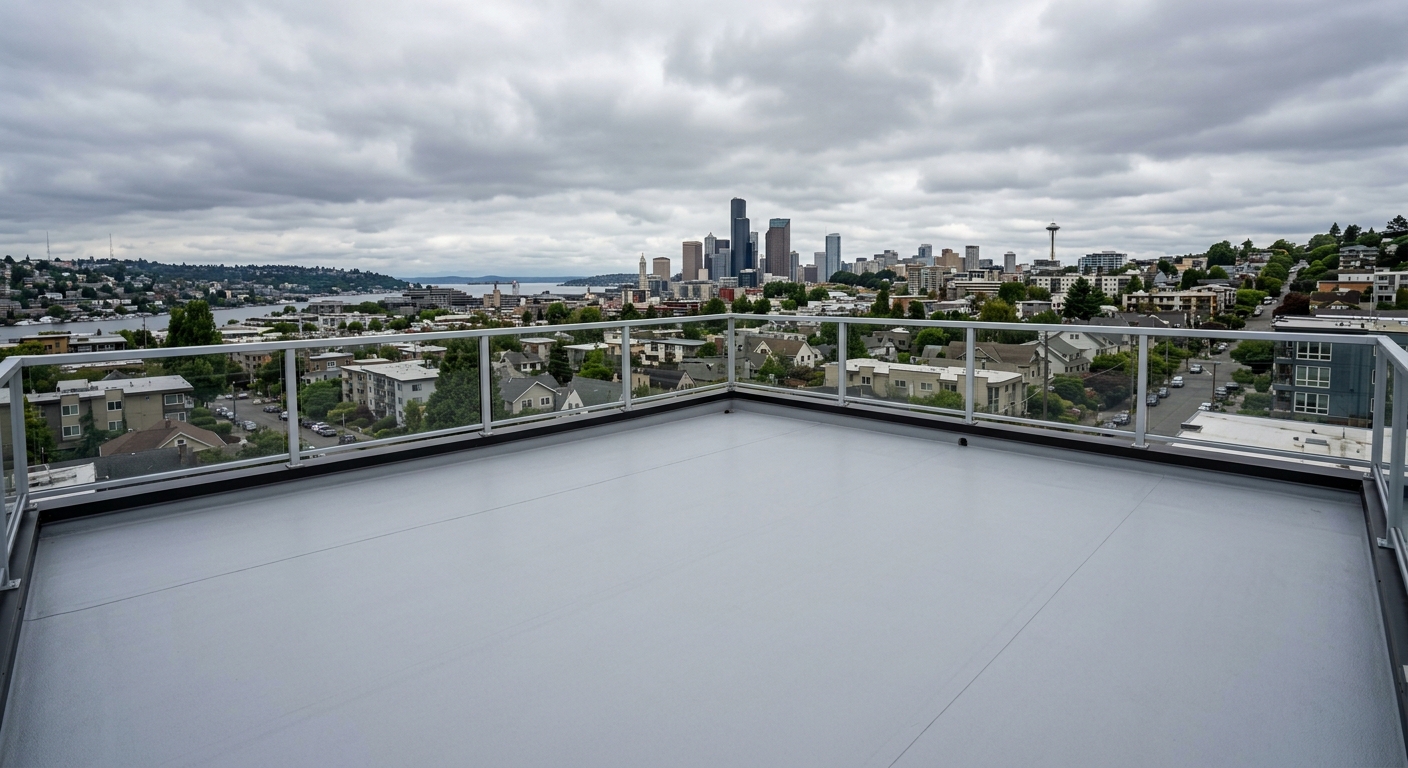
Waterproof Decking Over Living Space
Vinyl membrane (Duradek, Tufdek) is the right system when the deck is over a conditioned space — a garage, basement, or living room below. It creates a fully waterproof surface that protects the structure below. Not a decorative choice — a functional waterproofing solution. The cove base detail at the wall transition is the critical installation point.
Membrane decking is not a board product — it is a continuous vinyl sheet system heat-welded at seams to create a fully waterproof walking surface. It is the correct choice when the primary goal is waterproofing the space below the deck, not aesthetics. It is not a substitute for composite or PVC in standard ground-level deck applications.
When membrane is the correct spec:
- ✓ Rooftop decks where the space below is conditioned living area
- ✓ Elevated balconies over garages, living rooms, or basements
- ✓ Flat or low-slope applications (under 2% pitch) where board systems won't drain
- ✓ Covered patios where condensation protection is required below
- ✓ Commercial applications with specific waterproofing code requirements
Key facts:
Common misconception: Homeowners often ask for “membrane decking” because they want a low-maintenance surface. If you have a standard elevated or ground-level deck without waterproofing requirements, composite or PVC is almost certainly the better choice — better aesthetics, more color options, and simpler installation. Membrane is specified by its waterproofing function, not its surface properties. If you're unsure whether your application requires membrane, describe your project at your free estimate appointment and we'll give you a direct answer. See our membrane decking page for installation photos and Seattle waterproofing specs.
Full Material Comparison
| Material | Installed $/sqft | Lifespan | Maintenance | Mold Resistance | Best For | PNW Rating |
|---|---|---|---|---|---|---|
| Cedar | $18–$28 | 15–20 yrs | Seal every 2 yrs, annual inspection | Poor on shaded lots; good in full sun | Budget-first, sunny south-facing lots | ★★★★★ |
| Composite (mid) | $35–$45 | 25–30 yrs | Annual wash only | Good — capped surface resists mold | Most King County replacement projects | ★★★★★ |
| Composite (premium) | $48–$65 | 25–30+ yrs | Annual wash only | Excellent — 4-sided cap, best protection | Sammamish, Bellevue, HOA-required builds | ★★★★★ |
| PVC | $50–$75 | 30+ yrs | Annual wash, no sealing ever | Superior — no wood fiber, 0.1% absorption | Wet microclimates, rooftop, premium no-maintenance | ★★★★★ |
| Membrane | $15–$25 | 20–30 yrs | Annual cleaning, seam inspection | Excellent — fully waterproof system | Rooftop decks, elevated balconies with space below | ★★★★★ (specialized) |
Our Recommendation by Scenario
There is no single best material — only the best material for your specific lot, budget, and priorities. Here's how we actually advise clients after reviewing their sites:
Scenario
Budget build on sunny south-facing lot
Installed range
$18–$28/sqft
We recommend:
Cedar (Western Red Cedar)
South-facing exposure means UV kills mold before it establishes. Sealing schedule is manageable. Lowest installed cost makes sense for homeowners on tight budgets who plan to move within 10 years.
Scenario
Most Eastside replacement projects
Installed range
$35–$45/sqft
We recommend:
Mid composite — Trex Select or TimberTech Terrain
Best value balance in the PNW market. 25-year warranty at a lower price than premium lines. Handles shaded lots well. The default recommendation for standard suburban deck replacements in Renton, Kent, Federal Way, and Kirkland.
Scenario
HOA-required premium / Sammamish / Bellevue
Installed range
$48–$65/sqft
We recommend:
Premium composite — Trex Transcend or TimberTech Vintage
HOAs in Sammamish, Bellevue, and Issaquah typically require premium-line composite with enhanced grain texture and deeper color replication. The 4-sided cap on these products also provides the best mold protection on shaded Eastside lots with heavy tree canopy.
Scenario
North Creek / wet microclimate / no-maintenance premium buyer
Installed range
$50–$75/sqft
We recommend:
PVC — AZEK or TimberTech Pro
Lots near North Creek, wetland buffers, or canyon terrain receive so little UV and so much ambient moisture that even premium composite needs more attention than PVC. The lifetime warranty and 0.1% water absorption justify the price premium for buyers who will stay 15+ years.
Scenario
Rooftop deck or elevated balcony with living space below
Installed range
$15–$25/sqft (membrane) + overlay
We recommend:
Membrane system (walking surface: PVC boards)
Waterproofing the space below is non-negotiable on elevated structures. Membrane is specified for its waterproofing function. PVC board overlays are frequently installed on top for a better walking surface. This is a different install process requiring a certified membrane applicator.
Tropical Hardwood Alternatives: Ipe, Cumaru, Tigerwood
Bottom line up front: Tropical hardwoods are durable, beautiful, and extremely expensive. They are a niche choice in the Seattle market — less than 3% of our quotes. If you are considering them, read this section carefully before deciding.
Ipe
Brazil · 3,680 Janka
$60–$80/sqft installed
Lifespan: 40–75 yrs with maintenance
Densest common decking wood. Naturally resistant to insects, rot, and mold. Difficult to work with — specialized bits and pre-drilling required. Requires annual oiling or will silver-gray in 1–2 seasons.
Cumaru
South America · 3,540 Janka
$55–$72/sqft installed
Lifespan: 35–50 yrs
Similar density to Ipe at slightly lower cost. Less widely available in Seattle market. Same maintenance requirements as Ipe. Better tonal variation than Ipe in some boards.
Tigerwood
Africa / S. America · 2,160 Janka
$50–$65/sqft installed
Lifespan: 25–40 yrs
Distinctive striped grain pattern. Softer than Ipe/Cumaru — easier to work but less dent-resistant. Dramatic color fading in PNW rain without regular oiling. Niche aesthetic choice.
Important Caveats for Seattle Buyers
- !Sustainability: Ipe and Cumaru are harvested primarily in Brazil and face documented deforestation concerns. Specify FSC-certified material only — and understand that FSC certification for tropical hardwoods is difficult to verify through the supply chain. Many suppliers make unverifiable claims.
- !Contractor expertise: Ipe requires carbide-tipped blades, pre-drilling every fastener, and experience with the material's expansion behavior. Installers unfamiliar with it produce inferior results. We install tropical hardwoods rarely and only on projects where the homeowner has a specific, compelling reason.
- !PNW performance vs. alternatives: Tropical hardwoods outperform cedar in the PNW but offer no meaningful durability advantage over premium composite at 2–3× the maintenance requirement. The financial case for hardwood over composite is weak unless the natural appearance is a primary, non-negotiable priority.
Decking Material FAQs
Q:Is cedar or composite cheaper over 20 years in Seattle?
Composite is cheaper over 20 years when you account for maintenance. Cedar requires sealing every 2 years at $400–$600 per application — that's $4,000–$6,000 in maintenance costs over 20 years, not counting board replacements and periodic sanding. A mid-composite deck (Trex Select) installed at $35–$45/sqft carries a 25-year warranty with near-zero maintenance cost. Even at a higher installed price, composite total-cost-of-ownership is typically lower over a 20-year horizon — especially on shaded PNW lots where unsealed cedar deteriorates faster.
Q:What composite decking brand is best for Seattle?
Trex, TimberTech, and Fiberon all perform well in Seattle. For value, Trex Select and TimberTech Terrain offer 25-year warranties at mid-price points ($35–$45/sqft installed). For premium performance on shaded or high-moisture lots, Trex Transcend and TimberTech Vintage offer the best mold resistance and color stability with 4-sided cap technology. All three brands have capped composite lines that specifically address PNW conditions — the choice between them usually comes down to color selection and HOA-specific material requirements.
Q:Does composite decking get too hot in Seattle summers?
Standard composite can reach 125–145°F in direct summer sun — noticeably warmer than bare feet prefer. PNW decks spend most of the year in shade and rain, which mitigates this. If your deck faces south and gets full July/August sun, choose lighter-colored composite boards (lighter colors absorb less heat). Trex Transcend's Lineage collection includes a heat-mitigation cap layer. PVC runs slightly cooler than dark composite in direct sun. In our experience, heat is rarely the deciding factor for Seattle homeowners — mold resistance is a much more common concern.
Q:Can I install composite decking over an existing cedar frame?
Yes, if the existing cedar frame passes a structural inspection. Key factors we evaluate: joist spacing (composite requires 12-inch centers for perpendicular board runs, 16-inch for diagonal), beam load capacity, post foundation condition, and ledger attachment to the house. If the frame is sound and meets current code, composite boards can be installed over existing framing — saving $3,000–$8,000 in demo and disposal costs. Failed or soft joists must be sistered or replaced before composite installation. We assess existing frames at the free estimate appointment.
Q:How long does a composite deck installation take in Seattle?
Physical construction of a 300–400 sq ft composite deck takes 3–5 days once permits are in hand. The permit timeline is the variable: King County residential deck permits run 3–6 weeks for complete applications. Total project timeline from signed contract to finished deck is typically 6–10 weeks — 1–2 weeks for design and permit package preparation, 3–6 weeks for permit review, and 3–5 days for construction. Some cities in King County (Bellevue, Redmond) run faster at 2–4 weeks. We include permit management as part of our project scope.
Q:How do composite warranty terms compare across brands?
All three major brands (Trex, TimberTech, Fiberon) offer 25-year fade and stain warranties on their capped composite lines. TimberTech Legacy and Vintage extend to 30 years. Fiberon Promenade offers a lifetime warranty. Warranty terms cover: color fade beyond a defined threshold, surface staining that won't clean with standard methods, and structural defects. They do not cover: damage from improper installation, failure to use approved fasteners, or physical damage. PVC products (AZEK, TimberTech Pro) carry lifetime warranties. Warranty registration at install is required to activate coverage — we register every project we complete.