
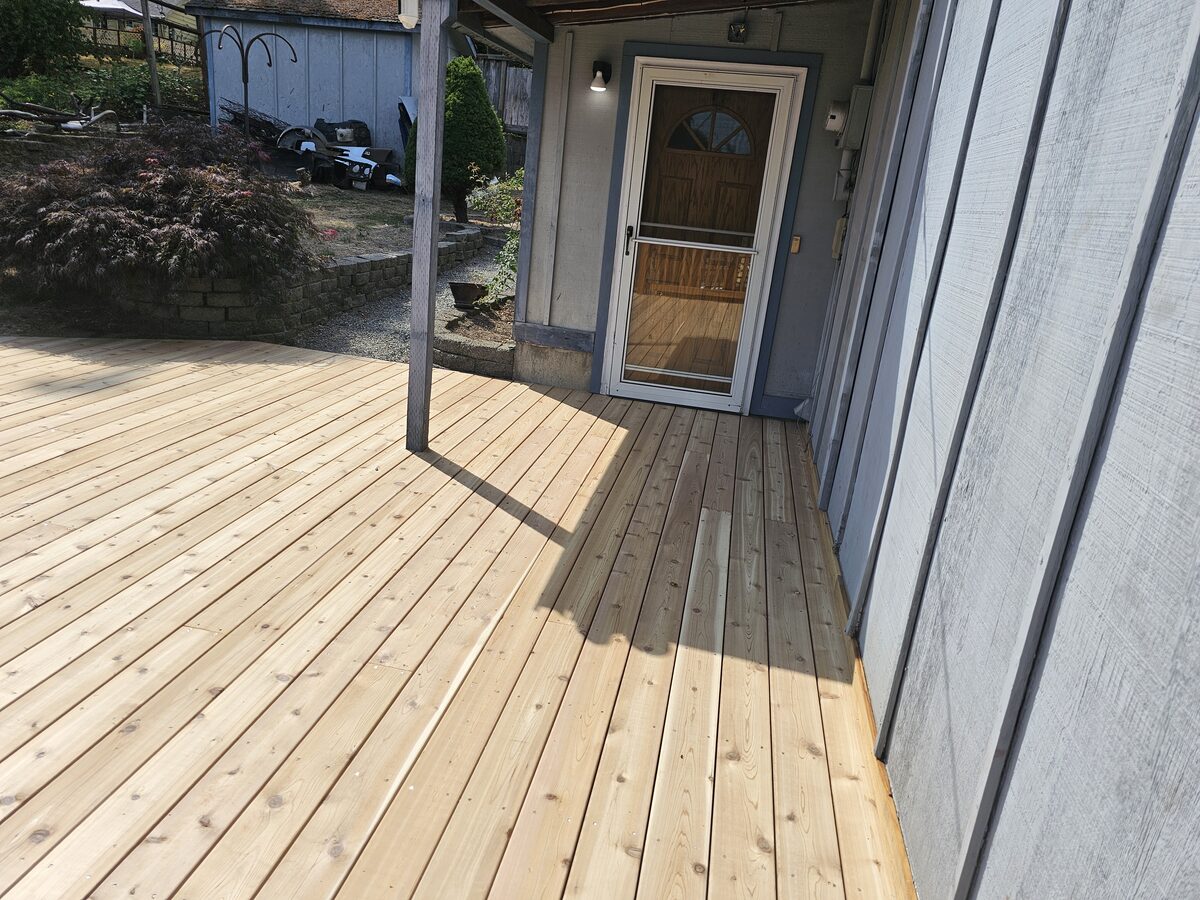
Deck Builder in North Seattle: What Ballard, Fremont, Queen Anne, and Magnolia Homeowners Need to Know
North Seattle is its own category of deck project. Not because the fundamental construction is different — joists, beams, posts, and decking boards work the same on every lot in King County — but because the specific conditions you encounter north of the Ship Canal require a contractor who has done this work in these neighborhoods, not just a contractor who builds decks somewhere in the greater Seattle area.
The housing stock is older. A bungalow in Ballard built in 1928 was not engineered to receive a deck ledger. The lots are steeper and more irregular, particularly in Queen Anne and Magnolia, where the bluff faces and ridge edges produce grade changes of 10–20 feet in a single backyard. The shade and moisture profile on north-facing slopes in Fremont creates conditions where cedar grays within a season and moss arrives before the warranty period on an inferior product runs out. And the jurisdictional environment — Seattle SDCI, with its specific ECA, SMA, and setback requirements — is distinct from the Eastside cities and requires a contractor who knows which lots trigger additional review before design begins.
We've been building in Ballard, Fremont, Queen Anne, Magnolia, and the communities just north of Seattle proper — Shoreline, Kenmore, Lake Forest Park, Mountlake Terrace, and Bothell — for over 15 years. What follows is what we know about building decks in these neighborhoods specifically: the structural challenges, the permit environment, the material choices that hold up on shaded PNW lots, and what projects in these neighborhoods actually cost in 2026.
North Seattle's Deck-Building Environment: What Makes It Different
The Age of the Housing Stock
Most homes in Ballard, Fremont, and parts of Queen Anne were built between 1910 and 1960 — the craftsman bungalows and foursquares that define the architectural character of these neighborhoods. These homes are genuinely beautiful. They are also not engineered to specifications that assumed a 400-square-foot composite deck would be attached to the rim joist.
The specific issue: ledger attachment on pre-1960 homes. The ledger is the board that connects the deck frame to the house structure. Modern code requires that this connection transmit load reliably and include proper flashing to prevent water infiltration. On a 1935 craftsman, the ledger attaches to a rim joist and house framing that wasn't designed for this purpose.
What this means in practice:
The exterior cladding — original lap siding, wood shingles, or stucco in some Fremont properties — must be removed at the ledger attachment zone to reach the framing behind it. You can't attach a ledger to siding. It attaches to the structural rim joist.
The rim joist condition must be assessed. On a home that's 60–90 years old and has never had a deck attached, the rim joist may be perfectly sound. More commonly, there's some moisture history — an old gutter failure, a flashing gap at a window — that has affected the framing at the attachment zone. A rim joist that probes soft cannot safely receive a ledger and needs sistering or replacement before any ledger connection is made.
Flashing at the ledger is the most commonly skipped step in residential deck construction, and on older homes in particular, it's the most consequential. Water that works behind the ledger through inadequate or absent flashing saturates the rim joist and wall framing, causes rot that progresses invisibly for years, and eventually produces a ledger connection that fails under load. Seattle's annual rainfall makes this not a theoretical concern.
When the rim joist assessment reveals that a sound ledger connection can't be made — or when the framing layout doesn't support proper attachment at the required height — a freestanding deck is the right design. A freestanding deck sits on its own post-and-footing system without attaching to the house at all. It's not a compromise; it's the structurally correct solution when the house doesn't support ledger attachment. We design freestanding decks regularly on Ballard and Fremont properties where the alternative would be a ledger attachment that isn't structurally defensible.
Steep and Irregular Lots
Queen Anne and Magnolia are defined by their topography. The south-facing slope of Queen Anne drops toward Mercer Street; the west face looks over Elliott Bay toward the Olympic Mountains; the east slope descends toward Lake Union. Magnolia's bluff faces Puget Sound and the ship canal. These properties have views that justify significant investment — and grade changes that require it.
On Queen Anne hillside lots, grade change from the back door to the lower yard frequently runs 10–18 feet. A single-level deck on these properties either requires posts reaching the same height as the grade change — which creates an elevated structure requiring engineering review and deep footings — or a multi-level design that steps down the slope.
The soils that underlie North Seattle's hillsides are primarily glacial till — compact, well-graded material with generally good bearing capacity. But the hillside zones in Queen Anne and Magnolia often include clay deposits in the lower slope areas and transition zones that move seasonally. We assess soil conditions at the footing locations before finalizing any footing design on hillside builds.
Note
Shade, Moisture, and the Material Selection Consequence
Fremont, Ballard, and the lower slopes of Queen Anne and Magnolia include some of the most heavily shaded residential lots in Seattle. Mature street trees, neighboring homes on narrow urban lots, and north-facing hillside orientation combine to create conditions where some decks see direct sun for only 2–3 hours per day, or less.
In these conditions, organic growth — moss, algae, and in severe cases mildew — colonizes outdoor surfaces faster than anywhere else in King County. The material consequence:
Cedar on a shaded North Seattle lot will begin showing green discoloration within one to two years without consistent maintenance. Without resealing every 12–18 months, cedar on a shaded Ballard lot develops embedded moss and begins surface decay within 3–5 years. The math of cedar maintenance in these conditions is unforgiving.
Uncapped composite on a shaded North Seattle lot absorbs moisture through the exposed wood fiber core at cut ends and fastener points, supports mold growth on the underside of boards, and begins losing structural integrity before its warranty period ends. We don't spec uncapped composite anywhere in King County, and especially not on shaded north-facing lots.
Fully capped composite — Trex Transcend, TimberTech Legacy, Fiberon Symmetry — is the correct specification for shaded North Seattle lots. The four-sided polymer shell prevents moisture absorption regardless of sun exposure. Annual rinsing removes biological growth without scrubbing. The material weathers consistently regardless of how much (or how little) direct sun it receives.
Cellular PVC (AZEK, Westlake Royal) takes the moisture resistance further — there is no wood fiber content at all, which eliminates the mold risk entirely. On deeply shaded lots in Fremont where the deck surface may stay wet for days at a time in the wet season, PVC is the best-performing material available.
Neighborhood-by-Neighborhood Guide
Ballard
Ballard is one of the highest-volume neighborhoods for deck replacement and new deck construction in North Seattle. The housing stock — primarily craftsman bungalows and turn-of-century homes — generates two types of projects: replacement of failing cedar decks that are 15–30 years old, and new deck additions on homes that originally had none.
The most common Ballard scenario: a homeowner has a cedar deck showing surface graying, some soft spots in a joist or two, and a ledger that "looks fine." Our assessment typically finds soft framing at the ledger, original galvanized hardware from the 1990s that has reached end of useful life, and a flashing situation that was never adequate. Surface wood replacement is rarely the right answer on these projects — the economics of repairing deteriorated structural members while replacing surface boards almost always favor full replacement.
For new deck additions on craftsman bungalows in Ballard, we typically position the deck off the kitchen or back living space, using fully capped composite matching the period-appropriate stain colors that work with the craftsman aesthetic. Trex Transcend in Havana Gold or Tiki Torch, and TimberTech Legacy in Weathered Teak, are commonly chosen in this neighborhood.
Lot configurations in Ballard tend to be rectangular with modest to moderate grade change — more manageable than Queen Anne or Magnolia hillside projects. The primary complications are ledger assessment on older homes and the shade/moisture considerations on lots with mature tree cover.
Typical Ballard project cost:
- Cedar replacement (re-deck over sound frame): $12,000–$20,000
- Full deck replacement with composite, ground-level: $22,000–$36,000
- New elevated composite build, 300 sqft: $30,000–$48,000
Fremont
Fremont's deck projects increasingly involve ADU and DADU development — homeowners on urban lots who are maximizing both the primary dwelling and an accessory unit are building outdoor living space that serves both. This creates specific design considerations: privacy between the main house and the ADU tenants, sightlines that work for both users, and structural designs that route the deck structure around the ADU footprint.
The topography within Fremont varies significantly. The hillside properties above the Burke-Gilman Trail and along the high-ground zone near N 39th Street require elevated deck engineering with deep footings and engineered post systems. Flatter lots near the Ship Canal are more straightforward builds. The tree canopy in Fremont is among the densest in North Seattle — mature Douglas firs and big-leaf maples that produce sustained shade and significant leaf fall that accelerates organic growth on deck surfaces.
For ADU-related deck projects in Fremont, membrane decking is sometimes the right solution when the deck sits over the ADU's roof or living space. See our membrane decking guide for a full explanation of when and why.
Typical Fremont project cost:
- Ground-level composite, 250–350 sqft: $20,000–$32,000
- Elevated deck over sloped terrain: $32,000–$55,000
- Deck-over-ADU rooftop (membrane system): $28,000–$50,000
Queen Anne
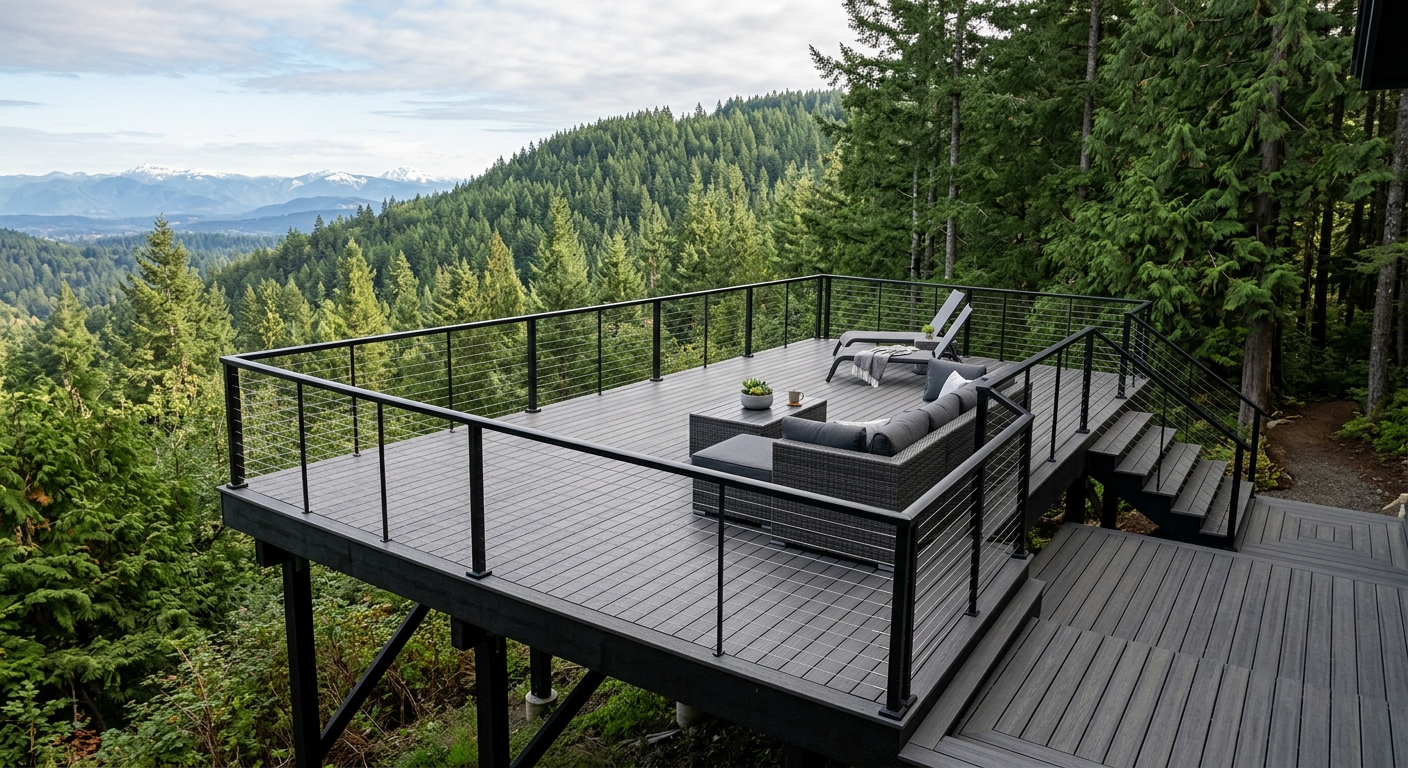
Queen Anne is the premium view deck neighborhood in North Seattle — possibly in all of Seattle. The south and west-facing slopes look over downtown, Elliott Bay, and the Olympic Mountains. The east slope faces the Lake Union basin and the Eastside skyline. On these properties, the railing selection is the defining design decision: it either preserves the view or destroys it.
We specify cable railing or frameless glass on all view-facing Queen Anne perimeters. The 42-inch code minimum height for decks over 30 inches above grade is non-negotiable — but how that 42 inches is filled determines whether the deck is an asset or an obstruction.
Queen Anne hillside lots commonly require:
- Engineered structural drawings (most elevated builds involve posts over 8 feet)
- Helical pier footings in the clay soils present in many mid-slope Queen Anne locations
- ECA documentation on steep-slope properties
- Freestanding deck design when the home's framing doesn't support ledger attachment
For geotechnical assessment on Queen Anne projects, we commission soils reports from licensed geotechnical engineers before finalizing footing design. The soils on the west face of Queen Anne vary significantly across short distances — making field assessment rather than general assumptions essential.
Typical Queen Anne project cost:
- Composite elevated deck, standard engineering: $38,000–$58,000
- View deck with cable railing, engineering required: $45,000–$72,000
- Multi-level hillside build with glass railing: $65,000–$110,000
Magnolia
Magnolia homeowners are building at the upper tier of the North Seattle value range. Home values on the bluff frequently exceed $1.5 million, and deck projects reflect that — large-footprint builds with premium materials, integrated pergolas, and outdoor kitchen rough-in are common.
The Magnolia Bluff face carries two specific considerations that don't apply in the same way to other North Seattle neighborhoods:
SMA (Shoreline Management Act) jurisdiction. Properties within 200 feet of Puget Sound or the Salmon Bay waterway — which covers significant portions of Magnolia's western and southern bluff — require SMA review in addition to standard SDCI permitting. SMA review adds a layer of assessment that can extend the permit timeline by 4–8 weeks on waterfront-adjacent properties. We identify whether a property falls under SMA jurisdiction at the initial site visit — before design work begins, not after.
Bluff-edge setbacks. Magnolia bluff properties have specific setback requirements that differ from standard Seattle code — the buildable area may be constrained by bluff edge condition even if the property line extends to the bluff face. We verify the buildable area before designing anything close to the edge.
Typical Magnolia project cost:
- Standard elevated composite: $40,000–$62,000
- Premium build with glass railing and pergola: $65,000–$110,000
- SMA-jurisdiction project (add for SMA review and documentation): $2,000–$4,500
| Category | Value |
|---|---|
| Ballard (composite replacement) | $30,000 |
| Fremont (elevated composite) | $42,000 |
| Queen Anne (view deck, cable rail) | $58,000 |
| Magnolia (premium, glass rail) | $82,000 |
| Shoreline (standard composite) | $34,000 |
| Kenmore (standard composite) | $32,000 |
| Bothell (standard elevated) | $42,000 |
North of Seattle: Shoreline, Kenmore, Lake Forest Park, Mountlake Terrace, and Bothell
The communities immediately north of Seattle city limits are a distinct sub-market from the urban North Seattle neighborhoods — different permit jurisdictions, different lot characteristics, and slightly different typical project profiles.
Shoreline
Shoreline sits directly north of Seattle's northern boundary (roughly N 145th Street) and is an incorporated city with its own permit office and building department. Shoreline residential lots tend to be larger than Seattle urban lots, with more varied topography — some areas are relatively flat, others have significant grade change toward Puget Sound or the ravine systems that cut through the city.
Permit jurisdiction: City of Shoreline Building Services. Processing runs 3–5 weeks for standard residential deck permits — faster than SDCI in most cases. Shoreline does not have SMA jurisdiction for most residential lots but does apply critical area protections to properties near steep slopes and wetlands.
Common project profile in Shoreline: Mid-size composite builds (300–500 sqft), frequent pergola additions, increasing outdoor kitchen integration on properties owned by homeowners who've been in the market long enough to have built equity. The lot sizes and setbacks in Shoreline typically give more room to work with than in dense Seattle neighborhoods.
Shoreline also includes some waterfront lots on the Puget Sound-adjacent bluff north of Richmond Beach. These properties have view considerations similar to Magnolia — cable or glass railing on the view perimeter is the consistent recommendation — and the bluff-edge setbacks require assessment before design begins.
Kenmore
Kenmore borders Lake Washington on the east and extends inland along the Sammamish River corridor. The lakefront properties in Kenmore have some of the most dramatic deck-building opportunities in the north suburban market — elevated views of Lake Washington, grade changes from home to waterline, and premium material specifications that match the property values.
Permit jurisdiction: City of Kenmore Development Services. Processing runs 3–5 weeks for standard permits. Kenmore applies shoreline management regulations to properties within 200 feet of Lake Washington and the Sammamish River — waterfront project timelines should account for SMA review.
Lake Forest Park is immediately adjacent to Kenmore and shares similar characteristics — lakefront lots with view decks being the premium project type, and inland lots with more modest builds. Lake Forest Park permits through its own building department with 3–5 week review timelines for standard projects.
Mountlake Terrace
Mountlake Terrace sits west of Interstate 5 between Shoreline and Lynnwood, with residential lots that are generally flatter than the hillside communities. Projects here tend to be standard suburban builds — composite decks, pergola additions, occasional elevated builds on lots with modest grade change.
Permit jurisdiction: City of Mountlake Terrace. Processing runs 3–4 weeks for residential deck permits — among the faster timelines in the North Seattle corridor. The straightforward permit process and manageable lot topography make Mountlake Terrace one of the more predictable markets for project scheduling.
Bothell
Bothell is where The Seattle Decking Company is headquartered — 22722 29th Drive SE — and where we build the highest volume of projects in the north suburban corridor. Bothell spans two counties (King and Snohomish) and several planning jurisdictions, which creates permit complexity that isn't immediately obvious.
Permit jurisdiction varies by location within Bothell:
- Incorporated Bothell: City of Bothell permit office (3–5 weeks processing)
- King County Bothell addresses: King County Development and Environmental Services (4–6 weeks)
- Snohomish County portions: Snohomish County Building and Fire Prevention (4–6 weeks)
The Bothell area includes a range of lot types — relatively flat lots in the Bothell-Kenmore corridor near the Sammamish River, hillside lots on the east side toward the Sammamish Plateau, and waterfront lots along the Sammamish River and Bear Creek corridor. We identify the correct permit jurisdiction — and assess the specific lot conditions — at the initial consultation.
Typical Bothell project cost:
- Ground-level composite, 300 sqft: $22,000–$35,000
- Elevated composite on hillside lot: $34,000–$58,000
- Premium build with pergola and outdoor kitchen rough-in: $50,000–$90,000
Seattle SDCI Permitting: What North Seattle Homeowners Need to Know
All deck projects within Seattle city limits — which covers Ballard, Fremont, Queen Anne, Magnolia, and all neighborhoods within the city boundary — permit through Seattle's Department of Construction and Inspections (SDCI).
Permit Thresholds
Subject-to-Field-Inspection (STFI) permits: Simple ground-level decks less than 18 inches above grade and less than 200 sqft can qualify for a STFI permit, which is issued same-day at a Seattle permit counter. Most residential decks with any elevation don't qualify.
Standard permit with plan review: Required for any deck with a walking surface more than 18 inches above grade, any deck attached to the structure, and any freestanding deck over 200 sqft. Plan review currently runs 4–8 weeks for complete submittals.
Complex permit: Projects with engineering drawings, ECA conditions, SMA overlap, or structural modifications to the existing house. Can run 8–14 weeks, sometimes longer for contested reviews or properties requiring geotechnical documentation.
Setback Requirements in Seattle
Seattle residential decks are subject to setback rules:
- Side yard setback: 5 feet minimum for structures over 18 inches above grade
- Front yard setback: 20 feet minimum
- Rear yard setback: 20 feet minimum in most residential zones
Irregular lot geometries in North Seattle — particularly in Fremont and Queen Anne where streets follow topography rather than a grid — can create non-standard setback situations. We verify setbacks using the city's GIS mapping tools before finalizing design, not during permit review.
ECA-Flagged Properties
Properties on slopes greater than 15%, within 50 feet of a steep slope crest, near landslide-prone zones, or within riparian buffers are designated ECAs by Seattle. ECA designation requires:
- Geotechnical report from a licensed engineer ($2,500–$6,000)
- ECA analysis included in the permit application
- Sometimes: neighbor notification or additional documentation
Queen Anne, Magnolia, and portions of Fremont and Ballard near ravines and bluffs commonly trigger ECA review. We identify ECA status at the initial site visit using the city's critical areas maps — before any design investment is made.
SMA-Affected Properties
Properties within 200 feet of designated shorelines — Lake Union (Fremont waterfront), Salmon Bay (Ballard), Puget Sound (Magnolia), and Lake Washington — are subject to Shoreline Management Act jurisdiction. SMA review runs parallel to building permit review but through a separate SDCI process. This extends effective permit timeline by 4–8 weeks depending on project complexity.
On waterfront-adjacent Magnolia properties, SMA review is standard, not exceptional. We identify SMA jurisdiction at the initial site visit. On Fremont properties near the Lake Union shoreline and Ballard properties near Salmon Bay, we check the SMA boundary maps at the consultation.
Tip
Material Recommendations for North Seattle's Shaded Lots
The material decision for a North Seattle deck comes down to shade exposure and moisture persistence — the two conditions that distinguish this market from the sunbelt guides that dominate national content.
| Material | North Seattle Performance | Annual Maintenance | Lifespan | Cost Range |
|---|---|---|---|---|
| Western Red Cedar | Grays in 1–2 years on shaded lots; moss risk high | Seal every 12–18 months | 15–20 years with care | $35–$55/sqft complete |
| Pressure-Treated | Warps and checks in PNW conditions; similar moss risk | Annual cleaning | 15–25 years | $22–$38/sqft complete |
| Uncapped Composite | Wood fiber absorbs moisture; mold on underside | Annual scrubbing | 10–15 years in PNW | $30–$50/sqft complete |
| Fully Capped Composite | Closed polymer shell resists moisture and mold | Annual rinse | 30+ years | $45–$70/sqft complete |
| Cellular PVC | Zero wood fiber; best on deepest shade sites | Rinse as needed | 30+ years | $55–$85/sqft complete |
For most North Seattle homeowners, fully capped composite is the right call. The cost premium over cedar is real — approximately $10–$15 per square foot more — but the maintenance savings on a shaded North Seattle lot are substantial. Cedar at $12–$18 per square foot in professional refinishing labor every 18 months adds up to more than the composite premium within the first decade.
On deeply shaded lots — Fremont properties where a mature tree canopy limits direct sun to 2–3 hours per day, or Ballard lots on the north side of taller neighboring structures — cellular PVC (AZEK) removes the moisture risk entirely. There is no wood fiber content to absorb moisture, and the material's performance in sustained damp conditions is superior to even the best capped composite.
We do not install uncapped composite products anywhere in King County. In Seattle's climate, uncapped products absorb moisture through cut ends and fastener holes, develop mold on the underside, and fail before their warranty periods end. This is not a theoretical concern — it's the common outcome we see when assessing installed uncapped composite decks across North Seattle neighborhoods.
Pergola Additions and Covered Deck Sections in North Seattle
North Seattle homeowners increasingly build covered sections over their decks — a pragmatic response to a climate that makes uncovered outdoor dining uncomfortable from October through April. A well-designed pergola on a Ballard or Magnolia deck extends the usable season by two to three months.
Cedar pergolas are the most common choice in North Seattle because they match the architectural character of the craftsman homes they're often attached to. Clear-grade cedar frames with galvanized hardware and stainless fasteners last 20–30 years in covered configurations where standing water exposure is limited. The aesthetic compatibility with Ballard and Fremont's housing stock makes cedar pergolas the default recommendation in these neighborhoods.
Aluminum pergola systems (Sunset, StruXure, and similar manufacturers) are the near-zero-maintenance alternative — powder-coated aluminum frames with adjustable louver systems that open for sun and close for rain. These systems run $15,000–$32,000 for a typical North Seattle installation and are increasingly popular as replacements for fixed pergolas on properties where maintenance schedule is a genuine constraint.
Polycarbonate panel roofing on a cedar or aluminum frame is the most weather-resistant covered option short of a solid roof — it admits filtered light while blocking rain, creating a space that functions in any Seattle weather. Less aesthetically refined than a louvered system but functional and durable. These installations typically run $8,000–$18,000 for a standard North Seattle pergola.
Permit requirements for pergolas in Seattle: A pergola attached to the deck (which is attached to the house) must be included in the original deck permit scope — adding it later requires a separate permit. Include the pergola in the original permit if you're building both simultaneously. Permit fees are usually modest; the processing timeline is the cost.
Project Process: What to Expect Working With Us
Here's the typical sequence for a North Seattle deck project:
Initial consultation (free, no obligation): We walk the property, assess the ledger attachment situation on older homes, identify ECA and SMA flags, note lot grade and soil conditions, and discuss material preferences and budget range. This visit typically takes 45–90 minutes. We book North Seattle consultations within 5–7 business days.
Concept design and estimate: Within 1–2 weeks of the consultation, we produce a concept drawing to scale with material specifications, railing options, and a line-item estimate. You know what you're buying before you commit to anything.
Permit application: We prepare and submit the complete permit package — site plan, structural drawings (for elevated builds), geotechnical documentation if required, and any ECA or SMA application materials. We track the application and respond to plan reviewer comments without burdening the homeowner with the process.
Construction: Once permits are issued, we schedule the crew within our current build queue. Standard North Seattle builds run 1–3 weeks for construction. Complex hillside builds with engineering may run 3–5 weeks. We keep homeowners updated at each milestone.
Inspections: We schedule all required inspections and are present for them. Footing, framing, and final inspections are all coordinated by our project manager.
Warranty documentation: Closed permit documentation, material warranty registration, and care instructions are provided at project completion. Our 3-year labor warranty begins at final inspection sign-off.
2026 Cost Summary for North Seattle Deck Projects
| Project Type | Size | Estimated Range |
|---|---|---|
| Ground-level composite, flat lot | 300 sqft | $22,000–$34,000 |
| Elevated deck (6–10 ft posts) | 300 sqft | $32,000–$52,000 |
| Queen Anne/Magnolia view deck, cable railing | 350 sqft | $45,000–$75,000 |
| Hillside deck with helical piers + engineering | 350 sqft | $40,000–$68,000 |
| Cedar re-deck over sound existing frame | 300 sqft | $12,000–$20,000 |
| Multi-level hillside composite | 500 sqft | $55,000–$100,000 |
| Premium build with pergola | 400 sqft | $55,000–$90,000 |
These ranges include materials, labor, permit fees, and demo/haul-away of any existing deck. Pergola additions, outdoor kitchen rough-in, and custom stair systems add $4,000–$25,000 depending on scope.
Key insight
FAQ
Frequently Asked Questions
What neighborhoods does The Seattle Decking Company serve in North Seattle?
Why do older homes in Ballard and Fremont sometimes need freestanding decks?
How long does a deck permit take in Seattle (SDCI)?
What's the best decking material for a shaded North Seattle lot?
Do I need a permit for a deck in Shoreline, Kenmore, or Bothell?
What is the Shoreline Management Act and does it affect my North Seattle deck?
How much does a deck cost in Ballard or Fremont?
What does ECA mean for my deck project?
Can I add a pergola to my existing deck in North Seattle?
Does The Seattle Decking Company install cedar decks in North Seattle?
How far out is your schedule in North Seattle?
Deck Replacement vs. Repair in North Seattle: Making the Right Call
North Seattle's older housing stock means we encounter more deck repair and replacement assessments here than anywhere else in King County. The question homeowners ask most often: "Can this deck be saved, or does it need to come out?"
The answer depends on what's failing and where.
Structural vs. Surface Deterioration
Surface deterioration — graying, surface cracking, checking, and delaminating boards — looks severe but often involves only the decking surface. If the frame beneath is sound, a re-decking project replaces only the boards and achieves an essentially new deck appearance for significantly less than a full replacement.
Structural deterioration — soft joists, rotted ledger, corroded hardware, failing post connections — affects the frame itself. A re-decking project on a structurally compromised frame is counterproductive: you've installed new boards on a structure that's going to fail regardless.
The field test we use: an awl or screwdriver probed firmly into joists, rim joists, ledger, and post bases. Sound wood resists penetration. Deteriorated wood — even when dry and stable in appearance — penetrates easily. A joist that probes 1/4 inch deep with moderate pressure is structurally compromised. We don't install new decking on compromised framing.
Common North Seattle Deck Failure Patterns
Ballard craftsman pattern: Cedar deck installed in the 1990s or early 2000s. Original boards showing surface rot and checking. Ledger was never properly flashed — the rim joist behind it has been absorbing water for 20+ years. Surface boards need replacement; rim joist and ledger need full replacement; joists are often borderline. Full replacement is typically the right call when rim joist condition is confirmed.
Fremont/Wallingford pattern: Deck built by a previous owner, possibly without a permit. Unknown framing lumber species and grade. Hardware is original galvanized that has consumed its service life in Seattle's climate. Connection hardware failure — not visible surface deterioration — is the primary structural concern. Assessment reveals failing post base connections and potentially undersized beam spans for current code. This type requires full replacement and permit for the new build.
Queen Anne elevated pattern: Original elevated deck on a view property, often with a cable railing that was installed before cable railing was widely understood. Cable tension inadequate, posts show base corrosion, post-to-beam connections are loose. The frame may be repairable if joists are sound; the railing needs full replacement regardless. Assessment determines whether the frame can be re-used with railing replacement, or whether the structural condition warrants a complete teardown.
The Economics of Repair vs. Replacement
Re-decking over a sound frame costs $12,000–$20,000 for a standard North Seattle deck. Full replacement — teardown, disposal, new frame and decking — costs $28,000–$55,000 for an equivalent project.
The decision math: if structural repair of the existing frame adds $8,000–$15,000 to a re-decking scope, you're now at $20,000–$35,000 for a repaired deck that still has a 20-year-old frame. Full replacement at $30,000–$45,000 gives you a new frame with 30+ years of service life. In most cases beyond basic joist sistering, full replacement is the economically rational choice.
We provide written assessment reports for deck repair evaluations — documenting what we found, what we recommend, and why. These reports are useful for homeowners comparing multiple contractor opinions on the same deck.
North Seattle Deck Design Trends: What Homeowners Are Building in 2026
The deck market in North Seattle has shifted meaningfully over the past five years. Here's what we're building most frequently in these neighborhoods in 2026:
Composite + Cable Railing on View Properties
On Queen Anne, Magnolia, and upper Fremont properties with any view component — downtown sightlines, water glimpses, or cityscape — the combination of dark-tone capped composite (Trex Transcend in Gravel Path, Havana Gold, or Rope Swing) with black powder-coat cable railing is the most frequently specified design. The dark composite color provides a contemporary aesthetic that contrasts with the natural vegetation, and cable railing's transparency preserves the view while meeting the 42-inch height requirement.
Craftsman-Compatible Composite Colors on Ballard Bungalows
On Ballard's craftsman housing stock, homeowners are choosing composite colors in the warm cedar and teak spectrum — TimberTech Legacy in Weathered Teak, Trex Transcend in Tiki Torch — that read as natural wood from across the yard but eliminate the maintenance burden of actual cedar. Pair with aluminum railing in a natural or bronze finish and the aesthetic is architecturally appropriate for the neighborhood's character.
ADU Integration Decks in Fremont and Wallingford
As ADU construction accelerates across North Seattle's urban neighborhoods, deck projects are increasingly designed to serve multiple users. These builds have to manage privacy (screening between primary dwelling and ADU occupants), circulation (separate stair access for primary and ADU), and structural considerations (when the deck sits above the ADU's living space, membrane decking is required rather than conventional composite).
Covered Upper Levels
Seattle's homeowners in every North Seattle neighborhood are increasingly specifying covered sections over their primary outdoor dining area — whether cedar pergola with polycarbonate panels, aluminum louvered systems, or simple post-and-beam overhead structure with lattice. The investment extends usability through March and October, the shoulder months that represent the gap between Seattle's actual climate and the homeowner's outdoor living goals.
Ready to Start Your North Seattle Deck Project?
The Seattle Decking Company is based in Bothell and builds throughout the North Seattle corridor and surrounding communities — Ballard, Fremont, Queen Anne, Magnolia, Shoreline, Kenmore, Lake Forest Park, Mountlake Terrace, and all points between.
We've been doing this in these specific neighborhoods long enough to know which Ballard blocks have rim joist problems, which Queen Anne parcels trigger ECA review, which Magnolia properties fall under SMA jurisdiction, and what materials actually hold up on the shaded north-facing lots in Fremont. That neighborhood-specific knowledge is what you're getting when you hire us — not just deck-building expertise, but expertise in building decks here.
Request a free estimate online or call us at (425) 675-6259. We'll schedule a site visit, assess the conditions on your specific property, and give you a written line-item proposal before you commit to anything. Our address: 22722 29th Drive SE, Bothell, WA 98021.
Planning a deck in the Seattle area?
Get an onsite design review and a clear, itemized quote from a licensed local builder.
Request a Free Quote