
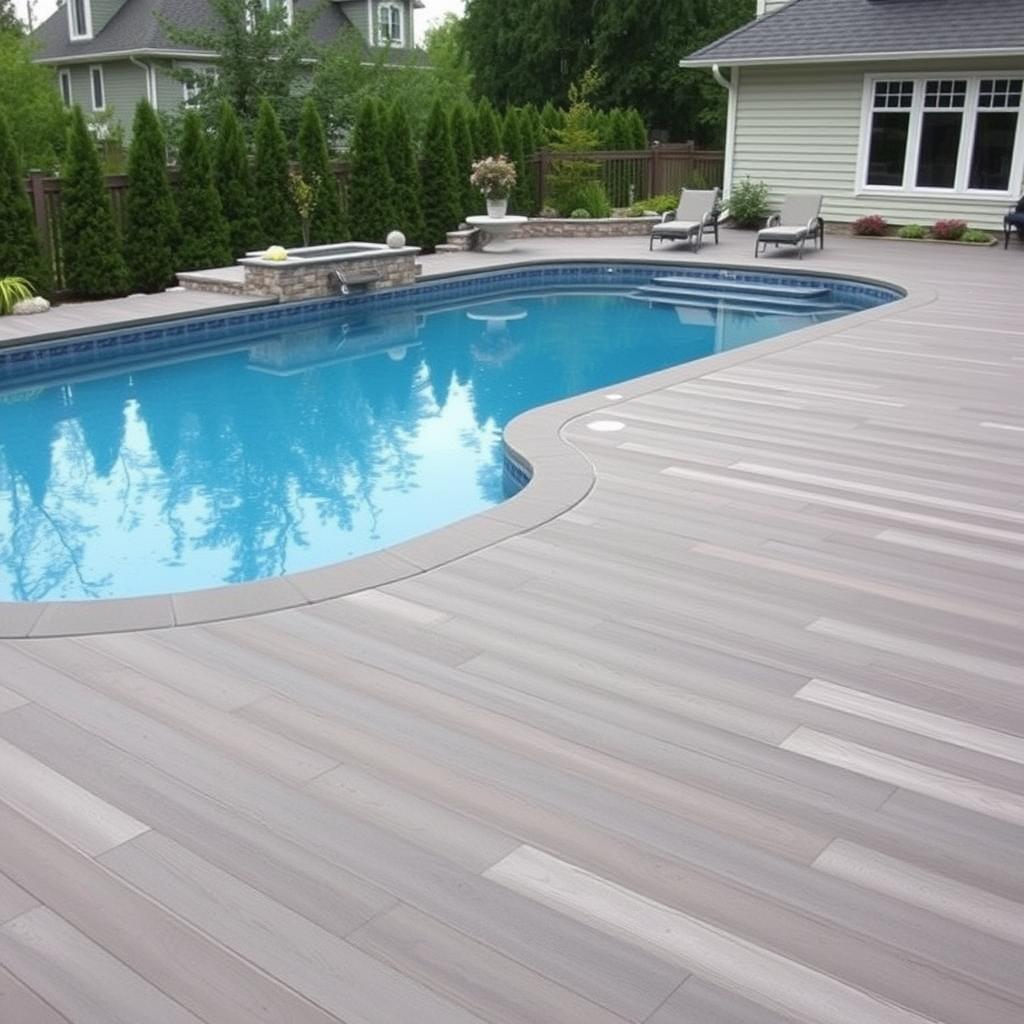
Most pool deck guides assume you're building in Florida or Arizona — hot summers, low annual rainfall, and a climate where the deck dries in 20 minutes after a splash. In Seattle, those assumptions fail. King County gets 38 inches of rain per year, averages 150+ days with measurable precipitation, and sits at a latitude where algae and biofilm colonize wet surfaces year-round, not just in summer. The pool deck that works in Phoenix is not the pool deck for a Bellevue backyard.
What makes Seattle pool deck construction genuinely distinct: chemical resistance (chlorine and salt water degrading some materials faster than others), sustained moisture exposure from rain rather than just pool splash, temperature swings that prevent smooth-finish surfaces from drying quickly enough to be safe, and shade from mature tree canopy that keeps deck surfaces damp long after the rain stops. The national guides miss most of this. The result is homeowners who spec beautiful natural wood decking around their King County pool and spend the next decade fighting rot, staining, and algae slipping hazards.
We've built pool deck surrounds throughout King County — Bellevue waterfront lots, Sammamish hillside properties with new builds, Woodinville estates with full outdoor room integration, and in-city Seattle lots with small fiberglass pool setups. The right material and drainage design for a Seattle pool deck isn't the same as what works in sunnier climates, and the construction decisions you make at the start determine whether the deck performs for 30 years or begins failing at year 8. This guide covers what those decisions are and why they matter.
Why Pool Decks Are Different in Seattle
A pool deck faces a specific set of stresses that ordinary decks don't: constant wet-dry cycling from pool splash and weather, chemical exposure from chlorinated or saltwater pool systems, barefoot traffic requiring non-slip surface even when wet, and in Seattle's case, persistent shade and rainfall that prevent surfaces from drying the way they would in drier climates.
The combination matters. Chlorinated water splash that lingers on a wood surface in Seattle's cool, damp environment doesn't evaporate in 20 minutes the way it would in Phoenix — it soaks in over 2–4 hours, every day the pool is used, all summer. Over a season, that accumulated exposure degrades wood-fiber products faster than any manufacturer's lab test accounts for, because the tests are run in controlled environments, not under Bellevue's overcast skies.
The material selection consequence is significant: products that are "pool-safe" in national specification guides may not be appropriate for Seattle's climate without qualification. Natural wood is essentially disqualified. Some composite products with higher wood-fiber content are marginal. PVC cellular products with no wood fiber are the most appropriate specification for Seattle pool environments.
The non-slip requirement compounds the challenge. Seattle pools, unlike pools in dry climates, often sit under partial shade from mature Pacific Northwest trees. Shade in a wet climate means the deck surface retains moisture longer between pool sessions and between rain events. A surface that meets non-slip standards in full sun may be hazardous when partially shaded and not given time to dry. The solution is to specify products with inherent non-slip surface texture (grooved board profiles), not products that rely on drying to achieve safe friction coefficients.
Material Comparison for Seattle Pool Decks
PVC Cellular Decking: Best Overall for Seattle Pools
PVC cellular decking — AZEK, TimberTech Pro, and similar fully cellular products — is the strongest specification for pool surrounds in King County. The reason is fundamental: there is no wood fiber in the product. The deck surface is entirely polymer, which means chlorine, saltwater, and pool chemical runoff have nothing organic to degrade. No wood fiber to saturate, no polymer shell to chip away at the core, no joints at fastener holes where chemical exposure concentrates.
In Seattle's specific climate, PVC cellular products also resist the algae and biofilm growth that plagues wood products in low-light, high-moisture conditions. Biofilm — the slippery green-gray biological film that grows on surfaces that don't fully dry between wet events — colonizes wood-fiber deck products faster than PVC in Seattle's shaded pool environments. PVC's non-porous surface gives biofilm significantly less purchase.
The grooved surface profile on PVC boards provides non-slip traction in wet conditions — the grooves channel water laterally away from the walking surface, maintaining the coefficient of friction that pool deck safety requires. Smooth-face PVC boards are not appropriate for pool deck applications — the smooth surface is slippery when wet.
Color selection for Seattle pool decks: Dark-colored PVC boards in direct summer sun can reach surface temperatures of 130–160°F during Seattle's July heat events. For south- or west-facing pool decks with afternoon sun exposure, specify lighter colors (driftwood tones, light gray, sand) that stay 25–40°F cooler underfoot than dark charcoal or espresso options. In Seattle's typically overcast pool season, surface heat is less often a concern than in dry climates — but the occasional August heat wave is when dark decking becomes genuinely uncomfortable for barefoot pool users.
Leading PVC products for Seattle pool decks:
- AZEK Harvest Collection: Excellent chemical resistance, wide color range, grooved and smooth profiles (specify grooved for pool zones)
- TimberTech Pro Reserve: Strong chemical-resistance rating, wide board options, concealed fastener system
- TimberTech Pro Legacy: Mid-price PVC option with solid pool-zone performance
Cost range for PVC cellular pool decking: $45–$65 per square foot installed for a complete pool surround in King County.
Fully Capped Composite: Good With Important Caveats
Fully capped composite decking — Trex Transcend, TimberTech Vintage, Fiberon Paramount — performs acceptably in Seattle pool environments when properly specified and installed. The polymer shell on all four board sides provides a barrier against moisture and chemical penetration into the wood-fiber core. The key distinction from PVC: there is still a wood-fiber core, and prolonged chlorine exposure at cut board ends and seams can eventually breach the polymer shell and affect the core over a 15–25 year timeframe.
For most King County homeowners, fully capped composite around a residential pool is a viable choice that performs well for its expected service life. The specification details that matter:
Board orientation: Position boards so cut ends face away from the pool coping rather than toward the pool. The cut end is the most vulnerable point — the polymer shell terminates at the cut, exposing wood fiber directly. A board running parallel to the pool edge puts one cut end at the pool-adjacent side of the deck; a board running perpendicular puts the cut ends at the far perimeter rather than at the pool coping.
Specify 4-sided capped products only: Uncapped composite — where only the face and sides carry a polymer shell, with the back face of the board exposed wood fiber — is not appropriate for pool deck applications. Water, pool chemicals, and algae penetrate uncapped board backs aggressively in pool splash zones.
Grooved board profiles: Same as with PVC, specify grooved composite profiles (not smooth face) for all surfaces within 6 feet of the pool coping.
Leading fully capped composite products appropriate for Seattle pool decks:
- Trex Transcend — industry standard, excellent moisture resistance, 25-year warranty
- TimberTech Vintage — premium aesthetics, strong polymer shell, chemical resistance documentation available
- Fiberon Paramount — competitive warranty, solid PNW dealer support
Cost range for fully capped composite pool decking: $35–$55 per square foot installed in King County.
Natural Wood: Not Recommended for Seattle Pool Decks
Cedar, redwood, ipe, and pressure-treated lumber are not appropriate primary materials for pool deck splash zones in Seattle's climate. Here's why each fails:
Cedar: Chlorinated pool water splash accelerates cedar surface degradation. The combination of chemical exposure and Seattle's sustained moisture environment means cedar requires sealing annually (rather than every 12–18 months for a standard deck) to maintain surface integrity in a pool splash zone. Without annual sealing, cedar grays, checks at the surface, and develops embedded algae within 2–3 seasons around a pool. The sealing schedule is aggressive and the failure mode — slippery algae-covered cedar around a pool — is a safety issue.
Pressure-treated lumber: ACQ treatment (the copper-based preservative used in modern pressure-treated wood) reacts chemically with chlorinated pool water. Extended exposure degrades the preservative and creates surface discoloration. More importantly, treated lumber develops surface checking and algae growth rapidly in pool splash zones.
Ipe and exotic hardwoods: Ipe is a beautiful, dense hardwood that performs well in dry climates. In Seattle's sustained moisture environment around a pool, ipe requires sealing every 6–12 months to prevent checking and surface fiber raising. It's also expensive ($55–$80 per square foot installed), heavy, and requires specialty fasteners. The maintenance requirement around a pool — where chemical exposure adds to the maintenance burden — makes ipe a high-maintenance choice for most King County pool decks.
Important
Concrete and Pavers: The Traditional Alternative
For homeowners who prefer traditional pool deck aesthetics, brushed concrete or non-slip pavers are proven options. These materials have a different character than composite or PVC — they feel different underfoot, they age differently, and their maintenance profile is distinct.
Brushed concrete: The traditional pool deck surface. Extremely durable, fully non-slip when the surface is properly finished (exposed aggregate or broom-finish textures, not smooth trowel finish). Resistant to pool chemicals. The Seattle-specific challenges: cold on bare feet during Seattle's cool spring and fall shoulder seasons, prone to moss growth in shaded areas that don't fully dry between rains, and the concrete surface retains a slippery algae film in shaded zones that requires pressure washing 2–3 times per year to manage safely.
Non-slip pavers: Natural stone pavers (cleft slate, bluestone) and concrete pavers with textured surface provide non-slip traction that holds up better than smooth concrete in wet conditions. Paver joints in a pool environment require polymeric joint sand and regular maintenance to prevent joint washout from pool splash and rain. On shaded King County pool lots, paver joint moss is a persistent maintenance issue.
Stamped concrete: A popular aesthetic option that can look like tile, stone, or brick. The concern for Seattle pools: stamped concrete patterns have recessed grout lines that collect standing water, algae, and debris. In a pool splash environment with Seattle's sustained moisture, stamped concrete requires more frequent cleaning than brushed concrete. Specify a penetrating sealer applied annually.
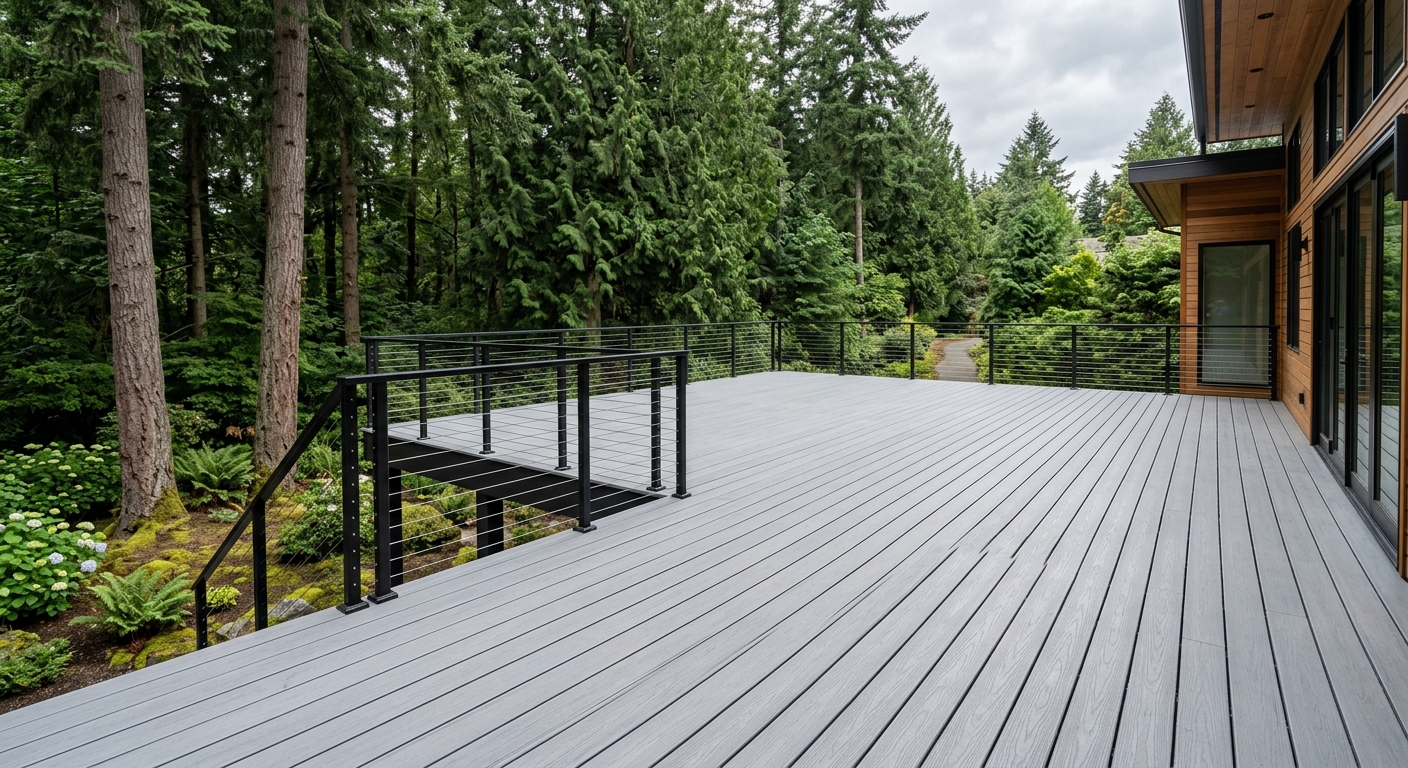
Non-Slip Requirements: Washington State and King County Standards
All pool deck surfaces in Washington State must meet non-slip standards under the International Residential Code (IRC), which Washington has adopted with state amendments. For residential pool decks, the key specification:
Wet coefficient of friction (DCOF): The dynamic coefficient of friction for pool deck surfaces must be 0.42 or higher when measured wet. This is the threshold at which barefoot traffic on a wet surface is considered safe per testing standards. Grooved composite and PVC boards from major manufacturers (Trex, TimberTech, AZEK) are rated at 0.50–0.65 DCOF when wet — comfortably above the minimum.
Smooth-face boards: Smooth composite and PVC profiles frequently fall below the 0.42 DCOF threshold when wet, particularly in pool splash zones. Anti-slip tape or grit sealers can bring them into compliance, but require ongoing maintenance. Specify grooved profiles instead — they meet the standard without modification.
Seattle's shade complication: Even boards that meet the wet DCOF standard in full sun can fall below safe friction levels when algae or biofilm establishes on the surface. In areas receiving fewer than 4 hours of direct sunlight per day — common on many Seattle residential lots with mature tree canopy — algae establishes on deck surfaces within a single pool season without active cleaning. PVC resists biofilm establishment significantly better than wood-fiber composite in these conditions.
Permit inspection: Seattle SDCI and King County suburban cities include pool safety in permit inspections. The structural inspection at completion includes verification of the pool barrier fence and gate, and some jurisdictions check surface COF compliance through contractor documentation. Provide manufacturer COF test data for your specified product at permit application time.
Note
Drainage Design: The Most Important Structural Decision for Seattle Pool Decks
Drainage is where pool deck design gets specific and where Seattle's conditions make it more demanding than national guides suggest.
The Basic Rule: Slope Away from the Pool
Pool deck surfaces must slope away from the pool coping at minimum 1% grade (1/8 inch per foot). The direction matters: water must run away from the pool edge, not toward it. Water that slopes toward the pool carries deck debris, biofilm, chemical runoff, and organic material from Seattle's tree canopy into the pool water. This contaminates the pool, increases chemical demand, and is a code violation in most jurisdictions.
We set this slope in the deck framing before any decking surface is installed. It cannot be corrected after the fact — the slope is built into the joist layout and cannot be shimmed or adjusted after decking is fastened down.
Grading the slope: A 1% grade means 1 inch of drop per 8 feet of horizontal distance. On a 10-foot deck surround around the pool perimeter, the outer edge of the deck sits 1.25 inches lower than the pool coping elevation. This is subtle but must be consistent around the entire pool perimeter.
Managing Runoff at the Deck Perimeter
Water that drains off the outer edge of the pool deck needs somewhere to go. In King County's annual 38 inches of rain, a pool deck surround generates significant runoff during rain events — not just pool splash, but rain falling on the deck surface and running to the perimeter.
Options for managing perimeter runoff:
French drain at deck perimeter: A gravel-filled trench with perforated drain pipe below the outer edge of the deck captures runoff and routes it to a stormwater outlet or infiltration area. This is the most reliable drainage solution for Seattle pool decks and is appropriate for both raised-frame and grade-level installations.
Catch basin and pipe: A small catch basin at the low point of the pool deck connects via 4-inch pipe to a stormwater outlet. Appropriate for smaller deck footprints where a full perimeter french drain isn't necessary.
Grade slope to yard: On lots with adequate grade away from the pool, the deck perimeter runoff can be directed to a sloped lawn or landscape area. Requires that the receiving area not be adjacent to the house foundation or other structures where drainage concentration would cause issues.
Deck drainage channels: For enclosed pool areas or decks where the perimeter is bounded by fence, raised walls, or adjacent structures, integral drain channels within the deck framing route water to collection points. This is common on pool surrounds integrated into larger outdoor room designs.
Drainage for Covered Pool Decks
Some King County pool decks are partially covered — a pergola or covered structure over the outdoor kitchen or entertaining zone adjacent to the pool. Covered areas concentrate rainfall into drip lines at the cover perimeter rather than allowing rain to distribute across the deck surface. These drip lines must be accounted for in drainage design: they deliver significantly more water to a concentrated zone than standard deck rainfall calculates.
For covered sections of pool decks, we install linear drain channels parallel to the drip line to capture the concentrated runoff and route it away from the pool and from the deck's perimeter foundation zones.
Code Requirements for Pool Decks in King County
Pool deck construction in King County involves two overlapping code frameworks: the structural deck code (International Residential Code, Washington State amendments) and the pool safety code (which includes barrier, gate, and alarm requirements). Both are inspected as part of the pool deck permit.
Structural Permit Requirements
A building permit is required for any pool deck construction in all King County cities. The structural review covers:
- Footing size and depth (minimum 18 inches below frost line in King County)
- Post and beam sizing for the deck's span and load
- Joist spacing and span
- Ledger connection (if deck is attached to house)
- Railing specification (42 inches minimum height for elevated decks)
- Non-slip surface documentation
Permit fees: $600–$1,600 for a standard pool deck in King County cities. Permit processing: 4–8 weeks depending on jurisdiction.
For detailed guidance on the King County permit process, see our deck permit guide. The Seattle SDCI permitting page at seattle.gov/sdci covers the process for City of Seattle properties.
Pool Barrier Requirements
All residential pools in Washington State require a compliant pool barrier — a fence or equivalent barrier that prevents unsupervised access to the pool by children under age 6. The barrier requirements:
- Minimum height: 60 inches (5 feet) for barrier fencing
- Maximum opening size: 4-inch horizontal spacing (prevents crawling through)
- Self-latching gate with latch on pool-side (out of reach for small children)
- Gate must be self-closing and latch in both directions
- No direct access from the house to the pool area without passing through a gate (in some jurisdictions)
Pool deck construction typically triggers both the deck structural permit and the pool barrier review — inspectors check both at the same final inspection. Arriving at the inspection with a non-compliant barrier is one of the most common delays in pool deck project completion in King County.
Key insight
Cost Breakdown: Seattle Pool Deck Projects in 2026
Pool deck cost in King County depends primarily on the scope of the surround — how much of the pool perimeter is decked, whether the deck is at grade or elevated, what material is specified, and whether any covered structure or outdoor kitchen is integrated.
Pool Surround Cost Ranges (Installed, King County 2026)
| Configuration | Size | PVC Cellular | Fully Capped Composite | Concrete |
|---|---|---|---|---|
| Full pool surround (40x20 pool) | 400–500 sqft | $22,000–$35,000 | $16,000–$27,000 | $8,000–$15,000 |
| Extended entertainment surround | 600–800 sqft | $32,000–$50,000 | $24,000–$42,000 | $12,000–$22,000 |
| Pool surround + elevated deck | 400 sqft surround + 300 sqft deck | $55,000–$80,000 | $42,000–$65,000 | N/A for deck portion |
| Pool surround + pergola | 400 sqft surround + 16x20 cover | $52,000–$75,000 | $38,000–$60,000 | $28,000–$48,000 |
These ranges include: pool surround framing, decking material, non-slip surface specification, drainage design (french drain or catch basin), pool barrier fence (standard aluminum picket or comparable), and permit.
They do not include: the pool itself, coping material, gas or electrical work for pool equipment, outdoor kitchen, or premium railing systems.
| Category | Value |
|---|---|
| Concrete (brushed) | $11,000 |
| Concrete pavers | $16,000 |
| Composite (fully capped) | $22,000 |
| PVC cellular | $28,000 |
What Drives Pool Deck Cost Higher in King County
Clay soil conditions: Much of King County's residential land — Bellevue hillsides, Sammamish Plateau, Kenmore and Bothell lots — has clay-heavy soil that requires deeper footings or helical piers rather than standard tube-form concrete footings. Each footing upgrade adds $300–$600 in cost, and pool deck surrounds typically require 8–16 footing locations.
Elevated surround on sloped lots: Pool decks on King County's hillside lots often require elevated framing on one or more sides where the yard slopes away from the pool. The elevated framing adds structural cost: taller posts, engineered beam sizing, and more labor-intensive access for framing work beneath the deck.
Chemical-resistant fasteners: Pool decks require hot-dipped galvanized or stainless steel fasteners throughout — standard zinc-plated fasteners corrode rapidly in pool chemical environments. The fastener upgrade adds $400–$800 to material cost on a full pool surround.
Non-standard pool shapes: Kidney, L-shaped, and freeform pool designs require custom-cut decking around the pool coping — more labor and more material waste than a simple rectangular surround. Budget 10–20% more for decking labor on non-rectangular pool designs.
Drainage complexity: Pool lots with limited perimeter drainage options — bounded by fence, house foundation, or elevated landscape — require more engineered drainage solutions. Linear drain channels, dry wells, or stormwater tie-ins add $1,500–$4,500 to project cost.
Heating Considerations for Year-Round Seattle Pool Use
Seattle pools are, at their default, seasonal. The average water temperature in Lake Washington runs about 65°F in summer — comfortable for a swim on a warm day, cold for extended enjoyment in the shoulder seasons. Residential pool water in unheated King County pools follows a similar seasonal curve.
For homeowners who want year-round pool use, heating is the enabling technology. The pool deck's design interacts with the heating decision in two ways:
Gas heater or heat pump mechanical placement: Pool heating equipment (gas heater or heat pump) requires clearances from deck framing, adequate ventilation, and a maintenance access path. We design pool decks to leave the required mechanical clearances and an access gate to the equipment area in the structural plan, not as an afterthought.
Deck warmth: Composite and PVC decking warms more quickly than concrete and retains warmth better in King County's 50–60°F shoulder-season temperatures. For homeowners extending pool use into May and October, the warmer surface temperature of composite or PVC underfoot makes the pool area more comfortable even on days when the air temperature is borderline.
Covered deck structure adjacent to pool: A covered outdoor room adjacent to the pool area creates a protected zone that's comfortable even on cool Seattle days when the pool itself is accessible for warmer-weather dips. A louvered aluminum pergola over the pool deck entertaining area extends comfortable outdoor time around the pool from 4 months to 7–8 months in King County's climate.
Designing the Pool Deck as Part of a Full Outdoor Room
The most successful King County pool deck projects we've built treat the pool as one element in a full outdoor room design, rather than as a standalone structure. The outdoor room around a Seattle pool typically includes:
Pool surround zone: The non-slip, chemical-resistant deck surface directly adjacent to the pool coping. This is the wet zone — material selection here is most critical, and it's where PVC or fully capped composite is non-negotiable.
Lounging and seating zone: A broader deck area beyond the splash zone where furniture sits. This zone can use a wider range of materials, has more flexibility in board profile (grooved still preferred, but smooth face is less hazardous here), and is where design aesthetics take precedence over chemical resistance.
Outdoor kitchen or bar zone: An increasingly common addition on Eastside pool properties. The outdoor kitchen adjacent to a pool needs to be positioned outside the pool barrier fence or integrated into the barrier design — the gate placement and barrier continuity must be maintained.
Covered structure zone: A pergola or covered outdoor room adjacent to the pool area. The cover doesn't need to be over the pool water (which would create debris issues) — it's over the entertaining, dining, and lounging area at pool deck level.
Transition zones and stairs: The path from the pool surround to the lounging zone, from the deck to the yard, and from the deck to the house are all design elements that need to be planned in the structural layout. Stair placement, landing sizes, and ramp grades (for accessibility) all need to be in the deck plan, not added at the end.
Tip
Project Examples: Seattle Pool Deck Builds
Sammamish Hillside Pool (New Construction)
Client built a new fiberglass pool on a hillside Sammamish lot with significant grade change from pool level to main house level. Pool deck scope: 460-square-foot PVC cellular surround (AZEK Harvest in Weathered Teak), elevated on one side to maintain level surface across grade change, with french drain at outer perimeter, catch basin at low corner. Pool barrier: aluminum picket fence at 60 inches, self-latching gate. Integrated stairs to 280-square-foot upper deck with composite (Trex Transcend) connecting to main house level. Permit: Sammamish building permit plus pool safety review. Total project: $78,000 (pool deck, surround, barrier, upper deck, stairs).
Bellevue Waterfront Pool Surround (Renovation)
Client replaced failing 15-year-old pressure-treated pool deck with new fully capped composite surround. Material: TimberTech Vintage in Antique Leather. 380-square-foot surround, grooved boards oriented perpendicular to pool coping (cut ends away from splash zone). New stainless steel fasteners throughout. Drainage: existing french drain confirmed adequate, new catch basin added at low corner. Barrier fence: replacement of original fence with new aluminum picket system at code-compliant height with new self-latching gate. Permit: Bellevue pool deck renovation permit. Total project: $38,500.
Woodinville Estate Pool Outdoor Room
Client wanted a full outdoor room surrounding their existing concrete pool. Scope: 600-square-foot composite deck surround (Trex Transcend, Spiced Rum), Struxure motorized louvered pergola over the 20x20 entertaining zone adjacent to the pool, outdoor kitchen with Napoleon built-in grill, refrigerator, and bar sink under the pergola. Pool barrier integrated into fence design around the full outdoor room perimeter. Gas line extended for grill and overhead heaters. Electrical: 3 circuits for kitchen appliances + pergola integrated lighting and heat. Permits: Woodinville building permit, gas permit, electrical permit. Total project: $142,000.
Maintenance: What Seattle Pool Decks Actually Need
The maintenance comparison between pool deck materials in Seattle's specific climate is worth summarizing directly:
PVC Cellular Pool Deck Maintenance
- Annual: Rinse with garden hose or low-pressure wash. Remove debris from board grooves.
- As needed: Clean biofilm or algae growth (rare) with deck cleaner — sodium percarbonate or oxalic acid-based cleaners safe for PVC. Wipe away any pool chemical spills promptly.
- Never: Power wash with strip setting. Use bleach products directly on PVC. Allow pool chemical concentrate spills to sit.
Fully Capped Composite Pool Deck Maintenance
- Annual: Pressure wash with low-pressure setting. Clear debris from board grooves with brush.
- Periodic: Apply a composite deck cleaner (non-bleach, manufacturer-approved) to any stained areas from pool chemical splash.
- As needed: Check cut board ends for any signs of moisture infiltration — cap any exposed end grain with end-cap molding or manufacturer-approved end trim.
Concrete Pool Deck Maintenance
- Annual: Pressure wash surface and clear any paver joints. Apply penetrating concrete sealer every 2–3 years.
- Spring: Treat moss growth in shaded areas with sodium percarbonate before pressure washing.
- Periodic: Inspect and reapply polymeric joint sand (for pavers) every 5–8 years. Re-seal concrete sealer when water no longer beads on surface.
Frequently Asked Questions: Pool Decks in Seattle
Frequently Asked Questions
What is the best decking material for a Seattle pool deck?
Can I use cedar decking around my Seattle pool?
Do I need a permit for a pool deck in King County?
What pool barrier requirements apply in Seattle and King County?
How should a Seattle pool deck be sloped for drainage?
How much does a pool deck cost in Seattle?
Is grooved or smooth composite better for a pool deck?
Will algae be a problem on my Seattle pool deck?
Can I build a covered structure over my Seattle pool deck?
How long does a composite pool deck last in Seattle?
Do you build pool decks in Seattle and on the Eastside?
Ready to Build Your Seattle Pool Deck?
A pool deck in Seattle is not a straightforward project — it involves material selection for chemical resistance, non-slip surface specifications, drainage engineering for 38 inches of annual rainfall, and pool barrier compliance that gets inspected at the same time as the deck structure. Getting those decisions right at the start determines whether your pool deck performs safely for 25+ years or starts showing problems at year 8.
We've built pool deck surrounds throughout King County. We know which materials hold up in Seattle's specific combination of pool chemical exposure and sustained rainfall, how to design drainage that works for 38 inches of annual rain, and how to navigate pool barrier compliance with each city's permit office.
Call (425) 675-6259 or request a free estimate online. We schedule consultations within 5–7 business days throughout King County.
Comparing Pool Deck Materials: A Full Side-by-Side
For homeowners comparing options at the same time, here's a comprehensive material comparison organized by the factors that matter most in Seattle's pool environment:
| Factor | PVC Cellular | Capped Composite | Cedar/Wood | Concrete |
|---|---|---|---|---|
| Chlorine resistance | Excellent | Good | Poor | Excellent |
| Saltwater resistance | Excellent | Good | Poor | Good |
| Non-slip (grooved, wet) | Excellent | Good | Variable | Good (brushed) |
| Biofilm resistance (shaded) | Excellent | Moderate | Poor | Moderate |
| Warmth underfoot (55°F day) | Good | Good | Good | Poor |
| Summer heat (90°F day) | Moderate (lighter colors) | Moderate | Good | Good |
| Annual maintenance | Minimal | Low | High | Moderate |
| Installed cost/sqft (King County) | $45–$65 | $35–$55 | $20–$35 | $15–$25 |
| Expected service life (pool) | 30–40 yrs | 20–30 yrs | 10–20 yrs | 30–50 yrs |
| Permit required | Yes (structure) | Yes (structure) | Yes (structure) | Yes (>200 sqft) |
The pattern across this comparison is consistent: PVC leads on performance in Seattle's pool environment at the highest installed cost; concrete leads on longevity at the lowest installed cost but underperforms on warmth and requires moss management in shaded areas; composite sits in the middle on both performance and cost; and natural wood is the lowest-cost option with the highest maintenance burden and shortest service life in pool applications.
Contractor Selection for Seattle Pool Deck Projects
Selecting the right contractor for a pool deck project is more consequential than for a standard deck because pool deck construction involves non-slip specification, drainage engineering, chemical-resistant material selection, and pool barrier compliance — all of which require specific knowledge of King County's regulatory environment.
What to look for when evaluating Seattle pool deck contractors:
Washington State registration: All contractors performing structural work in Washington must be registered with the Department of Labor and Industries. Verify contractor registration at lni.wa.gov before signing any contract. An unregistered contractor cannot pull permits in King County — which means the work would be unpermitted and your pool barrier would fail final inspection.
Permit experience: Ask specifically whether the contractor has experience with pool deck permits in your jurisdiction. King County's pool barrier requirements, non-slip surface documentation, and drainage review are distinct from standard deck permitting. A contractor who has not done this before will learn on your project.
Written scope: Request a written, line-item proposal before signing anything. Pool deck projects with drainage work, barrier fencing, and multiple trades (decking, electrical, gas) generate significant scope ambiguity when contractors work from verbal estimates. A written scope specifying material (including product name and grade), drainage approach, barrier fence specification, and included permits protects you from scope creep and contractor substitutions.
References: Pool deck projects should have specific references — homeowners with pool deck installations you can look at and ask about performance in Seattle's climate over time. A general deck contractor reference list doesn't tell you whether their pool deck work holds up around chlorine exposure and biofilm in King County conditions.
We provide written, line-item proposals for every pool deck project. We pull permits in all King County cities. We're registered with the Washington State Department of Labor and Industries. Our work is fully bonded. And we'll give you references from pool deck clients you can contact directly.
Call (425) 675-6259 or contact us online to schedule a site visit. We cover all of King County and provide estimates within 5–7 days of the consultation.
Planning a deck in the Seattle area?
Get an onsite design review and a clear, itemized quote from a licensed local builder.
Request a Free Quote