
A pergola quote in Seattle can come back anywhere from $6,000 to $55,000+ for what looks like the same structure on paper. A 16x20 pergola is a 16x20 pergola — until you specify whether it's open cedar slats or motorized aluminum louvers, attached to the house or freestanding, with basic footings or helical piers in clay soil, with or without electrical, with or without heaters. Each of those choices doubles or triples the price of the one before it. The contractor who quotes you $7,000 for a pergola and the contractor who quotes you $32,000 are often not quoting the same product.
This guide breaks down exactly what drives pergola cost in King County in 2026, with specific dollar ranges for each variable. We're builders, not marketers — so we'll tell you what each option actually costs, which ones genuinely solve Seattle's rain problem, and which ones look good in a showroom and leave you standing under a dripping open-slat roof in October.
The short version: if you want a covered outdoor space that's usable in Seattle's climate for more than four months a year, you need rain protection. Open cedar slats don't provide it. Polycarbonate panels do. Motorized aluminum louvers do better. A solid covered structure does best. Everything else is a beautiful outdoor decoration that won't get used from October through April.
How to Think About Pergola Cost: Roof Type First, Size Second
The typical homeowner approaches pergola cost thinking about size first. That's the wrong variable to optimize first. For a Seattle pergola, the most consequential specification isn't the footprint — it's what's on top.
Here's why: a 16x20 open cedar pergola (the most common "entry-level" pergola sold in the Pacific Northwest) costs $14,000–$22,000 installed. A 16x20 motorized aluminum louvered pergola costs $22,000–$42,000 installed. The cost difference is $8,000–$20,000. But the functional difference is enormous: the cedar structure is unusable when it rains. The aluminum louvered system closes to waterproof when rain starts and opens fully on sunny days. In Seattle's climate — where measurable precipitation falls on 150+ days per year — the structure you can use in the rain is worth a multiple of the structure you can't.
This is the first question to ask yourself before getting a single quote: do you want a pergola that extends your outdoor season, or a pergola that adds visual interest to your space in summer? Both are legitimate uses. But they lead to completely different products, and confusing them is how people end up with $14,000 cedar pergolas that they use for four months a year.
Roof Type Options for Seattle Pergolas
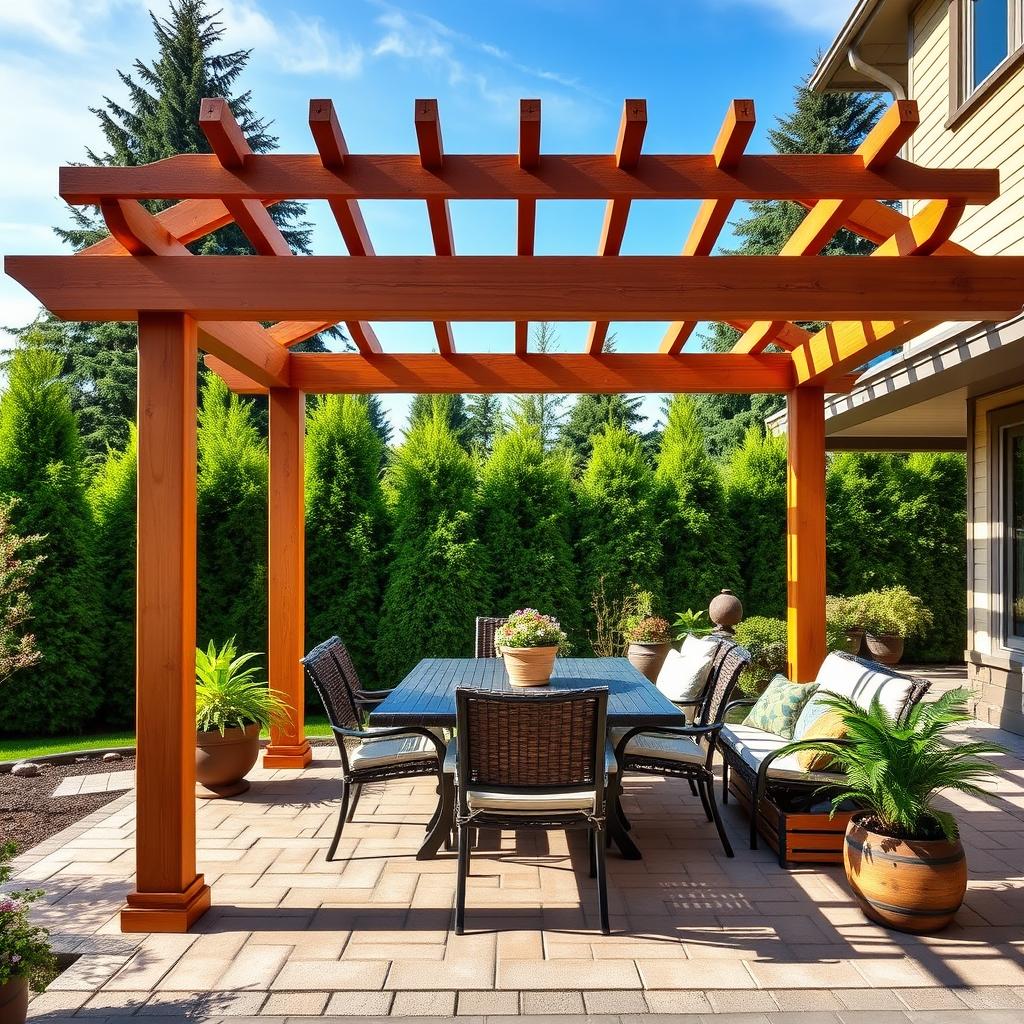
Open cedar slats (traditional): Provides filtered shade and a classic PNW aesthetic. Allows rain through. Best for homeowners who use the space primarily in summer and value the aesthetic over weather protection. Requires staining every 3–5 years to maintain condition.
Polycarbonate panel roof: Twin-wall or triple-wall polycarbonate panels installed over a pergola frame provide genuine rain protection at moderate cost. The panels transmit 80–90% of visible light while fully shedding rain. The result: a covered, bright outdoor space that works in Seattle's drizzle. Polycarbonate is a mid-tier solution — functional and affordable, but the aesthetic is more utilitarian than cedar or aluminum, and the panels yellow slightly over 15–20 years.
Motorized louvered aluminum system: The premium category. Louvers open fully for sun and air; close to waterproof when rain arrives. Operated by remote or app, with optional rain sensors for automatic closure. This is the only pergola option that genuinely extends Seattle's outdoor living season to 10–11 months. The premium cost is real — but so is the extended use.
Fixed louvered aluminum (non-motorized): A lower-cost version of the motorized system that provides shade but doesn't close to waterproof. Less expensive than motorized by $4,000–$8,000, but leaves you with a fixed angle that may not work for your sun exposure and doesn't provide rain protection.
Solid roof pergola or covered patio structure: Not technically a pergola — a solid roof attached to the house is a covered patio structure, which triggers different structural requirements and permits. Full rain protection, maximum enclosure. Requires the most engineering of any covered structure option.
Cost Ranges by Structure Type: Seattle Installed Prices (2026)
All ranges below are installed costs including permit where required, concrete footings (or helical piers where soil conditions require), all labor, and standard electrical rough-in. They do not include associated deck work.
Cedar Pergola Costs (Installed, King County 2026)
| Size | Open Slat (No Cover) | With Polycarbonate Panels | With Electrical |
|---|---|---|---|
| 12x12 (144 sqft) | $6,000–$10,000 | $9,000–$14,000 | Add $2,000–$3,500 |
| 14x16 (224 sqft) | $10,000–$16,000 | $13,000–$20,000 | Add $2,500–$4,000 |
| 16x20 (320 sqft) | $14,000–$22,000 | $18,000–$28,000 | Add $3,000–$4,500 |
| 20x24 (480 sqft) | $20,000–$32,000 | $25,000–$38,000 | Add $3,500–$6,000 |
Cedar pergola pricing assumes clear western red cedar framing (4x4 or 6x6 posts, 2x6 or 2x8 rafters), standard concrete tube-form footings, and standard architectural connections. Custom timber framing, heavy timber post-and-beam, or rough-sawn cedar adds $3,000–$8,000 to the base range.
Aluminum Pergola Costs (Installed, King County 2026)
| System Type | 12x12 | 16x20 | 20x24 |
|---|---|---|---|
| Fixed louvered (non-motorized) | $10,000–$18,000 | $18,000–$28,000 | $24,000–$38,000 |
| Motorized louvered (basic) | $16,000–$24,000 | $22,000–$34,000 | $30,000–$44,000 |
| Motorized louvered (premium brands) | $20,000–$32,000 | $28,000–$42,000 | $38,000–$55,000 |
| Motorized louvered with heaters + lights | $24,000–$38,000 | $32,000–$50,000 | $44,000–$65,000 |
Premium brands (Struxure, Renson, Louvretec) carry longer warranties (10–15 years on components), more refined aesthetics, and more sophisticated motor/sensor systems. Mid-tier motorized systems from domestic brands cost $4,000–$10,000 less but have less robust warranty coverage.
| Category | Value |
|---|---|
| Cedar open slat | $18,000 |
| Cedar + polycarbonate panels | $23,000 |
| Cedar + electrical | $20,000 |
| Aluminum fixed louver | $23,000 |
| Aluminum motorized (mid) | $28,000 |
| Aluminum motorized (premium) | $35,000 |
| Motorized + heaters + lights | $41,000 |
What Drives Cost Beyond the Roof Type
Size: The Most Controllable Variable
Pergola cost scales with square footage because every additional square foot means more posts, more beams, more rafters, more material, and more labor. The relationship is roughly linear: a 20x24 pergola (480 sqft) costs roughly 50–60% more than a 16x20 (320 sqft) for the same specifications.
If budget is a constraint, downsizing the footprint is the most effective cost lever while keeping the roof type specification that serves Seattle's climate. A 12x16 motorized aluminum pergola provides genuine year-round rain protection at $16,000–$24,000. A 20x24 open cedar pergola at $20,000–$32,000 is a larger structure that you can't use for half the year.
For most Seattle outdoor kitchen and entertaining setups, a 14x16 to 16x20 footprint covers the primary seating and cooking zone effectively. Larger footprints are appropriate for homeowners who entertain large groups regularly or who want to cover a substantial portion of a large deck.
Attached vs. Freestanding
Attached pergolas connect to the house structure at one or two sides. The house provides the support for that face, which reduces the number of posts and footings required. Attached pergolas are structurally simpler in this sense — but they always require permits (regardless of size) because they alter the building's structure. They also require proper ledger-to-house connection with adequate flashing, waterproofing at the attachment point, and verification that the house framing can accept the lateral load from the pergola.
Freestanding pergolas stand on their own four (or more) posts without connecting to the house. They require more posts and footings — which adds to cost — but don't create a ledger-to-house connection issue and, for smaller sizes (under 200 sqft), may not require a building permit in some King County jurisdictions. Freestanding pergolas also offer placement flexibility: they can be positioned anywhere in the yard rather than adjacent to the house.
Cost difference: for a 16x20 pergola, freestanding adds approximately $1,500–$3,500 in footing and post costs versus attached, because the fourth side requires two additional posts and two additional footings. On clay-heavy soils where helical piers are specified rather than standard tube-form footings, this differential increases.
Note
Electrical: Light, Fan, and Outlet Circuits
Adding electrical to a pergola is one of the highest-value per-dollar upgrades available — outdoor lighting under a pergola transforms evening entertaining, and a ceiling fan makes King County's hot summer days significantly more comfortable. The critical point: electrical should be added at the time of original construction, not retrofitted later.
Here's why: wiring for a pergola is routed inside the posts and beams — concealed within the structural members — during assembly. Once the structure is complete, the members are enclosed and there's no access path for wiring without destructive disassembly. Retrofit wiring requires surface-mounted conduit (ugly) or partial disassembly (expensive). We've quoted retrofit electrical on cedar pergolas that would have cost $1,800–$2,500 at original build time — the retrofit quotes came back at $4,500–$7,000 with conduit, or $7,000–$12,000 with disassembly required.
If there's any possibility you'll want lighting, a fan, or outlets in your pergola — and there almost always is — rough in the electrical conduit during construction regardless of whether you want to install fixtures immediately. The conduit cost at build time is $400–$800. Pulling wiring through later is a $50 cost. Versus $4,500–$12,000 to route after the fact.
Typical electrical add-ons and cost (at time of original construction):
| Electrical Feature | Cost (At Construction) |
|---|---|
| Conduit rough-in (future electrical) | $400–$800 |
| Basic LED lighting (string or recessed) | $1,200–$2,500 |
| Ceiling fan with light kit | $800–$1,500 per fan |
| GFCI outlet circuit | $600–$1,200 |
| Low-voltage transformer + pathway lighting | $500–$1,200 |
| Full electrical package (2 circuits, 2 fans, outlets) | $3,500–$5,500 |
Heaters: Infrared vs. Natural Gas
Outdoor heaters extend the Seattle pergola season by 4–6 weeks in spring and fall. The two options for pergola integration:
Infrared electric heaters: Surface-mounted to the pergola rafters, these provide focused radiant heat directly below the heater. Operating on a standard 240V circuit, infrared heaters warm occupants without heating the air — effective at countering Seattle's 45–55°F evenings in spring and fall. Cost: $800–$1,500 per heater installed (including electrical circuit), and 2–4 heaters typically cover a 16x20 pergola adequately. Most effective for stationary seating arrangements.
Natural gas overhead heaters: More powerful than infrared electric and provide warmth across a larger zone. Require gas line extension to the pergola zone. Gas heaters installed in covered spaces require adequate ventilation — the pergola must have open sides or venting to safely disperse combustion byproducts. Cost: $1,500–$2,500 per heater installed plus gas line extension ($600–$1,500).
For motorized aluminum pergola systems, some brands (Struxure, Renson) offer integrated infrared heater options that mount within the pergola frame — a cleaner aesthetic than surface-mounted heaters on cedar structures.
Cedar vs. Aluminum: The Seattle Pergola Decision
This comparison comes down to what you value and how you intend to use the space.
Cedar Pergola: The Case For
Aesthetic appeal. A clear cedar pergola with well-executed joinery is beautiful in a way that aluminum systems struggle to match. The grain, warmth, and organic quality of cedar fits the Pacific Northwest aesthetic — it complements landscape plantings, cedar or composite decking, and PNW architectural styles in a way that aluminum structures don't always.
Lower upfront cost. A 16x20 cedar pergola at $14,000–$22,000 open-slat costs $8,000–$20,000 less than a comparable motorized aluminum system. For homeowners with budget constraints, cedar makes a covered outdoor structure possible at a price point the motorized systems don't reach.
Customization flexibility. Cedar can be cut, joined, and detailed to match any architectural vision — heavy timber, traditional Japanese-influenced, craftsman-style, contemporary minimalist. Aluminum systems come in a more limited range of profiles and configurations.
Works well with polycarbonate. If your goal is rain protection at a moderate cost, a cedar frame with polycarbonate panel infill delivers it at $18,000–$28,000 for a 16x20 — significantly less than a motorized aluminum system. This is the practical middle-ground option that many King County homeowners choose.
Cedar Pergola: The Case Against
No rain protection at open-slat. The traditional open-slat cedar pergola is a fair-weather structure in Seattle. From October through April — 7 months of the year — it provides nothing more than filtered shade on the rare sunny winter day. The $14,000–$22,000 you spend on a cedar open-slat pergola buys you roughly 4 months of covered outdoor living. That's not a great per-month return on investment.
Maintenance requirement. Cedar in King County requires staining every 3–5 years to maintain appearance and structural integrity. Untreated cedar at Seattle's 78% average humidity and 150+ rain days per year grays within 1–2 seasons and develops moss on the north-facing surfaces of posts and beams within 2–3 seasons. The maintenance cycle is real and ongoing.
Moss on shaded locations. Pergolas on shaded lots — particularly north-facing, tree-surrounded properties in Kenmore, Lake Forest Park, or Fremont — develop moss on the undersides of rafters and the north faces of posts aggressively. This isn't just cosmetic; moss holds moisture against the cedar surface and accelerates weathering. More frequent maintenance (every 2–3 years instead of 3–5) is the reality on shaded PNW lots.
Aluminum Louvered System: The Case For
Actually keeps you dry. Motorized aluminum pergolas close to waterproof when rain arrives. This is the fundamental functional advantage: the space under a closed-louver aluminum pergola is as dry as an interior room during Seattle's drizzle. You can leave your outdoor furniture out year-round. You can grill in March. You can entertain in October without checking the forecast.
Zero maintenance. Powder-coated aluminum doesn't rust, fade, rot, or require finishing. The maintenance requirement for a motorized aluminum pergola is: occasionally rinse the louvers with a garden hose to clear debris. That's it. For the life of the structure — 30–40 years — there's no staining, no sealing, no board replacement.
Integrated smart features. Premium systems (Struxure, Renson) include rain sensors that automatically close the louvers when precipitation starts, wind sensors that close for structural protection in high-wind events, app control, scheduling, and integration with smart home systems. These aren't luxuries — the rain sensor in particular is genuinely useful in Seattle's intermittent drizzle environment.
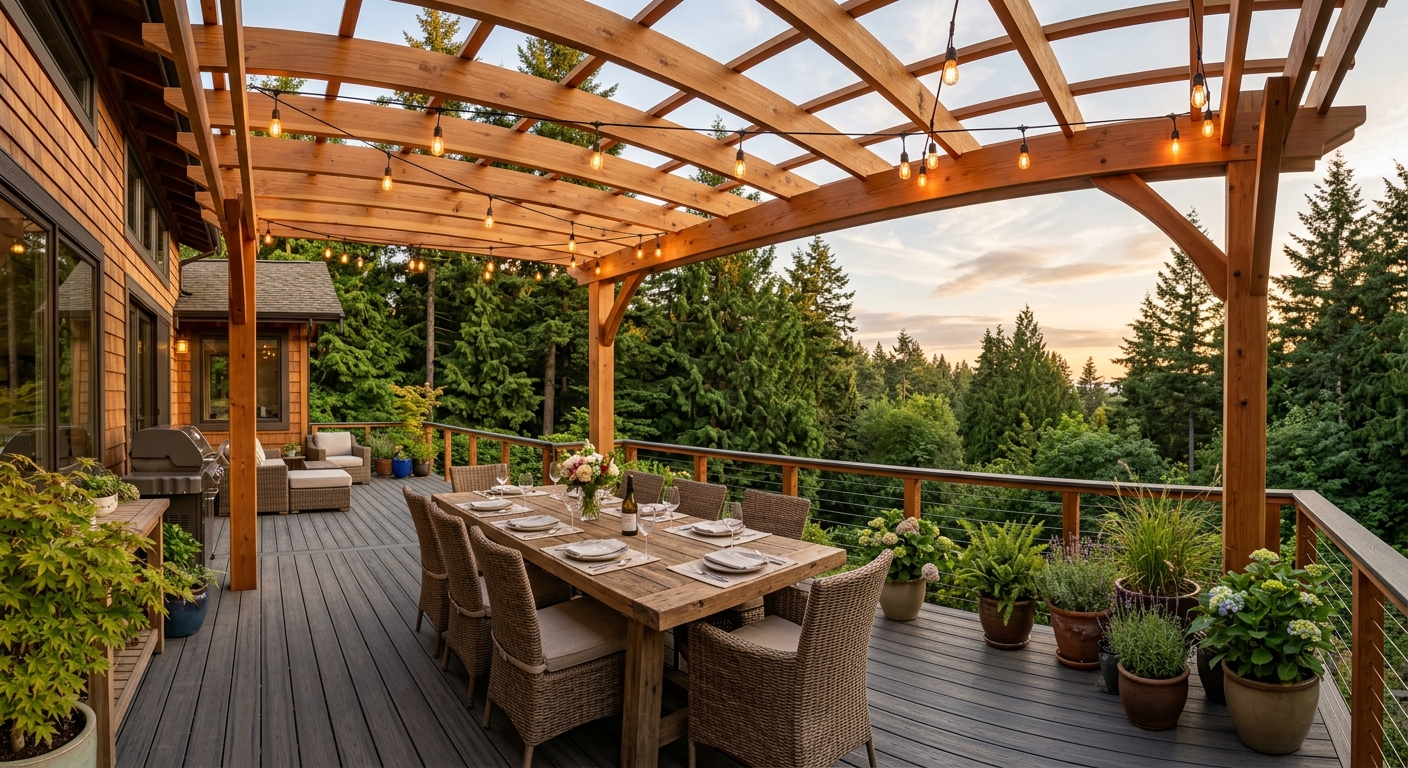
Best for outdoor kitchen integration. If your pergola is covering an outdoor kitchen, motorized aluminum is the specification that makes the kitchen usable year-round. Rain protection for the cooking surface and countertops means the kitchen doesn't need to be covered and uncovered with tarps between uses. The grill stays dry. The countertops stay clean. The outdoor kitchen investment performs for 10 months instead of 4.
Aluminum Louvered System: The Case Against
Higher upfront cost. A premium motorized aluminum system at 16x20 runs $28,000–$42,000 versus $14,000–$22,000 for cedar open slat — a $14,000–$20,000 upfront premium. Not all homeowners can absorb that differential, and for homeowners who only want a summer structure, the premium doesn't justify itself.
Contemporary aesthetic. The clean lines of aluminum louver systems are distinctly contemporary and architectural. They look excellent on modern homes, mid-century properties, and contemporary deck designs. They look less natural on craftsman bungalows, traditional cape cod homes, or properties where the landscaping skews toward naturalistic PNW design.
Lead time. Aluminum louvered systems are custom-manufactured to your specifications and shipped from the manufacturer. Lead times run 8–12 weeks from order to delivery, which means these systems require more project planning lead time than cedar.
Tip
Louvered Aluminum Pergola Brands: What We Use and Why
The motorized aluminum pergola market has three significant premium brands in the Pacific Northwest:
Struxure
Struxure Pergola X is the most commonly specified premium system in King County's high-value residential market. The posts are hollow aluminum with concealed cable channels for electrical, drainage channels for water management, and a clean powder-coated finish available in dozens of standard colors plus custom. The louver system closes to a fully waterproof condition; rain drains through channels in the beam structure to downspouts in the posts.
Struxure systems are available with integrated LED strip lighting, infrared heaters, and retractable shade screens for side enclosure. The system integrates with most smart home platforms. Lead time: approximately 10–12 weeks.
Struxure pricing for a 16x20 installed: $28,000–$38,000 depending on options.
Renson
Renson (Belgian manufacturer, North American distributor) makes the Algarve and Camargue louvered systems — a slightly more European aesthetic than Struxure with extremely precise engineering tolerances. Renson systems tend to have more refined profiles and a wider range of architectural configurations including freestanding with wire tensioning systems.
Renson pricing for a 16x20 installed: $32,000–$45,000 depending on configuration.
Louvretec
Louvretec (New Zealand-origin, with North American distribution) offers both opening-roof and fixed louvered systems at a moderate price point between premium and budget. Quality is solid; the aesthetic is more utilitarian than Struxure or Renson. Good choice for homeowners who want motorized functionality at a lower cost than the European premium brands.
Louvretec pricing for a 16x20 installed: $22,000–$32,000 depending on options.
We have experience with all three systems and can provide comparison recommendations based on your specific project requirements and budget.
Permit Requirements for Pergolas in King County
When Is a Permit Required?
The rule across all King County cities: attached pergolas always require permits. An attached pergola modifies the building's structure — it must be reviewed.
For freestanding pergolas, the threshold varies:
- In Seattle, freestanding structures over 200 square feet require a building permit
- In Bellevue, Sammamish, and Kirkland, the threshold is also approximately 200 square feet
- Smaller freestanding pergolas (under 200 sqft) may be exempt from building permits in most cities, but gas or electrical work still requires trade permits
Electrical work requires an electrical permit in all King County jurisdictions. The permit is pulled by the licensed electrician performing the work.
Gas work for heater connections requires a gas permit, also pulled by the licensed contractor performing the work.
You can verify King County permit requirements at kingcounty.gov/permits and Seattle requirements at seattle.gov/sdci.
Permit Fees and Processing Times
Building permit fees for a pergola in King County: $500–$1,500 depending on city and project valuation.
| Jurisdiction | Standard Pergola Permit Timeline |
|---|---|
| Mountlake Terrace | 2–3 weeks |
| Woodinville | 3–5 weeks |
| Shoreline | 3–5 weeks |
| Bothell | 4–6 weeks |
| Kirkland | 3–5 weeks |
| Bellevue | 4–6 weeks |
| Sammamish | 4–6 weeks |
| Seattle SDCI | 5–8 weeks |
Setback Requirements for Pergolas
Pergolas in King County must comply with the same setback requirements as other structures. Standard residential setbacks:
- Side property lines: 5 feet minimum in most cities
- Rear property lines: 10–20 feet minimum depending on city
- Front property lines: 20–25 feet minimum in most residential zones
Important
Cost of Add-Ons: Lighting, Heaters, Fans, and Screens
Beyond the base structure and electrical rough-in, these are the most common add-ons that affect total pergola project cost:
| Add-On | Cost Range | Notes |
|---|---|---|
| LED string lighting | $300–$800 | Surface-mount on rafters; needs outlet or hardwired circuit |
| LED recessed lighting | $600–$1,500 | For solid or louver roof; more architectural |
| Ceiling fan (standard) | $400–$900 | Requires dedicated circuit; wet-rated required |
| Ceiling fan (premium outdoor) | $800–$1,800 | Minka-Aire, Hunter, Big Ass Fans commercial |
| Infrared electric heater | $800–$1,500 | Per heater; requires 240V circuit |
| Natural gas heater | $1,200–$2,500 | Per heater; requires gas line extension |
| Gas fire table | $2,000–$5,000 | Freestanding; requires gas line extension |
| Retractable shade screen (manual) | $1,500–$3,000 | Per panel; side enclosure |
| Retractable shade screen (motorized) | $2,500–$5,000 | Per panel; most aluminum systems compatible |
| Outdoor TV mount + weatherproof enclosure | $800–$2,500 | Requires outlet; GFCI protected |
| Privacy lattice panels (cedar) | $600–$1,500 | Per section; attached to pergola frame |
For a typical mid-range King County pergola project, add-ons total $3,000–$8,000. Full-featured aluminum louvered systems with heaters, fans, screens, and audio can add $12,000–$18,000 to the base structure cost.
Combined Deck + Pergola: Full Project Packages
Most homeowners asking about pergola cost are building a pergola as part of a broader deck project — not adding a pergola to a standalone location. Here's what the combined projects look like in King County in 2026:
| Package | Description | Installed Cost Range |
|---|---|---|
| Composite deck + cedar open-slat pergola | 300 sqft Trex deck + 16x20 cedar pergola | $48,000–$65,000 |
| Composite deck + cedar + polycarbonate | 300 sqft Trex deck + 16x20 cedar pergola with panels | $55,000–$75,000 |
| Composite deck + mid-range motorized pergola | 300 sqft Trex deck + 16x20 aluminum louvered system | $65,000–$90,000 |
| Composite deck + premium motorized pergola | 400 sqft Trex Transcend + 20x20 Struxure system | $85,000–$120,000 |
| Composite deck + outdoor kitchen + pergola | 400 sqft deck + kitchen + 16x20 motorized system | $95,000–$140,000 |
These ranges are all-in costs for the outdoor living space: deck, pergola, permits, footings, electrical. They don't include landscaping or furniture.
For complete pricing transparency, see our deck cost guide for Seattle.
How Seattle's Climate Makes the Pergola Decision
Seattle receives measurable precipitation on approximately 150–155 days per year. This averages to rain on about 2 out of every 5 days across the full year. In the October–April period, that frequency increases to roughly 3 out of 5 days. The National Weather Service at Seattle publishes monthly precipitation data showing exactly how rain distributes across the year.
What this means practically for pergola decisions:
An open-slat cedar pergola gives you usable covered space for the 4–5 months when Seattle is reasonably dry: June, July, August, and parts of May and September. During these months it's beautiful and comfortable. During the other 7 months, it's a structure you walk under to avoid getting wet on the way to your car.
A polycarbonate-roof cedar pergola gives you usable covered space for 8–9 months: everything that an open slat provides, plus protection during the light spring and fall drizzle. It doesn't eliminate rain noise (polycarbonate is audible in heavy rain) and it doesn't eliminate condensation drip at the panel edges, but it keeps you generally dry for most Seattle precipitation events.
A motorized aluminum louvered system gives you usable covered space for 10–11 months. When the louvers are closed, you are dry. The acoustic experience during heavy rain is quieter than polycarbonate — the louver channels water away rather than letting it hit the panel surface.
This is the ROI framework for choosing between options: measure your intended use pattern against the effective outdoor season each option provides, then divide the cost by the months of effective use.
| Pergola Type | Effective Seattle Outdoor Season | Cost (16x20, Installed) | Effective Cost Per Usable Month |
|---|---|---|---|
| Open cedar (no cover) | 4–5 months | $18,000 | $3,600–$4,500 |
| Cedar + polycarbonate | 8–9 months | $23,000 | $2,556–$2,875 |
| Aluminum motorized (mid) | 10–11 months | $28,000 | $2,545–$2,800 |
| Aluminum motorized (premium) | 10–11 months | $35,000 | $3,182–$3,500 |
On this cost-per-effective-month basis, the polycarbonate panel system and the mid-tier motorized aluminum system are roughly equivalent. The mid-tier aluminum has no maintenance cost over 30 years; the cedar + polycarbonate requires staining on the cedar frame every 3–5 years and panel replacement at year 15–20.
Cedar vs. Aluminum Pergola: Side-by-Side Comparison
| Factor | Cedar Open Slat | Cedar + Polycarbonate | Aluminum Motorized |
|---|---|---|---|
| Rain protection | None | Full | Full (adjustable) |
| Upfront cost (16x20) | $14,000–$22,000 | $18,000–$28,000 | $22,000–$42,000 |
| Maintenance | Stain every 3–5 yrs | Stain cedar + panel refresh | None |
| Service life | 20–30 yrs | 20–25 yrs | 30–40 yrs |
| Usable months/year (Seattle) | 4–5 | 8–9 | 10–11 |
| Aesthetic | Natural, warm, PNW | Natural with utilitarian roof | Contemporary, architectural |
| Smart home integration | No | No | Yes (premium brands) |
| Lead time | 2–4 weeks post-permit | 2–4 weeks post-permit | 8–12 weeks from order |
What to Bring to the Pergola Consultation
When you meet with us to discuss a pergola, the conversation goes faster and the estimate is more accurate when you come prepared with:
The footprint you're considering: An approximate size (12x16, 16x20, etc.) or the area of your deck you want covered. Doesn't need to be exact — we'll refine it during the site visit.
How you intend to use the space: Primarily summer entertaining (open cedar may be fine), year-round outdoor kitchen use (motorized aluminum required), or somewhere in between. This single piece of information is the most important factor in roofing specification.
Your budget range: Not a specific number if you're not sure — just an honest range. The difference between a $12,000 cedar pergola and a $38,000 motorized aluminum system is large enough that it genuinely changes what we recommend. We don't try to upsell you past your budget; we find the best product for your budget.
Photos or Pinterest inspiration: Not required, but helpful for establishing aesthetic direction before we start discussing materials.
Permit status of your property: If you know you're in a shoreline buffer, a critical area, or an HOA with architectural review, tell us upfront. It changes the permit timeline and sometimes the design approach.
For information on verifying your contractor's licensing before hiring anyone, see lni.wa.gov. For more on railing options that complement your pergola, see our deck railing guide.
Frequently Asked Questions: Pergola Cost in Seattle
Frequently Asked Questions
How much does a pergola cost in Seattle in 2026?
Does a pergola need a permit in King County?
What's the best pergola for Seattle's rainy climate?
How long does a cedar pergola last in Seattle?
How long does a motorized aluminum pergola last?
What's the difference between an attached and freestanding pergola cost?
Should I add electrical to my pergola?
What are Struxure, Renson, and Louvretec?
Can I add a pergola to an existing deck?
How much does a pergola add to my home's resale value?
How long does it take to build a pergola in Seattle?
Do you offer combined deck and pergola packages?
Get a Pergola Estimate for Your Seattle Property
We design and build pergolas throughout King County — cedar open-slat, polycarbonate panel, and motorized aluminum louvered systems from Struxure, Renson, and Louvretec. We handle all permits, coordinate electrical and gas sub-contractors, and give you a written line-item estimate before you commit to anything.
If you're building a new deck, we strongly recommend discussing the pergola at the same consultation — combined projects are more cost-effective and the structural coordination between deck and pergola is cleaner when they're designed together.
Call (425) 675-6259 or request a free estimate online. We schedule consultations throughout King County within 5–7 business days.
ROI Perspective: Is a Seattle Pergola Worth It?
The return-on-investment question for a Seattle pergola comes down to how you measure return. There are two legitimate frameworks:
Financial ROI: What Buyers Pay For
The National Association of Realtors remodeling impact data shows covered outdoor structure improvements recovering 50–75% of cost in resale in premium real estate markets. In King County's Eastside — Bellevue, Sammamish, Kirkland — where median home values exceed $1 million, a well-built covered outdoor room is increasingly a buyer expectation rather than a luxury feature. A motorized aluminum pergola with outdoor kitchen integration on a Bellevue deck doesn't just add value — it moves the property into a category of listing that buyers at that price point are actively searching for.
The financial recovery is stronger for systems that:
- Include genuine rain protection (covered, not open-slat)
- Are integrated with an outdoor kitchen or full outdoor living space
- Are installed on premium composite or PVC decking
- Are paired with quality lighting and heating systems
A $14,000 open cedar pergola on a $35,000 composite deck recovers less proportionally than a $35,000 motorized aluminum system on the same deck, because the motorized system creates a fundamentally different category of outdoor space.
Lifestyle ROI: Additional Months of Use
The lifestyle ROI calculation is simpler: how many additional months of outdoor living does the pergola provide, and what is that worth to you?
Without any cover structure: Seattle's comfortable outdoor season runs approximately June through September — four months. An additional shoulder month on each end (May and October) depends on temperature and rain tolerance.
With polycarbonate or louvered cover: the comfortable outdoor season extends to March through November — eight to nine months. That's twice the seasonal use from the same deck. The pergola pays for itself annually in hosting capacity, family time, and the simple act of being able to use the space you've invested in.
With heaters added: the outdoor season extends to near year-round. December and January in Seattle are cold and dark, but the weeks on either side of those months — February, March, October, November — are genuinely habitable under a covered, heated outdoor structure.
For homeowners who entertain regularly, who work from home and use outdoor space for decompression, or who have children who benefit from semi-outdoor space adjacent to the house, the additional months of seasonal use represent a meaningful quality-of-life return that isn't captured in financial ROI analysis.
The Permit and Timeline Reality
Understanding the realistic project timeline for a Seattle pergola prevents the frustration of expecting to have a structure up before summer and discovering the permit took 8 weeks.
Cedar Pergola Timeline
- Consultation and design: 1–2 weeks
- Permit application submission: 1 week (we prepare the application)
- Permit processing: 3–8 weeks depending on jurisdiction (see table above)
- Material procurement: 1–2 weeks (cedar is locally available; no long lead times)
- Construction: 3–5 days
- Final inspection: 1–2 weeks after construction complete
Total realistic timeline: 8–16 weeks from initial consultation to occupancy. In Seattle, a cedar pergola started in March realistically completes in June. Started in January, you could have it by late March.
Aluminum Louvered Pergola Timeline
- Consultation and design: 1–2 weeks
- Permit application submission: 1 week
- Permit processing: 3–8 weeks
- System order placed (can overlap with permit): 10–12 week lead time from manufacturer
- Construction: 2–4 days
- Final inspection: 1–2 weeks
Total realistic timeline: 14–22 weeks from initial consultation to occupancy. An aluminum louvered system ordered in January may not be installed until May or June. For homeowners who want to use the system by July 4th, the project needs to start by January at the latest.
Key insight
How We Scope a Pergola Project
Every pergola project starts with a site visit. We look at:
The deck or outdoor space the pergola will cover: Existing deck condition, size, any railing or structural elements that interact with the pergola design. If the pergola is over a future deck, we plan both simultaneously.
The attachment point: If the pergola attaches to the house, we assess the wall connection point — what material the house exterior is clad with, where the framing is behind the cladding, and whether the attachment point is structurally appropriate for the pergola's lateral load.
Electrical panel location and access: If electrical is part of the plan, we note the panel location and the path for running new circuits to the pergola zone.
Gas access (if heaters planned): Location of the gas meter and the practical routing for gas line extension to the pergola zone.
Lot orientation and sun/shade pattern: South-facing lots benefit most from louvered systems (they get significant sun and benefit from adjustable shading). North-facing or heavily shaded lots may not need the louvered system's light-control function — a polycarbonate panel provides consistent rain cover without the motorized complexity.
After the site visit, we provide a written line-item estimate within 5–7 business days. The estimate covers: pergola structure (material and labor), permit fee, footings, electrical (if applicable), and any gas work. Every line item is explained — no "miscellaneous" categories.
If you'd like to understand contractor licensing requirements before hiring, lni.wa.gov is the Washington State resource for verifying contractor registration and bonding.
Call (425) 675-6259 or request your estimate online to schedule a site visit in your King County neighborhood.
Planning a deck in the Seattle area?
Get an onsite design review and a clear, itemized quote from a licensed local builder.
Request a Free Quote