
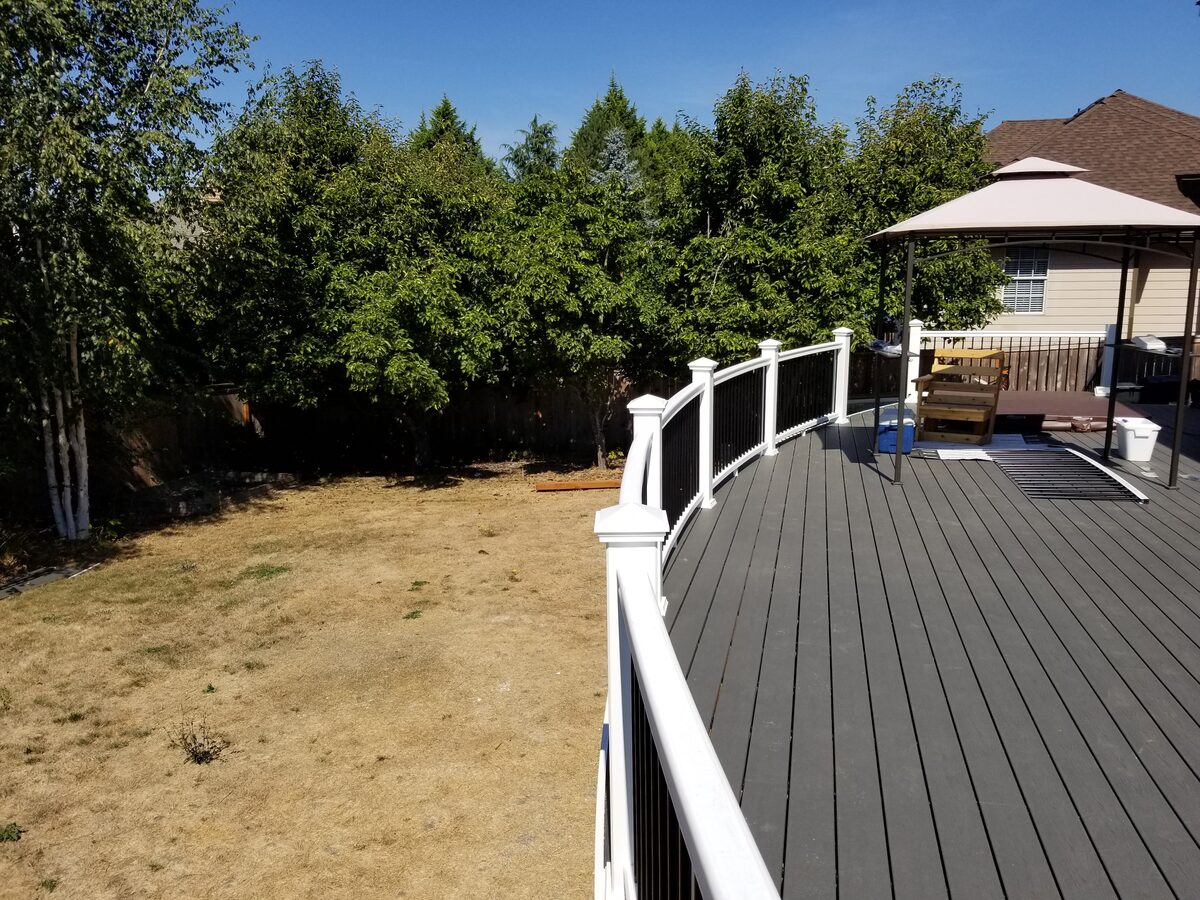
If you've started calling deck contractors in the Seattle area, you've probably already experienced sticker shock. A quote of $45,000 for a 400-square-foot composite deck on a Bellevue hillside lot isn't unusual — and it isn't a contractor trying to gouge you. It reflects the genuine cost of skilled labor, engineered materials, structural complexity, and a permitting system that has grown significantly more expensive over the last five years. Seattle sits at the intersection of some of the highest construction labor wages in the country, a lumber market still recovering from pandemic-era volatility, and terrain that routinely turns a "simple" deck project into a structural engineering exercise. Understanding where every dollar goes is the only way to budget accurately, evaluate quotes fairly, and avoid the costly surprises that derail projects months after construction begins.
The range of deck prices in the greater Seattle metro is genuinely wide. A basic pressure-treated ground-level deck in Renton or Kent — flat lot, simple rectangle, 200 square feet — can come in under $14,000 fully permitted and built. A cantilevered two-level composite deck on a Mercer Island slope with cable railings, built-in lighting, and a covered pergola section can exceed $90,000. Both figures are real, and both represent fair market value for what was built. The mistake most homeowners make is assuming their project will land at the low end of whatever range they read online, when the Seattle-specific factors we'll cover below almost always push the number higher than national averages suggest.
This guide draws on real project data from King County deck builds, current permit fee schedules from Seattle SDCI, King County, and surrounding cities, current labor market conditions, and five years of material cost history. We'll walk through every meaningful cost driver, give you real project examples with line-item breakdowns, and show you how to read a quote so you're comparing apples to apples — not a full-service contractor to a guy with a pickup truck and no insurance.
What You'll Actually Pay: Seattle Deck Cost by Material and Size
The most honest thing any contractor can tell you is that deck pricing is project-specific — but ranges matter for budgeting. Here's what real Seattle-area builds cost in 2025, broken down by material category and square footage.
Pressure-Treated Pine Decks
Pressure-treated pine remains the most affordable entry point for deck construction. In the Seattle metro, expect to pay $28–$42 per square foot fully installed for a straightforward ground-level PT build. That range accounts for variations in post depth (frost-line requirements here go to 12–18 inches), joist spacing, beam sizing, and finish work. A 200-square-foot PT deck on a flat Renton lot typically lands around $7,500–$9,500. A 400-square-foot version with stairs and a basic railing runs $15,000–$22,000.
What homeowners sometimes don't realize: pressure-treated decks in the Pacific Northwest still require annual or biennial sealing and staining to survive our wet winters. The upfront savings can evaporate quickly over a 10-year maintenance window. We cover this in detail in the 20-year total cost of ownership section below.
Cedar Decks
Western red cedar has been the regional default for generations of Seattle-area deck builders. It's naturally rot-resistant, dimensionally stable, and beautiful when freshly milled. Installed costs run $34–$52 per square foot in the current market, with clear vertical-grain cedar pushing toward the upper end. A 350-square-foot cedar deck with a simple picture-frame border and cable railing system typically lands in the $18,000–$28,000 range.
Cedar's cost has climbed meaningfully since 2020. Old-growth regional cedar is largely gone; what's available now is second-growth stock that's more prone to checking and warping. Quality varies significantly between lumber yards, and a contractor who sources from a high-quality supplier will quote higher material costs than one pulling budget stock — a difference that shows up in the finished product.
Composite Decking (Trex, TimberTech, Fiberon)
Composite decking now dominates new deck builds in the Seattle area for a simple reason: the Pacific Northwest climate makes wood maintenance genuinely painful. Our 140+ annual rain days accelerate deterioration, and the gap between composite's 25-year warranty and cedar's realistic 15-year lifespan in Western Washington conditions is meaningful. Composite installed costs in Seattle run $48–$85 per square foot depending on product tier, deck complexity, and site factors.
- Entry-level composite (Trex Enhance, Fiberon Paramount): $48–$62/sq ft installed
- Mid-range composite (Trex Select, TimberTech Terrain): $58–$72/sq ft installed
- Premium composite (Trex Transcend, TimberTech Landmark, Fiberon Concordia): $68–$85/sq ft installed
A 400-square-foot Trex Transcend deck with hidden fasteners, aluminum railing, and a standard stair run in the Eastside suburbs typically costs $32,000–$42,000 installed and permitted. Add a pergola, built-in lighting, or a second level, and you're moving toward $55,000–$75,000. For a full comparison of composite brands, see our guide to Trex vs. Fiberon vs. TimberTech in Seattle.
PVC Decking
PVC (polyvinyl chloride) decking — brands like AZEK and Versatex — represents the premium tier. It's 100% synthetic, impervious to moisture, and carries some of the best warranties in the industry. It's particularly popular for rooftop decks, waterfront properties on Lake Washington or Puget Sound, and clients who want zero maintenance indefinitely. Installed costs run $75–$110 per square foot for PVC decking in the Seattle metro. You can explore our PVC decking options for more detail on these products.
Installed costs include labor, materials, footings, and basic railing. Permit fees and hillside surcharges not included. Source: The Seattle Decking Company project data 2024–2025.
| Category | Value |
|---|---|
| Pressure-Treated | $35 |
| Cedar | $43 |
| Composite (Entry) | $55 |
| Composite (Mid) | $65 |
| Composite (Premium) | $76 |
| PVC/AZEK | $92 |
Neighborhood Cost Variations: Why Your Zip Code Changes Your Quote
One of the most significant — and least-discussed — factors in Seattle-area deck pricing is where you live. A 400-square-foot Trex Transcend deck doesn't cost the same in Mercer Island as it does in Federal Way, and the difference isn't contractor markup. It's site reality.
Hillside and Elevated Sites: The Eastside Premium
Bellevue, Mercer Island, Kirkland, Sammamish, and Medina are built on terrain that ranges from gently rolling to aggressively steep. When a deck sits on a hillside, the structural requirements change dramatically. Instead of short posts on shallow footings, you're looking at:
- Deep concrete piers driven to stable soil (often 6–10 feet on Eastside clay soils)
- Tall posts and engineered beams to carry the elevated load
- Diagonal bracing or moment frames required by structural engineers
- Soils reports sometimes required by the city before permit approval
- Erosion control during and after construction
- Access challenges that slow every phase of the job
A hillside deck on a Bellevue lot with 8-foot post heights and engineered footings can easily cost $10,000–$20,000 more than a structurally identical deck on a flat Renton or Kent lot. The structural steel, engineer fees, extra concrete, and added labor hours are real costs that don't disappear because the finished deck looks the same from a photograph.
Mercer Island and Waterfront Properties
Mercer Island's shoreline properties and waterfront homes on Lake Washington and Lake Sammamish add additional complexity. Waterfront builds often trigger Shoreline Management Act review through Washington State Department of Ecology, and many properties have critical areas buffers (CAO overlays) that restrict where you can build and require additional permits. Budget an extra $2,000–$6,000 for critical area review and the associated engineering documentation on waterfront properties.
Flat-Lot South King County: The Baseline
Kent, Renton, Auburn, Federal Way, and Tukwila tend to have flatter terrain, less restrictive geology, and shorter post heights. These are the conditions that produce the lower end of Seattle metro pricing. A builder who quotes $28/sq ft in Kent isn't doing inferior work — they're working on a site that doesn't require the structural depth of an Eastside hillside build. This is why you cannot benchmark a Bellevue quote against a Renton quote without accounting for site complexity.
North Seattle and Shoreline
North Seattle neighborhoods like Shoreline, Lake Forest Park, and Kenmore fall in the middle. Terrain varies block by block, but the predominant issue in these areas is lot coverage and setback restrictions that require careful permit navigation. Many North Seattle lots are small enough that a deck of meaningful size triggers Planning review in addition to Building review — adding timeline and cost.
Key insight
Labor Cost Deep Dive: Why Seattle Builds Cost More
National deck cost guides are built on national labor averages. Those averages do not apply to the Puget Sound region. According to the Bureau of Labor Statistics occupational employment data, construction trades wages in the Seattle-Bellevue-Tacoma metro run 25–40% above the national median. This premium has widened since 2020 as the region's tech economy kept housing demand elevated and construction labor in short supply.
Framing Labor vs. Finishing Labor
Professional deck contractors typically distinguish between two labor categories that have different skill requirements and different cost profiles:
Framing labor covers everything structural: layout, excavation, footing forms, concrete pours, post setting, beam installation, joist framing, and blocking. This is physically demanding, requires reading structural drawings accurately, and directly affects the long-term safety of the deck. In the Seattle metro, licensed framing crews cost $65–$95 per hour per person, and a two-person framing crew can frame a 400-square-foot deck structure in 2–3 days depending on complexity. On hillside builds, that extends to 4–6 days.
Finishing labor covers decking installation, fascia, stairs, railings, trim, and any feature work (lighting, pergola framing, built-ins). This work is more detail-oriented and in the case of composite decking, requires familiarity with specific manufacturer installation systems. Finishing labor in Seattle runs $55–$80 per hour per person, and a two-person finish crew typically needs 2–4 days on a standard 400-square-foot build.
Total Labor as a Percentage of Project Cost
On a typical Seattle composite deck project, labor accounts for 45–60% of total project cost — higher than the national norm of 40–50%. This reflects not just wage rates but the overhead costs of operating a legitimate contracting business in Washington State: workers' compensation insurance (among the highest in the country through the state-run L&I system), general liability insurance, vehicle costs, and the cost of maintaining licensing and bonding through Washington State Labor & Industries.
Note
What Legitimate Labor Costs Look Like
For a 400-square-foot Trex Transcend deck on a standard (not hillside) lot in Bellevue with a basic stair run and aluminum railing system:
| Labor Category | Hours | Rate | Cost |
|---|---|---|---|
| Site layout and footing excavation | 8 hrs | $75/hr (2 people = $150) | $1,200 |
| Concrete and post setting | 6 hrs | $150/hr crew | $900 |
| Beam and joist framing | 16 hrs | $150/hr crew | $2,400 |
| Ledger and flashing (attached deck) | 4 hrs | $150/hr crew | $600 |
| Composite decking installation | 14 hrs | $140/hr crew | $1,960 |
| Stair construction | 8 hrs | $140/hr crew | $1,120 |
| Railing installation | 10 hrs | $140/hr crew | $1,400 |
| Fascia and trim | 4 hrs | $140/hr crew | $560 |
| Cleanup and punch list | 4 hrs | $140/hr crew | $560 |
| Total Labor | ~$10,700 |
This is purely labor. Add materials ($14,000–$18,000 for Trex Transcend at this scale), permit fees ($1,200–$2,500), and contractor overhead and profit margin, and you arrive at a total project cost of $28,000–$35,000. That's consistent with real Eastside quotes.
Permit Costs by City: The 2025 Fee Landscape
Every deck in the Seattle metro requires a permit if it is attached to the house or elevated more than 30 inches above grade. This is non-negotiable — and the consequences of skipping permits range from stop-work orders to forced demolition when you sell the home. Permit fees have increased substantially across the region, and they're now a meaningful line item in any project budget.
2025 Permit Fee Changes
The Seattle SDCI implemented a 6.5% inflationary increase to most fees on January 1, 2025, changing the base hourly review rate to $274/hour and increasing construction permit fees by an average of 12%, with larger projects seeing increases of 19%. King County unincorporated areas saw even more dramatic increases — effective January 1, 2025, most King County permit fees increased by 49%. These are not typos.
Permit Fee Comparison Table by Jurisdiction (2025)
The following reflects typical deck permit fees for a $25,000–$40,000 project valuation (the range most 300–500 sq ft residential decks fall into):
| Jurisdiction | Issuing Authority | Estimated Deck Permit Fee | Notes |
|---|---|---|---|
| Seattle (City) | SDCI | $1,400–$2,800 | Fee based on project valuation; 2025 rates include 12% avg increase |
| King County Unincorporated | KC Permitting | $1,800–$3,500 | 49% fee increase effective Jan 1, 2025 |
| Bellevue | City of Bellevue Development Services | $1,200–$2,400 | Uses MyBuildingPermit.com regional portal |
| Kirkland | City of Kirkland | $900–$1,800 | Also uses MyBuildingPermit.com |
| Sammamish | City of Sammamish | $1,000–$2,000 | State Energy Code compliance check required |
| Renton | City of Renton | $800–$1,600 | Among lowest in region; faster review times |
| Bothell | City of Bothell | $900–$1,800 | Covers projects in 98021 zip code |
Tip
What the Permit Actually Buys You
Beyond legal compliance, the permit process provides structural review that catches problems before they become safety hazards. SDCI plan reviewers and field inspectors verify footing depth, beam sizing, joist span, ledger attachment, and railing height — all of which directly affect the safety of the structure. The $1,500–$2,500 permit fee is genuine value; the inspection process has caught under-built decks that would have failed under load.
We cover the full permit process in our detailed guide to deck permits in King County.
Material Cost History 2020–2025: How We Got Here
To understand current material costs, you need to understand the extraordinary volatility of the construction materials market over the past five years. The story is essentially three chapters: pre-pandemic stability, pandemic shock, and partial recovery with a new higher floor.
The Lumber Price Rollercoaster
In early 2020, framing lumber (2x6 Douglas fir, the backbone of deck framing) traded around $350–$400 per thousand board feet (MBF). By May 2021, pandemic-driven demand — home renovation surges, housing construction boom, sawmill shutdowns — pushed lumber to an all-time high above $1,600/MBF, a more than 300% increase in roughly 14 months. The effect on deck costs was immediate and dramatic.
Prices corrected through 2022 and early 2023, falling back below $500/MBF. But they didn't return to pre-pandemic levels, and they haven't since. As of 2025, framing lumber trades around $420–$870/MBF depending on species and grade — still 40–60% above the 2019 baseline. New tariff pressure hasn't helped: in August 2025, the U.S. Department of Commerce increased countervailing duties on Canadian softwood imports to 14.63%, pushing combined tariffs to approximately 35%, which lumber market analysts expect to maintain upward pressure on framing costs through 2026.
The practical effect: a deck that used $4,000 in framing lumber in 2019 requires roughly $5,600–$6,400 in equivalent lumber today, even after the partial price correction.
Composite Decking: A Different Story
Composite decking followed a different price trajectory. Unlike lumber, composite products (which blend wood fiber and plastic resin) didn't see the same pandemic spike. They did see price increases of 15–25% between 2021 and 2023 as petrochemical input costs rose. But by 2024–2025, composite prices have largely stabilized, with manufacturers like Trex implementing modest increases of 7.5–15% on specific product lines rather than across-the-board hikes. This relative stability is one reason composite's total value proposition has improved compared to wood in the current market.
Concrete, Hardware, and Other Materials
Concrete prices have increased 30–40% since 2020, driven by energy costs and aggregate supply chain issues. Stainless steel hardware (screws, connectors, hangers) is up 20–35%. These increases affect every deck regardless of decking material, since all deck structures require footings, hardware, and fasteners.
| Material | 2019 Baseline Cost | 2025 Cost | % Change |
|---|---|---|---|
| Framing lumber (2x6 DF, per MBF) | ~$380 | ~$550–$700 | +45–85% |
| Pressure-treated lumber (per MBF) | ~$450 | ~$750–$950 | +65–110% |
| Composite decking (mid-grade, per sq ft material) | ~$6.50 | ~$8.50–$10.00 | +30–54% |
| Concrete (per yard, delivered) | ~$115 | ~$155–$175 | +35–52% |
| Stainless screws/hardware | Baseline | +25–35% | +25–35% |
| Cable railing (per linear foot) | ~$85 | ~$115–$135 | +35–59% |
Important
Real Project Examples With Detailed Breakdowns
Abstract cost ranges become useful when you can see how actual projects are built up from components. Here are four representative King County deck builds with real line-item breakdowns.
Project A: Ground-Level Cedar Deck, Renton, 280 sq ft
Site: Flat lot, attached to house, 18-inch post height maximum, no stairs needed (grade access on two sides).
| Line Item | Cost |
|---|---|
| Permit (City of Renton) | $920 |
| Concrete footings (6 piers) | $1,400 |
| PT framing lumber (posts, beams, joists) | $2,100 |
| Cedar decking (280 sq ft + 15% waste) | $3,200 |
| Ledger board, flashing, hardware | $680 |
| Aluminum railing system, 3 sides, 40 LF | $3,800 |
| Labor (framing + decking + railing) | $6,400 |
| Contractor overhead and margin | $2,800 |
| Total | $21,300 |
Per square foot: $76 (reflects railing as large portion of small deck)
Project B: Two-Level Composite Deck, Bellevue Hillside, 520 sq ft
Site: Significant slope, upper level at 6-foot post height, lower level at grade, composite material, cable railing, stairs connecting levels.
| Line Item | Cost |
|---|---|
| Permit (City of Bellevue) | $2,100 |
| Structural engineering (hillside required) | $1,800 |
| Concrete piers (10 deep piers, 6-ft depth) | $5,200 |
| PT structural framing (posts, beams, joists, bracing) | $6,400 |
| Trex Transcend composite decking, 520 sq ft | $8,800 |
| Hidden fasteners and clips | $620 |
| Cable railing system, 80 LF | $9,600 |
| Stairs (two stair runs) | $3,200 |
| Ledger, flashing, waterproofing at house | $940 |
| Labor (framing + finishing + railing) | $14,800 |
| Contractor overhead and margin | $7,500 |
| Total | $60,960 |
Per square foot: $117 (hillside complexity and premium finishes drive PSF up significantly)
Project C: Entry-Level PT Deck, Kent, 200 sq ft
Site: Flat lot, freestanding (no ledger), single step down from door, basic 2x4 railing system.
| Line Item | Cost |
|---|---|
| Permit (King County unincorporated) | $1,100 |
| Concrete footings (4 piers) | $800 |
| PT framing and decking, complete | $2,800 |
| Basic PT railing system, 3 sides | $1,400 |
| Labor | $4,200 |
| Contractor overhead and margin | $1,800 |
| Total | $12,100 |
Per square foot: $60.50
Project D: Premium Covered Deck with Outdoor Kitchen, Mercer Island, 640 sq ft
Site: Waterfront-adjacent, requires CAO review, engineered footings, Trex Transcend Lineage decking, glass railing system, pergola with polycarbonate roof panels, outdoor kitchen rough-in.
| Line Item | Cost |
|---|---|
| Permit + CAO review (City of Mercer Island) | $4,800 |
| Structural and geotechnical engineering | $3,600 |
| Deep engineered concrete piers (12 piers) | $9,200 |
| Structural framing, complete | $8,400 |
| Trex Transcend Lineage, 640 sq ft | $12,800 |
| Glass railing system, 100 LF | $18,000 |
| Pergola structure and polycarbonate panels | $14,200 |
| Outdoor kitchen blocking, backing, electrical rough-in | $3,800 |
| Deck lighting system (Trex Outdoor Lighting) | $2,400 |
| Stairs and landing | $2,800 |
| Labor (full project, 3-week build) | $24,000 |
| Contractor overhead and margin | $11,000 |
| Total | $115,000 |
Per square foot: $180 (includes all covered structure and kitchen rough-in)
Change Orders and How to Prevent Budget Overrun
Change orders are the single most common source of project cost overruns, and they follow predictable patterns. Understanding those patterns in advance is the best budget protection available.
The Three Most Common Change Order Sources in Seattle
1. Footing depth discovery. This is the most frequent. Every jurisdiction specifies minimum footing depth, but what happens below the surface can't be fully predicted without excavation. Seattle-area soils are variable: some Eastside hillside lots have 18 inches of topsoil over competent gravel; others have 5 feet of fill over unstable clay. If the inspector requires deeper footings than planned — which happens frequently — the additional concrete, labor, and inspection costs are a legitimate change order. A well-written contract should have a contingency allowance for this.
2. Ledger and rim joist condition. When a contractor attaches a deck to the house, they must expose the rim joist and verify its condition. In older homes (pre-1990), it's not unusual to find rot, inadequate depth, or improper framing. Replacing or sistering a compromised rim joist adds $800–$2,500 and is non-negotiable for structural integrity.
3. Design modifications by the homeowner. The most preventable change orders are homeowner-initiated: upgrading decking after signing, adding lighting mid-project, extending the footprint, or changing railing style. Every design change in the middle of construction costs 30–50% more than it would have if decided upfront, because it disrupts scheduling, causes material reorders, and may require revised permit drawings.
How to Structure Your Contract to Minimize Exposure
- Demand a site visit before quoting. Any contractor who quotes without visiting the site is baking in a contingency that will show up as a change order.
- Ask for an explicit allowance for footing depth. A quote should state the assumed footing depth and a per-foot cost for additional depth if required.
- Get a unit-price schedule for common additions. What does an extra linear foot of railing cost? An extra tread on the stair? Having these pre-negotiated prevents surprise markup.
- Finalize all material selections before signing. Changing decking material from Select to Transcend after signing a contract adds the material cost difference plus a restocking or special-order premium.
- Read the change order clause in your contract. It should require written approval before work begins, not after.
For more guidance on reading a contractor's quote, see our complete guide to how to read a deck quote.
Key insight
When Cheap Quotes Become Expensive: The Change Order Pattern
We see this pattern regularly enough that it's worth naming explicitly. A homeowner gets three quotes: $28,000, $35,000, and $44,000 for what appears to be the same deck. They hire the $28,000 contractor. By the end of the project, they've paid $41,000 — and the experience was miserable.
How the Low Quote Is Typically Built
The lowest quote is often constructed by excluding line items that are mandatory in practice:
- Permit fees excluded ("We'll settle permits separately")
- Engineering excluded ("We'll see if the inspector requires it")
- Footing depth unspecified ("Standard depth, additional depth billed at cost")
- Materials described vaguely ("Composite decking as specified" — but grade unspecified)
- Hardware and fasteners excluded ("Billed at cost")
- Stair handrail excluded ("Not in original scope")
Each of these becomes a change order. A project that appeared to save $7,000 upfront often lands within $3,000–$5,000 of the higher quote — but with more stress, more delays, and a relationship that has become adversarial.
The Inspector Ratchet
A specific pattern unique to permitted work: a contractor who has never built in your city may not know that jurisdiction's specific requirements. Seattle SDCI inspectors, Bellevue Development Services inspectors, and King County inspectors all have slightly different interpretations and emphases. A contractor unfamiliar with SDCI requirements may genuinely not know that SDCI requires positive drainage away from the house foundation, specific flashing at the ledger, or specific blocking at joist ends — and discover these requirements from the inspector mid-project. Those become change orders that aren't the homeowner's fault, but they still pay for them.
Ask any contractor: "How many decks have you pulled permits for in [your city] in the last two years?" Experience with local inspectors is a genuine differentiator. Learn more about what to ask deck builders before signing.
Financing Options for Seattle Deck Projects
A $35,000–$55,000 deck project is a significant capital outlay. Many homeowners finance some or all of a deck build, and there are several good options depending on your equity position and credit profile.
Home Equity Line of Credit (HELOC)
For homeowners with substantial equity — and most Eastside Seattle homeowners do — a HELOC is typically the lowest-cost financing option. HELOC rates are variable, currently running 7.5–9.5% for well-qualified borrowers, and interest on home-improvement HELOCs may be tax-deductible (consult your tax advisor). The drawback: it takes 3–6 weeks to establish a HELOC, so it requires planning ahead of your build.
Home Equity Loan
A home equity loan provides a fixed amount at a fixed rate — currently 7.0–9.0% for most borrowers — which makes budgeting predictable. Unlike a HELOC, it disbursed as a lump sum, which suits a defined project well.
Contractor Financing Through GreenSky or Similar Programs
Many contractors offer point-of-sale financing through programs like GreenSky or Synchrony Home. These often come with promotional 12–18 month no-interest periods, which can be excellent if you're confident you can pay the balance before the deferred interest kicks in. If you can't, the interest retroactively charged is typically 26–29% APR — an expensive mistake.
Personal Loans
For homeowners without significant equity, personal loans from banks or online lenders are available at 8–15% fixed rate for qualified borrowers. The advantage is speed (funding in 1–3 days) and no home as collateral. The disadvantage is higher rates than equity-based options.
We cover all of these options in depth, with current rate ranges and application guidance, in our dedicated guide to deck financing in Seattle.
Tip
Twenty-Year Total Cost of Ownership by Material
The right way to compare decking materials isn't upfront cost — it's total cost over the life of the deck. In the Pacific Northwest's high-moisture environment, this calculation changes meaningfully compared to drier climates.
Pressure-Treated Pine: Lowest Entry, Highest Maintenance
A pressure-treated deck requires annual cleaning and sealing in Western Washington conditions. Realistic maintenance schedule:
- Year 1–2: Initial cleaning and seal ($200–$400 DIY; $400–$800 professional)
- Every 2 years: Full cleaning and recoat ($400–$800 professional)
- Year 10–12: Major refinish or partial board replacement ($2,000–$5,000)
- Year 15–18: Often requires partial or full replacement on high-moisture sites
20-year maintenance cost estimate: $8,000–$14,000 on top of original build cost.
Cedar: Beautiful but Demanding
Cedar requires similar maintenance to PT but is more sensitive to improper care. Applied the wrong product (oil-based when the wood is wet, or vice versa) and you'll see peeling, graying, and checking accelerated. Professional cedar care in Seattle:
- Annual cleaning: $300–$600
- Biennial staining: $800–$1,800 depending on deck size
- 10-year refinish: $1,500–$3,500
- Spot board replacement at 12–15 years: $1,000–$4,000
20-year maintenance cost estimate: $10,000–$18,000
Composite Decking: Premium Upfront, Low Long-Term Cost
Quality composite decking (Trex, TimberTech, Fiberon) requires cleaning 1–2 times per year and nothing else. No staining, no sealing, no refinishing. Manufacturer warranties run 25–30 years on most premium products, covering fading and staining.
- Annual cleaning: $150–$350 professional, or DIY with a garden hose
- No staining or sealing ever required
- Replacement unlikely within 25-year window
20-year maintenance cost estimate: $2,000–$5,000
20-Year Total Cost of Ownership Comparison (400 sq ft deck)
| Material | Initial Build Cost | 20-Year Maintenance | 20-Year Total |
|---|---|---|---|
| Pressure-Treated Pine | $14,000–$18,000 | $8,000–$14,000 | $22,000–$32,000 |
| Cedar | $18,000–$24,000 | $10,000–$18,000 | $28,000–$42,000 |
| Composite (Mid-Grade) | $26,000–$34,000 | $2,000–$5,000 | $28,000–$39,000 |
| Composite (Premium) | $30,000–$40,000 | $1,500–$4,000 | $31,500–$44,000 |
| PVC/AZEK | $36,000–$48,000 | $1,000–$3,000 | $37,000–$51,000 |
The table reveals something counterintuitive: over 20 years, a mid-grade composite deck and a well-maintained cedar deck cost roughly the same — but the composite requires a fraction of the ongoing time and labor investment. For homeowners who will actually do the cedar maintenance on schedule, cedar is a reasonable choice. For everyone else, composite's 20-year economics are increasingly compelling.
For a more detailed comparison, see our composite vs. cedar decking guide for Seattle.
Note
Complete FAQ: Seattle Deck Cost Questions
Frequently Asked Questions
How much does a deck cost in Seattle in 2025?
Why is my Seattle deck quote so much higher than what I see on national cost guides?
Do I need a permit to build a deck in Seattle?
How long does it take to get a deck permit in Seattle?
What is the cheapest decking material for Seattle?
How much more does a hillside deck cost compared to a flat-lot deck?
Should I choose composite or cedar decking for a Seattle deck?
How do I know if a deck contractor is legitimate in Washington State?
What is typically NOT included in a deck quote that I should ask about?
Can I build a deck myself in Seattle to save money?
How much does a deck increase home value in Seattle?
When is the best time to build a deck in Seattle?
Getting an Accurate Quote for Your Seattle Deck
The difference between a good quoting experience and a frustrating one comes down to preparation. Before you contact contractors, know: your approximate square footage target, your material preference (or ask for options), whether you want stairs and where they'll land, your railing style preference, and any feature work (lighting, pergola, outdoor kitchen rough-in). The more specific you are in the initial conversation, the more accurate the initial quote will be.
When you receive quotes, compare them on a line-item basis, not total price. A quote that breaks out permit fees, materials, labor, and subcontractor work separately is from a contractor who understands their own costs. A single-number quote with no breakdown is a flag — it may be hiding assumptions that will cost you later.
At The Seattle Decking Company, we build decks throughout King County and the greater Eastside — from ground-level cedar builds in Renton to engineered hillside composite systems in Bellevue and Mercer Island. We pull permits in every jurisdiction, provide detailed line-item quotes, and don't do surprise change orders. Every project starts with a site visit because we know that's the only way to quote accurately.
Ready to get a real number for your deck? Call us at (425) 675-6259 or request a quote online. We serve Bothell, Bellevue, Kirkland, Sammamish, Mercer Island, Renton, and the surrounding King County area. Our address is 22722 29th Drive SE, Bothell, WA 98021 — and we'd be glad to talk through your project, your lot, and your budget before you sign anything with anyone.
For more resources: How to find a deck builder in Seattle | Deck railing options | Best decking materials for Seattle | Composite decking options | Cedar decking
Planning a deck in the Seattle area?
Get an onsite design review and a clear, itemized quote from a licensed local builder.
Request a Free Quote