
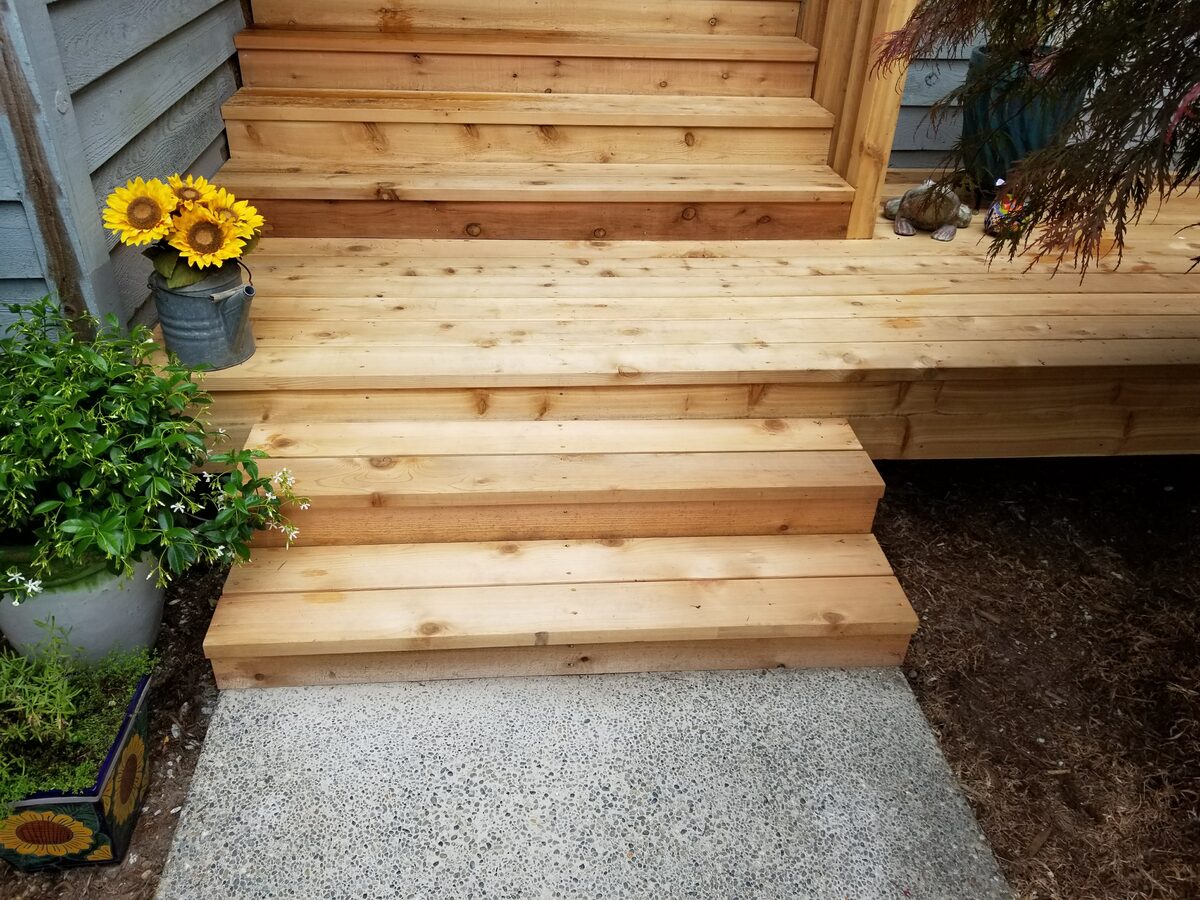
The patio-versus-deck question comes up in every region, but in Seattle it has a specific answer that depends on things most national guides gloss over: your lot's grade, your home's entry height, how your yard drains, and how you plan to use the space across twelve months in a climate that produces 38 inches of rain per year. In Phoenix or Atlanta, the choice is mostly aesthetic and budget-driven. In King County, terrain and drainage frequently make the decision for you — and when they don't, the maintenance math in a wet climate tilts the calculation in ways that matter over a 20-year ownership horizon.
We build decks throughout King County and have worked with homeowners who've made both choices — patios and decks — and lived with them through Seattle winters. The consistent pattern: homeowners who matched structure to lot conditions are satisfied with their choice. Homeowners who chose a patio on a sloped lot to save money spend years managing drainage problems and moss. Homeowners who chose cedar decking because it seemed like the natural choice in the Pacific Northwest spend their summers refinishing and their falls replacing boards.
This guide gives you the honest framework for making this decision for your specific property. Real cost numbers for King County in 2026. Real maintenance expectations in Seattle's climate. And clear guidance on when your lot's grade, your home's elevation, or your usage goals make one option substantially better than the other.
The Core Difference: What Grade Actually Decides
The terminology confusion comes first. A patio is a hardscaped surface at or near ground level — concrete slab, pavers, natural stone, or gravel — installed directly on the ground. A deck is an elevated framed structure built on posts and footings that stands above the ground. The distinction is not primarily aesthetic; it's structural.
The grade of your lot — how much elevation changes across your intended outdoor living footprint — determines which option is physically viable without expensive grading work.
Flat or nearly flat lot (grade change under 6 inches over the project footprint): A patio is fully viable. You have a real choice between patio and ground-level deck. Cost becomes the primary differentiator.
Moderate slope (grade change of 6–24 inches over the project footprint): A patio can still work but requires either grading (removing soil to create a level surface) or retaining work (building a low wall to create a level platform). The cost of that grading or retaining work narrows the gap between patio and deck cost significantly.
Significant slope (grade change exceeding 24 inches, or door threshold that's 24+ inches above the adjacent grade): A deck almost always makes more sense. Grading a site with 24+ inches of grade change requires significant earth movement, retaining walls, and drainage work — at which point you're often spending as much as a simple deck but ending up with a patio that still sits lower than you wanted it.
The clearest version of this rule: if your back door threshold is 24 inches or more above the existing grade where you want to stand and look at your yard, you need a deck. You need it not just aesthetically — for the connection between interior and exterior — but practically, because a patio that's 24 inches below your door threshold requires stairs to reach and creates a disconnected experience.
Throughout King County, the most common version of this scenario is a split-level or raised ranch home where the main living level is 4–6 feet above the backyard grade. On these properties, a deck off the main level is the only way to create a seamless indoor-outdoor connection. A patio 4–6 feet below requires stairs, creates a disconnected relationship with the home's living spaces, and feels like a detached outdoor area rather than an extension of the home.
Key insight
Cost Comparison: What Both Options Actually Cost in King County
Seattle's labor market and permitting environment mean that cost comparisons from national sources underestimate what you'll actually spend. Here are real 2026 installed cost ranges for King County:
Patio Costs (Installed, King County 2026)
| Patio Type | Cost per Sqft | 300 Sqft Installed | 500 Sqft Installed |
|---|---|---|---|
| Brushed concrete (standard) | $15–$22 | $4,500–$6,600 | $7,500–$11,000 |
| Stamped concrete | $20–$35 | $6,000–$10,500 | $10,000–$17,500 |
| Concrete pavers (standard) | $22–$35 | $6,600–$10,500 | $11,000–$17,500 |
| Concrete pavers (premium) | $32–$50 | $9,600–$15,000 | $16,000–$25,000 |
| Natural stone (flagstone, slate) | $40–$65 | $12,000–$19,500 | $20,000–$32,500 |
| Permeable pavers | $30–$48 | $9,000–$14,400 | $15,000–$24,000 |
Note: these are installed costs including site prep, base material (4–6 inches of crushed rock and sand), the surface material, and basic grading for drainage slope. They don't include retaining walls, significant earth removal, or stairwork.
Deck Costs (Installed, King County 2026)
| Deck Type | Cost per Sqft | 300 Sqft Installed | 500 Sqft Installed |
|---|---|---|---|
| Pressure-treated (ground level) | $55–$75 | $16,500–$22,500 | $27,500–$37,500 |
| Cedar (ground level) | $65–$90 | $19,500–$27,000 | $32,500–$45,000 |
| Composite (mid-grade, ground level) | $85–$110 | $25,500–$33,000 | $42,500–$55,000 |
| Composite (premium, ground level) | $100–$130 | $30,000–$39,000 | $50,000–$65,000 |
| Composite (elevated 4–8 ft) | $110–$150 | $33,000–$45,000 | $55,000–$75,000 |
| Composite (elevated 8–16 ft) | $130–$180 | $39,000–$54,000 | $65,000–$90,000 |
The cost gap between a concrete patio and a composite deck is genuine: a 300-square-foot concrete patio runs $4,500–$6,600; a 300-square-foot ground-level composite deck runs $25,500–$33,000. That's a 5:1 ratio for standard specifications. For homeowners with tight renovation budgets, this gap is decisive.
The gap narrows on sloped lots where the patio requires grading, retaining walls, or drainage work. Add $8,000–$20,000 in grading and retaining costs to that concrete patio for a significantly sloped lot, and the cost comparison against a ground-level deck changes materially.
For full detail on deck cost drivers in King County, see our deck cost guide.
| Category | Value |
|---|---|
| Concrete patio | $5,500 |
| Paver patio | $8,500 |
| Natural stone patio | $15,000 |
| PT wood deck (ground level) | $19,000 |
| Composite deck (ground level) | $29,000 |
| Composite deck (elevated) | $39,000 |
How Seattle's Rain Changes the Maintenance Equation
King County receives an average of 37–38 inches of precipitation per year across approximately 150–155 days with measurable precipitation. That's not a minor climate factor for outdoor surfaces — it's the defining operational condition for anything you build in your backyard. Understanding what rain does to each surface type is how you predict true 20-year cost of ownership.
What Rain Does to Concrete Patios
Concrete is the most rain-durable of the patio surfaces in Seattle's climate when properly installed. The critical factors:
Drainage slope: Concrete slabs must slope away from the house at a minimum of 1% grade (1/8 inch per foot) — this is code requirement in King County and a practical necessity. A patio that slopes toward the house directs hundreds of gallons of seasonal rain toward your foundation. The damage shows up slowly: efflorescence on basement walls, elevated interior humidity, eventually moisture infiltration in the foundation system. Improperly sloped patios are a common finding in home inspections throughout King County.
Moss and algae: Concrete in Seattle's wet, shaded environment develops moss and algae. The growth starts in joints, on porous surface areas, and in any spot that stays damp between rains. On a south-facing sunny patio, moss growth is moderate and manageable with annual treatment. On a shaded, north-facing patio — common in Seattle backyards surrounded by mature trees — moss can colonize aggressively within a single wet season. Annual treatment with a patio-safe moss killer and periodic pressure washing keeps it manageable.
Freeze-thaw: King County dips below freezing 20–30 nights per year, mostly November through February. Well-mixed, properly cured concrete with air-entrained admixture handles Seattle's freeze-thaw cycling without issue. The vulnerability is reinforcing steel corrosion in aging slabs — if concrete wasn't properly poured or the reinforcing steel is now exposed, freeze-thaw cycling accelerates deterioration at those points.
What Rain Does to Paver Patios
Paver patios are more vulnerable to Seattle rain than most homeowners expect at purchase.
Base erosion: Pavers sit on a sand-and-crushed-stone base. When Seattle's sustained winter rainfall exceeds the drainage capacity of that base — which happens on improperly sloped installations or in soils with low permeability — the base becomes saturated. Saturated sand base shifts; shifted base means settling pavers, uneven surfaces, and trip hazards within 5–10 years.
Polymeric sand washout: The jointing material between pavers (polymeric sand) hardens when wetted once and cured, but repeated exposure to standing water during heavy Seattle rain events erodes polymeric sand over time. Expect to reapply polymeric joint sand every 5–8 years in King County conditions.
Weed and moss intrusion: Paver joints are an ideal habitat for moss in Seattle's climate. Moss establishes in the joint material within 1–3 years without treatment. Annual application of a patio-safe moss inhibitor and a spring pressure wash keeps the patio presentable but requires ongoing attention.
Permeable pavers — which have wider joint spacing filled with crushed stone or gravel rather than sand — handle Seattle's rainfall better than standard pavers. Water passes through the joints into a permeable base rather than running across the surface. Permeable pavers reduce pooling, slow moss establishment in joints, and are increasingly specified for King County installations where stormwater management is a design consideration.
What Rain Does to Cedar Decks
Cedar is the Pacific Northwest's traditional deck material and there are good reasons for that: it's naturally resistant to moisture, dimensionally stable compared to pine, and aesthetically appropriate for the region. The limitation is maintenance discipline.
Cedar decks in Seattle require sealing every 12–18 months to maintain surface protection. A cedar deck that goes two or three seasons without sealing in King County's wet climate shows visible consequences: graying that progresses from silver to dark gray, moss establishing at board ends and between boards, and the beginning of surface fiber checking as the wood cycles through wet-dry exposure without protective sealant.
End grain rot is the structural concern. The cut ends of cedar boards — at the board ends and at fastener holes — are the entry points for moisture when sealant fails or is never applied. End grain rot doesn't announce itself visually until it's advanced. We've seen 8-year-old Bellevue decks that were maintained on the surface but had end grain rot at 40% of fastener holes because the sealant had never been applied to the back face and ends during installation.
What Rain Does to Composite Decks
Fully capped composite decking is the best performer in Seattle's sustained wet climate when measured against the full range of maintenance needs. The polymer shell on all four sides prevents moisture absorption into the wood-fiber core. Moss cannot establish in the polymer surface the way it can in open-grain cedar. The boards don't check, warp, or split when wet-dry cycling occurs.
The practical maintenance requirement for capped composite in King County: an annual rinse with a garden hose or pressure washer (low pressure, not strip setting) to clear pollen, dust, and leaf debris from board grooves. On shaded lots with heavy deciduous canopy, periodic clearing of groove channels from leaf debris in fall. That's the full maintenance program for a 25-year product life.
For the full material comparison, see our composite vs. cedar decking guide.
Permit Requirements: What Each Option Triggers in King County
This is a real difference between patios and decks that affects your project budget and timeline.
Patio Permits in King County
Most patio installations in King County do not require building permits. The general rule: a patio surface at grade level that doesn't alter drainage, add a retaining wall over 4 feet, or involve gas or electrical doesn't trigger building permit requirements in most King County cities.
Exceptions that do trigger patio permits:
- Retaining walls over 3–4 feet in height (threshold varies by city — Bellevue is 3 feet)
- Patios with integrated gas fire features (gas permit required)
- Patios with electrical work (permit required for new circuits)
- Patios in critical areas or shoreline buffers (may require additional review)
The permit-free status of patio installation is one of its genuine advantages for homeowners who want to move quickly. No permit application, no plan check timeline, no inspector visits.
Deck Permits in King County
Decks almost always require permits. The general threshold: any deck over 30 inches above grade requires a building permit in all King County cities. Decks under 30 inches above grade may qualify for simplified permits in some cities but are rarely fully exempt.
What the permit review covers:
- Structural plan showing footing size, post size, beam size, joist spacing, and ledger connection
- Setback compliance (decks over 18" above grade must meet standard setbacks from property lines in Seattle)
- Railing height compliance (42 inches minimum for elevated decks)
- Ledger connection details (including flashing and hardware specification)
Permit fees in King County for a standard 300-square-foot deck: $500–$1,500 depending on the city. Permit processing: 3–8 weeks depending on jurisdiction. For a full guide to the permit process, see our deck permit guide for King County. Seattle's SDCI publishes specific deck requirements at seattle.gov/sdci.
Note
When to Choose a Patio
Choose a patio when these conditions are present:
Your lot is flat. If your backyard is within 6–8 inches of level across the intended footprint, a patio is straightforward to install and genuinely competitive in quality with a ground-level deck. No posts, no framing, no inspector visits.
You want permanent heaviness. Concrete and natural stone patios have a solidity and permanence that wood or composite decking doesn't replicate. They feel different underfoot — heavier, more grounded. For some homeowners, this sensory quality is exactly what they want.
You're planning a fire pit or outdoor kitchen at grade. Concrete slab is the best base for a fire pit — no clearance concerns from combustion heat to the hardscape, no risk of ignition. For a heavy outdoor kitchen island placed directly at grade, a reinforced concrete pad is structurally simpler and more cost-effective than the structural engineering a deck kitchen requires.
Budget is the primary constraint. A 300-square-foot concrete patio at $5,500 is a real outdoor living surface. A 300-square-foot composite deck at $30,000 is a different investment tier. If the budget doesn't support the deck, the patio is not a compromise — it's the right choice for the financial parameters.
Your HOA approval process is simpler for patios. Many King County HOAs have stricter architectural review for elevated structures (decks) than for paved surfaces at grade. If you're navigating HOA review, a patio often has a clearer approval path.
You want faster project completion. A permit-free patio can be designed and built in 2–4 weeks. A deck with SDCI permitting takes 8–14 weeks from consultation to completion. If your timeline is short, the patio's speed-to-completion is a genuine advantage.
When to Choose a Deck
Choose a deck when these conditions are present:
Your home's main level is elevated above grade. If your back door opens to a step down of 24 inches or more to the yard, a deck creates a seamless connection. A patio 24 inches below door height requires stairs and creates a disconnected experience.
Your lot is sloped. Grade changes of 18+ inches across the project footprint favor a deck over graded or retained patio installation. The deck works with the grade instead of requiring expensive earth movement to fight it.
You want to maximize outdoor season. Composite decking dries faster than concrete and pavers after rain — an important distinction in Seattle's wet climate. After a Thursday night rain, a composite deck dries within 1–2 hours of sun emergence; a concrete patio retains surface moisture for 4–8 hours. Over a King County outdoor season, this difference adds up to meaningfully more comfortable outdoor time on a deck.
Resale value matters. In King County's premium residential market, decks add more measurable resale value than patios in the majority of cases. The NAR Remodeling Impact Report shows composite deck additions recovering 60–80% of cost in resale in premium markets. Patio additions recover 50–65% in comparable markets.
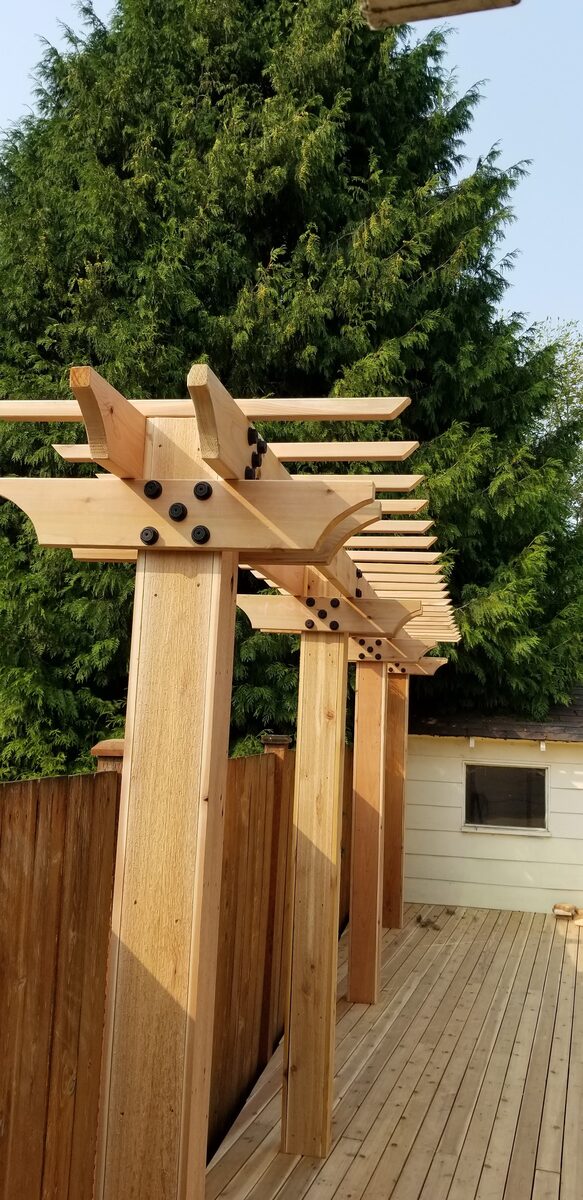
You want a design that builds up. Decks can be multi-level, cantilevered, or configured with built-in seating, planters, and pergola integration in ways that poured or paved surfaces can't be. For homeowners with a design vision that involves elevation changes, integrated furniture, or vertical structure, a deck is the right canvas.
Your lot has drainage limitations. Properly built decks drain naturally through the board gaps — precipitation falls through, not across. A deck on a challenging drainage lot doesn't require the slope management, French drain integration, or stormwater detention that a patio on the same lot might.
Tip
The Temperature Factor in Seattle
Seattle homeowners sometimes underestimate how cold concrete and stone feel underfoot during the region's long shoulder seasons. Concrete patios are cold. They retain chill effectively through Seattle's 40–50°F spring and fall temperatures. A concrete patio in March is unpleasant to walk on barefoot.
Composite and wood decking warm more quickly than concrete or stone and retain that warmth better in cooler temperatures. This affects how early in spring and how late in fall you actually use the outdoor space. On a King County property where outdoor season is already compressed by rain, the temperature factor matters.
The flip side: concrete and stone stay cool in heat, which is an advantage during Seattle's increasingly warm summer heat waves. When summer temperatures break 90°F — less rare now than a decade ago — concrete patios are cooler underfoot than dark composite boards that can surface-heat significantly in direct sun.
Note
The Hybrid Approach: Patio at Grade + Deck Off the Living Level
For many King County properties, the correct answer isn't patio versus deck — it's both, serving different purposes.
The most common hybrid scenario: a split-level home with a main living level 4–6 feet above the backyard grade. The deck serves the main level — it's the transition from the living room or kitchen to the outdoor space, designed for dining, lounging, and entertaining at the living level's elevation. The patio occupies the lower yard level — a second outdoor zone, perhaps around a fire pit or garden area, connected to the deck by stairs.
This hybrid layout maximizes backyard utility on King County's many split-level lots. The deck handles the elevation change elegantly; the patio provides a different-character outdoor space at grade. The combined investment runs $35,000–$70,000 for a moderate-scope deck plus a quality paver patio below — a budget that gets you two functional outdoor zones rather than one.
Other hybrid applications:
- Entry patio + back deck: A front or side entry patio at grade combined with an elevated deck off the main living level
- Pool patio + entertaining deck: A concrete pool surround at grade plus an elevated composite deck at the living level connecting to the pool area
- Side patio + rear deck: A side-yard patio garden space combined with a rear elevated deck for entertaining
For homeowners considering a hybrid approach, we recommend designing both surfaces simultaneously. The stair connection between deck and patio needs to be planned as part of the deck's structural layout. The visual relationship between both surfaces also reads better when they're designed together rather than treated as separate projects.
Resale Value: What Buyers in King County Actually Value
The resale value comparison between patios and decks deserves specific attention because both options represent a meaningful capital investment, and the return on that investment varies by property type, neighborhood, and buyer expectation.
In King County's higher-value market segments (Bellevue, Sammamish, Kirkland, Mercer Island, waterfront Seattle), buyers at price points above $1 million increasingly expect dedicated outdoor living structure — a deck, ideally composite, ideally covered. A concrete patio in the backyard of a $1.5 million Bellevue home reads to buyers as a missing upgrade, not a feature. The deck with integrated pergola structure is the expected standard.
In mid-tier markets (Renton, Auburn, Kent, outer Shoreline, Bothell), the distinction is less stark. A quality paver patio is a genuine amenity that buyers respond to. A composite deck is more expensive and commands a higher recovery value, but the differential is narrower than in premium zip codes.
Both add value — the honest answer to "does a patio or deck add more resale value" is: it depends on the home's price point and the buyer expectation for that neighborhood. For homes valued above $700,000 in King County, a deck consistently outperforms a patio in resale recovery. For homes valued under $500,000, the more affordable patio improvement often makes more financial sense as a resale investment.
| Category | Value |
|---|---|
| Concrete patio | $9,250 |
| Paver patio | $14,750 |
| Cedar deck | $42,000 |
| Composite deck (capped) | $33,750 |
| PVC deck | $38,500 |
Longevity: What Each Surface Lasts in Seattle's Climate
| Surface | Expected Lifespan (King County) | Typical Failure Mode |
|---|---|---|
| Brushed concrete | 30–50 years | Surface spalling, crack propagation at joints |
| Concrete pavers | 20–35 years | Base settling, joint sand washout, unit cracking |
| Natural stone | 40–60 years | Joint failure, surface wear in traffic zones |
| Pressure-treated wood deck | 10–20 years | Joist and ledger rot, surface checking |
| Cedar deck | 20–30 years with maintenance | Surface and end grain rot, ledger deterioration |
| Composite (uncapped) | 15–25 years | Mold, surface fade, moisture damage at cut ends |
| Composite (fully capped) | 25–35 years | Surface scratch wear in high traffic zones |
| PVC cellular deck | 30–40 years | Surface scratch, UV yellowing in extreme cases |
The comparison that surprises most homeowners: a properly maintained concrete patio lasts longer than a cedar deck — 30–50 years versus 20–30 years. The patio's durability advantage is real. The deck's advantages are in drainage, elevation connection to the home, design flexibility, and faster drying after rain. Neither option is better across all dimensions; the right choice is the one that fits your lot and your usage pattern.
Maintenance Cost of Ownership Over 25 Years
| Surface | Initial Cost (300 sqft) | Annual Maintenance | 25-Year Maintenance Total | 25-Year Total Ownership |
|---|---|---|---|---|
| Concrete patio | $5,500 | $150 (cleaning + moss treatment) | $3,750 | $9,250 |
| Paver patio | $8,500 | $250 (cleaning, joint refresh, moss) | $6,250 | $14,750 |
| Cedar deck | $22,000 | $800 (sealant, boards, refinishing) | $20,000 | $42,000 |
| Composite deck (fully capped) | $30,000 | $150 (annual rinse) | $3,750 | $33,750 |
| PVC deck | $36,000 | $100 (annual rinse) | $2,500 | $38,500 |
The 25-year comparison shifts the value calculation significantly. Cedar decking looks less expensive than composite at purchase — $22,000 versus $30,000 — but the 25-year ownership cost is comparable when maintenance is included, and cedar requires significantly more work to achieve that outcome.
Making the Final Decision: A Framework
Use this framework to organize your decision:
Grade test: Measure the elevation change between your door threshold and the far end of the intended outdoor footprint. Under 18 inches: genuine patio-or-deck choice. Over 18 inches: deck strongly preferred. Over 36 inches: deck almost certainly the only practical option without extensive grading.
Budget test: Determine your actual project budget. Under $12,000: concrete or paver patio is the viable option. $12,000–$25,000: quality paver patio or entry-level deck. Over $25,000: composite deck is in range. Over $40,000: premium composite deck with integrated features.
Usage test: How do you intend to use the space, and in what weather? Year-round grilling, covered entertaining, and furniture that stays out all season favor a deck with pergola cover. Seasonal garden parties and summer fire pits on a flat lawn favor a patio.
Maintenance test: How much time will you realistically spend maintaining outdoor surfaces? Low maintenance tolerance: composite deck or concrete patio. Medium tolerance: paver patio or cedar deck with active sealing schedule.
Timeline test: When do you need to use the space? Patio permitting (often none required) and installation move faster. Deck permitting (4–8 weeks in most King County cities) and construction take longer. If you need the space by July, starting a deck project in May is too late in most King County cities.
Frequently Asked Questions: Patio vs. Deck in Seattle
Frequently Asked Questions
Is a patio or deck better for a sloped Seattle lot?
How much does a concrete patio cost in Seattle in 2026?
Does a patio or deck add more value to a Seattle home?
Do I need a permit for a patio in King County?
What's the best patio material for Seattle's rainy climate?
How much does moss affect patio and deck maintenance in Seattle?
Can I build a patio and a deck, or do I need to choose?
Is composite decking worth the extra cost over concrete in Seattle?
How long does it take to build a patio vs. a deck in King County?
What is a permeable paver and should I use it for my Seattle patio?
Does a concrete patio require drainage work in Seattle?
Can I convert a concrete patio to a deck later?
Neighborhood-by-Neighborhood Guide: What Works Where in King County
King County's neighborhoods have distinct lot characteristics, topography, and home styles that make the patio-vs-deck question have somewhat different typical answers depending on where you live:
Capitol Hill, First Hill, Central District
Urban lots averaging 25–40 feet wide with mixed-grade backyards. The most common scenario: a raised foundation home (craftsman or foursquare) with a door threshold 18–30 inches above the backyard grade and a relatively short 20–35 foot deep yard behind. Here, a deck almost always wins — the door height requires it, and the small lot benefits from the multi-level design approach (main deck at door height, lower landing at grade) that makes urban decks feel larger than their footprint. Patios work on Capitol Hill lots that are essentially flat and where the homeowner's door opens close to grade — less common but they exist.
Most common configuration: Multi-level composite deck, 250–380 sqft total, cable railing, no pergola (lot too small for comfortable pergola clearance) or open cedar pergola over the main zone.
West Seattle (Admiral, Morgan Junction, Fauntleroy)
Strong mix of flat and sloped lots. The Admiral and Morgan Junction neighborhoods around the bluff have dramatic slopes that mandate decks — sometimes elevated 8 to 14 feet above grade with mountain and water views. The more inland portions of West Seattle are flatter and patio-viable. Home styles are varied: original craftsman bungalows, post-WWII ramblers, and newer construction, with door threshold heights ranging from 6 inches to 36+ inches above grade.
Most common configuration on sloped lots: Elevated composite deck with cable railing capturing views. On flat lots: quality paver patio or ground-level composite deck depending on budget.
Bellevue (West Side and East Side)
Bellevue's west side — the hills overlooking Lake Washington — has dramatic grade changes, view lots, and home values that support significant outdoor living investment. Decks are the only practical solution on many west Bellevue properties, and the investment level supports composite with cable railing and covered structures. Bellevue's east side and plateau areas are flatter, with family-oriented neighborhoods where the hybrid (deck + patio) configuration is common.
Most common configuration: Premium composite deck with cable railing on view lots (west Bellevue). Composite deck + paver patio combination on plateau lots. The Bellevue market fully supports pergola additions — covered structures are expected at high price points.
Sammamish Plateau
Flat-to-gently-rolling topography with newer housing stock (mostly 1995–2015 construction), typically with slab-on-grade or minimal foundation heights. Door thresholds are often 8–16 inches above grade — enough to warrant a deck but not dramatically elevated. Many Sammamish lots have grade changes of 18–36 inches across the backyard depth, which tips toward deck.
Sammamish also experiences more consistent wind than lower-lying Eastside neighborhoods — louvered pergola systems with motorized panels that can close in wind events are a sensible upgrade on Sammamish lots with southwest exposure.
Most common configuration: Ground-level or moderately elevated composite deck (300–500 sqft), polycarbonate-roofed cedar pergola or louvered system, hybrid deck + secondary patio common on larger lots.
Kirkland
Kirkland's west-facing lots near Lake Washington command some of the most view-premium outdoor living investments in King County. Cable railing is essentially standard on Kirkland view lots — any railing that obstructs lake views is a design error at Kirkland price points. Pergola systems over primary entertaining decks are common and well-supported by home values.
Eastern Kirkland (Juanita, Kingsgate) is flatter and more budget-diverse — patio-or-deck is a genuine choice on flat Kirkland lots, with quality paver patios being reasonable investments in mid-tier Kirkland neighborhoods.
Renton and South King County
South King County — Renton, Federal Way, Kent, Auburn — has the widest range of lot types, grades, and home values in King County. The correct choice varies dramatically by specific lot. Patio-viable flat lots are more common here than in hillside Seattle neighborhoods. Budget constraints are also more commonly the primary decision driver than in Eastside markets.
For Renton and south King County lots specifically: don't assume a patio is the obvious budget choice without understanding what proper drainage work on clay soils costs. Much of South King County has clay-heavy soil with poor permeability, which creates drainage challenges for both patios and decks. A patio on impermeable clay without proper crushed-stone base depth and drainage slope can perform worse in Seattle's wet climate than the same structure in more permeable South End soils.
Working With Contractors: What to Expect From Estimates
Whether you're getting a patio or deck estimate, the quoting process should be similar — detailed, itemized, and honest about what's included.
What a Good Deck Estimate Includes
- Permit fee (included in the quote, not added later as a surprise)
- Demo and disposal if there's an existing structure
- Footing excavation, concrete, and tube selection
- Framing materials: posts, beams, joists, ledger, hardware
- Decking material with specific product name and color
- Railing system with specific product name
- Stair system including stringer, treads, and handrail
- Labor for all phases
- Any electrical work planned
An estimate that quotes a single total without itemization is harder to compare against other estimates and harder to negotiate when you want to adjust scope. We provide line-item quotes on every project.
What a Good Patio Estimate Includes
- Site prep and grading
- Base material (crushed stone) depth and compaction
- Sand bedding layer
- Surface material with specific product, pattern, and color
- Edge restraint system
- Joint sand or gravel specification
- Drainage slope verification
- Any drainage structures (catch basins, perimeter drain channel)
- Labor for all phases
Questions to Ask Any Contractor
- Is permit cost included in the quote, or is it additional?
- Is the project quoted with named material brands and specific products, or just material categories?
- Who is responsible for permit application and management?
- What is the warranty on workmanship?
- Is the contractor licensed in Washington State? (Verify at WA Labor & Industries)
- Do they carry general liability insurance and a bond? (Ask for a certificate of insurance before signing.)
We provide answers to all of these questions at the initial consultation, without being asked. We're licensed, bonded, and carry general liability insurance — we'll provide proof at the first meeting.
Get Help Choosing for Your Property
The patio-versus-deck decision depends on your specific lot grade, your home's entry elevation, your budget, and how you intend to use the space across Seattle's twelve-month weather calendar. We've helped hundreds of King County homeowners work through this decision — and we don't have a stake in pushing you toward the more expensive option if the less expensive one genuinely serves your property better.
We offer free site consultations that include a grade measurement, drainage assessment, and honest comparison of both options for your specific lot. We build decks throughout King County and can give you a clear-eyed view of what each option costs and what it delivers on your property specifically.
Call (425) 675-6259 or request a consultation online. We serve King County from Bellevue to Bothell, Shoreline to Sammamish.
Planning a deck in the Seattle area?
Get an onsite design review and a clear, itemized quote from a licensed local builder.
Request a Free Quote