
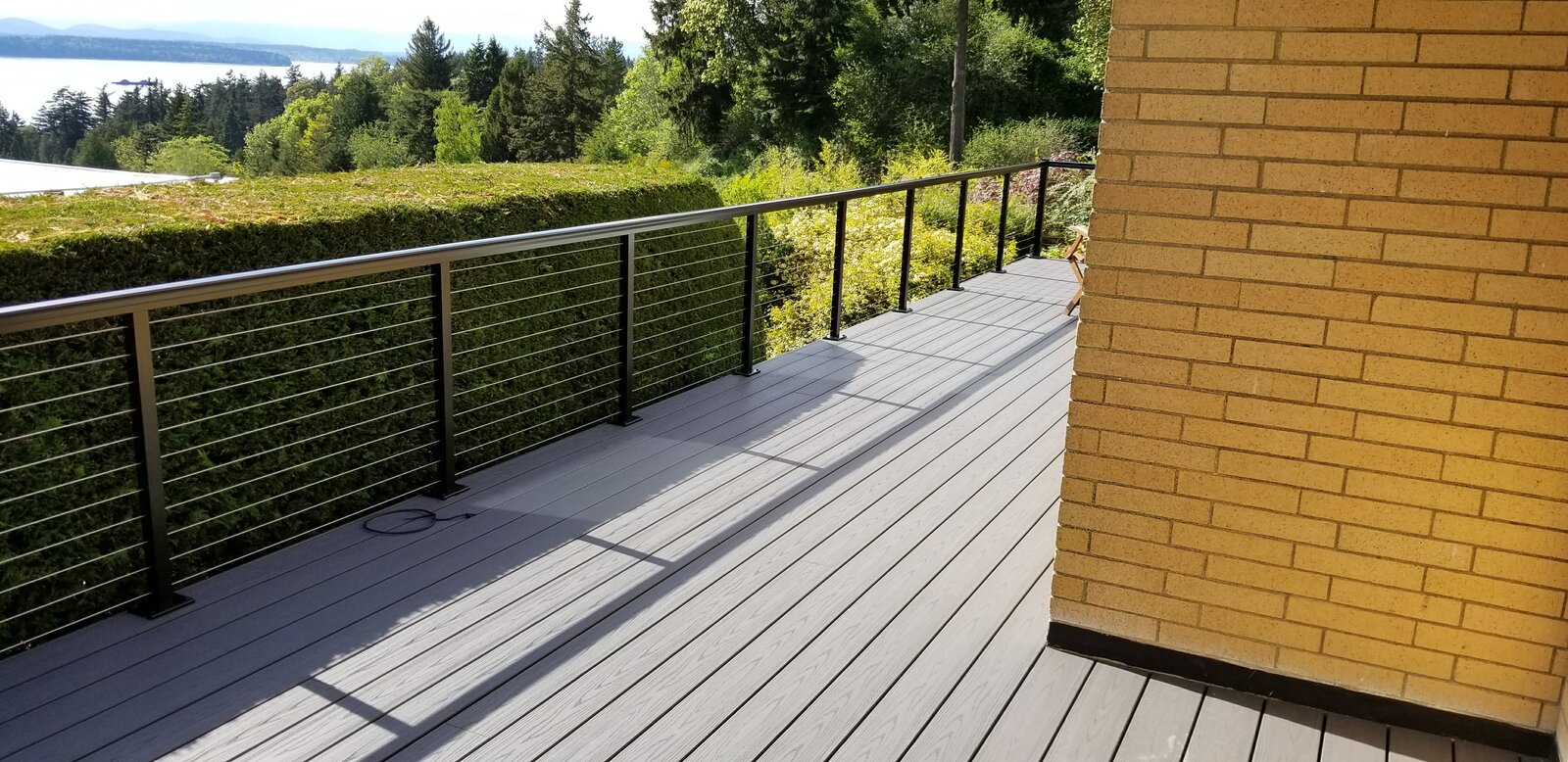
Every spring, we field the same call from homeowners in Bellevue, Kirkland, Redmond, and across King County: "My deck is turning gray and I'm seeing soft spots near the stairs — what do I do?" Nine times out of ten, the culprit is the same. A cedar deck that looked beautiful at installation has been fighting the Pacific Northwest's relentless moisture cycle for a few years without enough attention, and now it's losing. The caller wants to know whether to repair it or replace it — and whether, this time, they should go with composite instead.
That question — cedar or composite? — is the most common decision Seattle homeowners face when they build or replace a deck. It sounds simple, but it's not. The answer depends on your budget structure (money now versus money over 15 years), your tolerance for maintenance work, the specific microclimate of your property, and what you actually value in an outdoor living space. We've built hundreds of decks across King County over the past 15 years, in neighborhoods from Mercer Island to Maple Valley, and we've watched both materials perform in real Seattle conditions — not lab conditions, not Arizona conditions. What we've learned is worth sharing honestly, without a sales agenda.
Seattle gets approximately 38 inches of rain per year, with most of it falling between October and April in a persistent, low-grade drizzle that never quite lets surfaces dry out. That's a fundamentally different stress profile than, say, Chicago's freeze-thaw cycles or Houston's UV exposure. Our climate is mild enough that cedar can, in theory, last decades — but wet enough that it won't unless you actively protect it. Composite decking was engineered partly with climates like ours in mind. Which one actually wins in the Pacific Northwest? We'll give you an honest answer, backed by numbers.
Seattle's Climate Challenge: What 38 Inches of Rain Does to Your Deck
Most people think about Seattle rain the wrong way. When you imagine 38 inches of annual precipitation, you might picture dramatic downpours — the kind that last an hour and leave everything soaked but then give the sun a chance to dry things out. That's not what Seattle rain is. Our precipitation falls largely as extended drizzle, mist, and overcast humidity from October through April. A deck surface might be damp for eight to twelve consecutive weeks in the winter months, with only occasional breaks. That persistent moisture — never fully drying between rain events — is the enemy of any organic material.
Wood, including cedar, responds to moisture dynamically. It expands when it absorbs water and contracts when it dries. In a climate where that cycle repeats hundreds of times per year, the mechanical stress accumulates. Board edges begin to cup. End grain checks develop. Fastener holes loosen slightly with each expansion-contraction cycle. And wherever moisture is trapped — in a small crack, under a board, in a fastener hole — biological activity begins. Mold, mildew, algae, and eventually wood-decay fungi find their footing in exactly those spots.
What "Wet Climate" Actually Means for Deck Performance
When we say Seattle is demanding for deck materials, we're talking about several overlapping conditions. First, there's the sheer volume of moisture. Thirty-eight inches of rain is not exceptional in a global sense, but it arrives in a way that maximizes surface exposure. Second, our temperatures stay in the 40–60°F range for much of the rainy season — cold enough to slow drying, warm enough to support biological growth. Mold and algae thrive in exactly this range. Third, the combination of shade from our mature tree canopy and the extended overcast season means many decks in neighborhoods like Ravenna, Wedgwood, or Sammamish never get the sustained UV exposure that would naturally suppress biological growth.
The result is that deck materials are under sustained moisture stress for roughly half the year. Cedar responds to this stress with graying, checking, and — if left unsealed — gradual moisture infiltration that opens the door to dry rot. According to Corvus Construction's Pacific Northwest deck guide, an unsealed cedar deck in King or Pierce County can begin showing moss growth and gray discoloration within two years of installation. We've seen it happen faster than that on north-facing properties with heavy tree cover.
The Specific Failure Modes We See Every Year
In our work across King County, we see a predictable set of failure patterns in aged cedar decks. The first and most common is end-grain rot — the cut ends of deck boards, where moisture absorption is fastest, soften first. If the deck has exposed end grain at the rim (rather than properly capped or concealed ends), those spots often develop soft rot within three to five years in an unmaintained deck. The second common failure is fastener-area rot, where water infiltrates around screws or nails and the surrounding wood decays. The third, and most expensive, is structural rot — when moisture wicks down from surface boards into the framing, joists, and ledger. Structural rot repairs routinely exceed $2,000 and can reach $4,500 or more when joists and ledger boards need replacement.
Composite decking sidesteps most of these failure modes entirely. The boards themselves don't absorb water. They don't check, cup, or develop end-grain rot. The fastener systems used with composite (hidden clip fasteners or stainless plugged face screws) seal the penetration points effectively. The failure modes that exist in composite are different: fading under UV over many years, surface staining from tannins or iron, and — in lower-quality composites — surface mold on top of the board rather than inside it.
Note
The bottom line on climate challenge: Seattle's moisture environment is severe enough that material choice matters more here than it would in Denver or Atlanta. You can build a beautiful deck with either cedar or composite in the Pacific Northwest — but you cannot ignore the climate when making that choice.
Cedar Decking in the PNW: Natural Beauty With a Maintenance Price
Cedar has been the traditional decking material in the Pacific Northwest for generations, and for good reason. Western red cedar is grown here. It's a local material with natural properties that make it genuinely well-suited to damp climates — or so the story goes. The reality is more nuanced: cedar's natural properties give it a head start, but they don't remove the need for ongoing protection in a climate as demanding as ours.
Western red cedar contains natural oils and tannins that provide inherent resistance to rot, insects, and moisture — to a degree. These compounds are distributed unevenly through the wood, with heartwood (the darker center of the tree) offering much better protection than sapwood (the lighter outer rings). Premium-grade all-heartwood cedar boards are significantly more rot-resistant than lower grades that include sapwood. When we build cedar decks, we spec heartwood-dominant boards and pay attention to grade, because the performance difference is real.
What Cedar Does Well in Seattle
Cedar's natural moisture resistance, when combined with proper maintenance, allows it to perform genuinely well in the Pacific Northwest. Real Cedar's comparative analysis notes that cedar has an expected service life of 25 or more years when properly maintained — and we've seen that in practice. We've worked on cedar decks in Kirkland and Bellevue that were 30 years old and structurally sound, though they required significant maintenance to get there.
Beyond performance, cedar has aesthetic qualities that composite simply cannot replicate. The grain variation, the warmth of natural wood, the way it takes stain, the smell when freshly milled — these are real qualities that matter to a lot of homeowners. Cedar is also workable in ways composite isn't: you can rip it to non-standard widths, make curved cuts easily, mill it on-site for custom profiles. For decks with complex geometry or architectural details that need to match an existing wood element on the house, cedar often gives better results.
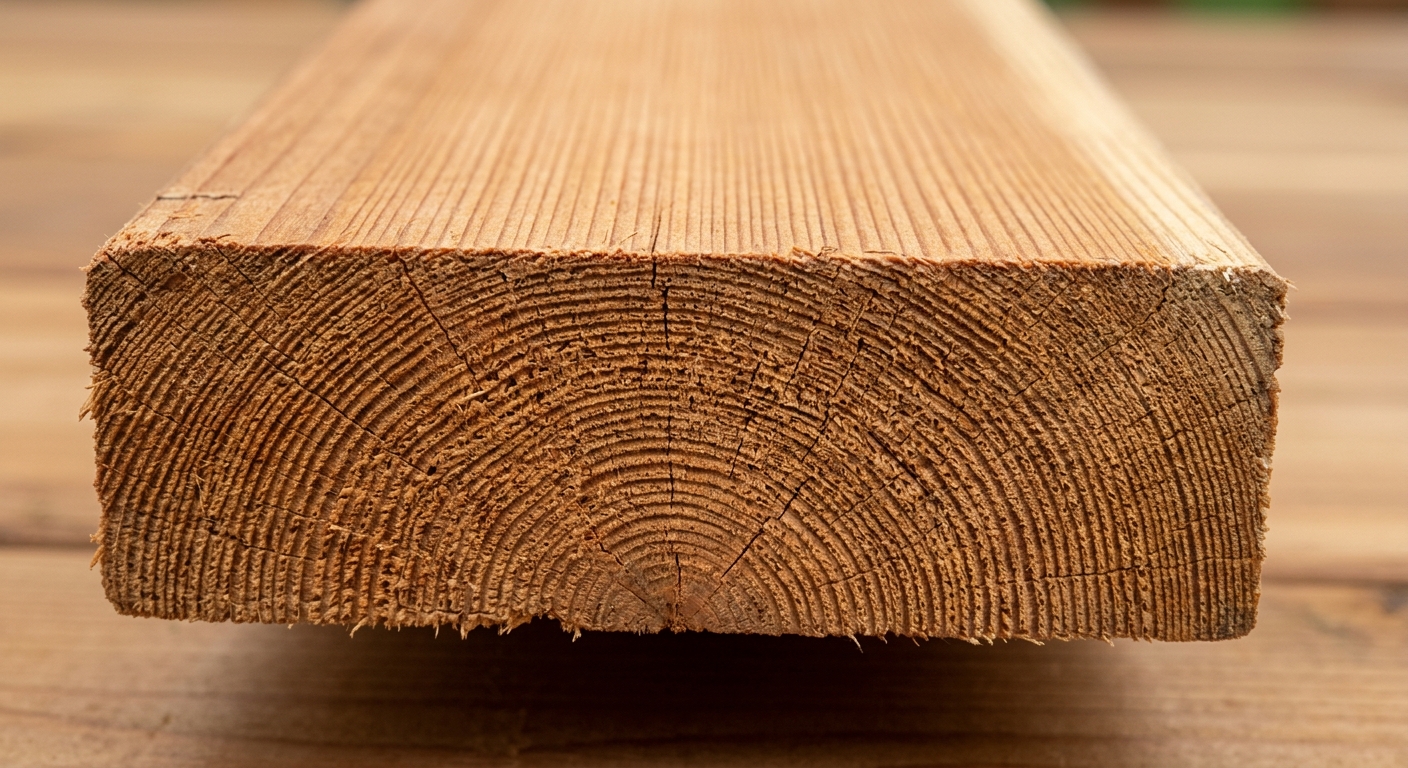
Natural cedar heartwood grain — the texture and warmth that composite is still working to replicate.
Cedar is also lighter than composite (roughly 2.2 lbs per linear foot for a 5/4x6 cedar board versus 3.5–4.5 lbs for a composite equivalent), which matters for elevated decks where structural load calculations are a factor. And as Real Cedar notes, cedar has the smallest carbon footprint of any common decking material — it's a natural, renewable resource grown in managed forests, and it sequesters carbon rather than releasing it.
The Maintenance Commitment: What You're Signing Up For
This is where the honest conversation has to happen. Cedar in the Pacific Northwest requires consistent maintenance — not the occasional weekend project, but a scheduled, recurring commitment. The Seattle Times reports that cedar needs to be stained or sealed every one to three years in the PNW, and that once mold, algae, and mildew take hold, a wet cedar deck can become as slippery as ice. We've walked cedar decks that were genuinely hazardous after just three or four years without maintenance.
The maintenance cycle for a properly cared-for cedar deck in Seattle looks like this:
- Annual spring cleaning: Pressure washing at appropriate PSI (too high damages wood fibers), treatment with a deck cleaner/brightener to remove tannin staining and kill surface mold, allowing full dry time before any coating application.
- Sealant/stain application every 1–3 years: An oil-based penetrating stain or sealant applied to clean, dry wood. This is where most people cut corners — applying stain to a damp or dirty deck dramatically reduces its protective life. Professional application runs $300–$1,200 per treatment depending on deck size and condition.
- Annual inspection: Checking fasteners for mushrooming, end grain for softness, any board edges showing separation. Catching a small soft spot early costs $120–$400 to fix. Missing it for two more years may mean $2,000+ in structural work.
Tool & Trade Construction's cedar maintenance analysis notes that cedar maintained with biennial oil-based sealant applications can consistently outperform pressure-treated lumber over a 15–25 year lifespan in Seattle's wet climate. The "consistently" in that sentence is doing a lot of work — the performance depends entirely on actually doing the maintenance.
Important
Cedar's Cost Structure
Cedar decking boards (5/4x6 standard profile) run $4–$8 per square foot in materials. That's boards only — you still need framing lumber, hardware, fasteners, and labor on top. A full cedar deck project in Seattle (300–500 sq ft range) typically lands between $18,000 and $45,000 installed, depending on complexity, height, site conditions, and finish details. That's the upfront number. The lifetime cost is higher, when you factor in the recurring maintenance cycles — more on that in the cost comparison section.
Our internal page on composite vs cedar decking dives further into the grade and product selection details for cedar, but the summary is this: cedar is a legitimate, beautiful, high-performing material if you're committed to maintaining it. It is not a "set it and forget it" option in the Pacific Northwest. Anyone who tells you otherwise hasn't lived here long enough.
Composite Decking in Seattle: The Low-Maintenance Case
The composite decking category has changed dramatically over the past 15 years. The early composite products — essentially ground wood fiber mixed with polyethylene — had real problems: they faded badly, grew surface mold, and felt cheap underfoot. The products that Trex, TimberTech, Fiberon, and AZEK now sell in 2026 are fundamentally different. They're capped composites with a co-extruded polymer shell that seals the wood-fiber core from moisture, dramatically reduces fading, and prevents the surface mold that plagued early products.
The reason composite has come to dominate the premium residential deck market in the Seattle area, as Orca Roofing's Pacific Northwest guide notes, is straightforward: homeowners who've owned cedar decks know what the maintenance burden looks like. When they replace those decks, they often choose composite specifically to escape that cycle.
How Composite Performs in Pacific Northwest Conditions
The specific properties that make capped composite attractive in Seattle's climate:
Moisture resistance: Capped composite boards don't absorb water. Period. The polymer shell prevents moisture infiltration at the board surface. There's no swelling, no checking, no end-grain rot. In a climate where moisture is the primary threat, this is the single most important performance characteristic.
Biological resistance: Because capped composite doesn't provide the organic substrate that mold and mildew need, surface biological growth is dramatically reduced compared to cedar. Some surface mold can grow on top of composite in heavily shaded situations (on top of the surface, from accumulated organic debris), but it's easily cleaned and doesn't penetrate into the material. Compare that to cedar, where biological growth actively breaks down the wood.
Dimensional stability: Composite boards expand and contract with temperature, not with moisture. The coefficient of thermal expansion is managed through proper gapping at installation. But there's no moisture-driven warping, cupping, or checking. The deck you install looks essentially the same five years later — something that's simply not true of unmaintained cedar.
Slip resistance: Quality composite decking has textured surfaces that maintain traction when wet. Cedar, when it develops algae or mildew, can become genuinely dangerous when wet. This is a safety consideration worth taking seriously, particularly on elevated decks or decks used by older adults.
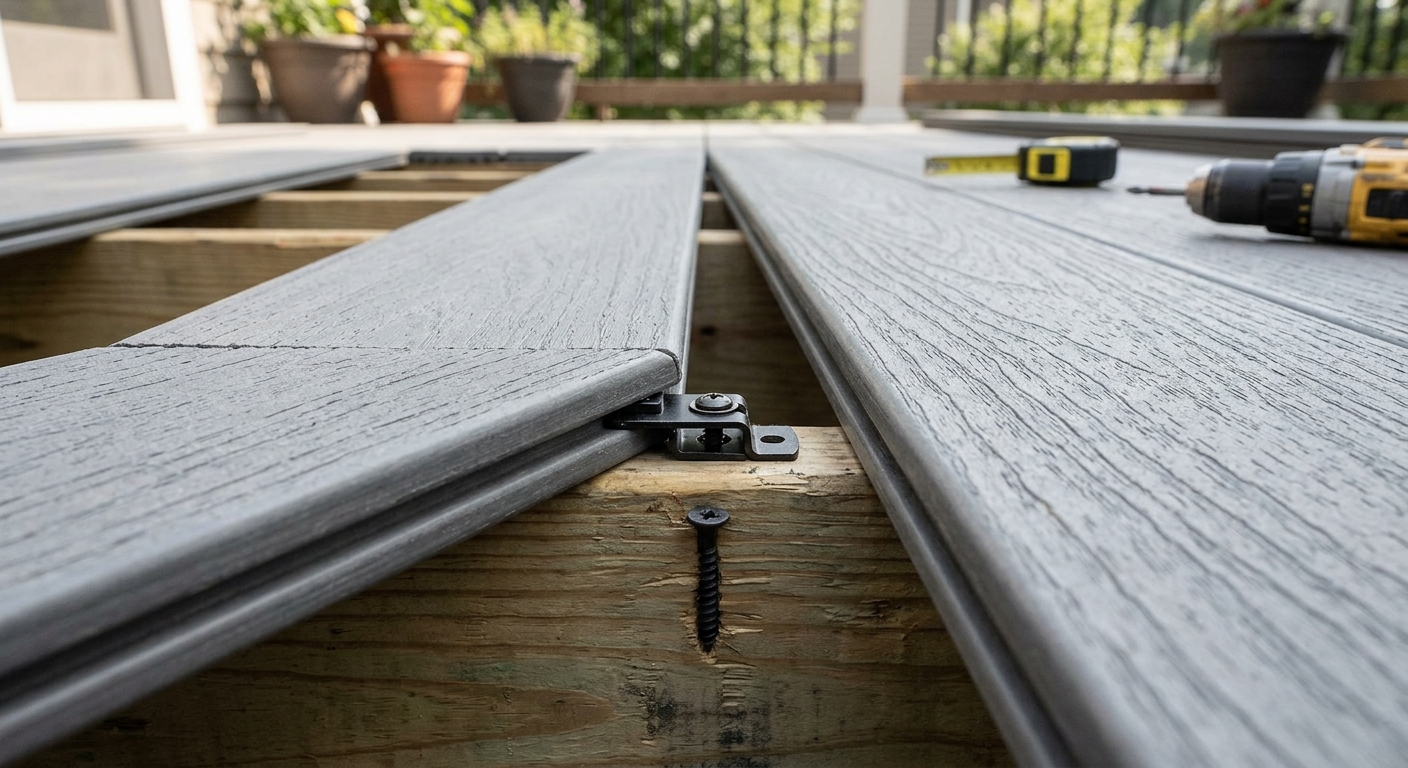
Capped composite with hidden clip fasteners — the installation method eliminates visible fastener holes and helps seal deck board edges.
Product Comparison: Trex, TimberTech, Fiberon, AZEK
We work with all four of the major premium composite brands, and each has a slightly different position. Our detailed comparison is at /blog/trex-vs-fiberon-vs-timbertech-seattle, but here's the high-level breakdown:
| Brand | Core Technology | Best For | Price Range (installed, $/sq ft) |
|---|---|---|---|
| Trex Transcend/Select | Capped composite (90% recycled) | Value + sustainability | $30–$52 |
| TimberTech AZEK | Capped composite / full PVC | Maximum durability | $38–$65 |
| Fiberon Symmetry | Capped composite | Mid-range balance | $32–$55 |
| AZEK (PVC) | 100% cellular PVC | Zero moisture absorption | $42–$75 |
AZEK and the TimberTech AZEK line occupy the premium end specifically because they're full PVC rather than composite — there's no wood fiber at all, which means they are genuinely impervious to moisture, not just resistant to it. For decks in particularly shaded or moisture-intensive situations (think: a deck under a tree canopy in Maple Valley, or a north-facing deck in Shoreline), the extra investment in full PVC is worth considering.
Tip
What Composite Doesn't Do
Honesty requires acknowledging composite's limitations. It's not wood. Even the best capped composite products, with embossed grain patterns and variegated coloring, don't feel or look exactly like natural cedar up close. If you're building a deck where the natural wood aesthetic is central to the design — where the deck is meant to complement cedar siding, timber beams, or extensive wood detailing — composite can feel slightly incongruous to a trained eye.
Composite also can't be easily milled or custom-profiled on-site the way cedar can. If you need a fascia board at a non-standard width, or a custom nosing profile for stair treads, cedar gives you more flexibility. And composite is significantly heavier than cedar, which can be a factor for elevated deck framing calculations.
Composite decking also retains heat more than wood. On a sunny summer day — yes, we do have those in Seattle — a dark composite deck surface can get noticeably hot underfoot. AZEK's full PVC products tend to run cooler than wood-fiber composites, but it's worth considering if you choose dark colorways.
Cost Comparison: Upfront Price vs. 15-Year Total Cost of Ownership
The most common framing mistake homeowners make when comparing cedar and composite is treating it as a simple materials cost comparison. Cedar is cheaper per square foot of board — that's true. But the decision is actually a time-value tradeoff between money spent now and money spent over the next 15 to 20 years. When you run the numbers on total cost of ownership, the gap between cedar and composite narrows considerably, and in some scenarios composite actually costs less over the long run.
Let's build a realistic scenario: a 400 square foot deck in the Seattle area, mid-complexity (single level, standard railing, no major grade change), installed by a professional contractor.
Upfront Installation Costs
For cedar, a 400 sq ft deck in Seattle using quality cedar boards and standard framing runs approximately $22,000–$35,000 installed, depending on site conditions and detail level. For composite (Trex Transcend or comparable), the same footprint runs approximately $32,000–$50,000 installed. The composite premium at installation is roughly $10,000–$15,000 on a project of this size.
That upfront premium is real and it matters. It's a meaningful amount of money. The question is what you get for it over the next 15–20 years.
Installed cost ranges for a 400 sq ft mid-complexity deck in King County. Cedar range reflects grade and complexity variation; composite range reflects brand and finish tier. Source: The Seattle Decking Company project data and regional contractor surveys.
| Category | Value |
|---|---|
| Cedar (low) | $22,000 |
| Cedar (high) | $35,000 |
| Composite - Trex (low) | $32,000 |
| Composite - Trex (high) | $50,000 |
| Composite - AZEK (high) | $65,000 |
15-Year Maintenance Cost Projection
Here's where the calculus shifts. A cedar deck requires, at minimum:
- Professional cleaning and sealing every 2 years: $600 average per treatment x 7 cycles = $4,200
- One minor repair (soft board, fastener area rot): $400 average
- One moderate repair (joist end or ledger area): $1,200 average
- Total 15-year maintenance cost, cedar: approximately $5,800–$8,500 (assuming diligent care)
If maintenance is inconsistent and a major structural repair is needed:
- Major dry rot repair (joist replacement, ledger work): $2,500–$4,500
- Total 15-year cost with one major repair: $8,000–$14,000
For composite, the 15-year maintenance picture is dramatically simpler:
- Annual cleaning (homeowner-DIY with soap and water or composite cleaner): $30–$80/year x 15 = $450–$1,200
- One professional cleaning (every 3–5 years): $150–$300 x 3 = $450–$900
- Repairs: typically none on quality capped composite within 15 years under normal conditions
- Total 15-year maintenance cost, composite: approximately $900–$2,100
The math: Cedar's installation savings of $10,000–$15,000 versus composite can be partially or fully offset by the $6,000–$12,000 in additional maintenance over 15 years — particularly if any significant repair work is needed. At the 15-year mark, the total cost of ownership for both materials is often within $3,000–$5,000 of each other, and for homeowners who've had one or two major repair events, composite may actually come out ahead.
Key insight
| Cost Category | Cedar (15 yr total) | Composite (15 yr total) |
|---|---|---|
| Installation (400 sq ft) | $22,000–$35,000 | $32,000–$50,000 |
| Regular maintenance | $4,200–$6,000 | $900–$2,100 |
| Repairs (minor to moderate) | $1,600–$5,700 | $0–$500 |
| Total 15-Year Cost | $27,800–$46,700 | $32,900–$52,600 |
You can also review our dedicated deck cost guide for Seattle for deeper breakdowns by project type and neighborhood, and our full deck cost calculator page for project-specific estimates.
Durability and Lifespan: How Each Material Holds Up in Pacific Northwest Conditions
Lifespan projections for building materials always come with a significant asterisk: they depend heavily on installation quality, ongoing care, and site-specific conditions. A cedar deck on a sunny south-facing property in Bellevue with regular maintenance will outlast a cedar deck on a north-facing property in a wooded area of Issaquah that's rarely touched. With that caveat stated, here's an honest assessment of what you can expect from each material in Pacific Northwest conditions.
Cedar Lifespan Expectations in Seattle
Cedar's longevity in our climate is directly correlated with maintenance frequency. Based on our project history and the broader research landscape:
- Properly maintained (annual cleaning, sealing every 1–2 years): 25–40 years of serviceable life. This is achievable but requires genuine commitment. We've seen cedar decks in this range in well-maintained Eastside neighborhoods.
- Moderately maintained (cleaning and sealing every 3 years): 20–30 years. This is probably the realistic median for motivated homeowners.
- Poorly maintained (5+ year gaps between treatments): 10–15 years before significant structural deterioration. At this point, replacement rather than repair usually makes economic sense.
The critical point: cedar's lifespan range (10–40 years) is dramatically wider than composite's. Your habits determine where in that range your deck lands. That's a lot of variability to assign to personal discipline.
Composite Lifespan Expectations in Seattle
Premium capped composite decking from major manufacturers carries 25-year warranties, and the actual material lifespan under normal conditions is expected to reach 30–50 years. The surface appearance changes over time — all composites fade somewhat in the first few years before stabilizing — but the structural integrity and moisture resistance remain essentially constant throughout the warranty period.
The NADRA (National Association of Deck & Railing Builders at nadra.org) notes that composite decking's predictable performance is one of the primary factors driving its adoption in the professional deck-building community. Builders know what to expect from it across a range of conditions.
Framing and Structure: The Variable Nobody Talks About
An important point that often gets lost in the cedar vs. composite board debate: the framing underneath is almost always pressure-treated lumber regardless of what you put on top. Deck boards are only one part of the equation. The ledger, the joists, the beams, and the posts are almost always PT lumber (or, increasingly, steel post brackets and hardware), and they age similarly whether you deck them with cedar or composite.
This matters because composite decking does not prevent framing rot — if water infiltrates the frame through improper flashing at the ledger, inadequate drainage, or accumulated debris, the structure will deteriorate even while the composite surface boards look pristine. Proper installation details, particularly at the ledger, are critical for the framing longevity of any deck. Our King County permit guide covers the inspection requirements that help catch these issues during construction.
Specific Failure Points: Cedar vs. Composite
| Failure Mode | Cedar | Composite (capped) |
|---|---|---|
| End-grain rot | High risk without sealing | Not applicable |
| Surface mold/algae | High risk in shade, without maintenance | Low risk; surface-level only |
| Board cupping/warping | Moderate (moisture cycling) | Minimal (thermal only) |
| Checking/splitting | Moderate (especially in sun) | Minimal |
| Fastener-area rot | High risk without proper installation | Low risk with hidden fasteners |
| UV fading | Moderate (sealer-dependent) | Low–moderate (stabilizes after year 2) |
| Impact damage | Moderate resistance | Generally good; varies by brand |
| Staining (tannin, iron) | Moderate | Low–moderate (capped surface) |
Maintenance Realities: What You'll Actually Do Each Year (and Each Decade)
We want to describe maintenance not as a brochure would but as a builder would — with specific tasks, realistic time and cost estimates, and honest acknowledgment of what happens when it doesn't get done.
Cedar Deck Annual Maintenance in Seattle
Spring (April–May): This is the critical window. After winter's wet season, your cedar deck needs assessment and treatment. The sequence:
- Clear the deck completely, including any furniture that's trapped moisture against the surface.
- Inspect every board for soft spots (probe with a screwdriver — it should not penetrate), cupping, separation at edges, and any lifted fastener heads.
- Pressure wash at 1,200–1,500 PSI with a fan tip (not a pinpoint tip), working with the grain. Use a deck cleaner with an appropriate dwell time to address mold, algae, and tannin staining.
- Apply a wood brightener (oxalic acid solution) to neutralize pH and restore color after cleaning.
- Allow full dry time — in Seattle spring conditions, this may require 3–5 days of dry weather. Applying stain or sealer to wet wood is the single most common mistake that causes premature failure.
- Apply penetrating oil stain or sealant with a brush or roller, working it into the grain. A second coat is often warranted for new or stripped wood.
Professional cost for this full sequence on a 400 sq ft deck: $600–$1,000. DIY cost in materials: $150–$350, plus a full weekend of work.
Ongoing season (June–September): Keep the deck clear of debris accumulations, particularly leaves and organic material that trap moisture. Promptly address any spills, particularly from rust-producing metal furniture or planters. Spot-treat any areas of mold growth with a diluted bleach solution.
Fall (October–November): Quick inspection after leaves have fallen. Clear gutters/drainage paths that might direct water onto the deck. If the spring staining was thorough and the product is still in good condition, fall may not require additional treatment. If you see any soft spots developing, address them before they expand over winter.
For more detailed care guidance, see our cedar deck sealing guide.
Composite Deck Annual Maintenance in Seattle
The composite annual maintenance conversation is dramatically shorter, which is the point.
Spring (April–May): Sweep the deck and wash it down with a garden hose. If there's any organic debris that's accumulated in the board gaps (leaves, dirt), clear it with a putty knife or gap tool. If you see surface mold from heavy winter shade, treat with a composite deck cleaner — not bleach at full concentration, which can affect some composite surfaces. Most capped composite brands specify their approved cleaning products in warranty documentation.
Ongoing season: Wash as needed. On a composite deck that gets regular use and light foot traffic, this is genuinely a hose-down-level operation.
Annual inspection: Check the framing where accessible (look through gaps or from underneath) for any signs of moisture damage. Check any transition points where the deck meets the house — particularly the ledger flashing — for integrity. These are framing issues, not composite board issues, but they apply to any deck.
For guidance on keeping your composite deck looking its best, visit our composite deck maintenance guide.
Tip
Environmental Considerations: Sustainability of Cedar vs. Composite
The environmental question is legitimate and worth addressing honestly, because we hear it from homeowners regularly and the answer is more nuanced than either side usually presents.
Cedar's Environmental Profile
Western red cedar grown in managed Pacific Northwest forests is, in principle, a renewable resource. Sustainably harvested cedar sequesters carbon during growth and stores it in the wood product for the life of the deck. Cedar requires minimal energy to mill and process compared to manufactured composite products. At end of life, cedar is biodegradable. These are genuine environmental advantages.
The complications: not all cedar is harvested equally sustainably, and the maintenance chemicals required over a cedar deck's life — stains, sealers, cleaners, brighteners — have their own environmental footprint. Many of the most effective penetrating oil stains contain VOCs, and their application and runoff (particularly in urban environments near storm drains) has environmental implications. In Seattle, where Puget Sound water quality is a genuine civic concern, this isn't a trivial issue.
The bottom line for cedar's environmental profile: it's favorable for the product itself, less favorable for the maintenance chemical stream.
Composite's Environmental Profile
Trex, notably, manufactures its composite products from 90% recycled materials — primarily reclaimed wood fiber and recycled polyethylene film (the kind from grocery bags and stretch wrap). That's a meaningful sustainability story. Using post-consumer recycled content avoids the need for virgin lumber while diverting plastic from landfill.
The complication with composite's environmental story is the polymer content. Composite decking, and especially full PVC products like AZEK, is not biodegradable. At end of life, it's plastic. Recycling programs for composite decking do exist (Trex operates take-back programs) but are not universally available. The embodied energy in manufacturing composite is also higher than for milled cedar.
Full PVC (AZEK and similar) has the highest polymer content and arguably the largest environmental cost of manufacture among common decking materials, but also the longest expected lifespan — which reduces the frequency of replacement and its associated material and disposal costs.
A Practical Environmental Verdict
Neither material has a clean environmental win. Cedar's advantages (renewable, biodegradable, low-energy manufacture) are real, as are composite's advantages (recycled content, low maintenance chemical use, long lifespan). For environmentally-minded homeowners, the most sustainable choice is often whichever material you'll maintain properly — because a cedar deck that fails at 12 years and gets replaced carries a far higher environmental cost than one that lasts 35 years. A composite deck that lasts 40 years represents a different but comparable environmental trade-off.
Structural Considerations: Permits, Codes, and What Changes Between Materials
Neither cedar nor composite affects your permit requirements in King County — the structural framing is what triggers permit thresholds, and that's the same regardless of decking material. But the material choice does affect some specific installation details that are code-relevant, and it's worth understanding them.
For a comprehensive overview of King County's deck permit requirements, including the 200 square foot and elevation thresholds that trigger a permit, see our King County deck permit guide, and the official King County permit office is the authoritative source. If your project is within Seattle city limits, the Seattle SDCI deck guidance applies instead.
Fastener and Gap Requirements
Cedar decking is typically installed with face screws (stainless steel is mandatory in cedar — regular steel fasteners will stain cedar and accelerate corrosion). Proper gapping between cedar boards is generally 1/8 inch to allow for expansion and drainage. Hidden fasteners are available for cedar but less commonly used because cedar expands/contracts differently than composite, and some hidden fastener systems are designed primarily for composite.
Composite decking typically uses a brand-specific hidden clip fastener system, which both creates the clean surface appearance and provides appropriate gapping. The gap specification varies by brand and installation temperature — composite expands thermally, so gaps are adjusted based on ambient temperature at installation. Installing composite without proper gapping in cold Seattle winters will result in boards buckling when temperatures rise in summer.
Railing Considerations
The railing system is often specified separately from the decking material, but the two affect each other. Cedar decks often use wood post-and-rail systems that match the deck surface. Composite decks more often use aluminum or composite railing systems. Cable railing — a very popular choice in Seattle for views in neighborhoods like West Seattle, Capitol Hill, or the Eastside waterfront areas — works with either decking material.
See our deck railing guide and our dedicated cable railing Seattle page for more on railing selection.
Our Recommendation: Which Decking Material Wins for Seattle Homeowners?
Fifteen years of building decks in King County has given us a clear picture of who gets the best results from each material. We don't have a product-agnostic position here — we've watched both materials perform in real Seattle conditions and we have genuine opinions.
Choose Cedar If:
- You genuinely love natural wood aesthetics and will appreciate the material's character over time — the natural grain, the way it takes stain, the texture underfoot
- You have a realistic plan for maintenance and the discipline (or budget) to execute it consistently — not "I'll probably get to it" but an actual schedule
- Your budget has a hard ceiling that makes the composite installation premium prohibitive, and you understand you're accepting a higher long-term maintenance cost
- You're building a deck that needs to closely match existing wood details on the house — cedar siding, timber beams, wood trim — where composite might look incongruous
- You're building a ground-level or low-elevation deck with good drainage and sunlight, where the moisture stress is reduced and cedar's natural properties have more headroom to work
Choose Composite If:
- You want to build the deck and then use it — not think about it every spring
- You have a north-facing property, heavy tree canopy, or other conditions that accelerate moisture-related degradation (these properties are extremely common across King County)
- You're planning to stay in the home long enough for the 15-year total cost of ownership to normalize (the upfront premium spreads thin over time)
- You're building an elevated deck where structural moisture exposure is higher and the consequences of framing deterioration are more significant
- Resale value matters to you — the National Association of Realtors' Remodeling Impact report consistently shows deck additions delivering strong cost recovery, and composite decks are increasingly what buyers expect at the premium end of the Seattle market
- You have young children, older adults using the deck, or anyone for whom slip resistance in wet conditions is a priority
The Honest Middle Answer
The honest truth is that for most Seattle homeowners in 2026, composite is the pragmatic choice. The climate here is genuinely hard on organic materials, the maintenance burden of cedar is real, and the quality of composite products has reached a level where the aesthetic tradeoff is minimal. The premium composite brands look and feel genuinely good — not "pretty good for plastic" but actually good.
But cedar is not wrong. For homeowners who are genuinely committed to the material and will maintain it, a cedar deck built with quality materials and proper installation is a beautiful, legitimate, long-lasting deck. The failure mode isn't the material — it's the maintenance gap. Know yourself.
Whatever you choose, the installation quality matters enormously. A well-installed cedar deck outperforms a poorly installed composite deck. Proper ledger flashing, appropriate fastening, correct gapping, quality framing — these variables are the same regardless of what you put on top, and they're controlled by the builder, not the material manufacturer.
Neighborhood Notes: Where We See Each Material Winning in King County
Our project history across King County gives us insight into where each material tends to get chosen and how it performs in specific local conditions. It's not scientific, but it's real.
Mercer Island and Bellevue waterfront: We see significant composite adoption, driven by high-value homes where the long-term appearance and low maintenance align with property investment. AZEK and TimberTech AZEK are common choices.
Woodinville and Redmond hillside properties: Mixed, with cedar remaining popular among homeowners who value the natural aesthetic against wooded settings. Maintenance is a real issue on the shaded north-facing slopes.
West Seattle and Burien: Strong composite adoption, partly driven by the relatively high density of older cedar decks that have needed replacement. Homeowners who've been through one cedar replacement cycle often choose composite the second time.
Maple Valley and Black Diamond: Cedar remains more common, with larger lots and more DIY-minded homeowners. The maintenance ethic tends to be stronger in these communities, and cedar performs well when maintained.
Capitol Hill and Central District: Urban lots with less yard space mean decks are heavily used outdoor living rooms. Composite is the dominant choice for decks that need to look good year-round with minimal effort.
Deck Additions, Combos, and Expanding Your Outdoor Space
Many King County homeowners aren't choosing between cedar and composite for a simple flat deck — they're planning more complex outdoor living spaces that combine deck areas with patios, pergolas, or landscape elements. These projects often involve both materials (a composite deck surface adjoining a concrete or paver patio, for instance) or require thinking about how the decking material interacts with other architectural elements.
Our deck addition guide covers the planning considerations for expanding an existing deck or adding a new deck to an existing property. For homeowners considering a combined deck and patio project, see /blog/deck-and-patio-combo-seattle. If you're interested in custom or curved deck designs — an area where cedar and composite each have specific capabilities and limitations — our custom curved decks page covers the construction considerations in detail.
The best decking materials guide for 2026 offers a broader comparison that includes pressure-treated lumber and PVC alongside cedar and composite, which may be useful if you're still early in the material selection process.
Making the Decision: A Framework for Seattle Homeowners
If you've read this far, you have the information you need to make a good decision. Let us offer a decision framework to bring it together.
Step 1: Assess your site conditions honestly. Is your deck location sunny or shaded? North-facing or south-facing? Is there tree canopy overhead that will deposit organic material and limit drying? High moisture sites are harder on cedar and make the composite argument stronger.
Step 2: Be honest about your maintenance habits. Not aspirational — realistic. Do you currently maintain your exterior finishes (siding paint, window caulking, gutters) on a consistent schedule? Or do those things tend to slip by a few years? Cedar rewards consistency and punishes inconsistency. Be honest with yourself.
Step 3: Calculate your budget structure. Do you have the upfront capital for composite, or does the installation premium put you in a difficult position? Can you fund that difference differently — through a longer project timeline or home equity? The 15-year cost analysis only works if you can fund the upfront cost.
Step 4: Consider your timeline. Are you planning to stay in the home for 15+ years, or is there a reasonable chance you'll sell in 5–8 years? For shorter horizons, cedar's lower upfront cost may make more sense. For long-term owners, composite's maintenance savings compound meaningfully.
Step 5: Get a professional assessment of your specific site. Online articles — including this one — can't substitute for an actual assessment of your property, access conditions, structural situation, and local microclimate. A builder who's worked extensively in your specific neighborhood will have relevant insights that no generic guide can provide.
Ready to talk through which material makes sense for your specific deck project? The Seattle Decking Company has been building decks across King County for 15 years, with experience on everything from ground-level cedar platforms to elevated composite decks on steep Eastside hillsides. Call us at (425) 675-6259 or visit our contact page to schedule a consultation. We'll walk your property, assess your site conditions honestly, and give you a recommendation that's based on your actual situation — not a sales script. Our office is at 22722 29th Drive SE, Bothell, WA 98021, and we serve homeowners throughout King County and the greater Seattle area.
Frequently Asked Questions
How long does cedar decking actually last in Seattle's climate?
Is composite decking worth the extra upfront cost in Seattle?
What is the best composite decking brand for the Pacific Northwest?
Does an unsealed cedar deck really gray out that fast in Seattle?
Can I convert my existing cedar deck to composite?
How much does it cost to seal a cedar deck in Seattle?
Do I need a permit to build a deck in King County?
Is cedar or composite better for resale value in Seattle?
Can composite decking get slippery when wet?
What is dry rot, and how much does it cost to repair on a cedar deck?
How do I know if my existing cedar deck needs to be replaced versus repaired?
Does composite decking hold up to Seattle winters specifically?
Planning a deck in the Seattle area?
Get an onsite design review and a clear, itemized quote from a licensed local builder.
Request a Free Quote