
Building a deck on a hillside lot in Seattle is a different project category from building a deck on a flat lot — not a more expensive version of the same thing, but a structurally distinct undertaking that requires engineering knowledge, site-specific footing design, and permit experience that the average residential deck contractor doesn't carry. The elevated posts, lateral bracing requirements, soil challenges, and geotechnical considerations that define hillside deck construction in King County are exactly why homeowners on steep lots in Queen Anne, Magnolia, West Seattle, Beacon Hill, Mercer Island, Bellevue, and Issaquah call specialists rather than general deck builders.
Hillside deck construction in King County costs 15–40% more than an equivalent flat-lot build — and on steep sites with challenging soil conditions, the premium can reach 50–70%. That's not markup. It's the real cost of doing the structural work correctly: engineered post systems, larger beam sizing, lateral bracing, geotechnical assessment, and the deeper, more robust footing work that King County's glacial till and expansive clay soil demands. Contractors who don't reflect this premium in hillside bids are either cutting structural corners or about to discover mid-project that the site requires more than they priced — and that discovery comes at your expense.
The weather patterns documented by NOAA's National Weather Service Seattle show King County receiving 37–38 inches of annual rainfall, concentrated in the October-through-April wet season. On a hillside lot, that rainfall saturates the slope, adds lateral soil pressure on footings, and accelerates the failure of any structural detail that wasn't designed for chronic moisture exposure. Hillside decks in this climate have a shorter tolerance for structural error than flat-lot decks do.
We've built elevated decks across King County's most demanding hillside terrain for 15-plus years — post heights from 8 to 18 feet, lots with grade changes of 25–35%, Environmentally Critical Area complications in Issaquah and Bellevue, and engineered helical pier foundations in saturated and steep-slope conditions. This guide covers everything you need to know before building a hillside deck in this market: structural requirements, footing options, real cost ranges, permit complexity, material choices, and the railing decisions that determine whether your investment in an elevated deck actually captures the view it was built for.
Why Hillside Lots Are a Structurally Different Category
Most of the Seattle metro sits on terrain shaped by glacial retreat approximately 14,000 years ago. The result is ridge lines, ravines, waterfront bluffs, and forested hillsides that create some of the most dramatic residential settings in the country — and some of the most structurally demanding deck projects a contractor will face.
A hillside deck means any project where the ground drops significantly below the home's floor elevation as the deck extends outward from the house. On a flat lot, deck posts run 2–4 feet tall. On a hillside lot in Bellevue's Somerset neighborhood, Mercer Island's lake-facing properties, or Capitol Hill's slope-adjacent homes, the same posts can reach 10–18 feet — and that single fact changes the structural design, engineering requirements, permit process, and project budget in ways that can't be addressed by simply adding more framing lumber.
The neighborhoods where hillside deck construction is most common in our work: Bellevue's Somerset, Newport Hills, and Cougar Mountain communities; Mercer Island's lake-facing west side; Issaquah Highlands and Cougar Mountain corridor; West Seattle's Admiral District and Alki bluffs; the hillside-heavy areas of Madrona, Leschi, and Magnolia in Seattle proper; Queen Anne's north and east slopes; and the Sammamish Plateau lots where the land drops toward creek corridors and wetland buffers.
What Changes Structurally Once You Leave Flat-Lot Territory
The prescriptive span tables in the International Residential Code — the tables that allow most flat-lot deck contractors to build without a structural engineer — stop applying once post heights exceed a threshold that hillside lots routinely cross. Understanding why those prescriptive limits exist explains why hillside decks require engineered design.
Post Height and Column Buckling
A 4-foot post carrying the load of a 16x20 deck (approximately 48,000 lbs of combined dead load, live load, and snow load on King County's 25 psf ground snow load) behaves predictably under that load. A 12-foot post carrying the same load is in a fundamentally different structural situation — it is at risk of buckling under combined vertical load and lateral wind force in ways that a 4-foot post is not.
Taller posts must be sized larger to resist buckling — not just for the vertical load but for the slenderness ratio (height divided by effective column diameter) that governs buckling risk. IRC prescriptive tables assume short posts that are not at buckling risk. Beyond those assumptions, an engineer must calculate the combined loading scenario specific to your site, your deck size, and your wind exposure.
Lateral Bracing: The Detail That Fails When It's Skipped
An elevated deck without adequate lateral bracing can behave like a flexible column when pushed sideways by wind load, seismic load, or eccentric loading from occupant movement. At 4 feet of post height, a deck's inherent rigidity from the ledger connection (for attached decks) or from the geometry of the post-to-beam connections provides enough lateral stability. At 10–14 feet of post height, that inherent stability is insufficient.
Lateral bracing options for hillside decks in King County:
- Diagonal knee braces: Steel or timber bracing installed between the post and the beam at an angle, providing a triangulated lateral load path. Most common on 8–12 foot post heights.
- Cross-bracing between posts: X-pattern bracing between post pairs, effective for posts in a line below the beam.
- Moment connections at the post base: Engineered steel base connections that transfer moment (rotational force) from the post into the footing, allowing the post itself to act as a column with rotational resistance at the base. This is the approach for taller post heights where diagonal bracing would interfere with the aesthetic or the space under the deck.
The specific bracing design is the engineer's call based on post height, post spacing, deck size, and wind exposure at your site. What is never the correct call: skipping lateral bracing on a post height above 8 feet to reduce cost.
Beam Sizing and Span Considerations
On hillside lots, footings are often placed further apart than on flat lots — the slope makes some footing locations impractical, and distributing load to accessible footing points sometimes means longer spans between posts. Longer spans require heavier beams. Where a flat-lot deck might use doubled 2×10 beams, a hillside deck with 10-foot post spacing may require doubled LVL (laminated veneer lumber) beams — engineered lumber with greater span capacity and more consistent performance than dimensional lumber.
LVL beams cost more than dimensional lumber, take longer to source (some sizes require special orders), and require a different connection hardware specification than dimensional lumber. These are line items in a hillside deck budget that don't appear on flat-lot bids.
Footing Design in King County's Challenging Soils
The foundation is where most of the hillside cost differential originates — and where the wrong choice creates problems that surface years after the build when correction is far more expensive than prevention would have been.
King County's Soil Profile: What's Under Your Hillside
King County's soil is predominantly glacial till — a compressed mixture of clay, silt, sand, and gravel deposited by glacial activity — with significant expansive clay content in many areas. The practical implications for deck footings:
Expansive clay expands when saturated and contracts when dry. The King County wet season (October–April) creates repeated cycles of clay saturation and expansion, followed by summer drying and contraction. A footing that sits in expansive clay soil experiences cyclical lateral force every year. Conventional concrete piers without adequate depth into undisturbed bearing material can shift, crack, or heave over time in these conditions.
Slopes increase lateral soil pressure on footings. A footing set into the uphill face of a slope experiences soil pressure from the uphill side in addition to vertical load from above. This is why hillside footings require more careful engineering than flat-lot footings even on sites with otherwise similar soil.
High groundwater is common on hillside lots near creeks, seasonal streams, and the toe of slope positions. High groundwater at footing depth compromises concrete curing, increases frost susceptibility, and creates soil instability that affects footing performance long-term.
Standard Concrete Piers: When They Work and When They Don't
Concrete piers work well for hillside deck construction when:
- The slope is moderate (under 15% grade at the footing locations)
- Soil conditions are relatively stable — good bearing capacity at the required depth
- Groundwater is not at or near the footing depth
- Post heights are in the 6–10 foot range (loads are manageable with standard pier sizing)
Standard concrete piers for a King County hillside deck are typically 12–16 inches in diameter and extend 24–36 inches below grade — deeper than flat-lot piers because hillside conditions require reaching undisturbed bearing material rather than just clearing the 12–18 inch frost depth. Cost per pier: $400–$800 installed, with 6–10 piers typical on a 300–400 sq ft hillside deck.
Helical Piers: The Right Specification for Difficult Sites
Helical piers are steel shafts with helical (screw-like) plates that are advanced into the soil using a hydraulic torque motor mounted on a small excavator. They develop load capacity through the helical plates bearing on competent soil, not through skin friction like conventional piers. The advantages for King County hillside deck construction:
- Reach competent bearing soil below the problematic upper soil layers — on sites with expansive clay near the surface overlying stable glacial till below, helical piers punch through the problematic zone and bear on the stable material
- No large excavation required — critical on steep lots where excavation itself creates disturbance risk
- Immediate load capacity — helical piers can often support load the day of installation; concrete piers require 7–28 days of cure time
- Verifiable capacity — installation torque correlates to bearing capacity, providing real-time quality verification during installation
The cost is the primary limitation: helical piers run $1,500–$4,000 per pier installed, depending on depth required and site access. A hillside deck with 6–8 helical piers at $2,000–$3,000 each represents $12,000–$24,000 in foundation cost alone.
When helical piers are the correct specification — steep lots over 20% grade, soft or saturated soil, high groundwater, post heights over 12 feet — the additional cost is not an upgrade, it's what the site requires to build correctly. Spec'ing standard concrete piers on a site that needs helical piers is the kind of savings that creates a structural problem six to ten years later.
| Category | Value |
|---|---|
| Standard concrete piers (flat/gentle slope) | $3,600 |
| Engineered concrete piers (moderate slope) | $6,000 |
| Helical piers (steep/soft soil) | $15,000 |
| Helical piers + geotechnical report (ECA site) | $18,500 |
The Real Cost Premium: What Hillside Actually Costs in King County
Understanding the cost premium on hillside builds requires separating the structural cost drivers from the material and surface costs, which don't change based on slope.
The decking material, railing system, and deck surface are priced the same on a hillside as on a flat lot — composite decking runs $35–$55/sq ft installed regardless of the slope below. The premium is entirely structural and permitting:
| Cost Driver | Flat Lot | Moderate Hillside (8–10 ft posts) | Steep Hillside (12–16 ft posts) |
|---|---|---|---|
| Post material and labor | Baseline | +$2,500–$5,000 | +$5,000–$12,000 |
| Lateral bracing | None | $1,500–$3,000 | $3,000–$6,000 |
| Beam sizing upgrade | None | $1,000–$2,500 | $2,500–$5,000 |
| Footing depth/size increase | Baseline | +$1,500–$3,000 | +$3,000–$8,000 |
| Helical piers (if required) | Not applicable | Occasionally $8K–$15K | Often $12K–$24K |
| Structural engineering | Not required | $1,500–$2,500 | $2,500–$5,000 |
| Geotechnical report (ECA) | Not applicable | Sometimes $1,500–$3,000 | Often $2,000–$4,000 |
| Total structural premium | Baseline | $8,000–$18,000 | $18,000–$44,000+ |
Applied to a complete project: a 300 sq ft composite deck with cable railing that costs $28,000–$38,000 on a flat lot runs $36,000–$56,000 on a moderate hillside and $46,000–$82,000 on a steep hillside with engineered foundation work.
These numbers are ranges because hillside sites vary enormously even within the same neighborhood. A lot with a gentle 10% grade, stable glacial till at 24-inch depth, and 8-foot posts at the outer edge is a very different engineering problem from a lot with a 30% grade, saturated clay soil, and posts that need to reach 16 feet. Site assessment before contract signing is the only way to price hillside work accurately.
Key insight
Permits for Hillside Decks: More Complex Than Flat-Lot Permits
Every deck in Seattle over 18 inches above grade requires a building permit — and every hillside deck exceeds that threshold, typically by a significant margin. The hillside permit process involves elements that flat-lot permits don't require.
Stamped Structural Drawings
Seattle SDCI requires stamped structural drawings for any deck where posts exceed 8 feet or where structural elements leave the prescriptive IRC span tables. In practice, this means every hillside deck in Seattle requires engineer-stamped drawings as part of the permit application.
Submitting the permit application without stamped drawings — and waiting for SDCI to request them via plan check comment — adds 2–4 weeks to the review timeline. We submit stamped drawings with the initial application on every hillside project, which is how experienced hillside deck contractors manage permit timelines.
For King County's unincorporated areas — which include many Sammamish and Issaquah hillside properties — the King County Building Safety and Inspection Division applies similar stamped-drawing requirements on elevated or complex structures.
Environmentally Critical Area Review
ECAs are the permit complication that hillside homeowners in Seattle and King County most commonly encounter without anticipating. King County and Seattle designate certain hillside lots as Environmentally Critical Areas based on slope angle (40%+ is a common threshold), landslide susceptibility mapping, proximity to streams or wetlands, or erosion potential.
When an ECA designation is triggered, additional review requirements apply:
- Geotechnical report from a licensed geotechnical engineer: soil analysis, bearing capacity data, slope stability assessment, and footing recommendations. Cost: $1,500–$4,000, with the range reflecting site complexity and access difficulty.
- ECA development standards: Additional setbacks from top-of-slope, toe-of-slope, and stream buffer positions. Footing design requirements specific to the slope category.
- Extended permit review: ECA reviews are handled by a separate review track at SDCI and King County, typically adding 3–6 weeks to the standard permit timeline.
ECA status is identifiable from parcel data before permit application — we identify ECA status at the site visit and include geotechnical review requirements in the project scope from the start. Discovering mid-permit-review that an ECA report is required is a manageable situation; discovering it after construction has started is not.
Hillside Permit Timeline Reality
- Standard hillside build (engineering required, no ECA): 6–8 weeks from complete SDCI application to permit issuance
- Hillside build with ECA review triggered: 9–14 weeks from application
- Spring permit rush (March–May) in either scenario: add 2–3 weeks
For Bellevue hillside projects through Bellevue Development Services, comparable timelines apply with similar requirements for stamped drawings on elevated structures.
Note
Material Choices for Hillside Sites: Why Cedar Is the Wrong Call
A hillside lot in Seattle often means a shaded lot — north-facing slopes, forested ravines, dense tree canopy above and beside the deck. The combination of minimal direct sun, persistent moisture from the PNW wet season, and organic debris from overhanging conifers creates the most hostile conditions for wood decking materials that King County produces.
Cedar on a chronically shaded hillside site in King County will begin developing moss colonization within 2–4 years without aggressive maintenance. The standard 2-year sealing cycle for cedar becomes an annual requirement on north-facing hillside sites, and even with consistent maintenance, the surface texture of cedar shingles open grain to moisture and biological growth in ways that accelerate degradation on shade-and-wet sites.
The Composite and PVC Recommendation for Hillside Builds
For hillside builds, we default to capped composite decking — Trex Transcend, TimberTech Legacy, or Fiberon Paramount — as the minimum material recommendation. The polymer cap layer on all four sides of a capped composite board blocks moisture absorption entirely. Moss has no organic surface to colonize. The maintenance requirement on a chronically shaded hillside site drops from annual to essentially zero beyond occasional cleaning.
For sites with maximum shade exposure, heavy tree canopy, and year-round moisture — heavily forested north-facing hillsides, ravine-adjacent positions, lakefront bluff sites — we specify cellular PVC decking as the optimal material. PVC contains no wood fiber at all; it is completely impervious to moisture, biological growth, and the organic chemistry of tannin staining from conifer sap. The premium over capped composite is approximately $4–$8/sq ft at current installation prices, but that premium is returned in full within three to four years of avoided maintenance costs on a hillside site.
The structural framing on a hillside deck is typically pressure-treated lumber regardless of the decking surface material — treated lumber is moisture-tolerant for the framing application and structurally appropriate for King County's wet climate. We specify the correct treatment level based on ground contact and above-ground exposure requirements.
View Deck Design: Getting the Railing Right
The reason most homeowners build a hillside deck is the view. Every hillside lot in Bellevue, Mercer Island, Queen Anne, and West Seattle that sells at a premium above comparable flat-lot homes is pricing the view — and a deck that captures that view is a meaningful contributor to residential enjoyment and property value.
Railing choice on a view deck is the decision that either preserves or diminishes that view. The options:
Cable Railing for View Decks
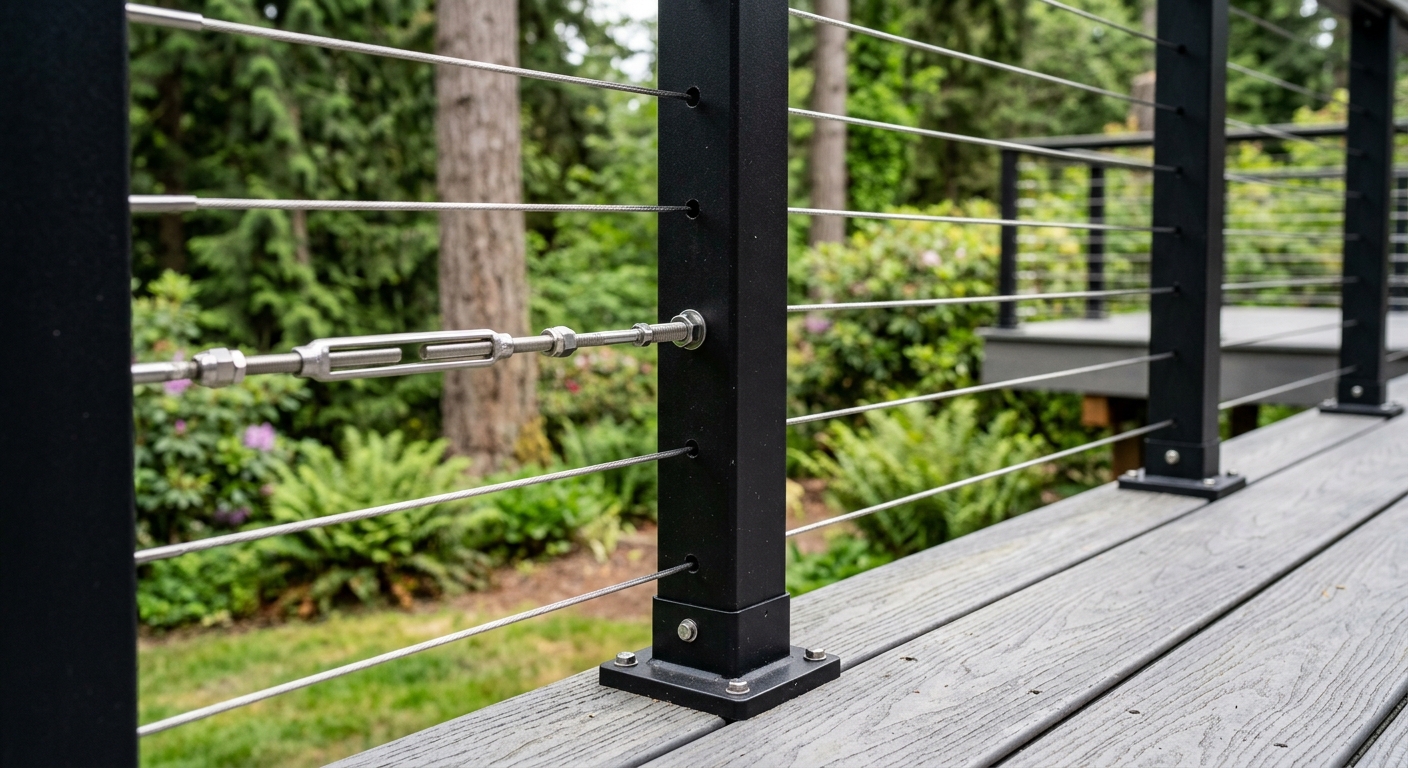
Stainless steel cable railing — 1×19 or 7×7 cable construction at 3-inch maximum spacing — is the most common view-railing specification on King County hillside decks. The cables are thin enough that they're nearly transparent at distance, allowing a nearly unobstructed view from the deck surface. Annual tensioning is required to maintain the required 200-lb concentrated load resistance (cables loosen slightly over time with thermal cycling). Hardware must be 316-grade stainless steel to resist King County's humidity-driven corrosion; 304 stainless will show rust streaks within 5–8 years.
Cable railing costs $120–$185 per linear foot installed on King County hillside decks, depending on post material (steel vs. wood vs. composite post sleeves) and cable run length. It is the most cost-effective view-preservation railing option.
See our railing options guide for full cable railing specifications.
Glass Railing for Premium View Decks
Frameless glass railing — tempered panels set into a continuous aluminum base channel — is the maximum view-preservation option. At 18 inches, glass railing disappears from the sightline. No horizontal lines, no vertical posts, no visual interruption of the sky, the water, or the horizon. For Mercer Island lakefront decks, Bellevue west-hill view positions, and West Seattle Sound-facing lots, frameless glass is the specification that architects and premium builders default to.
Frameless glass costs $250–$400/LF installed and requires engineering documentation at the permit stage because the glass panels bear the structural load that posts carry in other systems. The engineering is included in our permit package for glass railing projects. See our glass railing guide for full specification details.
Multi-Level Design for Extreme Grade Changes
On lots where the grade drops 15+ feet over the depth of the deck footprint, a single elevated platform at the second-floor door height produces a deck surface that's 14–18 feet above grade at the outer edge — structurally demanding, expensive, and visually imposing in a way that may not serve the property.
A multi-level approach — two or three connected platforms at different heights, connected by stairs — distributes the grade change across multiple surface elevations rather than concentrating it at the outer edge. The result is a deck that sits closer to the grade at each level, requiring shorter post heights (reducing structural cost), creates usable outdoor living space at multiple elevations (rather than one exposed platform), and integrates with the hillside more naturally from both the inside and outside view.
Multi-level hillside decks are the design solution we recommend most frequently for lots with greater than 15% average grade. They cost more than a single platform in aggregate (more framing, more connections, stairs between levels), but they cost significantly less than a single elevated platform at the equivalent square footage because the maximum post height is dramatically reduced.
| Category | Value |
|---|---|
| Single platform, 14-ft posts, cable railing | $68,000 |
| Two-level, 8-ft max posts, cable railing | $58,000 |
| Single platform, 14-ft posts, glass railing | $82,000 |
| Two-level, 8-ft max posts, glass railing | $70,000 |
Neighborhood-Specific Hillside Terrain Notes
Bellevue: Somerset, Newport Hills, Cougar Mountain
Bellevue's eastern hillside communities — Somerset, Newport Hills, and the Cougar Mountain area — have varied terrain from gentle rolling grades (8–12%) to steep ravine lots (25–35%). The Cougar Mountain area includes several lots with ECA designations related to ravine proximity and landslide susceptibility. Somerset and Newport Hills tend toward 10–18 foot post heights on view-facing decks. Bellevue Development Services requires stamped drawings for elevated structures above 8-foot post heights. Our local Bellevue permit track record means we know what Bellevue plan reviewers flag in hillside deck packages.
Mercer Island
Mercer Island's terrain is defined by the lake. The west-facing lots have Puget Sound and Olympic Mountain views; the east-facing lots have Lake Washington and Bellevue views. Most of the island's elevated-view lots require post heights of 8–14 feet and have the most active demand for frameless glass railing we see anywhere in King County. Island lots are also relatively constrained in footprint, which means maximizing view capture from a smaller deck is a common design priority.
West Seattle: Admiral District, Alki, Fauntleroy
West Seattle's elevated lots above Puget Sound are some of the most dramatic view properties in the city. The Admiral District hillsides face southwest toward the Olympics and the Sound, and the deck designs here are uniformly about maximizing the view capture. Post heights of 10–16 feet are common. The bluff properties near Alki and Lincoln Park have some of the most extreme grade changes in the city — these are the sites where multi-level deck design is most commonly the right answer and where geotechnical assessment is almost always warranted.
Queen Anne and Magnolia
Queen Anne's north and east slopes and Magnolia's east-facing bluff positions are both heavy hillside markets. Homes on Queen Anne's north slope face Lake Union, Capitol Hill, and the Cascades. Magnolia's bluff properties face Elliott Bay and the Olympic Range. Both are tightly packed urban lots with complex setback situations — the hillside deck design has to work within the city's urban setback requirements and, frequently, within sight-line sensitivity to neighboring properties. HOA considerations are less common in these older Seattle neighborhoods, but neighbor notification requirements under SDCI's early design review process occasionally apply.
Issaquah Highlands and Squak Mountain Area
The Issaquah Highlands community sits on the west face of Squak Mountain and Tiger Mountain, with many lots facing west toward Lake Sammamish and the Seattle skyline. Grade changes of 15–25% are common; some lots at the community's western edge drop dramatically toward the I-90 corridor. These lots also include some of the most challenging ECA situations we encounter — Issaquah's proximity to critical area designations means a higher proportion of hillside lots here trigger geotechnical review requirements.
Tip
Hiring a Hillside Deck Specialist: What to Look For
Not every deck contractor is equipped to build correctly on a hillside. The qualifications that matter specifically for elevated hillside construction:
Engineering relationships: Can they produce the stamped structural drawings required for your permit, or do they have to hire outside engineering support? Contractors who work regularly on hillside builds have established relationships with structural engineers who know deck engineering — the drawings arrive faster and are more specifically tailored to the project than generic engineering documents.
Helical pier experience: Have they actually installed helical piers, or are they familiar with them only as a concept? Helical pier installation requires specific equipment and contractor experience. A contractor who has never installed helical piers on a hillside deck should not be the first one trying it on your site.
ECA permit experience: Have they pulled permits on ECA-designated lots in King County? The geotechnical review, the additional submittal requirements, and the extended timeline are all manageable for a contractor who has navigated them before. For a contractor who hasn't, they're complications that add delay and cost.
Reference sites you can visit: Ask for references from hillside deck builds in King County specifically, ideally on lots with similar terrain to yours. Can they give you an address of a completed elevated deck you can walk by? Being able to see the structural approach and finish quality on an actual hillside project tells you more than any portfolio photo.
We meet all of these criteria and are happy to provide specific references from hillside builds comparable to your site. When you call us, mention that you're on a hillside lot — it helps us match you with the team member whose hillside project experience is most relevant to your site conditions.
Frequently Asked Questions
Why does a hillside deck cost so much more than a flat-lot deck in Seattle?
What is a helical pier and when is it needed for a hillside deck?
Do hillside decks always require a structural engineer in Seattle?
What is an Environmentally Critical Area (ECA) and how does it affect my hillside deck project?
What decking material is best for a shaded hillside lot in Seattle?
What does lateral bracing mean on a hillside deck, and why does it matter?
What railing should I use on a hillside view deck in Seattle?
How much does a hillside deck cost in King County?
What is a multi-level deck and when is it the right solution for a hillside?
Which Seattle neighborhoods have the most hillside deck projects?
Do I need a geotechnical report for every hillside deck project?
Can you build a deck on a slope with existing landscaping without disturbing it?
Start With a Hillside Site Visit — Not a Budget Estimate
Hillside deck projects in King County are the one project type where an accurate budget quote cannot be produced remotely. The slope angle, soil conditions, groundwater, ECA status, post height requirements, and utility positions at your specific site all affect the structural scope in ways that satellite imagery and a brief phone call can't capture.
We offer site visits for every hillside deck inquiry in King County — typically schedulable within one week. The visit takes 45–60 minutes, gives us the site-specific information we need to prepare an accurate budget, and tells you what your project actually involves structurally before you commit to anything.
Call (425) 675-6259 or reach out through our contact page to schedule a hillside deck site visit. We work across all King County hillside communities — Bellevue, Mercer Island, West Seattle, Queen Anne, Magnolia, Issaquah, and Sammamish. If you're on a hillside lot, the earlier you start the conversation, the more options you have on design, budget, and timeline.
See also: Deck costs in King County | Composite vs. cedar decking | King County permit guide | Glass and cable railing options
Planning a deck in the Seattle area?
Get an onsite design review and a clear, itemized quote from a licensed local builder.
Request a Free Quote