
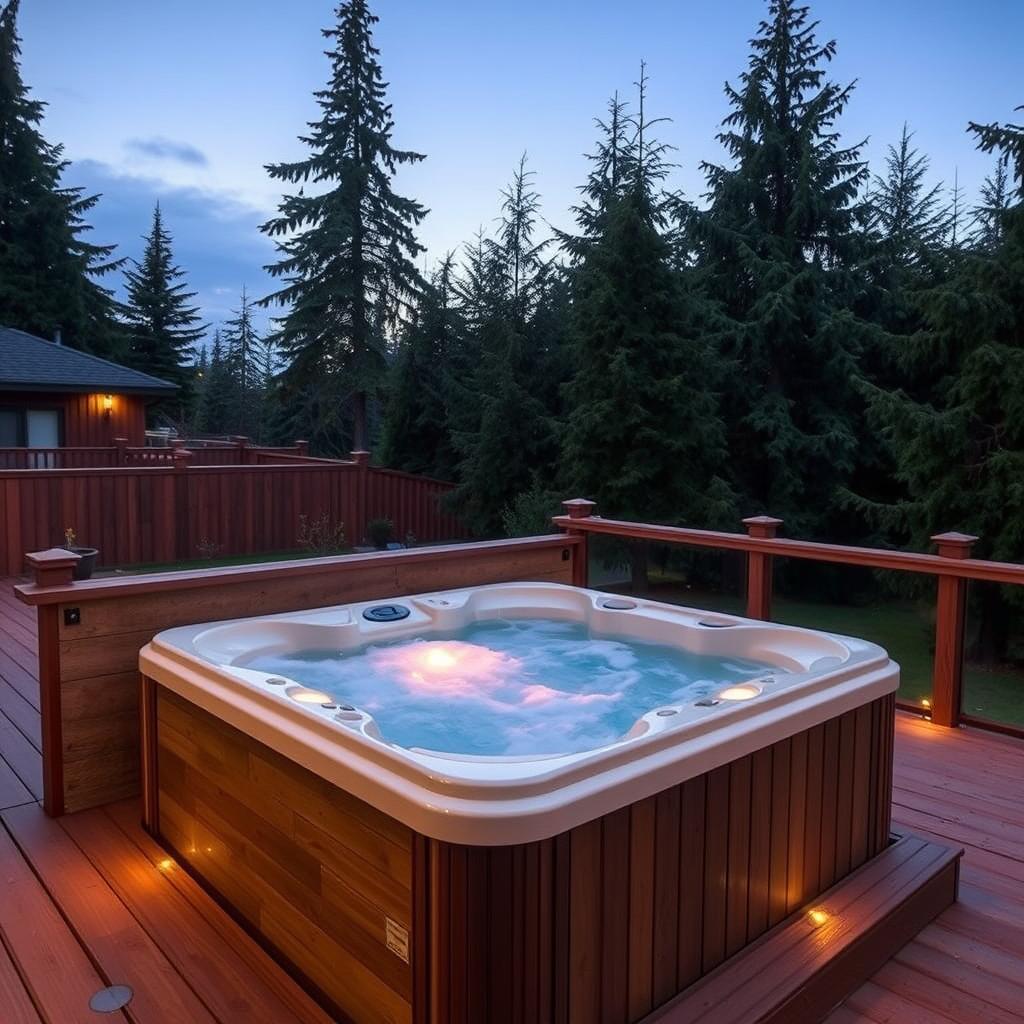
Building a deck specifically designed for a hot tub in Seattle is a fundamentally different project than building a standard entertainment deck. The structural requirements are different. The material selection calculus is different. The permit process is more involved. The electrical coordination has to happen during framing, not after. And in King County's clay-heavy soils and wet climate, the engineering decisions that seem minor on paper — footing depth, beam sizing, drainage slope — have real consequences when a 6,000-pound concentrated load sits permanently on the result.
We've built purpose-designed hot tub decks on Bellevue hillsides, Mercer Island waterfront lots, flat Renton backyards, and elevated Seattle urban properties. The structural design varies by site and elevation. The design process is the same regardless: know the load before the first board goes in, design the frame for it, and coordinate the electrical service during framing — not as an afterthought when the deck is finished and the electrician has to cut back into completed work.
This guide covers what it takes to build a new hot tub deck correctly in King County — from the structural load numbers through material selection, permits, electrical requirements, privacy screening options, and real cost breakdowns. If you're already thinking about an existing deck that needs reinforcement, our companion article on hot tub deck additions for existing Seattle decks covers that specific scenario.
Why Standard Deck Framing Fails Under Hot Tub Load
Residential decks in Washington State are engineered for 40–50 pounds per square foot of live load. That specification is designed for human occupancy — parties, furniture, moderate concentrated loads from outdoor cooking equipment. It is not designed for a permanently-positioned 5,000–6,500-pound concentrated load.
A 7×7-foot hot tub filled with water and four adults generates approximately 5,200 pounds across 49 square feet — roughly 106 PSF. That's more than double standard residential framing capacity, and it sits permanently, not just during a party. Standard 2×10 joists at 16-inch centers, which form the structural backbone of most Seattle-area decks, will deflect visibly under sustained loading at that level. On any deck that wasn't designed for it, the deflection shows up within one to two wet seasons.
We've assessed properties in Bellevue, Renton, and Kirkland where homeowners installed hot tubs on standard-framed decks without engineering review. The sagging is visible from below by season two. In the worst cases — particularly on lots with challenging clay soil conditions — we've found footing movement that created visible lateral shift in the deck structure above. The hot tub didn't fall through anything, but the repair scope was substantial and expensive.
The fix is straightforward: design the structural frame for the actual load before a single post is set. That means getting the hot tub manufacturer's specifications — dimensions, filled weight, electrical requirements, cover weight — before finalizing the structural design.
Site Assessment: What We Look At Before Designing
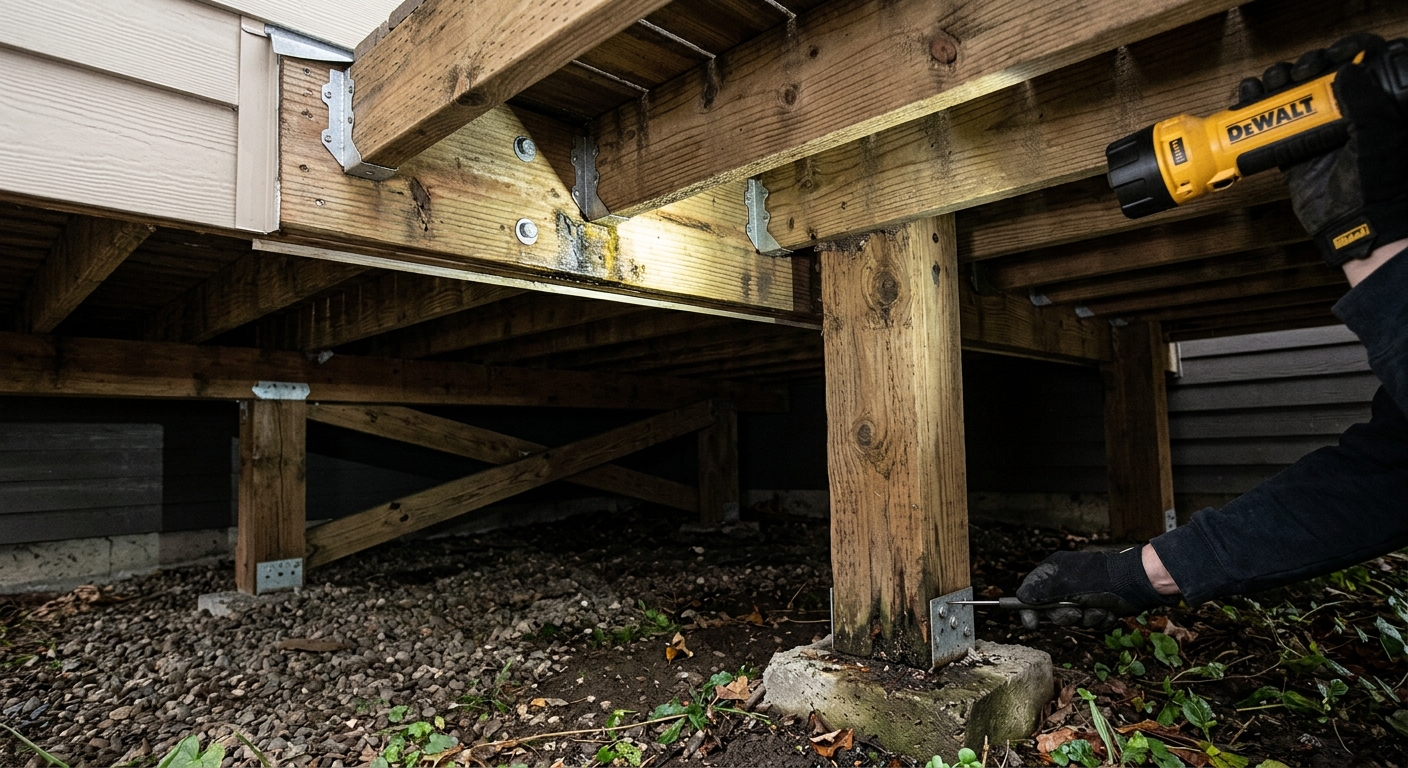
The design process for a hot tub deck begins with a site assessment, not a product selection conversation. We need to understand five things about your lot before we can design a structure that will perform correctly over the next 20–30 years.
Grade and slope: King County's hillside neighborhoods — Bellevue, Renton, Issaquah, West Seattle, Queen Anne — involve grade changes that affect post height, beam span, and drainage design. A deck on a lot with 15 feet of grade change from house to property line requires taller posts that carry lateral load in addition to vertical load. This isn't prescriptive-table territory — it's engineering.
Soil type: Clay-heavy soils — prevalent across Bellevue, Issaquah, the Sammamish Plateau, and South Seattle — require deeper footings and larger footing diameters under hot tub zone posts than standard prescriptive tables specify. Sandy or gravelly soils (less common on the Eastside) drain better and behave more predictably under load. We assess soil type visually and through the structural engineer's recommendations on every hot tub deck project.
Proximity to the house: How close the tub is to the house affects the ledger attachment design. Hot tub loads near the ledger concentrate stress on the house connection. Hot tub loads at the far edge of the deck concentrate stress on the outer posts and footings. Both scenarios are manageable — but they require different design responses.
Sun exposure and drainage: Hot tub decks need deliberate drainage design because of the constant splash-out from the spa. South- and west-facing decks dry faster between rain events. North-facing decks with dense canopy require more aggressive drainage slope and under-deck moisture management. Material selection for the tub surround is also affected by sun exposure — PVC is appropriate for persistently shaded sites; composite performs well with adequate sun drying.
Access and utility locations: We locate underground utilities before any footing is positioned. In King County, call 811 (Dig Safe) at least 3 business days before any excavation. Utility conflicts are common and require footing layout adjustments — better to know before design is finalized than after permits are submitted.
Structural Requirements: What Gets Designed Differently
For a new hot tub deck in King County, these structural elements are designed specifically for the tub load:
Joists Under the Tub Zone
Standard joist sizing for a residential deck at 16-inch on-center spacing assumes 40–50 PSF distributed live load. Under a hot tub, the effective load at the concentrated zone hits 100–140 PSF. The design response involves two concurrent changes: upsizing joist lumber (typically from 2×10 to 2×12) and reducing spacing (from 16-inch to 12-inch centers in the tub zone). Together, these changes bring the joist zone's capacity in line with the actual load. The transition from standard framing to reinforced framing in the tub zone gets blocked and detailed carefully — abrupt transitions create points where the structure is momentarily undercapacity.
Post and Footing Design
This is where King County's soil conditions have the most impact. In Seattle's clay-heavy soils — prevalent in Bellevue, Issaquah, the Sammamish Plateau, and South Seattle — standard tube-form footings sized for 40 PSF deck loads can shift under 100+ PSF continuous loading through wet winters. The seasonal saturation-and-drying cycle that King County experiences causes clay to swell and contract in ways that stress footing-to-post connections over time.
For hot tub deck footings in clay soil zones, we typically specify:
- Poured concrete footings at 24–36 inch depth — below the seasonal moisture fluctuation zone. At these depths, the footing sits in soil that isn't affected by surface saturation cycles.
- Upsized footing diameter — to distribute the higher point load from the hot tub zone posts across more soil bearing area. A standard 10-inch tube footing designed for a 40 PSF deck gets upsized to 14–18 inch diameter under hot tub zone posts.
- Helical piers where soil bearing capacity is limited — on Sammamish Plateau lots with heavy clay and high seasonal water tables, or on Issaquah hillside sites where soil bearing capacity at practical footing depths is insufficient, helical piers anchor into load-bearing strata below the problem soils.
Each post under the hot tub zone should be designed for point loads of 750–900 pounds at minimum — more on elevated decks with longer post spans. This calculation drives footing size, post size, and post-to-footing connection hardware.
A Structural Example: 12×14 Hot Tub Alcove on a 20×22 Deck
One of our typical designs for clients who want to integrate a hot tub into a larger deck creates a dedicated 12×14-foot hot tub alcove at one end of a 20×22-foot entertaining deck. This configuration isolates the hot tub's structural requirements from the rest of the deck without creating visual discontinuity.
In the tub alcove zone (12×14 = 168 sqft), we specify:
- 2×12 joists at 12-inch on-center spacing
- Footings at 30-inch depth, 16-inch diameter poured concrete (clay soil zone)
- 6×6 posts on all hot tub zone corners, 4×4 posts for remaining deck
- Doubled beams under the full tub zone perimeter
- Hot tub cutout framed with doubled headers and blocking
In the adjacent entertaining zone (standard 20×22 minus alcove = approximately 272 sqft), standard 2×10 at 16-inch framing applies. The structural systems transition at a blocked header that transfers loads cleanly between zones.
This design produces a deck where the hot tub zone meets 100+ PSF capacity while the entertaining zone maintains standard residential framing efficiency. The visible result on the finished deck is seamless — the alcove feels designed in, not bolted on.
Ledger Attachment
If the deck attaches to the house and the hot tub sits within 8–10 feet of that connection, the ledger attachment gets specific engineering attention. The concentrated load near the house transfers significant force to the ledger connection — more than a normal distributed deck load produces at the same location. Seattle building inspectors check ledger connection hardware on every hot tub deck permit. The specification includes fastener type (through-bolt versus structural lag), bolt pattern, spacing, and the hardware at the rim joist of the house.
If the house rim joist is deteriorated — a condition we find on roughly 30% of King County homes where a previous deck ledger trapped moisture against the rim — that rim joist must be repaired or sistered before the hot tub deck ledger goes on. No amount of correct ledger hardware compensates for a compromised substrate.
Beam Sizing
Beams spanning between posts are sized for the actual concentrated load in the hot tub zone, not for standard distributed deck loads. The span between posts, the post height, and the load from the zone above all factor into the beam sizing calculation. In many hot tub deck designs, we add a post directly below the center of the hot tub footprint to cut the effective beam span in half — this is often structurally cleaner and more cost-effective than sizing up to a substantially larger beam to handle a longer span.
Note
Material Selection Table: Chemical and Moisture Exposure
The material selection calculus for a hot tub deck in Seattle's climate is weighted differently than for a standard entertaining deck. Three factors drive the decision: chemical resistance, moisture resistance, and slip resistance when wet.
| Material | Chemical Resistance | Moisture Resistance | Slip Resistance Wet | Cost Installed King County | Recommended? |
|---|---|---|---|---|---|
| Trex Transcend (capped composite) | Good | Strong (4-sided cap) | Good (embossed) | $45–$65/sqft | Yes |
| TimberTech Legacy (capped composite) | Good | Strong (4-sided cap) | Good (wire-brushed) | $50–$70/sqft | Yes |
| Fiberon Paramount (capped composite) | Good | Strong (4-sided cap) | Good (embossed) | $48–$68/sqft | Yes |
| AZEK Vintage (cellular PVC) | Excellent | Excellent (all polymer) | Good (embossed) | $52–$70/sqft | Yes — shaded/N-facing |
| Western Red Cedar | Poor | Moderate | Good (rough grain) | $38–$55/sqft | No — not in tub zone |
| Standard composite (2-sided cap) | Moderate | Poor (edge exposure) | Moderate | $28–$38/sqft | No |
| Pressure-treated lumber | Poor | Moderate | Poor | $22–$32/sqft | No |
Fully Capped Composite: The Right Call for Most Hot Tub Decks
Trex Transcend, TimberTech Legacy, and Fiberon Paramount are all fully capped composites — polymer shell on all four sides of each board, sealing the wood-fiber core from moisture and chemical exposure. In Seattle's wet climate, the capping matters enormously.
Specify a textured or embossed surface finish from the start. Smooth-finish composite is noticeably slippery when wet; textured finishes provide meaningful grip improvement barefoot and in wet conditions. This is a safety specification that costs nothing extra when ordered at the same time as the decking.
Cellular PVC for Persistently Wet or Shaded Sites
AZEK and similar cellular PVC products contain no wood fiber whatsoever — they cannot absorb moisture or support mold growth from within. On north-facing lots in Kirkland or Sammamish, heavily shaded properties in Bellevue's west hills, or any hot tub deck site where limited airflow under the deck keeps moisture levels chronically elevated, PVC is the appropriate specification. It costs 15–25% more than premium composite decking but is the correct long-term choice when moisture exposure is highest and maintenance access is limited.
What to Avoid: Cedar and Standard Treated Lumber
Cedar is not an appropriate surface material for a hot tub surround. It absorbs water normally; around a hot tub it also absorbs chlorine and bromine from splash-out and vapor. That chemical exposure degrades cedar faster than normal weathering and voids most wood treatment warranties. Even well-sealed cedar in a hot tub surround zone requires resealing every 12–18 months and still deteriorates faster than composite or PVC.
Standard pressure-treated lumber has similar issues — it's designed for structural ground-contact applications, not for chemical-exposure surface decking. The copper compounds in ACQ treatment react with galvanized hardware and the chlorinated environment of a spa surround in ways that accelerate fastener corrosion.
For our full comparison of decking material options in PNW conditions, see our composite vs. cedar decking guide for Seattle.
Electrical Service Planning: 240V Circuit Into the Frame
Every residential hot tub requires a dedicated 240V circuit. Getting the electrical service into the deck framing correctly requires coordination between the deck contractor and the electrical contractor during the framing phase — before decking goes down.
What the Code Requires (NEC 680.43 / WAC 296-46B-680)
- Dedicated 240V, 50–60A circuit — the specific amperage is determined by the hot tub manufacturer's nameplate; verify before the electrical permit application. Most 5–7 person tubs require 50A; larger tubs sometimes require 60A.
- GFCI protection — required on the entire circuit, not just individual outlets.
- Manual disconnect — lockable disconnect located within sight of the tub but not within 5 feet of the water edge. This is separate from the main panel disconnect.
- Conduit routing — routed through the deck framing during the framing phase. Conduit buried in the ground below the deck or run through framing cavities before decking is installed. Retrofitting conduit into a finished deck requires cutting into completed work — an unnecessary cost when it's coordinated correctly.
- No standard outlets within 6 feet of the water edge — any outlets in the hot tub zone must be GFCI-protected and positioned at least 6 feet from the water.
Panel Capacity Assessment
Before finalizing the electrical design, the licensed electrician assesses the main panel's available capacity. King County homes built before 1990 commonly have 100A or 150A service panels that may be at or near capacity. A dedicated hot tub circuit drawing 50–60A requires available service capacity. If the panel is at capacity:
- 100A to 200A service upgrade: $2,500–$4,000 including utility coordination, permit, and inspection
- 200A panel replacement (aged panel): $1,500–$2,800
- Sub-panel installation for remote hot tub location: $1,000–$2,000
Planning the electrical sequence into the construction schedule:
- Frame the deck including all hot tub zone structural work
- Electrical rough-in during framing — conduit, wiring to disconnect box, panel connection
- Rough-in electrical inspection
- Install decking (conduit is now buried in the framing)
- Hot tub placement after decking is complete
- Electrician completes final connection from conduit stub to tub
- Electrical final inspection
The electrician returns for the final connection after the hot tub is placed. This two-visit approach — rough-in during framing, final after tub placement — is standard practice and coordinates cleanly with the construction schedule.
Budget $1,500–$3,000 for the dedicated circuit installation from the house panel to the tub location in King County.
Step-by-Step Permit Process for Hot Tub Decks in King County
A purpose-designed hot tub deck requires both a building permit (structural) and a separate electrical permit. These are not optional, and no legitimate contractor operating in King County suggests otherwise.
Step 1: Gather Hot Tub Specifications
Before any permit can be submitted, collect the manufacturer's specification sheet for the specific hot tub you're installing. Required information:
- Dimensions (length × width × height)
- Dry weight (shell + equipment, no water)
- Water capacity (gallons)
- Filled weight (typically provided by manufacturer)
- Electrical requirements (voltage, amperage, GFCI specification)
- Minimum structural support requirements
Step 2: Structural Engineer Engagement
For hot tub decks, engineer-stamped drawings are required at most King County jurisdictions. Engage the structural engineer at the preliminary design stage — their input on post sizing, beam specifications, and footing design shapes the permit application. Cost: $500–$1,200 for engineer review and stamped drawings on a hot tub deck project.
Step 3: Building Permit Application
Submit to the appropriate jurisdiction:
- Seattle SDCI for Seattle addresses
- King County Department of Local Services for unincorporated King County
- City building departments for Bellevue, Kirkland, Sammamish, Renton, Redmond, Issaquah, etc.
Application includes: site plan with setbacks, structural drawings (engineer-stamped), hot tub specifications, and permit fee payment. Fee: $400–$800 at most King County jurisdictions for new deck construction.
Review timeline:
- Seattle SDCI: 2–4 weeks standard, 3–6 weeks during spring peak (February–June)
- Bellevue: 3–6 weeks
- Sammamish: 4–8 weeks
- Kirkland: 3–5 weeks
- King County unincorporated: 3–5 weeks
Step 4: Electrical Permit
Processed separately through the electrical inspection division, submitted by the licensed electrical subcontractor. Timeline runs parallel to the building permit. Homeowner-permit option is not available for hot tub circuits — requires licensed electrical contractor.
Step 5: HOA Pre-Approval (Where Applicable)
Important
Step 6: Construction Sequence
Frame first (including all hot tub zone reinforcement) → electrical rough-in during framing → rough-in electrical inspection → decking installation → finish work and railing → building final inspection and permit closeout → hot tub delivery → electrical final connection → electrical final inspection → ready to soak.
Drainage: Designing Water Management Into the Hot Tub Deck
Water management is a design element on a hot tub deck, not an afterthought. Three water sources converge on the same zone: Seattle's standard 38-inch annual rainfall, splash-out from the tub during use, and runoff from the spa cover surface. Without deliberate design, all three sources create standing water, chronic moisture at the deck edge, and the conditions that accelerate structural deterioration.
Deck surface slope. The deck in the hot tub zone slopes a minimum of 1/8 inch per foot away from the tub and away from the house — consistently across the entire zone. This is achieved during framing, not by shimming finished decking. The slope ensures water moves to the deck perimeter and off the edge rather than pooling at low points.
Board spacing. Composite board gaps of 3/16 inch are standard, but in the hot tub zone we pay particular attention to consistency. Variable gaps create preferred drainage paths; uniform gaps ensure water disperses evenly through the deck surface. Debris (leaves, needles) that blocks gaps in the hot tub zone creates the moisture accumulation that drives mold and structural issues.
Perimeter drainage for high-volume sites. On lots with significant tree drip, concentrated roof runoff, or heavy spa use, a linear trench drain at the low perimeter of the hot tub zone moves high volumes of water off the deck surface more effectively than relying on board gaps and surface slope alone. These drains install flush with the decking surface and are barely visible.
Under-deck drainage systems. For elevated decks or enclosed under-deck spaces, an under-deck channel drainage system (TimberTech DrySpace, RainEscape, or similar) captures water draining through board gaps and routes it to a gutter and downspout. This keeps the structural framing below the hot tub zone dry — critical for longevity of the treated lumber substructure.
| Category | Value |
|---|---|
| PNW Rainfall (Nov–Mar avg) | gal42 |
| Tub splash-out (weekly use) | gal15 |
| Cover runoff + condensation | gal8 |
Privacy Screening: Options, Costs, and Integration
Integrating privacy screening into the deck design from the start is far more cost-effective than adding it after construction. Screens that are structurally integrated into the deck frame look intentional and are more durable than post-installed solutions.
| Screening Option | Privacy Level | Cost Installed (King County) | Longevity | Best Material in Tub Zone |
|---|---|---|---|---|
| Horizontal composite slat panels | Full | $1,800–$4,500 | 20+ years | Composite (chemical resistant) |
| Pergola with integrated screening | Overhead + partial | $6,000–$15,000 | 20+ years | Cedar or aluminum |
| Lattice panels | Partial | $900–$2,200 | 8–15 years | Composite (near tub), cedar (far) |
| Aluminum louver systems | Full, adjustable | $3,000–$7,000 | 25+ years | Aluminum |
| Privacy fence panels | Full | $1,500–$4,000 | 15–20 years | Composite preferred |
| Landscaping (arborvitae) | Full (3–5 yr) | $600–$2,500 | Indefinite | N/A |
Horizontal composite slat panels — Full composite boards in a horizontal fence pattern on a structural aluminum or composite post frame. Provides complete visual screening, matches the deck material for a cohesive aesthetic, and requires no painting or sealing. Cost installed: $1,800–$4,500 for a typical 3-panel configuration around a hot tub. Chemical resistance of composite makes it appropriate directly adjacent to the spa.
Pergola with integrated screening — A pergola structure above the hot tub zone provides overhead rain cover, defines the space visually, and creates mounting points for hanging privacy panels or climbing plant systems. A well-designed pergola transforms the hot tub area from a utility installation into a defined outdoor room. Add $6,000–$15,000 for a pergola integrated into the hot tub deck design. See our outdoor lighting guide for ideas on how lighting within a pergola extends hot tub usability into Seattle's dark winters.
Lattice panels with composite or aluminum framing — Lower cost ($900–$2,200) with partial visual screening. Cedar lattice in the immediate tub zone will weather faster than composite lattice due to spa chemical exposure on the interior face. Specify composite lattice within 4 feet of the water, cedar or composite beyond that zone.
Aluminum louver systems — Commercial-grade aluminum louver panels provide adjustable privacy control (angle the louvers to block or open sightlines). Cost: $3,000–$7,000 for a typical installation but provides a modern aesthetic that pairs well with contemporary composite decking designs. Best chemical resistance of any screening option.
Natural screening with plantings — Emerald Green arborvitae, Skip laurel, or English laurel planted at the deck perimeter provide year-round screening that improves 3–5 years. A cost-effective complement to minimal structural screening, particularly on properties with setback constraints that limit how close structural screening can be placed to the property line.
Cost Breakdown: Hot Tub Deck Package in King County
A complete hot tub deck package — new deck structure with integrated tub support, composite surface, electrical service, and permit management — costs more than a standard deck of the same size. Here's the realistic breakdown:
| Line Item | Cost Range |
|---|---|
| Standard 300 sqft composite deck (King County) | $28,000–$42,000 |
| Hot tub zone structural reinforcement (joists, footings, beams) | +$2,500–$6,000 |
| Hot tub cutout framing, surround detail, access panel | +$800–$2,000 |
| Dedicated 240V electrical circuit (electrician scope) | +$1,500–$3,000 |
| Panel upgrade if needed | +$1,500–$3,500 |
| Premium textured composite vs. standard composite spec | +$500–$1,500 |
| Privacy screening (basic horizontal panel) | +$1,800–$4,500 |
| Permit management (building + electrical) | +$600–$1,200 |
| Structural engineer review and drawings | +$500–$1,200 |
| Total: hot tub deck package, King County (without panel upgrade) | $36,200–$61,400 |
Structural reinforcement adds 8–14% to the base deck cost. The electrical circuit adds 4–7%. Privacy screening adds 5–10%. The entire hot tub-specific premium over a standard composite deck typically runs $7,200–$19,400 — with the bulk of that in the structural and electrical scope, not in material upgrades.
For complete Seattle-area deck pricing by material, size, and site complexity, see our Seattle deck cost guide.
Tip
Before and After: What a Good Hot Tub Deck Project Looks Like
Before — a common scenario we encounter: A Renton homeowner has an 8-year-old cedar deck, 16×20 feet, attached to the house. They've purchased a 6-person Bullfrog spa and have it scheduled for delivery in 8 weeks. They call us because the spa installer flagged that the deck might not support the load. Assessment finds 2×10 joists at 16-inch centers over a 9-foot span — technically inadequate for the spa's 4,900-pound filled weight. Ledger hardware is original 2015 installation, adequate but should be documented. No permits yet.
The correct sequence: We engage the structural engineer immediately. Drawings take 10 days. We submit the building permit to Renton's building department — standard review is 3–4 weeks. The homeowner pushes back the spa delivery to give the permit time to process. Framing reinforcement takes 3 days: joist sistering in the tub zone, one new post and footing augmentation beneath the center span, ledger hardware documentation and upgrade. Electrical rough-in during framing. Rough-in inspection passes. Composite decking in the tub zone (Trex Transcend to match existing cedar aesthetics as closely as possible). Final inspection. Spa delivery and final electrical connection.
After: The homeowner has a permitted, inspected, structurally adequate hot tub installation that will show up clean on a disclosure at resale. The project added 6 weeks to their timeline compared to simply placing the spa on the existing deck — and eliminated the footing movement, joist deflection, and eventual structural issue that would have appeared within 2–3 seasons otherwise.
The Design Sequence We Follow
Every hot tub deck we build follows the same sequence, regardless of the project's size or complexity:
Step 1 — Hot tub specifications first. We ask for the manufacturer's spec sheet at the first consultation. Dimensions, filled weight, cover weight, and electrical requirements all drive structural design decisions that can't be made without that data.
Step 2 — Site assessment. We look at the proposed deck location, the soil conditions, the slope, proximity to the house, access for framing below the deck, and any critical area overlays (wetland buffers, steep slope zones, view protection setbacks in some neighborhoods). We also measure for setbacks — confirming the proposed footprint is code-compliant before design begins.
Step 3 — Structural engineer coordination. For any hot tub deck, we bring in a licensed structural engineer for review and stamped drawings. This is included as a line item in your quote, not an add-on you discover later.
Step 4 — Permit applications. We submit the building permit application with complete structural drawings. We file the electrical permit through the licensed electrical subcontractor. Both are tracked until issued.
Step 5 — Construction sequence. Frame first, including all hot tub zone reinforcement. Electrical rough-in during framing. Inspection. Decking, trim, and railing. Privacy screening. Final inspection and permit closeout.
Step 6 — Hot tub placement and electrical final. After the deck is finished and final inspection is passed, the hot tub is delivered. The licensed electrician completes the final connection and calls for electrical final inspection. You're in the water.
Frequently Asked Questions
Frequently Asked Questions
What's the difference between building a hot tub deck from scratch vs. reinforcing an existing deck?
How deep do footings need to be for a hot tub deck in King County?
Do I need a structural engineer for a hot tub deck?
Can I install a hot tub deck on a sloped lot?
What is the typical footprint of a hot tub deck?
When should I order my hot tub?
What privacy screening option lasts longest around a hot tub?
Does a hot tub deck cost more to insure?
How long does a hot tub deck project take from start to finish?
What maintenance does a composite hot tub deck require?
What electrical service upgrade might I need for a hot tub?
How do I coordinate the deck contractor and electrician?
Why We Specify What We Do
The choices we make on every hot tub deck project — fully capped composite over cedar, textured surface finish over smooth, structural engineer review as a standard line item rather than an option, conduit rough-in during framing rather than retrofitted later — all come from the same source: we've seen what happens on the projects that cut corners.
We've assessed decks where homeowners skipped the structural engineer and ended up with visible footing movement within three winters. We've replaced hot tub surrounds where cedar was specified because it was cheaper, and the chemical exposure turned beautiful cedar into spongy gray boards in six seasons. We've been called in when electrical conduit wasn't coordinated and the electrician had to cut back into newly-installed decking to run conduit — doubling the electrical cost and ruining finished work.
The right approach isn't expensive in context. Structural engineer review is $500–$1,200. Upgrading from cedar to composite surround on the hot tub zone adds $1,000–$3,000 on a typical project. Coordinating the electrical rough-in during framing costs nothing extra — it just requires planning. These aren't luxury upgrades; they're the correct approach to a project that involves a 6,000-pound permanently-loaded structure in a wet climate on challenging soils.
King County Soil Conditions and Their Impact on Hot Tub Deck Design
The structural engineering of a hot tub deck doesn't happen in a vacuum — it responds to the specific soil conditions under your property. King County's varied geology creates meaningfully different structural challenges depending on where you're building.
Sammamish Plateau and Issaquah foothills: Expansive Alderwood gravelly sandy loam over clay-rich subsoils. High seasonal water table in many areas. Footings in these zones need to penetrate below the seasonal saturation horizon — typically 30–42 inches. Helical piers are frequently specified here rather than tube-form concrete footings because the clay subsoil behavior under sustained load is more predictable with driven steel than with poured concrete.
Bellevue and Renton hillsides: Predominantly clay-heavy soils with significant seasonal expansion and contraction. Grade change is the complicating factor — hot tub decks on these sites often require tall post systems (8–14 feet) that carry significant lateral load from wind and seismic in addition to the vertical hot tub load. The structural engineer's analysis on these projects is more complex than on flat-site builds.
South Seattle and central King County: Sandy and gravelly soils in some zones, clay-dominant in others. Less consistent soil profile than the Eastside — soil borings or deep hand augering during the design phase helps confirm bearing capacity before footing design is finalized.
Waterfront properties (Lake Washington, Lake Sammamish): Near-water soils can have high organic content and low bearing capacity at shallow depths. Helical piers or driven piles are the standard approach for waterfront hot tub decks — driven past the near-surface organic layer to stable bearing below. The waterfront aesthetic premium also typically justifies the footing cost premium.
What this means practically: the engineer's footing specification on a hot tub deck project should be informed by actual soil conditions at the build site, not by national prescriptive tables that assume stable, well-drained soils. We ask for soil observation during footing excavation on every hot tub deck project — if what we find doesn't match the design assumption, we stop and call the engineer before pouring concrete.
Access Planning: Getting Equipment to Challenging King County Sites
A 6,000-pound hot tub needs to get to your deck after construction is complete. Access planning for delivery and placement is a design consideration, not an afterthought.
Ground-level deck or accessible grade-level location: Standard delivery — hot tub arrives on a truck, is offloaded with equipment or a dolly, and is placed into position. No special access required.
Elevated deck with stairs only: Hot tub delivery typically requires a crane or a specialized spa mover service. Many King County delivery companies won't negotiate a spa up standard residential deck stairs — the weight and the potential for stair structure damage make this a non-standard service. Budget $400–$900 for professional spa placement service in addition to standard delivery.
Hillside or tight-access lot: Properties in Bellevue, Issaquah, and West Seattle where the backyard is accessible only through narrow gates or steep terrain require crane placement. Crane placement in King County for a residential spa runs $800–$2,000 depending on reach and duration. This cost should be factored into the hot tub purchase and placement budget — not discovered on delivery day.
The access question to ask at design phase: "How will the hot tub get from the truck to the deck surface after the deck is complete?" The answer determines whether access modifications are needed before or during construction — opening a fence panel, confirming gate dimensions, or designing a temporary construction access path.
What Separates a Good Hot Tub Deck Contractor from a Competent One
Any licensed contractor can frame a deck. Not every licensed contractor has designed and built a structurally engineered, electrically coordinated, properly permitted hot tub deck in King County's specific site conditions. Here's what to verify:
Structural engineer relationship: Do they use the same structural engineer regularly, or are they shopping for the lowest engineering fee? A contractor with a regular engineering partner produces better-integrated structural designs — the engineer understands how the contractor builds, and the contractor understands how to implement what the engineer specifies.
Electrical contractor coordination: On a hot tub deck, the deck contractor and electrical contractor need to be working from the same timeline. A deck contractor who says "you arrange your own electrician" is pushing project management responsibility to you for the most safety-critical element of the build.
Permit history with hot tub decks: Ask specifically how many hot tub deck permits they've pulled in King County in the last two years. A contractor who has done five hot tub decks in the last year knows the permit office's expectations. One who hasn't done one in the last three years is working from outdated process knowledge.
Material knowledge for chemical exposure: A contractor who suggests cedar around a hot tub — regardless of why — doesn't understand the chemical environment that a spa surround creates. This is a disqualifying answer for a contractor you're considering for this specific application.
Our contractor license is verifiable at WA L&I. Permit requirements for your jurisdiction can be confirmed at Seattle SDCI or King County Permitting.
Ready to plan your hot tub deck in King County? Call (425) 675-6259 or request a free estimate — we'll review your lot, discuss your hot tub specifications, and provide a complete written quote that covers every line item from structural engineer coordination through final electrical connection.
Planning a deck in the Seattle area?
Get an onsite design review and a clear, itemized quote from a licensed local builder.
Request a Free Quote