
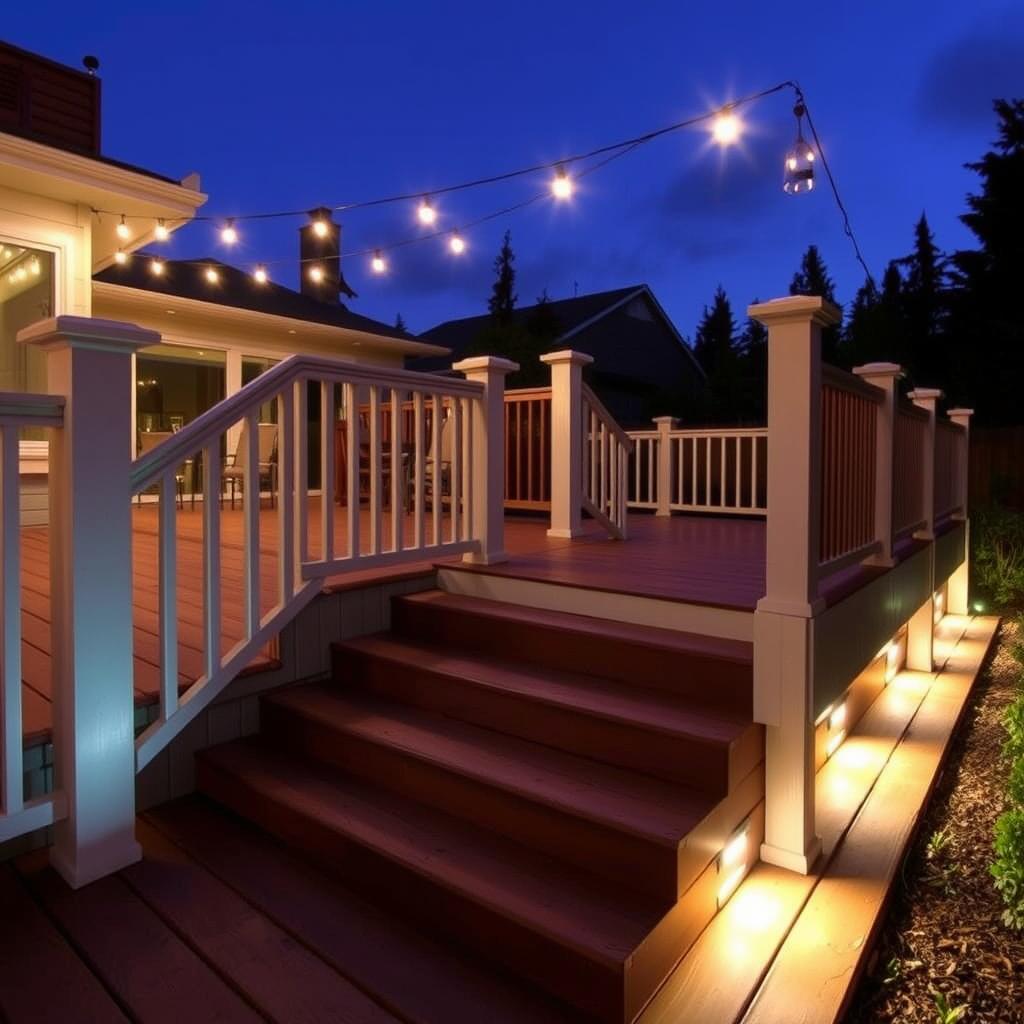
If you've lived in the Pacific Northwest for more than one winter, you already know the feeling: it's 3:45 in the afternoon in December, and the sky has gone the color of old concrete. By 4:00 p.m., full dark. The deck you spent good money building is now a black rectangle you can barely see from the kitchen window — much less use. This is the lighting problem that every Seattle homeowner faces, and it's not just a winter issue. Even in shoulder seasons like October and March, usable daylight on a cloud-covered afternoon shrinks to a narrow window. A well-lit deck in the Seattle area isn't a luxury upgrade. It's the difference between a space you use eight months of the year and one you use four.
The swing in Seattle's day length is dramatic. NOAA solar data puts Seattle's December sunset at around 4:10 p.m. and its June peak at roughly 9:10 p.m. — a five-hour daily spread across the calendar. Good lighting doesn't just extend your evening; it reclaims entire seasons. Properly planned deck lighting in our climate does three things simultaneously: it withstands constant rain and freeze-thaw cycles, it performs in genuinely dark conditions (not just dusk), and it creates enough warmth and atmosphere that people actually want to sit outside after dinner, even when it's drizzling.
What makes Seattle specifically challenging is the combination of precipitation volume and the nature of that precipitation. We're not talking about heavy Southern thunderstorms that dump and clear. Seattle sees over 150 days of measurable rainfall per year, with much of it arriving as persistent mist, drizzle, and light rain over extended periods. Fixtures that can handle a brief shower often fail slowly under months of constant moisture infiltration. This article covers what actually works here — the right ratings, the right fixture types, the right voltage systems, and the real costs — based on what we install on Seattle-area decks every year.
Why Seattle's Climate Demands More From Deck Lights
The words "outdoor rated" cover a wide range of actual performance, and in Seattle's climate, that range matters more than in most parts of the country. A fixture stamped "outdoor" from a big-box store might be tested in a rain shower — not in 38-degree drizzle for six consecutive months. Understanding the IP (Ingress Protection) rating system is the starting point for choosing fixtures that won't fail on you.
Understanding IP Ratings for Pacific Northwest Conditions
IP ratings are a two-digit code standardized by the International Electrotechnical Commission (IEC) that tells you exactly how well a fixture resists both solid particles (first digit) and water (second digit). Here's the breakdown relevant to Seattle deck lighting:
| IP Rating | Solid Protection | Water Protection | Seattle Deck Use |
|---|---|---|---|
| IP44 | Protected from objects >1mm | Splashing water from any direction | Insufficient — avoid |
| IP54 | Dust-limited protection | Water splashing from any direction | Marginal — covered areas only |
| IP65 | Dust-tight | Water jets from any direction (nozzle test) | Minimum acceptable for Seattle |
| IP67 | Dust-tight | Immersion up to 1 meter for 30 minutes | Required for in-deck surface lights |
| IP68 | Dust-tight | Continuous immersion beyond 1 meter | Ideal for below-grade or water-feature adjacent |
For exposed deck surfaces — post cap lights, stair riser lights, under-rail strips — IP65 is the floor, not the target. We recommend IP65 for elevated fixtures and IP67 for anything installed flush with or recessed into a deck surface, where standing water is a real possibility after a rain event.
Important
Why "Outdoor Rated" Isn't Enough
Many consumer-grade string lights and deck fixtures sold at home improvement stores carry a damp-location listing and a vague "outdoor" label. In a dry climate, this might be fine. In Seattle, damp-location fixtures installed in exposed positions tend to develop moisture infiltration inside the housing within 12-18 months, causing corrosion at the LED board, lens fogging, and eventual failure. The cost of replacing a cheap fixture every other year easily exceeds the upfront premium for a properly rated IP65 or IP67 unit.
Brands like Dekor Lighting, VOLT Lighting, and Kichler publish full IP ratings and UL wet-location listings on their product specs. This is the minimum documentation you should require before purchasing any deck fixture for a Seattle installation.
Low-Voltage (12V) vs. Line-Voltage (120V): What's Right for Your Deck
The voltage question shapes everything downstream: cost, complexity, permit requirements, safety, and flexibility. Most residential deck lighting projects in the Seattle area land in one of two camps, and the right answer depends on how extensive the system is and what fixtures you're planning to use.
Low-Voltage 12V Systems
Low-voltage systems step household current down to 12V DC through a transformer installed near the deck. This is the dominant choice for deck post cap lights, stair riser lights, under-rail strips, and most path and step lights. The advantages in a Seattle context are significant:
No permit required in most residential applications. The Seattle Department of Construction and Inspections (SDCI)/electrical-permit) generally does not require electrical permits for low-voltage lighting systems in single-family residential settings. This saves you both money and scheduling delays.
DIY-friendly. The 12V DC current won't deliver a lethal shock, which means homeowners who are comfortable with basic wiring can often install these systems themselves. Manufacturers like Dekor and VOLT Lighting publish detailed installation guides and sell complete transformer-and-fixture kits.
Flexible layout. Low-voltage cable can run along deck framing and joists without conduit in most configurations, making it far easier to route through a finished deck structure during a retrofit.
Smart-home compatible. Lutron's Caséta system and Dekor's WiFi-capable transformers allow dimming, scheduling, and app control over low-voltage deck lighting — useful for automating lights to come on at sunset (which changes by over five hours across Seattle's calendar year).
The main limitation is fixture variety. Most large-format fixtures — pendants, overhead floods, outdoor ceiling fans with lights — require line voltage. If you're planning a pergola with overhead fixtures, you'll likely need both systems.
Line-Voltage 120V Systems
Line voltage opens up a wider fixture catalog and is necessary for higher-output applications: flood lighting a large deck area, powering outdoor ceiling fixtures under a covered pergola, or running GFCI-protected outlets for outdoor appliances. The tradeoffs are real:
Licensed electrician required. Washington State electrical code requires a licensed electrical contractor for line-voltage work. Homeowners doing their own line-voltage work must meet the state's owner-builder requirements, and the work must still be inspected.
Electrical permit required from SDCI. Per the Seattle SDCI electrical permit process/electrical-permit), any new circuit or modification to existing circuits serving line-voltage fixtures requires a permit and inspection. Plan for this in your timeline and budget.
Higher installed cost. Conduit runs, weatherproof boxes, GFCI protection, and licensed labor add up. A simple two-circuit line-voltage deck lighting installation in the Seattle area typically starts around $1,500–$2,500 for labor alone.
Tip
Transformer Sizing and Planning
One of the most common DIY mistakes in low-voltage deck lighting is under-sizing the transformer. Each fixture draws a stated wattage, and your transformer capacity must exceed total load by 20–25% to allow headroom for wire-run voltage drop. A 300 sq ft deck with 8 post cap lights (4W each), 12 stair riser lights (2W each), and 20 feet of under-rail strip (15W total) draws 83W total — requiring a minimum 100W transformer, and ideally a 150W unit.
Smart transformers from brands like Dekor allow zone control, scheduling, and photocell-triggered activation. Given Seattle's dramatic seasonal variation in sunset time, a photocell or astronomical timer that adjusts automatically is worth the premium.
Fixture Types: What Works Where on a Seattle Deck
Not all deck lighting fixtures serve the same purpose, and the best systems layer multiple types to create both safety and atmosphere. Here's a practical breakdown of each fixture type and how it performs in Pacific Northwest conditions.
Post Cap Lights
Post cap lights sit on top of railing posts and are one of the most visible and architecturally significant elements of a deck lighting system. They define the perimeter of the deck, signal the edge boundaries, and provide ambient downlight across the deck surface.
Price range: $30–$150 per post cap, depending on material, finish, and output. Solar post caps fall at the low end of this range but should generally be avoided in Seattle (more on solar below). Hardwired LED post caps from Dekor, VOLT, and Kichler fall in the $50–$120 range per unit and will outperform any solar option in PNW conditions.
IP requirement: IP65 minimum. Most quality hardwired post caps meet this standard. Verify before purchasing.
Installation note: Post cap lights require wiring routed through or along the post. On a new deck build, this is straightforward — the electrician or builder routes low-voltage wire inside or behind posts during framing. On a retrofit, wire is typically surface-run along the post interior or concealed in a channel. This is worth planning during construction if you have any intention of adding lighting later.
Stair Riser Lights
Stair riser lights mount on the vertical face of each stair step, casting light downward across the tread. They are primarily a safety fixture — illuminating stair edges prevents trips and falls in the dark — but they also create a distinctive visual accent that defines the stair run at night.
Price range: $20–$60 per light. They're sold individually or in kits.
IP requirement: IP65 minimum. Stair risers are directly exposed to weather, including rain splash from treads above.
Installation: These are among the easiest deck lights to retrofit because the low-voltage cable can run along the underside of the stair stringer and pop through a small hole in each riser face. Dekor's riser light kits come with drill templates and pre-measured cable runs.
Spacing: One light per riser on stairs up to 48 inches wide; two lights per riser on wider stairs to maintain even illumination across the full tread width.
Under-Rail Lights
Under-rail lighting consists of small puck lights or LED strip channels mounted to the underside of the top rail cap, casting downward light across the deck surface. This creates a dramatic visual effect at night and provides diffuse ambient lighting without glare in the eyes of people seated on the deck.
Price range: $15–$50 per puck light; LED strip systems vary by linear foot ($8–$25/ft for quality IP65 strip in aluminum channel).
Installation: Typically surface-mounted with small screws to the underside of the rail cap or rail channel. Wire runs back to the transformer along the inside of the rail. On a composite railing system with a hollow rail interior, wire can often be routed completely out of sight.
Key insight
In-Deck Surface Lights
In-deck surface lights — recessed LED pucks or fiber optic points installed flush with the deck boards — are the most striking deck lighting option and the most demanding to install correctly. They require holes drilled through the decking surface, a waterproof housing below the board surface, and wiring routed through the joist space beneath.
Price range: $40–$120 per fixture for quality IP67-rated LED in-deck lights.
IP requirement: IP67 is the minimum for in-deck lights because standing water regularly collects on deck surfaces in Seattle rainfall. IP65's water-jet resistance is insufficient for a fixture sitting in a small pool of standing water.
Planning requirement: In-deck lights must be planned during construction. The fixture housing is installed before decking is laid, and the wiring is routed through framing. Retrofitting in-deck lights into an existing sealed deck is difficult and often requires removing boards.
Fiber optic option: Fiber optic in-deck lighting uses a remote illuminator (which holds the actual light source and transformer in a dry location) with thin fiber strands routed through tiny holes in the deck surface. The deck surface itself carries no electrical current, making it intrinsically safe and eliminating the IP rating concern for the deck-level component. Cost is higher ($150–$400 per illuminator plus fiber), but the visual effect — a field of tiny star-like points across the deck surface — is unique.
String Lights
String lights are among the most popular deck lighting choices, and they can work well in Seattle — but only when the right products are selected. Consumer-grade string lights sold for indoor or patio use frequently lack adequate weather protection for year-round Pacific Northwest exposure.
Requirements for Seattle: Look for IP65 or higher rated string lights with commercial-grade rubber or silicone socket covers, shatterproof LED bulbs (glass Edison bulbs break when temperature cycles cause thermal stress), and a heavy 16-gauge or larger wire gauge. Brands like Enbrighten and commercial-grade café-style strings from landscape lighting suppliers are built for the conditions.
Mounting: String lights on a deck need proper anchor points — eye hooks, catenary wire, or a pergola structure. Sagging string lights not only look poor but trap water in the cable runs and accelerate moisture infiltration. Run a taut stainless-steel catenary wire between anchor points and hang strings from it for clean appearance and long fixture life.
Soffit and Pergola Lights
For decks with covered pergolas, recessed soffit lighting under the pergola provides overhead ambient illumination — the equivalent of indoor recessed lighting, but weather-rated. These fixtures are typically line-voltage (120V) because the installation is overhead and the fixture selection is wider, but wet-location-rated 12V recessed fixtures do exist for low-voltage pergola applications.
Placement: Space recessed soffit lights at 4–6 feet on center across the pergola ceiling, offset slightly toward the deck perimeter to maximize downlight on seating areas rather than the center of the floor.
IP requirement: Damp-location is acceptable for fixtures under a solid pergola roof that sheds water away from the fixture. Wet-location required for any fixture under a slatted pergola that allows rain through.
Planning Deck Lighting: New Construction vs. Retrofit
The single most important decision in deck lighting isn't which fixture you choose — it's when you plan the system. Lighting integrated during construction costs a fraction of what a professional retrofit costs, and looks dramatically better.
Planning During a New Deck Build
If you're building a new deck with The Seattle Decking Company, we incorporate conduit sleeves, wire chase routes, and in-deck fixture housings during framing — before any decking material is installed. This is when the cost is lowest and the options are widest.
What to plan in advance:
- Conduit sleeves through concrete footings and rim joists for future wire runs
- In-deck fixture housing locations (must be set before decking)
- Post cap wiring chases inside posts (hollow composite posts make this clean and hidden)
- Transformer location and circuit capacity (coordinate with your electrician during rough-in)
- Pergola soffit junction box locations
A well-planned new deck can receive a complete lighting system with zero exposed wire, zero visible conduit, and fixtures that appear completely integrated — as if they were always part of the design. This is the professional result that retrofits rarely achieve.
Note
Retrofitting Lighting on an Existing Deck
Retrofitting lighting on a finished deck is absolutely achievable, but it requires more labor to conceal wiring and may limit fixture choices. Here's what the retrofit process typically looks like:
Assessment first: A good lighting installer will walk the deck and identify where wire can be routed through existing gaps in the structure — under the rim joist, through the joist bay, along the underside of the stair stringer — before proposing fixture locations.
Wire management: On a retrofit, some exposed wire is often unavoidable. Quality wire management channels in aluminum or UV-stable plastic can minimize visual impact and protect the wire. On composite decking, some installers route wire under the edge trim piece for a clean look.
Most retrofit-friendly fixtures: Post cap lights (wire down through post interior), stair riser lights (wire along stringer underside), and under-rail puck lights (wire along rail channel interior) are all retrofit-friendly. In-deck surface lights generally require board removal.
For more on planning your full deck project from the ground up, see our guide to deck costs in Seattle and our breakdown of how to read a deck quote.
Smart Controls: Automating Your Seattle Deck Lighting
Seattle's dramatic seasonal variation in sunset time makes manual lighting control inconvenient. Turning lights on and off manually means either missing the moment the deck goes dark or wasting energy by turning them on while it's still light. Smart controls solve this elegantly.
Photocell and Astronomical Timer Controls
The most reliable automation for Seattle deck lighting uses an astronomical timer or photocell in the transformer or control module. An astronomical timer uses GPS-synced data to know today's exact sunset time for your location — so it automatically turns lights on at 4:10 p.m. in December and 9:10 p.m. in June without any manual adjustment.
Dekor's WiFi-capable transformer series and VOLT Lighting's smart-compatible transformers both support astronomical scheduling. This is the feature we most commonly recommend to Seattle clients because it perfectly addresses the day-length variation that makes manual switching tedious.
Smart Home Integration
For homeowners with existing Lutron Caséta, Insteon, or similar smart home systems, low-voltage deck lighting can often be integrated through the transformer's compatible control inputs. Lutron's outdoor smart plug and wireless controls allow deck lights to be part of automated scenes — "movie night" dims the lights, "entertaining" brings them up, and "away" turns everything off.
Motion and Occupancy Controls
Motion-triggered deck lighting has practical applications in Seattle's climate — turning on a dark deck automatically when you step outside with a bag of groceries is genuinely useful. However, motion sensors work best when combined with a base ambient lighting level rather than as the sole light source. A deck that goes from full dark to bright and back to dark on motion alone can feel jarring.
The better approach: keep post cap and under-rail lights on a dim setting continuously after sunset, and use motion activation for stair and step lights that need brighter output for safety.
Cost ranges for professionally installed lighting systems. Low-voltage DIY costs are 40-60% lower. Source: The Seattle Decking Company project data and Homewyse 2026 estimates.
| Category | Value |
|---|---|
| Post caps only (8 posts, LV) | $900 |
| Stair lights only (10 risers, LV) | $650 |
| Full LV system (post caps + stairs + under-rail) | $1,800 |
| LV system + smart transformer | $2,200 |
| Line voltage pergola overhead | $3,000 |
| Full LV + line voltage combined | $4,200 |
Solar Deck Lighting in Seattle: The Honest Assessment
Solar deck lights are everywhere in home improvement stores and online marketplaces, and they're genuinely appealing: no wiring, no electrician, plug-and-play installation, zero operating cost. In sunny climates, they work reasonably well. In Seattle, they don't.
Why Solar Fails in the Pacific Northwest
Solar deck lights rely on a small photovoltaic panel to charge an internal battery during daylight hours. The battery then powers the LED at night. The problem is charge time: most consumer solar deck lights need 6–8 hours of direct or bright indirect sunlight to fully charge. Seattle averages approximately 226 cloudy days per year — more than double the number in Phoenix. In November, December, January, and February, it's common to go 10–14 days with overcast skies that provide only a fraction of the solar energy needed to charge these batteries adequately.
The result: solar deck lights in Seattle perform inconsistently at best. They may come on briefly at dusk and fade by 9 p.m. During extended overcast stretches in winter, they may not illuminate at all. For a $15 accent light along a garden path where sporadic illumination is acceptable, this might be tolerable. For actual deck lighting that you're counting on for safety and usability, it's a reliability failure.
When Solar Can Work (Limited Cases)
There are narrow circumstances where solar might function adequately in Seattle:
- South-facing, shade-free locations that receive maximum solar exposure throughout the year
- Supplemental accent lights where failure to illuminate on cloudy nights doesn't affect safety or usability
- Summer-only use when daylight hours are long and solar recharge is adequate
Even in these cases, we generally recommend hardwired LED over solar for Seattle decks. The performance gap is too large to justify the installation convenience.
Important
LED Color Temperature and Ambiance
Once you've solved the weatherproofing and power questions, the creative decisions begin. LED color temperature — measured in Kelvins (K) — determines whether your deck feels warm and inviting or bright and functional, and it's worth understanding before you specify fixtures.
Warm White (2700K–3000K): The Seattle Default
For seating areas, dining areas, and general deck ambiance, warm white LEDs in the 2700K–3000K range create the glow that most homeowners associate with a welcoming outdoor space. At 2700K, the light resembles a warm incandescent. At 3000K, it's slightly brighter and crisper, similar to halogen. Most post cap lights, stair risers, and under-rail puck lights from quality brands are available in 3000K as a standard option.
In Seattle's frequently gray and overcast environment, warm light feels particularly welcoming — it contrasts with the cool ambient light of overcast skies and creates a sense of refuge and warmth.
Cool White (4000K–5000K): Task and Security Lighting
Cooler color temperatures are appropriate for areas where visibility and task performance matter more than ambiance: outdoor kitchen work areas, garage approaches, security flood lighting. At 4000K (neutral white) and above, LEDs render colors more accurately and provide better visual acuity for tasks.
Avoid mixing color temperatures in a single space — a deck with 2700K under-rail lights and 5000K step lights will look mismatched and uncomfortable. Choose one temperature (we recommend 3000K for most Seattle decks) and apply it consistently across all fixtures.
Dimming and Scene Control
Dimming capability transforms a deck lighting system from a binary on/off switch into a flexible tool. Low-voltage transformers with dimming output, combined with dimmable LED fixtures, let you dial the deck from "entertaining" brightness to "quiet evening" ambiance to "low safety glow" at different times of night.
Not all LED fixtures are dimmable — verify this in the product specs before purchasing. Dekor and VOLT Lighting both offer dimmable fixture lines designed to work with their respective smart transformers.
For a complete look at how lighting considerations tie into your overall deck materials selection, see our guide to the best decking materials for Seattle in 2026 and our breakdown of composite vs. cedar decking.
Deck Lighting and Permits in Seattle: What You Need to Know
Navigating permit requirements is one of the questions we hear most frequently from homeowners planning deck lighting projects. The answer depends primarily on voltage and scope.
Low-Voltage (12V) Systems: Generally Permit-Exempt
In most single-family residential applications in Seattle, low-voltage lighting systems (12V DC, run from a UL-listed transformer plugged into an existing GFCI outlet) do not require an electrical permit from SDCI. The SDCI electrical permit FAQ/electrical-permit) addresses this category — low-voltage systems powered by a listed transformer are treated differently from line-voltage wiring.
This means a homeowner can legally install a Dekor or VOLT low-voltage post cap and stair lighting system without pulling a permit, provided they plug the transformer into an existing outdoor GFCI outlet and run only low-voltage wire from there.
Line-Voltage (120V) Systems: Permit Required
Any new 120V circuit, new outlet, or modification to existing line-voltage wiring on a deck requires an electrical permit from SDCI and must be performed by a licensed Washington State electrical contractor (or a qualifying homeowner meeting owner-builder requirements). This applies to:
- New outdoor GFCI outlet installation
- New circuit for overhead pergola lighting
- Installation of a line-voltage transformer with a hardwired connection
- Any work inside the panel
Budget $800–$2,000 for the electrical permit and licensed labor for a single new circuit addition, depending on distance from the panel and site conditions.
Deck Structure Permits vs. Electrical Permits
If you're building a new deck that requires a building permit (which most decks over 30 inches above grade do in King County — see our King County deck permit guide), the electrical work is covered under a separate electrical permit. Your deck contractor handles the building permit; your electrician handles the electrical permit. These are separate processes that run concurrently.
For more on the overall permitting landscape for decks in the Seattle area, our deck permit guide for King County walks through the full process.
Real Costs: What Seattle Deck Lighting Actually Runs
Cost transparency is core to how we work at The Seattle Decking Company. Here's what deck lighting actually costs in the Seattle area in 2026, broken out by scope and installation method.
Low-Voltage System Cost Breakdown (300 sq ft deck)
A typical 300 sq ft deck with 8 railing posts, 10 stair risers, and 60 linear feet of railing perimeter:
| Component | Qty | Unit Cost | Total |
|---|---|---|---|
| Post cap lights (IP65, hardwired) | 8 | $75 avg | $600 |
| Stair riser lights | 10 | $35 avg | $350 |
| Under-rail puck lights | 12 | $40 avg | $480 |
| Low-voltage transformer (150W, smart) | 1 | $200 | $200 |
| Low-voltage wire + connectors | — | — | $120 |
| Fixtures + materials subtotal | $1,750 | ||
| Professional installation labor | — | — | $600–$900 |
| Installed total | $2,350–$2,650 |
DIY installation of the same fixture package saves the labor cost, bringing total installed cost to $1,750 for materials. This aligns with the Homewyse 2026 cost data showing professional low-voltage deck light installation ranging from $298 to $481 per fixture in the Seattle area.
Minimal Starter System
For a homeowner who wants to start with safety lighting only and add ambiance later, a minimal system (stair lights + one transformer) for a deck with 10 risers runs approximately $500–$800 installed professionally, or $350–$500 DIY.
Full Premium System with Line Voltage
A premium installation on a 400 sq ft deck with pergola, including low-voltage deck field lighting plus line-voltage overhead soffit fixtures, smart transformer, Lutron integration, and a licensed electrician for the line-voltage circuit:
Estimated total: $4,500–$7,500 installed
This range reflects the true cost of a comprehensive, professionally installed system in the Seattle market. It's a significant investment, but one that transforms the space and adds measurable value — deck lighting consistently ranks among the highest-ROI deck upgrades in Pacific Northwest markets.
For context on how lighting fits into your overall deck investment, see our full deck cost guide for Seattle and our overview of deck financing options.
Brand Recommendations for Seattle Conditions
We've installed a lot of deck lighting in the Seattle area, and three brands consistently perform in our climate and hold up through the contractor warranty period and beyond.
Dekor Lighting
Dekor manufactures low-voltage deck and stair lighting with a focus on architectural integration. Their riser lights, post cap lights, and under-rail systems are IP65+ rated and designed specifically for composite and wood deck installations. The Dekor Smart Transformer with WiFi control and astronomical scheduling is our most frequently specified transformer — it handles the Seattle day-length variation automatically without programming.
Best for: Post cap lights, stair riser systems, under-rail puck lights, complete low-voltage deck systems.
VOLT Lighting
VOLT Lighting produces a professional-grade low-voltage line used widely by landscape contractors in the Pacific Northwest. Their brass and copper fixture housings are corrosion-resistant and hold up particularly well in Seattle's salt-air-adjacent environment (especially relevant for decks near Puget Sound). VOLT offers excellent technical support and publishes detailed photometric data for all fixtures.
Best for: High-durability installations, commercial-adjacent quality, deck perimeter and path lighting.
Kichler
Kichler's landscape and deck lighting line covers both 12V and line-voltage applications and is widely available through electrical supply houses and specialty lighting dealers in the Seattle area. Their LED deck step lights (16101 series) carry UL wet-location listing and have a strong track record in Pacific Northwest installations. Kichler is particularly strong for pergola and soffit lighting where line-voltage overhead fixtures are needed.
Best for: Pergola overhead lighting, step and path lights, mixed 12V and line-voltage systems.
For additional context on how lighting decisions intersect with material choices for your overall deck project, see our articles on Trex vs. Fiberon vs. TimberTech — many composite decking systems include coordinated post cap light options — and our guide on how to find a qualified deck builder in Seattle.
If you're in the planning phase for a new deck, our deck railing options guide covers how railing systems affect lighting installation choices, since hollow composite rails vs. aluminum rails handle wire routing very differently.
Frequently Asked Questions
Do I need a permit for deck lighting in Seattle?
What IP rating do I need for deck lights in Seattle?
Are solar deck lights worth it in Seattle?
How much does it cost to add lighting to an existing deck in Seattle?
What's the best color temperature for deck lights in Seattle?
Can I install deck lights myself in Seattle, or do I need an electrician?
When should I plan deck lighting — during construction or after?
How do I know if string lights are weatherproof enough for Seattle?
What is the difference between wet-location and damp-location rated fixtures?
What brands of deck lights are best for the Pacific Northwest?
How do I size the transformer for my deck lighting system?
Does deck lighting add value to a Seattle home?
Getting Your Seattle Deck Lighting Right
Deck lighting in Seattle isn't complicated — but it does require making the right decisions in the right order. Start with IP ratings and wet-location listings before you fall in love with a fixture. Choose your voltage system based on what you need the system to do and whether you want to DIY or hire. Plan during construction if at all possible, and if you're retrofitting, understand the wire-routing constraints before you select fixture types. Use warm white LED (3000K) for ambiance, hardwired low-voltage for reliability, and skip solar entirely.
The reward is real: a well-lit Seattle deck extends the usable season by months, makes the space safe after dark, and creates the kind of evening atmosphere that turns a deck into the place where dinner happens, where neighbors get invited, and where the value of your outdoor investment becomes fully apparent — even at 5 p.m. in November.
At The Seattle Decking Company, we design and build lighting systems into our decks from the framing stage, and we help existing deck owners retrofit systems that work in Pacific Northwest conditions. Our team is based in Bothell at 22722 29th Drive SE and serves the greater Seattle area including Bellevue, Redmond, Kirkland, Shoreline, Edmonds, and surrounding communities.
If you're planning a new deck or ready to add lighting to an existing one, call us at (425) 675-6259 or visit our contact page to schedule a consultation. We'll walk your deck, assess your options, and give you a clear picture of what a properly installed system costs and what it will do for your space — no pressure, no upselling, just honest advice from people who build decks in the rain every day.
Planning a deck in the Seattle area?
Get an onsite design review and a clear, itemized quote from a licensed local builder.
Request a Free Quote