
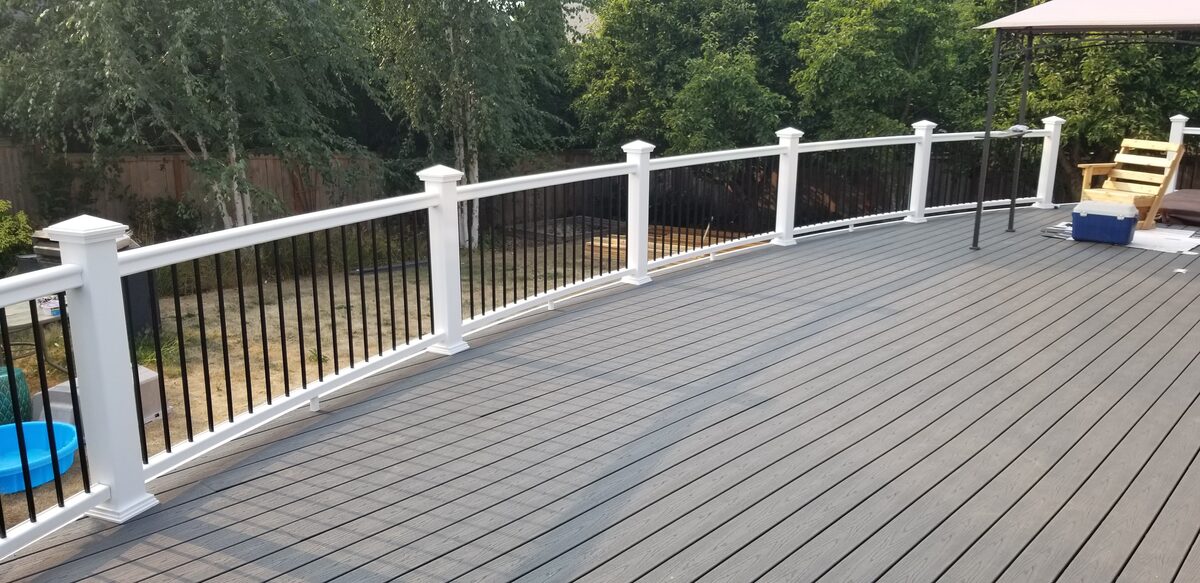
When you search "deck contractor near me" in the Seattle area, you'll get hundreds of results. Some belong to established local builders with 15 years of permitted work and a portfolio you can physically inspect. Some are national franchise operations with polished marketing, local crews you've never heard of, and a customer service center in another state. Some are unlicensed operators who will take your deposit and become unreachable by week three. The gap between those outcomes isn't incremental — it's the difference between a 30-year deck that adds real value to your home and a structural liability that surfaces at the worst possible moment.
King County has unique conditions that matter here: 38 inches of annual rainfall, 150+ wet days per year, glacial-till soil with high clay content, nine separate permit jurisdictions, and a permit review system with real wait times. A contractor who built decks in California or Colorado and relocated to the Pacific Northwest is learning those specifics on your project. A contractor who has pulled 50 permits in King County knows the system cold — which jurisdiction your address falls under, what the plan check comments typically look like, which submittal details get flagged, and how to estimate timelines accurately. That knowledge is part of what you're buying.
The NAR Remodeling Impact Report consistently shows outdoor living projects returning 70–80 cents on the dollar in strong real estate markets like the greater Seattle area. Getting the contractor selection right is how you protect that return. This guide gives you every criterion, every question, and every red flag you need to make the right call.
Why Local King County Expertise Is a Concrete Advantage, Not Marketing Language
Building a deck in Seattle is not the same as building a deck in Phoenix, Denver, or even Portland. The permit system, the climate, the soil, and the construction details specific to this region demand contractors who have worked here long enough to internalize them — not contractors who are learning King County on your job.
The Permit Jurisdiction Problem No One Warns You About
King County contains at least nine permit jurisdictions with meaningfully different processes: the City of Seattle's SDCI, the King County Department of Local Services Building Safety and Inspection Division for unincorporated areas, and separate permit offices for Bellevue, Kirkland, Redmond, Sammamish, Issaquah, Renton, and Bothell. Each has its own application portal, its own plan review staff with their own typical correction patterns, and its own seasonal backlog behavior.
King County's building safety division handles permits for unincorporated areas of the county and averages 4–8 weeks for residential deck plan review. Seattle SDCI runs similar timelines during the spring rush from March through May, when residential project volume spikes and review queues extend. A contractor who tells you a permit takes "a few weeks" without knowing which jurisdiction your address falls under is guessing.
Experienced local contractors know the correction letter patterns — the specific submittal details that plan check reviewers in each jurisdiction commonly flag. Ledger connection details at SDCI. Footing depth documentation in unincorporated King County. Lateral bracing callouts in Bellevue. Submitting those proactively, rather than waiting for a correction letter and response cycle, shaves 2–4 weeks off a typical permit timeline. That is not a small thing when you're trying to have a deck built by summer.
| Category | Value |
|---|---|
| Seattle SDCI | weeks7 |
| King County DPER | weeks6 |
| Bellevue | weeks5 |
| Kirkland | weeks5 |
| Sammamish | weeks6 |
| Issaquah | weeks5 |
| Redmond | weeks4 |
| Renton | weeks5 |
PNW Climate Details That Affect Construction Quality
Seattle's construction details differ from national standards in ways that compound over time. The board gap specification — 1/4 inch between composite boards — is critical in our rainfall environment for drainage and prevention of debris accumulation that retains moisture against the board surface. Ledger flashing in Seattle requires a specific sequence of Z-flashing, self-adhering membrane, and sealant that differs materially from what's standard in drier climates. Footing depth in King County's glacial-till soil requires reaching both below the frost line and into undisturbed bearing material — details that require local knowledge of the soil profile in different parts of the county.
A contractor who knows these details has built in this climate long enough to see what happens when they're skipped. After 15 years in King County, we have. We've replaced decks built by contractors who treated Seattle like any other market. We know what fails and why.
Key insight
The 5 Non-Negotiables: A Framework for Vetting Any King County Deck Builder
These five criteria define the floor below which no legitimate professional contractor falls. All five must be satisfied before you proceed to the proposal stage. A low price does not compensate for a missing item on this list — ever.
Non-Negotiable 1: Current Washington State Contractor License
Anyone who builds a structure for compensation in Washington State must be licensed with the Department of Labor and Industries. The license must be current — bonded and in good standing, with no unresolved complaints or enforcement actions.
Verify directly at the L&I contractor lookup. Search by company name or license number. Look for "current" status — not expired, not suspended, not cancelled. This takes under 60 seconds and is mandatory before any further conversation.
Important distinction: a Washington State contractor license is not the same as a business license. Business licenses are inexpensive, easy to obtain, and provide no consumer protection whatsoever. The L&I license covers the bond, the insurance requirements, and the accountability infrastructure that gives you legal recourse when something goes wrong. A contractor without a current L&I license is unlicensed, regardless of how long they've been in business, how many Google reviews they have, or how professional their website looks.
Important
Non-Negotiable 2: Liability Insurance and Workers' Compensation Coverage
A licensed contractor must maintain a surety bond — but the minimum bond amount in Washington State for most residential contractors is $12,000, which provides meaningful protection for small disputes but is insufficient for a $30,000–$60,000 deck project gone wrong.
Ask specifically for a Certificate of Insurance showing:
- General liability: $1 million minimum per occurrence
- Workers' compensation coverage for all employees
Workers' comp matters directly to you as a homeowner. If a worker is injured on your property and the contractor doesn't carry workers' compensation, your homeowner's insurance may become the coverage of last resort — with potential consequences for your rates, your coverage limits, and your renewal eligibility. A legitimate contractor provides current insurance certificates on request, without hesitation or delay.
Non-Negotiable 3: Written, Line-Item Quote with Full Material Specifications
Every legitimate deck contractor provides a written quote. The distinction between a quality quote and an inadequate one is specificity.
A quality line-item quote identifies:
- Decking material by manufacturer, product line, color name, and quantity (square feet)
- Framing lumber species and dimensions
- Railing system by manufacturer, style, and linear footage
- Hardware specifications (stainless steel grade, fastener type)
- Footing design (diameter, depth, concrete specification)
- Permit costs as an itemized line (not "permits if required")
- Exclusions listed explicitly by name
- Change-order process described in writing
- Payment schedule tied to completion milestones, not calendar dates
A quote that says "16x20 composite deck — $32,000" with no further breakdown gives you no protection if something is disputed, no basis for comparing bids, and no way to verify that what was installed matches what was agreed upon. When comparing multiple quotes, line-item breakdowns are the only way to compare equivalently — the "lower" quote may simply exclude permit costs, specify a lower-grade composite product, or omit the stair section entirely.
| Quote Element | Why It Matters |
|---|---|
| Material brand and product line | Prevents substitution with lower-grade material |
| Quantity specifications | Confirms scope and prevents under-ordering disputes |
| Permit cost as a line item | Proves permits are included, not an afterthought |
| Labor broken out by phase | Allows tracking progress against milestones |
| Named exclusions | Nothing is quietly omitted |
| Change-order process | Scope changes are documented before work begins |
| Payment schedule by milestone | You pay for completion, not promises |
Non-Negotiable 4: Permit Handling Included in the Contract
Ask directly: does your quote include obtaining the required building permit and managing all required inspections? The answer should be yes, without qualification.
Seattle's SDCI requires permits for any deck surface more than 18 inches above grade — which describes virtually every backyard deck in the city. King County's building department applies a similar threshold for unincorporated areas. The permit is the legal record that the structure was designed, reviewed, and inspected to code. It protects you at resale. It protects your homeowner's insurance coverage. It protects the people who use the deck.
Any contractor who suggests permits are unnecessary, offers to discount the price by skipping the permit, or says "inspectors don't come out to this area anyway" should be immediately and permanently disqualified.
The math on skipping: permit fees run $300–$800. Retroactive permitting of an unpermitted deck — which often requires partial demolition to prove code compliance — runs $5,000–$25,000. Unpermitted decks are disclosed in home sales and are a material defect that routinely kills residential real estate transactions in King County. We have witnessed this outcome multiple times. There is no scenario where skipping the permit is good advice.
Note
Non-Negotiable 5: Written Workmanship Warranty of at Least 2 Years
Manufacturer warranties cover material defects in the decking products — typically 25 years for capped composite, up to lifetime for premium PVC. They do not cover workmanship: incorrect installation, improper flashing, inadequate fastener spacing, or structural errors.
A workmanship warranty, in writing, from your contractor covers those issues. The industry standard for a reputable residential deck builder is 2–5 years on workmanship. A contractor who offers no workmanship warranty — or who says "we stand behind our work" without putting that in the contract — has no accountability after final payment is collected. Get it in writing, in the contract, with specific terms describing what is covered, how claims are submitted, and how corrections are made.
Red Flags That Disqualify a Contractor — No Exceptions
Beyond the five non-negotiables, certain behaviors signal enough risk that you should end the conversation and move on. These are not minor concerns to weigh against price or availability.
Cash-Only Payment Requests
Cash payment creates no paper trail — no documentation of what was paid, when, or for what. Legitimate contractors accept check, ACH, or credit card (with a processing fee, typically 2–3%). None require cash as the only payment method. Cash-only is a signature pattern of unlicensed operators who don't want a payment trail connected to their business name.
Deposit Demands Exceeding 25–30% Before Work Begins
A reasonable deposit at contract signing is 10–25% of the project total. This covers initial material orders and scheduling. Some larger projects justify up to 30% upfront when a significant material order must be placed before construction begins.
Demands for 50% or more before materials arrive or work begins are a pattern associated with contractor fraud in the residential market. The scenario: deposit collected, scheduling discussed, contractor becomes unreachable or company dissolves. The deposit is gone. Recovery without a physical business address and a court judgment is difficult. Progress payments tied to specific completion milestones — framing complete, decking installed, railing complete, final inspection passed — are the correct payment structure for the remaining balance.
Pressure to Sign the Same Day
A legitimate contractor gives you time to review a quote, check references, and compare alternatives. Any contractor who creates urgency around same-day signing — "this price is only good today," "I have another job starting next week and can only hold this slot until tonight" — is using a sales tactic, not protecting your interests. Take the time you need. Any legitimate contractor will still be available after you've done your due diligence.
No Physical Business Address
A post office box is not a business address. A residential address listed as the business address (common with newer one-person operations) warrants extra scrutiny. A legitimate local deck builder has an established physical presence. Ask where their office or yard is located and which suppliers they use. Names like "Dunn Lumber on Aurora" or "Pacific Coast Supply in Bellevue" are verifiable answers. Vague or deflecting answers are a yellow flag.
Inability to Provide Permit Records or References in Your Jurisdiction
Ask: "Can you show me a permit number from a project in [your city or county] in the last 18 months?" A contractor who regularly builds in your jurisdiction has a permit history you can verify. Seattle's and King County's permit systems are both searchable. A contractor who can't provide a permit number in your area either hasn't worked here recently or has been working without permits.
Important
How to Compare Quotes Correctly
Most homeowners compare quotes by looking at the final total. That's the least useful comparison metric. Two quotes for a "16x20 composite deck" can differ by $8,000 and both be accurate — for different scopes.
Build a Scope-Equivalent Comparison Sheet
Before requesting quotes, write down every element of your project:
- Exact deck dimensions
- Composite brand and product tier (entry, mid-range, or premium)
- Railing type and estimated linear footage
- Stair count and configuration
- Any lighting, electrical rough-in, or overhead structure
- Material color and finish preferences
Send this specification list to every contractor you're quoting. Ask them to quote the identical scope. Then compare line by line: Are permits included in both? What composite product line is specified in each? Does one quote include stairs while the other excludes them? Does one offer a workmanship warranty and the other not?
| Category | Value |
|---|---|
| Permit costs (if excluded) | $650 |
| Material tier difference (entry vs premium composite) | $4,500 |
| Stair section (if omitted) | $2,800 |
| Siding remediation (if not flagged at quote) | $3,200 |
| Ledger flashing upgrade (if generic spec) | $950 |
The detail level in a quote is itself a quality signal. Contractors with tighter project management and more experience produce more detailed quotes because they have seen what happens when scope is ambiguous.
Ask About the Change-Order Process
Every complex residential project has at least one unexpected issue — a rot pocket in an old rim joist, a footing location that hits an obstacle, a material color that's backordered. Ask each contractor: "What happens when we discover something unexpected? How are additional costs handled?"
The answer should describe a formal change-order process: written documentation of the added scope, an estimated cost, your approval before work begins, and the change-order amount added to the contract total in writing. Verbal agreements about scope changes during construction are effectively unenforceable and are the source of more contractor-homeowner disputes than any other single issue.
How to Read Google Reviews for Deck Contractors
Google reviews are useful — but require more interpretation than most homeowners apply. Looking at the star average is the least useful thing you can do with the data.
Volume and Recency
A contractor with 80 reviews accumulated over 10 years of active Seattle-area work is more credible than one with 80 reviews posted in the last 18 months. Volume over time reflects sustained customer satisfaction across varied conditions. A sudden spike in reviews — particularly if many reviewers have no other review history on their accounts — is worth noting.
Specificity of the Review Content
Generic five-star reviews ("Great work, highly recommend!") tell you nothing about how the contractor handles problems, communicates during a project, or manages the permit process. Reviews that name specific details — the project scope, the permit timeline, how a mid-project problem was resolved, the condition in which the yard was left — are written by real customers describing actual experiences. Those are the reviews worth reading in full.
The Negative Reviews
Read every one- and two-star review carefully. They come in two categories: legitimate descriptions of contractor failure, and unreasonable customer complaints. The difference is usually visible in the narrative detail. More importantly, look at how the contractor responds. A professional response that addresses the specific complaint, describes resolution steps, and acknowledges the customer's concern is a positive signal. A defensive, dismissive, or aggressive response to negative feedback tells you exactly how this contractor handles difficult situations during your project.
Tip
Reference Checking: The Questions Most Homeowners Don't Ask
Asking for references is standard. Asking the right questions during reference calls is not. Most homeowners ask "would you recommend them?" and consider the box checked. That question gets a yes from almost every reference — including from clients of contractors who had significant problems they ultimately resolved.
5 Reference Questions That Actually Surface Useful Information
1. "Did the contractor pull the permit, and how did the inspection process go?" This confirms permit compliance and whether the structure passed inspection without significant correction requirements. A contractor who says "we didn't bother with a permit for our project" has told you something important.
2. "Were there any mid-project surprises, and how were they handled?" Every complex project encounters at least one unexpected issue. The answer to this question tells you more about the contractor's character and competence than their portfolio photos.
3. "Was the final price close to the original quote? Were there any change-orders, and were they explained before the work was done?" Consistent scope creep — where final prices regularly exceed quotes by 20%+ — is a business practice issue, not a bad-luck pattern.
4. "How did communication work during the project? How quickly did they respond to questions or concerns?" Communication failure is the most common complaint category in residential construction. Ask this specifically. A five-second pause before the answer is itself informative.
5. "Have you referred them to anyone else, and would you hire them again?" Two questions that require different answers. Someone might hesitate to hire the same contractor again (because they wouldn't go through the disruption again) while still referring them. Or they might refer without fully recommending. The phrasing surfaces that nuance.
Ask for two or three references from work completed in the last 18 months, preferably in your jurisdiction. A contractor who has been actively building in your area recently should have multiple current, local references without hesitation.
Timeline Expectations for a Properly Managed King County Deck Project
Understanding the realistic timeline protects you from contractors who overpromise on schedule and helps you plan accurately for summer completion.
Phase-by-Phase Breakdown for a Standard 300–400 Sq Ft Composite Deck
Initial consultation and quote delivery: 1–2 weeks from first contact. A contractor who can get to your site within a week during the spring season is either less busy than average or has excellent scheduling systems.
Contract signing to permit application submission: 1–2 weeks. This includes preparation of permit drawings — dimensioned site plan, structural plan, footing and post schedule. A thorough permit package takes time to prepare correctly.
Permit plan review: 4–8 weeks depending on jurisdiction and season. Seattle SDCI and King County DPER average 6 weeks during spring peak. This timeline is entirely outside the contractor's control after the application is submitted. A contractor who promises "we'll have the permit in three weeks" in April is either working in a consistently faster jurisdiction (some are) or over-promising.
Material procurement: 1–2 weeks from permit issuance. Standard composite colors from Trex, TimberTech, and Fiberon are typically in stock at regional distributors. Custom colors and PVC products may have 2–3 week lead times.
Construction: 5–10 working days for a standard 300–400 sq ft composite deck with standard railing on a flat lot. Add 3–5 days for hillside builds with elevated framing. Add 3–4 days for cable or glass railing systems. Add 5–7 days for pergola or shade structure additions.
Final inspection: 1–5 business days to schedule after construction is complete, depending on inspector availability.
| Project Phase | Realistic Timeline |
|---|---|
| Initial consultation and quote | 1–2 weeks |
| Contract to permit application | 1–2 weeks |
| Permit plan review | 4–8 weeks |
| Material procurement | 1–2 weeks |
| Construction (standard build) | 5–10 working days |
| Final inspection | 1–5 business days |
| Total from contract signing | 9–14 weeks |
Homeowners who contact us in late May asking about June completion are almost always looking at a late-August or September build — not because construction takes long, but because the permit pipeline doesn't compress. The single most effective thing you can do to get the deck you want for summer is start the contractor selection process in January or February.
Understanding the Contractor's Material Recommendations — and When to Push Back
One underexamined aspect of hiring a deck contractor is understanding how they make material recommendations. A contractor who recommends one brand exclusively may have a supply agreement that makes that brand more profitable for them, not necessarily better for you. A contractor who can articulate why one product performs better than another on your specific site — not just in general — is demonstrating genuine knowledge.
The Right Questions About Material Recommendations
When a contractor recommends a specific composite product, ask:
- "Why this product over [another brand]?"
- "Have you seen this product perform in conditions similar to my site — shade level, moisture, north-facing exposure?"
- "What does this product look like after five years on a north-facing deck in King County?"
A contractor who can answer these questions with specifics — "TimberTech Legacy holds color better than Trex Enhance Basics on shaded sites in our experience because the polymer cap is more durable" — is drawing on field experience. A contractor who says "we like this brand, they're our supplier" is drawing on a business relationship.
The National Association of the Remodeling Industry (NADRA) is the primary trade association for deck contractors and has published technical guides on material performance in varied climates. A contractor who's engaged with industry resources on material performance is a contractor who takes this seriously.
What Material Selection Looks Like for PNW Sites
In King County, the material recommendation often depends more on site conditions than on product tier. The relevant site variables:
Sun exposure: A south or southwest facing deck on a sunny lot can support any composite product without special consideration. A north-facing deck on a heavily forested Issaquah lot that receives three hours of direct sun per day is a very different specification — moisture retention, algae resistance, and surface hardness under chronic damp conditions matter more than on a sunny lot.
Proximity to trees: Overhanging Douglas firs and big-leaf maples drop sap, leaf tannins, and debris onto deck surfaces year-round. Capped composite with a dense polymer surface is more resistant to surface staining and tannin deposits than uncapped composite or wood. On forest-adjacent lots, this is a functional specification, not just an aesthetic one.
Deck height above grade: An elevated deck — even on a flat lot — has better air circulation beneath the boards than a low-to-grade deck. Better circulation means faster drying after rain, which is meaningful for moisture-sensitive materials. Ground-level decks on flat lots in areas with poor drainage need the most moisture-resistant specification.
Railing exposure: Glass railings on waterfront or high-elevation sites experience wind and salt air exposure that doesn't apply to sheltered backyard decks. The hardware specification (316 vs 304 stainless) matters more on those sites.
A contractor who assesses these variables and connects them to specific material recommendations is one who has thought beyond the product catalog.
Contract Clauses That Protect You — and Ones That Don't
A written contract is required, but the quality of that contract varies enormously between contractors. Beyond the line-item quote format discussed earlier, there are specific contract clauses worth requesting and others worth reading carefully before signing.
Clauses That Protect You
Material substitution clause: Explicitly states that materials will match the specification sheet and requires written customer approval for any substitution. Without this, a contractor who can't source the specified composite color may substitute without informing you until after installation.
Completion date and delay remedy: A reasonable contract includes an estimated completion timeline and a defined process for delays. It won't include a penalty for rain delays or inspector scheduling delays (those are outside the contractor's control), but it should describe how delays are communicated and what constitutes an unacceptable delay.
Lien waiver on final payment: A final lien waiver from the contractor (and any major subcontractors or suppliers) at the time of final payment confirms that all bills related to your project have been paid. Without a lien waiver, a supplier who wasn't paid by your contractor can potentially lien your property even after you've paid the contractor in full. This is a real risk in residential construction.
Change-order process: Written requirement that all scope changes be documented in a signed change order before the additional work begins. This protects both parties — you're not surprised by added costs, and the contractor isn't doing work they can't collect on.
Clauses to Read Carefully
Dispute resolution / arbitration clause: Many contractor contracts include a mandatory arbitration clause. This isn't inherently problematic — arbitration can resolve disputes faster than litigation — but understand what you're agreeing to. Some arbitration clauses specify that arbitration costs are split equally (even if you're clearly the wronged party) or restrict the remedies available to you.
Limitation of liability clause: Some contracts limit the contractor's liability to the original contract value. In most circumstances this is reasonable — a contractor isn't liable for incidental or consequential damages beyond the project value. But confirm that any clause like this doesn't eliminate your ability to recover the cost of correcting defective work.
Warranty exclusions: Read the workmanship warranty's exclusion list. Standard exclusions (normal wear, cosmetic variation in natural materials, customer modifications after completion) are appropriate. Exclusions for structural settling, fastener failure, or ledger connection issues are not appropriate — those are workmanship issues that should be covered.
What Separates King County's Best Deck Builders from the Rest
After 15 years in this market, we've observed that the contractors who consistently produce excellent work — and maintain it over a full career rather than peaking and declining — share a small number of observable traits. These aren't just our qualities; they're what we'd tell you to look for in anyone.
They tell you what won't work. The best contractors are willing to tell you that your initial idea isn't the right one — that the ledger connection to your pre-1990 home presents risk you should understand before committing, that the composite color you've chosen won't look the same in King County's shade as it does in the manufacturer photo, that your desired footprint conflicts with a utility easement. A contractor who says yes to everything isn't serving your interests. A contractor who tells you the truth, even when it complicates the project, is.
They price it accurately the first time. Consistent accuracy between quoted price and final price is a discipline, not luck. It comes from thorough site assessment, complete scope development before quoting, and honest estimation of contingency risk. Contractors who chronically underbid to win jobs and recoup on change orders have made a business decision that comes at your expense. Compare final-to-quote accuracy in reference checks — it's one of the most reliable contractor quality signals available.
They photograph their permit history. A contractor who has pulled dozens of permits across King County and tracks their permit record has the institutional discipline to manage a complex regulatory environment. This isn't paperwork-for-paperwork's sake — permits, inspections, and recorded structural drawings are the documentation chain that makes your investment recoverable at sale and protects you if something ever needs to be repaired or modified.
Their crews stay stable. Labor continuity matters in residential construction. A contractor with stable crews who have worked together for years builds better than a contractor who hires differently for each project. Ask: do you use your own crews or subcontractors? How long has your primary framing crew been with you? The answer reveals a great deal about how the contractor manages their business.
What We Bring to Every King County Deck Project
We've built decks in King County for more than 15 years. Every project is permitted, inspected to completion, and backed by a written workmanship warranty. We pull permits across all King County jurisdictions — Seattle SDCI, DPER, Bellevue, Kirkland, Sammamish, Issaquah, Renton, and beyond — and our permit package preparation process is designed to minimize plan check corrections.
Our quotes are line-item documents. Every material is specified by manufacturer, product line, color, and quantity before you sign. We install composite decking from Trex, TimberTech, and Fiberon across their full product ranges, and we can tell you honestly where each performs best for your specific site conditions, exposure, and maintenance preferences.
We don't have manufacturing agreements that push us toward one product over another. We build what's right for your lot and your climate exposure. See our material comparisons at /blog/composite-vs-cedar-decking-seattle, current pricing at /blog/deck-cost-seattle-2025, and our full permit process overview at /blog/deck-permit-king-county-guide.
Frequently Asked Questions
How do I verify a deck contractor's license in Washington State?
What is a fair deposit for a deck project in Seattle?
Does my deck contractor have to pull the permit, or can I pull it myself?
How long does a deck permit take in King County?
What should a deck contractor warranty cover?
How do I compare deck quotes when prices vary significantly?
What red flags should immediately disqualify a deck contractor?
How many quotes should I get for a deck project in Seattle?
Can I verify a contractor's permit history in King County?
What questions should I ask deck contractor references?
What's the realistic timeline for a deck project in King County?
Is The Seattle Decking Company licensed and insured?
Ready to Start? Let's Talk Before You Commit to Anything
If you're planning a deck project in King County, the most useful first step is a conversation — not a commitment. We'll look at your site, explain what's structurally appropriate for your specific lot and soil conditions, tell you what the permit process looks like in your jurisdiction, and give you a line-item quote detailed enough to compare against anyone else in the market.
We won't pressure you into a same-day decision. We'll give you the information you need to make a good one, including honest assessments of where freestanding vs. attached construction makes sense for your home, what composite products hold up best in your specific shade and moisture conditions, and what a realistic schedule looks like for the time of year you're planning.
Call us at (425) 675-6259 or reach out through our contact page. We build in Seattle, Bellevue, Kirkland, Redmond, Sammamish, Issaquah, Mercer Island, Renton, and throughout King County. Site visits can typically be scheduled within one week.
Explore related resources: deck costs in Seattle | composite vs. cedar decking | King County permit guide | railing options
Planning a deck in the Seattle area?
Get an onsite design review and a clear, itemized quote from a licensed local builder.
Request a Free Quote