
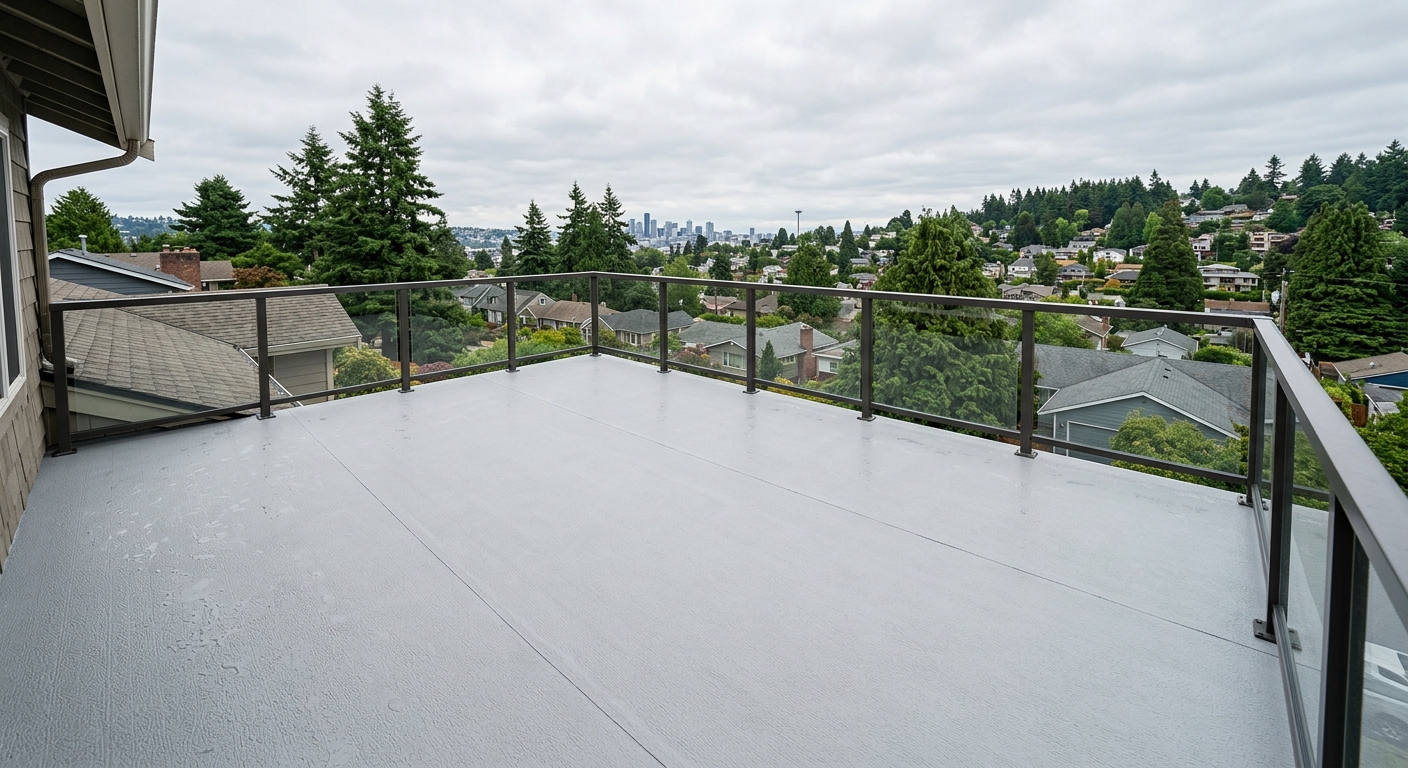
Seattle's urban neighborhoods have a space problem that doesn't have a ground-level solution. In Ballard, Capitol Hill, First Hill, and South Lake Union, residential lots that might have held a modest home with a real backyard in the 1970s now hold three-story townhouses, converted duplexes, and ADUs stacked to the setback lines. The outdoor space that used to exist — a grass yard, a garden, room to breathe — has been absorbed by density. What's left is frequently a six-foot strip between the building and the fence, or a concrete pad wedged between two structures, or nothing at all.
A rooftop deck solves this problem in a way that ground-level additions cannot. The flat roof over your detached garage, the top of a rear ADU, the roof of a second-floor addition — that square footage exists, it's already structural, it's already paid for as part of the building. Converting it from unused maintenance surface to outdoor living space is one of the most efficient transformations available to Seattle urban homeowners. Done correctly, it delivers views that no ground-level deck on the same lot could achieve, adds genuine outdoor square footage without consuming the yard you do have, and creates a private space that dense urban lots otherwise make impossible.
The honest caveat is equally important: rooftop deck construction in Seattle is categorically different from building at grade. The structural engineering requirements are non-negotiable. The waterproofing system is the most critical decision in the project — and it must be made before decking material or aesthetics are considered. The permit process involves engineering review that standard decks don't require. And in a city where NWS Seattle records 37 to 38 inches of annual rainfall with most of it falling between October and April, every flashing detail, every drainage path, and every penetration through the membrane represents a potential failure point if the design or installation is wrong. Rooftop decks built by experienced contractors who understand Seattle's waterproofing requirements perform beautifully for decades. Rooftop decks built by contractors who treat waterproofing as an afterthought cause water damage in occupied space below — damage that's often hidden for one to three years before it's discovered and expensive enough to repair that it overshadows the value of the deck itself.
This guide covers everything Seattle homeowners need to know: structural requirements, waterproofing systems, material selection, permit process, realistic cost ranges, and the specific project configurations most common in King County's urban neighborhoods.
Why Rooftop Decks Make Sense in Seattle's Urban Neighborhoods
Seattle's residential density creates a specific outdoor living problem. Ground-level decks require yard space. Covered porches require building footprint expansion. Rooftop decks use vertical space that already exists — converting a structural surface that was previously a maintenance liability into a premium outdoor amenity.
In Queen Anne's denser residential blocks, where Victorian-era homes were converted to condominiums and the effective backyard is a narrow strip between the building and the property line, a garage rooftop deck can be the only meaningful private outdoor space available to any unit. In Capitol Hill's townhouse blocks, where three-unit structures share a parking pad and a 200 square foot rear yard divided among three households, the rooftop is the only place where genuine outdoor privacy is achievable. In Ballard's rapidly densifying blocks — where the bungalow lots of the 1950s now hold two-story ADUs and detached garages with flat roofs at first-floor height — the garage rooftop is an underutilized resource sitting right off the second-floor hallway.
The view argument adds another dimension that ground-level builds can never compete with. Capitol Hill sits at 150 to 200 feet above Puget Sound. Queen Anne's north slope looks toward Lake Union and the Cascades. Beacon Hill and Columbia City look east toward Bellevue and the mountains. A rooftop deck at these elevations reveals panoramas that no ground-level deck on the same lot — regardless of how the footprint or orientation is optimized — can achieve. For urban properties where the lot itself has no meaningful outdoor space, the rooftop is both the only option and often the best option.
The caveat is genuine: these projects require a level of engineering, waterproofing expertise, and permit sophistication that most residential deck contractors don't have. Choosing the wrong contractor for a rooftop project is a more expensive mistake than choosing the wrong contractor for a ground-level deck. The stakes are higher because the failure mode — water intrusion into occupied space below — is more damaging and more expensive to remediate.
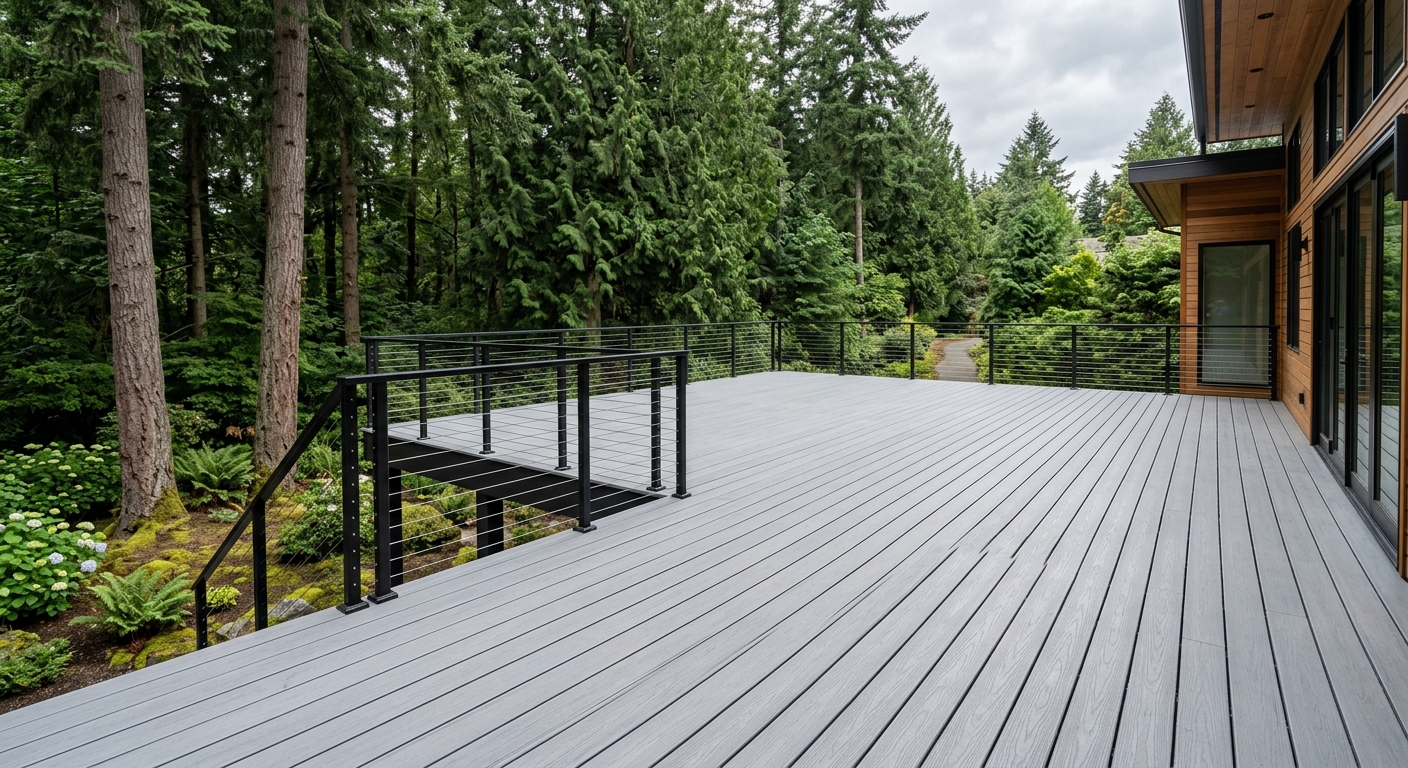
Is Your Roof a Candidate? The Structural Assessment That Everything Depends On
Not every flat roof can support a deck. Not every flat roof should have one. Before any design conversation, before any permit application, before any material selection, a licensed structural engineer must assess four things: framing capacity, roof condition, slope and drainage, and access. This assessment is not optional — it's the foundational determination that makes everything else possible, and it can't be performed by a deck contractor who doesn't have structural engineering credentials.
Framing Capacity: The Most Common Limitation
Most residential flat roofs were designed for a live load of 20 pounds per square foot — sufficient for snow accumulation and occasional maintenance access but nowhere near adequate for regular occupancy. A rooftop deck must support 40 to 100 psf depending on use: the structural dead load of the deck framing itself, the live load of occupants and furniture, and occasional concentrated loads from container gardens, hot tubs (if planned), and gatherings.
That's a two to five times increase over the original design load. Structural reinforcement to meet this requirement adds cost — typically $8,000 to $18,000 for a standard garage roof framing upgrade — but it's not a project-stopper if the existing framing is in sound condition. The engineer's assessment produces specific reinforcement requirements: sistering existing joists to increase span capacity, adding intermediate beams, installing new point supports through the structure below. Those specifications become part of the permit application and the construction scope.
What kills a rooftop deck project at the engineering assessment: framing that's in poor condition, structures that were built without the headroom necessary to accommodate the load path for reinforcement, or buildings where the wall structures below don't have adequate capacity to carry the added load to the foundation. These situations exist. When they do, the engineer says no, and the right response is to accept that assessment rather than find a different engineer who'll say yes without the structural backup to support that answer.
Roof Condition: The Prerequisite That Determines Timeline
If the existing roofing membrane is more than 10 years old or shows any signs of deterioration — blistering, surface cracking, flashing separation, soft spots, ponding water evidence — it must be replaced before the deck structure is built on top of it. Building a rooftop deck over a failing membrane traps the problem and makes future repair exponentially more difficult and expensive. The membrane under a finished rooftop deck is inaccessible without full demolition of the deck above it.
The correct sequence: structural assessment, then roofing assessment (concurrent with structural is fine), then membrane replacement if needed, then deck construction. Homeowners and contractors who skip the membrane assessment and build the deck over an aging membrane are creating a future problem that will cost significantly more to fix than doing it right in the first sequence.
A roofing contractor's assessment of membrane condition is an independent step from the deck construction contract. We assess membrane condition on every rooftop project we evaluate, and we will not build a rooftop deck over a membrane we can't stand behind.
Slope and Drainage: The Details That Determine the System
True flat roofs don't exist in practice. All "flat" roofs slope at least 1/4 inch per foot toward designed drain locations — scuppers, interior drains, or gutters. A garage with a 20-foot span has at least 5 inches of elevation change from the high point to the drain. That slope matters when you're trying to install a level deck surface above it.
Pedestal systems address slope elegantly. Adjustable pedestals set at different heights create a level deck surface above the sloped roof membrane, with water draining naturally between the deck boards and the pedestal grid below them. Pedestal systems accommodate slopes up to approximately 5% grade — more than adequate for most Seattle flat roofs. Roofs with steeper slopes may require tapered insulation under the membrane to bring the deck system into a workable pedestal range.
Drainage design matters at every scale. Water that falls on the deck surface needs a path between the deck boards or tiles, across the membrane surface below them, and to the designated drains or scuppers. Poor drainage design creates ponding water at the membrane level — the worst possible condition for long-term waterproofing performance.
Access: The Hidden Cost That Surprises First-Time Rooftop Deck Clients
Reaching a rooftop typically requires exterior stairs — a structure that's itself a permitted project in Seattle and most King County jurisdictions. A well-designed access stair doesn't just provide safe egress; it sets up the rooftop deck for practical daily use. Stairs that are steep, narrow, or awkwardly positioned turn a beautiful deck into a space that people visit rarely.
An exterior stair to a garage rooftop — typically 10 to 14 feet of rise — runs $3,500 to $8,000 for a code-compliant structure with proper landing. That cost should be in the initial budget from the first planning conversation, not discovered as an add-on after the main deck contract is signed.
Note
Waterproofing Systems: The Decision That Defines the Project
Seattle's rooftop deck failures share a common cause: inadequate waterproofing. Not inadequate decking material — inadequate waterproofing membrane. The two are related but distinct, and the membrane decision comes first.
The waterproofing membrane is the layer between the deck structure above and the occupied space below. It must be continuously watertight, permanently. Not for one season — for 20 to 30 years, through Seattle's full annual rainfall cycle, through post base movements and thermal expansion and contraction, through the minor structural movements that all buildings experience. Every penetration through that membrane — railing post bases, drain flanges, fasteners — is a potential failure point. The waterproofing system must address each penetration explicitly and durably.
System 1: Walkable Vinyl Membrane (Duradek / Tufdek)
A factory-manufactured vinyl sheet system that functions simultaneously as the waterproofing layer and the walking surface. No separate deck framing or surface material required. The vinyl is heat-welded at seams and lapped up and over curbs at edges, drains, and penetrations, creating a continuously watertight envelope.
Best for: Garage rooftop conversions where practical waterproofing performance is the priority, properties where budget constraints make a simpler system appropriate, situations where the flat roof has no structural issues and just needs a properly waterproofed walkable surface.
Performance: Excellent in Seattle's climate. Vinyl membrane systems have a 20 to 25-year service life when professionally installed. Duradek and Tufdek are both widely used in the Pacific Northwest and have a strong track record in Seattle's rainfall environment.
Installed cost: $10 to $18 per square foot for the membrane system including labor. No additional decking material required — the vinyl surface is the finished deck surface.
Limitations: The aesthetic is utilitarian — it looks like what it is, a vinyl membrane surface. Pattern and color options exist but are limited compared to composite or tile systems. For homeowners who want a premium deck aesthetic, the vinyl-only approach may not satisfy. For homeowners who prioritize reliable waterproofing over aesthetics, it's often the best choice.
System 2: Pedestal Tile System Over Professionally Installed Membrane
A professionally installed waterproofing membrane provides the foundation. Adjustable pedestals sit on top of the membrane without penetrating it. Porcelain tiles, stone pavers, or composite tiles sit on the pedestal grid, creating a floating deck surface with drainage occurring naturally below the tile plane.
Best for: Premium properties where the aesthetic result matters significantly, rooftops with moderate to complex drainage situations that benefit from the pedestal system's drainage flexibility, projects where the membrane system needs to remain fully accessible for future inspection and maintenance.
Performance: Excellent when the membrane system is high quality and professionally installed. The pedestal system protects the membrane from UV degradation and foot traffic. The tiles provide a premium visual result. The drainage design between tiles must be carefully detailed to prevent ponding at the membrane level.
Installed cost: $20 to $35 per square foot for the pedestal and tile system, plus the membrane system beneath it ($10 to $18 per square foot). Total: $30 to $55 per square foot for the complete system. Porcelain pavers at larger format (24x24 or larger) are at the upper end of the range.
Limitations: Higher cost than vinyl membrane alone. Requires careful coordination between the waterproofing subcontractor and the tile/pedestal installer. Not appropriate over membranes in poor condition — the membrane must be replaced first.
System 3: PVC or Composite Decking on Sleepers Over Membrane
A professionally installed TPO or PVC membrane provides the waterproofing layer. A framed sleeper system — pressure-treated sleepers laid flat on the membrane surface or elevated on point supports — provides structural support for standard decking boards installed above. The aesthetic result looks like a conventional deck.
Best for: Homeowners who want the look of a conventional deck, projects where the structural framing above the membrane can be designed to minimize membrane penetrations, rooftop conversions where the neighboring context or HOA aesthetic standards require a conventional deck appearance.
Performance: Excellent when the membrane and penetration details are properly executed. The critical discipline is membrane penetrations: each post base, each railing bracket, each fastener that reaches the membrane plane must be carefully flashed and sealed. Done correctly, this system performs for decades. Done carelessly — which is common among contractors without specific rooftop waterproofing experience — it leaks within two Seattle winters.
Why PVC decking (not composite) over membrane: Composite decking contains wood fiber. At penetration points where the membrane is compromised or at deck board ends near posts and fasteners, composite's wood fiber component can absorb moisture. In a rooftop application where any membrane failure concentrates water at specific points, that moisture absorption can lead to board-level degradation that accelerates failure. PVC decking (AZEK and similar) contains no wood fiber — it's a pure polymer product with essentially zero moisture absorption. At the penetration points that represent the highest-risk locations in a rooftop deck system, PVC's impermeability provides a meaningful safety margin.
Installed cost: $40 to $65 per square foot for PVC decking on sleepers, plus the membrane system beneath ($10 to $18 per square foot). Total: $50 to $83 per square foot for the complete system.
| Category | Value |
|---|---|
| Vinyl Membrane Only | $14 |
| Pedestal + Tile System | $42 |
| PVC Decking on Sleepers | $66 |
| PVC + Premium Railing | $90 |
PVC Decking on Rooftops: Why It's the Right Material Choice
The NADRA (North American Deck and Railing Association) guidelines for elevated and waterproofed deck applications consistently point to PVC as the preferred surface material, and the Seattle rooftop market reflects that consensus. Here's why PVC outperforms composite on rooftop applications specifically:
Zero wood fiber content. Standard composite decking — even capped composite from premium brands — contains a wood fiber core. That core is well protected under normal conditions by the polymer cap. On rooftops, where post base flashing and fastener penetrations create minor moisture exposure points, PVC's solid polymer construction provides a safety margin that composite cannot. In a leak scenario at any penetration, PVC boards don't absorb and hold moisture the way composite boards can.
Dimensional stability. PVC has lower thermal expansion coefficients than wood-composite materials. On a rooftop where the deck surface is fully exposed to Seattle's temperature range — from near-freezing winter nights to 85-degree summer afternoons — dimensional stability reduces the cumulative stress on end-gap details, fastener points, and penetration flashings.
Moisture impermeability at cut ends. Composite decking cut to length exposes the wood fiber core at the end cut. In normal applications, this is a well-managed detail. On rooftops where water pooling at board ends is a higher-risk condition, PVC's moisture-impermeable end cuts reduce the vulnerability at that detail.
AZEK in King County: AZEK (owned by TimberTech) is the dominant PVC brand in the Seattle market and the product we specify most frequently for rooftop applications. It's available in a wide range of colors and profiles, carries a 30-year product warranty, and has an installed base large enough in Seattle that warranty service is practical. For a full comparison of PVC vs. composite in Seattle conditions, see our composite vs. cedar decking guide.
Tip
Weight Load Engineering: The Numbers Behind the Assessment
Understanding why structural engineering is non-negotiable for rooftop decks requires understanding the load math. Here's what a 300 sqft rooftop deck adds to the structure it sits on:
| Load Component | Typical Value | Notes |
|---|---|---|
| Dead load — deck structure and materials | 15–25 psf | Framing, decking boards, railing system |
| Dead load — membrane and pedestal system | 5–12 psf | Varies significantly by system type |
| Live load — occupancy | 40 psf | Per building code minimum |
| Live load — planters and containers | 10–30 psf | Water-saturated soil in containers adds significant point load |
| Live load — concentrated (gathering) | 40–100 psf | Code-required crowd load scenario |
| Total design load | 70–167 psf | Versus original 20 psf design capacity |
A structural engineer working from these numbers determines what reinforcement — if any — is required to bring the existing framing to the required capacity. The reinforcement plan becomes a required component of the permit application.
The weight management strategy for rooftop decks: minimize deck dead load where possible (lightweight framing systems, lighter membrane options), plan planter and container locations at structural support points rather than mid-span, and design the deck for the actual intended use rather than a theoretical maximum that requires over-engineering the structure.
Drainage Design: Where Water Goes Under and Through the Deck
Drainage on a rooftop deck operates at two levels that must be designed simultaneously.
Level 1: Through the deck surface. Board-on-sleeper systems drain naturally through the gaps between boards. Pedestal tile systems drain between tiles. The gap width and spacing must be sized to pass Seattle's heavy rainfall events (up to 1 inch per hour during intense events) without ponding on the deck surface.
Level 2: Across the membrane to the drain. Water that passes through the deck surface must find a clear path across the membrane to the designated drain points. If the pedestal or sleeper layout inadvertently creates ponding zones at the membrane level — areas where water accumulates between structural elements rather than flowing toward drains — that standing water accelerates membrane wear and creates hydrostatic pressure at any minor imperfection.
Drain design on rooftop decks requires specific attention in Seattle, where the rain volume during wet season storms is significant. Undersized drains or undersized drain openings relative to deck surface area lead to membrane-level ponding during heavy rain events. We size drainage for the deck surface area and for Seattle's rain intensity, not for a generic average.
HVAC and rooftop equipment coordination is a related drainage consideration. Most Seattle urban properties have rooftop HVAC components — mini-split outdoor units, exhaust vents, plumbing penetrations. These must be maintained accessible, and the condensate drainage from rooftop HVAC must be directed to the drainage system rather than allowed to pond on the membrane. The deck layout should account for service clearance around rooftop equipment rather than incorporating it as a design afterthought.
Permit Requirements for Seattle Rooftop Decks
A full building permit from Seattle SDCI or the relevant King County jurisdiction is required for every rooftop deck project. There is no simplified permit path — no subject-to-field-inspection shortcut, no minor-improvement exception — for a project that modifies a building's roof structure and adds occupiable space above it. The permit application for a rooftop deck must include:
Engineer-stamped structural drawings showing existing framing capacity, design loads, and the proposed reinforcement scope. The engineer of record must be a licensed Washington State structural engineer. The drawings must address both the deck framing and the load path to the building's foundation.
Waterproofing details showing the membrane system, drain locations, penetration details, and railing base conditions. Seattle's SDCI has specific requirements for rooftop waterproofing detailing — the drawings must demonstrate that each penetration is addressed with a durable flashing system.
Site plan showing the deck footprint relative to property lines (setbacks apply to rooftop structures as well), access stair location, and existing rooftop equipment layout.
Processing timeline: Seattle SDCI runs four to eight weeks for rooftop deck permit review — longer than ground-level decks because the engineering review component is more involved. Properties in Environmentally Critical Areas (ECAs) add two to six weeks for additional review. Bellevue and Sammamish run four to six weeks on rooftop permit review.
Permit fees: For a $60,000 rooftop deck project in Seattle, permit fees typically run $1,400 to $2,200. For unincorporated King County projects, fees run comparable ranges on a project valuation basis.
See the Seattle SDCI permits page for decks for the current submittal requirements and fee schedule. See our King County deck permit guide for the full jurisdiction-by-jurisdiction comparison across the county.
Important
HOA and Condo Considerations for Rooftop Deck Projects
A significant percentage of Seattle rooftop deck projects occur on properties within homeowner associations or condominium regimes, where the roof is either common element or subject to HOA architectural review. These projects require HOA approval before permit application and sometimes before engineering assessment.
Structural review and liability. HOA boards for Seattle condominiums frequently require documentation that the rooftop structure was engineered specifically for the load it carries, that the waterproofing installation is warranted by a licensed waterproofing contractor, and that the insurance implications have been reviewed with the building's insurer. These requirements exist for good reason — a poorly waterproofed rooftop deck in a condominium can cause water damage to multiple units below, creating liability for both the deck owner and the HOA.
Common element roofs. In condominiums where the roof is a common element (typically all unit owners have proportional ownership), adding a deck to the roof may require consent from a majority of unit owners, not just the board. Review the condominium declaration and bylaws before beginning any design work. This is an HOA attorney question, not a contractor question.
Insurance implications. Adding a rooftop deck changes the building's liability profile. The HOA's building insurance carrier should be notified and may require a rider or premium adjustment. Failure to notify can result in claim denial for rooftop-related incidents. We recommend beginning the insurance conversation simultaneously with the HOA architectural review process.
Cost Breakdown: Rooftop Deck Projects in Seattle 2026
The cost of a Seattle rooftop deck varies significantly by system type, size, and site complexity. Here's a realistic cost framework for the most common configurations:
| Project Component | Typical Cost Range |
|---|---|
| Structural engineering assessment and drawings | $1,500–$4,000 |
| Membrane replacement (if existing membrane needs replacement) | $10,000–$22,000 |
| Structural reinforcement of existing framing | $8,000–$20,000 |
| Deck framing / sleeper system | $8,000–$18,000 |
| PVC decking surface (per sqft) | $40–$60 installed |
| Pedestal + porcelain tile system (per sqft) | $55–$90 installed |
| Vinyl membrane-only system (per sqft) | $10–$18 installed |
| Cable or glass railing | $180–$320 per linear foot |
| Exterior access staircase | $4,500–$10,000 |
| HVAC / equipment coordination and clearance | $500–$2,500 |
| Permit fees | $1,000–$2,500 |
| Typical total range — 200–300 sqft project | $45,000–$95,000 |
Seattle's labor market adds 15 to 25% above national averages across all construction trades. On rooftop decks specifically — where waterproofing specialization commands a premium and engineering coordination adds time — the labor premium is at the upper end of that range. Budget planning should use the $55 to $100 per square foot all-in figure as a realistic starting point, with the understanding that view-facing premium properties with cable or glass railing and premium tile systems regularly reach $100 to $140 per square foot.
For the complete breakdown of deck costs across King County by project type, see our Seattle deck cost guide.
Common Seattle Rooftop Deck Configurations
Garage Rooftop Conversion
The most common rooftop deck project in King County. Detached garages in Ballard, Fremont, Queen Anne, and Wallingford frequently have flat roofs at the 12 to 14-foot height level — one story above grade — that sit adjacent to or directly accessible from the home's second floor. Converting the garage roof to a deck creates private outdoor space off the second-floor living level without expanding the building footprint or consuming ground-level yard area.
The waterproofing requirement is paramount here: the garage below must remain dry through Seattle's full wet season. Walkable vinyl membrane is the most reliable choice for garage rooftop conversions where the primary goal is reliable waterproofing performance. Pedestal tile or PVC on sleepers is appropriate where aesthetics are a higher priority.
Structural note: Detached garage roofs were typically designed for lighter loads than residential flat roofs. Structural reinforcement is more commonly required for garage rooftop decks than for house rooftop decks. Budget for reinforcement as a likely line item rather than a contingency.
ADU Rooftop Deck
Accessory dwelling units built with engineered flat roofs are increasingly designed with rooftop deck potential in mind — a builder trend in Seattle's ADU market that reflects demand for outdoor space on small urban lots. An ADU rooftop deck of 150 to 250 square feet can be the primary outdoor space for the unit and a meaningful quality-of-life feature for the ADU tenant or owner.
The critical prerequisite: rooftop load capacity must be designed into the ADU from the beginning. ADUs built after 2018 under Seattle's new ADU permitting regime are frequently engineered with rooftop access in mind. ADUs built earlier, or ADUs converted from accessory structures that weren't originally designed for occupancy, require the same engineering assessment as any other rooftop project.
Urban Townhouse Top Floor
Seattle's townhouse market has produced a large stock of three-story attached units where the top floor sits at 28 to 35 feet above grade — significantly higher than a garage rooftop, with views that justify the additional structural complexity and cost. Top-floor townhouse decks in Capitol Hill and South Lake Union have become a premium amenity that commands meaningful premiums in the townhouse resale market.
The structural and waterproofing requirements are more complex at this height: the load path to the foundation is longer, seismic considerations are more involved, and the railing system must meet the 42-inch guard height requirement for the full 28 to 35-foot fall height. Engineering fees at this complexity level run $3,000 to $6,000. Total project cost for a 250 sqft top-floor townhouse deck with cable railing in a Capitol Hill or South Lake Union location: $70,000 to $120,000.
First Hill, South Lake Union, Capitol Hill Project Examples
First Hill 2024 — ADU rooftop deck, 200 sqft. Concrete ADU with a 10-year-old TPO membrane assessed as serviceable. Structural assessment confirmed framing adequacy with no reinforcement required. Pedestal system with 24x24 porcelain tile, aluminum railing with cable infill, access via new exterior stair from rear yard. Total: $68,000 including engineering, stair, and permit.
South Lake Union 2023 — Townhouse top-floor conversion, 250 sqft. Three-story attached unit, top-floor structural deck addition engineered from the beginning of the townhouse build but never installed by the original developer. PVC decking on sleepers, glass railing panels for unobstructed views of Lake Union, rooftop access through interior door with Juliette landing. Total: $74,000 including structural completion, PVC decking, glass railing.
Capitol Hill 2024 — Garage rooftop, 220 sqft. Detached two-car garage with 15-year-old built-up membrane requiring replacement. Membrane replacement with Tufdek vinyl, deck framing on sleepers, TimberTech AZEK PVC decking in Silver Maple, aluminum cable railing system, exterior stair from rear walkway. Total: $58,500 including membrane replacement and engineering.
Guard Rail Requirements at Rooftop Elevations
Rooftop decks at any meaningful height above grade require guard railings that meet the full building code requirements for elevated structures. At rooftop heights — typically 12 to 35 feet above grade — the fall distance makes railing compliance both a safety matter and a permit-critical detail.
Height requirement: Guard rails on decks more than 30 inches above grade must be at least 42 inches high in Seattle (some jurisdictions apply the residential 36-inch standard, but Seattle's code requires 42 inches for the elevations typical of rooftop decks). Baluster spacing must prevent a 4-inch sphere from passing through.
Material selection at rooftop heights: Cable railing is the dominant choice for rooftop decks in Seattle's view-oriented urban market — it provides the required guard height and structural integrity while preserving sightlines. Glass railing panels are appropriate for top-floor townhouse projects where the premium investment is justified by the view. Both require specific engineering for the post base connections that must penetrate the membrane — a detail that requires careful flashing design.
Railing post bases on membrane systems: This is the highest-risk penetration point in a rooftop deck. Railing post bases must be solidly anchored to the structural deck framing below, with all penetrations through the membrane carefully flashed and sealed. Railing post bases that rely on adhesive attachment to the membrane surface — a shortcut that some contractors use — will fail in Seattle's climate within two to three years as thermal cycling loosens the adhesive bond. We frame through the membrane to the structural deck below, with positive flashing at every penetration.
For our full comparison of railing types, costs, and performance in Seattle conditions, see our deck railing options guide.
FAQ
Frequently Asked Questions
How much does a rooftop deck cost in Seattle?
Does a rooftop deck require a permit in Seattle?
Can I put a composite deck on my roof in Seattle?
What is the best waterproofing system for a Seattle rooftop deck?
How do I know if my roof can support a deck?
What is the best material for a rooftop deck in Seattle?
How long does it take to build a rooftop deck in Seattle?
Can I add a rooftop deck to my garage in Seattle?
Do I need HOA approval for a rooftop deck in Seattle?
What are the setback requirements for a rooftop deck in Seattle?
How do I find a contractor who can build a rooftop deck in Seattle?
What happens if a rooftop deck leaks in Seattle?
The Bottom Line on Rooftop Decks in Seattle
Rooftop decks are among the most complex residential deck projects in Seattle's market — and among the most rewarding when done correctly. The combination of structural engineering, waterproofing expertise, permit sophistication, and material knowledge required to build one well is a higher bar than most residential deck contractors clear. The projects that fail aren't the ones where the budget was tight — they're the ones where the contractor treated a rooftop project like a ground-level deck with a slightly more complicated permit.
We've built rooftop decks across Seattle's urban neighborhoods — garage conversions in Ballard and Fremont, top-floor townhouse decks in Capitol Hill and South Lake Union, ADU rooftops in Columbia City and Beacon Hill. Every one of them started with an engineering assessment, involved a professionally specified membrane system, and was permitted with stamped structural drawings. None of them have leaked.
If you're considering a rooftop deck on a Seattle urban property and want an honest assessment of whether the project is feasible, what it's likely to cost, and what the process looks like from assessment to finished deck, call us at (425) 675-6259 or contact us online. The assessment conversation is free and will tell you quickly whether a rooftop deck is the right solution for your specific property.
The National Association of Realtors' remodeling impact data consistently shows outdoor living additions as high-ROI improvements in urban markets. In Seattle's 2026 real estate environment — where outdoor space is a premium amenity on urban lots that rarely have enough of it — a properly designed rooftop deck adds documented resale value while creating a space that makes daily life meaningfully better. For the urban homeowner who has no other option for outdoor space, it's not a luxury: it's the solution the property needs.
Planning a deck in the Seattle area?
Get an onsite design review and a clear, itemized quote from a licensed local builder.
Request a Free Quote