
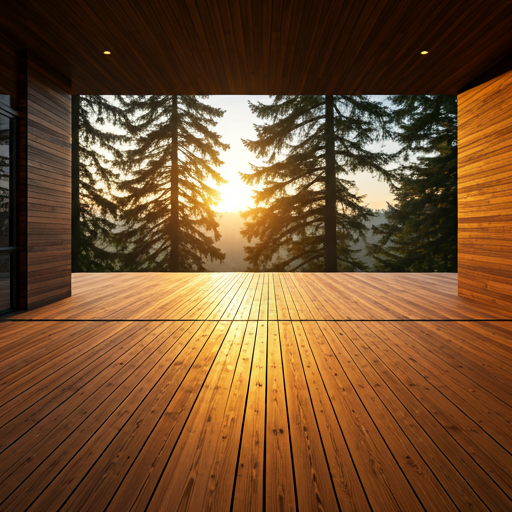
A second-story deck in Seattle does something no ground-level build can: it puts you level with the tree canopy, above the fence line, and in some of King County's hillside neighborhoods, looking straight at the Cascades or Puget Sound from a surface that was previously a wall. The view premium on second-story decks in Queen Anne, Beacon Hill, Mercer Island, and Bellevue's west-facing hillside neighborhoods is real and documented in resale data — these decks don't just improve quality of life, they improve property values in a market where outdoor space with a view commands a measurable premium.
The honest cost reality is equally clear. A second-story deck in Seattle costs 30 to 50 percent more per square foot than the same deck built at grade. The structural engineering, the deeper footings required to handle King County's clay-heavy soils, the seismic ledger requirements, the taller post systems, the engineering-stamped drawings for elevated structures — all of these add cost that doesn't appear on a ground-level deck quote. The premium runs $5,000 to $15,000 on a typical 300 sqft project above what grade-level framing would cost, and that assumes no unusual site conditions. On King County hillside lots where the downhill post height reaches 14 or 16 feet, the premium is higher.
What we tell homeowners who are weighing the additional cost: the structural premium is real, but it's a one-time investment that doesn't repeat. The deck performs at elevation for the same 25 to 30-year service life as a ground-level composite deck. And the use of that deck — the view, the privacy above the fence line, the connection to the upper living level — is meaningfully different from what a ground-level build delivers on the same property. For Seattle lots where elevation reveals something worth seeing, second-story builds pay back that structural premium in livability in ways that are hard to quantify on a spreadsheet but easy to understand on the first morning you have coffee looking at the Olympics.
Two Types of Second-Story Decks in Seattle — Know the Difference
"Second-story deck" in Seattle means two structurally and situationally distinct things, and the engineering challenges differ between them in ways that affect cost, timeline, and permit complexity.
Type 1: Off the second-floor door. The deck surface is at second-floor level, accessed directly from a bedroom, hallway, great room, or master suite. The deck surface height is typically 10 to 16 feet above grade. This is common in craftsman homes across Seattle's residential neighborhoods, newer construction in Redmond, Kirkland, and Sammamish, and two-story homes throughout the Eastside. The structural challenge is primarily the ledger connection — the point where the deck hangs on the house — and the post height, which must carry elevation loads efficiently to footings below.
Type 2: The hillside elevated deck. The deck surface is at or near first-floor level on the uphill side of the property but 10 to 20 feet off the ground on the downhill side because the lot drops away. This is the dominant elevated deck type in Seattle's hillside neighborhoods: Queen Anne, Magnolia, Capitol Hill, Beacon Hill, Columbia City, West Seattle's upper streets, Mercer Island bluff lots, and Bellevue's Somerset, Newport Hills, and Factoria hillside neighborhoods. The structural challenges here are more complex: unequal soil pressure on posts at different heights, managing drainage on sloped lots, and coordinating footings on slopes where soil bearing capacity varies across the deck footprint.
Both types require engineering attention beyond a ground-level build. But the engineering conversations are different, and homeowners benefit from understanding which type their project represents before beginning the planning process.
The View Opportunity That Justifies the Premium
On Seattle hillside lots — which constitute a significant share of the residential stock in Queen Anne, Beacon Hill, Capitol Hill, Magnolia, West Seattle, and the entire Eastside slope neighborhoods — a second-story or elevated deck at the right height reveals views that the ground level cannot access. A deck 12 feet above grade on Beacon Hill's west-facing slopes looks directly across the Duwamish Valley toward downtown and Elliott Bay. A deck at second-floor level on Queen Anne's north slope catches Lake Union and the Cascades. Mercer Island's west-facing properties at 150+ feet elevation have Olympic Mountain views that are visible only from above the tree canopy.
These views are the view premium that King County real estate markets price into elevated decks at resale. The National Association of Realtors' remodeling impact data documents outdoor living additions as high-return improvements in Western markets generally. In Seattle specifically, elevated decks with documented views command additional premiums beyond what the square footage cost of the deck itself would predict.
Structural Requirements That Don't Apply to Ground-Level Builds
The Ledger Connection and Seattle's Seismic Reality
Most elevated decks in Seattle attach to the house structure through a ledger — a horizontal beam bolted to the house's rim joist or band joist that carries the deck's gravity and lateral loads back into the building. At grade level, this connection handles modest loads. On an elevated deck, the same ledger connection handles significantly higher vertical loads (more deck weight at elevation) and substantially higher lateral loads from seismic forces that Seattle's building code requires be designed explicitly for.
Washington State is seismic Zone D — one of the highest seismic zones in the contiguous United States. Seattle's building code, aligned with the International Building Code's seismic requirements for Zone D, mandates that elevated deck ledgers resist not just the gravity load of the deck above but also the lateral seismic force that an earthquake applies to the deck mass. That means the ledger hardware — the pattern of lag screws or through-bolts, the metal joist hangers and seismic ties — must be specified to resist combined gravity and lateral loading.
Seattle DCI inspectors check ledger connection hardware at rough-frame inspection, and they look specifically at:
- Hardware type (lag screws vs. through-bolts — code specifies which applies where)
- Bolt spacing and edge distance
- Hardware manufacturer's specified installation pattern
- Ledger-to-rim-joist surface contact (no gap, no shims)
If the existing rim joist of the house — particularly in homes built before 1990 — is in deteriorated condition because a previous deck ledger trapped moisture against it without proper flashing, that rim joist must be repaired or sistered before the elevated ledger goes on. We find this condition on roughly 30% of elevated deck replacements in Seattle's older housing stock. It's not a project-stopper, but it's a line item that affects the budget and timeline.
Post Height Engineering: The 8-Foot Threshold
Seattle's prescriptive code path — the set of standard specifications that allow simple builds without individual engineering analysis — generally applies to decks with post heights under 8 feet. Above 8 feet of post height, or for decks with spans that exceed prescriptive limits, Seattle and most King County jurisdictions require engineer-stamped drawings.
In practice, this means:
- Decks with posts of 10 to 14 feet — common on Bellevue and Mercer Island hillside lots — require a licensed Washington State structural engineer's stamp on the permit drawings
- Engineering fees: $800 to $2,500 depending on project complexity, typically falling in the $1,200 to $1,800 range for a standard elevated residential deck
- The engineering fee is a project line item that appears before construction begins — billed as part of the permit preparation phase, not added as a surprise at project completion
What the engineer's analysis covers at these post heights: post section sizing (whether 6x6 is adequate or 8x8 is required at tall heights), base connection hardware (post bases must resist both the gravity load from above and the uplift force from wind or seismic events), lateral bracing requirements (X-bracing or knee brace patterns between posts at certain heights), and beam sizing to handle the combined dead and live loads at increased spans.
Building an elevated deck above 8-foot post height without engineer-stamped drawings creates real liability at resale. Home inspectors are increasingly checking permit histories and flagging elevated structures without documented structural review. In Seattle's competitive real estate market, a disclosure of an unpermitted elevated structure can affect transaction negotiations significantly.
King County's Clay Soil Problem — and Why It Matters at Elevation
Seattle's frost line is relatively shallow — 12 to 18 inches below grade — compared to Minnesota or Montana. For standard ground-level decks with modest loads, this means footing depth requirements are modest. For elevated decks in King County, the real footing challenge isn't frost: it's clay.
King County's native soils are predominantly glacial till and expansive clay — particularly in Bellevue, Issaquah, the Sammamish Plateau, and South Seattle. These clay soils swell significantly when wet and compress when dry, creating seasonal soil movement at typical footing depths (18 to 24 inches) of up to 1/2 inch vertically in high-clay locations. At grade level, that movement may be imperceptible in the deck above. On an elevated deck with 12-foot posts, a 1/2-inch footing movement amplifies to several inches of deck surface movement — visible, uncomfortable, and potentially structural.
For elevated builds in clay-soil zones, we typically specify:
- Poured concrete footings at 24 to 36-inch depth, below the seasonal moisture fluctuation zone where clay movement is most active
- Upsized footing diameter (typically 18 to 24 inches) to distribute the higher point loads from tall posts over more soil bearing area
- Helical piers where soil bearing capacity is limited by saturation — particularly on Sammamish Plateau lots with heavy clay and high water tables, and on West Seattle hillside lots where slope drainage creates high seasonal soil saturation
This footing specification adds cost compared to a standard ground-level footing, but it's not optional for elevated builds in clay-soil terrain. The alternative — undersized footings that move with seasonal soil cycles — produces a deck that moves, which is both uncomfortable and a structural concern over time.
| Category | Value |
|---|---|
| Grade Level 300 sqft Composite | $32,000 |
| Second-Story 300 sqft Composite | $46,000 |
| Grade Level 400 sqft Composite | $41,000 |
| Second-Story 400 sqft Composite | $60,000 |
Real Cost Ranges for Second-Story Decks in Seattle
Seattle labor rates run 15 to 25% above national averages. The structural premium on elevated builds adds another 25 to 50% above what the same square footage would cost at grade. Here's the realistic cost framework for 2026:
| Configuration | Western Red Cedar | Capped Composite (Trex/TimberTech) | PVC (AZEK) |
|---|---|---|---|
| 200 sqft, off second-floor door, standard post heights | $18,000–$28,000 | $26,000–$38,000 | $30,000–$46,000 |
| 300 sqft, hillside elevated, 10–14 ft posts | $26,000–$42,000 | $38,000–$58,000 | $44,000–$68,000 |
| 400 sqft, hillside elevated, full engineering scope | $36,000–$56,000 | $52,000–$78,000 | $60,000–$92,000 |
| Engineer's stamp (when required) | +$800–$2,500 | +$800–$2,500 | +$800–$2,500 |
| Structural permit fees | +$600–$2,200 | +$600–$2,200 | +$600–$2,200 |
| Cable railing upgrade (per linear foot) | +$150–$280 | +$150–$280 | +$150–$280 |
| Glass railing upgrade (per linear foot) | +$250–$450 | +$250–$450 | +$250–$450 |
These ranges include footings, framing (posts, beams, joists, ledger), decking, a standard stair run, and composite or aluminum railing. Cable and glass railing are separate line items — a 40-linear-foot cable railing on a view deck adds $5,000 to $9,000 to the budget.
For the complete deck cost breakdown across King County by project type, see our Seattle deck cost guide.
Line-Item Cost Breakdown: 16x20 Second-Story Composite Deck
A 320 sqft (16x20) second-story composite deck on a King County hillside lot with 12-foot post heights, a single stair run, and cable railing:
| Line Item | Estimated Cost |
|---|---|
| Structural engineering and stamped drawings | $1,400–$2,000 |
| Permit fees (King County or Seattle) | $800–$2,000 |
| Concrete footings (6 footings at 30-inch depth) | $2,800–$5,500 |
| Post and beam framing (6x6 posts at 12 ft, doubled 2x12 beams) | $4,500–$8,000 |
| Joist system and ledger (2x10 at 16" OC with seismic hardware) | $3,500–$6,500 |
| Capped composite decking — Trex Transcend or equivalent | $6,500–$11,000 |
| Fascia board and trim | $800–$1,500 |
| Stair assembly — 10-tread run to grade | $3,000–$6,000 |
| Cable railing system — 48 linear feet | $6,500–$11,000 |
| Under-deck drainage system (optional) | $2,500–$5,000 |
| Total | $32,300–$58,500 |
Permit Reality for Elevated Decks in King County
Any deck surface more than 18 inches above grade requires a building permit in Seattle and most King County jurisdictions. Second-story decks — typically 10 to 18 feet off the ground — require full plan review with structural drawings, not the expedited subject-to-field-inspection path available for simple, low-elevation structures.
What SDCI reviews on elevated deck permits:
- Structural drawings (engineer-stamped when posts exceed 8 feet)
- Footing design and soil bearing assumptions
- Ledger connection hardware specifications and fastener pattern
- Guard rail height compliance (42-inch minimum in Seattle for elevated structures)
- Setback compliance — the deck footprint must maintain required distances from property lines even at elevation, and the staircase footprint counts toward that calculation
Processing timelines in 2026:
- Seattle SDCI: 3–6 weeks for standard structural review
- Bellevue and Sammamish: 4–6 weeks, running longer during spring permitting season (March–June)
- Unincorporated King County (Covington, Maple Valley, parts of Woodinville): 2–4 weeks
See the Seattle SDCI decks page for current submittal requirements and fee schedules. For the full jurisdiction-by-jurisdiction King County permit breakdown, see our deck permit guide.
We handle permitting on every elevated deck project we build. The structural plan set coordination with SDCI's reviewer requires experience with Seattle's specific submittal requirements and the back-and-forth that's common when engineering firms submit drawings that don't initially meet the city's documentation standards. Self-permitting an elevated deck is technically possible but consistently slower and more frustrating for homeowners than contractor-managed permitting.
Important
Material Selection at Elevation: What Performs Best
All three primary deck material categories — cedar, capped composite, and PVC — are structurally appropriate for second-story applications. The material choice at elevation affects maintenance, warranty coverage, and long-term appearance.
Capped Composite at Elevation
Capped composite from Trex, TimberTech, and Fiberon is the dominant choice for elevated Seattle decks for the same reasons it dominates ground-level builds in King County: no sealing requirement, 25 to 30-year material warranties, excellent moss and algae resistance, and consistent appearance over decades.
At elevation specifically, composite has one additional advantage over cedar: the absence of maintenance requirements means the deck doesn't need to be accessed with a ladder and power washer for annual sealing. On a 12-foot elevated deck, the ease of composite maintenance — a garden hose from the deck surface — is a meaningful practical benefit.
Best capped composite for elevated Seattle decks: Trex Transcend and TimberTech Legacy are the products we specify most often for elevated builds in King County. Both offer 25 to 30-year warranties with specific coverage for moisture, fade, and staining. See our composite vs. cedar comparison for the full breakdown.
Western Red Cedar at Elevation
Cedar remains appropriate for homeowners with strong natural wood preferences who accept the maintenance commitment. Real Cedar — western red cedar from PNW mills — provides excellent natural rot resistance and a genuine wood aesthetic that composite approximates but doesn't perfectly replicate.
The maintenance reality at elevation: a cedar deck at 12 feet above grade requires ladder access for annual staining and sealing — a meaningful inconvenience compared to the hose-from-the-deck-surface maintenance composite requires. On shaded Seattle lots, cedar at elevation still needs the same one-to-two-year sealing cycle as ground-level cedar. The maintenance inconvenience is higher at elevation; the performance without it is the same.
PVC at Elevation
PVC decking (AZEK) is the premium choice for elevated Seattle decks, particularly for applications where the deck sits over occupied or finished space below (a bedroom, a covered patio, a garage). PVC's zero moisture absorption provides additional protection in the event of any deck board-level water exposure at post bases or fastener locations.
For standard elevated decks over grade, PVC is appropriate but the performance advantage over capped composite is modest. The cost premium is $8 to $15 per square foot over capped composite. In applications over occupied space, that premium is worth it. Over open grade, it's a quality upgrade rather than a practical necessity.
Tip
Staircase Requirements on Second-Story Decks
A stair from a second-story deck to grade is not optional — it's required for egress. Building code stair requirements for elevated residential decks:
Width: Minimum 36 inches clear width between railing posts. For wider decks or higher-traffic applications, 42 to 48 inches is a more livable staircase width.
Rise and run: Maximum 7-3/4 inch rise, minimum 10-inch run. These dimensions produce a safe, comfortable stair angle at residential scale. Steeper stairs (higher rise, shorter run) are not code-compliant regardless of how they might otherwise fit the site.
Landings: A landing is required at the top and bottom of the stair and at any change of direction. Landing minimum dimension: equal to the stair width in both directions.
Handrail height: 34 to 38 inches above stair nosing.
Graspability: Handrails must be graspable — round or oval profiles that can be wrapped by a hand, not flat cap rails.
For a 12-foot elevation drop (a typical single-story elevation), the staircase will have approximately 18 to 19 risers across about 16 feet of horizontal run, requiring a landing at mid-point or a landing and an angled stair configuration. On King County lots where the stair needs to land parallel to the house rather than perpendicular to it (to stay within the setback), an L-shaped or switch-back stair configuration adds $1,500 to $3,000 over a straight run.
The stair footprint and the under-stair area should be planned from the beginning of the deck layout, not treated as a location decision to make after the deck platform is designed.
The Under-Deck Space: A Bonus That Ground-Level Builds Don't Provide
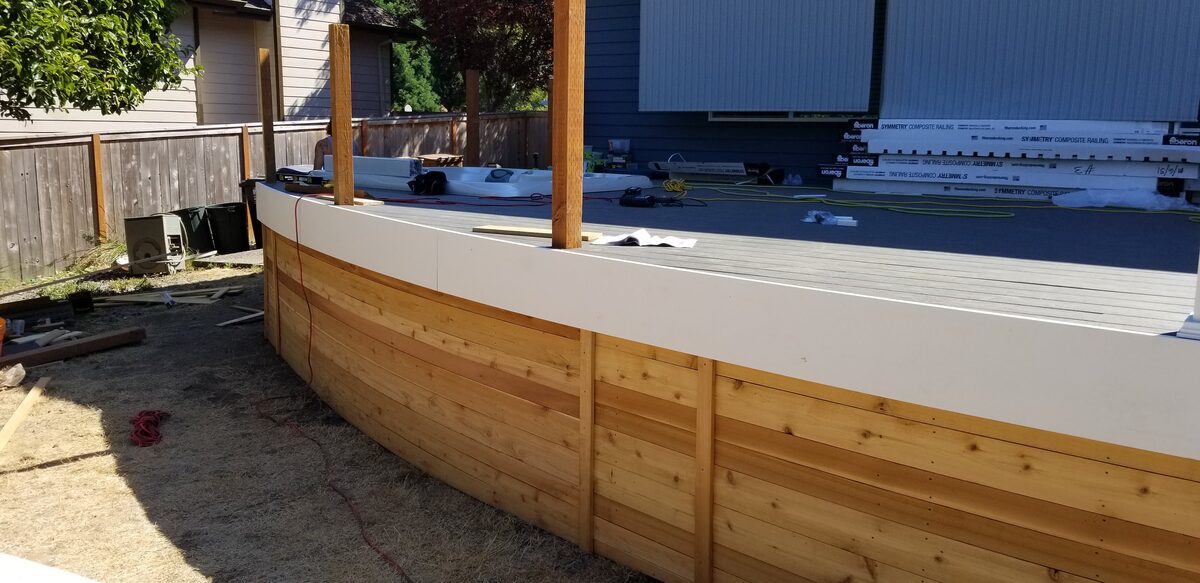
One of the frequently underestimated benefits of second-story decks is what they create below the deck surface. A 300 sqft second-story deck with 10-foot post heights produces 300 square feet of covered space below — dry through Seattle's entire wet season (under proper deck construction), protected from UV, and usable in ways that transform a backyard.
The most common under-deck uses in Seattle:
Covered storage. The most common and practical use. A locking gate in the under-deck skirting converts the space to covered storage for bicycles, kayaks, garden equipment, and seasonal items that would otherwise consume garage space or sit exposed in the yard.
Covered patio or dry entertaining space. With an under-deck drainage system — a drainage pan mounted between the joists that captures water that seeps between deck boards and directs it to the perimeter — the under-deck space becomes an all-weather covered patio. These systems run $2,500 to $5,000 installed for a typical 300 sqft deck and create usable outdoor space that Seattle's rain would otherwise make inaccessible nine months of the year.
Outdoor kitchen or bar area. On properties with access to a gas line and willing to invest in outdoor kitchen infrastructure, the covered under-deck area is the natural location for a built-in grill, refrigerator, and bar. Protected from rain, shaded in summer, and connected to the deck above by the stair.
When we design second-story decks, we plan the under-deck use from the beginning — because the structural framing decisions, the skirting attachment approach, and the drainage design all affect what the under-deck space can become.
Railing Options at Second-Story Heights
The railing on a second-story deck serves a more critical safety function than ground-level railing — the fall distance makes railing integrity genuinely consequential. Seattle building code requires 42-inch guard height for elevated decks, and second-story elevations are well above the threshold where that requirement applies.
Cable railing. The dominant choice for view-oriented second-story decks in Seattle. Cable railing provides the required guard height and structural integrity while preserving sightlines through the railing plane. The cable system — stainless steel cables running horizontally through aluminum or steel posts — meets code when the cable tension and spacing are specified correctly. For Seattle hillside decks where the view is the entire point of the elevation, cable railing is almost always the right choice.
Glass railing. Provides the maximum view preservation — structurally transparent rather than visually open. Glass panel railing costs $250 to $450 per linear foot installed and requires specific post anchor engineering for elevated applications. For premium view decks where the visual result justifies the investment, glass railing is the right choice.
Composite railing (aluminum composite systems). Fiberon, TimberTech, and Trex all offer aluminum-core composite railing systems with composite cap rails. These are the appropriate choice when the visual integration with the composite decking matters more than view preservation. Cost is $65 to $150 per linear foot installed.
Powder-coated aluminum. Straight aluminum railing systems with clean sightlines — less view-preserving than cable but more durable and lower-maintenance than composite railing. Appropriate for second-story decks where the railing aesthetic is the primary decision driver.
See our deck railing options guide for the complete comparison of railing systems — costs, performance, maintenance requirements, and typical applications in King County.
Case Studies: Second-Story Deck Projects in King County
Capitol Hill Townhome — Second-Floor Deck Off Master Suite
A 2024 project on Capitol Hill's south slope: 200 sqft off the master suite of a 2006 craftsman-influenced townhome. Post heights of 11 feet from grade to deck surface. The property's north-facing rear yard had minimal sun and no meaningful view — but at second-floor level, the deck cleared the neighbor's fence and looked over a wooded corridor toward Lake Washington.
Engineering was required at this post height. The engineer's assessment confirmed adequate rim joist condition on the relatively new structure and specified the ledger hardware pattern for Seattle's seismic requirements. Material: TimberTech Legacy composite in Weathered Teak, cable railing with stainless cables and powder-coated aluminum posts. Stair to grade in an L-configuration to fit within the side setback.
Total cost: $36,000 including engineering, permit, cable railing, and two-turn stair.
Mercer Island West-Facing Hillside — Elevated Deck with Olympic Views
A 2023 project on Mercer Island's west slope: 360 sqft at 14-foot post height on the downhill side (entry level on the uphill side). The property is on a south-facing hillside at 180-foot elevation — the deck surface at 14 feet above the downhill grade looks directly across Lake Washington to the Olympic Mountains.
Helical piers were specified by the engineer for the downhill post bases — the slope drainage pattern created high seasonal saturation at standard footing depth. Cable railing system for maximum view preservation. Trex Transcend decking in Vintage Lantern — a warm tone that contrasts with the gray Pacific Northwest palette.
Total cost: $54,000 including engineering, helical piers, permit, and cable railing system.
Bellevue Elevated Backyard — Somerset Neighborhood Hillside
A 2024 project in Bellevue's Somerset neighborhood: 320 sqft deck off the rear great room, ground level on the entry side but 12 feet above grade on the rear. The property sits in Bellevue's clay-heavy soils, requiring 30-inch footing depth and upsized diameter footings. Post heights of 12 feet at the outer edge, varying to 4 feet at the house-side posts due to grade change.
Engineering covered the variable post heights and the lateral bracing design for the taller outer posts. Composite decking (Fiberon Paramount in Ipe) with aluminum composite railing — the homeowner preferred the full-rail look over cable on this property. Under-deck drainage system installed for a covered patio below.
Total cost: $48,500 including engineering, upsized footings, under-deck drainage system, and permit.
Comparing Grade-Level vs. Second-Story: When the Premium Is Worth It
The structural premium on a second-story deck is real. Is it always worth paying? The honest answer depends on what the elevation provides.
| Factor | Grade-Level Deck | Second-Story Deck |
|---|---|---|
| Cost per sqft (composite) | $75–$125 | $90–$180 |
| Engineering required? | Rarely (posts under 8 ft) | Almost always |
| Permit complexity | Standard review | Full structural review |
| View access | Limited to grade | Above fence line, tree canopy |
| Privacy from neighbors | Moderate | High (above eye level) |
| Under-deck usable space | None | 100% of deck footprint |
| Maintenance access | Easy | Requires ladder for cedar |
| Stair requirement | Often optional | Always required |
The second-story premium is clearly worth paying when: the lot's topography creates a view at elevation that doesn't exist at grade; privacy above the fence line is a meaningful quality-of-life improvement; the connection to an upper-floor living space eliminates a stair trip for daily deck use; or the under-deck space creates additional covered area that has meaningful value on a small urban lot.
The premium is a harder sell when: the elevation provides no meaningful view advantage; the upper-floor connection is a minor convenience; or the lot's topography requires a grade-level deck regardless of what floor the access door is on.
FAQ
Frequently Asked Questions
How much does a second-story deck cost in Seattle?
Do I need a structural engineer for a second-story deck in Seattle?
What is the permit process for a second-story deck in Seattle?
Why do second-story decks cost more than ground-level decks in Seattle?
What material should I use for a second-story deck in Seattle?
What is the height requirement for railings on a second-story deck in Seattle?
Can I use the space under a second-story deck?
How deep do footings need to be for a second-story deck in Seattle?
What is the best railing for a second-story deck with views in Seattle?
How long does it take to build a second-story deck in Seattle?
Do I need a stair to grade from my second-story deck?
How does Seattle's seismic zone affect second-story deck design?
HOA and Neighbor Considerations for Second-Story Decks in Seattle
Second-story decks that sit above the fence line create visibility into neighboring properties in ways that ground-level decks don't. Understanding the implications before breaking ground avoids conflicts that can complicate construction and create ongoing friction with neighbors.
When HOA Review Applies
Seattle's urban neighborhoods contain a significant number of homeowners' associations — particularly in Bellevue, Sammamish, Issaquah, and Kirkland's planned communities, and increasingly in Capitol Hill and South Lake Union's newer townhouse developments. Many HOAs require architectural review for any exterior structure addition, including decks. The review process typically evaluates:
- Compatibility with neighborhood architectural standards
- Impact on neighboring properties' privacy and views
- Height and massing relative to surrounding structures
- Material and color consistency with the property's exterior
HOA architectural review is an entirely separate process from the building permit — you need both, and HOA approval typically must precede permit application rather than proceeding in parallel. The timeline for HOA review varies: some boards review monthly, some quarterly. In the worst cases, a project submitted for HOA review in June may not be approved until September.
The lesson: if you're in an HOA, identify the review requirement and the review schedule before any other planning step. A project that needs HOA approval in September and permit review after that isn't a summer deck regardless of how fast the contractor can build.
Neighbor Communication on Privacy
Second-story decks on Seattle's hillside lots can create meaningful privacy impacts for neighbors. A deck at 12 feet elevation on the downhill side looks directly into the yard (and potentially windows) of the property below. For properties on Seattle's hillside neighborhoods — where lots are stacked on the slope and the uphill neighbor's yard is at eye level with the downhill neighbor's second story — this is a real consideration.
Proactive neighbor communication before a second-story deck build is worth the uncomfortable conversation it sometimes requires. Specific design choices that address neighbor privacy:
- Privacy screen panels at the deck perimeter facing the impacted neighbor (rather than cable or open railing on that side)
- Pergola overhead structure that limits standing sightlines downward into the neighbor's yard
- Planter boxes at the perimeter that create a green barrier at standing height
- Deck orientation that positions the primary seating area away from the privacy-sensitive sightline
None of these choices are required by code — they're voluntary design considerations. But a neighbor who feels heard and sees that reasonable accommodation was made in the design is a significantly better long-term outcome than one who feels blindsided by a structure that looks into their bedroom window.
Material and Finish Choices That Last at Seattle's Elevation
The elevated position of a second-story deck creates specific exposure conditions that affect material performance over time. Here's what matters for long-term performance on King County hillside and elevated builds.
Wind Exposure at Elevation
Ground-level decks are partially sheltered by the house, the fence, and the surrounding terrain. A second-story deck that clears the fence line on a Queen Anne or Magnolia hillside may be meaningfully more wind-exposed than grade-level conditions on the same property. Wind exposure doesn't significantly affect composite or cedar decking performance — both are designed for outdoor exposure. It does affect:
Railing system selection: Cable railing at full wind exposure needs post spacing and cable tension specified for the site's wind loading. On highly exposed locations, the engineer's railing specification should account for wind load rather than just guard height requirements.
Furniture and accessory weight: Elevated decks in exposed locations need heavier outdoor furniture or furniture anchoring to prevent wind displacement. This is a use consideration rather than a structural one, but it affects how the homeowner uses the space.
Overhead structures: Pergolas on exposed second-story decks require more robust attachment to the deck framing than the same pergola on a sheltered ground-level build. The attachment method and fastener pattern for pergola beams should be specified for the actual exposure conditions.
Moss and Algae at Elevation
Shaded second-story decks on Seattle's hillside lots — particularly north-facing rear yards or lots with heavy tree canopy — experience the same moss and algae challenge as shaded ground-level decks, but with constrained maintenance access. Maintenance that requires ladder access to reach board surfaces with a scrub brush or power washer is maintenance that doesn't happen consistently.
This is the strongest argument for capped composite over cedar on shaded elevated Seattle decks. Capped composite's polymer surface resists moss and algae establishment significantly better than cedar, and the cleaning it does require can be accomplished with a garden hose from the deck surface rather than a ladder and a pressure washer from below. For cedar on an elevated shaded deck in King County, plan for the maintenance commitment honestly before choosing the material.
Fastener and Hardware Specifications at Elevation
The ledger fasteners, post base hardware, and railing post bases on an elevated deck carry higher loads than their ground-level equivalents and are exposed to the same moisture cycling that degrades fasteners over time. For elevated Seattle decks, we specify:
- Hot-dipped galvanized (HDG) or stainless steel hardware for all fasteners in the structural framing — not electrogalvanized, which doesn't have adequate coating thickness for long-term weather exposure
- Post base hardware with standoff design that keeps wood end-grain off the concrete surface — the most moisture-vulnerable hardware-to-wood contact point
- Ledger fasteners sized and patterned per the engineer's specifications, not the prescriptive minimum — elevated loads justify engineer-specified hardware patterns
These specifications are incorporated into every elevated build we do in King County. On a deck that's expected to perform for 25 to 30 years at elevation in Seattle's climate, the hardware quality is not a place to economize.
| Category | Value |
|---|---|
| Structural Framing | 32% |
| Decking + Fascia | 22% |
| Railing System | 18% |
| Stair | 10% |
| Engineering + Permit | 8% |
| Footings | 8% |
| Contingency | 2% |
What a Second-Story Deck Assessment Covers
Every second-story deck project we take on in King County starts with a site assessment before any design or pricing conversation. The assessment covers these specific elements that are unique to elevated builds:
Site topography measurement. Actual post heights at each footing location — not estimated from a visual read, but measured with a level and tape. On a hillside lot, the post heights can vary by 4 to 8 feet across the deck footprint, and the cost implications of that variance are significant.
Soil condition observation. Clay content, drainage pattern, seasonal saturation indicators at the proposed footing locations. On Sammamish Plateau lots and Bellevue hillside lots, obvious soil characteristics can be observed without a geotechnical report — though if the site has unusual drainage or visible soil instability, a geotechnical opinion may be warranted before design.
Existing rim joist condition. For replacement projects or additions to existing structures, probing the existing rim joist at the proposed ledger location. We do this at assessment — not at demo — because rim joist condition affects cost significantly and needs to be in the project estimate, not discovered as a surprise change order.
Setback verification. Measuring the buildable envelope from the property lines, confirming the available footprint for the proposed deck footprint and stair configuration.
Access path and stair location options. On hillside lots, the stair needs to reach grade in a location that makes sense for the site layout and stays within setbacks. This is often a constraint that affects deck orientation and size — worth working out at assessment rather than at design completion.
Jurisdiction and permit path. Confirming which jurisdiction applies (Seattle vs. Bellevue vs. unincorporated King County), what the permit path looks like for the specific post heights and engineering scope, and what the likely permit timeline is for the time of year the project is being planned.
The assessment takes 45 to 60 minutes on site and produces a realistic budget range, permit path, and timeline estimate. It's free, and it tells you what you actually need to know before committing to the project.
The Bottom Line on Second-Story Decks in Seattle
Second-story and elevated decks in King County are premium projects that require premium execution. The structural engineering, the code-compliant ledger hardware, the properly sized footings for King County's clay soils, the stamped drawings and inspected permit — these aren't bureaucratic overhead. They're the engineering rigor that makes an elevated deck safe for the people who use it, documented for the inspectors who verify it, and provably compliant for the buyers who eventually purchase the property.
The cost premium is real: 30 to 50% above what the same square footage would cost at grade. On a hillside Seattle lot where the elevation reveals a view that doesn't exist from the ground, that premium is a reasonable investment in a deck that fundamentally changes how you use your property. On a flat lot where the second-floor access is the primary driver, the premium reflects the structural reality of elevation rather than a view premium — and the decision to accept it should be made with clear eyes about what the elevation provides.
We build elevated decks across King County — from Capitol Hill townhomes to Mercer Island bluff properties to Bellevue hillside lots with 14-foot post systems. Every project starts with an honest structural assessment, a permit application prepared correctly from the start, and materials specified for Seattle's climate and the specific exposure conditions of that site.
If you want to know what a second-story or elevated deck would cost on your specific property, what the engineering and permit process looks like for your jurisdiction, and what design choices make the most of your site's elevation — call us at (425) 675-6259 or request a site assessment online. The conversation costs nothing and will give you a realistic picture of what your elevated build requires. We've been doing this in King County for 15 years, and the elevated builds we're most proud of are the ones that started with an honest site assessment rather than a wishful-thinking estimate.
For additional context on deck costs, permit requirements, and material choices across King County, see our guides: Seattle deck cost guide, King County deck permit guide, composite vs. cedar comparison, and deck railing options guide.
Planning a deck in the Seattle area?
Get an onsite design review and a clear, itemized quote from a licensed local builder.
Request a Free Quote