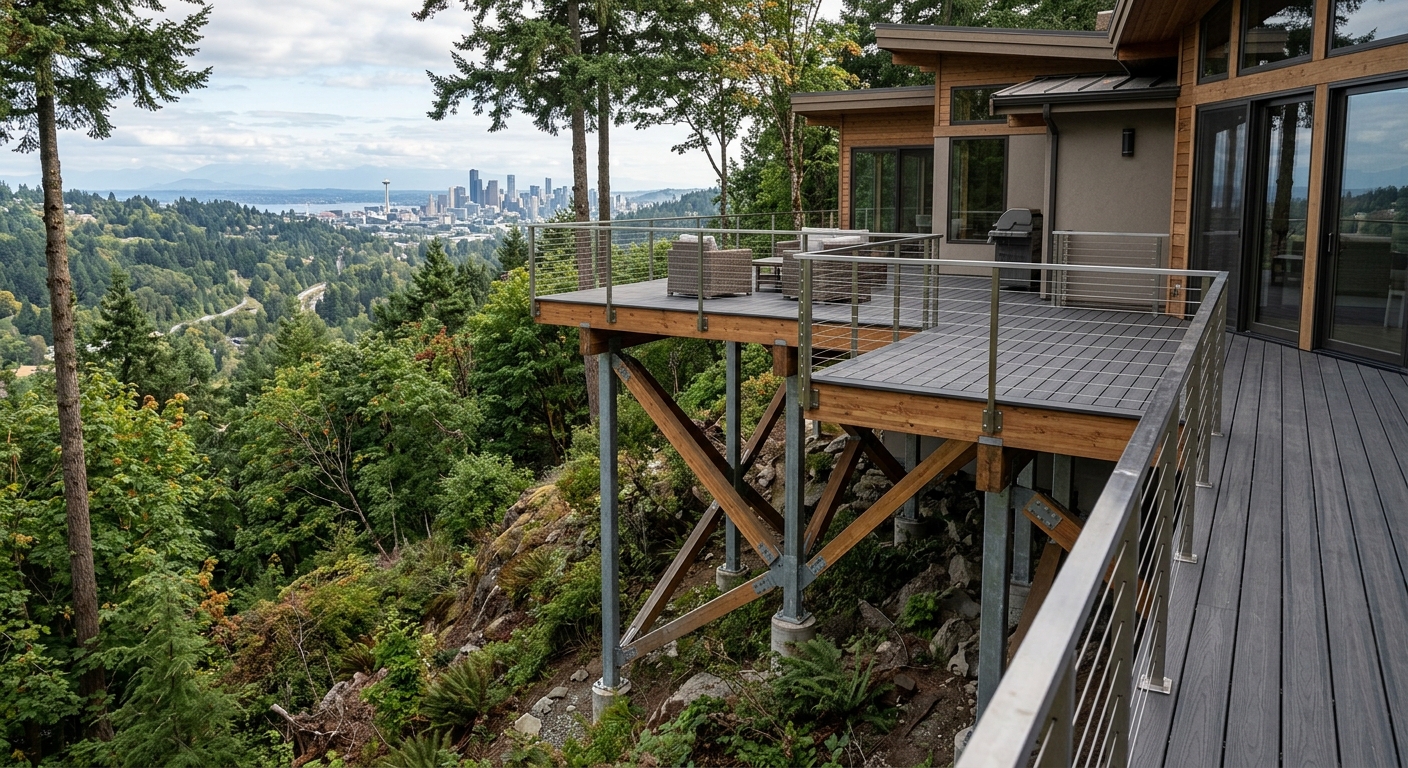
Three composite decking brands dominate King County installs: Trex, Fiberon, and TimberTech. Walk into any building supply house in Bellevue or Renton and you'll find at least two of the three stocked in significant depth. All three make genuinely excellent decking — and all three also make products we would never specify for a Seattle deck. The brand name is the least important variable in this decision. The product line within that brand is what determines whether your deck lasts two years or thirty.
This guide is not a marketing comparison. It's what we actually specify after 15+ years of King County installations, why we specify it, what our decks look like after 5–10 Pacific Northwest wet seasons, and where the real differences between brands surface once you cut through the packaging. If you're comparing Trex, Fiberon, and TimberTech for a Seattle area project, this is the context that translates into a decision that holds up through years of PNW rain.
Seattle decks face a climate challenge that national composite performance reviews don't adequately capture. We average 37–38 inches of rainfall per year, distributed across October through April in persistent, ambient drizzle — not the concentrated summer storms that drier-climate composite guides are calibrated against. Humidity runs 85–90% for weeks at a stretch during the rainy season. Deck surfaces in shade — common on King County lots with significant tree canopy — stay damp well into the afternoon after overnight rain. Under a deck, the air space between joists can remain saturated for days after a rain event. Any composite board with exposed wood fiber absorbs this ambient moisture continuously and begins degrading from the inside out within 2–4 years. That's not a brand problem. It's a product-line problem that every major manufacturer has addressed at their premium tiers and deliberately left unaddressed at their entry price points.
Why Brand Choice Is the Second Decision, Not the First
Before any brand comparison is useful, one distinction needs to be absolutely clear: whether a composite board is fully capped on all four sides is the single decision that determines whether a deck performs in Seattle's climate. It is more consequential than any brand preference, any color choice, or any price difference within the composite category.
Composite decking blends wood fiber — ground sawdust, wood chips, or wood flour — with plastic binders. That wood fiber gives composite boards weight, texture, and the ability to hold fasteners effectively. It also absorbs moisture through any surface that isn't sealed behind a continuous polymer shell. Original composite formulations from the 1990s left wood fiber exposed on board edges and undersides. The deck industry spent a decade paying warranty claims and rebuilding its reputation because of that design choice.
The industry's answer was the fully capped composite: a continuous bonded polymer shell on all four sides of the board — top walking surface, both side edges, and the underside — preventing moisture from reaching the wood-fiber core through any pathway. When the cap is truly complete, moisture cannot reach the core even when the board sits in standing water. That's the product that works in Seattle.
The critical complication: every major composite brand sells both fully capped and uncapped or partially capped products at different price points, often under the same brand umbrella. Trex Select looks nearly identical to Trex Transcend in a showroom until you look at the underside. Fiberon entry-tier boards sit attractively priced next to Fiberon Symmetry. The capping specification is not visually obvious and does not announce itself with a label.
Important
The North American Deck and Railing Association (NADRA) publishes installation standards for capped composite systems — including specific requirements for joist spacing, fastener type and spacing, and ventilation gap minimums that preserve warranty validity through Pacific Northwest conditions. Those standards assume you're working with a fully capped product to begin with. No installation standard can compensate for a board that absorbs moisture through its unsealed underside.
One additional Seattle-specific installation requirement: the end grain of any cut composite board — exposed when boards are trimmed to length, mitered, or cut around posts — is a direct exposure point for the wood-fiber core. Every cut must be sealed with manufacturer-approved end sealant immediately before installation. This is a certified installer requirement across all three brands and a moisture management step that's particularly critical in Seattle's sustained-moisture environment. An unsealed cut end is a slow-motion moisture entry point that works into the board over years of wet seasons.
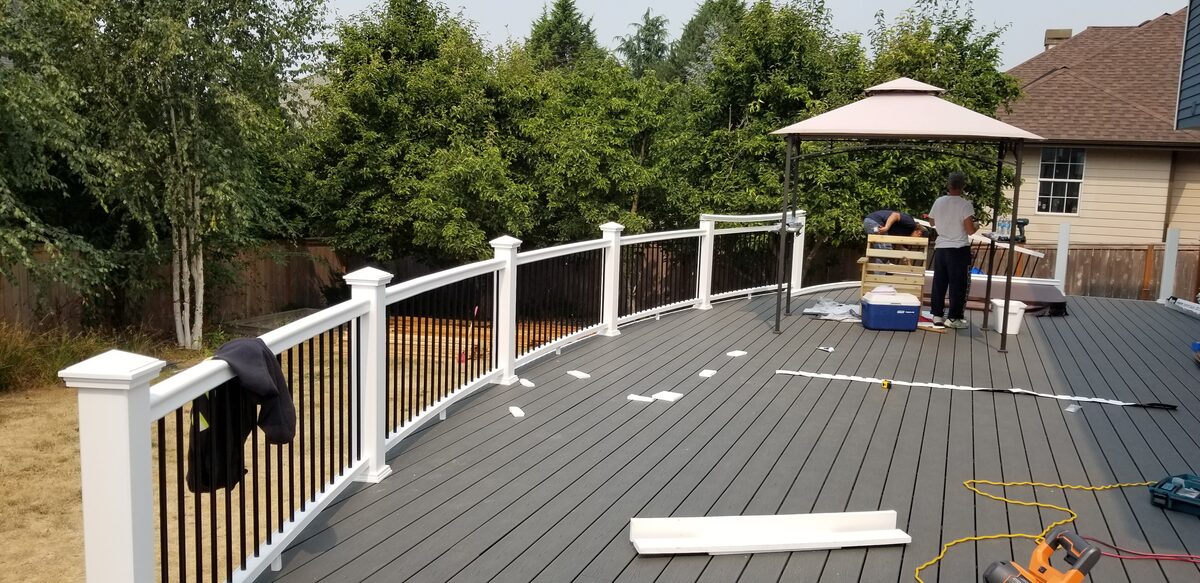
Trex: Market Leader, Widest Color Selection, One Line to Avoid
Trex is the most recognized composite brand in the United States, and its presence in the Seattle market reflects that. Trex is stocked at Home Depot locations throughout King County — Bellevue, Kirkland, Renton, Redmond, Federal Way, and beyond. That wide retail availability translates into genuine practical advantages: accessible supply, competitive pricing through high retail volume, and contractor familiarity that is the highest of any composite brand in the Pacific Northwest.
The downside of that availability: Trex Select — the partially capped entry-tier line that we never specify for full Seattle weather exposure — shares shelf space with Transcend and Enhance at the same retail stores. They look similar. Select costs meaningfully less. And in King County conditions, Select fails within 2–3 years on a fully exposed deck surface.
The Trex Product Lines for Seattle: What We Specify and What We Don't
| Trex Line | Cap Coverage | Seattle Recommendation | Fade/Stain Warranty | Installed Cost (King County 2025) |
|---|---|---|---|---|
| Transcend | Full 4-sided | Yes — primary Trex specification | 25 years | $44–$54/sq ft |
| Enhance Natural | Full 4-sided | Yes — strong value specification | 25 years | $39–$48/sq ft |
| Enhance Basics | Full 4-sided | Yes — entry value specification | 25 years | $35–$43/sq ft |
| Select | Top surface only | No — avoid for full PNW exposure | Structural only | $30–$38/sq ft |
Trex Transcend is our first-reach specification for most King County residential deck projects. The color palette — currently more than 20 options spanning tropical hardwood tones, Pacific Northwest naturals, cool grays, and warm earth tones — is the widest available in the entire composite category across any brand. Texture options range from subtle, uniform grain patterns to deeply embossed multi-tonal profiles that read convincingly as natural wood at normal viewing distances. The Lineage Collection within Transcend, introduced in recent product generations, uses a more pronounced wire-brushed texture and complex color streaking that brings it closest to natural hardwood aesthetics within the Trex product family.
We have Trex Transcend installations throughout King County — Mercer Island, Bellevue hillside properties, Queen Anne, Kirkland waterfront lots — in the 5–10 year age range. They perform exactly as expected: color consistent with installation condition, no surface mold or algae colonization beyond what any outdoor surface accumulates and an annual cleaning removes, boards dimensionally flat and stable through multiple seasonal cycles. This is what properly specified and correctly installed composite looks like after a decade of Pacific Northwest exposure.
Trex Enhance (Natural and Basics collections) is our value specification within the Trex lineup. Both Enhance lines are fully capped on all four sides and carry the same 25-year fade and stain warranty as Transcend. The color palette is narrower — primarily warm brown naturals and neutral gray tones — but covers the range that suits most King County home exteriors effectively. Installed cost runs approximately $8–$12 per square foot less than Transcend, representing meaningful project savings without any performance reduction.
Trex Select is what we never specify. Select has a polymer cap on the walking surface only — the board underside and side edges are exposed wood fiber. In Seattle's sustained moisture environment, moisture enters through the unsealed surfaces continuously during the wet season. We've seen Select installations on north-facing, heavily shaded Seattle and Bellevue decks develop visible surface discoloration from internal mold working outward within 18–24 months. In less shaded locations, the timeline is 3–4 years. Either way, the failure is premature and preventable, and the board replacement cost — labor plus materials plus disposal — typically equals the entire original project cost.
Key insight
Trex Color Strategy for Seattle Homes
The Transcend palette includes some of Seattle's most popular composite colors. Lava Rock — a warm dark gray with reddish undertones — pairs exceptionally well with the dark wood and muted exterior palettes common in Bellevue's newer neighborhoods. Havana Gold offers a honey-brown tropical hardwood tone that works on homes with warm cedar or brown exterior finishes. Island Mist and Gravel Path are the cooler gray options that complement contemporary gray and charcoal exterior paint palettes common in Seattle's newer residential construction.
One practical note on color selection in Pacific Northwest light: Seattle's overcast sky from October through April filters natural light differently than a sunlit showroom. Colors that look warm and saturated indoors can appear cooler and flatter outdoors on an overcast day. We always recommend viewing composite samples outdoors, ideally on an overcast day similar to Seattle's typical conditions, against the actual exterior siding and trim they'll sit adjacent to. The five-minute effort of that comparison prevents color regret on a product that will be part of your outdoor environment for 25+ years.
Installed pricing includes material, labor, hidden fasteners, and perimeter trim. Select shown for reference only — not specified for Seattle full-exposure conditions.
| Category | Value |
|---|---|
| Trex Select (not recommended) | $34 |
| Trex Enhance Basics | $39 |
| Trex Enhance Natural | $43 |
| Trex Transcend | $49 |
Fiberon: Equal PNW Performance, Lower Price — Our Best-Value Seattle Specification
Fiberon carries significantly less consumer brand recognition than Trex throughout the Seattle market. That lower profile is not a reflection of product performance — it reflects lower marketing spend. At the fully capped tier, Fiberon Symmetry performs comparably to Trex Transcend across every Seattle climate metric we track across our installations. The difference that shows up consistently in our project quotes and in homeowner budgets: Fiberon Symmetry runs 8–15% below Trex Transcend at equivalent product specifications. On a $42,000 composite deck project, that's $3,360–$6,300 in material savings with no measurable performance trade-off.
The Fiberon Product Lines for Seattle: What We Specify and What We Don't
| Fiberon Line | Cap Coverage | Seattle Recommendation | Fade/Stain Warranty | Installed Cost (King County 2025) |
|---|---|---|---|---|
| Horizon | Full 4-sided PermaTech | Yes — premium Fiberon specification | Lifetime | $48–$58/sq ft |
| Symmetry | Full 4-sided PermaTech | Yes — primary value specification | 25 years | $38–$47/sq ft |
| Pro | Partial cap | No — avoid for PNW full exposure | 15 years | $29–$37/sq ft |
| Good Life | Uncapped | No — avoid entirely | 10 years | $24–$32/sq ft |
Fiberon Symmetry is our primary Fiberon specification and the product we recommend most often when value is the governing consideration for a King County deck project. Fiberon's PermaTech capping system delivers a complete four-sided polymer shell with integrated stain and mold inhibitors. Board texture on current Symmetry product generations has improved substantially compared to the earlier Fiberon products — the wood-grain embossing creates realistic multi-tonal variation across the board face, and the color palette covers the warm-brown-to-neutral-gray range that works effectively on most King County home exteriors.
We have Fiberon Symmetry installations at the 4–9 year mark throughout King County — Bellevue, Renton, Kirkland, Sammamish, and South Seattle neighborhoods among them. Surface color is consistent with installation condition. No surface mold beyond what an annual cleaning addresses. Boards dimensionally flat and stable through multiple PNW wet seasons. The performance record in our installations is what drives our confidence in the recommendation. The data from our own projects is more reliable than any manufacturer performance claim.
The Symmetry color lineup includes warm earth tones (Ipe, Cedar, Mahogany), neutral naturals (Ashwood, Coastal Gray), and cooler options (Slate, Westminster) that translate well on King County home exteriors. The palette is narrower than Trex Transcend's 20+ options but covers the range needed for the vast majority of residential projects.
Fiberon Horizon is the premium Fiberon specification and carries a limited lifetime fade and stain warranty — the strongest warranty in the composite category among the three brands at this analysis level, and meaningfully stronger than Trex Transcend's 25-year coverage. Horizon board aesthetics step up from Symmetry in grain depth, color variation complexity, and surface texture — the result of more sophisticated co-extrusion technology that produces multi-tonal color streaking within individual boards for a more convincing hardwood appearance.
For homeowners with a long-term hold on the property, planning to hold through multiple decades, or who simply want the strongest available warranty without moving to AZEK pricing, Fiberon Horizon delivers lifetime fade and stain coverage at an installed cost that's still below TimberTech Legacy. It's a compelling value at the premium composite tier.
Fiberon Pro and Good Life are entry-tier products with partial capping and no capping, respectively. Their warranty terms reflect the design — 15 years for Pro, 10 years for Good Life — and we don't specify either for Seattle outdoor deck applications. The price point is attractive in isolation; the replacement cost when they fail is not. We see these boards most often on decks built by contractors who don't specialize in composite and don't fully understand the Seattle capping requirement.
Tip
The Fiberon Savings at Project Scale
The 8–15% material cost advantage of Fiberon Symmetry over Trex Transcend is consistent across our supplier quotes going back several years. The mechanism is straightforward: Fiberon spends less on consumer marketing and retail distribution infrastructure. The difference flows to the product price.
To quantify it at project scale: on a 400 sq ft composite deck project in King County, materials represent roughly 35–40% of total installed cost. The Fiberon Symmetry material savings relative to Trex Transcend translates to approximately $2,000–$5,000 less in total project cost depending on deck size, scope, and current pricing. For homeowners comparing bids where one contractor proposes Fiberon Symmetry at a lower total and another proposes Trex Transcend at a higher total, the correct question is whether the performance difference justifies the price difference. Our installation experience says it does not at these equivalent capping tiers.
Fiberon Symmetry and Horizon are the Seattle-appropriate specifications. Pro and Good Life are shown for reference only — not recommended for PNW full-exposure conditions.
| Category | Value |
|---|---|
| Fiberon Good Life (not recommended) | $28 |
| Fiberon Pro (not recommended) | $33 |
| Fiberon Symmetry | $43 |
| Fiberon Horizon | $53 |
TimberTech: Premium Grain Realism, Strongest Warranty at Mid-Tier, PVC Option Available
TimberTech occupies the premium end of the capped composite market. It is owned by The AZEK Company alongside the AZEK PVC line — an ownership structure that's relevant because these two product families solve different problems at different price points and the distinction between them is frequently misunderstood.
TimberTech composite delivers the most realistic wood-grain appearance in the capped composite category, in our assessment after seeing them all side by side at client design reviews. The grain realism argument for TimberTech Legacy isn't theoretical — it's consistent feedback from clients who compare samples from all three brands and find that Legacy simply looks more like real hardwood than the alternatives. If that comparison matters to your project, TimberTech is the specification.
The TimberTech Product Lines for Seattle: What We Specify and What We Don't
| TimberTech Line | Cap Coverage | Seattle Recommendation | Fade/Stain Warranty | Installed Cost (King County 2025) |
|---|---|---|---|---|
| Legacy Collection | Full 4-sided | Yes — premium specification | Lifetime | $52–$64/sq ft |
| PRO Collection | Full 4-sided | Yes — premium-mid specification | 30 years | $46–$56/sq ft |
| EDGE Collection | Full 4-sided | Yes — entry specification | 25 years | $37–$46/sq ft |
| ArmorGuard | Partial cap | No — avoid for full PNW exposure | 15 years | $28–$36/sq ft |
TimberTech Legacy is the top-tier composite specification and our recommendation when realistic wood-grain appearance is the design priority. Legacy uses TimberTech's most sophisticated surface embossing — a wire-brushed texture process that creates genuine depth in the grain profile, not a printed surface pattern. Combined with multi-tonal color formulation that places streaks, color variation, and grain-line differentiation across the board face, Legacy produces an appearance that requires close inspection to identify as composite. The Weathered Teak, Antique Leather, Pacific Coastline, and Mocha colors are particularly successful in the Seattle market — warm tones that work well under Pacific Northwest overcast light.
Legacy carries a lifetime fade and stain warranty — equal to Fiberon Horizon at the lifetime tier, and significantly beyond Trex Transcend's 25-year coverage. The combination of the best-in-category grain realism and a lifetime warranty makes Legacy the choice for clients who want no trade-offs at the composite premium tier. The cost is proportionate — installed pricing runs approximately $52–$64 per square foot in King County, making it the most expensive composite in this comparison — but for homeowners with a design brief centered on natural hardwood aesthetics and a long-term hold on the property, Legacy is consistently the right recommendation.
TimberTech PRO is the mid-tier specification and our recommendation when TimberTech brand alignment is important but Legacy pricing is outside the project budget. PRO delivers a full four-sided cap with a 30-year fade and stain warranty — five years longer than Trex Transcend at the equivalent tier. Board aesthetics step down from Legacy in grain depth and color variation complexity but remain strong: PRO boards look premium and have a realistic grain profile that holds up well at normal viewing distances. The PRO color range is extensive and includes both warm hardwood tones and contemporary cool neutrals.
TimberTech EDGE is the entry-level TimberTech composite and, notably, still carries a full four-sided cap — a meaningful difference from Trex Select, which is only partially capped at the entry tier. EDGE's cap thickness and grain sophistication step down from PRO, but the essential moisture protection is maintained. It's the TimberTech minimum specification we'd accept for a Seattle installation.
TimberTech ArmorGuard is partially capped and not appropriate for full Seattle weather exposure. We treat it the same as Trex Select — functional in dry climates, wrong for King County.
AZEK: A Separate Category That Deserves Separate Consideration
AZEK deserves its own clear explanation because homeowners frequently conflate it with TimberTech composite. They are not the same product. They share a parent company. They do not share a material composition, a price point, or an application profile.
AZEK is 100% polyvinyl chloride — cellular PVC with no wood fiber anywhere in the board. There is no wood-fiber core, no organic material of any kind. The board is solid polymer through and through.
The implications for Seattle applications are significant. A board with no organic material cannot absorb moisture through any surface — there is nothing hygroscopic in the material. It cannot support internal mold growth because there is no food source for mold within the board. Its dimensional stability across moisture cycling is fundamentally better than any composite board, because there is no wood-fiber component swelling and contracting in response to humidity changes. The underside of an AZEK board exposed to years of Pacific Northwest saturation looks the same as the day it was installed.
AZEK carries a 50-year limited warranty — the longest warranty in the decking category by a significant margin and nearly double the longest composite warranty available. Maintenance requirement over those 50 years: periodic rinsing to remove surface debris. That is the complete list.
Key insight
Full Brand Comparison: Seattle-Appropriate Products Side by Side
All products shown are fully four-sided capped at their respective tiers. AZEK is 100% PVC, not composite. Pricing reflects King County mid-2025 installation costs including labor, fasteners, and perimeter trim.
| Category | Value |
|---|---|
| Fiberon Symmetry | $43 |
| Trex Enhance | $41 |
| TimberTech EDGE | $42 |
| Trex Transcend | $49 |
| TimberTech PRO | $51 |
| Fiberon Horizon | $53 |
| TimberTech Legacy | $58 |
| AZEK (PVC) | $64 |
| Trex Transcend | Fiberon Symmetry | TimberTech PRO | TimberTech Legacy | AZEK (PVC) | |
|---|---|---|---|---|---|
| Material type | Capped composite | Capped composite | Capped composite | Capped composite | 100% PVC |
| Cap coverage | Full 4-sided | Full 4-sided (PermaTech) | Full 4-sided | Full 4-sided | N/A — no wood fiber |
| Installed cost ($/sq ft, 2025) | $44–$54 | $38–$47 | $46–$56 | $52–$64 | $56–$72 |
| Fade/stain warranty | 25 years | 25 years | 30 years | Lifetime | 50 years |
| Structural warranty | 25 years | 25 years | 30 years | Lifetime | 50 years |
| Wood grain realism | Very good | Good–Very Good | Very good | Best in class | Good — solid color focus |
| Color selection | 20+ options | 12–15 options | 18–22 options | 12–15 options | 15+ options |
| Local availability | Highest — retail + contractor | Contractor supply | Contractor supply | Contractor supply | Contractor supply |
| Price vs. Trex Transcend | Baseline | 10–18% less | Approx. equal | 8–15% more | 20–35% more |
| Seattle track record (our installs) | Excellent | Excellent | Excellent | Excellent | Excellent |
| Not-recommended line for Seattle | Select | Pro, Good Life | ArmorGuard | ArmorGuard | N/A |
When Trex Wins: The Scenarios Where Brand Choice Goes to Trex
Trex earns the specification for specific King County project scenarios:
Widest color selection is a requirement. No other composite brand offers the color breadth of Trex Transcend's full palette. When a client needs a specific warm terra-cotta tone, an unusual tropical hardwood look, or a color that matches a distinctive exterior paint, Transcend's 20+ options frequently include what the other brands don't.
Retail availability matters for timeline. For projects with tight timelines or where mid-project material replenishment is likely, Trex's Home Depot stocking throughout King County is a genuine convenience that Fiberon and TimberTech contractor-supply channels can't match on short notice.
Maximum contractor familiarity. Trex has the highest installer familiarity of any composite brand in the Pacific Northwest by volume. Most experienced deck contractors in King County have installed Trex significantly more than any other brand. For homeowners who want to minimize any installation ambiguity, Trex's widespread familiarity is a marginal advantage.
Scratch resistance priority. Trex Transcend has strong scratch resistance testing results — a meaningful advantage on decks that will see heavy furniture traffic, large dogs with claws, or frequent movement of heavy items across the surface. It's one of the most durable composite surfaces in routine daily use scenarios.
When Fiberon Wins: The Scenarios Where Value Logic Points to Fiberon
Fiberon Symmetry earns the specification in these scenarios:
Budget matters at project scale. An 8–15% material cost savings on a $45,000 project is $3,600–$6,750. When the aesthetics comparison is close between Symmetry and Transcend for the design brief — and in our experience, it frequently is — Fiberon is the financially rational choice for most King County homeowners.
Longest warranty at mid-tier price. Fiberon Horizon's lifetime fade and stain warranty at an installed cost below TimberTech Legacy is the best warranty value in the composite category. For long-hold owners who prioritize warranty terms, Horizon is the answer.
Color selection works for the design. Fiberon Symmetry's palette covers the warm-to-neutral range that suits the majority of King County residential projects. When the design brief works within that range, there's no performance or aesthetic reason to pay the Trex premium.
When TimberTech Wins: The Scenarios That Point to Premium Grain Realism
TimberTech earns the specification in these scenarios:
Grain realism is the governing design criterion. When the design brief is "composite that looks as much like real hardwood as possible," TimberTech Legacy wins. The wire-brushed texture and multi-tonal color formulation are demonstrably more convincing than the alternatives at a level that shows up in sample comparisons, not just written descriptions. Bring Legacy, Transcend, and Fiberon Symmetry samples to a design review and let the materials make the argument.
Both premium aesthetics and a lifetime warranty are required. TimberTech Legacy delivers both the best grain realism in the category and a lifetime warranty. No other composite product combines these two attributes.
AZEK for demanding applications. When the project is a rooftop deck, a waterfront property on tidal water, or any application where moisture performance requirements exceed what composite reliably delivers — AZEK is the correct specification. It's available through the same contractor channels as TimberTech, priced proportionately higher, and engineered to handle the applications where composite carries residual risk.
Project-Type Recommendations: Which Brand for Which Seattle Application
| Project Type | Primary Specification | Reasoning |
|---|---|---|
| Standard backyard residential deck | Trex Transcend or Fiberon Symmetry | Equivalent performance — choose on color preference and budget |
| Hillside elevated deck (Bellevue, West Seattle, Issaquah) | Fiberon Symmetry or Trex Transcend | Same spec; add AZEK consideration if limited drainage clearance below structure |
| Heavily shaded north-facing deck | TimberTech PRO or AZEK | Higher-performing cap in sustained wet/shaded conditions |
| Rooftop deck above living space | AZEK | PVC only — moisture management above inhabited space requires zero-absorption material |
| Waterfront — Lake Washington, Lake Sammamish (freshwater) | Trex Transcend, Fiberon Symmetry, or TimberTech PRO with Grade 316 stainless fasteners | Four-sided capped composite appropriate; upgrade fasteners to marine stainless |
| Waterfront — Puget Sound, tidal water (saltwater) | AZEK with Grade 316 stainless hardware | Salt air requires PVC for decking; all hardware must be marine grade |
| Design-priority project with wood-look premium | TimberTech Legacy | Best grain realism in composite category |
| Value-focused project with solid warranty | Fiberon Symmetry or Horizon | 8–15% below Trex equivalent; Horizon carries lifetime warranty |
| Long-hold or investment property | TimberTech Legacy (lifetime warranty) or AZEK (50-year) | Maximum warranty coverage for long-term asset management |
Availability and Lead Times in King County
Knowing what's available and when matters for project planning, particularly for projects with firm completion timelines.
Trex Transcend and Enhance: The most available composite brand in King County. Transcend standard colors are typically in stock at Home Depot locations and through our contractor wholesale channels. Specialty Lineage Collection colors may require 1–2 week lead time. Standard Enhance colors are routinely in stock. For projects with urgent timelines, Trex is the easiest brand to source.
Fiberon Symmetry and Horizon: Available through our contractor wholesale channels in the Seattle area. Standard Symmetry colors typically 1–2 week lead from order confirmation. Horizon may require 2–3 weeks for some colors. Not typically available at retail locations — contractor channel only. For most project timelines this lead time is straightforward; it's only relevant for projects requiring very rapid material delivery.
TimberTech PRO and Legacy: Available through contractor wholesale. Legacy colors 2–4 weeks depending on color and quantity; some specialty Legacy colors can extend to 5–6 weeks. PRO is faster — typically 1–3 weeks. For projects with specific Legacy colors and a firm construction window, ordering early against the permit approval is the right practice.
AZEK: Available through contractor wholesale. Standard colors and profiles 1–2 weeks. Specialty profiles or large quantities 3–4 weeks. Consistent availability with TimberTech through the same distribution network.
Note
Installation Variables That Matter as Much as Brand
After brand selection, the installation practices that determine how any capped composite performs in Seattle's climate are more important than most homeowners realize:
End-sealing every cut. Every composite board trimmed to length exposes wood fiber at the cut face. That end grain must be sealed with manufacturer-approved sealant before installation. This is a warranty requirement from all three brands and a critical moisture management step in Seattle's sustained wet climate. Contractors who skip end-sealing are creating slow-motion moisture entry points that degrade board performance over years of wet seasons. Ask your contractor directly whether they end-seal all composite cuts as standard practice.
Fastener system selection. All three brands have approved hidden fastener systems. Hidden fasteners eliminate face-screw penetrations into the board surface — each screw hole is a potential moisture entry point in composite boards. We install hidden fasteners as standard practice on all composite projects. Face-screwed composite in Seattle's climate accelerates the moisture infiltration timeline at every fastener location.
Joist spacing compliance. Composite boards have maximum recommended joist spacing for different installation angles. Standard 90-degree installation: typically 16 inches on center maximum. Diagonal (45-degree) installation: typically 12 inches on center. Exceeding the maximum spacing leads to board flex underfoot and can create drainage pooling between boards. All three brands publish these specifications in their installation guides; proper compliance is a basic quality marker.
Ledger flashing. Where the deck attaches to the house, proper flashing is critical in Seattle's rainfall volumes. An improperly flashed ledger drives moisture into house framing — a problem that's far more serious than any deck board moisture issue. All three brands specify approved ledger flashing systems; certified installers follow these specifications as standard practice.
Ventilation clearance. Adequate airflow under composite boards matters in Seattle's sustained-moisture environment. Closed fascia and lattice that blocks airflow under the deck can extend the time composite undersides stay wet between rain events. We maintain appropriate ventilation clearance as part of standard deck design on every project.
Key insight
Color Selection Strategy for Pacific Northwest Light
This deserves more attention than most composite guides give it. Seattle's ambient overcast light — which is the dominant light condition for your deck from October through April — renders colors differently than showroom lighting, direct sunlight, and most of the photography that appears in manufacturer marketing materials.
Warm earth tones translate reliably. Browns, teak tones, honey golds, driftwood grays with warm undertones — these colors read as warm and inviting even under Seattle's overcast sky. Lava Rock (Trex), Coastal Gray and Ipe (Fiberon), Pacific Coastline and Weathered Teak (TimberTech) all perform well in Pacific Northwest ambient light.
Pure cool grays can disappoint. Neutral or blue-leaning cool grays look crisp in showrooms and in direct sun but can feel flat, cold, and slightly blue-gray under Seattle's overcast light. Some warmer cool grays — those with brown or tan undertones — read better. Review cool gray samples outdoors before committing.
The overcast test is mandatory. We tell every client the same thing: take your sample out to your yard on a cloudy day, hold it against your house siding in the location the deck will sit, and look at it for five minutes. That's the light your deck will live in for most of the year. If the color looks right under those conditions, it's the right choice for Seattle. If it looks flat or cold, the finished deck will too.
What the Deck Looks Like After 5, 7, and 10 Years
The most meaningful thing we can offer in a brand comparison isn't a specification sheet — it's observational data from our own installations.
Trex Transcend at 5–10 years in King County: Color consistent with installation condition. Annual cleaning with a composite deck cleaner removes accumulated debris, pollen, and any surface algae. Boards dimensionally stable — flat profile, no cupping, no significant dimensional movement. Surface texture maintained. Where decks are heavily shaded, consistent annual cleaning prevents algae accumulation from becoming visible discoloration between cleanings. Transcend is performing exactly as its 25-year warranty implies.
Fiberon Symmetry at 4–8 years in King County: Same story. We have Symmetry installations on north-facing, heavily shaded Bellevue and Seattle lots that look excellent at 6–7 years with the annual cleaning regimen. Color consistent. No internal mold expression at the surface. Boards flat. Fiberon's PermaTech cap is doing its job in conditions that would have destroyed first-generation composite within 3–4 years.
TimberTech PRO and Legacy at 3–7 years in King County: Similar performance pattern. Legacy's grain appearance remains its primary differentiator throughout the lifecycle — it continues to read as more realistic hardwood at year 6 than at installation, as the subtle weathering that all outdoor composite experiences over time actually enhances the natural wood-look character of Legacy's wire-brushed surface.
The consistent finding across all three brands at the fully capped tier: in Seattle's climate, these products perform as their warranties promise when they're installed correctly. The failure stories about composite decking in the Pacific Northwest are almost universally about first-generation composites from the 1990s or about partially capped products installed in wet climates by contractors who didn't distinguish between capping specifications.
Permits and Contractor Licensing in King County
Composite decking selection doesn't change your permit requirements. In Seattle, any deck more than 200 square feet or more than 18 inches above grade requires a building permit through Seattle SDCI. In unincorporated King County, permits are required for decks more than 30 inches above grade through King County DPER. Bellevue, Kirkland, Renton, Sammamish, and other incorporated cities have their own permit offices with similar thresholds.
Washington State requires that any contractor performing deck construction work be licensed through the Department of Labor and Industries. You can verify contractor licensing at lni.wa.gov. We're licensed, bonded, and insured — our license information is available on our website and any contractor should provide it on request without hesitation.
For a complete walkthrough of the deck permit process in King County, see our deck permit guide.
Frequently Asked Questions
Which composite brand is best for Seattle's rainy climate?
Is Trex Select okay for Seattle?
Is Fiberon as good as Trex in Seattle?
What's the difference between TimberTech and AZEK?
How do I choose between Trex Transcend and TimberTech Legacy?
Can I use Fiberon or Trex composite on a rooftop deck?
What's the best composite decking warranty?
Which composite brand has the most realistic wood-grain appearance?
How do I verify a proposal is specifying the right composite product?
Do permits change based on which composite brand I choose?
How does composite decking compare to cedar for Seattle specifically?
Should I hire a certified Trex/Fiberon/TimberTech installer?
Ready to compare Trex, Fiberon, and TimberTech on your King County project? We bring samples from all four brands — Trex Transcend, Fiberon Symmetry, TimberTech Legacy, and AZEK — to every on-site consultation. You'll see them in your yard's actual light, compare grain texture and color against your house exterior, and get installed pricing with exact product specifications attached.
For full cost context including labor, permits, and railing see our Seattle deck cost guide. For the broader material comparison between composite and cedar, see our composite vs. cedar decking guide. For railing options that pair with composite decking, see our deck railing guide.
Call The Seattle Decking Company at (425) 675-6259 or schedule your free estimate online. We've been building composite decks throughout King County for 15+ years, and we stand behind every product we specify — with the installation record to back it up.
Planning a deck in the Seattle area?
Get an onsite design review and a clear, itemized quote from a licensed local builder.
Request a Free Quote