
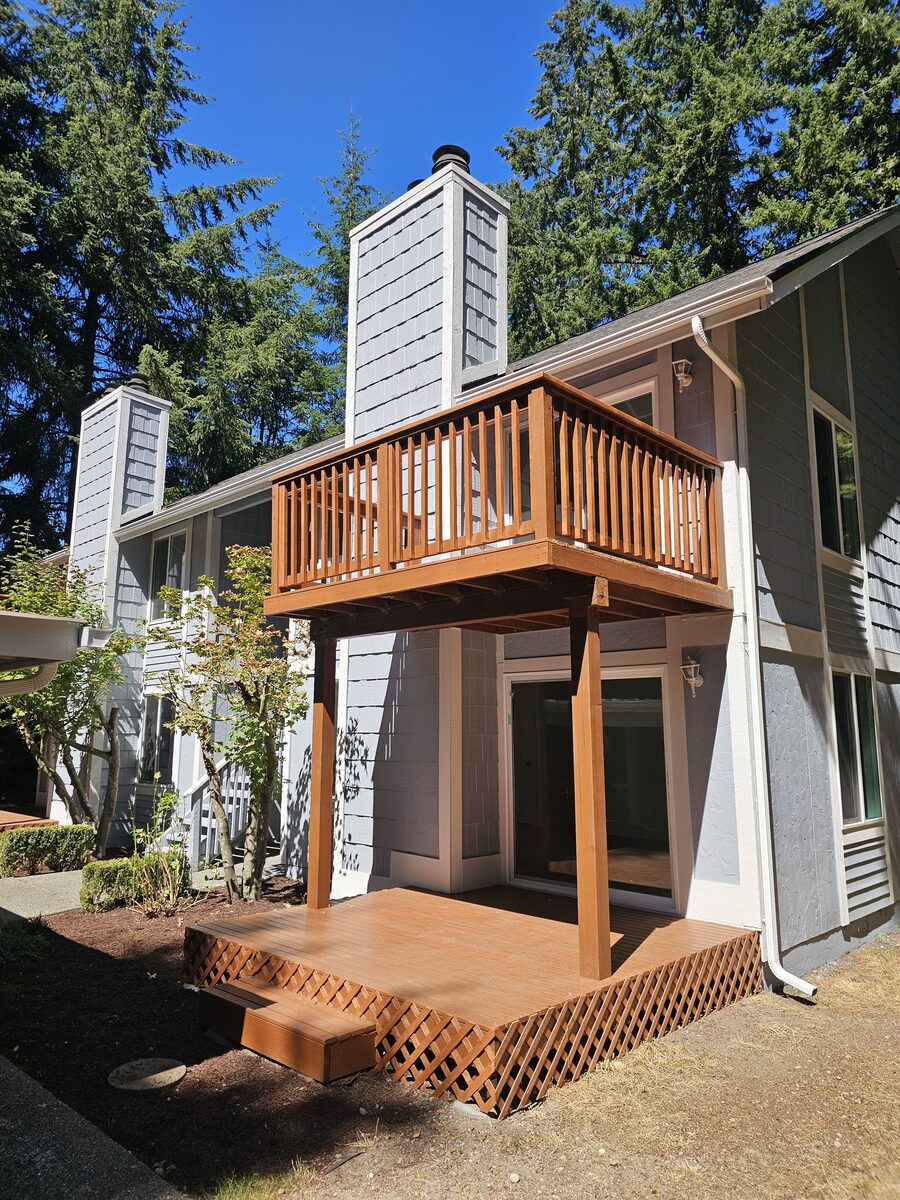
If you've priced out a new deck in Seattle recently, you already know that sticker shock is real. A standard composite deck on a typical Eastside or North Seattle lot runs $35,000 to $65,000 installed — and elevated or multi-level designs on hillside lots can push past $90,000 before the pergola and cable railing go in. That's not a purchase most homeowners write a check for on the spot. It's a decision that requires a financing strategy, and the strategy you choose can meaningfully change the total cost of ownership over the life of the project.
The good news: Seattle homeowners are actually in an unusually strong position to finance a deck right now. King County's median home value has crossed $900,000, and long-term owners in neighborhoods like Kenmore, Bothell, Kirkland, and Shoreline are sitting on six figures of accessible equity. That equity is the lever that unlocks the lowest-cost financing options — and understanding how to use it, what to avoid, and how to calculate whether the investment pencils out is exactly what this guide covers.
This isn't a generic "home improvement financing 101" article. It's written specifically for Seattle-area homeowners weighing a real deck project with real Pacific Northwest cost data, local lender context, and the kind of honest break-even math your contractor probably won't walk you through.
What a Deck Actually Costs in Seattle in 2026
Before you can evaluate financing options, you need a realistic sense of what you're financing. Seattle deck pricing has shifted significantly in the past three years — labor markets tightened after 2022, composite material prices stabilized but remained elevated, and King County permit fee increases of 49% in 2025 and 14% more in 2026 added real cost to every permitted project.
According to current contractor data compiled by Olympic Decks, here's what Seattle-area projects realistically cost in 2026:
| Project Type | Size | Material | Installed Cost Range |
|---|---|---|---|
| Entry-level ground-level deck | 150–200 sq ft | Pressure-treated | $12,000–$18,000 |
| Standard single-level | 300–400 sq ft | Cedar | $22,000–$38,000 |
| Standard single-level | 300–400 sq ft | Composite (Trex, Fiberon) | $32,000–$52,000 |
| Elevated/hillside deck | 300–500 sq ft | Composite | $45,000–$75,000 |
| Multi-level with stairs | 500–700 sq ft | Composite | $65,000–$95,000 |
| Premium build (outdoor kitchen, pergola, lighting) | 600+ sq ft | Composite/PVC | $90,000–$140,000+ |
The wide ranges reflect real variables: site access, existing structure removal, soil conditions requiring engineered footings, and the specific neighborhood — South Seattle projects can run 10–15% less in labor than equivalent builds in Medina or Mercer Island, where logistics add cost.
For planning purposes, the most common financing scenarios center around three project tiers: the $20,000 entry project (smaller lot, pressure-treated or entry composite, minimal stairs), the $35,000 mid-range project (350 sq ft composite, standard railings, basic lighting), and the $50,000–$70,000 elevated or premium build (hillside lot, multiple levels, cable railing, or outdoor kitchen elements).
King County Permit Costs in 2026
Permit fees are part of your project cost and therefore part of what you may finance. King County's Permitting Division implemented a 14% fee increase effective January 1, 2026, following a 49% increase in 2025. For a typical deck project valued at $35,000–$55,000, expect permit fees of $800–$2,200 depending on jurisdiction (Seattle proper vs. unincorporated King County). The Seattle SDCI permit cost estimator can give you a project-specific estimate for projects within city limits.
This matters for financing because permits are paid upfront — usually before a single board is cut — and are non-refundable if a project is canceled or paused.
What Drives Your Project Into a Higher Tier
The biggest cost drivers that push a project from $35,000 to $65,000 aren't the decking boards — they're structural. Hillside lots requiring tall posts and engineered footings, projects requiring old deck demolition and haul-away, elevated designs needing engineered beam spans, and any design that triggers a soil investigation or geotechnical review can each add $5,000–$20,000 to a base estimate. When you're planning your financing, build in a 10–15% contingency buffer — not because reputable contractors pad their quotes, but because soil conditions, existing structural issues discovered during demolition, and change orders for upgraded materials are genuinely common in the Pacific Northwest.
Understanding Your Equity Position in King County
The most important number in your deck financing decision isn't the interest rate — it's how much usable equity you're sitting on. And if you bought in King County more than five years ago, the answer is probably "more than you think."
King County Home Values and What They Mean for Borrowing
The Seattle/King County Association of Realtors tracks a median home price that has consistently tracked above $900,000 in King County through 2025 and into 2026 for detached single-family homes. That number obviously varies by submarket — Bothell and Kenmore (where The Seattle Decking Company operates) run $750,000–$950,000 median; Kirkland and Redmond often exceed $1.1M; Bellevue and Mercer Island frequently exceed $1.5M.
Here's what equity actually means in practice for deck financing:
How lenders calculate available equity: Most lenders allow you to borrow up to 80–85% of your home's current appraised value, minus your outstanding mortgage balance. This figure is your "combined loan-to-value" (CLTV) limit.
Example: Bothell homeowner, bought 2017
- Current home value: $850,000
- Remaining mortgage: $420,000
- 80% of value: $680,000
- Available to borrow (equity line): $680,000 − $420,000 = $260,000
For a $45,000 deck project, that owner has nearly six times the equity needed. Their financing constraint is income and debt-to-income ratio, not equity.
Example: Recent buyer, bought 2023
- Current home value: $820,000
- Remaining mortgage: $710,000
- 80% of value: $656,000
- Available to borrow: $656,000 − $710,000 = $0
This homeowner has no accessible equity yet — they may need to wait or use a personal loan or contractor financing.
How a Home Appraisal Affects Your Loan
Most HELOC and home equity loan applications require a property appraisal, either a full appraisal or an automated valuation model (AVM) review. In a stable or rising market like greater Seattle, this is typically not a problem — appraisals usually confirm or slightly exceed your estimate. But lenders can decline to appraise at a value you expect, which would reduce your available credit line. If you've made substantial improvements since purchase (kitchen remodel, roof replacement, ADU construction), make sure your lender knows — it can meaningfully affect the appraisal outcome.
Tip
Financing Options Compared: Rates, Terms, and When to Use Each
There are five primary ways Seattle homeowners finance deck projects. Each has a different risk profile, cost structure, and ideal use case. Understanding all five lets you choose the right tool — or the right combination.
Option 1: Home Equity Line of Credit (HELOC)
A HELOC is a revolving credit line secured by your home equity, similar in structure to a credit card but at dramatically lower rates. You're approved for a maximum credit line, draw from it as needed during a draw period (typically 5–10 years), and repay during a subsequent repayment period.
Current Seattle-area HELOC rates (June 2026): BECU — Washington's largest credit union — currently offers HELOCs at 6.99%–9.84% variable APR, with a 4.49% introductory rate for six months (offer through July 31, 2026). No annual fee, no application fee, no origination fee. Third-party closing costs typically run $150–$700.
Sound Credit Union, Salal Credit Union, and Numerica Credit Union offer comparable products, often with slightly more flexibility on LTV ratios for long-term members.
Best for:
- Homeowners who want to draw funds in phases as construction progresses
- Projects where the final cost isn't perfectly known at the start
- Borrowers who expect to pay down the balance quickly (variable rates are more attractive short-term)
Watch out for:
- Variable rates mean your payment can increase if the Prime Rate rises
- The draw period's interest-only payment option can create false comfort — you're still accruing balance
- HELOCs can be "frozen" by lenders in declining market conditions (less likely in Seattle's market, but it happens)
Monthly payment estimate (interest-only draw phase):
| Loan Amount | Rate | Monthly (Interest Only) |
|---|---|---|
| $20,000 | 7.50% | $125 |
| $35,000 | 7.50% | $219 |
| $50,000 | 7.50% | $313 |
| $70,000 | 7.50% | $438 |
Option 2: Home Equity Loan (Fixed)
A home equity loan is a lump-sum, fixed-rate loan secured by your home equity. You receive the full amount upfront, pay a fixed rate over a fixed term, and have predictable monthly payments from day one.
Current rates: Typically 7.24%–10.34% APR for well-qualified borrowers in Washington, slightly above HELOC rates because the lender is taking on fixed-rate risk.
Best for:
- Homeowners who want payment certainty
- Projects with a known, fixed cost (firm contractor quote in hand)
- Borrowers who are uncomfortable with variable-rate exposure
Monthly payment (fully amortizing over 10 years):
| Loan Amount | Rate | Monthly Payment | Total Interest |
|---|---|---|---|
| $20,000 | 7.50% | $237 | $8,440 |
| $35,000 | 7.50% | $416 | $14,920 |
| $50,000 | 7.75% | $601 | $22,120 |
| $70,000 | 8.00% | $849 | $31,880 |
Option 3: Personal Loan (Unsecured)
Personal loans require no home equity, close faster (often within 3–5 business days), and don't put your home at risk if you default. But that convenience comes at a cost — rates typically run 9%–14% APR for good-credit borrowers, and can exceed 18% for those with credit scores below 700.
Best for:
- Projects under $20,000 where the rate differential matters less in absolute dollars
- Homeowners with little or no accessible equity
- Situations where speed is critical (permit already in hand, contractor start date locked in)
The real cost of a personal loan vs. HELOC on a $35,000 project:
| Financing Type | Rate | Term | Monthly | Total Interest |
|---|---|---|---|---|
| HELOC (variable) | 7.50% | 7 years | $538 | $10,192 |
| Home Equity Loan | 7.75% | 7 years | $542 | $10,528 |
| Personal Loan | 11.00% | 7 years | $594 | $14,864 |
| Personal Loan | 14.00% | 7 years | $639 | $18,676 |
On a $35,000 project, choosing a personal loan at 11% over a HELOC at 7.5% costs you roughly $4,600–$8,500 more in interest over the loan life. That's real money — enough to upgrade your decking material tier or add a pergola.
Option 4: Contractor Installment Plans
Some deck contractors — including larger regional firms — offer in-house payment structures, most commonly a 25/50/25 arrangement:
- 25% at contract signing (covers materials ordering)
- 50% at project start or midpoint
- 25% at substantial completion
This isn't technically a loan — you're not paying interest on the balance. But it does mean you need to fund those tranches as they come due, which most homeowners handle by timing draws from a HELOC or using savings for the first tranche and financing for the remainder.
Important
Option 5: FHA Title I Home Improvement Loans
The FHA Title I loan program is a federally backed home improvement loan that doesn't require home equity — it's based on income and creditworthiness. Loan limits are $25,000 for single-family homes, terms up to 20 years, and rates are typically competitive with personal loans (currently 9–12% through most approved lenders). Because these loans are federally backed, lenders can approve applicants who might not qualify for conventional equity products.
This option is underused in Seattle because equity-rich homeowners usually have better options — but for owners who bought recently, have underwater equity, or are working with a bankruptcy that cleared within the past few years, Title I loans deserve a look.
Local Credit Unions: Why They Often Beat Banks for Deck Financing
Washington state has an unusually strong credit union ecosystem, and for home equity products specifically, credit unions routinely beat commercial banks on rate, fee structure, and underwriting flexibility.
BECU (Boeing Employees Credit Union)
BECU is the largest credit union in Washington and one of the largest in the United States, with 1.3 million members. They're not just for Boeing employees — membership is open to anyone who lives, works, worships, or attends school in Washington state. Their HELOC product is particularly strong for deck financing:
- No annual fee, no origination fee, no application fee
- Third-party closing costs typically $150–$700 (appraisal, title)
- Current variable rates: 6.99%–9.84% APR (as of June 2026)
- Introductory rate: 4.49% APR for six months (through July 31, 2026)
- Draw period: 10 years; repayment period: 15 years
- Line amounts: $10,000–$500,000
For a $35,000–$50,000 deck project, BECU's HELOC is frequently the lowest-cost equity financing option available in the Seattle market. The introductory rate alone saves several hundred dollars in the first six months.
Visit BECU's HELOC page to check current rates or apply online.
Sound Credit Union
Sound Credit Union serves members across Pierce and South King County and offers competitive HELOC and home equity loan products with a community banking orientation. They're worth contacting if you're in Renton, Kent, Auburn, or Federal Way.
Salal Credit Union
Salal (formerly Group Health Credit Union) operates across the greater Seattle metropolitan area and is known for flexible underwriting on home equity products, including for members with less-than-perfect credit histories. Their loan officers tend to spend more time on unusual situations than large bank underwriters.
Numerica Credit Union
Numerica serves Eastern Washington primarily but has expanded its online lending products statewide. Worth considering for competitive rate shopping, particularly if you live near the Snohomish County line.
How to Shop Multiple Lenders Without Hurting Your Credit
When you apply for a HELOC or home equity loan, the lender does a "hard pull" on your credit report — which can temporarily lower your score by a few points. However, the credit bureaus treat multiple mortgage-related inquiries within a 14–45 day window as a single inquiry (the exact window varies by scoring model). This means you can legitimately apply to BECU, Sound Credit Union, and a commercial bank within the same two-week window, compare offers, and accept the best one — with minimal credit score impact.
To make comparison shopping effective, request a Loan Estimate from each lender. This standardized document (required by federal law for mortgage-secured products) breaks out rate, APR, fees, monthly payment, and total cost over the loan life in a directly comparable format.
Note
The Tax Angle: Is HELOC Interest Deductible for a Deck?
This is one of the most misunderstood areas of home improvement financing, and the answer has changed significantly since the 2017 Tax Cuts and Jobs Act.
The Rule Post-2017
Under current IRS rules, interest on a HELOC or home equity loan is deductible — but only if the funds are used to "buy, build, or substantially improve" the home that secures the loan. If you use your HELOC to build a deck on your Seattle home, and your HELOC is secured by that same home, the interest qualifies as deductible home mortgage interest under IRS Publication 936.
If you use your HELOC for anything else — a car purchase, a vacation, paying off credit cards — that portion is not deductible.
The Itemizing Requirement
Here's the catch that affects most Seattle homeowners: to deduct mortgage interest (including HELOC interest), you must itemize deductions on Schedule A. The 2017 tax reform roughly doubled the standard deduction — in 2026, the standard deduction is $14,600 for single filers and $29,200 for married filing jointly.
Given that King County property taxes on a $900,000 home run approximately $8,000–$11,000 annually, and mortgage interest on a $600,000–$700,000 loan runs $30,000–$40,000 per year, many Seattle homeowners do itemize and do benefit from deducting HELOC interest used for home improvement.
Talk to a tax professional before assuming deductibility — your specific situation (existing mortgage balance, property taxes, other deductions) determines whether itemizing makes sense for you.
The Limit
The combined mortgage debt limit for interest deductibility is $750,000 for loans taken after December 15, 2017. If your primary mortgage plus your HELOC or home equity loan exceeds $750,000, only the interest on the first $750,000 is deductible. For homeowners with large mortgages in high-value King County, this cap can phase out some or all of the HELOC deduction. Another reason to work through the math with a CPA.
Key insight
ROI Analysis: Does a New Deck Actually Add Value in Seattle?
The honest answer: it depends on what metric you're optimizing for.
What the NAR Data Shows for the Pacific Region
The National Association of Realtors Remodeling Impact Report is the most rigorously constructed national dataset on home improvement ROI. The Pacific region data (which includes Washington, Oregon, California, and Alaska) consistently shows that outdoor living improvements — particularly deck additions — generate strong value recovery at resale:
- Wood deck addition (Pacific region): 50–75% cost recovery at resale
- Composite deck addition: Slightly higher perceived value due to lower maintenance burden for buyers — roughly 55–80% cost recovery
- Deck replacement (worn-out cedar to composite): 60–70% cost recovery
What "cost recovery" means in practice: if you spend $50,000 on a composite deck and sell your home 3–5 years later, you can reasonably expect the deck to have added $27,500–$40,000 to your sale price — not a dollar-for-dollar return, but far from zero.
Why Seattle's Market Shifts the ROI Calculation
National averages understate the Seattle-specific case for several reasons:
- Outdoor living is disproportionately valued here. Seattle buyers understand PNW weather and know that a quality deck is usable far more than 3 months per year with a quality cover or pergola. A well-built deck isn't a "nice to have" — it's expected in the $700K+ market.
- The buyer pool is unusually equity-rich. When a Seattle buyer is choosing between two comparable homes and one has a $50,000 composite deck with lighting and a pergola, they often factor in that they'd need to spend that $50,000 themselves if they chose the other home. That shifts their offer price accordingly.
- Your enjoyment years matter. If you build a $45,000 deck and live in the home for 7 years before selling, you've created thousands of hours of outdoor living value. The ROI calculation that only counts resale recovery misses the annual "quality of life dividend" entirely.
The Break-Even Analysis: Composite vs. Cedar
One of the most common financing questions we hear: "Is it worth financing composite instead of cedar?" The math is more nuanced than most people expect.
Assumptions for a 350 sq ft deck comparison:
| Category | Cedar | Composite (Trex/Fiberon) |
|---|---|---|
| Installed cost | $28,000 | $42,000 |
| Cost premium | — | +$14,000 |
| Annual staining/sealing | $800–$1,200/yr | $0 |
| Periodic board replacement | ~$1,500 every 7 yrs | $0 |
| Board replacement (year 15) | ~$8,000–$12,000 | $0 |
| Expected lifespan | 15–20 years | 25–35 years |
| 20-year maintenance cost | ~$20,000–$24,000 | ~$0–$2,000 (cleaning) |
20-year total cost of ownership:
- Cedar: $28,000 + $22,000 maintenance = $50,000
- Composite: $42,000 + $1,000 maintenance = $43,000
When you model the full ownership horizon, composite is actually cheaper than cedar — even though it costs $14,000 more upfront. The financing cost on that $14,000 premium (at 7.5% over 7 years) adds about $3,800 in interest, still putting composite $3,200 ahead over 20 years — before accounting for the superior resale performance.
This is why we consistently recommend composite for homeowners planning to stay 7+ years and cedar only for those who genuinely plan to move within 5 years.
Cedar's lower upfront cost reverses when maintenance is included. Composite saves ~$7,000 over 20 years even after financing costs.
| Category | Value |
|---|---|
| Cedar (installed) | $28,000 |
| Cedar (20yr maintenance) | $22,000 |
| Composite (installed) | $42,000 |
| Composite (20yr maintenance) | $1,000 |
For a deeper comparison of materials and their real-world performance in Seattle's wet climate, see our guide to composite vs. cedar decking in Seattle.
Monthly Payment Calculator: Real Numbers for Seattle Projects
Abstract interest rates don't help you plan — payment estimates do. Here's a detailed payment table covering the three most common Seattle deck project tiers at the financing options most homeowners actually use.
$20,000 Project (Entry-Level: Ground-Level Cedar or Entry Composite)
| Financing Type | Rate | Term | Monthly | Total Interest |
|---|---|---|---|---|
| HELOC (BECU variable) | 7.50% | 5 years | $401 | $4,060 |
| HELOC (BECU variable) | 7.50% | 7 years | $307 | $5,788 |
| Home Equity Loan | 7.75% | 10 years | $238 | $8,560 |
| Personal Loan | 10.00% | 5 years | $425 | $5,496 |
| Personal Loan | 13.00% | 5 years | $457 | $7,420 |
$35,000 Project (Mid-Range: 350 sq ft Composite, Standard Railing, Stairs)
| Financing Type | Rate | Term | Monthly | Total Interest |
|---|---|---|---|---|
| HELOC (BECU variable) | 7.50% | 5 years | $701 | $7,060 |
| HELOC (BECU variable) | 7.50% | 7 years | $537 | $10,108 |
| Home Equity Loan | 7.75% | 10 years | $416 | $14,920 |
| Personal Loan | 10.00% | 5 years | $743 | $9,580 |
| Personal Loan | 13.00% | 7 years | $584 | $18,946 |
$50,000 Project (Elevated or Premium Build)
| Financing Type | Rate | Term | Monthly | Total Interest |
|---|---|---|---|---|
| HELOC (BECU variable) | 7.50% | 7 years | $767 | $14,432 |
| HELOC (BECU variable) | 7.50% | 10 years | $594 | $21,280 |
| Home Equity Loan | 7.75% | 10 years | $601 | $22,120 |
| Home Equity Loan | 8.00% | 15 years | $478 | $36,040 |
| Personal Loan | 11.00% | 7 years | $849 | $21,236 |
$70,000 Project (Multi-Level, Outdoor Kitchen, Premium Features)
| Financing Type | Rate | Term | Monthly | Total Interest |
|---|---|---|---|---|
| HELOC (BECU variable) | 7.50% | 10 years | $831 | $29,720 |
| Home Equity Loan | 7.75% | 10 years | $841 | $30,920 |
| Home Equity Loan | 8.00% | 15 years | $669 | $50,420 |
| Personal Loan | 11.00% | 7 years | $1,189 | $29,732 |
Key insight from these tables: The spread between HELOC and personal loan financing widens significantly as project size increases. On a $20,000 project at 5 years, the difference is about $1,400. On a $70,000 project at 10 years, that spread can exceed $20,000. For larger projects, getting your equity financing in order before selecting a contractor is worth every hour of paperwork.
Tip
Red Flags, Scams, and Washington State Consumer Protections
Deck financing involves meaningful amounts of money and contractors who may or may not be legitimate. Knowing the warning signs protects you.
The 50%+ Deposit Red Flag
The single most reliable indicator of contractor fraud is a demand for more than 50% of the total project cost before work begins. In Washington state, the Attorney General has documented numerous cases where homeowners paid 60–80% upfront to contractors who then disappeared, did substandard work, or went bankrupt during the project.
Legitimate contractors have supplier credit relationships. They do not need your money to buy materials — they buy on account and settle monthly. A demand for more than 30–35% upfront is unusual; more than 50% should cause you to walk away, regardless of how compelling the contractor's pitch is.
The standard payment structure for a reputable deck contractor:
- 25% at contract signing (reasonable — covers materials ordering and scheduling)
- 50% at project start or designated midpoint milestone
- 25% at substantial completion (punch list agreed upon before final payment)
Washington State Contractor Licensing Requirements
Every contractor working on your home in Washington must be registered with the Washington State Department of Labor and Industries. You can verify any contractor's license status, bond, and insurance at the L&I Contractor Lookup. This takes approximately 30 seconds and should be mandatory before signing any contract.
A contractor without a valid L&I registration cannot legally pull permits in your name, which means any deck they build will be unpermitted — a significant problem when you sell your home.
The AG's Consumer Protection Act
Washington's Consumer Protection Act gives homeowners meaningful recourse against unfair or deceptive contractor practices, including misrepresentation of financing terms, failure to deliver on contract terms, and fraudulent collection of deposits. If you believe you've been defrauded by a contractor, the AG's consumer protection hotline (1-800-551-4636) is a legitimate resource.
Red Flags in Contractor Financing Offers
Some contractors offer "in-house financing" or partnerships with finance companies. These can be legitimate — but scrutinize the terms carefully:
- Deferred interest offers ("12 months no interest!") often revert to 25–30% APR if the balance isn't paid in full by the promotional deadline
- Contractor-arranged personal loans may carry origination fees that make the effective rate much higher than advertised
- Lease-to-own arrangements for decks are almost always more expensive than any conventional financing option
If a contractor's financing offer seems unusually easy to qualify for or promises unrealistically low payments, the rate buried in the fine print is almost certainly much higher than BECU's HELOC rate.
For more guidance on evaluating contractor quotes and spotting deceptive practices, see our guide on how to read a deck quote and questions to ask your deck builder.
Cash Purchase vs. Financing: The Real Math
If you have the cash, is it better to pay for your deck outright? The answer depends on what your cash would otherwise earn and what the tax treatment of your interest looks like.
The Opportunity Cost Framework
If you finance $40,000 for a deck at 7.5% (a HELOC) and your alternative is leaving that cash in a high-yield savings account earning 4.5%, you're paying a net rate of approximately 3% for the privilege of preserving liquidity. If HELOC interest is tax-deductible for you (saving perhaps 22–24% on the rate), that net cost drops even further.
On the other hand, if your cash is sitting in a standard checking account earning 0.5%, financing at 7.5% (non-deductible) costs you 7% net — a meaningful premium for no good reason.
Rule of thumb:
- If your cash is earning 4%+ (HYSA, Treasury bills, brokerage account) and HELOC interest is deductible for you: Finance the deck, invest the cash
- If your cash is in low-yield accounts and HELOC interest isn't deductible for you: Pay cash or make a larger down payment
- If you have high-interest debt (credit cards at 20%+): Pay off that debt first, then finance the deck through equity
Total Cost of Ownership: Cash vs. HELOC on a $40,000 Deck
| Scenario | Upfront Cost | 7-Year Interest | Tax Savings (22% bracket) | Net Total Cost |
|---|---|---|---|---|
| Cash purchase | $40,000 | $0 | $0 | $40,000 |
| HELOC at 7.50% | $0 down | ~$11,700 | ~$2,574 | ~$49,126 |
| HELOC at 7.50%, deductible | $0 down | ~$11,700 | ~$2,574 | ~$49,126 |
| Cash + $15K on HELOC | $25,000 | ~$4,400 | ~$968 | ~$28,432 |
The hybrid approach — pay what you comfortably can from savings, finance the remainder — often produces the best outcome: lower total interest, preserved liquidity, and a manageable monthly payment.
Getting Competing Lender Quotes: A Practical Checklist
Here's the actual process for securing multiple competitive financing offers in the Seattle market, without making common mistakes that slow things down or hurt your credit.
Step 1: Gather Your Documents Before Contacting Any Lender
You'll need:
- Last two years of W-2s and/or tax returns (for income verification)
- Last two months of pay stubs (for current income)
- Last two months of bank statements
- Most recent mortgage statement (showing balance and payment)
- Current homeowner's insurance declarations page
- A signed contractor estimate (not always required at application stage, but helps document purpose)
Step 2: Get Your Credit Score
Know your approximate FICO score before applying. You can get a free score through BECU's online banking if you're already a member, or through services like Credit Karma (VantageScore, which is directionally similar). If your score is below 680, expect rates at the higher end of lender ranges or possible denial. Scores above 740 typically qualify for the best-available rates.
Step 3: Apply to 3–4 Lenders Within a 14-Day Window
Start with:
- BECU — typically the rate leader for equity products in Washington
- Your current mortgage servicer — they may offer a relationship rate discount
- One other local credit union (Sound, Salal, or Numerica based on your area)
- One online lender (Figure, Spring EQ) for comparison
Apply to all within the same 14-day window so credit bureau soft-pull consolidation applies.
Step 4: Compare Loan Estimates Apples-to-Apples
When offers come in, compare:
- APR (not just stated rate) — APR includes fees and gives the true annual cost
- Fees: origination fee, appraisal fee, title search fee, annual fee (for HELOCs)
- Draw period length and repayment period length (for HELOCs)
- Whether the intro rate has strings attached (balance requirements, auto-payment discounts)
- Prepayment penalties (rare for equity products, but ask)
Step 5: Lock Your Rate and Coordinate With Your Contractor
Once you've selected a lender, get the approval in writing before signing a construction contract. Most HELOC approvals are valid for 60–90 days, giving you time to finalize contractor selection and get on their schedule. Coordinate the timing so your first draw aligns with your contractor's first milestone payment.
For guidance on what to look for in a contractor proposal before you draw funds, see our article on how to find a deck builder in Seattle.
Note
Frequently Asked Questions
Frequently Asked Questions
How much can I borrow for a deck project in Seattle using my home equity?
Is a HELOC or home equity loan better for a deck project?
Can I deduct the interest on a HELOC used to build a deck?
How much does a deck cost in the Bothell and Kenmore area?
What is the typical contractor payment schedule, and how large a deposit is normal?
How long does it take to get a HELOC approved in Washington?
Does adding a deck increase my home's value in Seattle?
Is composite worth the extra financing cost compared to cedar in Seattle?
What is the FHA Title I loan program and is it available in Seattle?
Should I get the deck permit included in my contractor's contract or pull it myself?
Can I finance a deck if I have a second mortgage or existing HELOC on my home?
What should I watch out for in contractor financing offers?
Why Working With a Local Builder Changes Your Financing Strategy
Here's something that rarely gets mentioned in generic home improvement financing guides: your choice of contractor affects your financing options in ways that go beyond the payment schedule.
A contractor who provides a detailed, itemized written estimate gives you the documentation your lender needs to approve a home equity loan or project-specific HELOC draw. A contractor who gives you a vague ballpark quote creates financing uncertainty — lenders often want to know the purpose and project scope for draws above certain thresholds.
A contractor who pulls their own permits and manages inspections ensures the work creates an actual record of improvement that supports your home's future appraised value (which supports future equity access). An unpermitted deck does the opposite — it can actually complicate or reduce your home's appraisable value and creates disclosure obligations when you sell.
The Seattle Decking Company provides full itemized proposals, handles all permitting and inspections, and works with homeowners' lender timelines regularly. We're accustomed to coordinating with HELOC draw schedules and can provide draw certificates for milestone-based disbursements if your lender requires them.
If you're planning a deck project in the Bothell, Kenmore, Kirkland, Woodinville, Shoreline, or greater North Seattle area, we'd welcome the chance to walk through both the construction plan and a financing scenario that fits your situation. There's no obligation and no pressure — just honest numbers.
For more context on what a complete deck project looks like from design through permit to final inspection, see our deck cost guide for Seattle in 2025 and our overview of the best decking materials for Seattle in 2026.
The Bottom Line: Is Financing a Deck Worth It?
For most Seattle-area homeowners, the answer is yes — with caveats.
A composite deck on a King County home is simultaneously a quality-of-life investment, a home improvement that recovers 55–80% of cost at resale, and a project that's realistically financeable at rates that make the monthly payment manageable. A $35,000 project financed through a BECU HELOC at 7.5% over 7 years costs approximately $537/month — less than many car payments — and the interest may be partially offset by a federal tax deduction.
The caveats: use equity-based financing if you have it, because the rate and total interest advantages over personal loans are substantial on projects over $25,000. Know your contractor's licensing and payment structure before signing anything. Build in a contingency buffer. And if the monthly payment at reasonable rates doesn't fit comfortably in your budget, scale the project — a well-built 200 sq ft composite deck you can actually afford is a better decision than a 500 sq ft project you're financially stretched by.
We're happy to help you think through what makes sense for your lot and your budget. Call us at (425) 675-6259 or request a free estimate online — we serve Bothell, Kenmore, Kirkland, Woodinville, Shoreline, and communities throughout North King and South Snohomish counties.
The Seattle Decking Company 22722 29th Drive SE, Bothell, WA 98021 (425) 675-6259 theseattledeckingcompany.com
Planning a deck in the Seattle area?
Get an onsite design review and a clear, itemized quote from a licensed local builder.
Request a Free Quote