Both Fiberon and AZEK make decking products that will survive in Seattle's wet climate. The question isn't which one endures King County's 37 to 38 inches of annual rainfall — both will, when correctly installed. The question is which one makes more sense for your specific project, budget, and site conditions. That answer is not the same for a 300-square-foot Sammamish backyard deck as it is for an elevated waterfront property on Mercer Island, and it is not the same for a homeowner who plans to sell in five years as for one building a multi-decade outdoor living space.
We've installed both Fiberon and AZEK decking across King County — on hillside lots in Bellevue, lakefront properties in Kirkland, north-facing shaded lots in Renton, and exposed view decks on Mercer Island. Both product families have earned a place in our material rotation. What we've learned in 15 years of installation and follow-up is that the right choice depends on factors the marketing from either brand rarely discusses honestly: what's under the cap, how exposed your site is to sustained moisture, and what the cost delta actually means at King County installed prices.
This guide covers the material differences that matter in PNW conditions, the warranty comparison, 2026 installed costs for both products, and direct recommendations for the most common Seattle deck scenarios. By the end, you'll know which product we'd specify for your site — and why.
Why This Comparison Matters Specifically in Seattle
In most of the country, the Fiberon vs. AZEK comparison comes down to budget and aesthetics. In the Pacific Northwest, moisture performance is the primary variable — and Seattle's climate makes it a more urgent question than it would be in Charlotte or Denver.
King County receives 37–38 inches of rain per year at Sea-Tac, with significantly more falling on the Sammamish Plateau, in the Issaquah foothills, and on the north-facing hillside lots that characterize a substantial portion of the area's residential inventory. The region sees 150+ wet days per year, marine humidity from June through September, and freeze-thaw cycling from October through March. A deck material's moisture handling characteristics aren't theoretical here — they're tested every year across the full range of conditions.
The baseline requirement at The Seattle Decking Company is four-sided capping on any composite product we install. We do not specify two-sided capped composites (boards with exposed edges) in King County, because the edge exposure creates moisture infiltration pathways that degrade the wood-fiber core over time. AZEK eliminates this concern entirely through material composition — there is no wood-fiber core to protect. Fiberon Concordia addresses it through four-sided capping. Both approaches can produce durable decks; the question is which one performs better in the most demanding PNW conditions.
Understanding the answer requires understanding what each product is actually made of.
Material Composition: The Core Difference
AZEK (TimberTech AZEK): Solid Cellular PVC
AZEK — now marketed under the TimberTech AZEK brand following the company's consolidation under Fortune Brands Innovations — is a cellular PVC product. The board is 100% polymer throughout: no wood fiber, no organic content of any kind. The interior structure is a cellular foam core (lighter than solid PVC, with better impact characteristics), encased in a denser polymer shell.
When an AZEK board sits in standing water, experiences PNW wet season conditions for six consecutive months, or cycles through freeze and thaw in November and December, there is no organic material in the board to absorb moisture, harbor mold, or degrade from water cycling. AZEK's material chemistry is fundamentally impervious to water at the board level — the same principle that makes PVC plumbing pipe a 50-year material.
The practical implication: exposure points that matter on composite boards — cut ends during installation, fastener penetrations, impact damage — are less consequential on AZEK because the polymer throughout the board doesn't absorb water. A cut end on an AZEK board exposes more polymer. A cut end on a composite board exposes the wood-fiber core.
More information about AZEK's product specifications is available at TimberTech's website.
Fiberon Concordia: Capped Wood-Plastic Composite
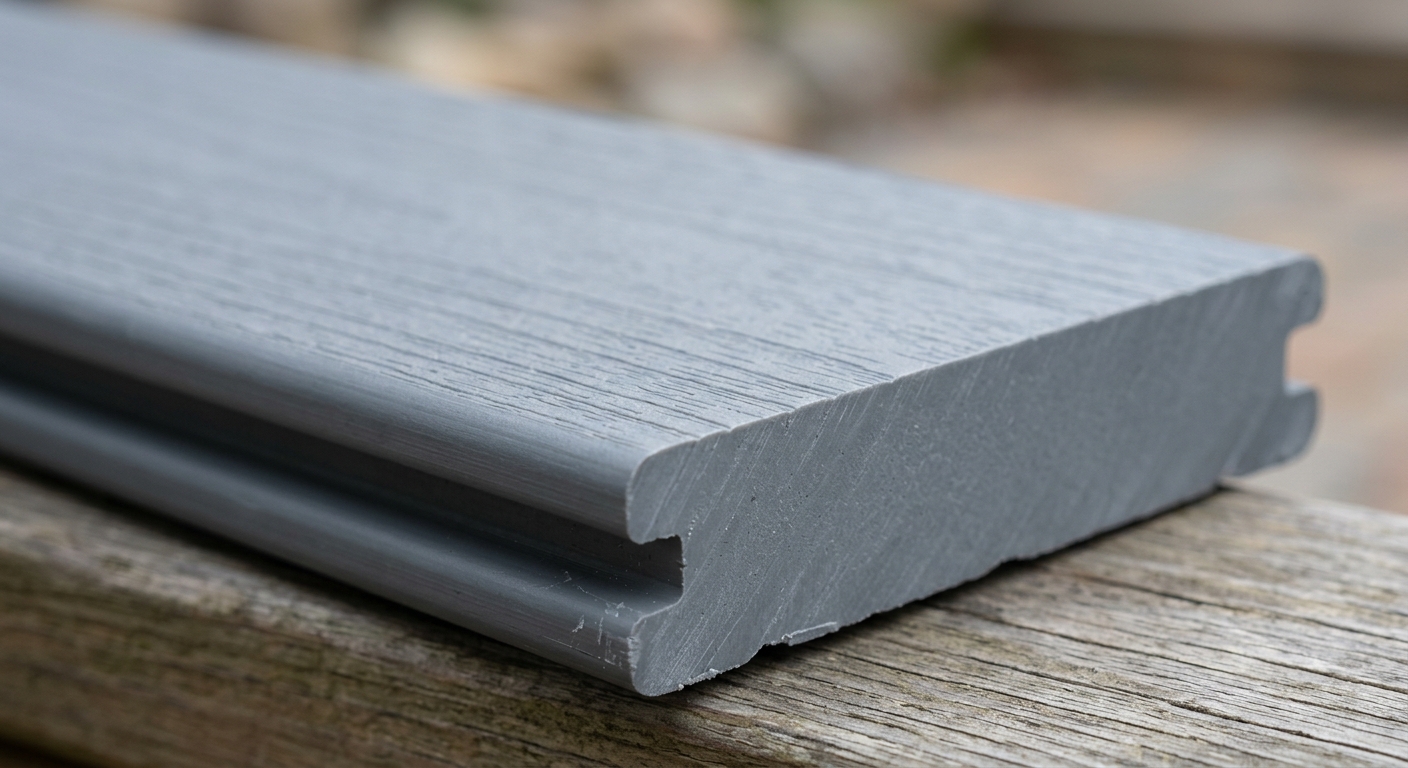
Fiberon Concordia is a capped composite: a core of ground wood fiber blended with recycled plastic, encased on all four sides by a dense polymer cap layer. The cap layer is what makes Concordia a PNW-appropriate product — it seals the wood-fiber core against moisture on every exposed surface. Without the cap, the composite core would absorb moisture freely and degrade in Seattle's climate.
In ideal conditions — properly installed, with correct slope, correct fastener spacing, and intact cap material — Concordia performs well in King County. The cap does its job. Where the cap is compromised — a saw cut at board end during installation, an aggressive impact that fractures the cap surface, or a fastener installed without proper depth control — the composite core beneath is exposed to PNW moisture. This doesn't mean Concordia fails; it means the installation details matter more for composite than for solid PVC.
Fiberon's full product lineup and specifications are available at fiberondecking.com.
Both products are manufactured by Fortune Brands Innovations. That shared ownership does not make them equivalent — material composition is a more fundamental variable than brand ownership — but it does mean shared investment in R&D, which has narrowed the quality gap between Fiberon's upper-tier products and AZEK compared to where it stood five years ago.
Detailed Product Line Comparison: Fiberon Concordia vs. AZEK Collections
Before comparing brands head-to-head, it's worth understanding that each brand spans multiple product lines at different price and aesthetic tiers. The "Fiberon vs. AZEK" question is actually a series of sub-questions depending on which specific lines you're comparing.
| Fiberon | AZEK | |
|---|---|---|
| Entry composite/PVC | ArmorGuard | AZEK Arbor |
| Mid-range | Sanctuary | AZEK Harvest |
| Premium | Concordia | AZEK Vintage |
| Material type | Capped composite (all lines) | Cellular PVC (all lines) |
| Wood fiber content | Yes (sealed by 4-sided cap) | None |
| Standard warranty (top tier) | 50-yr fade, lifetime structural | 50-yr fade, lifetime structural |
| Installed cost — King County | $36–$60/sqft | $48–$70/sqft |
| Color options (top tier) | 7 colors | 10+ colors (Vintage) |
| Fire resistance | Class A (Promenade PVC only) | Standard |
| Scratch resistance | Higher (composite cap) | Moderate (PVC softer) |
| Surface temperature in sun | Warmer (composite absorbs heat) | Cooler (PVC reflects more) |
| End-seal required on cuts | Yes (composite lines) | No (all PVC) |
| Parent company | Fortune Brands Innovations | Fortune Brands Innovations |
The most direct comparison for most Seattle homeowners is Fiberon Concordia vs. AZEK Harvest or Vintage — premium composite vs. mid-to-premium PVC. That comparison drives the price and performance trade-off that matters most in King County's market.
AZEK's Color and Aesthetic Edge
One consistent finding across product comparisons: AZEK's color palette is broader and its premium collections (particularly Vintage) offer deeper grain texture than Fiberon Concordia. AZEK Vintage's grain depth is among the most convincing wood-look profiles in the composite/PVC category — at close inspection, it reads more convincingly as natural hardwood than most competing products.
Fiberon Concordia's grain has improved significantly in recent product generations and is excellent at normal viewing distances. The gap narrows considerably for observers who aren't standing 12 inches from the board. For high-visibility applications — view decks that appear in real estate photography, elevated decks visible from interior living spaces — AZEK's aesthetic edge is worth noting and may justify the cost premium for design-forward projects.
For color selection specifically, Concordia's warm tones (Antique Leather, Weathered Teak) and AZEK Vintage's darker options (Mahogany, Brownstone) both work well in Seattle's ambient light. We recommend reviewing samples outdoors on an overcast day — showroom lighting is significantly warmer than Pacific Northwest cloud-diffused daylight, and boards that look rich and warm under indoor display lights can read differently against a house exterior on a typical Seattle afternoon.
Performance Comparison for Seattle's Climate
Moisture Resistance
AZEK holds the material advantage by construction. No wood fiber content means no moisture absorption pathway at the board level. Fiberon Concordia's four-sided cap performs well in real-world King County conditions — we've followed up on Concordia installations after five-plus years and found the boards presenting well — but AZEK's cellular PVC construction is the technically superior specification for sustained moisture environments.
Where this matters most practically: hillside lots with limited drainage and slow-drying microclimates, waterfront properties on Lake Washington or Puget Sound with constant humidity exposure, decks in north-facing orientations that see minimal sun drying, and any application with standing water risk — rooftop decks, decks over living space, low-slope configurations.
For a well-drained, properly sloped backyard deck with adequate sun exposure, Fiberon Concordia's moisture resistance is sufficient for King County conditions. For the most demanding PNW applications, AZEK's material advantage is meaningful.
Mold and Mildew Resistance
Both products resist surface mold when installed with proper slope and fastener spacing that allows airflow beneath boards. In low-sun, north-facing exposures — the deck corners that sit in shade nine months of the year in King County — AZEK's all-polymer surface has an edge: there is no organic substrate for mold to colonize, even in chronically damp, shaded areas.
Fiberon Concordia's polymer cap also resists mold colonization at the surface. The difference shows up in the most demanding microclimates — deeply shaded north-facing lots, decks under mature tree canopy with minimal air circulation — where any organic content in the substrate creates a growth advantage for moss and mildew. AZEK's edge in these conditions is real, though routine cleaning addresses mold growth on either product.
Slip Resistance When Wet
Seattle decks are wet nine months per year. AZEK's embossed surface profiles deliver measurably better traction in wet conditions than competing composite products in manufacturer testing. For elevated decks, stair sections, and households with children or elderly members, wet-condition slip resistance is not a theoretical concern.
Fiberon Concordia's embossed surface also provides reasonable wet traction. The gap between products is not large enough to be a decisive factor for most projects, but for applications where wet-surface slip resistance is a primary concern — pool decks, coastal properties, stair-heavy designs — AZEK's rating is worth noting.
Thermal Performance in Seattle's Mild Summers
Seattle summers are mild by national standards, but deck surface temperature matters for barefoot comfort and material performance. Cellular PVC boards run measurably cooler than composite boards of equivalent color and exposure — manufacturers cite up to 30°F surface temperature differential in direct sun conditions.
On a King County August afternoon at 85–90°F (increasingly common as PNW summers warm), the difference between a dark Fiberon composite board and an AZEK board in the same color family is noticeable underfoot. For south and west-facing decks with significant sun exposure, lighter board colors from either product family reduce surface temperatures meaningfully. Dark AZEK and dark Fiberon both get warm in direct Seattle sun; the relative advantage of PVC is consistent but should be considered alongside color choice, not as the primary factor.
UV and Color Stability
Both AZEK and Fiberon Concordia incorporate UV inhibitors throughout the cap layer and carry multi-decade fade and stain warranties. Seattle sits at 47° north latitude, where lower-angle solar UV is less intense than in Sun Belt markets. Premium composite and PVC products have historically fared better here than in Arizona or Florida.
Neither product shows meaningful fade within its warranty period in King County's UV environment when correctly installed. Color stability is not a differentiating factor between these two products in Seattle's specific climate.
Note
Cost Comparison: Fiberon Concordia vs. AZEK in King County (2026)
| Category | Value |
|---|---|
| Fiberon Concordia — 300 sqft low | $12,600 |
| Fiberon Concordia — 300 sqft high | $18,000 |
| AZEK — 300 sqft low | $15,000 |
| AZEK — 300 sqft high | $22,500 |
| Fiberon Concordia — 400 sqft low | $16,800 |
| Fiberon Concordia — 400 sqft high | $24,000 |
| AZEK — 400 sqft low | $20,000 |
| AZEK — 400 sqft high | $30,000 |
| Fiberon Concordia | TimberTech AZEK | |
|---|---|---|
| Material cost per sqft | $8–$14 | $12–$18 |
| Installed cost per sqft (King County) | $42–$60 | $48–$70 |
| 300 sqft project installed | $12,600–$18,000 | $14,400–$21,000 |
| 400 sqft project installed | $16,800–$24,000 | $19,200–$28,000 |
| AZEK premium over Fiberon | — | ~10–20% |
King County labor rates run 15–25% above national averages, which means the absolute dollar gap between these products is larger here than in other markets. On a typical 350-square-foot King County project, the installed cost delta between Fiberon Concordia and AZEK runs $2,500–$6,000 in Concordia's favor. In the context of a $20,000–$45,000 deck project, that delta is real — enough to fund a cable railing upgrade, a pergola addition, an extended deck footprint, or stair construction that would otherwise be out of budget.
Total Cost of Ownership: 20-Year Comparison
Looking beyond installed price to long-term cost changes the frame. On a 350-square-foot deck over a 20-year ownership period:
| Cost Category | Fiberon Concordia | AZEK Harvest |
|---|---|---|
| Initial installed cost | $17,850 avg | $20,650 avg |
| Annual cleaning (20 yr) | $500 | $400 |
| Board-level repairs (if any) | $500–$1,500 | $250–$750 |
| Structural recheck (15 yr) | $350 | $350 |
| 20-year total estimate | ~$19,200–$20,200 | ~$21,650–$22,150 |
The 20-year differential narrows compared to the upfront gap because both products have low ongoing maintenance costs. The primary driver of AZEK's higher 20-year cost is the initial installation premium — annual maintenance costs for both products are comparable and minimal. For most homeowners, the upfront delta is the more meaningful financial consideration rather than any long-term maintenance cost difference.
Whether the AZEK premium is justified depends on your site conditions, your intended ownership timeline, and the specific application. For our recommendation by scenario, see the section below.
For a full breakdown of deck project costs by material type and size in King County, see our Seattle deck cost guide.
Warranty Comparison: Fiberon Concordia vs. AZEK
| Fiberon Concordia | TimberTech AZEK | |
|---|---|---|
| Structural warranty | Lifetime | Lifetime (transferable) |
| Fade and stain warranty | 50 years | 50 years |
| Mold and mildew coverage | Included | Included |
| Certified installer required | Yes | Yes |
| Warranty transferable at sale | Yes | Yes |
Both products now offer lifetime structural warranties and 50-year stain/fade coverage. This represents an improvement from earlier years when Fiberon's coverage lagged AZEK's. Today, the warranty terms are effectively equivalent at the premium tier of each product family.
Tip
Both warranties transfer to subsequent homeowners, which matters in King County's active resale market. A deck with a transferable lifetime structural warranty is a genuine asset at resale — buyers in Sammamish, Mercer Island, and Bellevue markets increasingly ask about deck material and warranty when evaluating properties. According to the NAR Remodeling Impact Report, outdoor living additions rank among the highest-returning exterior improvement categories — and warranty documentation is part of what makes that return transferable.
Installation Differences: What Contractors Know
Both Fiberon and AZEK have specific installation requirements, and there are practical differences worth knowing before you spec one over the other.
End-sealing cut ends: Every time a Fiberon Concordia board is cut — for deck length, around posts, at stair nosings — the cut end exposes the wood-fiber core. Those ends must be sealed with manufacturer-approved sealant. AZEK cuts expose more polymer throughout — no end sealing required. On a 350-square-foot deck, this is a meaningful difference in installation labor and in moisture management quality, particularly in Seattle where every unsealed composite cut end is a slow moisture infiltration point.
Thermal expansion: PVC expands and contracts more than composite with temperature change. AZEK's installation guide specifies gap requirements at board ends based on installation temperature — a board installed in January needs different end gaps than one installed in August. In Seattle, where installation temperatures range from the low 40s to the low 80s depending on season, this variable matters. Fiberon Concordia's composite construction is more dimensionally stable than AZEK through temperature cycles, which simplifies installation sequencing.
Cutting and working: Both products cut cleanly with carbide-tipped saw blades. AZEK's cellular PVC is slightly softer and more forgiving to work than Fiberon's composite, which tends to be denser at the board surface. Neither is difficult to work with the correct tooling.
Fastener systems: Both Fiberon and AZEK offer hidden fastener systems for grooved-edge boards. We use hidden fasteners on all composite and PVC installations — they deliver cleaner aesthetics and eliminate screw-head corrosion at the surface, which matters in King County's persistent moisture climate. Face-screwing composite or PVC is an installation shortcut we don't take.
Weight: AZEK's cellular PVC is lighter than Fiberon's composite at equivalent board size — roughly 15–20% lighter. On large projects, this affects handling logistics. It's not a decisive specification factor, but it's worth knowing for projects with challenging access.
For both products, correct slope (minimum 1/8 inch per foot), board gap consistency (3/16 inch between boards for drainage and thermal expansion), and ventilated substructure are non-negotiable in Seattle's climate. For more on composite and PVC installation requirements in King County, see our best decking materials guide.
Aesthetics: How the Two Products Look on a Seattle Deck
Both products have evolved significantly in recent years, and both now offer realistic wood-look finishes that read as premium at conversational distances. The aesthetic differences worth noting:
Color range: TimberTech AZEK offers a broader color palette — 15+ options across multiple collections — compared to Fiberon Concordia's 7–8 available colors. For homeowners with specific color or undertone requirements that fall outside Fiberon's palette, AZEK may be the only way to achieve the exact look.
Texture depth: AZEK's Landmark and Coastline collections feature deeply embossed grain patterns that are among the most realistic wood-look textures available in composite or PVC decking. Fiberon Concordia's texture is excellent and has improved significantly in recent product generations, but at close inspection on a freshly installed deck, AZEK's grain depth is more convincing to most observers.
Visual consistency: PVC boards can be manufactured with more consistent color distribution through the board cross-section than composite, which means AZEK maintains a more stable appearance at cut ends and edge-visible sections. On visible fascia details and stair risers, AZEK's color consistency is a minor aesthetic advantage.
Seattle home styles: Craftsman homes throughout Seattle's established neighborhoods — Bellevue's Bridle Trails, Kirkland's Juanita area, South Renton neighborhoods — often pair better with Fiberon Concordia's warmer composite tones (Antique Leather, Weathered Teak) that closely echo the warm cedar aesthetics these homes were built with. Contemporary Eastside builds with dark or monochromatic exterior palettes tend to pair well with AZEK's cooler grays and driftwood tones, where the broader AZEK palette offers options that are harder to match in Fiberon's more limited color range.
Real Customer Scenarios: Covered vs. Exposed, Rooftop vs. Backyard
The right product often depends more on the specific site configuration than on brand preference. Here's how the choice plays out across the most common Seattle deck scenarios:
Backyard deck, 400 sqft, south-facing, Bellevue: Strong sun exposure, good drainage, well-ventilated. Fiberon Concordia is the clear call. The additional moisture resistance of AZEK is not needed in this microclimate, and the cost savings — approximately $3,000–$6,000 on a project this size — are meaningful. Concordia's warranty coverage is equivalent to AZEK's at this tier. Verdict: Fiberon Concordia.
Rooftop deck, 250 sqft, Seattle Capitol Hill ADU: Any rooftop or over-structure application requires PVC — not composite. The drainage limitations and proximity to the structure below make composite's residual moisture risk unacceptable. For this application, AZEK (or Fiberon Promenade PVC) is the non-negotiable specification. Verdict: AZEK or Fiberon PVC.
Covered deck with roof, 350 sqft, Sammamish: A covered deck changes the moisture equation significantly — rain doesn't hit the boards directly. Reduced direct rain exposure makes composite a stronger contender even on shaded lots. If the site has adequate drainage and the coverage is solid (not partial), Fiberon Concordia performs well here. Verdict: Fiberon Concordia preferred, AZEK viable.
Waterfront deck, Lake Washington property, Kirkland: Constant humidity, potential splash from wind-driven water, salt air interaction in some exposures. AZEK's all-polymer construction is the appropriate specification. The premium is justified by the demanding exposure conditions and by the premium nature of the property where the deck's longevity and appearance matter most. Verdict: AZEK.
North-facing shaded lot, 300 sqft, Issaquah foothills: Dense conifer canopy, minimal sun exposure, persistent damp conditions October through May. This is the microclimate where AZEK's zero-organic-content construction matters most. The deck may not fully dry between rain cycles from October through March. Fiberon Concordia's cap will perform, but the sustained shade creates conditions where AZEK's structural advantage is most meaningful. Verdict: AZEK preferred.
Fiberon vs. AZEK: Site-Specific Recommendations for Seattle
After 15 years of specifying and installing both products across King County's varied conditions, here is how we approach the choice by site type:
Standard Backyard Deck, Well-Drained, Partial Sun
Specify Fiberon Concordia. For a typical Eastside or South King County backyard deck with adequate slope, reasonable sun exposure, and standard drainage, Concordia's four-sided cap performs well, and the cost savings compared to AZEK are meaningful. There is no site-specific reason to pay the AZEK premium in this scenario.
Elevated Hillside Deck, View Property, Bellevue / Mercer Island
Specify Fiberon Concordia or AZEK depending on exposure. On hillside lots with good drainage and south or west orientation, Concordia is appropriate. On north-facing hillside lots with persistent shade and limited airflow — common in Bellevue's canyon-bottom properties and Issaquah's forested hillsides — AZEK's polymer construction justifies the premium by eliminating any residual moisture risk in the most demanding microclimate. See our hillside deck builder guide for more on elevated lot construction.
Waterfront Deck, Lake Washington or Puget Sound
Specify AZEK. Constant humidity, direct moisture exposure, and salt air (Puget Sound properties) create conditions where the zero-organic-content specification of AZEK PVC is worth the cost premium. For properties where the deck is a primary feature visible from the water, AZEK's broader color palette and superior texture depth also justify consideration.
Rooftop Deck or Deck Over Living Space
Specify AZEK or Fiberon Promenade/Paramount PVC. Composite decking — including Fiberon Concordia — is not appropriate for applications with sustained standing water or inadequate drainage slope. Rooftop and over-structure applications require PVC. AZEK and Fiberon PVC compete directly in this category; the choice comes down to color, texture preference, and distributor availability.
HOA Community with Restricted Color Palette
Specify whichever product matches the HOA's approved materials list. In Issaquah Highlands, Klahanie, and Sammamish communities with specific material and color requirements, your options may be constrained by what the HOA has pre-approved. We can work with both Fiberon and AZEK color ranges to find compliant options in most communities.
Heavily Shaded North-Facing Lot, Dense Tree Canopy
Specify AZEK. Chronically shaded lots — north-facing slopes, lots under mature Douglas fir or maple canopy — combine maximum moisture retention with minimal UV-drying. These conditions favor the zero-organic-content construction of AZEK PVC.
Important
The Composite vs. PVC Question: Where Fiberon and AZEK Sit
Understanding the Fiberon vs. AZEK comparison requires understanding that these two products occupy different positions on the composite-vs-PVC spectrum — not just different brands of the same material.
Fiberon Concordia is the best composite product Fiberon makes. It competes with Trex Transcend and TimberTech Legacy — other premium composites. AZEK is a PVC product that competes with other PVC lines including Fiberon's own Promenade and Paramount.
In other words, if you compare Fiberon Concordia (best composite) to AZEK (PVC), you're comparing different material categories. The more apples-to-apples comparisons are:
- Fiberon Concordia vs. TimberTech Legacy: Premium composite vs. premium composite
- Fiberon Promenade/Paramount vs. AZEK: PVC vs. PVC
- Fiberon Concordia vs. AZEK: Premium composite vs. PVC (the comparison this article addresses)
If budget is a primary constraint and your site conditions don't demand PVC, Fiberon Concordia vs. TimberTech Legacy is the more directly comparable competition. If PVC is the right specification for your site and you want to compare Fiberon's PVC to AZEK's PVC, Fiberon Promenade runs $48–$65/sqft installed vs. AZEK at $50–$70/sqft — a much narrower gap than Concordia vs. AZEK.
For a full breakdown of how Fiberon, Trex, and TimberTech compare across all product tiers, see our composite decking comparison guide.
Frequently Asked Questions
Is Fiberon or AZEK better for Seattle's rainy climate?
What is the cost difference between Fiberon and AZEK in Seattle?
Are Fiberon and AZEK made by the same company?
Which has the better warranty, Fiberon or AZEK?
Is AZEK worth the extra cost over Fiberon in Seattle?
Does Fiberon or AZEK hold up better in moss-heavy environments?
Which product looks more like real wood?
Can I use Fiberon or AZEK on a rooftop deck?
How does Fiberon Promenade compare to AZEK (PVC vs. PVC)?
How do I choose between Fiberon and AZEK for a Seattle deck?
Do Fiberon and AZEK require permits in Seattle?
Which Seattle contractors install both Fiberon and AZEK?
Our Recommendation
After 15 years of installing both products across King County, our honest assessment:
Fiberon Concordia is the right choice for the majority of Seattle-area backyard deck projects. It performs well in King County's climate, carries warranty coverage that now matches AZEK at the premium tier, and saves $2,500–$6,000 on a typical project — money that can go toward railings, stairs, pergola structures, or simply staying within budget. For homeowners comparing the two products and trying to decide which deserves the premium, Concordia earns its specification in most King County conditions.
AZEK is the right choice for waterfront properties on Lake Washington, Puget Sound, or Lake Sammamish; for rooftop and over-structure deck applications; for chronically shaded north-facing lots with limited airflow; and for premium markets (Medina, Mercer Island, Clyde Hill) where the broader color palette and superior texture depth of AZEK's top collections justify the cost. In those specific applications, AZEK's construction advantage is meaningful and the premium is earned.
Neither product is universally superior. The right choice is the one that matches your site, budget, and design — and we'll give you a direct answer at the site visit.
Installation Differences That Matter Most in Seattle
Beyond material composition, the practical installation differences between Fiberon Concordia and AZEK affect project scheduling, budget, and long-term performance.
End-Sealing: The Step Composite Requires That PVC Doesn't
Every time a Fiberon Concordia composite board is cut — for length, around posts, at stair nosings — the cut end exposes the wood-fiber core. Those cut ends must be sealed with Fiberon's approved end-sealant before installation. This is a warranty requirement and a practical moisture-management step in Seattle's climate. An unsealed cut end in King County's persistent rain is a slow moisture infiltration point that degrades performance over years.
AZEK cuts expose more polymer throughout — no end sealing required because there's no exposed fiber. On a 350-square-foot deck with multiple cuts, end sealing adds 30–60 minutes of installation time and requires the sealant material. Professional installers do it consistently; less experienced crews sometimes skip it. Ask your contractor explicitly whether they end-seal every cut on composite boards.
Board Gap Specification: Seattle vs. National Standards
Fiberon and AZEK both publish minimum board gap specifications — but those minimums are written for the national average, not for King County's persistent wet climate. In Seattle, composite boards expand more through the wet season than in drier climates because ambient humidity stays elevated for months at a stretch.
For Fiberon Concordia composite: we install at 3/16-inch gap minimum, typically 1/4 inch on shaded or north-facing lots. For AZEK PVC: we install at 3/16-inch minimum, with slightly wider gaps at board ends to account for PVC's higher coefficient of thermal expansion through Seattle's full temperature range (January lows in the upper 30s through August highs approaching 90°F on south-facing decks).
Fascia and Trim Compatibility
Both Fiberon and AZEK offer matching fascia and trim products in coordinated colors. On a Fiberon Concordia deck, using Fiberon's matching composite fascia maintains color cohesion. On an AZEK deck, AZEK's PVC trim boards match the deck boards precisely throughout the product's service life — PVC maintains more consistent color across fascia and deck surfaces over decades than composite-to-composite matching, which can show slight variation as weathering proceeds at different rates on different profiles.
For projects where color consistency matters at the fascia detail — elevated decks visible from grade, decks with prominent perimeter sections — AZEK's consistent PVC-throughout approach has a minor advantage.
Understanding Composite vs. PVC: The Seattle Homeowner's Decision Framework
The Fiberon vs. AZEK comparison is a subset of a broader composite-vs-PVC question. Here's the condensed framework for making that decision in King County:
Lean toward Fiberon Concordia composite when:
- The deck is well-drained with at least partial sun exposure
- Budget is a meaningful constraint (save $2,500–$6,000 on a typical project)
- The site doesn't have persistent standing water or chronic shade
- Warranty terms at the premium tier are equivalent (they are — both now offer 50-yr fade/lifetime structural)
- The client wants the widest composite color and texture options at equivalent price
Lean toward AZEK PVC when:
- The site is chronically shaded, north-facing, or has limited airflow under the deck
- The application is rooftop, over living space, or waterfront
- Zero-wood-fiber-content is the specification priority (highest moisture performance)
- Premium aesthetics and the broadest color palette justify the cost
- The property is in a premium market (Medina, Mercer Island, Clyde Hill) where the cost is proportional to the investment
Lean toward Fiberon PVC (Promenade/Paramount) when:
- PVC is the right specification but AZEK's price point is too high
- Class A fire resistance rating is required (Promenade's unique advantage)
- Both brands are being compared PVC-to-PVC rather than composite-to-PVC
For any project, the right answer comes from a site assessment, not a brand comparison chart. See our composite vs. cedar guide for the broader context on composite material selection for Seattle.
Seattle Neighborhoods: Where Each Product Shows Up Most Often
After 15 years of building across King County, patterns emerge in where each product gets specified:
Fiberon Concordia most commonly specified: Sammamish Plateau suburban backyards with good drainage, Renton and Southend flat-lot replacements of aging cedar decks, Bellevue hillside projects with south or west orientation, mid-range Eastside projects where premium composite is the goal and budget limits AZEK.
AZEK most commonly specified: Waterfront properties on Lake Washington in Kirkland, Bellevue, and Mercer Island; rooftop deck applications in urban Seattle (Capitol Hill, Queen Anne, Eastlake); chronically shaded lots in Issaquah's forested neighborhoods; premium projects in Medina and Clyde Hill where the property value justifies the material cost; second-story balconies with limited drainage access.
Fiberon PVC (Promenade) most commonly specified: Properties in or near Issaquah Highlands and Sammamish Plateau areas with wildland-urban interface adjacency where Class A fire resistance rating is a consideration; cost-sensitive waterfront projects where the PVC specification is non-negotiable but AZEK's premium is prohibitive.
Permit requirements for either product in your King County jurisdiction can be confirmed at Seattle SDCI or King County Permitting. Our contractor license is verifiable at WA L&I.
Call (425) 675-6259 or visit our contact page to schedule a free consultation. We build in every King County jurisdiction and carry installer certifications for both Fiberon and AZEK/TimberTech product lines.
Planning a deck in the Seattle area?
Get an onsite design review and a clear, itemized quote from a licensed local builder.
Request a Free Quote