
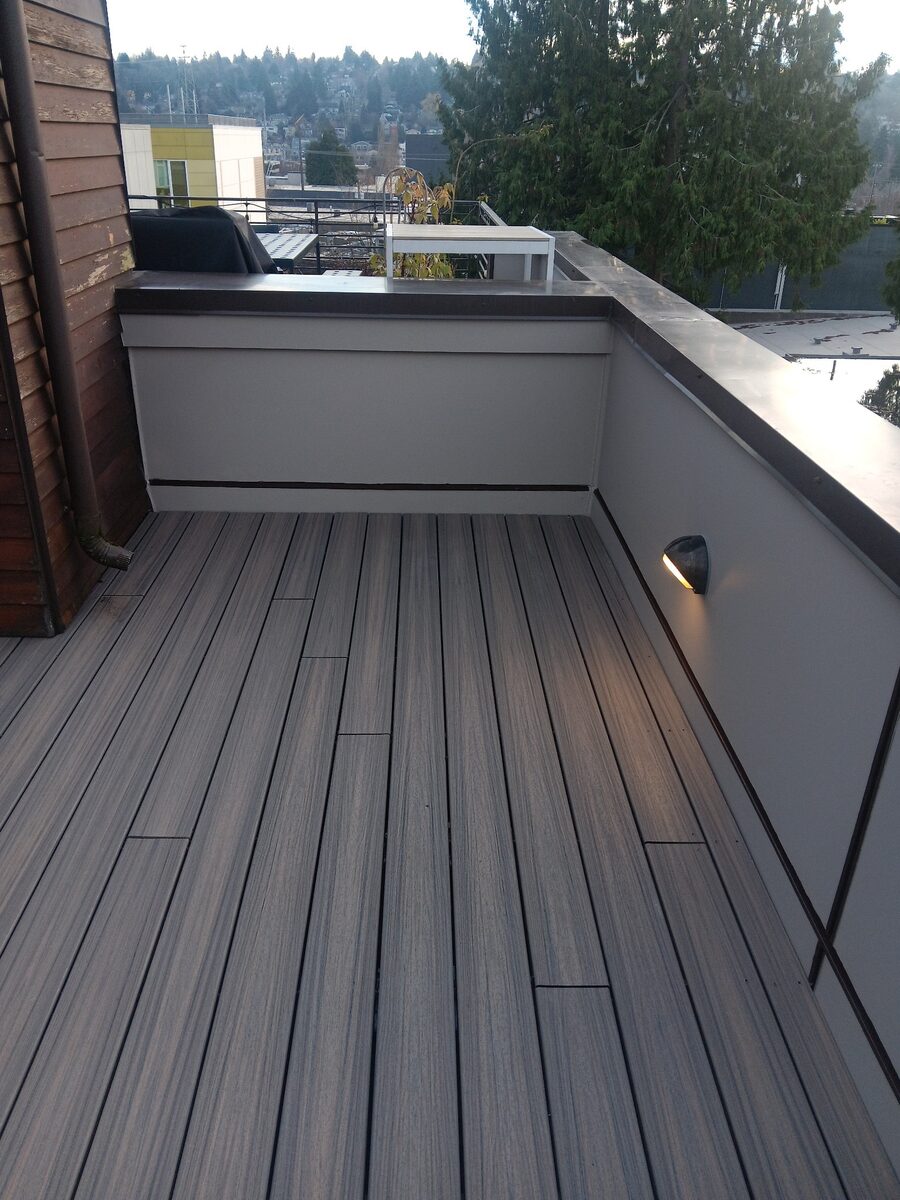
If you live in Seattle, you already know: your deck doesn't get a break. The Pacific Northwest delivers over 150 wet days per year — that's not a rough estimate, it's a documented climate reality from NOAA — and every one of those rainy days is a direct invitation for moss, mildew, algae, and black mold to establish themselves on your deck surface. Unlike drier climates where homeowners might clean their deck once every few years and call it done, Seattle decks demand a twice-yearly cleaning rhythm and, depending on your material, a very specific approach. Use the wrong tool, the wrong chemical, or the wrong pressure setting and you can void your manufacturer warranty, strip a cedar deck bare, or permanently damage a composite cap layer that costs thousands of dollars to replace.
The challenge is that composite decks, cedar decks, and PVC decks each require completely different cleaning protocols — and what works perfectly for one material can ruin another. Walk into any big-box hardware store and you'll find a wall of deck-cleaning products, most of which don't specify what material they're safe for. Ask the average pressure washing company whether 2,500 PSI is safe on a Trex deck and watch them hesitate. This article gives you the precise, material-specific guidance that most generic deck-cleaning articles skip: exact PSI ranges, specific product categories, the chemical reactions you need to avoid, and the post-cleaning steps that determine whether your deck looks great for two years or needs professional refinishing in six months.
Whether you're tackling the job yourself on a dry weekend in April or pricing out professional cleaning services (which run $200–$500 for a standard 300–400 square foot Seattle deck), the information here is organized by material type, by problem type, and by the seasonal timing that makes sense for the Puget Sound climate. We've built and refinished hundreds of decks in Bothell, Kirkland, Bellevue, Edmonds, and across King and Snohomish counties, and we've seen firsthand what poor cleaning technique does to a five-year-old deck. Here's what actually works.
Why Seattle's Climate Creates Year-Round Deck Maintenance Challenges
Most homeowners think of deck cleaning as a spring ritual. In Seattle, that mental model isn't wrong — it's just incomplete. The Puget Sound climate creates conditions for biological growth almost continuously from October through June, which means the window between "clean deck" and "moss colony" is measured in weeks, not months. Understanding the climate mechanics helps you clean smarter and schedule maintenance before damage accumulates.
The 150+ Wet Days Problem
Seattle averages approximately 152 days of measurable precipitation per year, according to historical climate data from the National Weather Service Seattle forecast office. Unlike the Southeast or Midwest, where rainfall comes in hard downpours that dry out quickly between storms, the Pacific Northwest delivers moisture as persistent drizzle, fog, and low-ceiling overcast that keeps surfaces damp for days at a stretch. A cedar deck board can stay at elevated moisture content for 5–7 consecutive days following a typical Seattle rain event, particularly on north-facing surfaces that receive limited afternoon sun.
That sustained moisture, combined with Seattle's moderate temperatures (rarely cold enough to kill moss, rarely hot enough to dry things out completely), creates a near-perfect incubator for:
- Moss and lichen: Thrives in 40–75°F with sustained moisture — exactly Seattle's operating range from October through May.
- Black mold and mildew: Establishes on composite and wood surfaces within 48–72 hours of continuous dampness.
- Algae: Green or black-green slime growth accelerates on shaded deck surfaces in spring when rain and emerging sunlight create competition between biological organisms.
- Tannin staining: On cedar, wet weather leaches natural tannins to the surface, creating dark brown or gray staining that looks like mold but requires different treatment.
The Two Cleaning Windows That Matter in Seattle
The Seattle climate dictates two natural cleaning windows, and timing matters more than most homeowners realize.
Spring cleaning (late March through early May): This is your primary window. Winter accumulates the most biological growth because decks stay wet the longest. Spring cleaning removes winter moss before it anchors deeply into wood grain or composite textures, clears debris that has trapped moisture against the surface all winter, and preps the deck for the primary use season. For cedar decks, spring cleaning also sets the stage for re-staining before the summer dry season bakes the surface.
Fall cleaning (September through mid-October): The secondary window, often skipped — but important. Summer debris (leaves, bird droppings, pollen, barbecue grease, foot traffic grime) sits on the deck surface and feeds the biological growth that will explode the moment fall rains begin. A thorough fall cleaning removes that food source and significantly reduces how severe your spring cleaning job will be. Fall is also when to install zinc strips if moss has been a recurring issue.
Key insight
Cleaning Composite Decks in Seattle: Material-Specific Protocol
Composite decking is the dominant material on Seattle-area decks built in the past decade — and for good reason. Composite decking is explicitly engineered to resist the moisture and biological growth that destroys wood. But "resistant" doesn't mean "maintenance-free," and the cleaning protocols for composite are stricter than most homeowners expect. The wrong approach doesn't just leave your deck dirty — it voids your warranty.
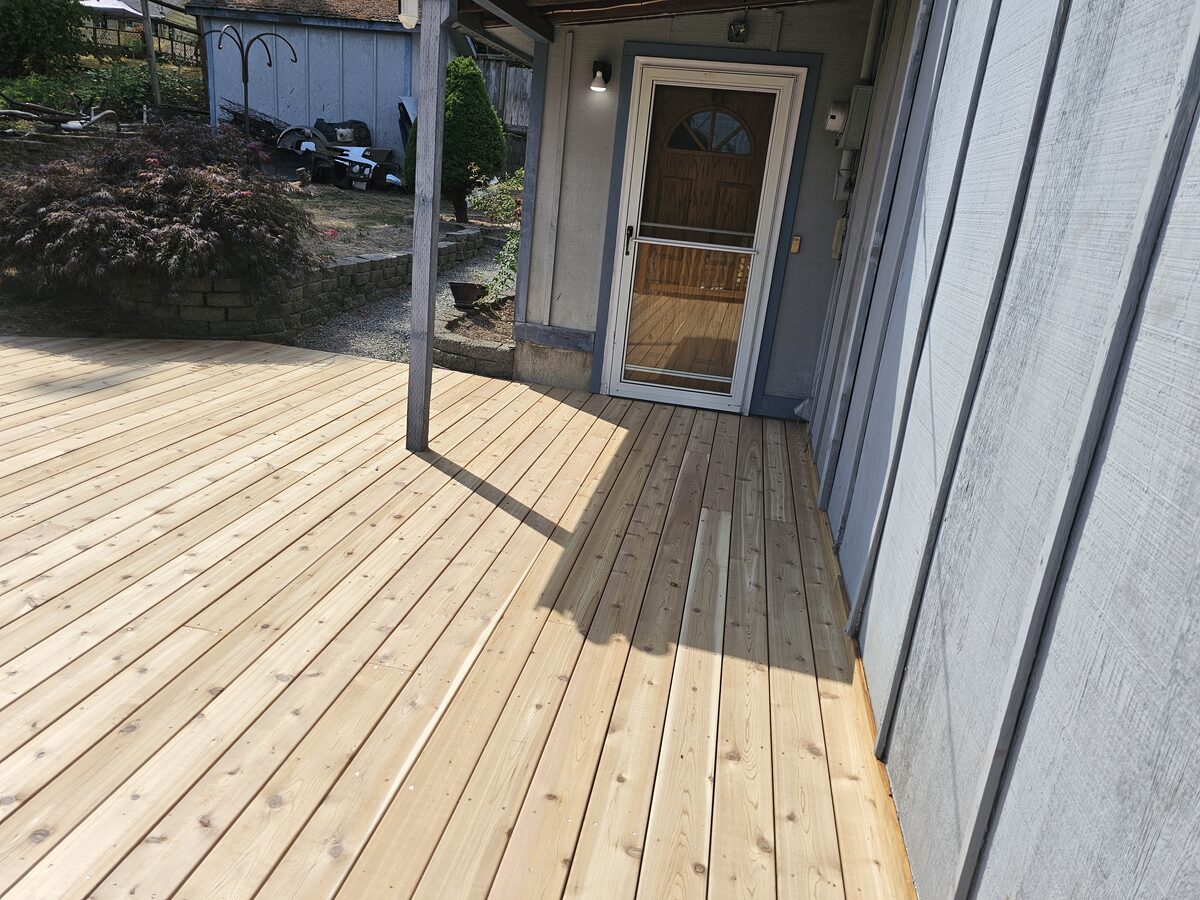
Understanding Capped vs. Uncapped Composite
Modern composite decks — Trex, Fiberon, TimberTech, Deckorators — are manufactured with a polymer cap layer that encases the wood-plastic composite core. This cap is what gives them stain, fade, and moisture resistance. It's also what makes them vulnerable to specific cleaning mistakes. Trex's official care and cleaning guidelines specify that pressure washers above 3,100 PSI may damage the cap, but in practice, a 1,500 PSI fan-tip wand is more than adequate for routine cleaning and carries significantly less risk of surface damage.
Older uncapped composite (pre-2010 in most cases) has a more porous surface that can harbor mold more deeply and may require more aggressive treatment. If you're not sure which type you have, compare the options in our composite vs. cedar comparison guide.
Step-by-Step Composite Deck Cleaning
What you need:
- Manufacturer-approved deck cleaner (oxygen bleach-based, mold/mildew formula)
- Soft-bristle brush (nylon, not wire)
- Garden hose or pressure washer set to 1,500 PSI maximum with fan tip
- Bucket and measuring cup
Step 1 — Clear the deck. Remove all furniture, planters, grills, and rugs. Sweep loose debris.
Step 2 — Pre-wet the surface. Rinse the deck boards with clean water before applying any cleaner. This opens the surface texture slightly and prevents concentrated cleaner from drying too quickly in sunlit areas.
Step 3 — Apply cleaner. Mix your oxygen bleach deck cleaner per label directions and apply with a brush or pump sprayer. Work in sections of 100–150 square feet. Let the solution dwell 5–10 minutes — do not let it dry on the surface.
Step 4 — Scrub. Use your soft-bristle brush to work the cleaner into the composite texture, scrubbing along the board direction. Pay extra attention to gaps between boards where debris and biological matter accumulate.
Step 5 — Rinse thoroughly. Rinse with clean water, working from high points toward drains. If using a pressure washer, keep the fan tip at least 8 inches from the surface and work in the direction of the board grain.
Step 6 — Inspect for mold stains. After drying, check for any remaining dark staining. Apply a second round of oxygen bleach solution to persistent spots and let dwell 15 minutes before rinsing.
What Voids Composite Warranties
This is where homeowners and pressure washing companies make expensive mistakes. Based on manufacturer documentation across major composite brands:
| Action | Warranty Impact |
|---|---|
| Pressure washing above 3,100 PSI | Voids warranty for any cap damage |
| Chlorine bleach on colored composite | Voids warranty; causes color fading |
| Abrasive cleaners or wire brushes | Voids warranty; scratches cap layer |
| Power sanding composite surface | Voids warranty |
| Leaving dirty rinse water to dry | Not warranty-voiding but causes filming |
| Oil-based cleaners | Not recommended; can stain porous composite |
Important
Cleaning Frequency for Composite
A twice-annual schedule (spring and fall) is sufficient for most Seattle composite decks. Decks under heavy tree cover — particularly firs and cedars that shed throughout the year — may benefit from a light wash every 8–10 weeks during the wet season to prevent debris from sitting and feeding biological growth.
Cleaning Cedar Decks in Seattle: The Wood-Specific Protocol
Cedar remains one of the most beautiful and regionally appropriate decking materials for the Pacific Northwest. Cedar decking is naturally resistant to rot and insects, and when properly maintained, it can last 20–30 years. But "properly maintained" is doing a lot of work in that sentence. Cedar cleaning requires a more involved protocol than composite, and the post-cleaning steps — neutralizer, dry time, re-staining — are where most DIY projects go wrong.
Why Cedar Requires a Different Approach
Cedar is a living wood fiber, even in deck board form. It expands and contracts with moisture, it has an open grain structure that harbors biological growth differently than composite, and it responds chemically to the pH of cleaning products in ways composite does not. The same oxygen bleach solution that's gentle enough for composite can actually dry out cedar fibers if used at high concentration, so dilution matters. And unlike composite, which you clean and walk away from, cedar must be re-stained within 48–72 hours of cleaning — a window that many Seattle homeowners miss because they clean on a Saturday and then it rains all week.
Cedar Cleaning Products That Work
Commercial wood cleaners: Products like Olympic Premium Deck Cleaner, Cabot Wood Cleaner, or Defy Wood Cleaner are formulated for wood fiber and are the correct starting point for routine cedar cleaning. These contain mild acids or oxidizers that lift surface dirt, mildew, and gray weathering without over-drying the wood.
TSP (trisodium phosphate) solution: For heavy mold accumulation on cedar — the kind of black-green biological mat that forms under shaded deck furniture left all winter — TSP at a concentration of 1–2 tablespoons per gallon of water is an effective treatment. TSP is a phosphate-based cleaner that cuts through heavy organic matter and mold. Note that phosphate runoff is restricted in some Washington State jurisdictions; check King County's guidelines on cleaning product restrictions before using TSP near storm drains.
Oxygen bleach (sodium percarbonate): The same product that works for composite also works for cedar mold treatment, but at slightly higher concentrations for deeply embedded mold. Oxygen bleach is safer for the surrounding landscape than chlorine bleach and doesn't break down wood fibers at normal cleaning concentrations.
Step-by-Step Cedar Cleaning Protocol
What you need:
- Commercial wood cleaner (Olympic, Cabot, or similar)
- TSP for heavy mold areas
- Pressure washer (600–800 PSI maximum for cedar)
- Medium-bristle brush (softer than you'd use for concrete, stiffer than composite)
- Wood neutralizer (oxalic acid-based, critical for TSP use)
- Re-stain or sealant product (must apply within 48–72 hours)
Step 1 — Clear and sweep. Remove everything from the deck. Sweep leaves and loose debris.
Step 2 — Pre-wet cedar boards. Wet the wood before applying any cleaner. Dry cedar absorbs cleaning product unevenly.
Step 3 — Apply wood cleaner. Mix per label and apply with a brush or pump sprayer. On heavy mold areas, apply TSP solution separately. Let dwell 10–15 minutes.
Step 4 — Scrub with the grain. Always scrub cedar along the grain direction to avoid raising the wood fibers. Cross-grain scrubbing creates a fuzzy texture that absorbs stain unevenly.
Step 5 — Pressure wash at 600–800 PSI. This is the maximum recommended for cedar. Higher PSI drives water into the grain under pressure, raising and splitting fibers and creating an uneven surface for staining. Use a 40-degree fan tip and maintain at least 12 inches of distance from the surface. Work in the direction of the board grain.
Step 6 — Apply wood neutralizer. If you used TSP, a neutralizer (oxalic acid-based) is essential — TSP raises wood pH, and staining over high-pH wood results in poor adhesion and premature peeling. Even if you used a commercial wood cleaner rather than TSP, a neutralizer helps open the wood grain for better stain penetration. Apply per label, let dwell, rinse.
Step 7 — Dry time. Cedar needs to reach below 15% moisture content before staining. In Seattle's climate, allow 48–72 hours of dry weather after cleaning. This is the tightest part of the whole operation: check the forecast before you clean, and plan your staining day in advance.
Tip
Post-Cleaning Cedar Steps: Neutralizer and Stain
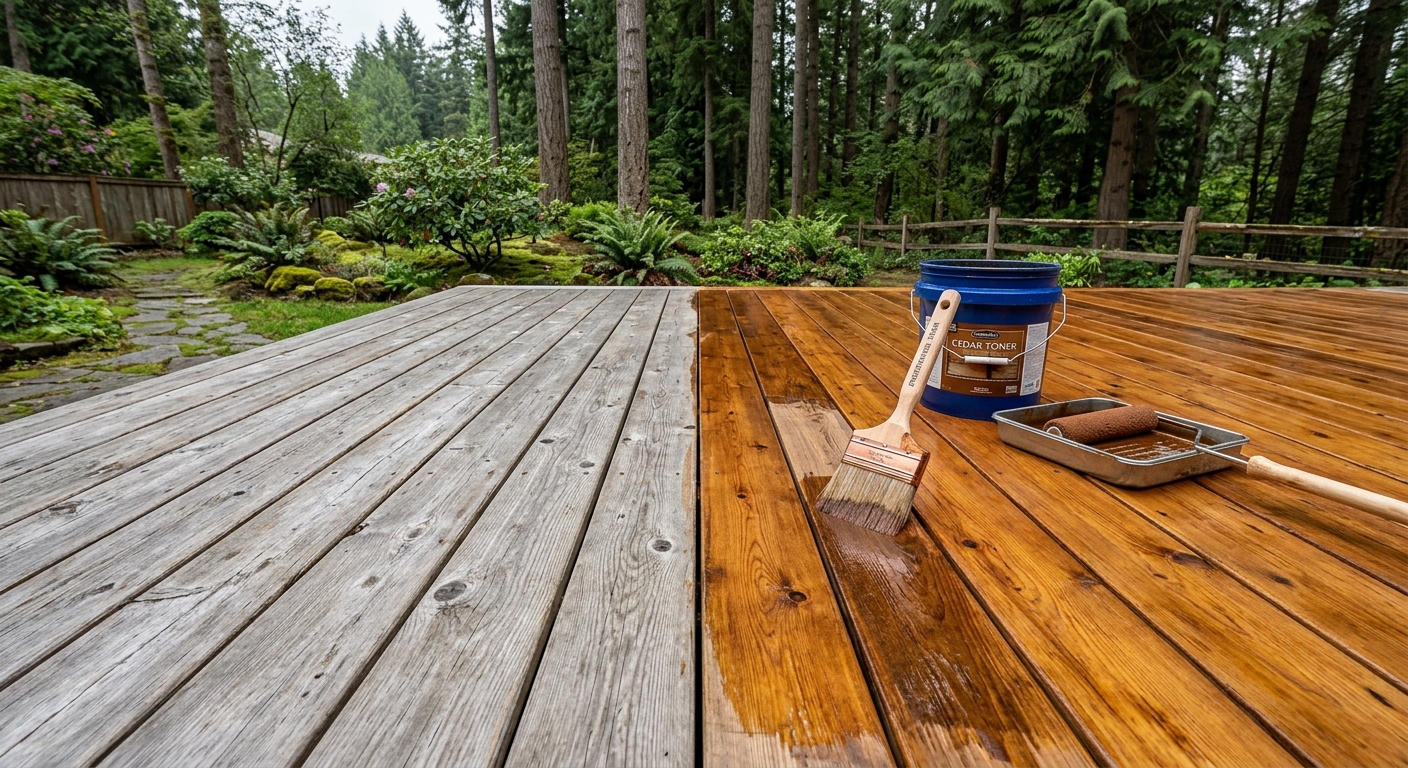
The neutralizer and stain are not optional for cedar. A cleaned but un-stained cedar deck will begin weathering immediately and will look gray and blotchy within 30–45 days. Worse, without the moisture barrier that stain provides, a cleaned deck (which has open grain and slightly elevated porosity from cleaning) actually absorbs more moisture than before — setting up for accelerated biological growth.
After applying neutralizer and allowing the cedar to dry:
- Apply a penetrating oil stain (semi-transparent or solid) with a roller or brush, working with the grain
- Back-brush immediately to work stain into the grain
- A second coat after 24 hours dramatically extends protection life
- For Seattle weather protection, a stain with water repellent and mildewcide is strongly preferred over basic sealant
For a full comparison of cedar maintenance requirements versus composite, see our deck staining vs. composite guide.
Cleaning PVC Decks in Seattle: The Easiest Material to Maintain
PVC decking — full polyvinyl chloride, like Azek, TimberTech Vintage, or similar — is by far the most forgiving material to clean. PVC contains no wood fiber, which means it has nothing for mold to feed on biologically. Mildew on PVC is a surface phenomenon, not an embedded one, and it cleans up far more easily than on composite or cedar.
PVC Cleaning Protocol
The basic protocol for PVC cleaning is similar to composite with even fewer restrictions:
- Routine cleaning: Soap, water, and a soft brush handle 90% of PVC maintenance. Dish soap diluted in water works for light grime and surface mildew.
- Mold and mildew: Oxygen bleach solution (same as composite) applied with a soft brush removes surface biological growth quickly. PVC is non-porous, so mold doesn't penetrate — it sits on the surface and releases easily.
- Pressure washing: PVC is more tolerant than composite. A 1,500–2,000 PSI wash with a fan tip is acceptable. Avoid concentrated stream nozzles at any PSI.
- Scuffs and marks: This is where PVC has a unique advantage. A Mr. Clean Magic Eraser (melamine foam) removes scuffs, heel marks, and stubborn surface staining on PVC that would require more effort on composite. Dampen the eraser and use light circular pressure.
Note
Comparison: Cleaning Requirements by Material
| Material | PSI Range | Cleaner Type | Frequency | Post-Cleaning Step | Relative Difficulty |
|---|---|---|---|---|---|
| Composite (capped) | Max 1,500 PSI | Oxygen bleach, manufacturer-approved | 2x/year | None required | Moderate |
| Cedar | 600–800 PSI | Commercial wood cleaner, TSP for heavy mold | 2x/year | Neutralizer + re-stain within 72 hrs | High |
| PVC | Max 2,000 PSI | Soap + water, oxygen bleach | 2x/year (or as needed) | None required | Low |
| Uncapped composite | Max 1,000 PSI | Oxygen bleach, avoid abrasives | 3–4x/year | None required | Moderate-High |
Moss Treatment: How to Kill It, Remove It, and Stop It Coming Back
Moss is not just a cosmetic issue on Seattle decks. A mature moss colony holds moisture against the deck surface continuously — even during dry periods — because the moss itself acts as a sponge. On cedar, sustained moss-trapped moisture is a direct pathway to rot in the underlying structure. On composite, moss accumulation in deck gaps can trap enough moisture to create ideal conditions for mold to grow in the structural framing below.
The Right Product: Sodium Percarbonate
The most effective and safest moss treatment for all deck materials is sodium percarbonate, commonly sold as oxygen bleach or under brand names like OxiClean Outdoor (though formulations vary — look for products specifically listing sodium percarbonate as the active ingredient). Here's why it works:
- Sodium percarbonate releases hydrogen peroxide and sodium carbonate when mixed with water. The hydrogen peroxide kills moss and mildew organisms at the cellular level.
- It's effective on all deck materials (unlike chlorine bleach, which damages composite and accelerates wood fiber breakdown).
- It breaks down into water, oxygen, and sodium carbonate — no harmful residues in your soil or drainage.
- Seattle Public Utilities and King County environmental guidelines favor oxygen-based cleaners over chlorine bleach for surface cleaning near storm drains and drainage systems.
Application for moss:
- Mix sodium percarbonate at 2–4 oz per gallon of warm water (higher concentration for heavy moss).
- Apply to dry or slightly damp moss with a pump sprayer. Avoid applying in direct hot sun.
- Let dwell 20–30 minutes. The moss will visibly change color (from green to brown/black) as the organisms die.
- Scrub dead moss loose with a stiff brush — it releases much more easily than live moss.
- Rinse thoroughly.
Zinc Strips: Prevention Is Easier Than Treatment
The most effective long-term moss prevention strategy for Seattle decks is zinc metal flashing installed along the top of any overhead structure (pergola ridge, adjacent roof edge, or fence line above the deck). When it rains, water running over zinc carries zinc ions onto the deck surface below — and zinc ions are toxic to moss, algae, and lichen at extremely low concentrations.
This is the same principle behind the Mos-Ex or Z-STOP zinc strips used on roofs, and it works the same way on decks. A 50-foot roll of 2.5-inch zinc strip runs $20–$35 and lasts 5–10 years. Installed along the ridge of a pergola or overhead beam, it reduces moss growth on the deck below by 70–90% compared to untreated control surfaces in Pacific Northwest testing.
Tip
What Not to Use on Moss
- Chlorine bleach: Kills moss but damages composite coloring, accelerates cedar fiber breakdown, and creates harmful runoff.
- Power washing alone: High-pressure water breaks up live moss temporarily but doesn't kill the rhizoids (root-like anchors) embedded in the surface. Without a biocidal treatment, moss regrows within 4–8 weeks.
- Salt: Effective at killing moss but also kills surrounding vegetation and accumulates in soil, creating long-term landscape damage.
Seasonal Timing: When to Clean Your Seattle Deck
Based on Seattle's 150+ wet days per year and typical biological growth rates by material type. Cedar and uncapped composite require more frequent attention.
| Category | Value |
|---|---|
| Cedar (stain every year) | x/year2 |
| Capped Composite | x/year2 |
| PVC Decking | x/year2 |
| Uncapped Composite | x/year3 |
| Cedar (heavy shade) | x/year3 |
Spring Cleaning: March 15 – May 15
Spring is the primary cleaning window for Seattle decks, and the timing matters more than homeowners usually give credit for. The goal is to clean after the worst of winter biological growth but before the primary use season — and for cedar, to clean while the weather still offers a reasonable chance of a 72-hour dry window for re-staining before the summer "dry" season (which in Seattle often doesn't fully arrive until July).
Spring cleaning priority checklist:
- Remove and inspect any rugs or furniture left on deck over winter (rugs trap moisture and create perfect moss conditions underneath)
- Clear debris from between deck boards — use a flat pry bar or deck cleaning tool to clear gaps
- Inspect deck surface for soft spots (on cedar) or delamination (on older composite)
- Apply moss treatment first if moss is present; let dwell, scrub, rinse before general cleaning
- Full clean per material type
- For cedar: neutralize and re-stain within the next dry window
For a comprehensive guide to what to look for structurally during your spring cleaning, see our deck winter inspection guide.
Fall Cleaning: September 1 – October 15
Fall cleaning is the easier of the two sessions but often the most neglected. The key is timing: you want to clean after summer debris accumulation but before the fall rains arrive in earnest (typically mid-October in the Puget Sound). Cleaning after the rains have started means you're cleaning a deck that's already beginning to host biological growth again.
Fall cleaning focus areas:
- Sweep and blow off all leaf debris (fallen leaves from deciduous trees are a primary moss food source)
- Clear between boards
- Light wash to remove summer grime, bird droppings, and pollen
- Inspect composite boards for any surface damage from summer heat or UV
- Consider applying a moss preventive treatment (sodium percarbonate or a commercial moss preventive spray) in late October as a prophylactic measure
DIY vs. Professional Deck Cleaning in Seattle: Cost Comparison
For most Seattle homeowners, the decision between DIY and professional deck cleaning comes down to time, equipment access, and whether the deck needs specialized treatment (heavy moss, cedar re-staining) that changes the complexity equation.
DIY Cost Breakdown
A full DIY cleaning kit for a 300–400 square foot Seattle deck typically includes:
| Item | Estimated Cost |
|---|---|
| Oxygen bleach deck cleaner (1-gallon concentrate) | $15–$25 |
| Commercial wood cleaner (for cedar) | $20–$35 |
| Wood neutralizer (for cedar, 1 quart) | $10–$15 |
| Stiff-bristle brush | $8–$15 |
| Pump sprayer (if not owned) | $15–$30 |
| Pressure washer rental (1 day, if not owned) | $40–$75 |
| Total (composite) | $38–$70 |
| Total (cedar, with neutralizer, no stain) | $53–$120 |
| Total (cedar, with stain product) | $120–$250 |
If you already own a pressure washer, the cost drops significantly. Note that cedar stain is a separate line item — a quality penetrating oil stain for a 300 sq ft deck runs $40–$80 in product cost alone.
Professional Cleaning Cost in Seattle
According to current pricing data from Angi and Seattle-market service providers like Seattle Suds:
- Basic pressure wash + clean (composite): $150–$300 for 300–400 sq ft
- Full cleaning with moss treatment: $200–$400 for 300–400 sq ft
- Cedar cleaning + neutralizer + prep for staining: $250–$450
- Cedar cleaning + staining (full service): $500–$1,200+ depending on deck size and stain type
- Per-square-foot rate: $0.30–$0.57 for basic cleaning; higher for specialized treatment
The professional premium makes most sense in three scenarios: (1) heavy moss or mold requiring chemical treatment and proper disposal planning, (2) cedar decks where the post-cleaning staining is also being contracted out, and (3) decks with complex configurations (multiple levels, built-in seating, pergola integration) where access for DIY cleaning is genuinely difficult.
Note
Common Deck Cleaning Mistakes Seattle Homeowners Make
We've seen the results of deck cleaning mistakes on decks we've been called to repair or rebuild. Most of them are avoidable. Here are the most common, and what to do instead.
Mistake 1: Using Chlorine Bleach on Composite
The most frequent warranty-voiding mistake. Chlorine bleach (standard household bleach, sodium hypochlorite) is widely available and does kill mold and mildew. But on composite decking — particularly darker colors — it reacts with the cap layer pigments and causes irreversible color stripping. The affected boards don't just look faded; they look chemically burned, with irregular bleached patches that cannot be touched up. Replacement is the only fix.
The fix: Always use oxygen bleach (sodium percarbonate) on composite. Same mold-killing effectiveness, zero cap layer damage.
Mistake 2: Pressure Washing Cedar at Composite-Safe PSI
The correct PSI for composite (up to 1,500 PSI fan tip) is still too high for cedar. At 1,500 PSI, you'll begin to raise the grain on cedar boards, creating a fuzzy, fibrous surface that absorbs stain unevenly and traps debris more aggressively than a smooth grain. Cedar requires 600–800 PSI maximum with a fan tip.
The fix: If you're renting a pressure washer, rent one with adjustable pressure or ask what tips are available. The 40-degree fan tip at controlled distance keeps cedar in the safe PSI range.
Mistake 3: Cleaning Cedar and Not Re-Staining
A cleaned cedar deck with open grain and no stain protection is actually more vulnerable than an un-cleaned deck. The cleaning removes the protective surface layer (whatever remained of the old stain) and opens the grain, increasing moisture absorption. Without re-staining within 48–72 hours, the wood begins weathering immediately and biological growth re-establishes faster than before.
The fix: Never clean cedar without having stain product on hand and a dry weather window confirmed. If you can't stain within 72 hours, postpone the cleaning.
Mistake 4: Ignoring the Gaps Between Boards
The gaps between deck boards are where biological growth anchors first. Moss rhizoids, algae, and debris all accumulate in gaps, and a surface-level cleaning that doesn't address gaps leaves the most aggressive growth source intact. Within 30–45 days of a gap-neglected cleaning, biological material from the gaps will spread back across the surface.
The fix: Use a deck gap cleaner tool (a flat, hook-shaped implement) or a flat pry bar to clear debris from gaps before cleaning. Apply cleaner solution directly into gaps and use a narrow brush to scrub gap surfaces.
Mistake 5: Cleaning in Direct Hot Sun
Applying any deck cleaner in direct, hot midday sun causes the solution to evaporate before it can dwell and work. The result is uneven cleaning, potential streaking (especially on composite), and wasted product. On especially hot days, evaporating cleaners can also leave salt or chemical residue on the surface that requires additional rinsing.
The fix: Clean on overcast days or in the morning/evening when the deck surface temperature is below 80°F. Seattle's overcast spring climate is actually ideal for deck cleaning — use it.
When to Call a Professional: Signs Your Deck Needs Expert Attention
DIY cleaning handles routine maintenance well. But there are situations where the deck condition, the material complexity, or the structural concerns involved warrant professional attention — not just for cleaning, but for assessment.
Structural Concerns Revealed During Cleaning
Cleaning removes the surface layer that often hides structural issues. As you clean, watch for:
- Soft spots on cedar boards: Press with your foot — soft spots suggest rot in the board or the framing below. Don't ignore this; deck structural issues found early are far less expensive than those found after failure.
- Delamination on composite: Cap layer separating from the core, visible as bubbling or peeling sections. This is a manufacturer defect on recent decks (covered under warranty) or UV/age damage on older material.
- Cracked or cupped boards: Boards that have cupped (curled at edges) or cracked may indicate water infiltration issues that cleaning won't solve.
- Fastener corrosion: Visible rust around screws or hidden fasteners, particularly on coastal-exposure decks.
Any of these findings warrants a call to a professional deck builder for structural evaluation, not just a cleaning crew.
When Moss Has Penetrated Structural Members
Moss visible on the deck surface is one thing. Moss growing on joists, beams, or ledger boards visible from below is a different problem entirely — it indicates structural wood is retaining moisture and biological growth in areas that are not cleaned during normal deck maintenance. This is a sign of drainage or ventilation issues and sometimes of advancing wood rot.
When Cedar Re-Staining Has Been Deferred for Multiple Years
If a cedar deck hasn't been stained in 3+ years and has significant gray weathering, a full professional cleaning and refinishing project is likely more efficient and effective than a DIY cleaning. Professional refinishing often involves light sanding to remove deeply weathered surface fibers before cleaning and staining — a step that goes beyond routine maintenance and requires equipment most homeowners don't own.
For context on what professional deck work in the Seattle market costs, see our 2025 deck cost guide and our composite vs. cedar comparison.
Choosing Deck Cleaning Products: What Works, What Doesn't, What to Avoid
Not all "deck cleaners" are equal, and marketing language on product labels is often vague enough to be misleading. Here's a framework for reading deck cleaning product labels and selecting the right product for your material.
Reading Active Ingredient Labels
Oxygen bleach / sodium percarbonate: The active ingredient of choice for mold, mildew, and moss on all deck materials. Look for it listed as the active ingredient, not just implied by words like "oxy" or "oxygen-activated" (some products use hydrogen peroxide, which is less stable and less effective for dwell applications).
Sodium hypochlorite (chlorine bleach): Avoid on composite entirely. Use sparingly on cedar, heavily diluted, and follow immediately with a neutralizer. Many "deck brightener" products contain small amounts of hypochlorite — check the label.
Oxalic acid: The active ingredient in most "wood brighteners" and deck neutralizers. Excellent for restoring gray weathered cedar to a brighter appearance and for neutralizing the pH after TSP treatment. Not suitable as a primary cleaner — use after the main cleaning step.
Phosphoric acid: Found in some heavy-duty wood cleaners. Effective for heavy tannin staining on cedar but can be harsh — follow label dilution carefully and rinse thoroughly.
Citric acid: A gentler brightening agent found in some eco-friendly deck cleaners. Works well for light weathering on cedar but underpowered for significant mold or moss.
Product Recommendations by Situation
| Situation | Recommended Product Type | Avoid |
|---|---|---|
| Routine composite cleaning | Manufacturer-approved deck cleaner, oxygen bleach | Chlorine bleach, abrasive cleaners |
| Composite mold/mildew | Oxygen bleach solution | Anything with sodium hypochlorite |
| Cedar routine cleaning | Commercial wood cleaner (Olympic, Cabot, Defy) | High-concentration chlorine bleach |
| Cedar heavy mold | TSP solution (2 tbsp/gallon) | Products not labeled for wood |
| Cedar gray weathering | Oxalic acid brightener | Pressure alone |
| PVC surface mildew | Dish soap + water, oxygen bleach | Petroleum-based solvents |
| PVC scuffs/marks | Melamine foam (Magic Eraser) | Abrasive scrubbing pads |
| All materials — moss | Sodium percarbonate, zinc strips for prevention | Chlorine bleach, salt |
FAQ
Frequently Asked Questions
How often should I clean my deck in Seattle?
Can I use a regular pressure washer on my Trex or composite deck?
What's the best moss killer for a Seattle deck that won't damage the boards?
Can I use bleach to clean my composite deck?
How long does it take cedar to dry before I can re-stain after cleaning?
What is the cost of professional deck cleaning in Seattle?
How do I remove black stains from my deck boards?
Is it safe to use a Magic Eraser on composite decking?
When should I replace instead of clean a cedar deck?
What cleaning products void composite deck warranties?
Can I clean my deck in winter in Seattle?
How do I prevent moss from coming back after cleaning?
Get Professional Help with Your Seattle Deck
Whether your deck needs a thorough seasonal cleaning, a full cedar refinishing project, or a professional assessment of potential structural damage uncovered during cleaning, The Seattle Decking Company has been working on decks across King and Snohomish counties for years. We understand the specific maintenance demands that Seattle's climate places on every deck material — because we build them here, maintain them here, and see firsthand what happens when cleaning gets delayed or done wrong.
If you're seeing significant moss accumulation, dark staining that won't respond to DIY cleaning, soft spots in cedar boards, or composite delamination, those are signs that a professional assessment is the right next step — not just a more aggressive cleaning. We can evaluate your deck's condition, recommend the right cleaning and maintenance protocol for your specific material and situation, and handle anything from routine maintenance to full deck repairs or replacement.
Call us at [(425) 675-6259](tel:4256756259) to schedule a deck inspection or cleaning consultation. We serve Bothell, Kirkland, Bellevue, Edmonds, Woodinville, Redmond, and surrounding communities throughout King and Snohomish counties.
You can also contact us online to describe your deck's condition and get a callback from our team. We're located at 22722 29th Drive SE, Bothell, WA 98021, and we answer the phone during business hours — no forms, no waiting for an automated response.
For more on maintaining your deck investment, explore our related guides:
- Best Decking Materials for Seattle in 2026
- Composite vs. Cedar Decking in Seattle
- Deck Staining vs. Composite: What Seattle Homeowners Actually Save
- Deck Winter Inspection Checklist for Seattle
- How to Find the Right Deck Builder in Seattle
Planning a deck in the Seattle area?
Get an onsite design review and a clear, itemized quote from a licensed local builder.
Request a Free Quote