
If you've spent any time scrolling Houzz or Pinterest lately, you've noticed the national deck trend content — gray composite everywhere, cable railings on flat suburban lots, outdoor kitchens styled for Phoenix or Atlanta. That content was never designed for King County. Seattle homeowners face a specific set of challenges: 55 inches of annual rainfall, slopes that make level ground a luxury, views worth protecting at any cost, and a building department that takes permits seriously. The deck trends shaping 2026 in this market look different from what you'll read about in national roundups, because the climate, the topography, and the homeowners here are different.
What we're seeing on job sites across Bellevue, Kirkland, Mercer Island, and North Seattle right now is a clear shift away from the "build a platform and furnish it" mindset. In 2026, King County homeowners are building outdoor rooms — full-featured, weather-resistant, year-round living spaces that extend the livable square footage of their homes. According to King County permitting data, residential deck permit applications have been trending upward across unincorporated King County, with permit fees increasing approximately 14% at the start of 2026 to reflect higher project values. The average permitted deck project in our area is getting bigger, more complex, and more integrated with the home than it was even three years ago.
The trends below aren't predictions — they're what's actually being specified in conversations with homeowners right now. We've filtered them through Seattle's climate reality, the specific neighborhoods where demand is highest, and honest cost ranges so you can evaluate what makes sense for your property.
1. Covered Structures: The Trend That Actually Makes Sense in Seattle
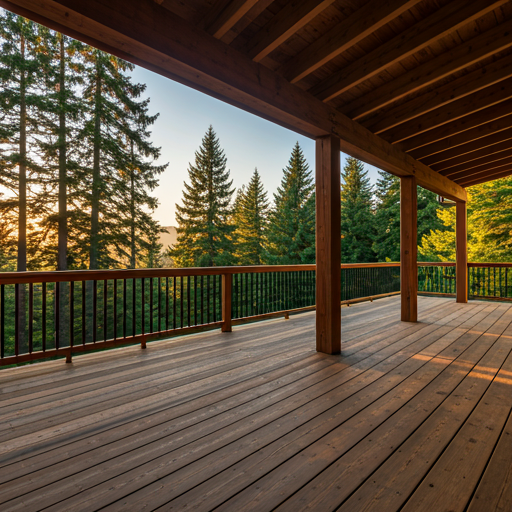
No trend on this list has more practical impact in the Pacific Northwest than covered structures. A pergola or solid-roof deck cover doesn't just look good — in Seattle, it's the difference between a deck you use nine months a year and a deck you abandon every October.
Why Covered Decks Are Everywhere Right Now
King County averages roughly 150 days of measurable precipitation per year. That's not constant rain — it's frequent drizzle, unexpected afternoon showers, and the kind of overcast dampness that discourages outdoor use even when it's technically "not raining." A proper cover changes the calculus entirely. Homeowners who add covered sections to their decks consistently report using those spaces through November and back into March, which in Seattle terms is essentially year-round.
The category has expanded significantly. In 2024 and 2025, we saw mostly simple pergola additions — open-lattice structures that provide partial shade and a sense of enclosure without true rain protection. By 2026, the requests have shifted toward more serious weather protection:
Louvered pergolas are the growth category. Systems from manufacturers like Struxure, Sunesta, and similar brands allow aluminum louvers to pivot open or closed via motor, controlled by a smartphone app or wall switch. Close the louvers during a rain shower; open them when the sun breaks through. These systems start around $18,000–$25,000 installed for a typical 12×16 section in King County, where labor rates run 25–40% above national averages.
Solid-roof additions that match the home's existing roofline are the premium end of this category. A properly permitted, fully roofed covered deck section — with matching shingles or a standing-seam metal roof, integrated gutters, and finished soffits — typically runs $45–$75 per square foot for the roof structure itself, on top of the deck platform costs. It's a significant investment, but it converts the deck into something closer to an exterior room. On a $1.2M home in Kirkland or Sammamish, that ROI calculus often pencils out.
Simple pergolas with polycarbonate panel inserts remain popular for cost-conscious projects. A pressure-treated or cedar pergola with clear corrugated polycarbonate panels provides genuine rain protection at a fraction of the cost of a louvered system — typically $8,000–$15,000 installed depending on size.
Tip
What to Pair With Your Covered Structure
The real value of a covered deck unlocks when you layer in complementary features. Infrared ceiling heaters mounted to a covered pergola or roof — ceiling-mounted electric or gas units, not the freestanding patio heaters — extend comfortable use into sub-50°F evenings. A set of two ceiling-mount infrared units runs $800–$1,500 in equipment plus installation. Outdoor fans keep air moving in summer under a solid roof. Integrated lighting (see the dedicated section below) becomes essential under a covered structure where ambient sky light is eliminated.
2. Warm Composite Colors: The End of the Gray Era
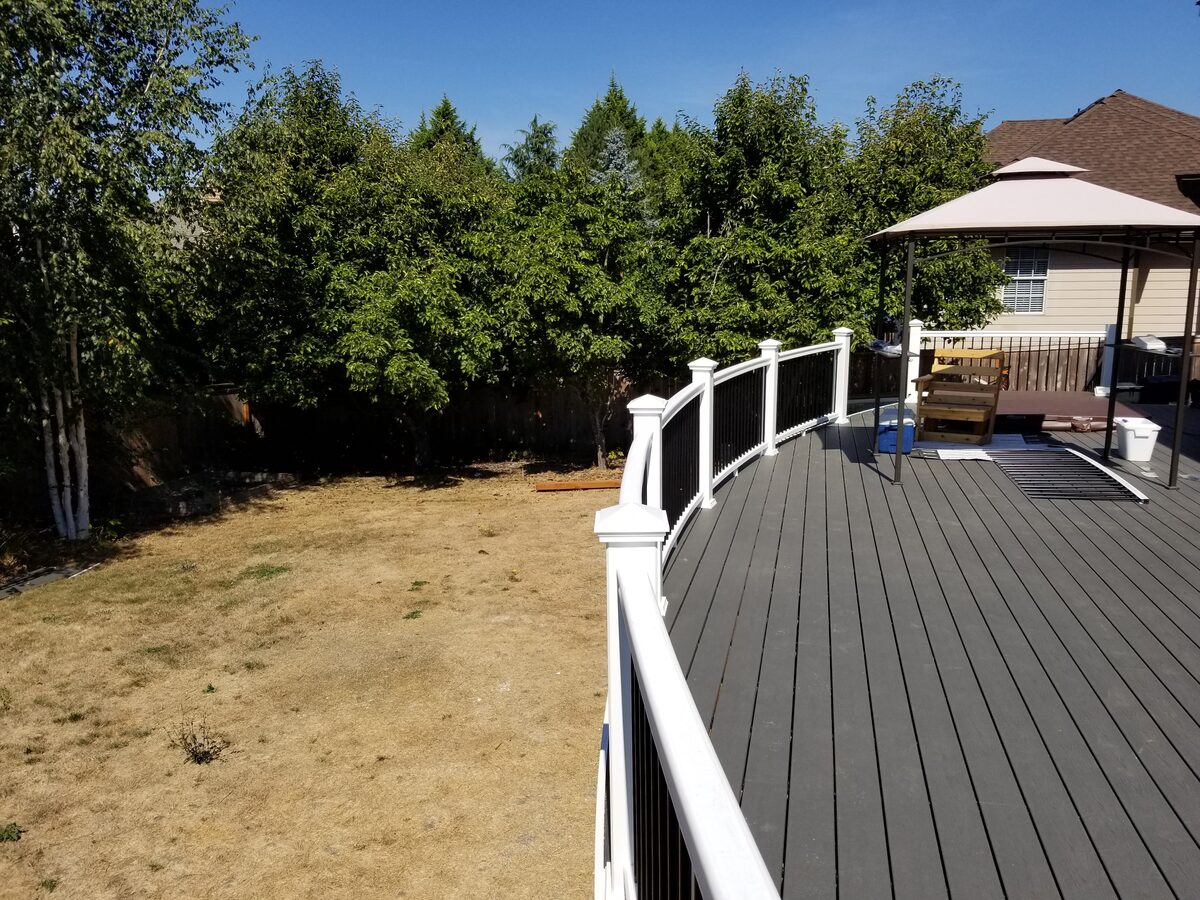
Walk through any Seattle neighborhood where composite decking was installed between 2017 and 2022, and you'll see a lot of cool gray. Trex Gravel Path, Fiberon Ipe (the grayish variant), TimberTech Antique Leather in its cooler iterations — gray became the default because it read as "modern" and photographed well. By 2026, that aesthetic has reached saturation, and homeowners are actively moving away from it.
The Shift to Warm Tones
Trex's 2026 color trend guidance reflects what we're seeing in the field: Biscayne, a warm taupe with subtle charcoal streaking, is positioned as their 2026 Color of the Year precisely because it addresses the market's fatigue with flat gray. Other warm options getting significant traction in our market include Cinnamon Cove (a mid-tone brown with rich undertones), Havana Gold (golden honey with brown streaks for a tropical hardwood look), and Hatteras (a neutral warm brown).
TimberTech and AZEK have similarly expanded their warm-tone offerings. The AZEK Harvest Collection — colors like Kona, Mocha, and Brownstone — have been steady performers in our market, particularly on craftsman-style homes in neighborhoods like Laurelhurst, Magnolia, and the Eastside's older Bellevue neighborhoods where wood-look aesthetics fit the architecture.
Why warm composites work especially well in King County: Cedar is the indigenous lumber of the Pacific Northwest. For generations, Seattle homeowners built with western red cedar because it was local, beautiful, and naturally rot-resistant. Many of the homes in our region were built with cedar siding, cedar trim, and cedar decks. When composite decking mimics warm cedar tones — which the current generation of capped composites does convincingly — it integrates naturally with those homes in a way that gray composite never did.
Key insight
Comparing the Leading Composite Collections for Warm Tones
| Brand | Warm-Tone Collection | Flagship Colors | Price Range (Installed, per sq ft) |
|---|---|---|---|
| Trex | Transcend Lineage | Biscayne, Havana Gold, Hatteras | $38–$52 |
| TimberTech | Legacy Collection | Tigerwood, Pecan, Mocha | $36–$50 |
| AZEK | Harvest Collection | Kona, Brownstone, Mocha | $40–$55 |
| Fiberon | Promenade | Ipe, Hazel, Teak | $32–$44 |
For a detailed brand-by-brand breakdown, see our guide to Trex vs. Fiberon vs. TimberTech for Seattle homeowners and our broader composite versus cedar comparison.
Note
3. Cable Railing: The View-Preservation Standard for Hillside and Waterfront Seattle
Seattle is not a flat city. The neighborhoods that hold the highest-value properties in King County — West Seattle bluffs, Magnolia, Queen Anne, Bellevue's Medina and Clyde Hill, Mercer Island's west side, Kirkland waterfront — are defined by their topography and the views that topography creates. Cable railing has become the standard specification in these markets because it solves a specific, expensive problem: standard picket or panel railings block the views that make these properties worth what they cost.
How Cable Railing Works and What It Costs
Horizontal stainless steel cable runs between vertical posts, typically with 3-inch spacing to meet code requirements for fall protection. The cable is nearly invisible from a distance, particularly when viewed from inside the home. On a hillside lot in Medina with Lake Washington views, the difference between cable railing and composite picket railing isn't aesthetic preference — it's whether you can see the water while standing on your deck or sitting in your living room looking out through the sliding door.
In King County in 2026, cable railing installed by a licensed contractor typically runs $120–$180 per linear foot. That's meaningfully more than composite railing at $60–$100 per linear foot, or even aluminum railing at $70–$110 per linear foot. But for the neighborhoods where it's in demand, the premium is consistent and defensible.
Post material choices affect both cost and look:
- Stainless steel posts: Highest durability, best resistance to corrosion (particularly important near the water), most expensive at $200–$350 per post installed.
- Powder-coated aluminum posts: Good corrosion resistance, available in custom colors including black (the dominant choice in 2026), priced at $120–$200 per post.
- Steel posts: Lower cost but requires vigilant finishing to prevent rust in Seattle's damp climate — generally not recommended for waterfront or lakefront applications.
For a full comparison of railing options including glass panels (another high-transparency option), see our guide to deck railing options for Seattle homeowners.
Where Cable Railing Makes the Most Sense (and Where It Doesn't)
Cable railing is the right choice when views are the point. If your deck overlooks a greenbelt, Lake Washington, Lake Sammamish, Puget Sound, or a hillside panorama, cable railing is often the only option that makes design sense. If your deck faces a fence or neighboring home and views aren't a factor, you can likely get the same clean modern look from glass infill panels or slim aluminum railing systems for comparable or lower cost.
Important
Installed cost per linear foot for common railing types in King County, 2026. Cable and glass command premiums in view-lot neighborhoods.
| Category | Value |
|---|---|
| Pressure-Treated Wood | $45 |
| Composite Picket | $80 |
| Aluminum | $90 |
| Cable (Aluminum Posts) | $145 |
| Cable (Stainless Posts) | $165 |
| Glass Panel | $195 |
4. Outdoor Kitchens and Built-In Grills: Year-Round Cooking for Seattle Homeowners
The outdoor kitchen trend has been building for several years nationally, but in Seattle it took longer to mature because of an obvious obstacle: the weather. In 2026, that obstacle has largely been engineered away by combining outdoor kitchens with the covered structure trend above. A built-in grill or full outdoor kitchen under a louvered pergola or solid-roof cover becomes a year-round cooking destination, not a summer-only novelty.
What Seattle Homeowners Are Actually Building
The spectrum is wide. At the entry level, we're seeing homeowners add a built-in 36" or 42" natural gas grill to their deck — plumbed to the home's gas line, set into a stone or composite countertop structure, with cabinet storage below. This kind of project typically runs $8,000–$18,000 depending on countertop material, grill brand, and structural requirements.
Mid-range outdoor kitchens add a refrigerator, prep space, a smoker or pizza oven module, and storage. These projects run $20,000–$40,000 installed, including gas plumbing and electrical for refrigeration and lighting. At the upper end — particularly in Medina, Clyde Hill, and Mercer Island — full outdoor kitchens with high-BTU commercial-style grills, beverage centers, outdoor dishwashers, and custom stone countertops easily exceed $50,000.
Tip
The Permit Reality
In Seattle (SDCI jurisdiction) and unincorporated King County, outdoor kitchens with gas plumbing and electrical require permits. A gas line extension requires a mechanical/plumbing permit. Electrical for outlets and refrigeration requires an electrical permit. The structure supporting the kitchen components is typically covered under the deck permit itself. King County Permitting has a thorough permit portal at MyBuildingPermit.com. Budget $1,500–$3,000 for permits on a mid-range outdoor kitchen project in King County.
See our complete guide to deck permits in King County for the full process.
5. Multi-Level Decks: Connecting the House to the Yard on Sloped King County Lots
King County is hill country. The flat-lot ranch house with a simple walk-out deck describes a fraction of the residential properties in this market. The much more common scenario: a home on a sloped lot where the backyard is significantly below the main living level, reached by a steep bank or an underutilized strip of grass that nobody actually uses.
Multi-level decks are the architectural solution to this problem, and they're in high demand across the Eastside and throughout Seattle's hillside neighborhoods. The concept: instead of building a single elevated platform at the main floor level (which leaves you looking down at your yard) or a ground-level patio (which disconnects from the house), you build a connected system of levels that descends with the grade.
What Multi-Level Designs Look Like in Practice
A typical multi-level deck in our market might include:
Upper level at main floor height: The primary outdoor living space, connected directly to the kitchen or living room. This level often features the outdoor kitchen, dining area, and covered section. On a hillside lot, this deck may be 10–16 feet above grade at its far edge, requiring significant structural support — helical piers are common in King County's clay-heavy soils.
Mid-level landing or platform: A transition zone, often containing stairs, built-in seating, or a dedicated spa/hot tub area. This level typically sits 4–8 feet above grade and serves as both a design feature and a practical break in the elevation change.
Lower level or ground-level area: Either a deck platform at near-grade elevation connecting to the lawn, or a paved patio that transitions from the final deck step to the landscaped yard.
This kind of project is inherently more complex — multiple ledger connections or freestanding post systems, multiple permit inspections, more linear feet of railing, and more structural engineering at the elevated portions. Budget for multi-level decks ranges from $60,000 for a straightforward two-level build to $150,000+ for a complex three-level structure with all the integrated features described in other sections of this article. See our detailed post on multi-level deck builds in Seattle for cost breakdowns by scope.
Key insight
6. Low-Voltage Integrated Lighting: Not an Afterthought Anymore
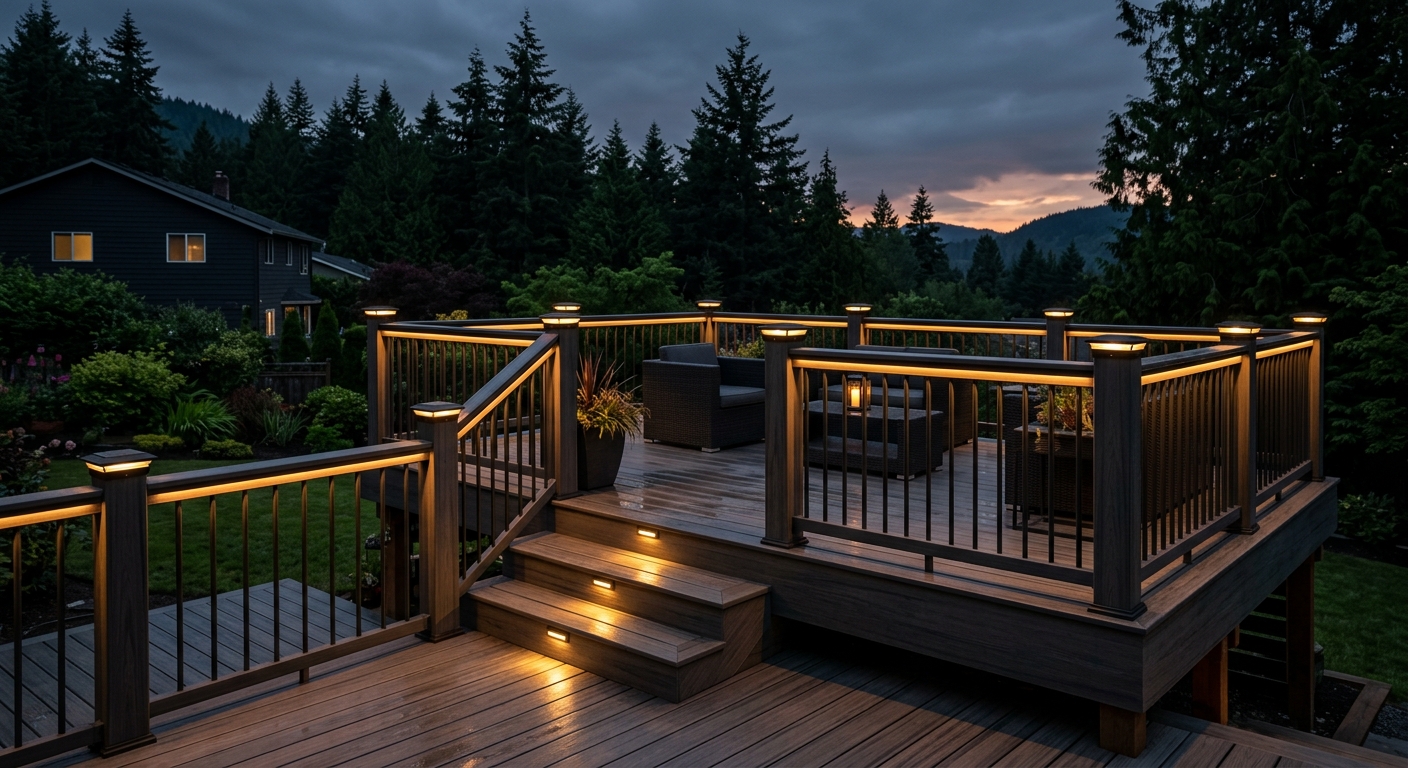
There's a before/after inflection point in the evolution of deck lighting in this market. Before: lighting was an afterthought — a string of Edison bulbs on a pergola post, maybe some solar stake lights along the path. After: lighting is designed into the deck structure from day one, with dedicated conduit runs, transformer sizing, and fixture selection made during the planning phase.
In 2026, integrated low-voltage LED lighting is present on virtually every premium deck build we undertake in King County. This isn't decorative preference — it's functional necessity given Seattle's latitude. At 47.6 degrees north, winter days are short. By October, sunset comes before 6 PM. By December, it's dark by 4:15. A deck without lighting is unusable for five months of the year.
The Three Zones of Deck Lighting
Structural lighting — built directly into the deck itself:
- Stair riser lighting: LED strips or individual fixtures recessed into each riser face. Cost: $150–$300 per stair per linear foot.
- Post cap lights: Low-profile LED fixtures mounted to railing post tops. Cost: $60–$150 per post.
- Deck rail lighting: Strip LEDs run along the underside of the top rail, providing ambient glow downward. Cost: $80–$180 per linear foot.
- Inset deck surface lights: Small puck-style LEDs flush-mounted into the decking field, especially effective near steps and transitions. Cost: $45–$95 per fixture.
Ceiling/overhead lighting under covered structures:
- Recessed LED cans in solid-roof soffits: $200–$400 each installed.
- Pendant lights for a more finished look: $300–$600 each.
- Strip LEDs along pergola beams for ambiance.
Perimeter and landscaping integration:
- Step lights along approaches and paths.
- Uplighting on key structural elements or adjacent trees.
- Smart integration with landscape lighting systems.
Note
The Smart Lighting Layer
The convergence of low-voltage LED and smart home integration is a significant 2026 trend on its own. Lutron Caseta outdoor controls, Kichler integrated smart systems, and landscape lighting brands with direct Alexa/Google/HomeKit integration allow Seattle homeowners to automate deck lighting by sunset time (which varies dramatically here across seasons), set scenes for dining versus entertaining, and control everything from a phone. The smart layer adds $500–$2,000 to a lighting project but delivers genuine daily quality-of-life improvement.
7. Gas Fire Tables and Outdoor Heating: Extending the Season Intelligently
Seattle's outdoor season without supplemental heat ends sometime in September. With the right heating infrastructure, that same deck becomes comfortable through November and usable on most clear winter days. Fire tables and integrated heating are the tools homeowners are using to reclaim those months.
Gas Fire Tables: The Dominant Outdoor Fire Feature
The wood-burning fire pit — once a staple of outdoor design — has largely given way to gas fire tables in King County, for several reasons:
- Air quality regulations. The Puget Sound Clean Air Agency enforces burn bans during poor air quality periods, which in King County can mean wood burning is prohibited on dozens of days per year, often during the shoulder-season evenings when you most want a fire.
- Convenience. Gas fire tables light with a switch, produce no smoke, require no wood storage, and extinguish instantly.
- Clean integration. A gas fire table is a piece of outdoor furniture, not an installation project. It can be moved, repositioned, or replaced without structural changes.
The dominant design in 2026 is a linear or square gas fire table with a concrete, porcelain, or aluminum tabletop surround and a lava rock or glass media fill. Priced between $800 and $4,000 for the table itself, plus $400–$1,200 to have a licensed plumber extend a natural gas line and install a quick-connect fitting. Quick-connect allows the table to be disconnected and stored during heavy rain or winter months without losing the gas line investment.
Tip
Overhead Radiant Heaters
For covered structures, ceiling-mounted radiant heaters are more efficient and effective than fire tables for pure warming. Electric infrared heaters (240V) provide instant, directional heat and are available in designs that look intentional — not like afterthoughts bolted to a pergola. Natural gas or propane overhead heaters are also available for higher BTU output on large covered areas. Budget $800–$2,500 per unit installed, with most covered deck applications requiring 2–3 units.
8. Smart Outdoor Systems: When Technology Actually Earns Its Place on a Deck
Not every "smart" feature belongs on a deck. There's a tendency in 2026 design circles to specify smart features for their novelty, which usually means homeowners pay for technology they stop using within a year. The smart outdoor systems that are earning their place in Seattle projects are the ones that solve real PNW problems.
Weather Sensors and Automated Shades
Louvered pergola systems from manufacturers like Struxure and Brustor include integrated rain sensors that automatically close the louvers when precipitation is detected. In Seattle, where a shower can arrive with little warning, this is a genuinely useful feature rather than a novelty. The same systems integrate wind sensors that protect louvers from storm damage by closing them when wind speeds exceed safe operating thresholds. These weather-responsive systems are standard in the premium louvered pergola category and add $1,500–$3,000 to the base system cost.
Automated exterior shades — motorized roller shades or retractable screens that can be programmed to drop at sunset or activated by remote — have gained significant traction on covered deck applications where privacy and glare control are needed. A quality motorized exterior shade system runs $1,200–$3,500 per shade unit installed, depending on size.
Integrated Audio
Outdoor audio has matured significantly. Flush-mounted in-ceiling or in-wall speakers under a covered structure, connected to a streaming audio system, deliver genuinely good sound in ways that wireless portable speakers can't match. Sonos outdoor speakers with weatherized enclosures, Polk Audio or Klipsch outdoor rated systems, or higher-end marine-grade audio packages from Russound are popular specifications in Eastside luxury builds. Budget $2,500–$8,000 for a properly designed outdoor audio zone with an amplifier and quality weatherized speakers.
What's Overdone vs. What Has Staying Power
Not every trend in the 2026 outdoor living market deserves a spot on your deck. A few honest observations from our project conversations:
Overdone/overhyped:
- Outdoor TVs in uncovered applications (the PNW rain makes them impractical without a cover and appropriate housing)
- Complex automated lighting scenes that require an app to operate — homeowners use them twice and then give up
- Outdoor misting systems (in a climate that already provides plenty of mist)
Has staying power:
- Covered structures (structural, not trend-dependent)
- Integrated gas for cooking and fire (infrastructure investment that pays forward)
- Cable railing on view lots (as long as views are the point of the property)
- Quality low-voltage LED lighting with simple dusk-to-dawn controls
9. Eco-Friendly and Recycled-Content Composites: When Sustainability Aligns With Performance
The eco-angle on composite decking has evolved from a marketing claim to a genuine product differentiator. The leading manufacturers now produce boards with substantial recycled content, and for King County homeowners who care about sustainability metrics, the options are legitimately good.
What "Recycled Content" Actually Means
Trex's composite decking is made from up to 95% recycled materials — primarily reclaimed wood fiber (sawdust, wood chips, and reclaimed wood) and recycled polyethylene film from grocery bags, bread bags, and shrink wrap. That's not greenwashing: Trex operates one of the largest recycled plastic film collection programs in the country. Their Transcend, Enhance, and Select lines all share this core composition with different cap material quality tiers.
Fiberon's composite decking similarly uses high recycled content — their flagship Promenade and Horizon collections include recycled wood fiber and plastics. Fiberon also maintains FSC-certified wood fiber sourcing options.
For Seattle homeowners, the practical advantages of recycled-content composites align with sustainability goals: no annual sealing, no chemical treatments, no pressure-treated lumber containing preservatives. The environmental math is more complex than a simple "recycled is better" equation — producing composite decking is energy-intensive — but over a 25–30 year lifespan versus a cedar deck that may need replacement in 15–20 years, the lifecycle picture for composites is competitive.
Note
PVC vs. Capped Composite for Environmental Considerations
PVC decking (100% plastic, no wood fiber) represents a different tradeoff. It contains no wood to absorb moisture and is extremely durable in Seattle's wet climate, particularly for rooftop decks and membrane deck applications. However, PVC production has a more significant environmental footprint than recycled-content composites. See our PVC decking service page and our guide to best decking materials for Seattle 2026 for a complete comparison.
10. Privacy Screens: Integrated Design vs. the Fence Afterthought
Privacy on decks has historically been addressed as an afterthought — a fence panel bolted to the railing post, a trellis stuck in a planter. In 2026, privacy is being designed into deck structures from the planning phase, with better aesthetic outcomes and better structural integrity.
Privacy Screen Integration Methods
Railing-height privacy panels: Horizontal slat panels in cedar, Ipe, or composite that match the deck's material palette, running along one or more sides of the railing system. These provide privacy from neighboring sightlines while maintaining some airflow. Cedar horizontal slat panels are a popular choice in craftsman-era Seattle neighborhoods. Cost: $80–$150 per linear foot for cedar; $120–$200 per linear foot for Ipe or composite.
Pergola-integrated privacy walls: When a pergola or covered structure is present, privacy can be integrated into the structural columns and beams — panels that fill between pergola posts, motorized retractable fabric panels that unroll from the beam for privacy when needed. These designs look intentional because they are intentional.
Planted privacy: Living walls and vertical gardens mounted to deck structures, growing climbing plants on trellises. Slower to establish but highly effective and visually distinctive. This requires proper irrigation planning and structural considerations for plant weight.
Frosted glass or tempered glass privacy panels: For contemporary builds, frosted tempered glass panels in metal frames provide privacy while maintaining a clean aesthetic. These are most common in contemporary designs on Eastside luxury properties.
Key insight
King County HOA Considerations
In many Eastside neighborhoods and master-planned communities, privacy screen design is subject to HOA review in addition to building permits. Our guide to HOA deck approvals in King County covers what triggers HOA review, how to prepare a design package, and how to avoid the delays that come from submitting incomplete applications.
What All Ten Trends Have in Common — and What to Build First
Looking across these ten trends, a pattern emerges: the most popular deck features in Seattle in 2026 are all responses to specific local conditions. Covered structures solve the rain problem. Cable railing solves the view problem. Multi-level decks solve the slope problem. Integrated lighting solves the short-day problem. Warm composites solve the aesthetic integration problem. These aren't national trends applied here — they're solutions that happen to be popular because the problems they solve are universal to King County homeowners.
That framing matters when you're deciding what to prioritize with a limited budget. The features with the most staying power are the ones solving real functional problems, not the ones that are simply fashionable. A louvered pergola cover with heating and lighting will deliver more daily satisfaction than a smart outdoor TV system that sits unused in February. A properly specified cable railing system on a view lot will deliver more property value than a trend-driven color choice that may look dated in five years.
Priority Framework by Budget
If you have a defined budget and want to allocate it strategically:
Under $40,000 total project: Build a quality deck platform with warm composite decking, integrated LED lighting designed in from the start, and cable railing if your lot has a view. Hold the covered structure for Phase 2.
$40,000–$80,000: Add a covered section (louvered pergola or basic pergola with polycarbonate) and at least one integrated heating unit. Include gas rough-in for future outdoor kitchen.
$80,000–$150,000: Full outdoor kitchen, multi-level design if the lot calls for it, quality louvered pergola system with weather sensor automation, complete integrated lighting design, privacy screening.
$150,000+: Everything above plus full smart integration, high-end gas fire feature, premium material upgrades throughout, possibly second-level covered structure, professional landscaping integration.
For detailed cost breakdowns at every price point, see our complete Seattle deck cost guide and deck financing options in Seattle.
Ready to Build in 2026? Talk to a King County Specialist
The trends in this article aren't abstract — they're what we're actually designing and building right now for homeowners across Bellevue, Kirkland, Mercer Island, Bothell, and throughout King County. Every project starts with an honest conversation about your property, your budget, and which features will actually improve how you use your outdoor space.
If you're ready to discuss a deck build or major renovation for your King County home, call us at (425) 675-6259 or request a consultation online. We serve homeowners throughout the greater Seattle area from our Bothell office at 22722 29th Drive SE, and we're happy to start with a site visit to understand your specific lot, views, and goals before talking about features and budget.
Whether you're drawn to a covered outdoor room with integrated kitchen, a hillside multi-level build with cable railing and Lake Washington views, or a straightforward composite deck done right — we can walk you through the real costs, the right materials, and the permit process without the guesswork.
Contact The Seattle Decking Company today to get started.
Frequently Asked Questions
What deck trends are most popular in Seattle for 2026?
How much does a covered deck or pergola cost in King County in 2026?
Is cable railing worth the extra cost in Seattle?
What composite decking colors are most popular in Seattle for 2026?
Do I need a permit for a deck with an outdoor kitchen or covered structure in King County?
What is a multi-level deck and when does it make sense in Seattle?
How can I extend deck use through Seattle's rainy season?
What is the ROI on deck improvements for King County homes?
Are there HOA restrictions on deck trends like privacy screens and cable railing in King County neighborhoods?
What's the difference between a louvered pergola and a regular pergola for Seattle use?
What deck features are overhyped versus genuinely valuable in Seattle for 2026?
How do I find a reputable deck builder for a complex 2026 Seattle project?
Planning a deck in the Seattle area?
Get an onsite design review and a clear, itemized quote from a licensed local builder.
Request a Free Quote