
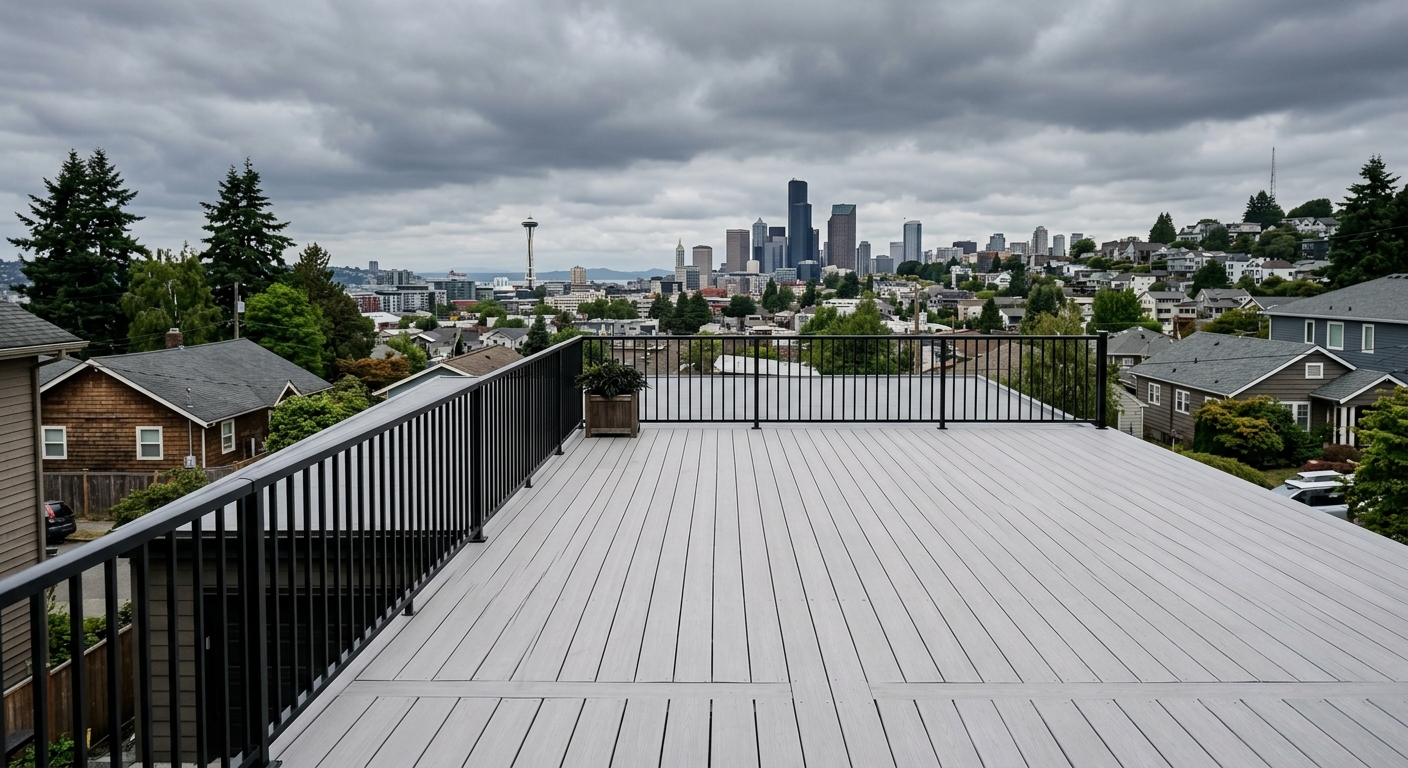
Most homeowners shopping for a new deck in Seattle spend their research time on aesthetics: which color looks good with their siding, whether to go with a wood grain or a smooth surface, how wide the boards should be. That is completely understandable. Color and style are the things you can see in showroom samples. But there is one technical specification that will determine whether your deck looks exactly the same in 2035 as it does the day it is installed — or whether you are calling a contractor to diagnose widespread mold, deep staining, and board degradation before the decade is out. That specification is whether your composite decking is capped or uncapped.
In a climate like Seattle's, where the National Weather Service records roughly 37 inches of annual rainfall spread across long gray winters and a persistent marine layer, that single spec is more consequential than brand loyalty, color preference, or even price per square foot. Water is patient. It will find every exposed surface, every open wood fiber, every unsealed cut end, and it will work its way in over months and years until the board's structural integrity is compromised from the inside. Capping changes that equation entirely — and the difference between the two product categories is not subtle once you understand how composite boards are actually manufactured.
This article is written by the builders at The Seattle Decking Company, not a marketing department. We have installed hundreds of decks across King County — in Bellevue, Kirkland, Redmond, Bothell, Shoreline, Renton, and everywhere in between — and we have also been called in to replace decks that were built using the wrong materials for this climate. What follows is everything we know about the capped vs. uncapped distinction, why it matters more in the Pacific Northwest than anywhere else in the country, and how to use that knowledge to make a smart buying decision for your specific project.
What Is Capped Composite Decking — And What Definitely Isn't
To understand why capping matters, you first need to understand what composite decking is made of at its core. Traditional composite decking — what the industry now calls "uncapped" or "first-generation" composite — is manufactured by blending wood fiber (typically sawdust, wood flour, or reclaimed wood scraps) with plastic resins (polyethylene or polypropylene) and various binding agents and colorants. The resulting material is then extruded into board profiles that approximate the dimensions of traditional lumber.
That wood-plastic composite core has real advantages over pure wood. It doesn't rot the same way solid lumber does, it doesn't splinter, it resists insect damage, and it requires significantly less maintenance than a cedar or pressure-treated pine deck. But the wood fiber content — which typically accounts for 50 to 70 percent of the board's total composition — retains one critical vulnerability: it is still hygroscopic, meaning it absorbs and releases moisture from the surrounding environment. In Seattle, that environment is wet for eight or nine months out of the year.
How Capping Changes the Equation
Capped composite decking starts with the same wood-plastic composite core, but adds a manufacturing step: the board is encased in a thin but dense layer of plastic polymer — typically a form of polyethylene, polypropylene, or PVC — on some or all of its external faces before the board exits the extrusion process. Think of it as a protective skin bonded directly to the board during manufacturing, not applied afterward as a coating.
The quality and extent of that cap varies significantly by manufacturer and product line, which is something we will get into when we discuss specific brands. Full four-sided capping — where all four faces of the board including both sides, the top surface, and the bottom surface are encased — provides maximum protection. Some products are capped on three sides (top and both edges) but leave the bottom face uncapped. That is better than no capping, but it does allow some moisture migration from the underside, which can matter in certain installation configurations.
Note
What "Uncapped" Actually Looks Like in Practice
Uncapped composite was the dominant product category from the early 1990s through the mid-2000s. Many first-generation composite decks installed during that era have since been removed and replaced — not because composite as a concept failed, but because those early uncapped products absorbed enough moisture over time to support widespread mold and mildew growth on the board surfaces and in the pores of the material. If you have ever seen a composite deck with dark streaking, fuzzy gray patches in the board grooves, or a chalky, faded appearance even after cleaning, you have likely seen uncapped composite showing its age in a wet climate.
Uncapped boards are still sold today, primarily in lower price tiers. They have improved substantially since the 1990s through better resin formulations and denser fiber-to-plastic ratios. Some uncapped products perform reasonably well in arid climates like Phoenix or Las Vegas, where ambient humidity is low and moisture exposure is minimal. But in the Pacific Northwest, we consider them the wrong tool for the job — and we will show you the data behind that position in the next section.
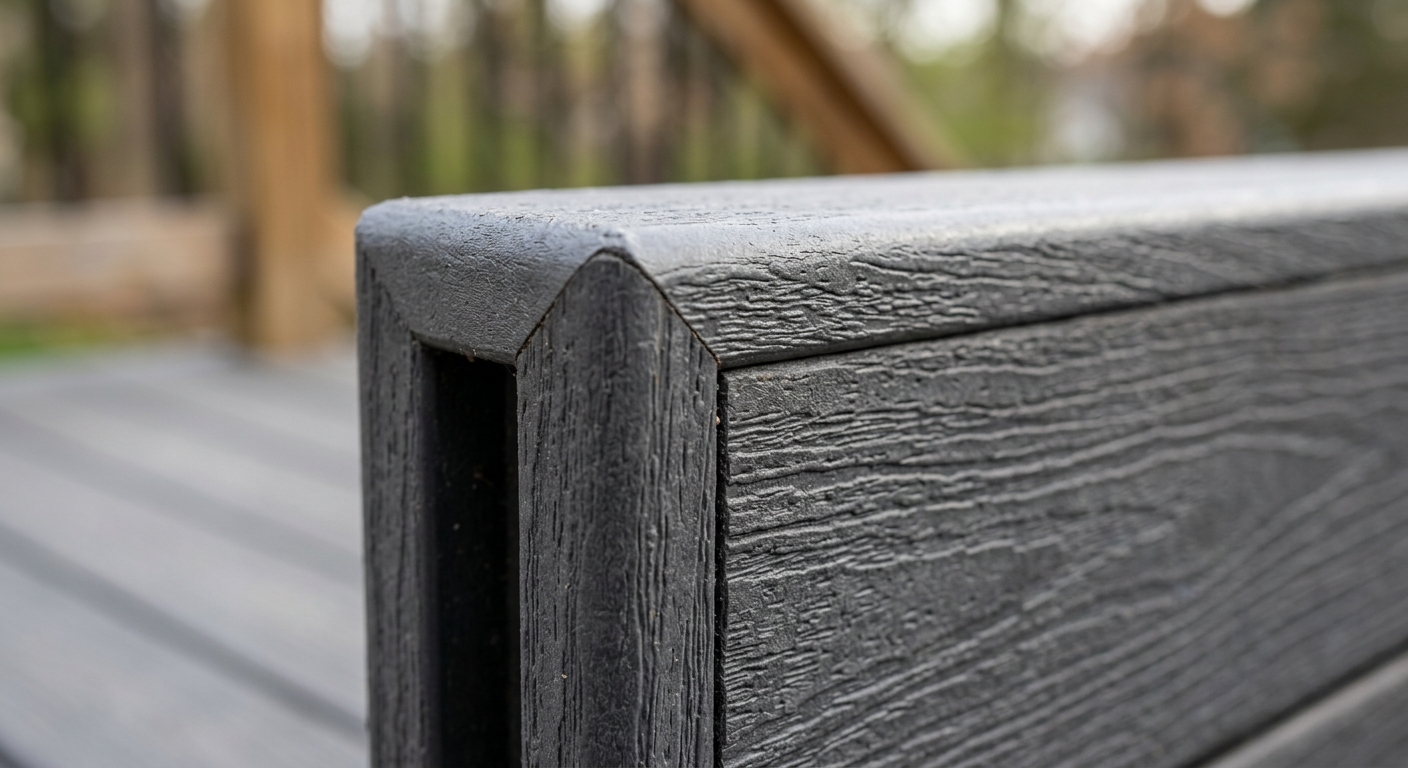
Premium capped composite boards feature a dense polymer shell that is bonded to the core during manufacturing, not applied as a topcoat.
Why Seattle's 37-Inch Rainfall Makes Capping Non-Negotiable
Let us put Seattle's rainfall in context before we go further. The city proper receives approximately 37 inches of precipitation per year — which sounds modest compared to cities like Miami (62 inches) or New Orleans (64 inches) until you factor in how that precipitation is distributed. Seattle's rain falls over a very long wet season that runs from October through May, with frequent sustained rainfall events rather than concentrated summer thunderstorms. The marine layer delivers constant ambient humidity even on days when it is not actively raining.
What this means for decking is that a Seattle deck surface is wet or near-wet for roughly 200 to 220 days per year. It does not get the long drying cycles that give wood and composite materials a chance to fully exhale and return to equilibrium moisture content. The moisture is persistent, it is pervasive, and it attacks every vulnerable surface continuously across eight months of the year.
The Moisture Absorption Cycle That Destroys Uncapped Composite
Here is the failure mechanism in plain terms. An uncapped composite board has millions of tiny pores and channels created by the wood fiber component in its core. When that board surface is wetted, moisture migrates into those pores through capillary action. When the board dries — during a sunny stretch in July, for instance — that moisture evaporates. But during the drying cycle, any dissolved organic material, airborne mold spores, or mineral deposits from the water can become embedded in the pore structure.
Over time, the board accumulates organic matter in its pores. Mold spores find that organic matter and the residual moisture and establish themselves. The result is surface mold and mildew that cannot be effectively removed with standard cleaning because the organisms are growing inside the board material, not just on the surface. In Seattle's climate, this process can begin showing visible results within three to five years on uncapped products — sometimes sooner on north-facing or heavily shaded installations where the board never gets meaningful UV exposure to help suppress surface organisms.
According to research from NewTechWood, "the plastic shell on capped composite stops water, dust and oily dirt from reaching the surface, so mould and mildew cannot stick to it." That is the essential protective function: the cap is a physical barrier that prevents moisture and organic debris from ever reaching the wood fiber core where the damage actually happens.
Important
Mold Is Not Just Cosmetic
It bears emphasizing that mold on a deck is not merely a cosmetic problem, though the appearance issues are significant on their own. Heavy mold growth on a deck surface creates a slip hazard — biofilm and mold colonies on composite can be as slippery as ice when wet. This is a liability concern for any homeowner, but particularly for families with children or elderly household members.
Beyond the slip hazard, progressive moisture damage to composite boards eventually compromises their structural properties. Boards that have cycled through thousands of wet-dry-wet sequences while absorbing organic matter begin to lose dimensional stability. They can warp, cup, or develop surface checking as the stressed fibers within the board respond to moisture gradients. At that point you are not looking at a cleaning problem — you are looking at a replacement project.
The UV Component of Seattle's Climate Challenge
Seattle's climate challenge is not purely about rainfall. The Pacific Northwest also delivers significant UV exposure during summer months — particularly in late June, July, and August — and that UV exposure, combined with the moisture cycling described above, creates a compounded stress on deck materials. UV radiation degrades the polymer resins in composite boards over time, making the material more brittle and more susceptible to cracking. It also bleaches colorants, leading to the faded, chalky appearance that homeowners often incorrectly attribute to low-quality manufacturing rather than UV degradation of the surface material.
Capped composite products typically incorporate UV inhibitors directly into the cap layer, providing continuous UV protection as long as the cap itself is intact. In contrast, UV protection in uncapped composite must be distributed throughout the entire board composition, which is a less efficient use of the UV-stabilizing additives and tends to result in faster color shift.
For more on how different materials compare in Seattle's specific climate, see our detailed guide at /blog/composite-vs-cedar-decking-seattle, which walks through the full spectrum of material options including western red cedar and tropical hardwoods alongside composite products.
Capped vs. Uncapped: Side-by-Side Performance in Pacific Northwest Conditions
Let us make the comparison concrete. The following table summarizes how capped and uncapped composite decking differ across the performance dimensions that matter most for a Seattle installation.
| Performance Category | Capped Composite | Uncapped Composite | Why It Matters in Seattle |
|---|---|---|---|
| Moisture resistance | Excellent — cap physically blocks water | Moderate — relies on resin density to slow absorption | 37 inches of annual rain, 200+ wet days per year |
| Mold and mildew resistance | Very high — no porous surface for organisms to colonize | Moderate to low — wood fiber pores harbor mold growth | North-facing, shaded Seattle installations are particularly vulnerable |
| Stain resistance | Very high — liquids bead on cap surface | Moderate — stains can absorb into wood fiber core | Cooking, tannins from leaves, iron from hardware |
| UV color retention | Excellent — UV inhibitors in cap layer | Moderate — color fade typically visible within 3-5 years | Seattle summers deliver significant UV despite cool temps |
| Scratch resistance | High — dense polymer cap surface | Moderate — softer surface more prone to surface marring | Outdoor furniture, pet claws, foot traffic |
| Heat retention | Moderate — capped composites can run warm in direct sun | Similar — both composite types absorb heat | Mitigated by lighter color selection; less issue in Seattle than in Arizona |
| Expected lifespan | 25–30+ years with proper installation | 15–25 years depending on climate and product quality | Seattle's moisture climate accelerates degradation timeline for uncapped |
| Warranty coverage | Typically 25–30+ years (some brands 50 years for PVC) | Typically 10–25 years | Warranty reflects manufacturer's own confidence in product longevity |
| Cut-end vulnerability | Present — exposed core at cuts must be sealed | Present — similar vulnerability, but entire surface also vulnerable | Every cross-cut during installation creates a moisture entry point |
| Material cost | $15–$27+ per sq ft (materials only) | $8–$15 per sq ft (materials only) | Price delta is substantially recovered through longer lifespan and lower maintenance costs |
The Cut-End Issue: A Critical Installation Detail That Applies to Both Types
One nuance that surprises many homeowners: even a fully capped composite board has a vulnerability at every cut end. When you cross-cut a board to length during installation, the cut exposes the wood-fiber composite core at the cut face. That exposed core is as vulnerable to moisture intrusion as any uncapped surface.
Quality installers address this with a cut-end sealant — typically a specialized end-grain sealer that is applied immediately after cutting and before the board is fastened into position. This is a small but important step that not all contractors take consistently. We seal every cut end on every composite installation we do, without exception. On a 400-square-foot deck with typical board layouts, there can be 60 to 100 individual cut ends that each need to be addressed.
As noted by the composite decking experts at Cladco, "capped composite is better at resisting moisture but only if the cladding is intact and cut ends have been properly sealed." This is an honest assessment of how the protection actually works in practice — it depends on both product quality and installation quality simultaneously.
Tip
How Long Does Each Type Last? Warranty and Lifespan Breakdown
Warranties on composite decking are long and often confusing, with multiple tiers covering different aspects of board performance — stain resistance, fade resistance, structural integrity, and manufacturing defects are often warranted separately, and the terms and conditions can be complex. Here is how to read what the warranties are actually telling you.
Understanding Warranty Tiers in Composite Decking
A composite decking warranty typically has several components:
Structural warranty: Covers the board against physical failure — breaking, cracking, or losing structural integrity. This is the most fundamental coverage and is the baseline that separates legitimate products from budget imports.
Fade warranty: Covers excessive color change beyond a defined threshold (usually measured in Delta E color units). This warranty is particularly relevant in Seattle because UV-driven color fade is a real issue, though it is far more severe in sunnier climates.
Stain warranty: Covers against permanent staining from common household and outdoor sources — cooking grease, leaves, iron from fasteners, and similar agents.
Workmanship addendum: Some manufacturers require certified or registered installation by a participating contractor to activate the full warranty terms.
| Brand / Product Line | Type | Structural Warranty | Fade/Stain Warranty | Notes |
|---|---|---|---|---|
| Trex Transcend | 4-sided capped | 25 years | 25 years | Most established brand in composites; strong installer network in Seattle |
| Trex Select | 3-sided capped | 25 years | 25 years | Good mid-tier option; capped on 3 sides |
| TimberTech AZEK Vintage | Full PVC (no wood fiber) | 30 years | 30 years | Zero wood fiber; maximum moisture resistance |
| TimberTech PRO | 4-sided capped | 30 years | 30 years | Excellent choice for Seattle climates |
| Fiberon Sanctuary | 4-sided capped | 25 years | 25 years | Solid mid-premium option with good PNW installer support |
| Decorators Voyage | Mineral composite (uncapped but inorganic core) | 50 years | 50 years | Unique product — no wood fiber means no organic pore structure for mold |
| Azek Vintage PVC | Full PVC | 50 years | 50 years | Top-tier moisture performance; premium price point |
| Generic/budget uncapped | Uncapped | 10–15 years | 5–10 years | Not recommended for Seattle installations |
Real-World Lifespan vs. Warranty Coverage
Warranties and real-world lifespans are not the same thing. A 25-year warranty does not automatically mean the deck looks good for 25 years — it means the manufacturer will cover defined failures up to that period, subject to conditions and exclusions.
Real-world composite decking lifespans in Seattle depend on three factors roughly equally: product quality, installation quality, and site conditions. A premium capped composite installed correctly on a well-framed structure with proper drainage can legitimately look excellent for 30 years in a Seattle climate. An uncapped composite poorly installed on a frame with inadequate drainage can show serious problems in five to eight years. Most real-world outcomes fall somewhere in the middle of those extremes.
According to research compiled by Composite Deck Direct, "uncapped boards often last 20–25 years while capped boards can go even longer, with warranties extending 25 years or more." In Seattle's specific climate, we would shade those estimates modestly downward for uncapped products installed in high-exposure or north-facing situations.
For perspective on how these lifespan projections affect total cost of ownership, our deck cost guide at /blog/deck-cost-seattle-2025 breaks down the math on upfront cost versus replacement cycle cost across different material categories.
Top Capped Composite Brands for Seattle Homeowners
Not all capped composite products are created equal, and the Pacific Northwest market has developed clear preferences based on what actually performs well in wet conditions. Here is our honest assessment of the leading products we regularly spec and install for Seattle-area homeowners.
Trex: The Established Standard
Trex is the largest composite decking manufacturer in North America and has been in the market long enough that you can find 15- and 20-year-old Trex installations to examine firsthand — a meaningful advantage when evaluating a 25-year warranty claim. Their flagship Transcend line is a fully capped product with a four-sided polymer shell, and it performs well in Pacific Northwest conditions.
Trex Transcend comes in a wide range of color families including lighter tones that reduce heat absorption — a minor but real consideration even in Seattle, where a south-facing deck on a clear August afternoon can get surprisingly warm underfoot. The board profiles are available in grooved (for hidden fasteners) and solid-edge versions, and Trex's color-matched hidden fastener system produces a very clean finished appearance.
What we appreciate about Trex from a contractor perspective is the consistency of the product and the maturity of their installation documentation. Their technical guides are thorough, their warranty administration is reasonably straightforward, and their products are stocked at enough local distributors that lead times are manageable even during the spring and summer installation rush.
Trex Transcend typically runs $30 to $45 per square foot installed in the Seattle market, placing it in the premium composite tier but not at the absolute top of the price range. For a detailed comparison of Trex against competing premium brands, see our dedicated analysis at /blog/trex-vs-fiberon-vs-timbertech-seattle.
TimberTech and AZEK: The Premium PNW Performers
TimberTech and AZEK are now under the same corporate umbrella, offering products at two distinct tiers. TimberTech PRO and AZEK Vintage are both exceptional choices for Seattle homeowners, with different compositions that address the moisture challenge in different ways.
TimberTech PRO is a capped composite — it has the wood-plastic composite core encased in a four-sided polymer shell. It comes with a 30-year warranty and performs very well in wet climates. The color selection is extensive and includes some of the most realistic wood-grain aesthetics available in composite decking, which matters to Seattle homeowners who want the look of natural cedar without the maintenance requirements.
AZEK Vintage is a different animal entirely: it is a full PVC product with no wood fiber content whatsoever. There is no wood fiber in the core to absorb moisture, harbor mold, or degrade over time. The result is arguably the most moisture-resistant deck board available today, and the 50-year warranty reflects that confidence. The trade-off is price — AZEK Vintage is a premium product with a premium price point — and some homeowners find that full PVC boards have a slightly different underfoot feel and sound compared to composite.
For Seattle installations with maximum shade, northern exposure, or locations where the deck is directly under a heavy tree canopy, we frequently recommend AZEK Vintage or comparable full-PVC products because they eliminate the organic-moisture-mold failure pathway entirely.
Fiberon: The Value-Oriented Premium
Fiberon offers strong performance at a slightly lower price point than Trex Transcend or TimberTech PRO, making their Sanctuary and Symmetry lines attractive for homeowners working with defined budgets. The Sanctuary line is a fully capped product with a 25-year warranty and performs solidly in Pacific Northwest conditions.
Where Fiberon stands out is in the breadth of their color and profile options. They offer more textured surface options than some competitors, which can be an aesthetic advantage, and their integrated railing systems have improved significantly in recent product generations.
Decorators Voyage: The Mineral Composite Option
This is a product that most homeowners have not heard of, and it deserves more attention in the Seattle market. Decorators Voyage is a mineral-based composite — instead of a wood fiber core, the board is composed primarily of mineral materials with virtually no organic content. This means there is nothing for mold or mildew to metabolize, addressing the organic-growth vulnerability at the core composition level rather than by capping it.
The practical result is a deck board with extraordinary resistance to moisture damage and a 50-year warranty in residential applications. Several Seattle-area Alki Deck Builders have specifically cited both AZEK Vintage PVC and Decorators Voyage as their top choices for wet Seattle weather conditions.
The material has a different aesthetic than wood-grain composite — it leans toward a more modern, stone-like appearance that suits contemporary architecture but may not be the right fit for every home's style.
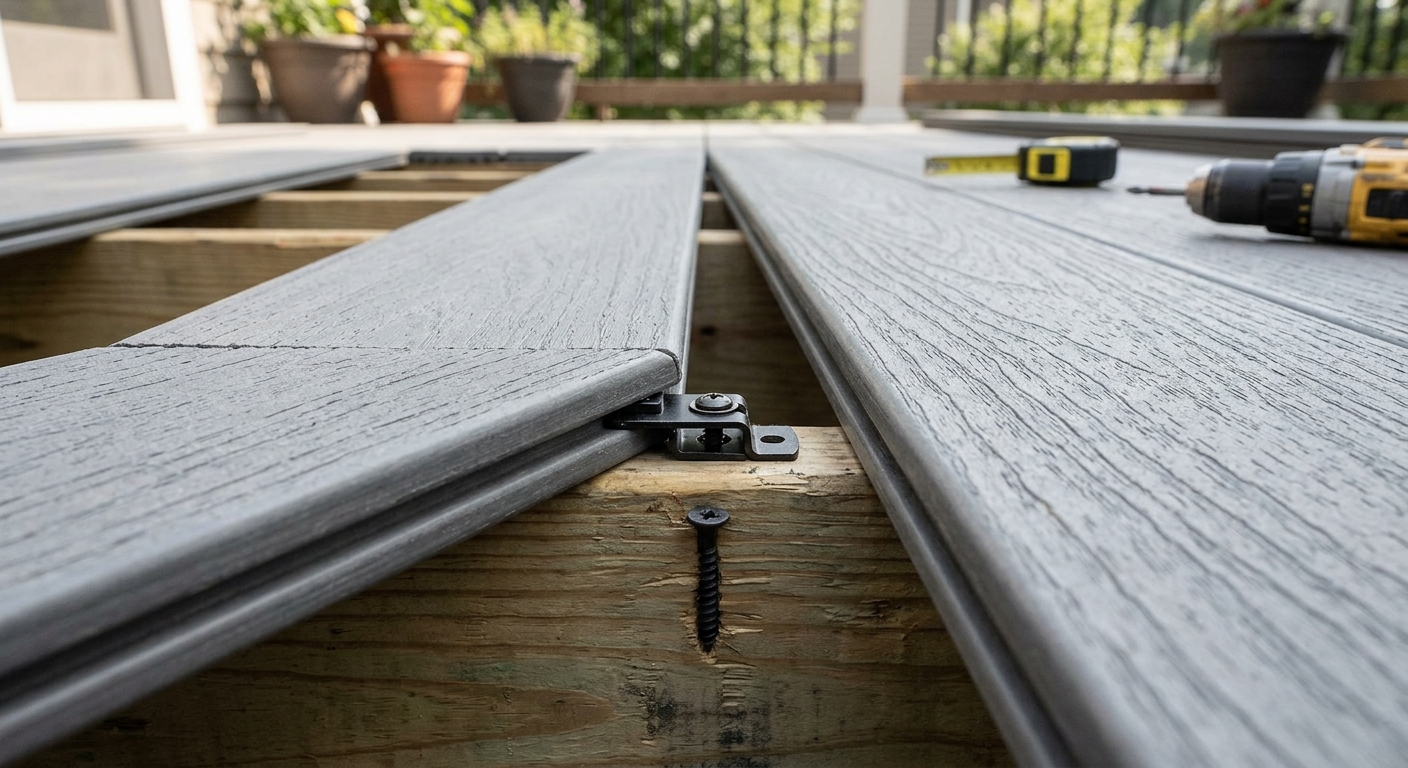
Hidden fastener systems used with grooved composite boards eliminate exposed fastener heads and reduce moisture entry points at the fastening locations.
2025–2026 Seattle Pricing: What Capped Composite Actually Costs Installed
Let us be direct about money, because this is an area where a lot of online content is either wildly out of date or not calibrated to Seattle's actual labor and materials market. Pricing here reflects what Seattle-area homeowners are actually paying in 2025 and 2026, not what composites cost in rural Idaho or suburban Georgia.
Materials Cost Breakdown
Composite decking board cost varies significantly by product tier:
- Budget uncapped composite (not recommended for Seattle): $8–$12 per square foot materials only
- Mid-range capped composite (Trex Select, Fiberon Symmetry): $15–$22 per square foot materials only
- Premium capped composite (Trex Transcend, Fiberon Sanctuary, TimberTech PRO): $22–$30 per square foot materials only
- Full PVC or mineral composite (AZEK Vintage, Decorators Voyage): $28–$40+ per square foot materials only
These are board-only costs. A complete deck project includes substantially more material beyond the decking boards themselves: the substructure framing (pressure-treated lumber or steel), concrete footings, joist hangers and hardware, hidden fasteners or screws, railing system, lighting if specified, stair materials, flashing and moisture barriers, and any required ledger bolting and waterproofing.
Total Installed Cost in Seattle
Fully installed composite deck pricing in Seattle currently falls in the $80 to $180 per square foot range all-in, according to multiple Seattle-area contractor surveys including data compiled by Olympic Decks for 2026. That wide range reflects the enormous variation in deck complexity — a simple ground-level platform deck off a sliding door is very different from an elevated multi-level deck with integrated stairs, cable railing, built-in seating, and lighting.
Prices reflect typical all-in installed costs in King County. Elevated, complex, or permited projects trend toward upper range. Source: Seattle-area contractor data 2025–2026.
| Category | Value |
|---|---|
| Basic ground-level (200 sq ft) | $18,000 |
| Standard platform deck (400 sq ft) | $36,000 |
| Mid-complexity with stairs (400 sq ft) | $48,000 |
| Elevated deck with cable railing (400 sq ft) | $60,000 |
| Premium multi-level (600 sq ft) | $95,000 |
For most Seattle homeowners, a standard 400-square-foot composite deck with a mid-premium capped composite product, standard railing, and a simple stair runs between $32,000 and $55,000 fully installed including permit costs. The Redrra cost guide puts composite projects in the 300 to 500 square foot range between $28,000 and $65,000 installed, which aligns with our own project history.
The True Cost of Choosing Uncapped: A Long-Term Math Exercise
Here is the calculation that changes the conversation when homeowners balk at the premium for capped composite. Suppose you install an uncapped composite deck for $22,000 (a lower-cost installation using budget materials and competitive labor pricing). In Seattle's climate, that deck begins showing mold and color degradation within five to eight years, requires aggressive annual cleaning to maintain appearance, and needs full replacement at year 15 to 20.
A capped composite installation at $38,000 on the same footprint, installed correctly, looks excellent at year 15 and continues performing well at year 25 or beyond. The annual maintenance cost difference — premium capped composite requires little more than a periodic wash with a garden hose — further compounds the cost-of-ownership advantage.
The National Association of Realtors remodeling impact report consistently shows that high-quality deck additions recover a strong percentage of their cost at resale. That recovery is conditional on the deck being in good condition at time of sale. A 12-year-old uncapped composite deck showing mold and fading is a negotiating liability, not an asset.
For a full cost analysis including material comparison and ROI projections, see our detailed breakdown at /deck-cost-seattle.
Key insight
Installation Details That Affect Performance: Joist Spacing, Cut-End Sealing, Flashing, and Ledger Waterproofing
Even the highest-quality capped composite board will underperform if the installation underneath it is flawed. The substructure — the framing that supports the deck boards — and the way the deck is connected to your house are as important as the board choice itself. Here is what every Seattle homeowner should understand about the installation details that separate a deck that performs for 30 years from one that develops problems in five.
Joist Spacing: 16 Inches Is Non-Negotiable for Most Products
Standard residential framing often uses 24-inch joist spacing, and many older Seattle homes have decks that were framed at 24-inch centers. Most premium composite decking products, however, require 16-inch joist spacing for proper support — particularly when the boards are run at an angle (diagonal installation) or when boards are relatively wide (5.5 inches or greater face width).
As noted in the Corvus Construction Pacific Northwest deck guide, "many composite products require joists spaced no more than 16 inches apart; 24-inch spacing may require additional joists." In practice, this means that if you are replacing an existing wood deck on an existing frame that was built at 24-inch spacing, you may need to sister additional joists into the existing frame before installing composite boards — adding cost that is not always captured in initial budget estimates.
This is a detail worth asking about specifically when getting bids. A contractor who does not measure your existing joist spacing before quoting a replacement project is not doing proper due diligence.
Ledger Connection and Waterproofing
Where the deck attaches to your house — the ledger board connection — is both the structurally most critical point and the most common source of long-term water intrusion damage in Seattle installations. When a deck ledger is improperly flashed or waterproofed, water migrates behind the ledger into the wall assembly of your home, leading to rot in the band joist, wall sheathing, and potentially the structural framing behind.
Seattle-specific framing conditions complicate this further. Many Seattle homes built in the 1980s and 1990s have EIFS (synthetic stucco) or hardboard siding that is particularly vulnerable to water intrusion at penetrations. Proper ledger installation in these situations requires removing the siding in the ledger zone, installing continuous flashing that directs water away from the wall assembly, and in some cases applying self-adhered waterproofing membrane to the exposed sheathing before the ledger is attached.
The Seattle Department of Construction and Inspections and King County building permits division both have specific requirements for ledger attachment and flashing, and inspectors in both jurisdictions look carefully at this connection during framing inspection. Our detailed guide at /blog/deck-permit-king-county-guide walks through the full inspection process for King County projects.
Drainage and Air Circulation Below the Deck
Water management below the deck surface is another installation detail with long-term consequences. Composite decking boards need airflow beneath them to manage any moisture that does get through. Decks installed at very low clearance to grade — less than 6 to 8 inches of clearance between the framing and the soil — can develop moisture problems in the substructure even when the deck boards themselves are premium capped composite.
In Seattle, we also recommend against installing composite decking in direct contact with organic material — mulch, leaves, soil — because that contact traps moisture against the board ends and fastening points. This applies especially to decks that are at or near grade level, where the accumulation of leaves and debris against the deck's perimeter can create persistent wet spots.
Fastener Selection and Corrosion Resistance
In Seattle's wet climate, all fasteners used in deck construction — including joist hanger nails, ledger bolts, post base hardware, and decking screws — need to be rated for exterior and coastal conditions. Standard galvanized hardware is minimum; hot-dipped galvanized or stainless steel is better, and stainless steel is the right choice for any installation within a few miles of Puget Sound where salt air is a factor.
For composite decking specifically, most quality products require or strongly recommend using the manufacturer's specified hidden fastener system rather than face-screwed installation. Hidden fasteners serve two purposes: they produce a cleaner finished appearance without visible screw heads, and they eliminate the small surface penetrations that face screws create — each of which is a potential moisture entry point in a high-rainfall climate.
For more specifics on how railing connections are handled at the rim joist and posts, see our guide at /blog/deck-railing-options-seattle, which covers both aesthetic choices and structural requirements for railing in Seattle.
Permit Requirements for Composite Decks in Seattle and King County
No treatment of Seattle deck installation is complete without addressing permits, because this is an area where homeowners regularly get surprised — either by the cost and time involved, or by the consequences of skipping the process.
When a Permit Is Required
In Seattle proper, permits are required for decks that are more than 18 inches above grade, attached to the structure, or larger than 200 square feet. In King County (for unincorporated areas), the permit threshold is broadly similar but with some variation by jurisdiction. Kirkland, Bellevue, Redmond, Bothell, and Renton each administer their own permit departments with their own specific thresholds and requirements.
The Seattle SDCI decks page is the authoritative resource for Seattle projects, and King County's building permits page covers unincorporated county and links to incorporated city permit departments.
What Permitting Involves
For a typical 400-square-foot composite deck on a single-family home, permitting in King County typically involves:
- Submission of a site plan showing deck location relative to property lines and structures
- Structural drawings showing framing layout, post sizing, beam sizing, and ledger connection
- Engineer stamp or prescriptive compliance with the IRC deck construction tables (which King County follows)
- Plan review period: typically 2 to 6 weeks for residential over-the-counter or express review
- Framing inspection during construction
- Final inspection after completion
Permit fees for a standard residential deck in Seattle or King County jurisdictions typically run $500 to $1,500 depending on project valuation, jurisdiction, and whether expedited review is requested.
Why Permits Are Not Optional
Beyond code compliance, there are practical reasons to pull permits that affect you as a homeowner. An unpermitted deck can create complications when you sell your home — buyers' lenders sometimes require that unpermitted structures be either permitted retroactively (expensive and uncertain) or removed before closing. Unpermitted decks also complicate homeowner's insurance claims if a structural failure occurs.
The NADRA (North American Deck and Railing Association) estimates that a meaningful percentage of deck structural failures involve improperly built or uninspected structures. Permit inspections are not a bureaucratic inconvenience — they are a second set of eyes on the structural connections that keep your deck from collapsing under load.
All work performed by The Seattle Decking Company is permitted through the appropriate jurisdiction. We handle permit acquisition, plan preparation, and inspection scheduling as part of our standard project management process.
Is Uncapped Composite Ever Worth It in Seattle? (Honest Assessment)
We have made a strong case for capped composite throughout this article, and we stand by it as the right default recommendation for the Pacific Northwest. But to give you a genuinely useful perspective rather than a sales pitch, let us address the situations where uncapped composite might be a defensible choice — and where the decision is clearly wrong.
When Uncapped Composite Might Be Acceptable
Budget-constrained replacement where timeline is understood: If you are a homeowner who understands the 15- to 20-year lifespan in Seattle's climate, needs a deck now, and is working with a strict budget, a high-quality uncapped product is substantially better than pressure-treated pine with no finish maintenance plan. Going in with clear eyes about what you are buying — a 15-year deck, not a 25-year deck — is a legitimate position.
Fully covered deck structures: A composite deck installed under a full roof cover — not a pergola, but a solid roof that completely intercepts rainfall — has dramatically reduced moisture exposure regardless of cap type. In this application, the performance delta between capped and uncapped narrows significantly.
South-facing, full-sun installations: The sun-exposure variable matters for the organic-growth mechanism. A south-facing deck in full sun has more UV exposure that suppresses biological growth and dries faster between rain events. The mold vulnerability of uncapped composite is most acute on north-facing, shaded, or sheltered installations.
When Uncapped Composite Is the Wrong Choice in Seattle
North-facing decks: More shade, less sun, slower drying. This is exactly the environment where uncapped composite's porous surface is most vulnerable to mold colonization.
Under-tree installations: Organic debris — leaves, moss, seeds, bark — accumulates on deck surfaces and in the grooves between boards. On uncapped composite, this debris provides both the organic material and the moisture retention that mold needs. On a capped composite, the debris can be cleaned off the surface without penetrating the board.
High-humidity or creek-adjacent sites: Seattle has many homes on slopes near streams or in gullies where ambient humidity is consistently elevated. These sites push uncapped composite toward the shorter end of its lifespan range.
Any installation intended to last 20+ years without replacement: If your goal is a deck that looks good and performs well for the long haul without a mid-life replacement, uncapped composite is simply not the right product for Seattle's climate. The math on total cost of ownership does not support it.
For a broader discussion of material options including western red cedar — which has its own distinct advantages and maintenance requirements in the Pacific Northwest — see our comparison at /blog/composite-vs-cedar-decking-seattle and our cedar-specific guides at /blog/cedar-deck-sealing-seattle.
Color, Aesthetics, and the Heat Issue: Getting the Details Right
We have focused heavily on moisture performance, but a few additional specification details are worth addressing because they affect your long-term satisfaction with the installation even if the boards themselves perform flawlessly.
Color Selection and Thermal Performance
Composite decking absorbs solar radiation and converts it to heat. Darker colors — charcoal, dark gray, dark brown — absorb more radiation and can reach surface temperatures that are uncomfortable underfoot on warm, sunny days. In Seattle this is a less acute issue than in Phoenix, but it is not irrelevant: a south-facing deck in direct afternoon sun in August can get warm enough in dark composite to be noticeable.
TimberTech and several other brands now offer "capped polymer" board formulations with enhanced heat dissipation or lighter color families that reflect more radiation. If you are planning a south or west-facing deck in a neighborhood that gets consistent summer afternoon sun — parts of Bellevue, the Eastside slopes, or exposed hillside lots in Seattle's West Seattle or Queen Anne neighborhoods — we recommend considering the lighter color families regardless of which brand you choose.
Groove Profile: Aesthetic Choice With Maintenance Implications
Most capped composite products are available in both solid-edge and grooved profiles. The grooved version accepts hidden fasteners for a screw-free surface appearance. The trade-off: the grooves between boards can collect debris, and in the Pacific Northwest, that debris tends to be wet organic material. Both capped and uncapped boards accumulate debris in the grooves, but the easier-cleaning surface of capped boards makes groove cleaning faster and more effective.
For a very clean, minimal aesthetic, some Seattle homeowners are moving to solid-edge boards with face screws — accepting the visible fastener for the cleaner board profile and easier groove management. Both approaches are defensible; the right choice depends on your maintenance preferences and aesthetic priorities.
Railing Integration
Your railing selection will interact with your decking choice in practical and aesthetic ways. Cable railing — one of the most popular choices in Seattle's contemporary architectural market — requires posts that penetrate the deck surface and anchor into the framing below. Those post penetrations are moisture entry points that need to be detailed carefully regardless of deck board type. Composite post sleeves can conceal the structural post while providing a weatherproof finish at the deck surface.
For more on railing options and how they interact with composite decking, see our dedicated guides at /blog/deck-railing-options-seattle and /blog/cable-railing-seattle.
Composite Deck Maintenance: What Capped Actually Means for Your Annual To-Do List
One of the most compelling practical arguments for capped composite in Seattle is the maintenance reality. Here is what deck maintenance actually looks like over a ten-year period for the three main material categories.
Capped Composite Maintenance Reality
Premium capped composite decks require very little ongoing maintenance. Annual tasks typically include:
- Spring wash-down: A garden hose or low-pressure washer with a mild soap solution removes winter accumulation, pollen, and any organic debris from the board surfaces and grooves.
- Periodic groove cleaning: A stiff brush and water dislodge compacted debris from between boards. This is a 1 to 2 hour job on a typical 400-square-foot deck.
- Fastener and railing hardware inspection: Once a year, a visual check of post bases, railing connection points, and any exposed fasteners for corrosion or loosening.
That is essentially it. No staining, no sealing, no sanding, no bleach treatments for mold. This is the maintenance profile that most homeowners who switch from cedar to composite are amazed by.
Uncapped Composite Maintenance in Seattle
Uncapped composite requires more involved maintenance, particularly in Seattle's climate:
- Annual mold treatment: Products containing sodium percarbonate or quaternary ammonium compounds are effective against composite mold but require careful application and rinsing. This is an annual or biannual task for most Seattle uncapped installations.
- Stain treatment: Any oil or tannin stains need to be addressed promptly before they penetrate deeper into the board surface. Immediate blotting and cleaning is essential.
- Quarterly groove cleaning: Debris in grooves promotes mold growth on uncapped surfaces and should be addressed more frequently than on capped boards.
For more detail on maintaining composite decks through Seattle's seasons, see our guide at /blog/composite-deck-maintenance-seattle.
The Right Questions to Ask Any Seattle Deck Contractor
We close with a practical consumer guide: the questions that separate informed homeowners from those who get sold the wrong product for their situation. When you are meeting with deck contractors — including us — these are the questions that surface the information you actually need.
"Is this board capped on all four sides or three?" Not all products marketed as capped are four-sided. Three-sided is better than uncapped but not the gold standard for Seattle.
"What joist spacing does this product require, and does my existing frame meet that spec?" This question will reveal whether your existing frame needs modification — a cost item that should be in the bid, not a surprise during construction.
"What is your protocol for sealing cut ends?" A quality contractor seals every cut end. If they don't have a protocol, ask what they use and how they ensure it is done consistently.
"How do you handle the ledger connection and flashing?" The answer should involve specific reference to the flashing method, moisture barrier, and how they ensure the connection does not create a water intrusion pathway.
"Is this project going to be permitted?" The answer should be yes for any attached deck over 18 inches off grade in Seattle or King County. If a contractor suggests skipping the permit to save money, that is a red flag.
"What warranty is available, and what does it actually cover?" Ask them to show you the warranty document and walk you through the stain, fade, and structural coverage terms separately.
Working With The Seattle Decking Company
If you have read this far, you understand that composite decking in Seattle is not a commodity purchase. The specification decisions — capped vs. uncapped, joist spacing, cut-end sealing, ledger waterproofing, fastener selection — are not aesthetic preferences. They are performance-determining technical choices that will determine whether your investment holds its value for three decades or turns into a replacement project in a decade.
At The Seattle Decking Company, we build decks for the Pacific Northwest climate specifically. We spec capped composite products for virtually every Seattle and King County installation we do. We pull permits. We seal cut ends. We detail ledger connections the way they should be detailed. We have been doing this work in King County long enough to know what fails and what doesn't, and we build accordingly.
We serve homeowners throughout King County — Bothell, Bellevue, Kirkland, Redmond, Shoreline, Renton, Mercer Island, Sammamish, Issaquah, and the city of Seattle itself. Whether you are planning a simple 200-square-foot platform deck or a complex multi-level installation with integrated cable railing and lighting, we can walk you through the specification decisions and give you an honest assessment of what your project should cost and how long it should last.
Give us a call at (425) 675-6259 or visit us at theseattledeckingcompany.com/contact to schedule a free consultation. We are located at 22722 29th Drive SE, Bothell, WA 98021. We are happy to come to your property, evaluate your site conditions, and give you a straight-talking recommendation based on what will actually perform best at your specific location — not what has the best margin for us.
Frequently Asked Questions
What is the difference between capped and uncapped composite decking?
Is uncapped composite decking worth considering in Seattle?
How much does capped composite decking cost installed in Seattle in 2025–2026?
Which composite decking brands are best for Seattle's rainy climate?
Do composite decks require permits in Seattle and King County?
What joist spacing is required for composite decking installation?
Why do cut ends of capped composite boards need to be sealed?
How do I maintain a capped composite deck in Seattle's wet climate?
Does the cap on composite decking ever wear off or fail?
Can composite decking get hot enough to be uncomfortable in Seattle summers?
How does composite decking compare to cedar for Seattle homes?
What should I ask a deck contractor before signing a contract for a composite deck in Seattle?
Planning a deck in the Seattle area?
Get an onsite design review and a clear, itemized quote from a licensed local builder.
Request a Free Quote