
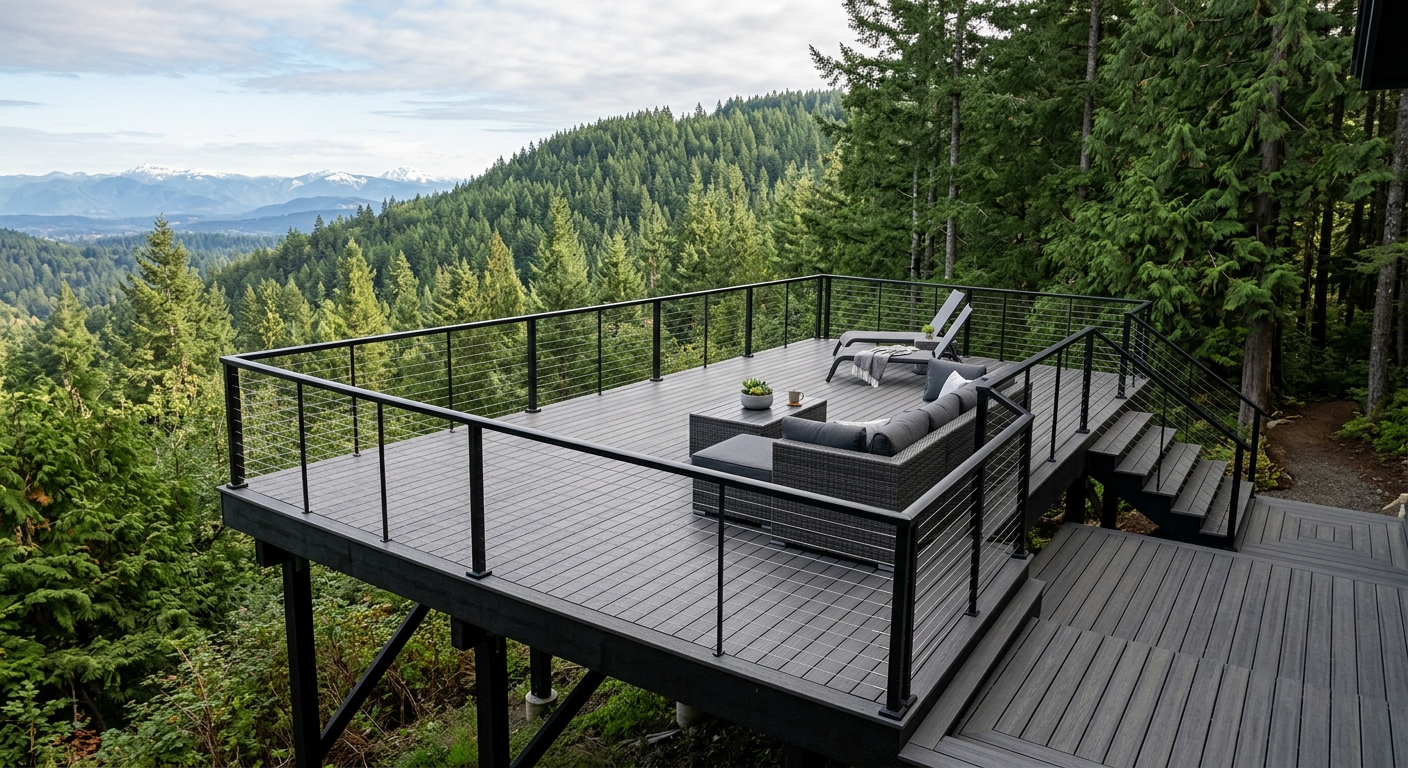
If you've owned a composite deck in Seattle for more than one full year, you already know that the sales pitch — "virtually maintenance free!" — was not the complete story. Composite decking is genuinely lower-maintenance than cedar or pressure-treated wood, and that distinction matters enormously in a climate that delivers rain from October through June without apology. But "lower maintenance" and "no maintenance" are two very different things, especially when your deck sits under a Douglas fir canopy in Maple Leaf, faces a west-northwest exposure in West Seattle, or catches morning fog off Lake Washington every single day from November through March.
Seattle receives more than 37 inches of rain annually, and the city logs upward of 150 cloudy days per year. More importantly for deck owners, the rain doesn't come in dramatic storms that wash surfaces clean — it comes in persistent, low-volume drizzle that keeps surfaces wet for days at a stretch. That slow, continuous dampness, combined with the organic debris shed by the region's dense evergreen canopy, creates ideal conditions for mold, algae, moss, and tannin staining on any horizontal outdoor surface. Composite decking resists these biological agents better than wood, but it does not repel them entirely. Understanding exactly what your composite deck can and cannot withstand — and building a cleaning routine calibrated to Seattle's specific conditions rather than the national averages printed in manufacturer manuals — is what separates a deck that looks good at year fifteen from one that looks green and dingy at year four.
This guide was written by builders who work in King County every week, not by a marketing team writing for a generic national audience. We've built composite decks in Bellevue, Kirkland, Shoreline, Kenmore, and Bothell. We've watched what happens when homeowners skip the fall cleanup after the maples drop. We've seen the mold colonies that grow under deck furniture left in place all winter. And we've cleaned enough composite decking to know which methods work, which ones damage the boards, and which manufacturer warnings are absolutely not optional.
Why Seattle's Climate Is Uniquely Hard on Composite Decks
Most composite decking manufacturers develop their maintenance guidelines for a broad national audience. That audience includes homeowners in Phoenix, Atlanta, Denver, and Minneapolis — climates with either dry summers, seasonal freezes that kill biological growth, or both. Seattle fits none of those patterns. Our maritime climate produces a nearly unbroken stretch of wet, overcast conditions from fall through late spring, followed by a relatively dry summer that's genuinely beautiful but also the only practical window for thorough deck maintenance.
The Rain Window Problem
To understand why Seattle is harder on composite decks than most other major US cities, consider the exposure calendar. In a typical Seattle year, meaningful rainfall occurs in every month from October through June — that's nine consecutive months during which your deck surface is being wetted, dried slightly, and wetted again in cycles that never fully dry out. The summer months of July, August, and the first half of September offer the dry conditions needed for deep cleaning and inspection, but that window is only about 60–75 days in a good year. Miss it, and you're looking at another nine months before conditions are right again.
This is not a hypothetical concern. According to weather data for the Seattle area, October through March regularly delivers 3–6 inches of rain per month. Even April and May, which feel like "spring" to residents, average 2–3 inches of rainfall. The consequence for composite decks is that the surface rarely dries completely for extended periods during the cool months, which is precisely the condition that allows mold and algae spores — always present in the air — to establish colonies on the deck surface.
The Organic Debris Factor
Seattle's neighborhoods are heavily wooded with both deciduous trees and evergreens. Neighborhoods like Maple Leaf, Lake Forest Park, Wedgwood, and the residential areas east of Bothell near Woodinville are particularly dense with canopy cover. According to research from deck builders familiar with PNW conditions, dense evergreen tree coverage keeps decks shaded and damp, requiring more frequent cleaning attention. The practical result is that composite decks in these neighborhoods may need cleaning two to three times per year rather than the once-a-year schedule that works in drier climates.
Deciduous trees compound the problem seasonally. Big-leaf maple, red alder, ornamental cherry, and sweetgum all shed large volumes of wet leaves in October and November. Those leaves, sitting on a composite deck surface in 50-degree, damp conditions, do two things: they trap moisture against the deck boards, creating a continuously wet microenvironment, and they leach tannins — organic compounds — that stain composite surfaces over time. The staining from tannins is not permanent if addressed promptly, but it becomes progressively harder to remove the longer leaves sit on the surface.
What the Marine Layer Does That Rain Doesn't
Beyond the rainfall totals, Seattle's marine layer deserves specific attention. On mornings from September through May, a thick layer of low cloud and fog regularly deposits moisture directly onto deck surfaces even when it isn't technically raining. This means that even on days your weather app shows "partly cloudy," your deck may be starting the day wet from condensation. Combined with afternoon temperatures that rarely get warm enough to fully evaporate surface moisture during the rainy season, the net result is a deck surface that can stay continuously damp for weeks at a stretch.
Note
For homeowners considering a new composite deck build in the Seattle area, these climate factors should directly influence your material choices. We cover this in depth on our composite vs. cedar decking comparison page, but the short version is that capped composite products are significantly better suited to Seattle's persistent dampness than either uncapped composite or cedar — for reasons we'll explain in the next section.
Capped vs. Uncapped Composite: Which Holds Up Better in the PNW
Understanding the distinction between capped and uncapped composite decking is not an academic exercise for Seattle homeowners — it has direct, practical consequences for your maintenance workload and the long-term appearance of your deck.
What Capping Actually Does
Composite decking is manufactured from a blend of wood fiber and recycled plastic. In uncapped composite products, the outer surface of the board is this raw blend — porous enough that water can penetrate the outer layer and reach the wood fiber inside. In Seattle's climate, this matters enormously, because moisture that reaches wood fiber creates conditions for biological growth that goes beyond the surface. Uncapped composite boards can develop mold that grows into the board structure, becomes progressively harder to remove, and can eventually compromise the structural integrity of the board itself.
Capped composite products — which include the major premium lines from Trex, Fiberon, AZEK, and TimberTech — wrap the wood-plastic composite core in an outer shell of solid polymer. This cap is effectively waterproof. Mold, algae, and moss that grow on a capped composite deck are growing on the outer surface of the cap, not penetrating the board itself. As Olympic Decks notes from their Seattle experience, mold on capped composite sits on the surface and does not penetrate the material — meaning it can be scrubbed off without structural consequence, as long as it's addressed before the colony becomes too established.
The Performance Gap in Seattle Conditions
The performance difference between capped and uncapped composite is larger in Seattle than in most other US climates, specifically because of the prolonged wet season. In a climate with dry summers and cold winters, even uncapped composite gets regular drying cycles that limit moisture penetration. In Seattle, those drying cycles are minimal from October through June. An uncapped composite deck in a shaded Shoreline backyard can remain damp for weeks at a time during the rainy season, accelerating the degradation of the outer surface.
| Feature | Capped Composite | Uncapped Composite |
|---|---|---|
| Water penetration | Polymer cap blocks moisture from core | Wood fiber core can absorb moisture |
| Mold location | Surface only — scrubs off | Can penetrate into board structure |
| Stain resistance | High — cap resists tannins and grease | Lower — stains penetrate more easily |
| Cleaning effort (PNW) | Annual or biannual | May need 3x/year or more |
| Long-term appearance | Retains color well | Fading and graying more common |
| Structural risk from moisture | Minimal | Higher in wet climates |
| Typical Seattle price range | $22–$45/sq ft installed | $14–$22/sq ft installed |
| Warranty period | 25–50 years | 15–25 years |
Key insight
For a more detailed breakdown of how Trex, Fiberon, and TimberTech specifically perform in PNW conditions, see our Trex vs. Fiberon vs. TimberTech Seattle comparison. We get specific about which product lines hold their color best under Seattle's UV-low, high-moisture conditions.
PVC Decking: The Maximum-Protection Option
For homeowners in the dampest microclimates — shaded north-facing decks in neighborhoods like Kenmore, or decks directly adjacent to Lake Washington where morning fog is intense — 100% PVC decking deserves consideration alongside capped composite. Unlike composite products that contain any wood fiber at all, PVC decking is entirely synthetic. There is literally no organic material in the board for mold to feed on as a nutrient source. PVC boards can still develop surface algae (which feeds on airborne organic particles, not the board itself), but the overall maintenance burden in extremely wet conditions is typically lower than even premium capped composite.
AZEK's Vintage and Harvest collections are the most commonly specified PVC products we install. They carry a 50-year warranty and are among the most resistant to the specific conditions Seattle decks face. The tradeoff is cost — PVC decking runs at the high end of the $35–$45 per square foot installed range in our market — and feel underfoot, which is slightly different from composite products that contain wood fiber. We discuss this more on our best decking materials Seattle 2026 page.
The Seattle Composite Deck Cleaning Calendar
One of the most common mistakes we see Seattle composite deck owners make is treating maintenance as a once-a-year event — typically a spring cleaning when the sun finally comes out. For most of the country, once a year is adequate. For Seattle, it's not. The nine-month wet season creates conditions that benefit from seasonal attention, and the specific timing of Seattle's biological growth cycles means that certain maintenance tasks need to happen in fall, not just spring.
Here is the maintenance calendar we recommend for composite deck owners in King County:
October–November: The Critical Fall Window
This is arguably the most important maintenance period for Seattle composite deck owners, and it's the one most often skipped. As deciduous trees begin dropping leaves in early October, your maintenance priority shifts to debris removal. The goal is to prevent leaves from sitting on the deck surface long enough to cause tannin staining or create a mold-feeding substrate.
What to do:
- Sweep or blow leaves off the deck after every significant leaf drop event — aim for within 48 hours.
- Clear debris from between deck boards, where it collects water and accelerates biological growth at the fastener points.
- Remove all deck furniture and potted plants by late October if possible; these create shaded, wet microenvironments underneath them.
- Do a visual inspection of all board surfaces and note any mold colonies that have begun establishing — October is still warm enough to treat these effectively before they become winter-established.
- Perform a light cleaning wash (garden hose and soft brush) to remove the organic film that builds up on the surface during the summer months of use.
What not to do:
- Do not attempt a full deep-clean in late November or December when overnight temperatures drop near freezing. Cleaning solutions need reasonable temperatures to work effectively.
- Do not leave teak oil, deck sealant, or any penetrating finish on a composite deck — these products are designed for wood and can actually trap moisture and promote mold on composite surfaces.
December–February: Minimal Intervention Period
During Seattle's wettest months, your composite deck maintenance is primarily about monitoring rather than active cleaning. With temperatures often dropping to the 35–45 degree range and rainfall nearly continuous, deep cleaning is neither practical nor effective.
What to do:
- Continue sweeping debris after storms — this is a year-round requirement in Seattle.
- Monitor for moss establishment, particularly in shaded areas. Moss can establish even in winter conditions and becomes harder to remove if left until spring.
- Check that deck drainage channels between boards are not blocked with accumulated debris, which can lead to standing water on the surface.
March–May: Spring Assessment and Cleaning
As temperatures warm into the 50s and eventually 60s, and as rainfall begins tapering (though "tapering" in Seattle terms still means several inches per month through May), this is the time for a thorough assessment and the first meaningful cleaning of the year.
What to do:
- Complete a full surface inspection in good light — look for mold colonies (typically dark green or black), algae films (often appears as a greenish or gray slick), moss patches (particularly in corners and shade zones), and any tannin staining from last fall's leaf accumulation.
- Perform your first thorough cleaning using appropriate composite deck cleaner. See the cleaning section below for specific technique.
- Inspect all visible fasteners, railings, and post bases for any issues that need professional attention before the outdoor season.
Tip
June–August: Summer Maintenance Window
Seattle summers, when they arrive, are genuinely excellent. Low humidity, warm temperatures, and extended dry stretches make June through August the ideal window for any more intensive maintenance work.
What to do:
- Perform a second thorough cleaning if mold or algae was significant in the spring assessment, or if you notice buildup from summer entertaining (food, beverage, sunscreen, and grill grease all stain composite decks if not cleaned promptly).
- Address any stubborn stain areas with targeted composite-specific cleaners.
- This is also your window for any structural inspection or repairs — checking ledger connections, post bases, and the substructure.
- If you're having any significant work done (railing replacement, board replacement, structural repairs), schedule it for the summer window.
What to do after every BBQ or outdoor entertaining event:
- Rinse the deck surface with a garden hose to remove food residue, oils, and beverage spills before they set.
- Never let grease from a grill drip onto composite boards without cleaning promptly — grease stains on composite are one of the few types that can become very difficult to remove if left for extended periods.
September: Late-Season Prep
September is a transitional month in Seattle — often the best month of the year weather-wise, but also the beginning of the leaf drop season and the return of morning fog. Use September to prepare your deck for the approaching wet season.
What to do:
- Do a final clean if needed after summer use.
- Clear early leaf drop from deciduous trees.
- Check all railing connections and hardware for anything that should be addressed before winter.
- This is your last reliable window for any structural work before the rains return in force.
How to Remove Mold, Algae, and Moss from a Composite Deck
Let's get specific about what you're actually dealing with when you see biological growth on your Seattle composite deck, because different types of growth respond to different treatments.
Understanding What You're Seeing
Mold on composite decking typically appears as dark spots or patches — green-black to black in color. In Seattle's climate, mold most commonly establishes in areas with limited airflow and persistent moisture: corners, edges near the house foundation, areas under furniture, and north-facing deck sections. Because capped composite seals the core from penetration, mold on a capped composite deck is a surface phenomenon. It's growing on organic film (dust, pollen, leaf residue) that has accumulated on the surface, not on the board material itself.
Algae typically appears as a greenish, slightly slick film across the deck surface. Unlike mold, which tends to form discrete colonies, algae can spread across large areas of the deck relatively uniformly. It's most pronounced on decks that stay wet for long periods and receive some indirect light — which describes almost every Seattle composite deck from November through April. Algae also makes deck surfaces slippery, which is a safety concern beyond aesthetics.
Moss is the most structurally assertive of the three organisms. Unlike mold or algae, which are essentially films on the surface, moss develops actual root structures (technically rhizoids) that can grip surface irregularities in composite decking. Moss is most common in the shaded corners and edges of Seattle decks, and in the channels between boards. It needs to be addressed promptly when you see it establishing, because established moss is harder to remove than new moss and may leave cosmetic marks on some composite surfaces after removal.
The Basic Cleaning Process
For routine mold, algae, and general surface cleaning, the process is straightforward:
What you need:
- Garden hose with standard spray nozzle
- Soft-bristle deck brush or push broom (not stiff wire bristles)
- Bucket
- Composite deck cleaner (commercial product, $15–$40 per bottle) OR DIY vinegar solution
DIY cleaning solution: Combine 1 cup of white vinegar per gallon of warm water. This concentration, documented by multiple sources including Wet & Forget's composite deck cleaning research, effectively removes algae, mold, and mildew from composite surfaces without damaging the material or voiding manufacturer warranties. For heavier growth, you can increase to 1.5 cups per gallon, but do not use undiluted vinegar directly on composite boards.
Step-by-step process:
- Sweep or blow all loose debris off the deck surface and from between boards.
- Rinse the entire deck surface with the garden hose to wet it and loosen surface film.
- Apply your cleaning solution liberally to the affected areas. For commercial products, follow label dilution directions.
- Allow the solution to dwell on the surface for 10–15 minutes — do not let it dry completely.
- Scrub with your soft-bristle brush, working with the direction of the board grain (the lengthwise direction of the boards, not across them).
- Rinse thoroughly with the garden hose. Do not allow cleaning solution to dry on the surface.
- Inspect results after the surface dries. Repeat if necessary for stubborn growth.
Treating Established Moss
Moss that has established in board channels or corners requires a slightly more targeted approach. A stronger cleaning concentration (oxygen bleach-based deck cleaners are effective and safe for capped composite) applied specifically to the moss colony, combined with more vigorous scrubbing with a stiff-but-not-wire brush, is typically necessary. For very established moss, you may need two treatment cycles a week apart.
After removing moss, inspect the area carefully. If moss has been present for more than one season, check whether the board surface shows any cosmetic marking. With quality capped composite from brands like Trex or TimberTech, the surface should be intact — the polymer cap prevents moss rhizoids from actually etching the material. With uncapped or lower-quality composite, surface marking is more likely.
Tannin Stain Removal
Tannin staining — the reddish-brown to dark brown discoloration caused by wet leaves sitting on the deck surface — requires a different approach than mold or algae. Standard cleaning solutions are less effective on tannin stains because tannins bond chemically to the surface rather than simply sitting on top of it.
For fresh tannin stains (leaves removed within a week): the standard vinegar or deck cleaner solution, applied and scrubbed, is usually adequate.
For set tannin stains (leaves were on the surface for multiple weeks): an oxygen bleach-based composite deck cleaner applied to the stain with a longer dwell time (20–30 minutes, kept wet) and vigorous scrubbing is usually effective. Products like Defy Composite Deck Cleaner or Restore-A-Deck Composite Cleaner are formulated for this type of stain.
For deeply set tannin stains: if the stain has been on the surface through multiple wet-dry cycles and standard cleaning doesn't remove it, it may be a job for a professional composite deck cleaning service. They have access to commercial-grade cleaning compounds that can address staining that DIY products can't fully reach.
Important
Pressure Washing: What Seattle Homeowners Get Wrong
This is the section of the guide we wish we didn't need to write, but it's necessary because pressure washing is the single most common mistake we see Seattle composite deck owners make — and it's often a very expensive mistake.
Why Pressure Washing Is Tempting in Seattle
We understand the impulse. After a wet Seattle winter, a composite deck with mold, algae, and general grime looks genuinely discouraging. The idea of blasting it clean with a pressure washer in 20 minutes is understandably appealing compared to the elbow grease required for manual scrubbing. And it's true that a pressure washer makes certain outdoor cleaning tasks dramatically faster.
The problem is that composite decking — even premium capped composite — is not designed to withstand residential pressure washing at standard operating pressures.
What High-Pressure Washing Does to Composite Boards
Residential pressure washers typically operate at 1,500–3,000 PSI. Standard composite deck cleaning specifications from all major manufacturers — Trex, Fiberon, AZEK, TimberTech — specify maximum cleaning pressure between 1,000–1,500 PSI with a fan-tip nozzle held at a minimum distance of 8–12 inches from the board surface. Many homeowners with standard residential pressure washers exceed these specifications without realizing it, particularly when using turbo or rotating nozzle tips.
At excessive pressure, two types of damage occur. First, the surface fibers of the composite material can be physically etched or scarred by the high-pressure water stream, creating micro-abrasions that are visible as a light streak pattern on the board surface. These marks do not heal and are not covered by manufacturer warranties. Second, and more seriously for capped composite products, high-pressure washing at close range can compromise the bond between the polymer cap and the composite core. The cap lifting at the edges of boards — a condition called delamination — is sometimes caused by or accelerated by improper pressure washing.
As Synapse Construction notes from their Seattle experience, avoiding high-pressure wands that scar fibers or blow off protective caps is the most important tool-related precaution for composite deck maintenance.
If You Must Use a Pressure Washer
If you insist on using a pressure washer rather than a garden hose, follow these constraints strictly:
- Use a fan tip (25-degree minimum) — never a turbo nozzle, zero-degree tip, or rotating tip.
- Keep the nozzle at least 12 inches from the board surface at all times.
- Keep the pressure washer output at or below 1,000–1,200 PSI.
- Always move the nozzle in the direction of the board's length, never perpendicular or at an angle.
- Test in an inconspicuous area first and inspect carefully after drying before proceeding with the full deck.
Even with all these precautions, we recommend against it for routine maintenance. The garden hose and soft brush approach takes longer but carries zero risk of surface damage.
| Cleaning Method | Cleaning Speed | Risk of Damage | Manufacturer Warranty Safe | Cost |
|---|---|---|---|---|
| Garden hose + soft brush | 1–2 hours (300 sq ft) | None | Yes | $0–$10 (solution) |
| Pressure washer (correct settings) | 30–45 minutes | Low–Moderate | Marginal | $50–$100 (rental) |
| Pressure washer (standard settings) | 20–30 minutes | High | No — voids warranty | $50–$100 (rental) |
| Professional cleaning service | N/A | None | Yes | $150–$400 |
DIY vs. Professional Composite Deck Cleaning: Seattle Cost Comparison
Let's put real numbers to the decision between doing your own composite deck maintenance and hiring a professional service, because the math is not always as obvious as it appears.
DIY Annual Maintenance Cost Breakdown
For a 300–400 square foot composite deck in King County, a thorough DIY cleaning program requires:
Materials per cleaning session:
- Commercial composite deck cleaner: $15–$40 per bottle/gallon (sufficient for 300 sq ft with one application)
- Soft-bristle deck brush (if not already owned): $20–$35, lasts several seasons
- Garden hose spray nozzle (if not already owned): $15–$25
Time investment:
- Debris clearing and sweep: 30 minutes
- Full cleaning wash: 60–90 minutes
- Inspection and spot treatment: 30 minutes
- Total per session: 2–2.5 hours
Annual DIY maintenance cost estimate (two sessions — fall and spring):
- Materials: $30–$80
- Your time (valued at $30/hour): $120–$150
- Total annual investment: $150–$230
Professional Cleaning Service Cost
Professional composite deck cleaning services in the Seattle area charge $150–$400 per visit for a standard 300–400 square foot deck. The range reflects the scope of service — basic rinse and scrub at the lower end, full treatment including moss removal, tannin stain treatment, and inspection at the higher end.
For a two-visit annual program (fall and spring, as recommended for Seattle), professional service costs $300–$800 per year.
When Professional Service Makes More Sense
Despite the higher cost, professional composite deck cleaning makes sense in several specific Seattle scenarios:
When you have significant established growth: If your deck hasn't been thoroughly cleaned in 2+ years and has established moss colonies, heavy tannin staining, or widespread mold growth, professional treatment is often more effective and faster than DIY attempts. Professionals have commercial-grade cleaning compounds and equipment calibrated to composite surfaces.
When your deck is difficult to access: Second-floor or elevated decks in Seattle homes — common on hillside lots in Capitol Hill, Seward Park, or the Eastside neighborhoods — can be significantly more difficult and hazardous to clean DIY. Professional services have appropriate access equipment.
When you want an inspection included: A good composite deck cleaning service will flag structural concerns, fastener problems, and substructure issues that need attention. On an older deck, this inspection value can justify the service cost alone.
Cost of deferred maintenance: The financial argument for regular maintenance — DIY or professional — becomes clear when you look at repair costs. According to Angi's Seattle deck repair data, deck repair in Seattle averages $3,248, with a range of $1,276–$5,231 depending on scope. Some of that repair cost represents structural issues that maintenance wouldn't have prevented, but a meaningful portion represents damage that proper cleaning and inspection would have caught earlier. Regular maintenance at $150–$400 per year is a much better financial outcome than a $3,000–$5,000 repair bill.
Comparison of annual maintenance investment versus average repair costs when maintenance is deferred. Data from Angi Seattle deck repair averages and local service pricing (2025–2026).
| Category | Value |
|---|---|
| DIY (2x/year) | $200 |
| Professional (2x/year) | $550 |
| Avg. Repair Cost | $3,248 |
| Major Repair (high end) | $5,231 |
Preventing Stains and Buildup Under Seattle's Evergreen Canopy
For homeowners whose decks sit under or near Seattle's signature evergreen trees — Douglas fir, western red cedar, Sitka spruce, Pacific madrone — the maintenance equation has additional complexity. These trees create conditions that go beyond ordinary wet-season maintenance and require specific strategies to manage.
What Evergreens Do to Your Deck
Deciduous trees are well understood as a deck maintenance problem — leaves drop in fall, cause staining, and the problem is seasonal. Evergreens are actually harder in some ways, because their debris is year-round and takes different forms.
Douglas fir and other conifers shed needles continuously throughout the year. The needles themselves are less prone to tannin staining than maple leaves, but they accumulate quickly and pack tightly into the channels between deck boards. Packed needles hold moisture against the board surface even during dry stretches, creating a continuously damp environment even when the rest of the deck dries.
Douglas fir trees also periodically drop pollen in massive quantities in spring, coating everything nearby in yellow-green dust. This pollen layer traps moisture and creates an organic film on composite deck surfaces that accelerates mold and algae growth if not removed promptly.
Certain evergreen species — particularly shore pine and some ornamental conifers — shed sticky sap or resin. Resin on composite decking is challenging to remove and is one of the few situations where a dedicated composite deck cleaner specifically formulated for resin removal is needed.
Strategic Tree Management
The most effective long-term solution for deck owners with heavy canopy coverage is selective tree trimming to improve airflow and reduce direct debris drop over the deck. This doesn't mean removing trees — it means working with a certified arborist to thin the canopy above and immediately adjacent to the deck.
Key objectives for tree trimming near decks:
- Raise the canopy height above the deck to improve air circulation, which accelerates drying time after rain.
- Remove limbs that extend directly over the deck surface to reduce debris drop.
- Reduce shade on the deck — more direct sunlight means faster drying, which directly reduces biological growth frequency.
In dense evergreen neighborhoods like Lake Forest Park, Shoreline, or the east Bellevue hillsides, homeowners who invest in annual arborist work often report significantly reduced deck cleaning frequency — potentially from three times per year to once per year.
Physical Strategies for Reducing Buildup
Beyond tree management, certain physical approaches can reduce debris accumulation on composite decks:
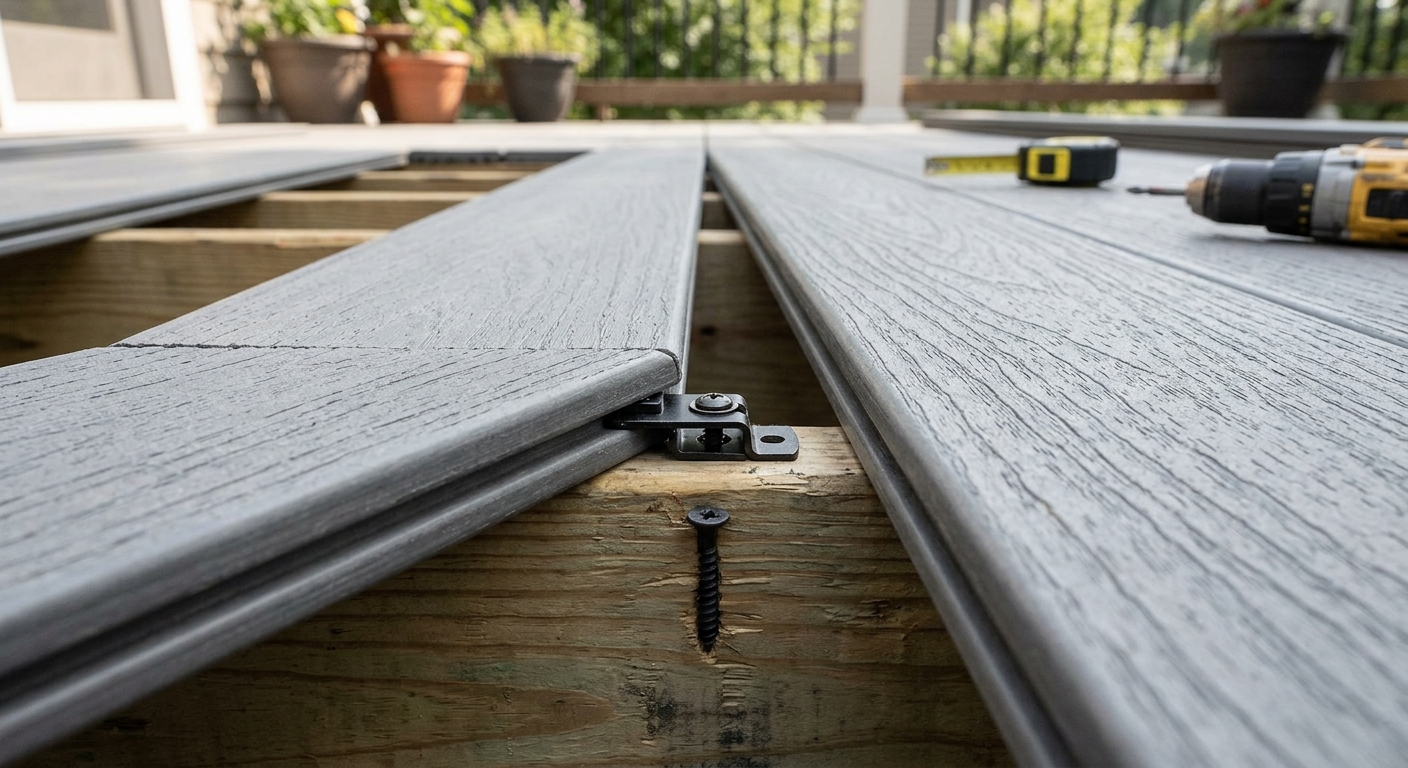
Gapping and fastener type: Composite decking installed with hidden fastener systems that maintain consistent gaps between boards drains and dries better than boards installed with face screws at tight spacing. If your composite deck was installed with inconsistent or overly tight gapping, debris accumulates more readily in the seams. This is worth noting if you're planning a new composite deck build — we cover fastener options in more detail on our composite deck maintenance Seattle page and in our best decking materials Seattle 2026 guide.
Deck furniture management: Elevated furniture (chairs, tables with legs rather than solid bases) allows airflow under the furniture and prevents the creation of continuously damp patches beneath solid furniture pieces. If you're storing furniture over winter on your Seattle deck, either use furniture with good ground clearance or store it off the deck entirely.
Pot saucers and planter management: Potted plants on composite decks in Seattle create specific problems. Waterlogged saucers create continuously wet contact points with the deck surface, and plant matter — soil, debris, organic matter — in contact with the deck surface creates ideal mold growth conditions. Use pot feet or stands to raise planters off the deck surface, or use waterproof saucers that drain freely.
Tip
Preventing and Addressing Common Seattle-Specific Composite Deck Stains
Beyond the biological stains from mold, algae, and moss, Seattle composite deck owners deal with a specific set of staining challenges that aren't as prominent in drier climates. Understanding these stains and how to address them keeps your composite deck looking its best throughout its service life.
Iron Staining from Metal Fasteners
In Seattle's wet climate, composite decks installed with face screws — even screws marketed as "stainless" — can sometimes develop rust streaks if the fasteners are lower-grade stainless or carbon steel. The streaks appear as reddish-brown lines radiating from the fastener head along the board grain.
True Grade 316 marine-grade stainless steel fasteners do not rust, but Grade 304 (often sold as "stainless" without further specification) can develop surface rust under continuous wet conditions. If you see rust streaks from your deck fasteners, the solution involves both cleaning the stain and replacing the fasteners.
For the stain itself, oxalic acid-based deck brighteners are effective on iron staining on composite surfaces. Apply per product directions, scrub gently, and rinse thoroughly.
Grease and Oil Stains from Cooking
Summer grilling season is wonderful on a Seattle deck, but composite decking and cooking grease are an incompatible pair if spills aren't addressed promptly. Grease that's allowed to cool and set on composite decking — particularly on textured composite surfaces with wood-grain embossing — is one of the harder stains to fully remove.
For fresh grease spills: absorb the excess with paper towels or a dry cloth immediately, then clean with warm water and a small amount of dish soap worked in with a soft brush. Rinse thoroughly.
For set grease stains: commercial composite deck cleaners with degreasing formulations are the best option. These are more effective than DIY solutions for oil-based staining. In some cases, two or three treatment cycles may be needed before the stain fully releases.
Prevention is more practical than treatment: use a deck mat or outdoor rug under your grill, positioned so that grease drips onto the mat rather than the deck surface. Make sure the mat doesn't stay in place permanently, though — a mat that stays put all summer creates its own moisture trap and shaded environment.
Fertilizer and Pool Chemical Staining
Fertilizers applied to adjacent lawn or garden areas can be tracked or blown onto composite decking. Most granular fertilizers contain iron compounds that can stain composite surfaces when wet. Sweep fertilizer off the deck surface immediately after any nearby application, and rinse the deck surface with water to prevent the granules from leaving iron stains as they dissolve.
Pool chemicals, for Seattle homeowners with above-ground pools on their decks (more common than you might expect in the Lake Sammamish and Lake Washington residential areas), can stain and potentially damage composite decking if spills are not promptly rinsed. Chlorine compounds in particular can bleach composite board surfaces — another reason not to use chlorine bleach for cleaning, since it replicates the same chemistry.
When to Call a Pro: Signs Your Composite Deck Needs More Than Cleaning
Routine maintenance is what this guide is primarily about, but it would be incomplete without addressing the signs that your composite deck needs professional evaluation or structural repair — not just cleaning.
Surface Signs That Warrant Professional Assessment
Board delamination: If you see the outer cap of your composite boards beginning to separate from the core — visible as edge lifting, bubbling in the surface, or sections where the cap appears loose — this is a warranty and performance issue that needs professional evaluation. Board delamination can be caused by manufacturing defects (potentially a warranty claim), improper installation (ledger or substructure issues causing excessive board flexion), or in some cases by improper cleaning methods (high-pressure washing). Do not try to repair delaminated boards yourself.
Widespread mold that doesn't respond to cleaning: Surface mold on capped composite should respond to proper cleaning treatment within one or two sessions. If you have mold that returns within a few weeks of cleaning, or mold that doesn't respond to the standard cleaning approaches described above, it may indicate that you're dealing with uncapped or damaged composite, or that there's a moisture source below the deck (from the substructure) that is keeping the surface persistently wet in ways that airflow alone won't address.
Soft spots or board flexion: Walk your entire deck and pay attention to any areas where boards feel soft, flex excessively underfoot, or produce a different sound when walked on versus the rest of the deck. Soft spots in composite decking almost always indicate substructure issues — joists, beams, or ledger boards that have been damaged by moisture. Composite decking itself doesn't develop soft spots; the problem is what's beneath it.
Fastener or connection concerns: Inspect the visible fasteners on your deck's railings, post bases, and any face-screwed decking. Significant rust on structural fasteners, loose rail posts, or movement in the rail system are safety concerns that need professional attention. For railing-specific information, see our deck railing options Seattle page and our cable railing Seattle guide.
When Cleaning Reveals Permit Compliance Questions
Sometimes a thorough deck inspection — even if prompted by a routine cleaning — reveals questions about whether the deck as built meets current code requirements. This is particularly common with older decks in Seattle that were built before current King County or SDCI requirements took effect.
If your deck inspection reveals concerns about structural connections, rail height, or stair requirements, it's worth understanding what permits were pulled for the original construction and what current requirements look like. The King County permits page and Seattle SDCI decks page have current code references, and our deck permit King County guide covers the local permitting process in practical detail.
Important
Understanding When Replacement Makes More Sense Than Repair
This is a conversation we have regularly with Seattle homeowners who have aging composite or wood decks. The repair-vs-replace decision depends on several factors: the age of the deck, the scope of the damage, the material quality of the original build, and what value the project would deliver in the context of your property.
For decks built before 2010 with first-generation uncapped composite materials, extensive repairs often don't make economic sense because the replacement materials will significantly outperform the remaining original material. A deck built with a quality capped composite product from the last 5–10 years, where the issue is limited substructure damage rather than widespread material failure, is a better candidate for targeted repair.
The NAR remodeling impact report consistently shows that deck additions and replacements deliver strong value recovery in the Pacific Northwest real estate market — particularly in King County, where outdoor living space is prized. If you're facing a significant repair bill on an aging deck, running the numbers on a full replacement with current capped composite material is often a more financially sound decision than repairing an older deck with diminishing useful life.
We cover the full decision framework on our deck addition Seattle page and our detailed deck cost Seattle 2025 guide.
Building a Maintenance-Optimized Composite Deck from the Start
The best composite deck maintenance strategy begins before the first board is installed. If you're planning a new composite deck build in King County or planning a significant deck renovation, the design and installation decisions made at the construction stage directly determine how much maintenance the finished deck will require.
Material Selection for Minimum PNW Maintenance
The hierarchy of composite deck materials for Seattle's climate, from highest to lowest maintenance requirement:
- 100% PVC decking (AZEK Vintage/Harvest): No wood fiber content means no organic material for mold to consume. Surface algae can still grow, but the overall biological burden is lowest. Highest cost, lowest maintenance.
- Capped composite with full four-sided cap (Trex Transcend, TimberTech Azek Harvest, Fiberon Concordia): Four-sided capping protects all board surfaces including the underside. Best moisture resistance among composite products.
- Capped composite with three-sided cap (most standard capped composite products): The underside of the board is uncapped. In elevated deck applications, this is generally not an issue, but for low-clearance decks close to grade, the uncapped underside can absorb moisture from the ground.
- Uncapped composite: Not recommended for Seattle's climate. Higher maintenance, faster surface degradation, greater susceptibility to mold penetration.
Installation Practices That Reduce Maintenance
Hidden fastener systems: Decks installed with hidden fasteners maintain consistent spacing between boards, which improves drainage and drying. Face-screwed decks can develop inconsistent spacing over time as boards shift, creating debris traps.
Substructure material: Composite decking installed over a pressure-treated wood substructure (the standard approach) is fine, but the wood substructure requires its own maintenance considerations. Some builders in Seattle's wet climate are now using steel framing systems or composite framing materials for the substructure, which eliminates wood decay concerns from the equation entirely. The upfront cost is higher, but the long-term maintenance reduction is significant.
Slope and drainage: Composite decking should be installed with a slight slope away from the house (typically 1/8 inch per foot minimum) to promote drainage. Decks that are perfectly level or that slope toward the house hold standing water on the surface, accelerating biological growth. Confirm with your builder that proper slope is built into the frame before decking is installed.
Canopy clearance: When siting a deck in a heavily wooded Seattle lot, the distance from the deck surface to the lowest tree canopy directly affects drying time after rain. More clearance equals better airflow equals faster drying equals less mold. If you have flexibility in deck placement on your lot, a location with better sun exposure and canopy clearance will reduce your lifetime maintenance burden even with identical materials.
For a complete look at how material choices, installation methods, and design decisions interact with Seattle's specific climate, see our composite vs. cedar decking Seattle comparison and our deck and patio combo Seattle guide for integrated outdoor living designs.
The NADRA Framework for Deck Safety Inspections
The National Association of Deck and Railing Builders (NADRA) provides standardized guidelines for deck inspection that we recommend all Seattle homeowners follow, particularly for decks over five years old. NADRA's inspection checklist covers structural connections, fastener integrity, rail systems, stair safety, and ledger connections — the areas most likely to develop safety-critical issues over time.
We recommend following NADRA's guideline of a professional structural inspection every five years for composite decks in Seattle's climate, in addition to the annual cleaning and surface assessment program outlined in this guide. The combination of regular surface maintenance and periodic structural inspection is what keeps Seattle composite decks performing safely for their full 25–50 year warranty periods.
The Real Cost of Neglect: What Happens When You Skip Seattle Composite Deck Maintenance
It's worth being direct about what deferred maintenance actually costs Seattle composite deck owners, both in aesthetic terms and in dollars. Because composite decking is genuinely durable, it can look "fine" even as surface conditions worsen — right up until it doesn't.
A composite deck that hasn't been properly cleaned in Seattle's climate for two or three years typically shows:
- Widespread algae film: A green-gray slick covers the entire surface, making the deck slippery and visually dingy. The deck's original color is barely recognizable.
- Established moss colonies: Particularly in shaded corners and board channels. Moss at this stage requires significant mechanical work to remove and may leave surface marks on some composite products.
- Tannin staining: Multiple seasons of leaf accumulation has left reddish-brown staining across significant portions of the deck surface. Some of these stains may be permanent or very difficult to fully remove.
- Debris-impacted board channels: The channels between boards are packed with compacted needle, leaf, and organic debris that can no longer drain freely. Standing water during rain events is likely.
- Potential substructure concerns: Three or four years of deferred maintenance means the substructure hasn't been inspected. Any developing issues with ledger connections, joist ends, or post bases have been progressing without detection.
Returning a neglected composite deck to acceptable condition in Seattle typically requires professional cleaning service at the high end of the $150–$400 range for routine service, potentially multiple visits, and possible professional treatment for staining or structural concerns. The total cost of restoration easily exceeds the cumulative cost of three or four years of routine maintenance. And some aesthetic damage — deeply set tannin stains, surface marking from moss removal on certain composite products — may be permanent.
The financial analysis is clear, as illustrated by comparing maintenance costs to Seattle repair averages. Regular maintenance in the range of $150–$400 annually is almost always less expensive than the consequences of neglect.
The Seattle Decking Company: PNW Composite Deck Expertise
At The Seattle Decking Company, we build composite decks throughout King County — from Bothell and Kenmore to Bellevue, Shoreline, and the Seattle city neighborhoods. We work with Trex, Fiberon, AZEK, and TimberTech product lines, and we specify materials based on the specific site conditions each project presents, not on which product line has the highest margin for us.
We wrote this guide because we've seen too many composite deck owners in the Seattle area get wrong information from resources written for national audiences or by people who don't actually work in the PNW climate. The maintenance requirements for a composite deck in Seattle are meaningfully different from those for a composite deck in Sacramento or Charlotte, and building your maintenance routine around national averages will leave you behind the curve by the time fall arrives.
If your composite deck needs professional assessment — whether for cleaning, structural evaluation, or a conversation about whether it's time to invest in a replacement — we're the right call. And if you're planning a new composite deck build or a significant renovation in King County, we want to be involved early in the process so the material choices and design decisions you make at the start set you up for the lowest possible maintenance burden over the life of the deck.
Call us at (425) 675-6259 to schedule a consultation, or visit our contact page to describe your project and we'll be in touch. Our office is at 22722 29th Drive SE, Bothell, WA 98021, and we serve the full King County area including Seattle, Bellevue, Kirkland, Redmond, Shoreline, Kenmore, Lake Forest Park, Bothell, and surrounding communities.
For more resources, see our complete deck cost Seattle guide and our blog hub for PNW-specific information on decking materials, permits, design, and maintenance.
Frequently Asked Questions
How often should I clean my composite deck in Seattle?
Can I pressure wash my composite deck in Seattle?
Is composite decking actually low-maintenance in Seattle's climate?
How do I remove moss from a composite deck in Seattle?
Will leaves from my maple tree stain my composite deck permanently?
Does composite decking need sealing or staining in Seattle?
What's the best composite decking for Seattle's wet climate?
How much does professional composite deck cleaning cost in Seattle?
When should I replace my composite deck instead of repairing it?
Do I need a permit to clean or repair my composite deck in Seattle?
What's the DIY cleaning solution for composite decks that won't void my warranty?
How do I prevent mold on my composite deck in Seattle?
Planning a deck in the Seattle area?
Get an onsite design review and a clear, itemized quote from a licensed local builder.
Request a Free Quote