
If you bought a home in Kirkland, Bellevue, or the Eastside neighborhoods of King County in the last 15 years, there's a reasonable chance your deck is closer to the end of its life than you think. That's not alarmism — it's math applied to Seattle's climate. The National Weather Service reports Seattle receives approximately 37–40 inches of precipitation annually, spread across roughly 150 rainy days per year. For a wood deck, those aren't just wet days. They're cycles of saturation and partial drying, accelerated biological growth, and progressive structural fatigue that simply don't exist at the same intensity anywhere east of the Cascades.
National deck lifespan charts are built on averages that include Phoenix, Scottsdale, Denver, and Atlanta. Those averages mean nothing here. A pressure-treated deck in Scottsdale might legitimately last 25 years with minimal maintenance. The same deck in a shaded Shoreline backyard, under a Douglas fir canopy that holds moisture and blocks afternoon sun, will likely be structurally compromised in 10 to 12 years. We see it constantly. Homeowners call us thinking they need a repair, and the framing tells a different story — blackened joists, crumbling post bases, ledger boards that have lost their connection to the house. These aren't catastrophic surprises. They're the predictable result of PNW conditions meeting decks designed for the national average.
This guide will give you honest, Seattle-specific lifespan data for every common decking material, explain exactly what accelerates deterioration in King County's climate, show you how to read the signs that your deck has reached end of life, and walk through the repair-versus-replace math. If you've been wondering whether your deck has more years left or whether it's time to start planning a replacement, you're about to get a clear answer.
Why Seattle's Climate Destroys Decks Faster Than the National Average
To understand deck lifespans in the Pacific Northwest, you need to understand the specific failure mechanisms that Seattle's climate creates — and they're different from what drives deck failure in the rest of the country.
The Wet-Dry Cycle Problem
In dry climates, wood decks degrade primarily from UV exposure and seasonal movement. The wood expands and contracts with temperature, but it dries out thoroughly between rain events. In Seattle, wood rarely gets the chance to fully dry. During our eight-month wet season (October through May), a wood deck may absorb moisture repeatedly, week after week, without reaching the low moisture content that inhibits fungal growth. According to King County's precipitation monitoring, some areas of the county receive significantly more than the 37-inch SeaTac average, particularly in foothill communities like Maple Valley, Black Diamond, and the eastern Bellevue slopes.
Wood rot requires moisture content above approximately 20% to sustain fungal activity. A Seattle deck joist can stay above that threshold for months at a time. The result: biological degradation doesn't pause for winter here the way it does in cold, dry climates. Our "winter" is wet and mild — ideal conditions for the fungi that destroy wood structure.
Shade as an Accelerant
If your deck sits under a Douglas fir, cedar, or big-leaf maple canopy — which describes the majority of Bellevue, Mercer Island, Redmond, and Sammamish backyards — you've added another failure accelerant. Shade prevents the UV exposure that would otherwise slow biological growth on the wood surface. It also inhibits the evaporation that would pull moisture out of the framing. Moss and algae take hold faster, and the resulting biological mat holds even more moisture against the wood surface. We've seen joists that were visually sound from above turn out to be structurally compromised because the underside stayed perpetually damp under a thick moss mat that grew through the gaps between decking boards.
Hardware Corrosion in Coastal and Near-Coastal Zones
Seattle and the westside communities of King County fall within what the International Code Council considers a corrosive environment for hardware. Salt air from Puget Sound, combined with persistent moisture, accelerates the corrosion of undersized or improperly specified hardware — lag screws, joist hangers, post bases — at a rate that surprises homeowners accustomed to national lifespan expectations. Hardware that might last 25 years in an inland dry climate may show significant corrosion in 10–15 years in Ballard, West Seattle, or Shoreline. And corroded hardware doesn't just look bad. When post-base hardware corrodes away, the structural connection between your deck and the ground disappears — and the deck becomes a collapse hazard.
The Pressure Treatment Change Nobody Told You About
Prior to 2004, pressure-treated lumber used chromated copper arsenate (CCA) as its preservative — a treatment that performed exceptionally well against rot and insects. In 2004, CCA was phased out for residential use and replaced with alternatives like alkaline copper quaternary (ACQ) and copper azole (CA). The newer formulations are safer from an environmental standpoint, but they're also more corrosive to metal hardware and, in some studies, slightly less effective in high-moisture environments. If your deck was built between roughly 2004 and 2010 with the new treatment formulations but with the old hardware specifications (standard zinc-plated joist hangers, for example), the hardware may already be failing even if the wood looks acceptable.
Key insight
Material Lifespans in Seattle's Climate: An Honest Assessment
Here's how each major decking material actually performs in King County conditions, based on what we see in the field rather than what manufacturers print on optimistic spec sheets.
Pressure-Treated Wood: 10–15 Years in Seattle Without Active Maintenance
Pressure-treated pine or fir is still the most common decking material in older Seattle-area homes, and it's still the lowest-cost option for new construction. In a dry climate with consistent maintenance, PT wood decks can reach 20 years. In Seattle, the realistic range without active maintenance is 10–15 years — and "without active maintenance" describes most PT decks we inspect, because homeowners simply aren't told how much work it takes to extend the lifespan of wood in this climate.
Active maintenance for PT wood in Seattle means: annual cleaning with a deck cleaner or mild detergent, reapplication of a penetrating water repellent or semi-transparent stain every 1–2 years, immediate repair of any board splits or checking where water can pool, and annual inspection of all hardware, post bases, and the ledger-to-house connection. Homeowners who do all of this consistently can push a PT deck toward 18–20 years. Most don't, and 10–12 years is a more realistic expectation for the average Seattle backyard.
The framing (joists, beams, posts) typically outlasts the decking surface because it's protected from direct UV and traffic wear — but framing is also where the most dangerous rot develops, because it's hidden. A deck can look surface-acceptable while the structural members beneath are compromised.
Cedar Decking: 15–25 Years with Regular Staining
Western red cedar is the traditional premium choice for Pacific Northwest decks, and for good reason. It's dimensionally stable, naturally resistant to rot and insects, and it's a locally abundant species that performs well in our climate. According to the Western Red Cedar Lumber Association (Real Cedar), cedar can provide long service life when properly maintained — and the key phrase is "properly maintained."
In Seattle's climate, cedar decking requires staining or sealing every 1–3 years to maintain its rot resistance and appearance. Left unfinished, cedar will naturally weather to a silver-gray color, which many homeowners appreciate aesthetically. But in a shaded, perpetually damp environment, unfinished cedar doesn't just gray — it develops surface mold and eventually begins to soften at the surface from biological growth. The Seattle Times has documented how specific care practices matter for cedar in our climate.
With a consistent staining schedule and annual cleaning, a cedar deck in Seattle can reach 20–25 years for the surface boards. The structural framing, if built with appropriate PT lumber and correct hardware, can last longer. When cedar decks fail prematurely in the PNW, it's almost always due to inconsistent finishing, ponding water issues (often from flat or low-slope board layouts), or debris accumulation in corners that holds moisture.
We cover the cedar-versus-composite decision in more detail in our composite vs. cedar decking comparison for Seattle homeowners. The short version: cedar has aesthetic warmth that composite can't fully replicate, but the maintenance commitment in Seattle is real and ongoing.
Composite Decking: 25–30 Years in Seattle
Composite decking — a blend of wood fiber and recycled plastic — was engineered specifically to solve the rot and maintenance problems of wood in high-moisture environments. In Seattle, it delivers on that promise. Trex's composite decking carries a 25-year fade and stain warranty, and quality composite boards from Trex, Fiberon, and TimberTech routinely reach or exceed 25–30 years in PNW conditions.
The performance advantage in Seattle is significant. Because composite decking contains no natural wood on its exposed surfaces (in capped composite products, the surface is a protective polymer shell), it doesn't absorb moisture the same way, doesn't support moss or algae as readily as bare wood, and doesn't require staining or sealing. Annual cleaning with soap and water is generally sufficient to maintain both appearance and function.
Important Seattle-specific caveat: composite decking does not solve the structural framing problem. Joists, beams, posts, and the ledger board are almost always pressure-treated wood, even when the deck surface is composite. A composite deck installed on poorly maintained or undersized framing will still fail when the framing fails. The surface will look perfect while the structure beneath it deteriorates. We've rebuilt composite decks in Issaquah and Redmond where the boards were immaculate but the framing was at end of life — the homeowner was stunned because they thought "composite" meant they didn't need to think about maintenance. The surface, yes. The structure, never.
For more on which composite brands perform best in Seattle conditions, see our Trex vs. Fiberon vs. TimberTech comparison.
PVC Decking: 30–50 Years in Seattle
Full PVC (polyvinyl chloride) decking contains no wood fiber at all — it's a 100% synthetic product. This makes it the most moisture-resistant decking material available and the longest-lasting option in Seattle's climate. TimberTech's AZEK PVC line carries a lifetime limited product warranty and a 50-year fade and stain warranty — warranty terms that reflect genuine confidence in the material's longevity.
In Seattle conditions, PVC decking essentially doesn't interact with moisture in ways that cause degradation. No rot. No swelling or checking. Minimal biological growth, and what does grow cleans off easily. The trade-offs are price (PVC typically costs 20–30% more than mid-grade composite) and thermal expansion (PVC expands and contracts with temperature more than composite, requiring careful installation with appropriate gapping and fastener systems). For Seattle rooftop decks, low-slope applications, or any situation where drainage and moisture management are critical, PVC is often the right choice.
See our PVC decking page for more on how we specify and install PVC in Seattle applications.
Membrane Decking Systems: 25–35 Years in Seattle
Waterproof membrane decking — products like Duradek or Fibertex applied over a plywood substrate — is the dominant choice for Seattle's flat and low-slope decks, rooftop decks, and decks above living spaces. Rather than being a decking board product, membrane is a continuous waterproofing layer that completely prevents water intrusion into the structure below.
In Seattle, membrane systems typically last 25–35 years when properly installed and maintained. The critical factor is professional installation: membrane must be properly adhered, seams must be sealed correctly, and edge terminations must be flashed and protected. A membrane system installed by a qualified contractor with experience in Seattle's conditions will routinely outlast a composite board deck installed on a poorly detailed wood framing system. Our membrane decking guide covers installation specifics and maintenance requirements in detail.
Field-observed lifespans in King County conditions — lower end assumes shade, poor drainage, or minimal maintenance; upper end assumes good installation, drainage, and active upkeep.
| Category | Value |
|---|---|
| Pressure-Treated Wood | yrs13 |
| Cedar (maintained) | yrs22 |
| Composite (capped) | yrs28 |
| PVC (full) | yrs40 |
| Membrane System | yrs30 |
Factors That Accelerate Deck Aging in Seattle
Understanding the general lifespan ranges is useful. Understanding what specifically causes early failure is more useful, because most of these factors are visible — and addressable — before they become catastrophic.
Factor 1: Shade and Moss Accumulation
We've already touched on this, but it deserves emphasis as a standalone factor. In neighborhoods like Lake Forest Park, Kenmore, Woodinville, and the wooded hillsides of Issaquah and Sammamish, decks frequently sit under continuous tree canopy. Moss establishes on wood and composite surfaces within a year or two in these conditions. On wood decking, moss traps moisture directly against the board surface 24/7 — dramatically accelerating surface degradation and creating conditions for rot in the top layer of the board. On composite, moss is primarily cosmetic but should be removed because the decaying organic matter beneath a thick moss mat can eventually cause surface staining and in some cases chemical interaction with the board surface.
If your deck has moss on it now, treat it this season. Sodium percarbonate-based cleaners work well on both wood and composite without the damage risk of pressure washing. Don't use bleach on composite — it can damage the cap layer. And don't pressure wash wood decking above 1,500 PSI — you'll drive water deeper into the wood and accelerate the very problem you're trying to solve.
Factor 2: Ponding Water and Flat Deck Surfaces
Deck boards should be installed with a slight slope away from the house — typically 1/8 inch per foot — and with adequate spacing between boards to allow water to drain quickly. In Seattle, decks that weren't installed with appropriate drainage slope, or that have settled and lost their original pitch, create low spots where water ponds after rain. Ponding water on wood decking is one of the fastest failure mechanisms we see. A board that's holding an inch of standing water after every rain event can show significant surface degradation in two to three years and become structurally soft in five.
This is also why we pay close attention to end-grain exposure during installation. Deck boards cut in the field have open end grain at the cut point, and in Seattle's climate, those open ends are the primary entry point for moisture. Proper end-grain sealing during installation, or installation details that protect cut ends, can meaningfully extend board life.
Factor 3: Wood-to-Concrete Contact at Post Bases
Post base failure is one of the two most common causes of structural deck failure cited by NADRA (North American Deck & Railing Association). In Seattle, we'd add that this failure mode is particularly prevalent because concrete holds moisture, and the interface between a wood post and a concrete footing or pier is exactly the kind of perpetually damp environment where rot initiates fastest.
Properly installed post bases use galvanized or stainless steel standoffs that keep the wood post above the concrete surface, allowing the wood to dry out between rain events. We see a significant number of older decks in Renton, Auburn, and south King County where posts were installed directly in concrete — or even in dirt — without adequate standoffs. By the time we're called, the bottom foot of the post is essentially mush, the metal anchor has corroded away, and the deck is being held in position more by habit than by structural integrity.
Factor 4: Undersized or Corroded Hardware
The International Residential Code and American Wood Council span tables specify minimum fastener and connection sizes for deck structures. But codes establish minimum standards, not optimal specifications for Seattle conditions. A deck built exactly to code minimums with standard zinc-plated hardware in a Burien neighborhood near the Sound can develop hardware failures within 10–15 years.
Hardware specified for hot-dip galvanization or stainless steel lasts significantly longer in our conditions — we're talking about connections that remain sound for 25–35 years rather than showing significant corrosion at 12–15. The cost difference per deck is relatively small (hardware typically represents a small fraction of total deck cost), but the impact on longevity is substantial. When we bid replacement decks in Seattle, we spec hot-dip galvanized or stainless steel hardware throughout — not because code requires it, but because building to Seattle conditions means building above code minimums.
Important
Factor 5: Ledger-to-House Connection Failures
The ledger board is the horizontal member that connects your deck to your house — it's the structural interface between your deck framing and your home's band joist. In Seattle, this connection is a frequent failure point for two reasons: moisture intrusion behind the ledger can rot both the ledger itself and the house framing it connects to, and improper flashing allows water to run behind the ledger and into the wall assembly.
A correctly flashed and detailed ledger-to-house connection includes continuous flashing that directs water out and away from the house, appropriate sealant at penetrations, and inspection access so the connection can be evaluated periodically. We've opened up ledger connections in older Redmond and Bellevue homes and found the house band joist in advanced stages of rot — not because of anything the homeowner did wrong, but because the original installation didn't include proper flashing for Seattle's climate.
Note
Signs Your Deck Has Reached End of Life
Knowing the average lifespans is one thing. Knowing how to read the specific signs that your deck has reached end of life is what actually tells you whether to act now or watch and wait.
Structural Rot in Joists, Beams, or Posts
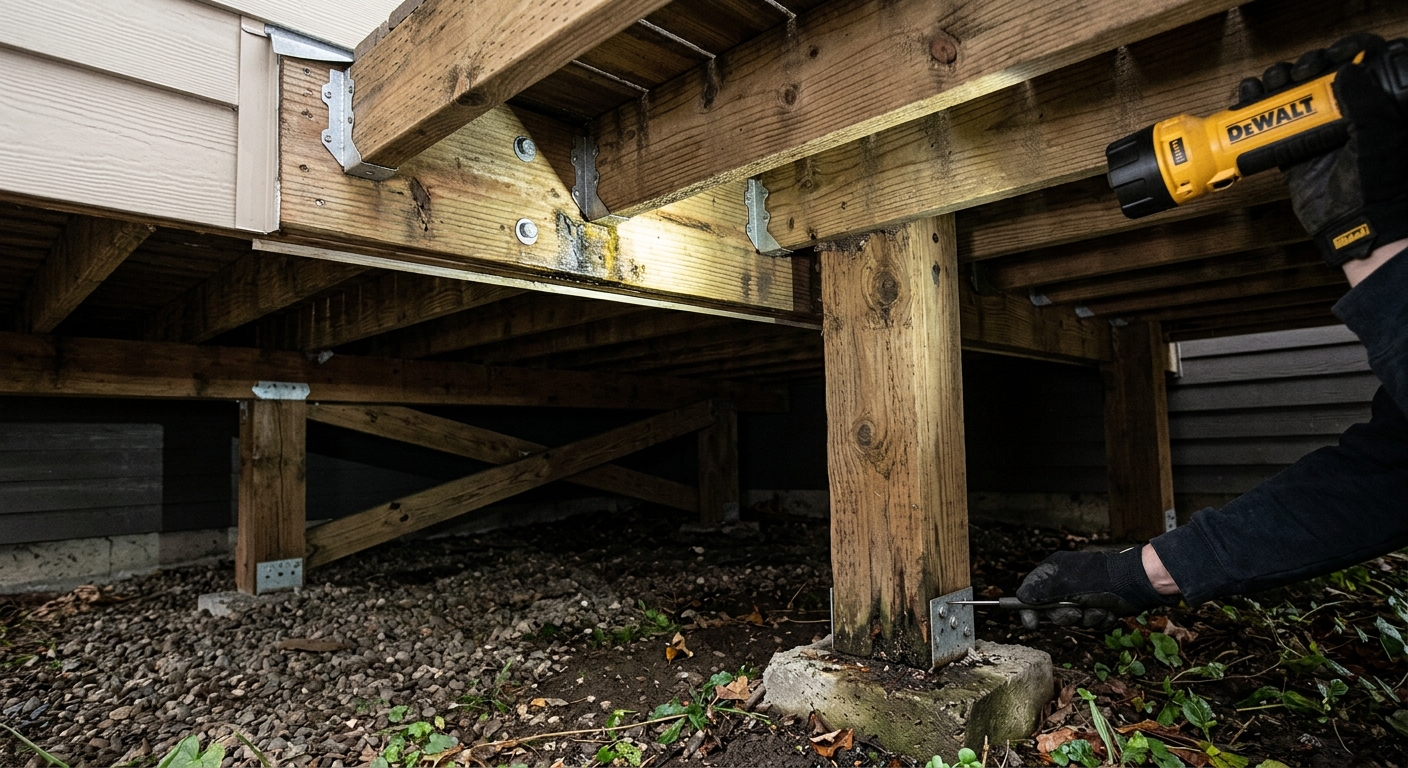
This is the definitive end-of-life signal. Take a screwdriver or an awl and probe your deck joists in several locations — especially near the ledger, at mid-span where water might pool above, and at the ends where they're supported by the beam. Healthy pressure-treated wood will resist penetration. Wood in early-stage rot will feel slightly soft. Wood in advanced rot will penetrate easily, sometimes to an inch or more, with essentially no resistance. If you're finding penetration in more than two or three spots across the joist run, you have a structural problem that surface repair cannot solve.
Do the same probe test on your posts and beams. For posts, probe at the base where they meet the post base hardware, and also around the mid-height of the post if there's any visible discoloration or soft spots. For beams built up from multiple lumber members, probe between members at the top where water can work in.
Widespread Surface Board Failure
If more than 25–30% of your deck boards show significant checking (deep cracks running along the grain), cupping, or surface softening, you're looking at a re-decking project at minimum — and likely a full replacement once the framing is exposed for inspection. Spot-replacing deteriorated boards is economically sensible when it's a small percentage of the total surface. When it becomes a majority of the deck, the labor cost of selective replacement approaches or exceeds the cost of full re-decking, and you still end up with a patchwork of boards in different stages of weathering.
The surface inspection should also include checking for board movement — boards that are lifting at the fastener points, boards that rock underfoot, and boards where the fastener has pulled through the wood because the wood around it has degraded. These are signs that the board is at end of useful life.
Ledger Failure
A failing ledger board is potentially the most dangerous deck failure mode because it typically results in the deck pulling away from the house suddenly rather than gradually. Signs of ledger failure include: visible separation between the deck surface and the house (even a quarter-inch gap that wasn't there before is significant), rust staining running down the house wall below the ledger level, deck boards that are visibly lower at the house end than they used to be, and any soft spots when you probe the ledger board itself.
If you suspect ledger failure, stop using the deck and call a contractor immediately. This is not a watch-and-wait situation.
Post Base Failure
Stand on your deck and push laterally — side to side and toward/away from the house. A deck with sound post bases will feel completely rigid. A deck with compromised post bases will have noticeable movement, sometimes a few inches of sway in bad cases. You should also physically inspect the post bases by crouching under the deck and looking at the condition of the hardware and the wood at the base of each post. Any visible corrosion on the hardware beyond surface oxidation, any soft wood at the post base, or any visible gap between the post and its bearing surface needs immediate professional evaluation.
Tip
When to Repair vs. When to Replace: The Math
This is the question we get most often, and the honest answer requires doing some arithmetic rather than applying a simple rule.
The 30% Rule and When It Breaks Down
A widely cited rule of thumb is: if repair costs exceed 30–40% of full replacement cost, replace rather than repair. This is a reasonable starting point, but it doesn't account for the age of the existing structure. If your deck is 20 years old and needs $8,000 in repairs on a $25,000 replacement value, you're at 32% — technically below the threshold. But you're also investing $8,000 into a structure that has 3–5 years of remaining useful life at best. You'll be doing this again in five years.
The better framework: calculate the amortized annual cost of each option over a 15-year horizon.
- Repair scenario: $8,000 repair + $25,000 replacement in 5 years = $33,000 over 10 years. Amortized annual cost: $3,300/year.
- Replace now scenario: $25,000 replacement lasting 25–30 years (if composite) = $25,000 over 25 years. Amortized annual cost: $1,000/year.
The replacement scenario is nearly always the better financial decision once structural framing is compromised, even when the upfront repair cost seems more manageable. We walk homeowners through this math in our deck cost guide for Seattle so they can see the full picture before making a decision.
Surface-Only Replacement (Re-Decking) as a Middle Path
If your structural framing is sound — meaning the joists, beams, posts, and ledger pass a thorough inspection — but the surface boards are at end of life, re-decking is a genuine middle path that makes economic sense. Re-decking means removing the existing decking boards, inspecting and repairing the framing as needed, and installing new decking on the existing structure.
In Seattle, this is also an opportunity to upgrade from pressure-treated or cedar surface boards to composite or PVC — extending the next surface replacement cycle to 25–30 years rather than 10–15. The labor involved in re-decking is significant (removing old boards, inspection, any framing repairs, installing new boards with proper fastening and drainage details), but the resulting deck performs like new at a cost well below full replacement.
For current cost ranges on both repair and full replacement in King County, see our deck cost estimator for Seattle homeowners.
When Structural Compromise Rules Out Repair
Some conditions make repair essentially not viable regardless of the cost comparison:
- Ledger board rot that extends into the house framing — this requires opening the wall assembly and replacing house structural members, at which point full deck replacement is the only logical scope of work.
- More than 30% of joists with significant rot — sistering all compromised joists, replacing blocking, and addressing the drainage issues that caused the failure in the first place approaches or exceeds the cost of full replacement.
- Post bases that have failed at multiple locations — suggests a systemic drainage or hardware specification problem that will recur with the existing post layout.
- Any situation where the permit-required repairs would require bringing the entire structure to current code (see King County's permitting requirements and our deck permit guide for King County for detail on when permits are required for repair work).
Key insight
The True Cost of Waiting: Why End-of-Life Timing Matters
We have conversations every year with homeowners who have been watching a deck deteriorate for two or three years, meaning to address it but putting it off. There are understandable reasons — cost, disruption, uncertainty about whether it's "really" time yet. But in Seattle's climate, waiting almost always increases the final cost of the project rather than reducing it.
How Decay Spreads
Deck rot is not a static condition. Once fungal decay establishes in a joist, it continues progressing as long as moisture conditions remain favorable — which in Seattle means most of the year. A joist with 20% rot in 2023 doesn't just stay at 20% in 2025. It's at 50–60%, and now it's compromising the adjacent joists through direct contact and moisture transmission. A ledger board with isolated soft spots in 2024 has expanded rot that's reaching the house band joist by 2026. The biological processes that cause wood decay operate on a continuous schedule; our project timelines don't.
Liability and Safety
A structurally compromised deck is a liability risk that homeowners' insurance policies may not fully cover if the deterioration was "known and not repaired." We're not attorneys, and you should consult your insurance provider for specifics — but we've spoken with enough homeowners after deck incidents to know that documented knowledge of structural problems that weren't addressed can complicate insurance claims significantly.
Beyond insurance, there's the simpler reality that a deck with compromised posts, a failing ledger, or significantly rotted joists can fail under occupancy. NADRA data on deck failures consistently points to structural connection failure — posts, ledgers, hardware — rather than surface board failure as the cause of deck collapses. The surface of your deck tells you about maintenance history. The structure tells you about safety.
Replacement Timing and Seattle's Contractor Market
King County's deck building market has meaningful seasonal dynamics. The period from October through February is traditionally slower for deck projects — contractors are more available, lead times are shorter, and some material costs are lower. Spring (March through June) and summer are peak season, with lead times from initial contact to project start often running 6–12 weeks at reputable companies.
If your deck is showing signs of end-of-life, initiating the evaluation and quoting process in fall or winter positions you for a spring project start at the best possible slot in a contractor's schedule. Getting on a waitlist in March for a "deck that's showing some problems" typically means your project doesn't start until July or August — with a full Seattle summer of missed outdoor living, plus continued deterioration of the deck throughout that wait.
For guidance on vetting contractors and understanding the quoting process, our how to find a deck builder in Seattle guide and how to read a deck quote guide cover what to look for and what to avoid.
Seattle Neighborhood Patterns: Where We See Decks Aging Fastest
Twenty years of building and repairing decks across King County has given us a clear picture of which neighborhoods and property types produce the most end-of-life deck calls — and why.
Wooded Eastside Neighborhoods
Issaquah, Sammamish, Woodinville, and the hillside neighborhoods of Bellevue (Somerset, Cougar Mountain area, the eastern edges of Bridle Trails) have some of the highest rates of premature deck failure we see. The combination of heavy tree canopy, significant rainfall (the foothills receive meaningfully more than SeaTac), and lots that often slope toward the house (creating drainage pressure toward foundations and deck framing) produces conditions that consistently age PT wood decks to end-of-life in 10–12 years rather than 15. Composite and PVC decks in these neighborhoods are meaningfully better performers, but framing inspection remains critical.
North Seattle and Lake Forest Park
The dense tree canopy of North Seattle neighborhoods — Thornton Creek, Pinehurst, Meadowbrook, Victory Heights — creates similar shade-and-moisture conditions. We also see a higher proportion of older homes (1960s–1980s) in these neighborhoods with decks that are reaching or have passed the 20-year mark. Many of these were built with CCA-treated lumber (pre-2004), which actually performs better than newer PT formulations in high-moisture conditions — but even CCA wood has a biological lifespan, and decks in this age range deserve a thorough structural inspection regardless.
West Seattle and Burien
The Puget Sound-adjacent communities — West Seattle, Burien, Des Moines — add the corrosive-environment hardware challenge to the standard Seattle moisture conditions. We specify hardware upgrades here automatically on any new build or re-deck. Hardware that might last 20 years in Bellevue may show significant corrosion in 12–14 years in these communities.
Renton and South King County
Renton, Tukwila, and south King County communities see a significant volume of older mid-range homes with decks that were built during the housing boom of the late 1990s and early 2000s. Many of these decks are now in the 20–25 year range, built with the transitional PT formulations (early ACQ) and often without the drainage details that modern installation standards require. We get a steady stream of end-of-life evaluations from these communities every season.
Note
End-of-Life Replacement: What the Process Looks Like
If your assessment — either your own walk-through or a professional inspection — confirms that your deck is at end of life, here's what the replacement process looks like with an experienced Seattle deck builder.
Initial Assessment and Scope Definition
The process starts with a site visit that evaluates the existing structure, documents the scope of demolition required, identifies any conditions affecting the new design (drainage, slope, structural connection to the house), and establishes what permits will be required. In King County, permits are required for virtually all deck construction over 30 inches above grade and for significant structural replacements. You can review permit requirements directly at Seattle's SDCI for City of Seattle projects or through King County's permitting portal for unincorporated areas.
Material Selection for Seattle Conditions
For replacement decks in Seattle, we recommend composite or PVC decking for the surface in the large majority of situations — not because cedar isn't a good material, but because the amortized cost of composite over 25–30 years in PNW conditions typically beats cedar plus 10–12 staining cycles over the same period. We cover this math in detail in our deck staining vs. composite cost comparison.
For framing, we use #2 or better pressure-treated lumber with current treatment retention levels appropriate for ground contact applications where relevant, and we specify hot-dip galvanized or stainless steel hardware throughout — not the minimum code-compliant zinc-plated hardware.
Timeline and What to Expect
A standard single-level deck replacement in the 300–500 square foot range typically runs 3–5 weeks from permit issuance to project completion, including permit approval time (which runs 2–6 weeks in most King County jurisdictions). Multi-level, complex, or large-footprint projects run longer. We provide a detailed project timeline at the time of contract signing so you know what to expect at each phase.
For homeowners managing project financing, our deck financing guide for Seattle homeowners covers the options available — including home equity products and contractor payment plans — that can make a replacement project more manageable.
Get an Expert Assessment of Your Deck's Remaining Life
If this article has raised questions about your specific deck — if you're looking at a 15-year-old pressure-treated deck with some concerning soft spots, or a cedar deck that hasn't been stained in five years and is showing widespread moss — the next step is a professional evaluation from someone who's seen hundreds of Seattle decks at every stage of life.
The Seattle Decking Company has been building and replacing decks throughout King County for years, and we bring a straightforward approach to end-of-life assessments: we'll tell you honestly whether your deck needs repair, re-decking, or full replacement, show you exactly why, and give you a clear cost comparison so you can make an informed decision. We don't benefit from steering you toward a full replacement when repair is the right answer — our reputation depends on giving homeowners accurate information.
Call us at (425) 675-6259 to schedule a deck inspection and evaluation, or reach out through our contact page to describe your situation and get a quick initial response from our team. We cover all of King County and the Eastside, including Bellevue, Redmond, Kirkland, Issaquah, Renton, Bothell, Woodinville, and surrounding communities.
Our office is located at 22722 29th Drive SE, Bothell, WA 98021.
Frequently Asked Questions
How long does a deck last in Seattle?
Why do Seattle decks fail faster than decks in other cities?
How do I know if my deck needs repair or full replacement?
What are the signs a deck needs to be replaced immediately?
Does composite decking really last longer than wood in Seattle?
How often should a Seattle deck be inspected?
What's the cost to replace a deck in Seattle?
Can I just replace the deck boards without replacing the framing?
Does pressure-treated wood last longer than cedar in Seattle?
Do Seattle decks need permits?
What type of decking is best for Seattle's rainy climate?
How does shade affect deck lifespan in Seattle?
Planning a deck in the Seattle area?
Get an onsite design review and a clear, itemized quote from a licensed local builder.
Request a Free Quote