
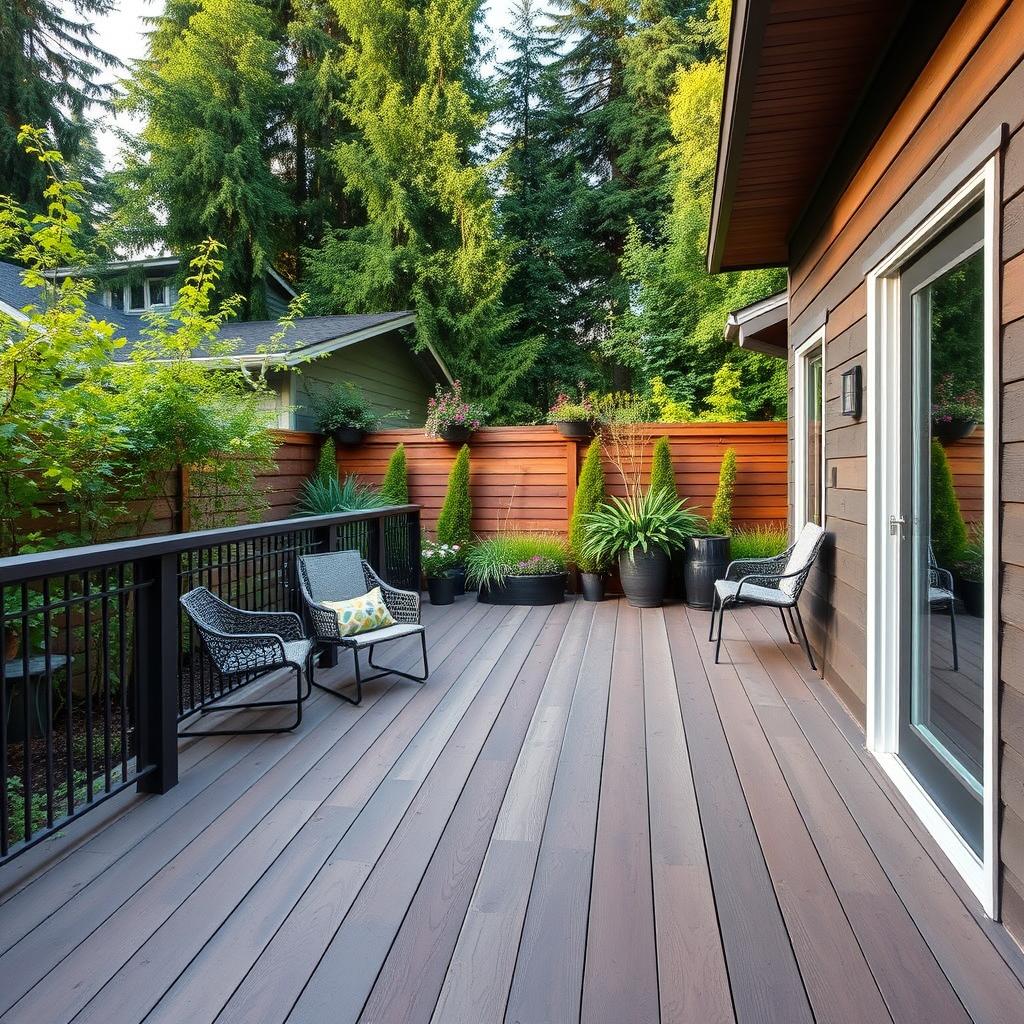
If you've ever stood on a deck in Ballard during a January downpour, or watched the moss creep across pressure-treated boards in Maple Leaf by February, you already understand something most national decking guides miss entirely: sustainability in Seattle isn't the same as sustainability in Phoenix. Our 38 inches of annual rainfall, combined with the mild temperatures that keep fungal spores active year-round, means that an eco-friendly decking choice has to survive the Pacific Northwest's particular brand of relentless moisture before it can earn any green credentials at all. A product that rots in eight years isn't sustainable no matter how many recycled milk jugs went into it.
We've been building decks across King County — Bellevue, Kirkland, Redmond, Shoreline, Edmonds, Kenmore — for years, and the sustainability conversation has changed dramatically in the last decade. Homeowners used to ask us about eco-friendly decking as an afterthought. Now it's often the first question out of the gate. Families in Seattle's Phinney Ridge or Ravenna neighborhoods, surrounded by the culture of sustainability that defines this city, want their outdoor spaces to reflect the same values as the rest of their lives. That's a reasonable ask. But it requires honest answers about what actually works here, not just marketing language about recycled content.
The good news: the sustainable decking market has matured enormously. There are now genuinely excellent options at every price point, from FSC-certified cedar to high-recycled-content composites to thermally modified hardwoods that need no chemical treatments. The trick is matching the right material to your priorities — and understanding that in Seattle's climate, longevity itself is the most powerful environmental argument you can make.
What "Eco-Friendly" Actually Means for a Seattle Deck
The term "eco-friendly" gets thrown around so loosely in the building materials industry that it's almost lost meaning. When we evaluate sustainability for a Seattle deck project, we break it down into four distinct dimensions that each tell a different part of the story.
Sourcing Sustainability
Where did the raw materials come from, and at what environmental cost? For wood products, this is primarily about forest management practices. The Forest Stewardship Council (FSC) certification is the most rigorous standard available, requiring chain-of-custody documentation that tracks lumber from a certified, responsibly managed forest all the way to the job site. The Sustainable Forestry Initiative (SFI) is a competing standard that's somewhat less stringent but still meaningfully better than uncertified lumber.
For composite decking, sourcing sustainability is about the origin of the recycled feedstock. A product made from post-consumer waste — the plastic bags and film that would otherwise go to a landfill — is making a measurably different environmental claim than one made from post-industrial manufacturing scraps that would have been recycled anyway.
Local sourcing matters too, though it's often overlooked. Western Red Cedar milled in Oregon or Washington and trucked 200 miles to a King County job site has a dramatically lower transportation carbon footprint than tropical hardwood shipped from Brazil or Southeast Asia. That transportation impact is real and quantifiable, even if it doesn't appear on any product certification label.
Manufacturing Impact
How much energy and how many resources were consumed to turn raw materials into finished decking boards? This is where composite decking and aluminum face some nuanced scrutiny. Manufacturing composite decking requires significant energy to extrude and cap the boards. Aluminum production is notoriously energy-intensive — though recycled aluminum requires only about 5% of the energy needed to produce primary aluminum from bauxite.
Thermally modified wood has a relatively low manufacturing footprint: the modification process uses heat and steam, no chemical inputs, and the energy involved is modest compared to the chemical treatment processes used for pressure-treated lumber.
Longevity as Environmental ROI
This is the dimension most homeowners underestimate, and it might be the most important one in Seattle's climate. Every deck replacement generates construction waste, requires new material production, and involves labor and transportation impacts. A cedar deck that needs replacement every 15-20 years has a fundamentally different environmental footprint over a 60-year horizon than a composite or thermally modified deck that lasts 40-50 years.
When we run the lifecycle math for Seattle projects, this often changes the ranking of materials considerably. A product with 30% recycled content that lasts 40 years may have a better overall environmental profile than a product with 80% recycled content that fails in 12 years. The longer-lasting deck doesn't just save you money — it saves the planet from another manufacturing and disposal cycle.
End-of-Life Recyclability
What happens when the deck does eventually need to come down? Wood products are compostable and biodegradable, though treated wood may require special disposal. Some composite manufacturers are beginning to develop take-back programs, though this is still nascent in the industry. Aluminum is highly recyclable and retains most of its value at end of life — aluminum decking that comes down in 50 years will almost certainly be recycled into new products.
Key insight
FSC-Certified Cedar: The Classic PNW Choice Done Right
Western Red Cedar is woven into the architectural DNA of the Pacific Northwest. From the cedar-sided craftsman bungalows of Columbia City to the modern farmhouses going up in Issaquah, cedar is what this region builds with. And when it comes from an FSC-certified source, it's one of the most genuinely renewable decking materials available.
Why Cedar Makes Environmental Sense Here
Western Red Cedar (Thuja plicata) is native to the Pacific Northwest. It grows in the same wet, mild climate where you're building your deck, which means it's naturally adapted to the conditions it will face. It contains natural oils — thujaplicins and thujic acid — that provide genuine resistance to rot and insects without any chemical treatment. This is a renewable, biodegradable, locally available material with a natural defense mechanism against the exact conditions it will encounter in Seattle.
When sourced from FSC-certified forests in Washington and Oregon, cedar represents a closed loop: trees grown in regional forests, harvested under standards that ensure regeneration, milled by regional businesses, and installed a short truck ride from where they grew. Real Cedar (WRCLA) provides excellent resources on sustainable sourcing standards for Western Red Cedar products.
The Pacific Northwest has several excellent FSC-certified cedar suppliers. Sustainable Northwest Wood in Portland stocks local FSC-certified lumber from regional forests. The Northwest Natural Resource Group maintains resources for FSC wood buyers across the region. These are real forest-to-deck supply chains that make the sustainability claim verifiable, not just aspirational.
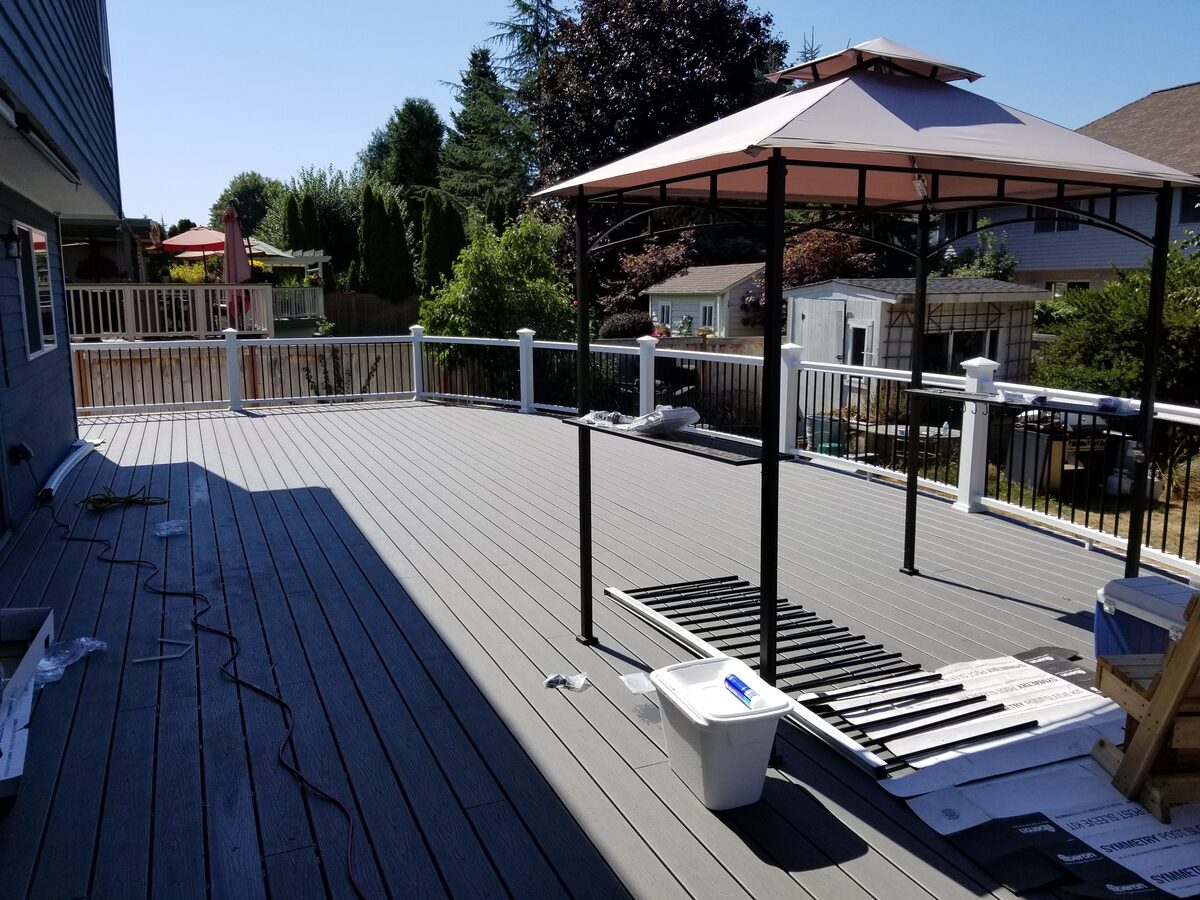
The Honest Maintenance Conversation
Here's where we have to be straight with you: cedar's environmental story depends heavily on how you maintain it. Unfinished cedar in Seattle will gray beautifully, but without periodic oiling or sealing — typically every 2-4 years — it will eventually begin to check, crack, and lose structural integrity. If you commit to that maintenance schedule, cedar can last 25-30 years. If you don't, you might be looking at replacement in 15 years or less.
The maintenance products themselves have an environmental footprint. Many traditional deck stains and sealers contain VOCs and chemical preservatives. If you're committed to eco-friendly cedar, you'll want to pair it with low-VOC, water-based finishes from companies like Cabot or DEFY. These products have improved dramatically in performance over the last decade.
We also recommend considering clear or semi-transparent finishes over solid stains for cedar, not just for aesthetics but because they're easier to recoat without the prep work that solid stains require. Less prep work means less solvent use and more consistent maintenance compliance over the life of the deck.
Tip
Cedar Decking Cost in Seattle
FSC-certified cedar typically runs $5-$8 per linear foot for the decking material itself, somewhat more than commodity cedar due to the certification premium. For a 400 square foot deck, expect to pay $3,500-$6,000 just for FSC cedar boards, before labor or any structural components. For a full comparison of material costs and what drives Seattle deck pricing, our deck cost guide breaks it down in detail.
Composite Decking: The Recycled-Content Revolution
Composite decking has undergone a remarkable transformation since the early generations of gray, plastic-looking boards that populated Seattle backyards in the early 2000s. Today's premium composites look genuinely like wood, perform better in wet conditions, and — most relevant to this article — are made in ways that represent a meaningful advance in materials sustainability.
Trex: The Recycled Content Standard-Bearer
Trex is the brand most Seattle homeowners have heard of, and its environmental story is genuinely impressive. Trex boards are made from 95% recycled content — a blend of reclaimed wood (sawdust and wood fiber from flooring and cabinet manufacturing) and polyethylene film (plastic bags and wrap collected at retail locations across the country). Trex is one of the largest recyclers of plastic film in North America, having diverted over 5.5 billion pounds of plastic from landfills since the company's founding.
The ICC-ES SAVE certification (VAR-1011), renewed in 2025, independently verifies that Trex products contain a minimum of 95.4% recycled content. This isn't marketing copy — it's a third-party verified specification. For Seattle homeowners who want to point to a certification when making their eco-friendly claim, Trex delivers.
In terms of Seattle performance, Trex's capped composite boards — the Transcend, Select, and Enhance lines — hold up well in our climate. The polymer cap that encases the wood-plastic core resists moisture infiltration, which is the critical failure mode for composite decking in wet climates. The cap also resists the mold and mildew growth that plagued first-generation composites.
Fiberon and the Broader Composite Market
Fiberon is another major player with strong recycled-content credentials. Fiberon's Concordia and Symmetry lines use recycled content including reclaimed wood fiber and recycled plastic, with the Concordia line achieving PVC-free composition. Fiberon also offers a broader range of profiles than Trex, including grooved and solid-edge options that accommodate different hidden fastener systems.
TimberTech (AZEK Company) takes a somewhat different approach with its AZEK line of cellular PVC decking, which uses no wood fiber at all — the boards are solid PVC with a foamed core. PVC is not biodegradable, but AZEK's boards are manufactured to last 50 years with minimal maintenance, and the company offers a recycling program for scrap material generated during installation.
For a deep dive into how these brands compare specifically for Seattle conditions, our Trex vs. Fiberon vs. TimberTech comparison covers performance, warranty, and pricing in detail.
100% Recycled HDPE Composites: The Next Level
At the premium end of the recycled-content spectrum sit 100% recycled HDPE (high-density polyethylene) decking products. Brands like ChoiceDek and Geodeck use plastic from post-consumer sources — primarily recycled milk jugs and detergent bottles — to manufacture boards that contain no wood fiber at all.
The environmental advantage is that HDPE is highly recyclable at end of life and contains no organic material that can support mold or rot. The disadvantage is that HDPE boards can feel more plastic-like underfoot than capped wood composites, and some homeowners find the aesthetic less satisfying.
Note
Approximate recycled content by material type. Composite products vary by line; figures represent flagship products. Source: manufacturer specifications.
| Category | Value |
|---|---|
| Trex Transcend | 95% |
| 100% HDPE Composite | 100% |
| Fiberon Concordia | 94% |
| TimberTech AZEK PVC | 0% |
| Thermally Modified Wood | 0% |
| FSC Cedar | 0% |
| Aluminum Decking | 75% |
Aluminum Decking: The Underrated Sustainable Option
Aluminum decking doesn't get much attention in eco-friendly conversations, which is somewhat puzzling given its sustainability profile. Aluminum is among the most recyclable materials on Earth — it can be recycled indefinitely without loss of quality, and recycling aluminum requires approximately 95% less energy than producing primary aluminum from bauxite ore.
The Sustainability Case for Aluminum
Most aluminum decking products contain substantial recycled content — typically 70-80% recycled aluminum from post-consumer and post-industrial sources. When that decking eventually comes down, it will be worth money as scrap aluminum and will almost certainly be recycled rather than landfilled. This creates a genuinely closed-loop material story that very few other decking options can match.
Aluminum decking also has one of the longest service lives in the category — 50+ years with virtually no maintenance beyond occasional washing. No staining, no sealing, no re-treating. In Seattle's climate, where wood maintenance is an ongoing commitment and even composite boards benefit from periodic cleaning, the minimal maintenance footprint of aluminum has real environmental value.
From a performance standpoint, aluminum is impervious to rot, insects, and moisture damage — the three threats that claim the most Seattle decks prematurely. It doesn't support mold or mildew growth. It doesn't warp, cup, or check. In the Issaquah highlands or along a Mercer Island waterfront where moisture is constant and severe, aluminum can be the most practical choice.
Practical Considerations
Aluminum decking costs more upfront than most wood or composite options — typically $20-$35 per square foot installed, compared to $15-$25 for premium composite. But over a 50-year lifecycle, that premium looks very different. The absence of maintenance costs and the near-certain avoidance of replacement cycles make aluminum increasingly competitive on a lifecycle cost basis.
The aesthetic is different from wood — aluminum decking has a distinctive planked appearance that reads more modern than rustic. For contemporary architecture in neighborhoods like South Lake Union or in the new construction going up around the Eastside, this aesthetic can be a perfect fit. For a craftsman bungalow in Wallingford, it may feel incongruous.
Aluminum also gets hot in direct sun — a consideration for decks on south-facing exposures without shade. In Seattle's limited full-sun periods this is less of an issue than in sunnier climates, but it's worth noting for exposed south-facing decks.
Tip
Thermally Modified Wood: Chemical-Free Durability
Thermally modified wood is one of the most interesting sustainable decking innovations of the past two decades, and it's genuinely underappreciated in the Seattle market. The concept is straightforward: by subjecting wood to temperatures of 400-500°F in a steam environment, manufacturers fundamentally alter the wood's cellular structure in ways that dramatically improve its durability — without using any chemical preservatives whatsoever.
How Thermal Modification Works
The thermal modification process removes the sugars, starches, and moisture from wood cells that make them attractive to decay fungi, insects, and rot-causing bacteria. The result is a wood product that is significantly more dimensionally stable, more resistant to moisture absorption, and more durable than the same species in its unmodified form.
Thermory, a leading European manufacturer, documents the change in durability class: thermally modified pine, for example, moves from durability class 4-5 (not durable) to class 2 (durable), with an expected outdoor lifespan of 15-25+ years. Thermally modified ash, which has superior density, achieves class 1 durability with an expected lifespan exceeding 25 years.
Why This Matters for Seattle
The specific appeal of thermally modified wood in a Seattle context is the combination of genuine longevity with zero chemical inputs. Pressure-treated lumber — the traditional approach to extending wood durability — uses chemical preservatives (typically copper azole in modern formulations) that do raise end-of-life disposal questions and represent chemical manufacturing inputs. Thermally modified wood achieves comparable or superior durability through a purely physical process.
For Seattle homeowners who prioritize both longevity and the avoidance of chemical treatments, thermally modified wood occupies a compelling niche between natural cedar and composite decking. It looks and feels like real wood — because it is real wood. It can be finished with oils or left to silver naturally. And it won't require replacement in 15 years from rot damage, which is the fate of inadequately maintained natural wood in our climate.
Species Options and Sourcing
Thermally modified ash, pine, and radiata pine are the most common species available through Pacific Northwest suppliers. The sustainability of thermally modified wood depends significantly on the sourcing of the base species — thermally modified wood from FSC-certified forests carries the full sustainability chain from source to finish.
Costs for thermally modified decking boards typically run $8-$14 per linear foot, positioning it between premium cedar and premium composite in cost. Installation costs are comparable to cedar or composite.
Important
Reclaimed Wood and Tropical Hardwoods: The Nuanced Cases
Two material categories require more careful sustainability analysis than their marketing often suggests: reclaimed wood and tropical hardwoods. Both have genuine appeal, but both come with complications that Seattle homeowners should understand before committing.
Reclaimed Wood: Romantic, But Complicated
The appeal of reclaimed wood decking is real. Barn boards, old-growth timber pulled from demolished industrial buildings, or salvaged timbers from deconstructed structures represent material that was already produced — often from old-growth forests that no longer exist — repurposed without any new forestry impact. From a pure sourcing standpoint, reclaimed wood has an unimpeachable sustainability story.
The complications arise in practice. First, pest and mold history is unknown. Old-growth timber salvaged from a historic building could carry dormant insect infestations, mold colonies, or previous chemical treatments that aren't visible on the surface. Second, old-growth wood often has high density and natural durability, but you can't always verify the species and its actual performance characteristics from visual inspection alone.
Third, and most practically for Seattle: installing reclaimed wood requires working with material of varying dimension, potentially inconsistent moisture content, and often embedded fasteners or other hazards that slow installation and increase labor costs. What sounds like a budget-friendly choice can become expensive when the complexity of the installation is fully accounted for.
If you pursue reclaimed wood, work with a reputable Pacific Northwest reclaim supplier who can document the source building, the species, and any treatments the wood may have received. Get it kiln-dried before installation if possible — this addresses moisture content and kills any dormant biological threats.
Ipe and Tropical Hardwoods: Durability vs. Sourcing
Ipe (pronounced "ee-pay") and other tropical hardwoods — Cumaru, Garapa, Tigerwood — deliver exceptional durability. Ipe in particular has a 25-40 year outdoor lifespan with proper maintenance, a Class A fire rating, and natural resistance to rot and insects that requires no chemical treatment. In terms of raw performance in Seattle's climate, it's outstanding.
The sustainability concern is sourcing. Tropical hardwood forests in Brazil and Southeast Asia have faced significant illegal logging and deforestation pressures. Some ipe in the market comes from legitimate FSC-certified sources, but the supply chain verification is more complex and less reliable than for domestic species.
If you're drawn to tropical hardwoods for their performance characteristics, the critical question is FSC certification with a verifiable chain of custody. Without that documentation, the environmental claim is unverifiable — and the risk of inadvertently supporting unsustainable forest practices is real.
We generally recommend that Seattle homeowners who prioritize sustainability look first at thermally modified domestic species, which deliver comparable durability performance without the sourcing complexity. For those committed to tropical hardwoods, verified FSC certification from a documented source is the non-negotiable minimum.
Key insight
Seattle's Climate and the Lifecycle Analysis
We keep coming back to lifecycle analysis because it fundamentally changes how you rank decking materials on sustainability. Let us show the math in Seattle's context.
The Replacement Cycle Problem
Imagine a 400-square-foot deck. Here's a simplified lifecycle comparison over 45 years:
Scenario A: Untreated cedar, replacement every 15 years
- Three complete deck builds over 45 years
- Three sets of material production and transportation
- Three disposal events (pressure-treated framing generates special disposal considerations)
- Three sets of installation labor and its associated transportation
Scenario B: Premium composite with 40-year warranty
- One deck build, potential board refresh at year 25 if aesthetics drive it
- One set of material production
- Minimal end-of-life disposal concern (boards can potentially be recycled)
Even if the composite deck has a more energy-intensive manufacturing process than cedar, the cedar that needs replacement three times over the same period almost certainly carries a higher total lifecycle environmental impact — especially in a climate where premature rot is a realistic failure mode.
Seattle's Climate Context
King County averages 38 inches of precipitation annually, distributed across a long rainy season that runs roughly from October through May. But that number understates the challenge, because much of our precipitation falls as persistent drizzle rather than heavy downpours. Standing water issues aside, it's the chronic ambient humidity — surfaces that are perpetually damp rather than cyclically wet and dry — that creates the most challenging conditions for organic materials.
Fungal growth requires moisture, oxygen, and an organic food source. Seattle's climate provides the first two in abundance from October through May. The difference between a 15-year and a 30-year deck lifespan often comes down to whether the decking material gives fungal organisms that organic food source.
Composite decking, thermally modified wood, and aluminum all deny fungi their food source in different ways. FSC-certified cedar provides it — mitigated by those natural oils — but requires maintenance to keep those oils effective. This is why our sustainability analysis consistently circles back to the same conclusion: material durability matters as much as material composition in Seattle's climate.
Alignment with Seattle's Sustainability Goals
Seattle's commitment to sustainability is embedded in city policy. The Seattle Department of Construction and Inspections (SDCI) runs Green Building programs that provide incentives for environmentally responsible construction. The One Seattle Climate Action Plan establishes ambitious goals for reducing the city's overall environmental footprint.
Residential decking isn't directly regulated by commercial green building standards like LEED, but the principles translate. Choosing durable, responsibly sourced materials for your deck is consistent with the values that drive Seattle's broader sustainability agenda — and for homeowners who care about alignment with community values, that matters.
Some green building certifications do include residential credits for responsible material sourcing. LEED for Homes, for example, awards credits for materials with verified recycled content, FSC-certified wood products, and locally sourced materials. If you're building a home or undertaking a comprehensive renovation that might pursue LEED for Homes certification, your decking choices can contribute to that certification pathway.
Estimated lifespan ranges based on Seattle climate conditions and manufacturer documentation. Actual results depend on installation quality and maintenance compliance.
| Category | Value |
|---|---|
| Untreated Cedar (no maintenance) | yrs10 |
| Cedar (maintained) | yrs25 |
| Pressure-Treated Pine | yrs20 |
| Composite (capped) | yrs40 |
| 100% HDPE Composite | yrs50 |
| Thermally Modified Wood | yrs30 |
| Aluminum | yrs50 |
| FSC Ipe (verified) | yrs35 |
Certifications, Standards, and How to Verify Claims
The sustainable building materials market includes a significant amount of greenwashing — claims of environmental responsibility that aren't backed by verifiable standards. Knowing which certifications to look for, and how to verify them, protects you from paying a premium for marketing language rather than genuine sustainability.
Forest Stewardship Council (FSC)
FSC certification is the gold standard for wood products. It requires:
- Chain-of-custody documentation from certified forest to end product
- Forest management practices that maintain biodiversity, worker rights, and community rights
- Prohibition on conversion of natural forests to plantations
- Annual audits by accredited third-party certification bodies
When a supplier claims FSC certification, ask for the certification number and verify it at info.fsc.org. Legitimate FSC-certified products can be traced through this database. If a supplier can't provide a verifiable certificate number, the claim may not be legitimate.
Sustainable Forestry Initiative (SFI)
SFI is a North American certification standard that's somewhat less rigorous than FSC — it allows fiber sourcing from non-certified suppliers under certain conditions, and the auditing requirements are different. SFI is broadly recognized in the building industry and represents a meaningful improvement over uncertified sourcing, but sustainability advocates generally prefer FSC for its stricter requirements.
ICC-ES SAVE Verification (Composite Decking)
The ICC Evaluation Service's Sustainable Attributes Verification and Evaluation (SAVE) program provides third-party verification of manufacturers' sustainable attributes claims for composite and other building products. Trex's 95% recycled content claim is backed by ICC-ES SAVE certification VAR-1011. When comparing composite brands, look for this kind of independent verification rather than relying on manufacturer self-reporting.
LEED Credits for Residential
LEED (Leadership in Energy and Environmental Design) for Homes awards credits relevant to decking material choices:
- MR Credit: Certified Wood — requires a minimum percentage of wood products to be FSC-certified
- MR Credit: Recycled Content — credits materials with verified pre- or post-consumer recycled content
- MR Credit: Regional Materials — credits materials extracted and manufactured within 500 miles of the project
If you're pursuing LEED for Homes certification, work with your contractor and LEED AP to understand how decking choices contribute to these credits. Note that decking is a smaller portion of the overall materials budget than structural and finish materials, so its LEED credit contribution will be proportionally modest — but it counts.
What to Ask Your Contractor
When you're evaluating contractors and proposals for an eco-friendly deck, ask:
- Can you provide the FSC chain-of-custody certificate for the cedar or wood products you're specifying?
- What is the verified recycled content percentage for the composite you're recommending, and can you show me the ICC-ES or equivalent certification?
- How do you handle material waste on-site — do you recycle or properly dispose of composite offcuts and treated wood waste?
- Can you provide references for decks you've built with eco-friendly materials in Seattle that are five or more years old?
Our guide on how to find a deck builder in Seattle and questions to ask your deck builder provide additional frameworks for vetting contractors on sustainability and quality dimensions.
Note
Making Your Decision: A Seattle Homeowner's Framework
After all of this, how do you actually choose? Here's how we work through this with Seattle clients.
Prioritize by Your Values Hierarchy
Different homeowners weight sustainability dimensions differently, and that's legitimate. If your primary sustainability concern is keeping materials out of landfills, high-recycled-content composite like Trex is your best answer. If your primary concern is forest health and you want to support sustainable forestry in the Pacific Northwest, FSC-certified cedar or thermally modified wood from a verified source makes sense. If your primary concern is lifecycle impact and minimizing replacement cycles, aluminum or capped composite with a 40+ year warranty delivers the best result.
Be honest about maintenance commitment. If you're not going to refinish cedar every 2-4 years — and many Seattle homeowners aren't, because life gets busy — then choosing cedar for its "natural" credentials but failing to maintain it is actually worse for the environment than choosing a low-maintenance composite that will last without intervention.
Factor in Seattle's Specific Climate Demands
Materials rankings that make sense in dry climates may not translate to King County. Western exposure decks in Seattle neighborhoods like Magnolia or West Seattle, where moisture-laden Puget Sound air dominates, demand materials with proven wet-climate performance. North-facing decks in tree-shaded yards in Bellevue or Kirkland may never fully dry out between our October-May rainy seasons.
For high-moisture, low-sun exposure situations — which are common in Seattle's dense residential neighborhoods — we lean toward capped composite or thermally modified wood over natural cedar, purely on durability grounds. A sustainable material that fails early is a sustainability failure, not a success.
Consider the Total Cost of Ownership
Our composite vs. cedar comparison and our best decking materials guide for 2026 both work through total cost of ownership over 30-40 year horizons. The upfront cost difference between materials looks very different when you factor in maintenance costs, potential replacement costs, and the time value of your effort.
For most Seattle homeowners pursuing eco-friendly goals, our recommendation hierarchy is:
| Priority | Best Choice | Second Choice |
|---|---|---|
| Minimize landfill waste | Trex / 100% HDPE Composite | Fiberon Composite |
| Support regional forestry | FSC Cedar (+ maintenance commitment) | Thermally Modified Wood |
| Minimize lifecycle impact | Aluminum | Premium Capped Composite |
| No chemical inputs | Thermally Modified Wood | FSC Cedar |
| Maximum longevity | Aluminum | 100% HDPE Composite |
| Balance of all factors | Premium Capped Composite | Thermally Modified Wood |
Permits, HOA, and Local Requirements
Whatever eco-friendly material you choose, you'll still need to navigate King County's permitting requirements for decks above a certain size and height. Permits aren't just bureaucratic hurdles — they ensure your deck is built safely and to code, which itself extends its useful life. Our King County deck permit guide walks through the process in detail.
If you're in an HOA community — common in Eastside neighborhoods like Redmond's Trilogy or Sammamish's Trossachs — your HOA may have specific requirements about decking materials, colors, and finishes. Our HOA deck approval guide for King County covers the approval process and how to document eco-friendly material choices for HOA review.
Get a Sustainable Deck Estimate from The Seattle Decking Company
Choosing eco-friendly decking materials is a meaningful decision, but it needs to be executed by a team that understands both the materials and the specific conditions of your site. A composite deck installed without proper ventilation and drainage will still develop mold problems. FSC cedar installed without adequate spacing will cup and warp. The sustainability of your material choice is only realized when the installation is done right.
At The Seattle Decking Company, we've worked with the full range of sustainable decking materials across King County — from FSC cedar projects in Shoreline to high-recycled-content Trex builds in Bellevue to thermally modified wood installations on Mercer Island. We can walk you through the sustainability dimensions of each option, provide references for similar projects we've completed, and give you an honest assessment of which material makes the most sense for your specific site, exposure, and maintenance commitment.
We'd love to talk through your project. Call us at (425) 675-6259 or reach out through our contact page to schedule a free on-site consultation. We'll look at your yard, understand your goals — sustainability and otherwise — and give you a clear proposal with materials that will actually hold up to Seattle's climate for decades.
You can also explore our material-specific service pages for more detail: composite decking, cedar decking, and PVC decking. And if you're still working through the numbers, our deck financing options guide covers the various ways Seattle homeowners fund these projects.
The most sustainable deck is a well-built deck that lasts. Let's build you one.
Frequently Asked Questions
What is the most eco-friendly decking material for a Seattle home?
How much does eco-friendly decking cost in Seattle compared to standard options?
Does FSC-certified cedar really make a difference environmentally?
How does Seattle's rainy climate affect the sustainability of my decking choice?
Is composite decking really eco-friendly if it's made of plastic?
What is thermally modified wood, and why is it considered sustainable?
Can I get LEED credits for my residential deck if I use eco-friendly materials?
What's the difference between FSC and SFI certifications for wood decking?
Is reclaimed wood a good sustainable decking option for Seattle?
How does aluminum decking compare to composite for sustainability in Seattle?
Do eco-friendly decking materials require different permits in King County?
Where can I buy FSC-certified cedar or sustainable decking materials in the Seattle area?
Planning a deck in the Seattle area?
Get an onsite design review and a clear, itemized quote from a licensed local builder.
Request a Free Quote