
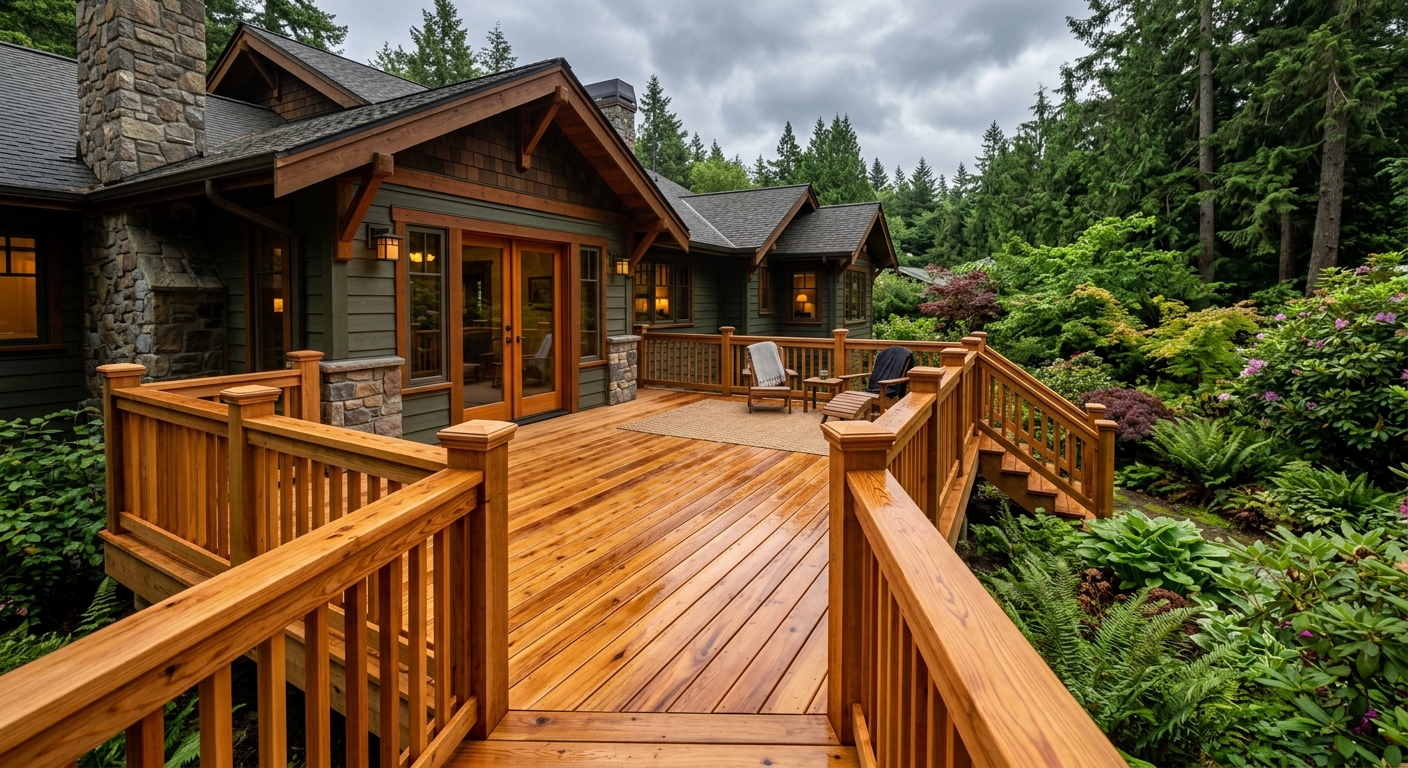
If you've been wondering whether a new deck is a smart financial move before listing your Seattle home — or whether you're simply spending money you won't get back at closing — you're asking exactly the right question. Here's the short answer: in the Pacific Northwest, a quality deck addition is one of the highest-returning exterior remodeling projects you can undertake. The 2025 Remodeling Impact Report from the National Association of Realtors put wood deck additions at a 95% cost-recouped figure nationally, and the Pacific region — which includes Washington state — consistently outperforms that number. In the 2025 Zonda Cost vs. Value data cycle, the Pacific region ranked as the top remodeling ROI region in the entire country for the first time in the report's 23-year history.
That matters enormously for King County homeowners. When the median home price is hovering around $880,000 to $900,000 and buyers are competing for every listing that offers genuine outdoor living space, a well-built deck doesn't just add square footage — it changes the conversation at the negotiating table. Buyers in Seattle aren't buying decks the way buyers in Minneapolis or Phoenix are. They're buying them because they know the Cascade Mountain views, the long PNW summer evenings, and the culture of outdoor living here make a functional deck a core feature, not an upgrade.
This article breaks down the actual ROI numbers from verified industry sources, explains how King County's high home prices amplify the math, walks through the composite vs. wood distinction that most homeowners get wrong, and gives you an honest builder's perspective on what buyers in Seattle neighborhoods actually pay premiums for versus what they don't.
What the 2025 Data Actually Says About Deck ROI in the Pacific Region
The numbers that get quoted most often in deck ROI conversations come from two primary sources: the annual Zonda Cost vs. Value Report (formerly published by Remodeling Magazine) and the NAR's Remodeling Impact Report. Both are based on real survey data from real estate professionals and remodeling contractors, but they measure slightly different things — and understanding that distinction changes how you read the numbers.
The Cost vs. Value Report asks: what does this project cost to build, and what does it add to resale value according to real estate agents in your market? The NAR's Remodeling Impact Report asks: what did homeowners actually recoup at sale, and what was their satisfaction with the project? Both are worth reading. Neither tells the whole story alone.
The 111% Figure — What It Means and Where It Comes From
The 111% cost-recouped figure for wood deck additions in the Pacific region has been cited in multiple cycles of the Cost vs. Value Report for the western states. What it means is that homeowners in the Pacific region (Washington, Oregon, California) who built wood decks recouped, on average, more than 100% of their project cost at resale — meaning the deck paid for itself and then some.
This happens for a few interconnected reasons. First, the underlying land and home values in the Pacific region are among the highest in the country, so the dollar-per-square-foot calculation for outdoor living space scales up with the home's base value. Second, PNW buyers are culturally primed to value outdoor space — years of low inventory and a tech-worker buyer pool that prioritizes lifestyle features have trained the market to pay for quality outdoor living. Third, homes without decks in many King County neighborhoods are increasingly seen as having a "missing feature" rather than simply a neutral absence.
National Baseline vs. Pacific Region Reality
Nationally, the 2025 data shows:
| Project | National Avg Cost | National Resale Value | National ROI |
|---|---|---|---|
| Wood Deck Addition | ~$17,000–$18,200 | ~$16,100–$17,300 | 93–95% |
| Composite Deck Addition | ~$24,200–$25,100 | ~$21,300–$22,300 | 87–89% |
In Seattle, where labor costs run 15–25% higher than the national average and material costs reflect West Coast supply chains, your actual deck investment will be higher than these national figures. A 300–400 sq ft pressure-treated wood deck in King County typically runs $18,000–$28,000 installed. A composite deck of similar size runs $28,000–$45,000 depending on the brand and features. See our full breakdown at /blog/deck-cost-seattle-2025 for current pricing.
The Pacific region's elevated ROI means that even with those higher build costs, you're still coming out ahead of the national average at resale — and in many King County submarkets, you're coming out significantly ahead.
Key insight
How Real Estate Agents in Seattle Price Decks
When listing agents in King County pull comps for a home with a quality deck versus one without, the adjustment is real and measurable. In neighborhoods like Kirkland, Bellevue, Issaquah, and the Eastside suburbs, a 400 sq ft composite deck in good condition with cable railings and proper permitting can warrant a $15,000–$25,000 positive adjustment in the comparable sales analysis. In higher-end neighborhoods — Medina, Clyde Hill, Mercer Island, Queen Anne — that adjustment can run higher, particularly when the deck is integrated with the architecture and offers mountain or water views.
The key phrase here is "in good condition." A deck that's visibly weathered, has soft spots, missing balusters, or shows signs of deferred maintenance actually hurts your listing rather than helping it. Buyers see it and mentally add a discount for the cost to repair or replace.
King County's Home Prices Amplify the Deck ROI Math
This is the part that most national ROI articles miss, and it's arguably the most important factor for Seattle homeowners.
When the national Cost vs. Value data establishes a 95% ROI for wood decks, it's averaging across markets where median home prices range from $200,000 in some Midwest cities to $900,000+ in Seattle. The absolute dollar value of a percentage-point gain in home value is wildly different depending on where you live.
The $880K Median Price Effect
King County's median home sale price in the first half of 2026 has ranged between $859,000 and $907,000 depending on the month, with the three-month rolling average near $887,000 according to Redfin's King County market data. At those price points, here's what the deck ROI math actually looks like in practice:
Based on 1–3% value lift from quality deck addition. King County median ~$887K vs. national median ~$420K (2025 data).
| Category | Value |
|---|---|
| National: 1% lift ($420K home) | $4,200 |
| National: 2% lift ($420K home) | $8,400 |
| King County: 1% lift ($887K home) | $8,870 |
| King County: 2% lift ($887K home) | $17,740 |
| King County: 3% lift ($887K home) | $26,610 |
A 2% lift in home value is entirely realistic for a quality, permitted deck in a King County neighborhood where outdoor living is expected. That's $17,740 in added value on an $887,000 home — potentially covering the majority of a wood deck project, or a significant chunk of a composite deck build.
Neighborhood-Level Comparables: Where Decks Move the Needle Most
Not every King County neighborhood responds the same way to a deck addition. Appraisers and listing agents use a "comparables approach" — they look at what similar homes with and without decks have actually sold for in the same area over the past 6–12 months. In neighborhoods where nearly every home has a deck, the absence of one is a deficiency. In neighborhoods where decks are common but not universal, a high-quality deck commands a premium.
Markets where decks have the highest ROI impact:
- Eastside suburbs (Kirkland, Redmond, Issaquah, Sammamish): Lots are often larger, buyers are tech-adjacent and accustomed to premium finishes, and the mountain views from decks are a genuine selling point.
- Bellevue and Mercer Island: High price points amplify dollar-value of percentage gains; buyers expect full outdoor living packages.
- North Seattle (Shoreline, Kenmore, Bothell corridor): Strong demand, family buyers who heavily value functional backyard space.
- South King County (Renton, Kent, Auburn): More price-sensitive buyers, but quality decks still differentiate listings in competitive micro-markets.
Note
Composite vs. Wood Deck: The ROI Difference Seattle Buyers Actually Care About
The ROI math for composite vs. wood decks is counterintuitive to most homeowners. On paper, wood decks have a higher percentage ROI (95% vs. 89% nationally). But that framing obscures what's actually happening in the Seattle market, where buyers are making nuanced decisions about long-term cost of ownership.
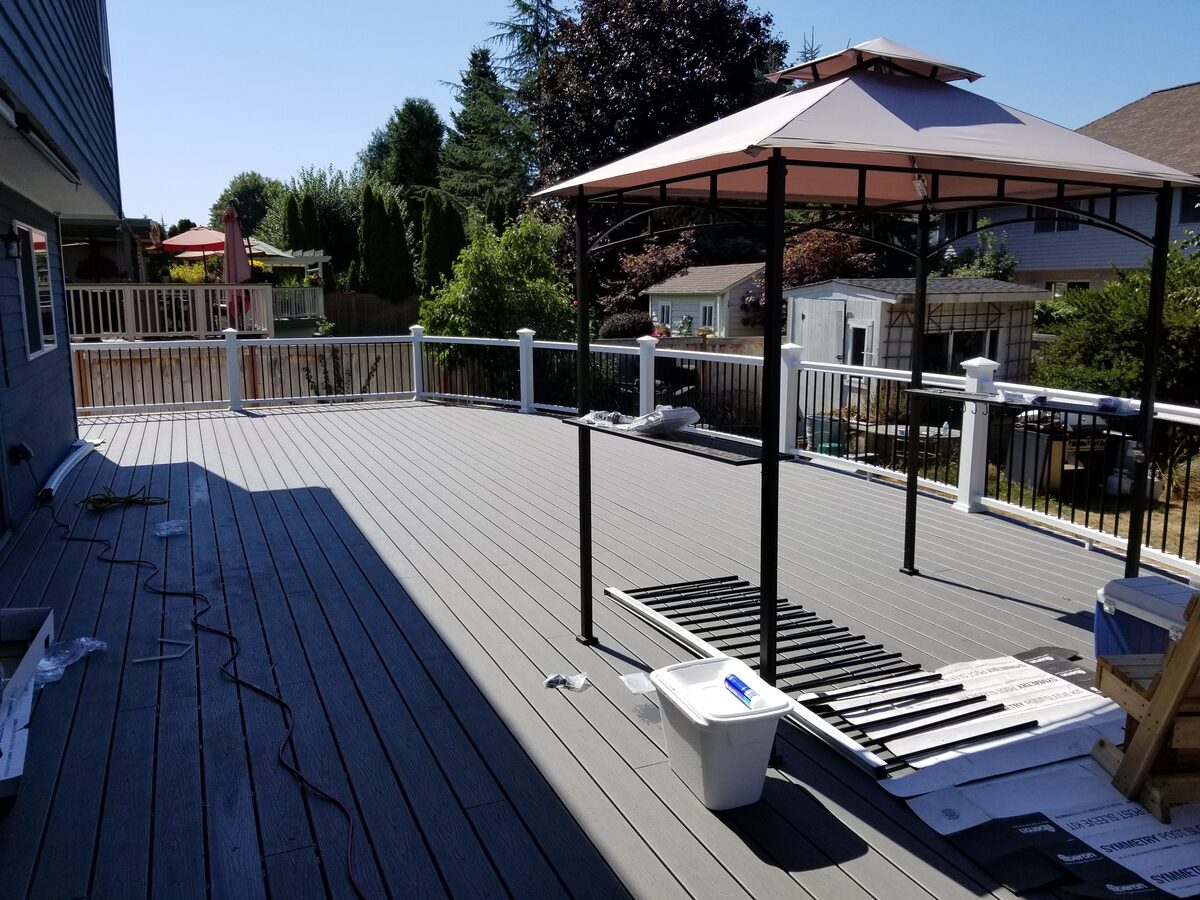
Why Wood Decks Have Higher Percentage ROI
Wood decks — primarily pressure-treated pine or western red cedar — cost less to build than composite, so the percentage recouped is naturally higher on a lower base cost. A $20,000 cedar deck that adds $19,000 in value is a 95% return. A $35,000 composite deck that adds $30,000 in value is an 86% return. The composite deck added more total dollars to the home value, but at a lower percentage.
This matters when you're comparing projects in isolation, but it doesn't necessarily mean wood is the better financial choice for a Seattle homeowner planning to stay in the home for 3–7 more years.
Why Composite Commands a Premium in Seattle's Buyer Market
Seattle buyers in the $700K–$1.2M range are almost uniformly looking for low-maintenance homes. The combination of high-pressure jobs (Amazon, Microsoft, Boeing ecosystem), long commutes on I-5 and I-405, and expensive contractors means buyers are actively paying premiums for features that require less weekend maintenance.
A 10-year-old cedar deck that hasn't been restained in 3 years looks tired. It telegraphs maintenance deferred — and buyers who see it are wondering what else hasn't been maintained. A 10-year-old Trex, Fiberon, or TimberTech composite deck that still looks clean and intact? That's a selling point, not a liability.
From an appraiser's perspective, composite materials are weighted more favorably than wood when the deck is 5+ years old, because appraisers account for depreciation. A composite deck depreciates more slowly than wood, meaning its residual value at the time of sale is higher relative to its original cost.
Tip
What the Materials Comparison Table Looks Like
| Feature | Pressure-Treated Wood | Western Red Cedar | Composite (Trex/Fiberon/TimberTech) |
|---|---|---|---|
| Initial cost (400 sq ft, Seattle) | $18,000–$24,000 | $22,000–$30,000 | $28,000–$45,000 |
| Lifespan (maintained) | 15–20 years | 20–30 years | 25–30+ years |
| Annual maintenance cost | $500–$800/yr | $600–$1,000/yr | $50–$150/yr |
| ROI at resale (national avg) | ~95% | ~90% | ~87–89% |
| Appraiser depreciation rate | Higher | Moderate | Lower |
| Seattle buyer appeal | Good | Strong | Strongest |
The lifetime cost picture often flips: a composite deck that costs $10,000 more upfront may save $8,000–$12,000 in maintenance over a decade, making the total cost of ownership comparable or lower. See /blog/deck-staining-vs-composite-seattle for the full 10-year cost comparison.
The Appraiser's Perspective: How Decks Get Valued at Closing
Understanding how appraisers actually handle decks removes a lot of the mystery from the ROI question. Appraisers don't assign a fixed dollar figure to a deck based on what it cost to build — they use the comparable sales method, which means they look at what similar homes with and without decks have actually sold for in the same market area.
The Comparable Sales Approach
An appraiser valuing your $900,000 Kirkland home with a 400 sq ft composite deck will search for recent sales of similar homes in the area. If three comparable homes without decks sold at $875,000, $880,000, and $870,000 — and two comparable homes with quality decks sold at $905,000 and $910,000 — the appraiser will make a positive adjustment for the deck. The adjustment typically reflects the market evidence, not the cost-to-build.
This is why the "deck cost $35,000 so it should add $35,000 in value" expectation is unreliable. The market dictates the adjustment. In a hot market where buyers are competing, deck adjustments run higher. In a normalizing market like 2025–2026 King County (where inventory has risen 30%+), adjustments are still positive but may be more modest.
What Appraisers Look for in a Deck
Appraisers are trained to assess condition, functionality, and integration with the property. Specific factors that raise or lower the appraised value of a deck:
Positive factors:
- Proper permits and final inspections (verifiable through public records)
- Materials consistent with or above the home's finish level
- Good structural condition (no soft spots, secure ledger attachment, proper footings)
- Integration with the home's architecture (sliding glass doors, continuous sightlines)
- Functional features: built-in seating, lighting, pergola or cover, outdoor kitchen
Negative factors:
- Missing or incomplete permits
- Visible weathering, rot, or deferred maintenance
- Poor workmanship (uneven boards, missing balusters, exposed fasteners on premium finishes)
- Materials significantly below the home's finish level (e.g., pressure-treated wood on a $1.2M home)
- Structural concerns flagged by the home inspector
Important
Permits and Their Effect on Appraisal in Seattle
The Seattle Department of Construction & Inspections (SDCI) requires permits for most deck additions — particularly any deck more than 30 inches above grade, attached to the house, or in a regulated shoreline or environmentally critical area. King County has parallel requirements for unincorporated areas.
When an appraiser pulls comps in Seattle, they're working with MLS data that agents populate with features — including whether a deck exists and is permitted. When an appraiser or buyer's agent checks SDCI's public permit portal and finds no record of the deck, it creates an immediate problem: the structure is technically unpermitted, may not meet current code, and cannot be reliably valued as an asset.
The cost to retroactively permit an existing deck — going through SDCI's after-the-fact permit process, hiring an engineer to verify the structure, potentially upgrading footings or railings to current code — can run $3,000–$10,000 or more. Doing it right the first time costs significantly less and adds the appraiser's confidence in the structure's legitimacy.
Covered vs. Uncovered Decks: Seattle's Hidden ROI Multiplier
This is where Seattle diverges most dramatically from national deck ROI data, and it's the conversation we have with almost every client who asks about adding a deck before selling.
Seattle Gets 150+ Rain Days Per Year
According to NOAA climate data for the Pacific Northwest, Seattle averages around 150 days of measurable precipitation annually. The rain is rarely heavy — it's the persistent grey drizzle from October through April — but it fundamentally shapes how residents use outdoor spaces. An uncovered deck in Seattle sits unused from November through March. A covered deck with a pergola, attached roof extension, or full outdoor room is usable 10–11 months a year.
Buyers in King County have internalized this. When they walk through a listing and see an uncovered deck, they're mentally calculating the months it'll actually be useful. When they see a covered deck — especially one with string lights, a ceiling fan, and a gas line for a heater — they see a functional extension of their living space that genuinely works in the PNW climate.
The ROI Premium for Covered Decks in Seattle
Our experience building decks across King County — from Bothell to Bellevue to Burien — is that a quality covered deck commands a 15–25% higher dollar-per-square-foot premium over an uncovered deck at resale, when controlling for other variables. Part of this is the additional cost of the cover structure. But a significant part is genuine buyer preference and willingness to pay.
A well-executed pergola with polycarbonate roof panels and integrated lighting on a 400 sq ft deck might add $8,000–$12,000 to the project cost. At resale, that investment in coverable outdoor space frequently generates buyer interest that drives competing offers — which is where the real return lives. See our full guide on covered decks and pergolas for Seattle-specific design options.
Key insight
What Buyers in Seattle Are Actually Searching For
When listing agents in King County conduct buyer preference surveys and track search filter behavior on Redfin and Zillow, "outdoor living space" consistently ranks in the top 5 amenities. But the composition of what buyers mean by that has shifted:
- 2019: A deck or patio with some landscaping
- 2022: Deck with fire pit or outdoor seating area
- 2025–2026: Covered outdoor living space with functional cooking, heating, and lighting — an actual outdoor room
This trend reflects both the post-COVID shift toward home as primary social venue and the PNW climate reality that finally made Seattle buyers less willing to compromise on usability. If you're adding a deck before selling in 2026, building a covered or partially covered structure isn't an indulgence — it's market positioning.
Deck Condition's Effect on Sale Price: The Deferred Maintenance Penalty
One of the most underappreciated aspects of deck ROI is that a deck in poor condition doesn't just fail to add value — it actively subtracts from your sale price. Home inspectors in Seattle are trained to evaluate decks thoroughly, and their findings go directly into the report that buyers use to negotiate concessions.
What Home Inspectors Flag on Decks
The National Association of the Remodeling Industry (NARI) notes that exterior project condition is one of the strongest predictors of buyer perception. For decks specifically, Seattle-area home inspectors commonly flag:
- Ledger connection issues: The point where the deck attaches to the house is the highest-stakes structural element. Improper ledger flashing allows water intrusion into the rim joist and can lead to hidden rot inside the wall system. This is the single most common deck defect in Seattle inspections.
- Post-to-footing connection: Aging decks built before 2005 often have posts sitting directly on concrete footings without proper post bases — which allows moisture wicking and accelerates rot.
- Soft decking boards: Individual board rot or softness, particularly near the ledger and around planters.
- Railing height and baluster spacing: Current IRC code requires 36-inch railings for decks under 30 inches above grade, 42-inch for higher decks, and baluster spacing under 4 inches. Older decks frequently don't meet current code.
- Stair structure and handrails: Non-continuous stair handrails and improperly spaced stringers are common flags.
Each of these findings becomes a negotiating chip. A buyer who gets a home inspection report listing 8 deck deficiencies will typically request either a price reduction or a credit — and their agent will price those corrections at retail contractor rates, not your cost basis.
The True Cost of Deferred Deck Maintenance
We've worked on numerous pre-listing deck repairs for Eastside and North Seattle homeowners, and the pattern is consistent: a deck that needed $2,000–$4,000 in maintenance over the past 5 years is now generating $8,000–$15,000 in buyer concession requests at closing. The math of deferred maintenance is punishing.
If you're planning to sell within 24 months and your wood deck is more than 8 years old, a professional inspection and targeted repairs are worth doing now. Our deck repair service includes a full structural assessment that gives you the same checklist a home inspector will use — so you know exactly what to address before listing. See also our deck winter inspection guide for a checklist you can use to self-assess condition.
Tip
Time-to-Sell Impact: Does a Quality Deck Speed Up Your Listing?
Home sellers in King County are now dealing with an inventory environment that's materially different from 2021–2022. Active listings across King County rose by nearly 35% in 2025–2026 compared to the prior year, according to Redfin market data. More inventory means buyers have choices, and homes with differentiating features — including quality outdoor living spaces — tend to spend fewer days on market.
What Agent Data Shows About Deck-Listed Homes
Listing agents in competitive King County submarkets consistently report that homes with well-presented outdoor living areas:
- Generate higher showing volume in the first 7 days on market
- Receive offers faster — often within the first open house weekend
- Are less likely to require price reductions after 21+ days on market
The mechanism is simple: online listing photos that feature a beautiful deck as a primary selling image attract more clicks, more showings, and more offers. In an era when 95%+ of home searches begin online and buyers make showing decisions based on thumbnail images, curb appeal extends to your outdoor living space.
The Photography Factor
A professionally staged and photographed composite deck with cable railings, a pergola, and outdoor furniture photographs extraordinarily well. It creates the lifestyle image that sells homes. A weathered, furniture-free pressure-treated deck with aging gray boards does the opposite.
If you're listing with an existing deck and not planning to replace it, at minimum: power wash the deck, apply fresh stain or sealant if it's wood, replace any visibly damaged boards, add fresh railing hardware, and stage it with outdoor furniture and plants before photos. The cost of this prep — $500–$2,000 — pays for itself in photos alone.
Before-and-After: Real Listing Examples from King County
While we can't share specific client addresses or MLS numbers for privacy reasons, we can share composite profiles based on our work across King County neighborhoods.
Case Study 1: Kirkland Craftsman, Uncovered Wood Deck Replacement
Situation: 1990s Craftsman in North Kirkland. Original pressure-treated deck, 320 sq ft, showing significant weathering. Ledger had minor rot at one corner. Owners planning to list in spring 2025.
Work done: Full tear-down and rebuild with Trex Transcend composite decking, hidden fasteners, white aluminum railing with stainless cable infill, new composite stairs. Proper permit pulled through King County. Total project: $31,500.
Outcome: Home listed at $895,000. Received 3 offers in first weekend, accepted at $912,000. Listing agent attributed approximately $15,000–$20,000 of the above-ask premium to the deck presentation (along with the updated kitchen). Days on market: 6.
Case Study 2: Bothell Rambler, No Deck
Situation: 1980s rambler in south Bothell, backing to a green belt. No deck — just a cracked concrete patio. Owners originally planned to list "as-is" and price accordingly.
Work done: 480 sq ft ground-level composite deck with Fiberon Symmetry, post lighting, and a 12-foot pergola section over the main seating area. Permit through King County. Total project: $38,200 (including pergola).
Outcome: Instead of listing at $699,000 with a price acknowledgment for the missing outdoor space, they listed at $749,000 with the deck as the hero feature in their listing photos. Sold at $751,000 after 8 days. The $38,200 investment netted an estimated $50,000 additional in sale price versus the "as-is" baseline — better than 130% ROI in absolute dollar terms for their specific situation.
Case Study 3: Issaquah, Aging Cedar Deck Pre-Inspection Issue
Situation: Issaquah homeowner called us after their home inspector flagged their cedar deck during a pre-listing inspection. Issues: failing ledger flashing, 4 soft boards, railings 4 inches below current height code, improper post connections.
Work done: Structural ledger repair, board replacement, railing rebuild to code. Did not replace the full deck — strategic repairs only. Cost: $4,200.
Outcome: Follow-up inspection cleared the deck. Buyer's request for $12,000 in concessions was resolved. The $4,200 in repairs saved $7,800+ net versus accepting the concession request.
Note
Getting Financing Right for a Pre-Sale Deck Investment
One question we hear often: "Should I put this on a credit card, use my HELOC, or finance through you?" The answer depends on your timeline to sale and your current equity position.
HELOC and Cash-Out Refinance
If you have substantial equity in your King County home — and at $880K+ median prices, most long-term homeowners do — a home equity line of credit from a local lender like BECU or Sound Credit Union can be a cost-effective way to fund a deck project before selling. The interest on a HELOC used for home improvements is typically tax-deductible, and if the deck adds more than its cost to the sale price, the math works cleanly.
Timing Considerations
A deck project typically takes 3–8 weeks from permit approval to final inspection in King County, depending on permitting speed and contractor schedule. If you're planning to list in spring, you need to have your contractor hired and permit submitted by January at the latest. Spring is King County's most competitive listing window — decks that are freshly built and staged look especially compelling to buyers emerging from a gray winter.
See our guide at /blog/deck-financing-seattle for a full breakdown of financing options specific to the Seattle market.
How to Work With The Seattle Decking Company Before Your Listing
If you're a King County homeowner considering a deck addition, replacement, or pre-listing repair as part of your sale strategy, here's how our process works:
We start with an in-person consultation at your property. We evaluate your existing structure (if any), the site conditions, your timeline, and your target sale price range. We then give you an honest assessment of which project scope makes the most financial sense for your specific situation — not the most expensive project, but the one with the best return for your timeline and neighborhood.
We pull all required permits through King County's permit office and Seattle's SDCI for city-limit projects. We coordinate final inspections and provide you with permit documentation that your listing agent can present to buyers — a tangible differentiator in a market where buyers are increasingly savvy about permit status.
Our office is located at 22722 29th Drive SE, Bothell, WA 98021. We serve all of King County and parts of Snohomish County. Call us at (425) 675-6259 or visit /contact to request your pre-listing deck consultation.
Tip
Choosing the Right Contractor for a Pre-Sale Deck Project
Not all deck contractors operate with the same level of accountability when it comes to permitting, scheduling, and quality standards — and for a pre-listing project, accountability is everything. A deck that's started but not finished, or finished but not inspected, is a liability rather than an asset when your listing goes live.
When evaluating contractors for a pre-sale deck project, verify their Washington State contractor license through Washington L&I's contractor verification tool. Confirm they carry general liability and workers' compensation insurance. Ask specifically about their process for pulling permits and coordinating final inspections — a contractor who can't clearly articulate this process probably isn't doing it consistently. Our guide at /blog/how-to-find-deck-builder-seattle walks through the full vetting checklist for King County homeowners.
You should also look at their warranty terms relative to the timeline of your listing. If you're selling within 6–12 months of building the deck, the warranty is primarily a selling tool for buyers — a transferable 5-year workmanship warranty from a licensed contractor is a meaningful differentiator that some listing agents include in marketing materials. Ask about it before you sign.
For a complete overview of what to look for in a deck quote — line items, material specifications, permit line entries, and the red flags that signal underbidding — see our guide at /blog/how-to-read-a-deck-quote. Getting at least two competitive bids also gives you a market check on pricing so you can make a confident investment decision before listing.
Frequently Asked Questions
Does a deck actually increase home value in Seattle?
What is the ROI on a composite deck vs. a wood deck in Seattle?
Do I need a permit for a deck in Seattle, and does it affect my home's value?
How much does a deck add to a home's value in King County specifically?
Does a covered deck add more value than an uncovered deck in Seattle?
How does deck condition affect my home's sale price?
How long does it take to build a deck in King County before listing?
What deck materials do Seattle buyers prefer?
Will adding a deck help my home sell faster?
Should I replace my old wood deck or repair it before selling?
Does the outdoor living trend in Seattle affect deck resale value?
How do I find out if my deck was properly permitted?
Planning a deck in the Seattle area?
Get an onsite design review and a clear, itemized quote from a licensed local builder.
Request a Free Quote