

Your deck has seen better days. Maybe there are a few boards that bounce underfoot, some surface cracks that have been nagging you since last fall, or you noticed last winter that a post base looks rustier than it should. Now you're standing on the back porch trying to figure out whether you're looking at a few hundred dollars of fixes or a five-figure replacement — and the difference matters a lot. In the Pacific Northwest, that decision is more nuanced than it is in drier climates, and getting it wrong in either direction costs you real money.
Seattle's weather is uniquely punishing to outdoor wood structures. We're talking eight-plus months of rain, persistent morning fog, moss and lichen growth, and almost no prolonged dry period to let structural lumber fully dry out. That moisture cycle accelerates rot, mold, and corrosion at a rate that would surprise homeowners who moved here from drier states. A deck that would last 25 years in Phoenix might show structural rot in a Seattle frame in 12-15 years if it wasn't built with pressure-treated lumber throughout and properly flashed at the ledger. The upside: because this is so common here, contractors and inspectors in the Seattle area know exactly what to look for and how to price it.
The core principle of the repair-versus-replace decision is simple even if the execution isn't: assess the frame first, the surface second. The surface — the deck boards you walk on — is cosmetic. Boards can be replaced relatively cheaply. The frame — joists, beams, posts, ledger, footings — is structural and load-bearing. When frame members rot or corrode, you have a safety issue, not just an aesthetic one. In King County and the City of Seattle, a compromised frame may also trigger permit requirements and code upgrades that change your cost picture entirely. This guide walks you through the exact assessment process we use when homeowners call us for a deck repair evaluation.
How to Assess Your Deck Like a Contractor
Before you can make a smart financial decision, you need real information about what's actually going on with your deck's structure. The good news is that a basic structural assessment doesn't require specialized tools — just a flathead screwdriver, a flashlight, and the willingness to get on your knees and look at parts of your deck that you've probably never examined before.
Start at the Ledger
The ledger board is where your deck attaches to your house. It's the single most critical connection on an attached deck and the most common source of catastrophic failure. Deck collapses often trace back to ledger failures — either the wood rotted, the fasteners corroded, or the flashing was installed incorrectly (or not at all) and water has been getting behind the board for years.
Look for these warning signs at the ledger:
- Separation gap — any visible gap between the ledger and the house rim joist is a serious problem
- Staining on the siding above — water streaks running down from behind the ledger indicate flashing failure
- Soft wood when you probe — press your screwdriver firmly into the ledger face. Solid wood gives a solid thunk and the tip barely penetrates. Rotted wood feels soft, spongy, or hollow, and the screwdriver sinks in with minimal pressure
- Corroded fasteners — ledger bolts or lag screws that show significant rust, especially if the deck was built before stainless and hot-dipped galvanized hardware became standard practice
If the ledger is soft, pulling away, or shows flashing failure, you're likely looking at a replacement or at minimum a major partial replacement. A ledger repair alone — which involves removing siding, installing proper flashing, sister-joisting if needed, and re-fastening with code-compliant hardware — typically runs $1,500-$4,000 in the Seattle market. That's a meaningful repair job, but it's still far less than full replacement if the rest of the frame is sound.
Probe the Joists and Beams
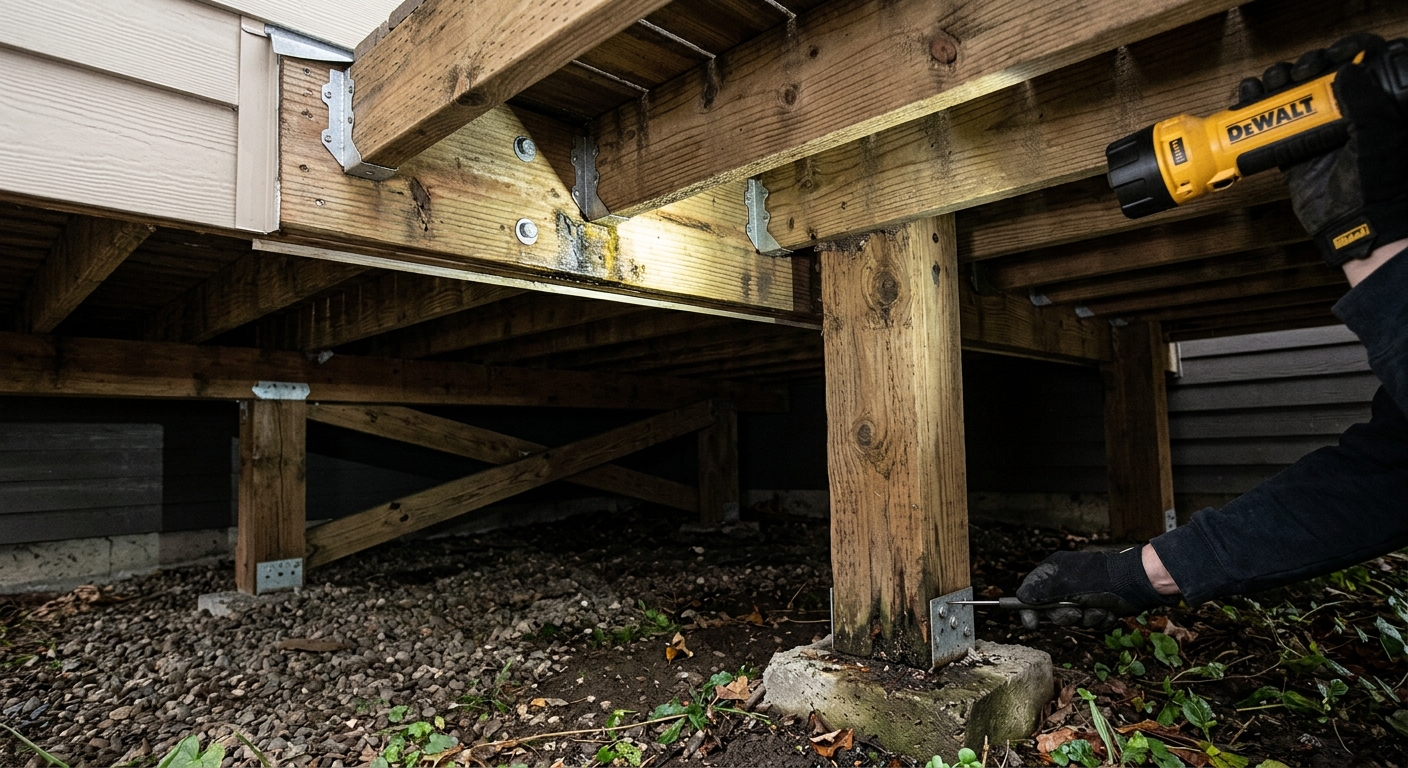
Get under your deck with a flashlight. You're looking for any joist, beam, or blocking that shows discoloration, cracking along the grain, or surface mold that goes deeper than surface-level mildew. Probe each joist at its mid-span and at the end connections — the ends are where moisture collects and rot starts.
The screwdriver test is straightforward: a solid thunk means the wood is healthy; a soft, punky, or hollow response means rot. Don't be gentle — press with real force. Rotted wood will compress or crumble. Healthy pressure-treated lumber will resist the tip.
Pay special attention to:
- Rim joists — the outer perimeter joists that are most exposed to weather
- Joist ends where they sit on the beam — water pools in these connections
- Any area where a board above had a visible gap — water funnels through gaps and lands on the framing below
If you find isolated soft spots on 2-3 joists out of 20, that's potentially repairable by sistering (installing a new joist alongside the rotted one). If you're finding soft wood on more than 20% of your joists, you're past the repair threshold for the frame.
Check Post Bases and Hardware
Post bases are the metal connectors that secure your posts to the concrete footings. In Seattle's wet climate, these corrode over time — especially older galvanized hardware that predates the higher-zinc-content hardware now standard for exterior use. Corroded post bases lose structural capacity even if the wood posts themselves are fine.
Look for:
- Heavy surface rust — some rust is cosmetic; rust that has caused the metal to pit, flake, or lose thickness is structural
- Cracked concrete footings — hairline cracks are common and usually not serious; cracks that have allowed the post to shift are a problem
- Wood-to-concrete contact — any post that sits directly on concrete without a post base is a code violation and a rot concern; moisture wicks up through concrete into the end grain of the post
Tight post bases with intact hardware and no significant corrosion are a good sign. Multiple failing post bases — especially combined with other frame issues — push the decision toward replacement.
Inspect Stair Stringers
Stair stringers are frequently the first structural component to fail on a deck because they're often closer to the ground, they span open cuts that expose end grain directly to rain, and they're under constant foot traffic load. Test each stringer at the ground contact point and at each tread notch. Soft or hollow spots in stringers are common and don't automatically mean full replacement — but failing stringers combined with joist problems shifts the calculus.
Reading the Signs: Repair, Resurface, or Replace?
Once you've done the assessment, you need to interpret what you found. Here's how we think about it after doing hundreds of deck repair consultations in Seattle and the greater King County area.
Signs the Frame Is Sound (Repair or Resurface)
When we find these conditions, repair or resurfacing is likely the right call:
- Boards bounce uniformly — if the deck has some bounce but it feels consistent across the whole surface without any dead spots, the joists are likely still structurally sound (some flex is normal and even code-compliant)
- Probing produces solid thunk everywhere — no soft spots when you systematically probe all joists and beams
- Post bases are tight and hardware is intact — minimal rust, no movement when you push laterally on posts
- Ledger flashing appears sound — no gap, no water staining, siding above looks dry and intact
- Rot is isolated to surface boards only — the boards themselves are failing but the framing below is solid
In these scenarios, you're a candidate for board-by-board replacement or a full resurface. A resurface means removing all the existing deck boards and installing new decking over the existing frame — a cost-effective solution when the frame has useful life remaining. If you're resurfacing, this is also a natural moment to consider upgrading from pressure-treated wood to composite decking or cedar, since the labor to pull and reinstall boards is the same regardless of material.
Signs Replacement Is Needed
These conditions indicate that repair will be expensive, short-lived, or both:
- Widespread joist rot — more than 20% of joists showing soft spots on the screwdriver test
- Ledger pulling away from the house — any visible gap or movement means the primary structural connection has failed
- Multiple post base failures — not just surface rust but actual structural deterioration at multiple bases
- Original framing undersized for current code — many decks built in the 1980s and 1990s used framing spans that no longer meet current IRC requirements; if you're rebuilding more than 50% of the deck anyway, you may be required to bring the whole structure to current code
- Footings that are too small or too shallow — Seattle's code requires footings below the frost line (typically 12-18 inches in King County) and sized for the deck's tributary load; undersized original footings often need to be addressed during a replacement
Important
The Cost Breakdown: What You're Actually Paying For
Understanding where the money goes in each scenario helps you evaluate contractor quotes and make an apples-to-apples comparison. Let's walk through realistic cost ranges for the Seattle market in 2026.
Scenario 1: Board-by-Board Repair
When the frame is solid but individual boards are cracked, split, or rotting out, board-by-board replacement is the most targeted option. Costs in our market:
- Labor to remove and replace individual boards: $3-8 per square foot of affected area
- Pressure-treated replacement boards: $1.50-3.50 per linear foot
- Cedar replacement boards: $3-7 per linear foot
- Composite replacement boards: $4-12 per linear foot (matching existing composite is tricky — profiles change over product generations)
- Total for typical board repair job (100-200 sqft affected): $500-1,500
The challenge with board-by-board repair is matching. If your deck is 10+ years old, the exact profile may be discontinued. Color matching on composite is almost impossible once weathering has occurred. Many homeowners doing board repairs end up with visible patches, which is fine functionally but affects appearance.
Scenario 2: Railing Repair
Railing failures are common and often independent of overall deck condition. A damaged or corroded railing section doesn't necessarily mean the deck needs replacing — but Seattle code requires railings on any deck surface more than 30 inches above grade, and they must meet current height and baluster spacing requirements (42 inches high for decks more than 30 inches above grade; baluster spacing no greater than 4 inches).
- Repair or replace a single railing section (10-20 LF): $300-800
- Full railing replacement on a 400 sqft deck: $2,000-6,000 depending on material
- Cable railing upgrade: $150-220 per linear foot installed
Learn more about your railing options in our full guide to deck railing options in Seattle.
Scenario 3: Ledger Repair
A compromised ledger is serious but not always a death sentence for the whole deck. If the framing is otherwise sound, a proper ledger repair can extend the deck's life significantly. This is a complex job that involves:
- Temporarily supporting the deck structure
- Removing siding and any water-damaged sheathing behind the ledger
- Treating or replacing the rim joist inside the house if moisture has migrated
- Installing proper through-wall flashing per current code
- Re-securing the ledger with code-compliant bolts at the correct spacing
- Re-siding and finishing
Typical ledger repair cost in Seattle: $1,500-4,000 depending on extent of damage and siding type. If the siding is fiber cement or stone, costs trend higher because of the difficulty of reintegration.
Scenario 4: Full Replacement
Full deck replacement means removing everything — boards, frame, posts, and in some cases footings — and starting over. According to data from Angi's Seattle deck cost research and our own project history:
- Pressure-treated wood deck: $35-45 per square foot installed
- Cedar deck: $40-55 per square foot installed
- Composite deck (Trex, TimberTech, Fiberon): $45-70 per square foot installed
- Typical 400 sqft deck replacement total: $14,000-28,000
- Larger 600+ sqft decks with stairs and railing: $30,000-55,000
These ranges reflect Seattle labor rates, permit fees, and material costs as of 2026. King County permit fees for deck replacements typically run $400-900 depending on scope and valuation.
Note
Approximate costs for common scenarios on a 400 sqft Seattle deck. Full replacement cost shown as total project; repair scenarios shown as typical range midpoints.
| Category | Value |
|---|---|
| Board Repair (partial) | $1,000 |
| Rail Repair/Replace | $2,500 |
| Ledger Repair | $2,750 |
| Resurface Only | $7,000 |
| Partial Frame + Resurface | $14,000 |
| Full Replacement (PT) | $22,000 |
| Full Replacement (Composite) | $32,000 |
The 50% Rule: When Repair Stops Making Financial Sense
The 50% rule is a common guideline in construction and home improvement: if the cost to repair a system exceeds 50% of the cost to replace it entirely, replacement is almost always the better investment. This isn't an arbitrary number — it reflects the economic reality that repair money spent on a declining asset has diminishing returns.
Applying the 50% Rule to Decks
Let's work through an example. You have a 400 square foot pressure-treated wood deck. Full replacement cost in your specific situation (accounting for site conditions, access, permit requirements) comes in at $20,000. That means your repair-or-replace threshold is $10,000.
Now the inspection reveals:
- Ledger needs full repair: $2,500
- 6 of 18 joists need sistering: $3,500
- Surface boards need full replacement: $4,000
- Stair stringer replacement: $1,500
Total repair estimate: $11,500 — which is 57.5% of replacement cost. The 50% rule says replace.
Why? Because after spending $11,500 on that 15-year-old frame, you still have a 15-year-old frame. The footings haven't been upgraded. The remaining 12 joists still have 15 years of moisture exposure and will start showing their own issues within 3-5 years. You've bought yourself some time but not a new deck. Meanwhile, $20,000 gives you a fully code-compliant structure with a 25-30 year life expectancy for the frame.
Key insight
When the 50% Rule Has Exceptions
The rule has flexibility in a few scenarios:
Recently upgraded components: If you put in new composite decking just 3 years ago and the issue is only a couple of rotted joists underneath it, the math changes. You might be willing to spend more on repair to preserve those newer boards.
Budget constraints: Sometimes $12,000 for repair is manageable when $24,000 for replacement isn't. That's a legitimate reason to repair now with the understanding you're buying time, not a long-term solution.
Partial replacement: Many projects fall between "repair" and "full replacement." If one section of a large deck is failing while the other section is sound, a partial replacement of just the compromised section may make excellent financial sense — closer to repair costs but delivering new-frame quality where it matters. We do partial replacements regularly in Seattle on larger decks where only one section has significant frame damage.
Seattle-Specific Factors That Affect the Decision
Not every market has the same considerations. Here's what specifically shapes the repair-vs-replace decision in the Seattle/King County area.
Permitting and Code Upgrade Requirements
Seattle's SDCI has specific rules about when deck work triggers full permit review — and permit review often triggers code upgrade requirements. This matters for the repair-vs-replace decision because:
- If you're replacing more than 50% of the structural framing, Seattle and King County typically require a permit and full code compliance
- Code compliance may require larger footings, updated ledger connections, 42-inch railings, updated stair geometry (rise/run requirements have tightened), and in some cases structural engineering for larger decks
- These upgrades add cost to a repair that wouldn't apply to simply patching a few boards
When a repair project is large enough to trigger permit requirements, the cost differential between repair and replacement narrows significantly. In those cases, full replacement becomes more competitive because you're paying for permits and inspections regardless.
For a full guide to navigating the permitting process, see our deck permit King County guide.
The Ledger-to-Vinyl-Siding Problem
A significant portion of Seattle-area homes built in the 1990s and 2000s have vinyl siding. Vinyl is nearly impossible to properly flash around a ledger board — the flashing has to go behind the siding, and reintegrating vinyl after ledger work is a persistent challenge. If your deck is attached to a vinyl-sided house and the ledger needs work, the repair cost climbs because of siding removal, possible damage during removal, and the difficulty of reinstallation. In these cases, full replacement with proper flashing installation from scratch often makes more sense.
Pressure-Treated Lumber Changes
The formulation of pressure-treated lumber changed significantly in the early 2000s (from CCA to ACQ/CA treatments), and again with the current generation of MCA-treated lumber. Older CCA-treated decks used fasteners and hardware that aren't compatible with newer treatment chemistry — and vice versa. If your deck was built before 2004 and used original CCA lumber, mixing old and new framing materials requires attention to hardware compatibility. When substantial sistering or partial replacement is needed on older frames, we sometimes recommend full replacement to avoid compatibility issues and ensure uniform corrosion resistance across all hardware.
Hillside and Elevated Decks
Seattle is a city of hills. Second-story decks and hillside decks have more exposed framing than grade-level decks, which means more surface area subject to moisture exposure, more complex post-and-beam systems, and often more significant structural implications when rot occurs. The higher the deck, the more we lean toward full replacement when frame issues are found — because frame failure on an elevated deck has more serious safety consequences, and the cost of partial repairs on complex elevated structures is higher relative to full replacement.
Tip
Material Choices When You Do Resurface or Replace
If the assessment leads you toward resurfacing or full replacement, you have real options for the decking material — and those choices have significant implications for long-term maintenance costs and lifespan in our climate.
Pressure-Treated Wood
The lowest upfront cost and still perfectly viable if properly maintained. Modern pressure-treated lumber (ACQ or MCQ treated) resists rot and insect damage but still requires regular cleaning, staining or sealing, and annual inspection. In Seattle's climate, plan on restaining every 2-3 years to maintain protection. See our article on deck staining vs. composite for the full comparison.
Cedar
Cedar is a premium wood option with natural rot resistance from its oils. It's beautiful, works with Seattle's aesthetic, and is sustainably available from Pacific Northwest sources. Cedar requires the same maintenance as pressure-treated wood but starts from a higher baseline of natural protection. The cost is higher than PT wood but lower than most composites.
Composite Decking
Composite decking — brands like Trex, TimberTech, and Fiberon — has become the default recommendation for Seattle homeowners who want to minimize ongoing maintenance. Capped composite boards resist moisture absorption, won't rot, don't need staining, and are highly resistant to the moss and mildew growth that plagues unsealed wood in our climate. The upfront cost is higher (roughly $45-70/sqft installed for mid-grade composite), but the 25-year product warranties and near-zero maintenance cost make the long-term economics compelling. Read our detailed Trex vs. Fiberon vs. TimberTech comparison to see how the major brands stack up.
PVC Decking
PVC decking is the highest-performance option for Seattle's wet climate — fully synthetic, 100% waterproof, and with the longest-lasting color stability of any decking category. The tradeoff is higher cost (typically $60-85/sqft installed) and a different underfoot feel than wood. PVC makes particular sense for rooftop decks, second-story decks over living space, or any application where water infiltration below the deck is a concern.
For a comprehensive look at all the material options, see our best decking materials Seattle 2026 guide.
Getting Accurate Quotes and Avoiding Common Mistakes
Whether you decide on repair or replacement, getting accurate, comparable quotes from contractors is the next challenge. Seattle's deck contractor market ranges from highly qualified licensed builders to fly-by-night operations that will take your deposit and disappear. Here's how to protect yourself.
What a Proper Assessment Looks Like
A contractor who doesn't physically get under your deck and probe the framing before giving you a quote is not giving you a real quote — they're guessing. Any legitimate assessment of a deck that may need structural work involves:
- Walking the surface and noting bounce, soft spots, and board condition
- Getting under the deck to visually inspect and probe all structural members
- Checking the ledger connection and flashing from multiple angles
- Testing post bases and checking footings for movement
- Documenting findings with photos and a written report
If a contractor gives you a repair-vs-replace recommendation over the phone or after a 5-minute walkthrough, treat that quote with significant skepticism.
Understanding Quote Line Items
When you receive quotes, make sure they specify:
- Which structural members are being replaced vs. repaired
- What decking material is included (species, grade, brand)
- Whether permit fees are included
- What the warranty covers (labor vs. material vs. both)
- Timeline and whether the project requires you to vacate the space
Our guide to how to read a deck quote walks through every line item you should expect to see.
Red Flags in Repair Quotes
Watch for:
- "We'll fix it as we go" — structural repair requires a plan before work starts, not discovery along the way
- Cash-only large deposits — legitimate contractors work with written contracts and standard payment schedules
- No permit discussion — if a contractor doesn't mention permits on a replacement job, they may be planning to skip them; unpermitted work creates serious problems at resale
- Matching composite guarantees — be cautious of contractors who promise to match your existing composite exactly; product lines change and color match on weathered composite is nearly impossible
For a full vetting checklist, see our guide on how to find a deck builder in Seattle.
Note
Timing Your Repair or Replacement in Seattle
Unlike roofing or painting, deck work can happen year-round in the Seattle area — but timing does affect both cost and the quality of the result.
Best Timing for Repair Work
Small repairs — replacing a few boards, fixing railing sections, addressing a localized ledger issue — can happen in any season. The key constraint is that fresh pressure-treated lumber needs time to dry before staining, and Seattle winters don't provide ideal drying conditions. For appearance-focused repairs, late spring through early fall gives new wood time to dry and accept finish properly.
Composite repairs don't have the same moisture sensitivity and can be done any time of year.
Best Timing for Full Replacement
Spring (March-May) and early fall (September-October) are the sweet spots for Seattle deck replacements. Summer is peak season — contractors are booked out further and you may pay a slight premium. Winter replacements are possible but concrete pours for new footings are temperature-sensitive (concrete shouldn't be poured when temperatures are forecast below 40°F without protective measures), which can complicate footing work on a full replacement.
If you're considering a replacement, getting your contractor selected and permitted in the fall means you're first in line for spring scheduling — often the best combination of pricing and timeline. Learn more in our guide on the best time to build a deck in Seattle.
The Annual Inspection Habit
Whether you repair, resurface, or replace, the best way to avoid another major decision in a few years is to build a simple annual inspection habit. Our deck winter inspection guide outlines the 20-minute walkthrough we recommend for every Seattle homeowner each fall. Catching a small ledger flashing issue at year 5 is a $500 repair. Missing it until year 12 is a $2,500+ problem or a replacement trigger.
The Trex Protect deck inspection guide also offers a solid checklist for homeowners who want to do their own annual assessment between professional inspections.
Cost Summary and Decision Framework
Let's bring it all together into a clear framework. After your assessment, you should have enough information to place your deck in one of four categories:
| Condition | Recommended Action | Typical Cost (400 sqft Seattle deck) |
|---|---|---|
| Frame solid, boards worn/damaged | Board-by-board repair | $500-1,500 |
| Frame solid, boards widely failing | Full resurface (new boards, existing frame) | $5,000-9,000 |
| Minor frame issues + board failure | Targeted frame repair + resurface | $8,000-15,000 |
| Widespread frame damage (>20% joists, ledger issues, multiple post failures) | Full replacement | $14,000-35,000+ |
Decision Tree
Step 1: Do the screwdriver test on all structural members. If more than 20% of joists are soft, or the ledger is failing, or multiple post bases have failed → full replacement.
Step 2: If frame is solid, assess the boards. If only isolated boards are failing → board repair. If most boards are failing but the frame is solid → resurface.
Step 3: If you have minor frame issues plus board failure, get repair estimates. Apply the 50% rule: if repair exceeds 50% of full replacement cost → replace.
Step 4: If replacing, decide on material based on your budget and maintenance tolerance. Pressure-treated is lowest upfront cost; composite is lowest long-term cost; PVC is highest performance in Seattle's wet climate.
For a full breakdown of how replacement costs are calculated in our market, see our Seattle deck cost guide.
Frequently Asked Questions
How do I know if my deck needs repair or full replacement?
What does deck repair cost in Seattle?
What is the 50% rule for deck repair?
Do I need a permit for deck repair in Seattle?
How long does deck repair take in Seattle?
What are the most common signs that a Seattle deck needs replacement?
Can I resurface my deck instead of replacing it?
How long will a repaired deck last in Seattle's climate?
Is composite or wood better for deck repair in Seattle?
What should I ask a contractor before getting a deck repair quote?
How much does it cost to repair a deck ledger in Seattle?
Can I do deck repairs myself in Seattle?
Making the right call between deck repair and full replacement in Seattle comes down to one thing: honest information about your frame. Surface boards are cosmetic and replaceable. The structural system — ledger, joists, beams, posts, footings — is what determines whether your deck is safe and whether repair money is being well spent. Our team at The Seattle Decking Company has been doing these assessments across King County, Snohomish County, and the greater Seattle area for years. We'll get under your deck, probe the framing, check the ledger and post bases, and give you a straight answer about what we find — whether that answer is "this frame has a lot of life left in it" or "it's time to start fresh."
Don't make a $10,000 repair decision based on guesswork. Call us at (425) 675-6259 for a professional structural assessment, or contact us online to schedule a consultation. We serve homeowners throughout Seattle, Bothell, Bellevue, Kirkland, Redmond, Shoreline, and surrounding King and Snohomish County communities. Our office is located at 22722 29th Drive SE, Bothell, WA 98021 — right in the heart of the communities we build and repair decks for every day.
Whether you're looking at a targeted repair, a full resurface with new composite decking, or a complete replacement designed to last the next 30 years, we're ready to help you make the call that makes financial sense for your specific situation. Get a quote today and let's take the guesswork out of it.
Planning a deck in the Seattle area?
Get an onsite design review and a clear, itemized quote from a licensed local builder.
Request a Free Quote