
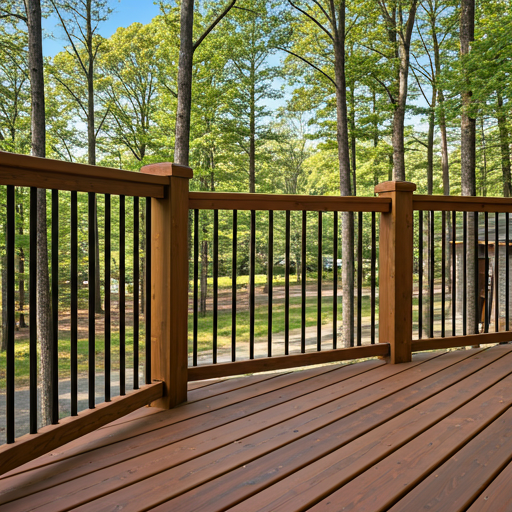
Walk into any lumber yard in King County and ask which wood to use for a deck, and you will get two confident answers from two different people standing ten feet apart. One will tell you cedar is the only choice that makes sense in Seattle's wet climate. The other will tell you pressure-treated is what professionals actually use because it holds up and costs less. Both are partially right, and neither is giving you the complete picture — because in the real world of Pacific Northwest deck building, the answer almost always involves both materials doing the jobs they are each built to do.
Seattle homeowners spend a lot of time asking the wrong version of this question. The real question is not cedar versus pressure-treated. It is cedar versus pressure-treated for which part of the deck, in which application, at what budget, and with what maintenance commitment over the next two decades. Those are harder questions, but they are the ones that determine whether your deck looks beautiful and stays structurally sound in 2040 or turns into a warped, checked, moss-covered liability by 2032.
This article is not going to tell you one material is universally better than the other. What it will do is give you the actual numbers, the real maintenance expectations, the code requirements that apply specifically to King County and Seattle jurisdictions, and the hybrid approach that experienced local builders — including our crew at The Seattle Decking Company — use on the vast majority of projects we build across Bothell, Kirkland, Bellevue, West Seattle, Edmonds, and everywhere in between.
Why Seattle's Climate Changes the Cedar vs. Pressure-Treated Equation
Most of the cedar versus pressure-treated comparison guides you will find online are written for a national audience. They account for somewhere between 20 and 40 inches of annual rainfall, moderate humidity, and enough summer sun to dry out wood surfaces between rain events. Seattle is not that climate.
King County averages roughly 38 inches of rainfall per year — but what makes Seattle uniquely punishing on wood decks is not the total precipitation, it is the distribution. Unlike Atlanta or Houston where you get heavy rain events followed by days of drying sun, Seattle's precipitation falls across 150 to 160 days per year, often as light drizzle and overcast moisture that keeps wood surfaces perpetually damp from October through June. The sun angle during winter months is also low enough that north-facing deck surfaces in neighborhoods like Ballard, Beacon Hill, and the west-facing slopes of West Seattle can go weeks at a stretch without significant UV exposure to help dry them out.
That environmental reality reshapes the entire cedar versus pressure-treated conversation in two important ways.
Moisture Retention and Biological Growth
Both cedar and pressure-treated lumber absorb moisture in Seattle's climate. Neither is immune to it. The difference is in what happens when they stay wet. Cedar contains natural oils and tannins — specifically thujaplicin — that inhibit fungal growth and insect infestation even when the wood is damp. These are not added chemicals; they are inherent to the species, which is why Western Red Cedar has been used for roofing, siding, and boat building in the Pacific Northwest for over a century.
Pressure-treated Southern yellow pine, by contrast, achieves its decay resistance through chemical impregnation — historically chromated copper arsenate (CCA), now replaced by safer alkaline copper quaternary (ACQ) and copper azole (CA) formulations. The treatment protects against fungal decay and insect damage, but it does not prevent surface moisture absorption. In Seattle's extended damp seasons, this means PT lumber surfaces are more prone to surface checking and face grain absorption that allows moss and algae to colonize more aggressively than cedar.
According to a Block Renovation guide on Seattle deck building, Seattle's year-round moisture environment causes mold and algae buildup on both cedar and PT wood, with annual power washing recommended regardless of species. That is accurate. But the character of that buildup differs — PT surfaces tend to show dark surface staining and mold colonization more visibly than cedar, especially on horizontal surfaces where water ponds between deck boards.
The UV Factor
Here is something Seattle homeowners often overlook: ultraviolet radiation is a primary driver of wood surface degradation — UV breaks down lignin, which is the polymer that holds wood fibers together and gives wood its color. In Arizona or Southern California, UV is the main enemy of deck surfaces. In Seattle, moisture is the primary enemy, but the low UV environment also means surfaces stay wet longer and dry out more slowly between events.
For cedar, the low UV environment is actually a minor advantage — cedar weathers more slowly in Seattle than it would in a sunnier climate, meaning its natural oils hold longer before the wood needs re-sealing. For pressure-treated lumber, the low UV environment matters less for the structural chemistry of the treatment, but the consistently damp surface conditions accelerate the surface checking and grain raising that make PT boards look rough and weathered within a few seasons if they are not maintained.
Key insight
Western Red Cedar Versus Southern Species
It is worth being specific about species, because "cedar" and "pressure-treated" both describe categories of wood, not single species. The cedar used in Pacific Northwest decking is almost universally Western Red Cedar (Thuja plicata), which is grown locally in British Columbia, Washington, and Oregon. It is lighter, more dimensionally stable, and more naturally rot-resistant than Eastern Red Cedar or Atlantic White Cedar — the species sometimes sold as "cedar" in East Coast markets.
Similarly, "pressure-treated" in most Seattle lumber yards means Southern Yellow Pine (SYP) — a dense, heavy species grown in the American Southeast. It takes pressure treatment extremely well because of its open grain structure, which allows the preservative chemicals to penetrate deeply. Some PT lumber sold in the Pacific Northwest is also hem-fir or Douglas Fir, which are locally grown but take treatment less thoroughly than SYP.
When we reference "cedar" and "pressure-treated" throughout this guide, we mean Western Red Cedar and pressure-treated Southern Yellow Pine — the two species you will actually encounter in King County lumberyards and on most Seattle deck projects.
Material Cost Breakdown: Cedar vs. Pressure-Treated in King County (2026 Prices)
Let us get into numbers, because that is what most homeowners actually need when they start planning a deck project. Pricing data for Seattle in 2026 shows a consistent spread between the two materials at both the material-only level and the installed project level.
Material-Only Costs
For decking boards (the surface boards you walk on), current King County pricing runs:
| Material | Material Cost (per sq ft) | Notes |
|---|---|---|
| Western Red Cedar (1x6 or 5/4x6 decking) | $8–$14/sq ft | Premium grades run higher; #2 grade on the lower end |
| Pressure-Treated Pine (5/4x6 decking) | $4–$8/sq ft | ACQ or CA treatment standard in WA state |
| Cedar (framing lumber, posts, beams) | $10–$18/sq ft | Rarely used for framing due to cost |
| Pressure-Treated (framing lumber, joists, beams) | $5–$9/sq ft | Code-required for ground contact; most common framing choice |
For a 400 square foot deck surface using cedar boards, expect to spend $3,200–$5,600 on surface board materials alone before you account for framing lumber, hardware, fasteners, concrete, and labor. That same 400 square foot surface in pressure-treated decking boards runs $1,600–$3,200 in materials.
Those material savings matter, but they need to be understood in context. Labor to install a deck in Seattle runs $25–$50 per square foot for a typical crew on a standard project — which means material costs are a significant but not dominant portion of total project cost for most installations.
Installed Project Costs in Seattle (2026)
According to Olympic Decks' 2026 Seattle cost guide, average deck installations in Seattle run $18,000–$45,000 for standard 300–500 sq ft decks. Our own pricing at The Seattle Decking Company aligns with that range. Breaking it down by material:
- Cedar-surfaced decks installed: $60–$90 per sq ft all-in
- Pressure-treated surfaced decks installed: $45–$70 per sq ft all-in
For a concrete 400 sq ft deck, that means:
- Cedar-surfaced deck: $24,000–$36,000 complete
- PT-surfaced deck: $18,000–$28,000 complete
The $6,000–$8,000 gap on a mid-range 400 sq ft project is real and significant. But that gap looks different when you factor in maintenance costs over a 20-year ownership period, which we cover in detail in the maintenance section below. You can also explore our full Seattle deck cost guide for a deeper breakdown of cost drivers beyond material selection.
Installed cost ranges per square foot for common decking materials in King County, 2026. Source: Olympic Decks, Kolmo.io, The Seattle Decking Company project data.
| Category | Value |
|---|---|
| Pressure-Treated (low) | $45 |
| Pressure-Treated (high) | $70 |
| Cedar (low) | $60 |
| Cedar (high) | $90 |
| Composite (low) | $70 |
| Composite (high) | $110 |
What Drives the Price Difference
The cost gap between cedar and pressure-treated is not simply about the board material. Several factors contribute:
Grade and availability: Western Red Cedar is a regionally abundant species, but premium clear grades (no knots, tight grain) carry significant premiums. Pressure-treated SYP is produced at enormous scale in the Southeast and shipped to the Pacific Northwest, keeping per-board costs lower despite the treatment process.
Weight and installation speed: PT SYP is heavier than cedar — typically 35–40 lbs per cubic foot versus cedar's 23–28 lbs per cubic foot. Heavier boards are slower to handle and install, which somewhat offsets the material savings on a pure labor-hours basis.
Hardware compatibility: Modern ACQ and CA pressure treatments are significantly more corrosive to standard zinc-plated hardware than older CCA treatments were. Using PT lumber requires hot-dipped galvanized or stainless steel fasteners and connectors — which are more expensive than the standard connectors acceptable for cedar framing. This is not optional; the wrong hardware will fail within a few years in wet Pacific Northwest conditions.
Important
The Hybrid Approach: Why Most Seattle Decks Use Both Wood Types
Here is what the cedar versus pressure-treated debate misses: the question assumes you are choosing one material for the entire deck. Experienced deck builders in King County do not do that. The standard professional approach uses each material for the structural role it performs best.
The Structural Logic
A deck is two different assemblies that happen to be connected:
- The substructure — posts, beams, girders, joists, ledger boards, and any wood embedded in or resting on concrete. This assembly is often hidden, sometimes partially buried, and always subjected to ground moisture even when the deck surface boards are dry.
- The surface assembly — decking boards, fascia, railings, post caps, and trim. This assembly is visible, walkable, and the part homeowners care about aesthetically.
These two assemblies have different performance requirements, different exposure conditions, and should be built with different materials.
For the substructure, pressure-treated lumber is not just preferred — it is legally required. Seattle SDCI and King County building codes, reflecting Washington State Residential Code requirements, mandate naturally decay-resistant or pressure-treated wood for any lumber in contact with concrete or near soil. You can review the specifics at the Seattle SDCI decks permit page and at the King County building permits office. This is not a preference — it is a code requirement that an inspector will check during your framing inspection.
For the surface assembly, pressure-treated lumber can legally be used, but it is not the optimal choice. Cedar performs better aesthetically, takes stain immediately (versus PT's 3–6 month dry-out requirement), and produces a finished surface that homeowners actually want to walk on barefoot — important in Seattle where decks extend outdoor living from April through October.
What a Hybrid Deck Looks Like in Practice
On a standard Seattle residential deck, the hybrid approach means:
- Concrete footings and post bases: Concrete with Simpson ACQ-rated post bases or equivalent
- Posts: 6x6 pressure-treated, ground contact rated (UC4B for posts in soil contact)
- Beams and girders: Doubled 2x10 or 2x12 pressure-treated, above-grade rated (UC3B)
- Ledger board: Pressure-treated, flashed with proper waterproofing membrane
- Joists: 2x10 or 2x8 pressure-treated, 12" or 16" on center depending on span
- Blocking: Pressure-treated
- Decking surface boards: Western Red Cedar 5/4x6 or 2x6
- Fascia boards: Cedar or composite
- Railings and balusters: Cedar, composite, metal, cable, or glass depending on homeowner preference
This hybrid approach is what experienced builders across Bothell, Kirkland, Sammamish, and Bellevue use on the overwhelming majority of projects. The Seattle Kolmo cost guide references this approach as the regional standard. Our composite vs. cedar decking comparison covers how to extend this logic when you are considering composite surface boards as an alternative to cedar.
Tip
The Ledger Connection Problem
One area where hybrid construction requires particular attention in Seattle is the ledger board — the structural member bolted to your house that supports one end of the deck. This connection point is also the most common source of moisture intrusion and structural failure on older Seattle decks.
Code requires pressure-treated lumber for the ledger. But the connection also requires proper flashing — a waterproofing membrane that directs water away from the house wall rather than allowing it to pool behind the ledger. In neighborhoods like Ballard, West Seattle, and Wallingford where older homes have wood siding or Hardie plank, improper ledger flashing leads to rot in the house rim joist within a decade. This is not a cedar versus PT issue — it is a flashing and waterproofing issue that applies regardless of your decking material choice.
A properly flashed ledger connection uses waterproofing tape on the house wall, a sloped metal flashing cap over the ledger, and standoff spacers between the ledger and wall framing to allow drainage. This detail adds modest cost to a deck build but prevents the $8,000–$15,000 repair bills that come with rotted rim joists and compromised house framing.
Maintenance Reality Check: What Each Wood Actually Demands in the PNW
No material question for Seattle decks can be answered honestly without addressing maintenance — specifically, the actual time, cost, and consistency required to get the expected lifespan out of each wood type. Many homeowners underestimate what wood deck maintenance requires in the Pacific Northwest, then feel deceived when their deck deteriorates faster than they expected.
Cedar Maintenance in Seattle
Western Red Cedar, when properly maintained, is genuinely well-suited to Seattle's climate. The key phrase is "when properly maintained." Cedar in Seattle requires:
Annual cleaning: Power washing or hand scrubbing to remove moss, algae, dirt, and tannin staining. Seattle's moisture environment means moss and algae establish on cedar surfaces within a single rainy season if left unaddressed. Annual cleaning prevents biological buildup from holding moisture against the wood and accelerating surface weathering. The Seattle Times' local coverage on cedar deck care recommends annual cleaning as a baseline for Seattle cedar decks.
Biennial sealing or oiling: An oil-based penetrating sealant or deck oil applied every 1–3 years, depending on exposure. North-facing decks in shade may need less frequent application; south-facing decks with afternoon sun may need annual reapplication. Products like Cabot Australian Timber Oil, TWP (Total Wood Preservative), or Armstrong Clark work well on Western Red Cedar in the PNW. Water-based sealants are less effective in Seattle's conditions because they form a surface film rather than penetrating the wood grain — in a wet climate, that surface film tends to peel and crack rather than shed water.
Spot staining and touch-up: High-traffic areas, around post bases, and along edges where boards contact framing members will weather faster than field areas. Annual inspection with spot treatment of high-wear areas extends the interval between full recoating.
Costs: Professional cleaning and sealing runs $300–$800 per year depending on deck size and condition. DIY cleaning and material costs run $100–$300 per year for a 400 sq ft deck. Over a 20-year ownership period, expect cumulative maintenance costs of $2,000–$8,000 for DIY maintenance or $6,000–$16,000 for professional maintenance. You can find more detailed maintenance guidance in our cedar deck sealing guide for Seattle.
What happens if you skip maintenance: A cedar deck in Seattle that receives no maintenance will turn gray within 2–3 years (this is normal weathering, not necessarily damage) and will begin to show surface checking, grain raising, and end-grain cracking within 5–7 years. Biological growth — particularly moss on horizontal surfaces — will hold moisture and accelerate surface degradation. A completely neglected cedar deck in Seattle can reach end-of-life conditions within 10–12 years instead of the 20–25 year well-maintained expectation.
Pressure-Treated Maintenance in Seattle
Pressure-treated lumber is often marketed as "low maintenance," and this marketing is partially true for structural framing applications where the wood is not visible and not subject to foot traffic. For surface decking boards, PT maintenance is comparable to cedar — with one critical difference.
The dry-out period: New pressure-treated lumber arrives at your job site wet — the treatment process forces water-based preservative solution into the wood under pressure, and that moisture takes 3–6 months to fully dry out under typical Seattle conditions. A PT deck installed in October may not be dry enough to accept stain until spring. According to Niehaus Lumber's material comparison guide, PT lumber requires this dry-out period before staining, while cedar can be sealed immediately. This is not a minor inconvenience — it means your new PT deck will look unfinished for months and is subject to surface checking and weathering during that window, which is then locked in under any sealant you apply.
Checking and surface weathering: PT Southern Yellow Pine has denser, less dimensionally stable grain than Western Red Cedar. In Seattle's wet-dry cycles — wet winters, drier summers — PT boards are more prone to surface checking (small cracks running along the grain) and cup warping across the board width. These are cosmetic and minor structural issues on most boards, but they become tripping hazards and water-trapping problems if boards cup significantly.
Ongoing maintenance: Once dry, PT decking can be stained with a penetrating oil-based sealant on the same schedule as cedar — clean annually, reseal every 1–3 years. The chemistry is the same; the dry-out period is the practical difference.
Costs: Comparable to cedar maintenance — $300–$800 per year professional, $100–$300 DIY. However, the checking and grain-raising that PT experiences in Seattle's climate can make the surface harder to apply sealant evenly over time, which sometimes means PT decks in Seattle need more intensive surface preparation before recoating.
| Maintenance Factor | Western Red Cedar | Pressure-Treated Pine |
|---|---|---|
| Time before staining after installation | Immediate | 3–6 months dry-out required |
| Annual cleaning required | Yes — power wash or scrub | Yes — power wash or scrub |
| Resealing interval | 1–3 years | 1–3 years (after initial dry-out) |
| Surface checking tendency | Low–Moderate | Moderate–High |
| Moss/algae susceptibility | Moderate | Moderate–High |
| DIY maintenance cost/year | $100–$300 | $100–$300 |
| Pro maintenance cost/year | $300–$800 | $300–$800 |
| Consequence of neglect | Gradual graying, surface checking | Rapid checking, cupping, surface staining |
Lifespan Comparison: How Long Will Each Option Last in Seattle's Rain
Lifespan estimates for deck materials need to be treated as conditional — they depend on installation quality, maintenance consistency, and site-specific conditions. That said, there are meaningful differences between cedar and pressure-treated lumber longevity in Seattle's climate.
Cedar Lifespan in King County Conditions
Well-maintained Western Red Cedar decking in Seattle can realistically last 15–25 years before replacement is warranted. This aligns with Ecohome's comparison guide which cites 15–25 years for maintained cedar versus 10–15 for pressure-treated. The upper end of that range — 20–25 years — requires consistent biennial maintenance and adequate drainage. The lower end — 15–17 years — is achievable even with occasional missed maintenance cycles.
Factors that shorten cedar lifespan in Seattle:
- North-facing or heavily shaded installation where moss establishes aggressively
- Inadequate ventilation beneath the deck (no airflow between joists)
- Boards installed face-grain down (bark side up) which holds more moisture
- Horizontal flat surfaces without adequate slope for drainage
- End-grain exposure that is not sealed — end grain absorbs water rapidly and should always be end-sealed at installation
Factors that extend cedar lifespan:
- Proper board spacing (3/16" to 1/4" gap) for drainage and airflow
- Consistent biennial oiling with penetrating oil-based sealant
- Annual cleaning to remove biological growth
- Good airflow beneath the deck — at minimum 18" clearance from joists to grade
Pressure-Treated Lifespan for Surface Boards
Pressure-treated lumber used as structural framing (posts, beams, joists) is rated for ground contact or above-ground use at 25+ years, and those ratings are realistic when the wood is properly sized, detailed, and protected from standing water. Pressure-treated as a structural material in Seattle is excellent and durable.
PT used as surface decking boards is a different story. In Seattle's wet-dry cycle, properly maintained PT surface boards can realistically last 10–15 years — the lower half of Ecohome's cited range. Improperly maintained PT surface boards in Seattle can show significant warping, cupping, and surface checking within 5–7 years, particularly on decks with poor drainage or boards that were too wet when installed.
The gap in longevity between cedar (15–25 years) and PT decking surface boards (10–15 years) is significant when you run the math on a full replacement. On a 400 sq ft cedar-surface deck costing $24,000–$36,000 installed, you might go 20 years before replacing decking boards — a $100–$120/year amortized cost for the decking surface itself. On a PT-surface deck at $18,000–$28,000, you might replace boards at 12 years — a $125–$175/year amortized cost that closes much of the initial price gap.
This is why the "cedar costs more" argument is true on the invoice but not necessarily true over the life of the deck. Our detailed composite vs. cedar decking analysis explores similar lifetime cost comparisons with composite materials, where the math shifts again.
Note
Structural Framing Lifespan
One area where the longevity comparison strongly favors pressure-treated: structural framing longevity. PT posts, beams, and joists, when properly installed with appropriate corrosion-resistant hardware and not sitting in standing water, will outlast the decking surface boards significantly. It is not unusual for us to replace cedar surface boards on a 20-year-old deck while finding the PT framing still structurally sound — which is exactly the hybrid logic playing out over time. A well-built PT substructure can support multiple generations of decking surface without replacement.
<img src="/images/generated/detail-cedar-grain.jpg" alt="Close-up of Western Red Cedar deck boards showing natural grain pattern and warm tones — the preferred surface material for Seattle decks due to its natural rot resistance" />
King County Permit and Code Requirements: What Wood Is Legally Required Where
Understanding permit requirements for deck projects in King County is essential before any material discussion, because the code itself mandates certain material choices regardless of your preferences. This is also an area where Seattle homeowners get confused because the rules vary significantly by jurisdiction — what applies in the City of Seattle is not identical to what applies in Bellevue, Sammamish, Issaquah, or unincorporated King County.
Permit Thresholds by Jurisdiction
According to Masterdecks' Seattle permit guide, Washington State Residential Code provides the baseline, but individual jurisdictions set their own permit thresholds:
| Jurisdiction | Permit Required When | Key Contact |
|---|---|---|
| City of Seattle | Attached to house OR over 30" above grade | SDCI: seattle.gov/sdci |
| Bellevue | Over 200 sq ft OR over 30" above grade | Bellevue Dev Services |
| Sammamish | Attached OR over 30" above grade | Sammamish Permit Center |
| Issaquah | Most deck projects | Issaquah Building Division |
| Unincorporated King County | Over 30" above grade OR attached | King County DLS |
| Bothell | Most deck projects attached to home | Bothell Community Dev |
For projects in the City of Seattle specifically, the SDCI decks page has the current permit requirements. For unincorporated King County, the King County building permits page is the authoritative source.
If your deck is small, detached, and low to grade, you may fall into an exempt category — but this exemption is jurisdiction-specific and requires verification. Our King County deck permit guide walks through the permit process in detail for each major local jurisdiction.
Code Requirements That Dictate Material Choice
Regardless of jurisdiction, Washington State Residential Code (which local codes incorporate by reference) specifies material requirements for wood decks that affect your cedar versus PT decision:
Ground contact and concrete contact: Any wood in contact with concrete, resting on soil, or embedded in ground must be pressure-treated at UC4B rating (ground contact) or be naturally decay-resistant. Western Red Cedar has some natural decay resistance, but it is not rated for ground contact applications under Washington building code without treatment. Practically, this means:
- Deck posts in soil or in concrete: must be PT (UC4B)
- Ledger boards against house: must be PT (UC3B minimum, often UC4B specified)
- Any blocking or nailer in contact with concrete: must be PT
Above-grade framing: Joists, beams, and above-grade structural members require PT (UC3B) or naturally decay-resistant wood. Cedar is technically acceptable for above-grade framing under code, but it is rarely used in practice because PT framing at comparable dimensions costs 30–40% less and is specifically engineered for this application.
Surface decking: No code requirement mandates PT for surface boards — cedar, composite, tropical hardwoods, and other species are all acceptable for surface decking in Washington State and local codes. This is where the material choice decision actually lives.
Fasteners and hardware: ACQ and CA pressure-treated lumber requires hot-dipped galvanized (minimum G185 galvanizing), stainless steel, or polymer-coated fasteners and connectors. This is a code requirement verified during inspection, not an optional upgrade.
Important
The Inspection Process and What Inspectors Check
When you pull a permit for a deck in King County or Seattle, you will typically have two inspection points:
- Footing inspection: After footings are dug and formed, before concrete is poured. Inspector verifies depth (frost line), diameter, and placement.
- Framing inspection: After framing is complete but before decking is installed. Inspector verifies joist sizing, span tables, ledger connection, hardware ratings, and — relevant to our material discussion — that framing lumber is properly rated PT or cedar where code requires it.
- Final inspection: After decking and railings are complete. Inspector verifies railing height, baluster spacing, and overall conformance.
The framing inspection is where material specifications get verified. An inspector will look at lumber grade stamps on structural members and confirm they match what was specified on the permit drawings. Using the wrong grade of PT lumber or cedar in a structural application will fail inspection and require re-framing — a costly and time-consuming problem to fix.
Comparing Total Cost of Ownership: The 20-Year Math
Most homeowners evaluate deck materials based on the project invoice. The more useful framework is total cost of ownership over the expected life of the installation — initial cost plus ongoing maintenance minus residual value at end of service life.
20-Year Cost Comparison for 400 Sq Ft Seattle Deck
Let us run the 20-year cost of ownership math for three scenarios on a 400 square foot deck:
Scenario A: PT-framed, Cedar-Surfaced Deck (Hybrid Approach)
- Initial build cost: $22,000–$30,000
- Annual maintenance (cleaning + biennial sealing): $400–$600/year average
- Surface board replacement at year 20 (cedar): $4,000–$7,000
- 20-year total: $34,000–$49,000
Scenario B: PT-Framed, PT-Surfaced Deck
- Initial build cost: $18,000–$25,000
- Annual maintenance (cleaning + biennial sealing after dry-out): $400–$600/year average
- Surface board replacement at year 12–15 (PT): $3,500–$6,000
- Surface board replacement at year 20+ if extending: $3,500–$6,000
- 20-year total: $29,500–$43,000
Scenario C: PT-Framed, Composite-Surfaced Deck
- Initial build cost: $28,000–$44,000
- Annual maintenance (annual cleaning only): $100–$200/year
- No surface board replacement within 25-year warranty period
- 20-year total: $30,000–$48,000
The 20-year math shows the scenarios converging more than the initial invoice suggests. The cedar hybrid (Scenario A) and composite (Scenario C) end up in similar total cost territory, while the PT-surface option saves meaningfully upfront but erodes some of that savings in earlier board replacement and comparable maintenance costs.
What the numbers do not capture: the aesthetic and livability value of cedar over PT surface boards. Cedar is more dimensionally stable, splinter-resistant, and visually warm underfoot. These qualities have real value for families using the deck daily during Seattle's warm-season months from May through September.
<img src="/images/generated/guide-cedar-natural.jpg" alt="Wide-plank Western Red Cedar deck boards installed on a Bothell home — warm grain, natural color, and proper board spacing typical of professional PNW cedar deck construction" />
Which Wood to Choose for Your Seattle Home: A Decision Framework
Rather than a universal recommendation, here is a decision framework that captures how we think through material selection at The Seattle Decking Company based on homeowner priorities, site conditions, and budget.
Choose Cedar Surface Boards When:
Your priorities include aesthetics and the deck is a primary living space. Cedar's warm color, natural grain, and dimensional stability produce a finished surface that looks and feels distinctly better than PT or even many composites underfoot. If your deck is a primary outdoor living room — entertaining space, hot tub platform, dining area — the aesthetic investment in cedar surface boards is usually worth the cost premium.
You want to stain or customize the finish color immediately. PT requires 3–6 months before staining. Cedar accepts stain, oil, or sealant the day after installation. If your project timeline includes finishing before a specific event or season, cedar is the only wood choice that allows same-season finishing.
Your home is in a higher price bracket and resale value matters. The National Association of Realtors remodeling impact report documents that outdoor living improvements including decks recover 60–70% of project cost at resale. In Seattle's competitive real estate markets — neighborhoods like Medina, Mercer Island, Kirkland waterfront, and Bellevue — a cedar or composite-surfaced deck is a selling feature that a PT surface is not.
You have committed to the maintenance schedule. Cedar's longevity advantage over PT in Seattle is maintenance-dependent. If you are realistic about committing to biennial cleaning and sealing, cedar delivers meaningfully better long-term value. If your home improvement maintenance track record involves years of deferred action, consider composite instead.
Choose Pressure-Treated Surface Boards When:
You have a tight budget and the deck is utilitarian. For a garage-adjacent utility deck, a ground-level landing, or a secondary deck off a basement door, PT surface boards are entirely reasonable. The aesthetic compromise matters less for utilitarian applications, and the cost savings are real.
The deck will be covered, painted, or covered with outdoor rugs. If your deck design includes a covered pergola structure or will be primarily covered with outdoor furniture and rugs, the visible surface quality matters less. PT boards covered by outdoor rugs or furniture arrangements are functionally adequate.
You are building a ground-level or grade-level deck. Low-to-grade decks — within 6–8 inches of soil level — have different ventilation dynamics than elevated decks, and PT framing and decking are specified by code for any members close to grade. For very low decks, an all-PT approach simplifies both the material spec and the code compliance discussion.
When Composite Is the Right Answer Instead
For homeowners who want genuinely low maintenance and are willing to pay the upfront premium, composite decking over a PT frame eliminates most of the annual maintenance burden. In Seattle's moss and algae environment, composite's non-porous surface resists biological growth more effectively than either cedar or PT. Brands like Trex, Fiberon, AZEK, and TimberTech all offer products specifically suited to high-moisture Pacific Northwest conditions. Our best decking materials guide for Seattle 2026 covers composite options in full detail, and our composite deck maintenance guide explains what "low maintenance" actually means for these products in practice.
Tip
Contractor Tips: What Local Seattle Deck Builders Actually Recommend
After years of building decks across King County — from modest backyard platforms in Bothell and Kenmore to elevated multilevel structures in Bellevue and Kirkland — here is what we actually recommend to homeowners who ask us the cedar versus pressure-treated question directly.
The Recommendation We Give 80% of Clients
For the vast majority of Seattle homeowners — typical budgets, standard deck sizes, typical maintenance expectations — the recommendation is: PT substructure, cedar surface boards, with composite as an upgrade if maintenance is a primary concern.
This is not a hedge. It is the honest answer that accounts for code requirements (PT framing is required), cost efficiency (PT framing costs less than cedar framing with no performance downside), and surface quality (cedar is better underfoot, looks better, and accepts finish immediately).
The only clients for whom we recommend something different are:
- Very tight budget: All-PT including surface boards, with explicit expectation-setting about the 3–6 month dry-out, early checking, and 10–15 year surface board lifespan in Seattle conditions
- Maximum longevity, minimal maintenance: PT frame with composite surface boards — Trex Transcend, Fiberon Premia, AZEK Landmark, or TimberTech PRO — with appropriate expectations about the higher initial investment
- Aesthetic premium: All-cedar structural and surface members where budget permits and the homeowner wants the warmest, most traditional look — accepted cost premium and consistent maintenance commitment required
Railing Material Decisions
Railing selection interacts with surface material choices in ways homeowners often do not anticipate. Cedar surface boards pair well with cedar railing posts and top rails for visual consistency. But cedar horizontal railing components — particularly the top cap of a standard rail system — are also subject to Seattle's weather and need the same maintenance as the deck surface.
For homeowners choosing cedar surface boards but wanting lower-maintenance railings, cable railing systems (our cable railing Seattle guide covers these in detail) or aluminum balusters with cedar posts are common solutions. Glass panel railings (see our deck railing options guide for Seattle) are popular on elevated decks with view corridors and require almost no maintenance in Seattle's climate. These hybrid railing approaches can reduce total maintenance burden while preserving the cedar aesthetic on the walking surface.
What to Ask Any Contractor Before Hiring
If you are getting competing bids for a Seattle deck project, these questions will help you evaluate the quality of the proposals you are receiving:
- What PT lumber grade and use category do you specify for posts, ledger, and joists? (Correct answer: UC4B for ground contact, UC3B minimum for above-grade)
- What fastener and hardware specification do you use with ACQ-treated lumber? (Correct answer: HDG G185 minimum or stainless steel)
- What flashing detail do you use at the ledger connection? (Correct answer: waterproofing tape on house framing, metal flashing cap, drainage standoffs)
- Do you pull permits for this project? If not, why not? (Any "we can skip the permit" answer should end the conversation)
- What cedar grade do you typically specify for surface boards? (Correct answer: Clear or #2 and better — not construction common, which has more knots and defects)
- Do you back-prime or end-seal cedar boards before installation? (Better contractors do; it meaningfully extends lifespan at modest additional cost)
The NADRA (North American Deck and Railing Association) provides contractor certification and quality standards that can also help you evaluate a contractor's professionalism and training background.
Common Mistakes Seattle Homeowners Make
After reviewing dozens of existing decks each year as part of repair and replacement consultations, these are the mistakes we see most often:
Installing PT surface boards and not waiting for dry-out before staining. Homeowners or impatient contractors apply stain to freshly installed PT boards before they have dried, resulting in stain that peels within 12–18 months and PT boards that check and warp before the finish has a chance to protect them.
Using cedar for posts or direct-ground-contact applications. Cedar has meaningful natural rot resistance but is not appropriate for posts set in concrete or soil. We have seen cedar posts used to save cost that had failed structurally within 8 years in Seattle's ground moisture conditions.
Under-sizing joist span for composite decking. Composite decking has different span requirements than wood — many composites require 12" on center joist spacing versus 16" for wood decking. Framing a deck for wood surface boards and then switching to composite at the last minute creates a structural problem that requires re-framing. Plan composite from the start if that is your material choice.
Skipping the ledger waterproofing detail. This is the single most expensive mistake we see on older Seattle decks. A properly flashed ledger costs $200–$400 more to build correctly than an improperly flashed one. The repair when water infiltrates through an unflashed ledger costs $5,000–$15,000 and requires opening up the house wall.
Not considering the deck and patio combo. Many Seattle homes have both a covered patio (under the deck on a lower level) and an upper deck surface. Material choices for these combo systems require coordination — what you choose for the deck surface affects water drainage to the patio below. Our deck and patio combo guide for Seattle covers the design and material integration for these systems.
The Honest Bottom Line for King County Homeowners
Cedar versus pressure-treated decking in Seattle is not a binary choice — it is a conversation about which material serves which function best, accounting for local climate, code requirements, budget reality, and honest maintenance expectations.
Here is the summary that 20 years of building decks in King County produces:
Pressure-treated lumber belongs in your deck's structure — posts, beams, joists, ledger, blocking. It is code-required in ground contact applications, cost-efficient, structurally appropriate, and will outlast the surface boards above it with minimal drama. Do not compromise on PT quality for structural applications; use the correct use-category ratings, specify the correct hardware, and install it with proper flashing at every moisture-sensitive connection.
Western Red Cedar belongs on your deck's visible surfaces — the decking boards, fascia, visible post wraps, and often the railing system. It is naturally suited to Seattle's climate, accepts finish immediately, weathers more gracefully than PT, and produces the warm, tactile, natural surface quality that makes a deck feel like an outdoor room rather than a utility platform. Commit to biennial maintenance and it will serve you for 20 to 25 years.
And if you want to simplify the maintenance equation and have the budget for it, composite surface boards over a PT frame produce the lowest long-term maintenance burden with 25–50 year material warranties from reputable manufacturers.
The worst outcome is using cheap PT surface boards, skipping the dry-out period, applying stain too early, doing no subsequent maintenance, and wondering why your Seattle deck looks rough and feels splintery by year seven. We see this outcome regularly, and it is entirely avoidable.
If you are planning a deck project in King County and want to talk through material options with a crew that builds in this specific climate — not material reps, not national big-box advisors, but local builders who have seen how cedar and PT perform over 20-year periods in Bothell, Kirkland, Bellevue, West Seattle, and everywhere in between — call us at (425) 675-6259 or visit us at 22722 29th Drive SE, Bothell, WA 98021. You can also reach us through our contact page or review full pricing context at our Seattle deck cost estimator. We are happy to walk a property, review an existing deck, or talk through a new build scope — no pressure, just honest conversation from builders who know this climate.
Frequently Asked Questions
Is cedar or pressure-treated better for a Seattle deck surface?
Do I legally have to use pressure-treated lumber in my Seattle deck?
How much more does cedar cost than pressure-treated for a Seattle deck?
How long does cedar decking last in Seattle's climate?
Can I stain new pressure-treated lumber right away in Seattle?
Do I need a permit to build a deck in Seattle or King County?
What is the hybrid approach to deck building in Seattle?
How much does cedar deck maintenance cost per year in Seattle?
Is composite decking better than cedar for Seattle's climate?
What fasteners should I use with pressure-treated lumber in Seattle?
How do I stop moss growing on my cedar deck in Seattle?
What railing options work best with a cedar deck in Seattle?
Planning a deck in the Seattle area?
Get an onsite design review and a clear, itemized quote from a licensed local builder.
Request a Free Quote