
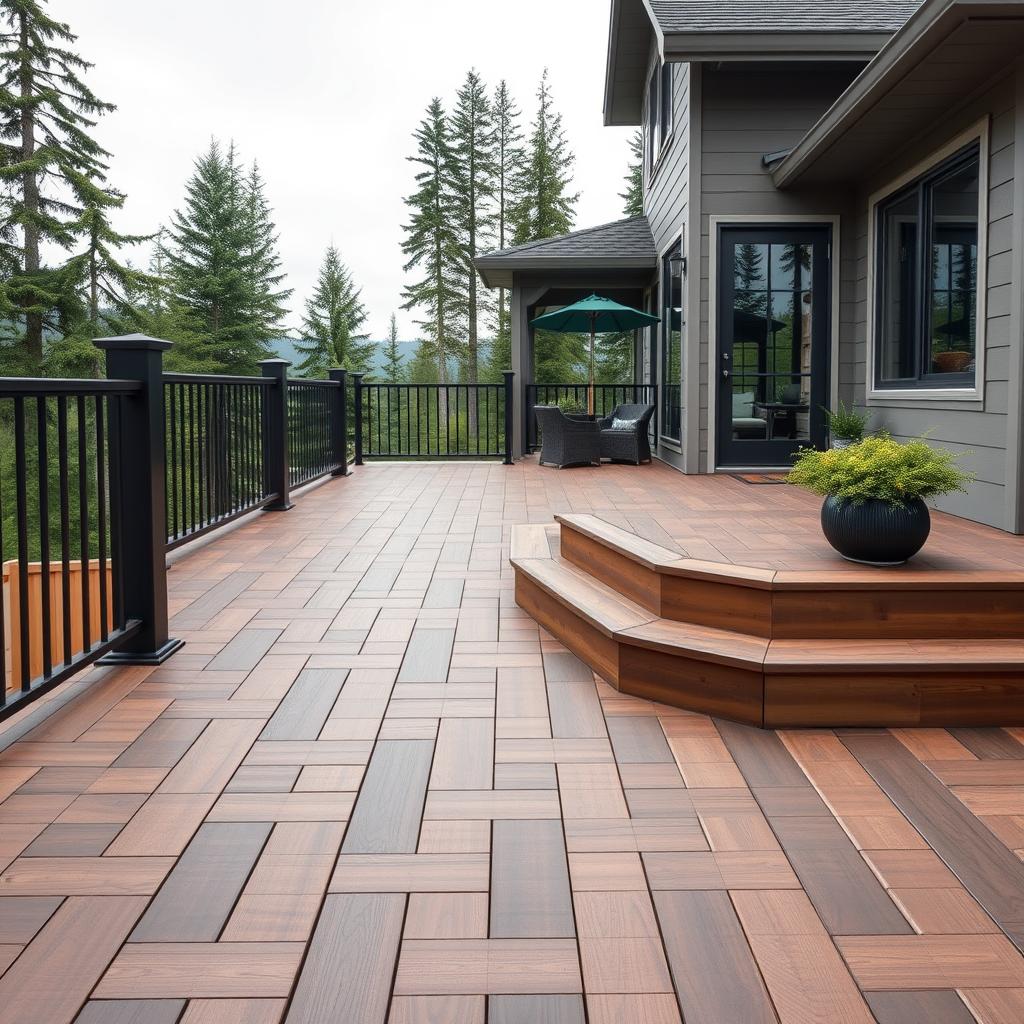
Walk into any big-box home improvement store in Bellevue or Kirkland and you will find composite decking sample boards displayed under fluorescent lights that bear almost no resemblance to Seattle's actual outdoor conditions. A rich espresso-brown board looks bold and dramatic under that artificial glare. Take it outside on a cloudy October afternoon in Maple Leaf or Leschi, and the same board reads flat, muddy, and ten years older than it did in the store. That disconnect between showroom lighting and Seattle's real-world gray-sky palette is the single most common reason homeowners end up dissatisfied with their deck color choice — and it is entirely preventable with the right guidance before you sign a contract.
Seattle's climate is not just wet. It is diffused. The region averages more than 150 days per year of overcast or mostly cloudy conditions, and much of the year's remaining daylight arrives through thin cloud cover that strips the warmth and contrast out of every color. This matters enormously for composite deck color selection because composite boards, unlike paint, cannot be changed on a whim. You are committing to a color for 25 to 30 years. What looks perfect in Phoenix or Denver in a manufacturer's marketing photo may look completely wrong surrounded by Douglas fir canopy and cedar siding in Seward Park. This guide is written by builders who work in King County every week, not by marketers photographing decks in Southern California sun.
The good news is that Seattle's environmental context — the overcast sky, the evergreen canopy, the cedar and fiber-cement home exteriors that dominate the region — actually points clearly toward a defined set of composite colors that perform exceptionally well here. Once you understand the framework, color selection stops being a stressful decision and becomes a logical process.
Why Seattle's Light Changes Everything About Color Selection
Color perception is not fixed. The same physical wavelengths of light that make a board look rich and dimensional in direct sun flatten and cool under overcast skies. This is not a subjective preference issue — it is basic physics, and it has profound implications for anyone selecting composite deck colors in the Pacific Northwest.
The Science of Diffused Light and Color Rendering
Direct sunlight produces a color temperature of roughly 5,500 to 6,500 Kelvin with high intensity across the full visible spectrum. Every color renders at something close to its theoretical maximum saturation and contrast. Overcast sky light, by contrast, delivers color temperatures in the 6,500 to 7,500 Kelvin range — distinctly cooler and bluer — while simultaneously reducing total light intensity and flattening shadows. The result is that warm tones (reds, oranges, golden browns) lose their richness and shift toward a dull brownish-neutral, while cool tones (grays, blue-grays, driftwood silvers) actually become more vivid and accurate in appearance.
Seattle averages more than 345 days per year of some combination of mixed or cloudy light conditions. On many winter days in neighborhoods like Beacon Hill or Laurelhurst, you might experience entirely diffused light from sunrise to sunset. This is the dominant viewing condition for your deck during the fall, winter, and spring months — which in Seattle comprise the majority of the calendar year.
The practical implication: any composite board in a warm mid-range brown — tones that read as handsome café au lait in a Southern California showroom — will often read as a desaturated khaki-gray in your backyard. Boards that manufacturers describe as "rich mahogany" in their brochures can look like flat mud under a January sky in Bothell. This is not a flaw in the product; it is a fundamental property of how light interacts with pigmented surfaces.
How to Properly Evaluate Colors Before You Buy
The single most important step in color selection is to obtain full-size sample boards and evaluate them in your actual yard, at the time of day when you most commonly use your outdoor space, under typical Seattle conditions — which means overcast or thin-cloud cover, not direct sun.
Most reputable composite manufacturers provide 12-inch sample chips, but these are too small to give an accurate impression of a full deck field. A 2-foot or longer board section is much more useful. Place it on the ground in your yard, ideally next to your home's siding, and observe it at different times of day over several days including at least one fully overcast day.
Tip
Pay particular attention to how the sample interacts with the colors reflected off your home. Cedar siding reflects warm amber tones into adjacent surfaces. Dark green or blue-gray fiber cement siding cools everything nearby. The deck color you choose will always be seen in context with these adjacencies, and the interaction can shift your perception of the deck color substantially.
Tree Canopy and the Dappled Light Problem
Many of Seattle's most desirable neighborhoods — Seward Park, Maple Leaf, Wedgwood, Leschi, Magnolia — feature mature evergreen canopy that creates a specific lighting condition most manufacturers never address: dappled green-filtered light combined with deep shade patches. This light is tinted green by chlorophyll in the overhead foliage, which biases your perception of all adjacent colors toward the green-yellow range.
Under these conditions, warm brown composite boards can develop a greenish or olive cast that reads as unpleasant. Cool gray boards tend to remain visually neutral because their blue-gray tone partially cancels the green-yellow tint. Deep espresso browns under heavy canopy can look like black, losing all the dimensional wood-grain texture that makes them appealing in the first place.
If your property has mature evergreens within 20 feet of your deck location — a description that applies to a large percentage of King County residential lots — the green-canopy lighting effect deserves serious consideration in your color selection process.
Cool Grays vs. Warm Browns: The PNW Color Decision
The central question in Seattle composite deck color selection is almost always a variation of this: do I go with a cool gray, or do I go with a warm brown? Both palettes have strong advocates among local builders, and both work well in the right context. The key is understanding which context applies to your specific home and lot.
The Case for Cool Grays in Seattle
Gray composite decking has surged in popularity across the Pacific Northwest over the past decade, and the reasons are more functional than trendy. Cool gray and gray-taupe composite colors align naturally with Seattle's overcast sky, creating a visual continuity between the deck surface and the ambient light that makes outdoor spaces feel larger and more integrated with their environment. Rather than fighting the gray Pacific Northwest sky, these tones work with it.
Gray composite boards also pair exceptionally well with the color palette that dominates Seattle-area home exteriors: white trim, dark navy or forest green fiber cement siding, weathered cedar shingles, and unpainted concrete foundations. The gray deck reads as a neutral bridge element that connects these exterior components without competing with them. When stainless cable railing (which is effectively silver-gray in tone) is added — a very common specification in King County contemporary builds — the gray deck creates a cohesive monochromatic palette that photographs well and ages gracefully.
From a maintenance standpoint, mid-tone grays have another advantage: they show moss and algae accumulation less aggressively than very light or very dark boards. Seattle's wet season promotes biological growth on all horizontal outdoor surfaces, and while composite is far more resistant than wood (see our composite vs. cedar comparison), no surface is completely immune. A mid-tone gray board that develops a faint green haze after a wet winter requires a simple annual cleaning to restore — and the haze is far less visible in the interim than it would be on a light tan or near-white board.
Popular gray composite options for Seattle builds include:
| Color Name | Brand | Tone Character | Best Application |
|---|---|---|---|
| Gravel Path | Trex Transcend | Warm light gray, slight tan undertone | South/west exposure, open lots |
| Rocky Harbor | Trex Transcend | Gray-taupe, driftwood character | Wooded lots, cedar siding |
| Foggy Wharf | TimberTech Landmark | Pale silvery gray | Contemporary homes, cable railing |
| Whidbey | AZEK Vintage | Cool misty gray, PNW-specific | Coastal aesthetic, fiber cement exteriors |
| Silver Maple | Fiberon Paramount | Blue-gray, mid-tone | Shaded lots, dark siding |
The Case for Warm Browns in Seattle
Warm brown composite decking — ranging from honey tan through café-brown to deep espresso — remains the top choice for Seattle homeowners whose properties have significant natural wood context: cedar-clad homes, properties with mature deciduous trees, or homes where the deck connects directly to interior hardwood flooring through sliding doors. The warm brown palette creates continuity between interior and exterior spaces, a design strategy that is particularly effective on Seattle's frequently rainy days when the line between indoor and outdoor becomes blurred.
Deep brown and reddish-brown composite tones also perform well in wooded contexts where the goal is integration rather than contrast. A deep walnut or mahogany-toned composite deck in Seward Park reads as a natural extension of the surrounding environment — it feels like the forest floor elevated, rather than a manufactured surface imposed on the landscape. This is exactly the aesthetic that many Seattle homeowners in tree-rich neighborhoods are seeking.
The thermal performance caveat applies here with particular force, however. Deep espresso, dark walnut, and charcoal-brown boards will absorb and retain substantially more heat on south and west exposures. On Seattle's hottest summer days — which are getting hotter as climate patterns shift — a dark composite board on a west-facing deck can reach surface temperatures above 130°F in direct afternoon sun. This is not a hypothetical concern; it is a documented issue that our crews encounter regularly on decks we are called to evaluate. For deep-south or full-west exposures, we recommend stepping up to a medium-tone warm brown rather than the darkest options in a manufacturer's lineup.
Important
Best Composite Deck Colors for Wooded Seattle Lots
Wooded lots are the norm rather than the exception across King County's residential neighborhoods. Whether you are in the tree-lined streets of Maple Leaf, the steeply wooded slopes above Lake Washington in Leschi, the deep shade corridors of Seward Park, or the fir-canopied lots of Wedgwood and View Ridge, your deck color choice happens within an ecological context that most composite manufacturers simply ignore in their national marketing.
Reading the Green: How Tree Canopy Affects Color Perception
As discussed earlier, mature evergreen canopy introduces a green-yellow light bias that affects everything beneath it. But the effect goes beyond light tinting. Dense tree canopy also creates high contrast between shaded areas and the bright patches where sunlight breaks through, creating a visual environment that shifts constantly throughout the day as the sun moves and the wind moves branches. A static composite board color must look appropriate across this entire range of conditions simultaneously.
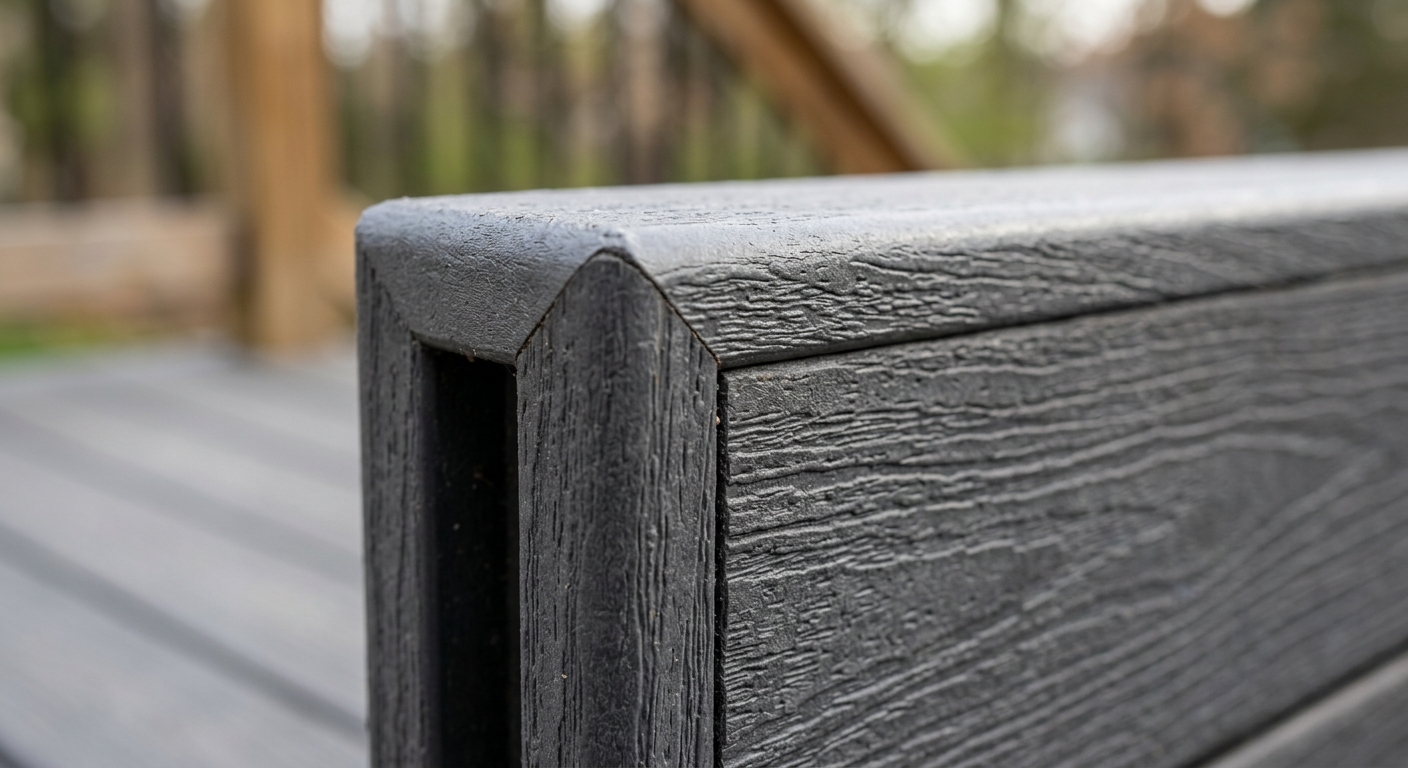
The composite colors that perform best under heavy canopy share a common characteristic: they have enough inherent value contrast (lightness-to-darkness range) in their wood-grain embossing that they remain visually dimensional even in flat, filtered light. The worst performers under canopy are flat-toned boards with minimal grain variation — these look like painted plywood in shade regardless of their color. The best performers are boards with high-quality multi-tonal embossing that catches even diffused light from multiple angles.
Trex Transcend's wire-brushed line, TimberTech's Legacy collection, and AZEK's Vintage series all offer this kind of deep grain embossing that reads well under canopy. Entry-level composite products with stamped rather than multi-pass embossing tend to look flatter under Seattle's characteristic lighting.
Specific Color Recommendations by Neighborhood Context
Leschi, Seward Park, Maple Leaf (heavy canopy, mixed deciduous/conifer): These neighborhoods typically benefit from mid-to-deep warm brown composite tones that mirror the woodland floor aesthetic. Trex Transcend Spiced Rum — a reddish-amber brown — performs exceptionally well here because its warm reddish undertone holds up under green-filtered canopy light without developing an olive cast. Rocky Harbor's gray-taupe character also works well as a neutral bridge between the warm wood tones of cedar homes and the cool evergreen environment.
Magnolia, Queen Anne (partial canopy, views, architectural homes): Magnolia and Queen Anne properties often combine partial tree coverage with significant view corridors and architecturally distinctive homes. Here, the goal is typically a color that reads well in both shade and direct light conditions. Warm gray tones like Gravel Path or Trex Transcend Havana Gold (a golden warm gray) bridge this requirement well.
Bellevue, Medina, Clyde Hill (open lots, newer construction, south exposure): Eastside neighborhoods with newer, more open landscaping and larger south-facing lots are precisely where the thermal performance issue matters most. For these builds, we consistently specify lighter gray-tans and warm whites. Trex Transcend Gravel Path is our most-recommended specification for Eastside builds, and TimberTech Landmark Foggy Wharf for homeowners who want a more distinctly gray result.
Bothell, Kenmore, Woodinville (wooded suburban, cedar siding, moderate sun): North King County / south Snohomish County suburbs typically have mixed canopy conditions and a high proportion of cedar-sided homes. The cedar-siding pairing benefits from a board that complements without exactly matching the siding tone. Our most common specification here is Trex Transcend Spiced Rum for cedar-clad homes and TimberTech Weathered Teak for homes with darker fiber-cement or painted wood siding.
Note
South and West Exposures: Avoiding the Heat Trap
Seattle's climate is famously temperate, but the city has been setting heat records with increasing frequency. The 2021 heat dome brought temperatures above 100°F to Seattle — an event that would have seemed absurd to previous generations of Pacific Northwesterners. Climate projections suggest that extreme heat events will become more common over the coming decades. For anyone building a composite deck today on a south or west exposure, thermal performance is not a legacy concern from Arizona's playbook — it is a current, relevant factor in King County.
How Composite Decking Absorbs and Retains Heat
Composite decking is a wood-fiber and plastic composite, and the plastic component is what creates the heat retention problem on dark-colored boards. Plastic has lower thermal conductivity than wood, meaning it transfers heat away from the surface more slowly. Dark-colored boards absorb more solar radiation to begin with (darker colors have higher solar absorptivity values), and the plastic-composite matrix then holds that absorbed heat longer than a natural wood board would.
The numbers are significant. Independent testing has shown surface temperature differences of 20°F to 40°F between the lightest and darkest composite options from the same manufacturer under equivalent direct-sun conditions. For a south-facing Seattle deck that receives 6 to 8 hours of direct sun in July and August, that difference can translate to a comfortable 85°F surface (a light gray or tan) versus a painful 125°F+ surface (a deep espresso or charcoal) during peak afternoon hours.
Several composite manufacturers have responded to this problem. Trex introduced their CoolDeck technology, which incorporates reflective pigments that reduce surface heat absorption without requiring lighter colors. TimberTech's Terrain collection incorporates similar heat-management technology. AZEK's cellular PVC decking — which is a different material category from wood-plastic composite — has a naturally lower heat absorption rate due to the absence of wood fiber in its composition.
The Exposure Chart: Matching Color Value to Sun Exposure
The matrix below represents our general guidance for Seattle-area builds based on orientation and shade coverage. "Color value" refers to the lightness-darkness scale, where light equals pale gray or tan and dark equals espresso or charcoal.
| Orientation | Shade Coverage | Recommended Color Value | Specific Examples |
|---|---|---|---|
| North-facing | Any | Any tone works | Full flexibility |
| East-facing | Any | Light-to-medium | Gravel Path, Foggy Wharf, Spiced Rum |
| South-facing | Heavy tree shade | Medium | Rocky Harbor, Weathered Teak |
| South-facing | Partial or open | Light-to-medium | Gravel Path, Whidbey, Island Mist |
| West-facing | Heavy tree shade | Medium | Spiced Rum, Rocky Harbor |
| West-facing | Partial or open | Light only | Gravel Path, Foggy Wharf, Silver Maple |
| Southwest | Any | Light only | Gravel Path, Whidbey, Clam Shell |
This is not about avoiding dark colors for aesthetic reasons — it is about protecting your comfort and your investment. A dark board on a west-facing, unshaded deck in Bellevue may cause the composite's surface temperature to cycle repeatedly between 130°F and ambient temperature. While modern composite products are engineered to withstand this thermal cycling, it accelerates color fade over the product's lifespan and, more importantly, makes the deck physically unusable during the hottest parts of the best summer days.
Premium Composite Products with Better Heat Management
If a client has their heart set on a darker composite tone for a south or west-facing deck, we have several options beyond simply changing the color:
AZEK Vintage and Harvest Collections (cellular PVC): AZEK's cellular PVC products are not technically composite — they contain no wood fiber. This gives them better thermal properties than wood-plastic composite because PVC's specific heat capacity differs from the combined wood-plastic matrix. They also offer excellent color stability because the color runs through the material rather than just the surface cap layer. Available at azek.com. The trade-off is higher cost, typically $12–$18 per board linear foot for material alone.
TimberTech AZEK Vintage Reserve: TimberTech (now part of the same family as AZEK) offers their Vintage Reserve line with a capped polymer decking construction that delivers better heat management than standard capped composite. Colors like Weathered Teak and Coastline offer deep warmth without the severe heat absorption of true dark composite. More at timbertech.com.
Trex Transcend with CoolDeck: For homeowners who want to stay with Trex's familiar and widely-distributed product line, the Transcend tier includes CoolDeck Technology in their darker color offerings. While not a magic solution, testing shows surface temperatures 10°F to 30°F lower than equivalent non-CoolDeck composite boards. Full color lineup at trex.com.
Key insight
Matching Deck Color to Seattle Home Exteriors
The deck color does not exist in isolation. It is always seen against — and in relationship to — your home's exterior cladding, trim, roofline, and any adjacent hardscape. Getting this relationship right is what separates a deck that looks designed from one that looks afterthought.
Cedar Siding and Shake: The Most Common PNW Pairing
Cedar is deeply woven into the Pacific Northwest architectural vernacular. A large proportion of King County homes built between 1960 and 1990 feature natural cedar siding, cedar shakes, or stained cedar shingles. If your home has cedar exterior cladding, your deck color options open up in some directions and close in others.
The fundamental principle with cedar-clad homes is value contrast. Cedar siding reads as a warm medium tone — neither very light nor very dark, with amber and honey undertones. A deck that exactly matches this tone will read as a blur — no visual separation, no hierarchy, no sense of intentional design. You want either a step lighter or a step darker to create clear visual distinction between wall and deck plane.
Lighter option (most popular): A warm light gray like Gravel Path or a pale tan like AZEK's Harvest Coconut creates a clean, contemporary contrast against natural cedar that reads as intentional and fresh without being harsh. The warmth in the gray's undertone picks up the amber in the cedar without competing with it.
Darker option (classic Northwest look): A deep warm brown like Trex Transcend Spiced Rum or TimberTech Weathered Teak placed against natural cedar creates a rich, layered look that emphasizes the traditional Northwest wood-palette aesthetic. This pairing works especially well when the trim is painted in a cream or off-white rather than bright white.
What to avoid: Cool blue-gray composite boards on cedar-clad homes. The blue-gray undertone in colors like AZEK's Harbor or Fiberon's Driftwood Gray clashes with cedar's inherent warmth, creating an unresolved tension between the two exterior elements.
Fiber Cement and Engineered Siding
James Hardie, LP SmartSide, and similar fiber-cement or engineered wood products have become increasingly prevalent on newer King County construction, including substantial numbers of ADUs, additions, and full rebuilds across Seattle's urban neighborhoods. These products are typically painted — often in the cool charcoal grays, deep navies, and sage greens that dominate the current King County exterior palette.
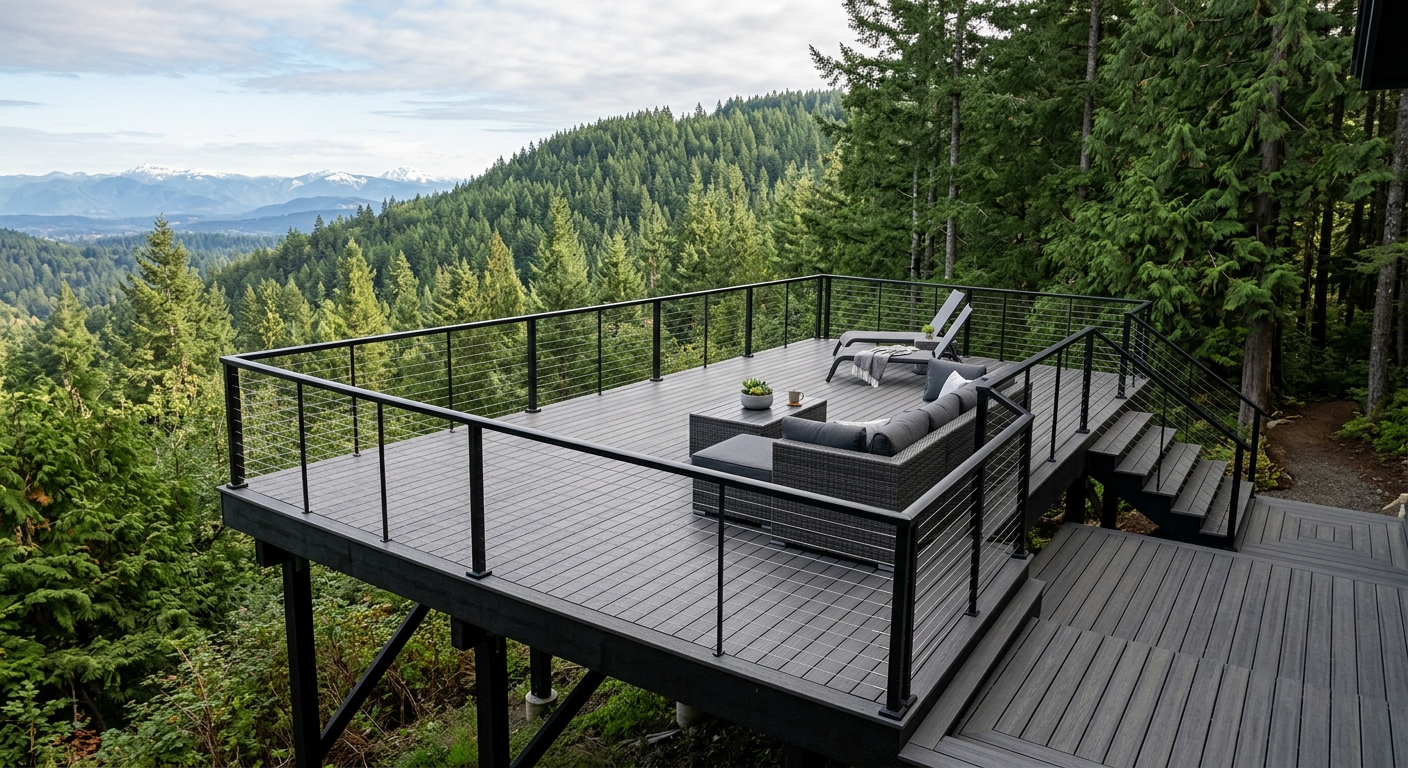
Against dark, cool-toned fiber cement siding, the deck color options shift significantly. Cool-gray composite boards in the light-to-medium range create a sophisticated tonal relationship — the deck reads as a lighter extension of the siding's cool character. This is the palette of contemporary Pacific Northwest architecture: charcoal Hardie lap, light gray composite deck, stainless cable railing, black powder-coated steel posts. It is a look that appears repeatedly in Seattle home design magazines and for good reason — the components reference each other coherently.
Warm brown composite boards can also work against dark fiber cement siding, but the contrast needs to be considered carefully. Against a very dark charcoal or navy siding, a mid-tone warm brown deck creates a bold warm-cool contrast that can be striking in small doses but exhausting at scale. A deep warm brown like espresso against dark charcoal siding typically works better than a mid-range tan, because the value contrast is clear enough to read as intentional.
Brick and Painted Wood Siding
Seattle has fewer brick homes than most East Coast cities, but significant brick construction exists in Capitol Hill, First Hill, and parts of Bellevue's older residential neighborhoods. Brick presents a specific design constraint: its terra-cotta red-orange tones are very specific in their color relationship demands.
Against red-toned brick, composite boards in the gray family are almost always the right choice. Gray is the natural complement to brick's warmth, providing contrast without clashing. The gray also echoes the mortar tone that is typically a cool gray. Warm brown composite boards against brick can create a discordant earth-tone pile-up — two warm, complex natural tones competing with each other.
For painted wood siding homes — a significant proportion of Seattle's older Craftsman and bungalow stock — the deck color should typically complement rather than match the paint tone. A sage-green painted Craftsman bungalow in Columbia City might pair beautifully with a warm gray composite deck that picks up the gray-green undertone in the sage without matching it exactly.
Top Composite Brands and Their PNW-Friendly Color Lines
Three manufacturers dominate composite deck specifications in King County: Trex, TimberTech, and AZEK. Fiberon is also present in the market and worth considering. Here is a builder's honest assessment of each brand's PNW-relevant color offerings.
Trex: The Market Leader with the Widest Distribution
Trex is the most widely specified composite brand in King County, and that market position is earned through consistent product quality, comprehensive warranty support, and the widest distribution network of any composite manufacturer. When something goes wrong with a Trex board five years after installation — and occasionally something does — warranty support is reliably accessible through their network.
Trex's product line runs three tiers: Enhance (entry), Select (mid), and Transcend (premium). For Seattle builds, our standard recommendation is Transcend for anything that is going to be prominently visible or heavily used. The difference in board quality, grain detail, and cap layer performance between Enhance and Transcend is significant enough to matter over a 25-year deck lifespan.
Trex colors that perform best in Seattle:
- Gravel Path (Transcend): Warm light gray with tan undertones. The single most-specified Trex color in King County by volume. Works on virtually every exposure, pairs with virtually every exterior color. Not the most interesting choice aesthetically, but almost never the wrong one.
- Spiced Rum (Transcend): Reddish warm brown, reminiscent of aged teak. Excellent in wooded contexts. Works beautifully against cedar siding. Moderate heat absorption — acceptable on partial-south exposures but not for open southwest.
- Rocky Harbor (Transcend): Gray-taupe with driftwood character. The gray alternative for clients who want warmth in their gray. Pairs well with both cedar and contemporary fiber cement.
- Havana Gold (Transcend): Warm golden tan. Unusual choice but one that works exceptionally well on Eastside homes with warm-beige or stucco-influenced aesthetics.
- Island Mist (Transcend): Very light gray-white. Best for open south-facing decks where heat management is critical. Requires more attention to cleaning (shows dirt accumulation) but delivers the coolest surface temperatures in Trex's lineup.
TimberTech: The Premium Alternative
TimberTech has positioned itself as the premium alternative to Trex, with product lines that often feature more sophisticated grain embossing and broader color palettes. Since their acquisition by AZEK Building Products, the TimberTech and AZEK product lines have been rationalized but still offer distinct product identities.
TimberTech's Legacy and Landmark collections include several colors specifically marketed to PNW and coastal aesthetics:
- Foggy Wharf (Landmark): Pale silvery gray. The quintessential Pacific Northwest gray — it looks like morning fog off Puget Sound translated into a deck board. Exceptional on contemporary homes with cable railing, excellent thermal performance on south exposures.
- Weathered Teak (Legacy): Warm medium brown with gray undertones. One of the better-performing warm tones for partial-shade Seattle conditions because the gray undertone prevents it from reading as olive under canopy light.
- Coastline (Landmark): Cool blue-gray. Striking on contemporary homes with dark siding and water views. Less versatile than the gray-tans but architecturally distinctive.
- Antique Leather (Legacy): Rich warm brown, similar in feel to Trex Spiced Rum but with slightly more red in it. Strong performer in Maple Leaf and Leschi wooded contexts.
AZEK: The PVC Premium Option
AZEK occupies a distinct position because their flagship product is cellular PVC, not wood-plastic composite. This distinction matters for Seattle specifically: PVC decking does not contain wood fiber, which means it is categorically more resistant to the biological growth that Seattle's wet season promotes. It also has better thermal properties than wood-plastic composite, as noted above.
AZEK's color lines that resonate most strongly in Seattle include:
- Whidbey (Vintage): A color literally named for the island visible from Seattle's waterfront neighborhoods. Cool misty gray that reads authentically Pacific Northwest. Particularly strong against white trim and gray-green fiber cement siding.
- Harvest Coconut (Harvest): Warm pale tan — lighter than most of the brown options and with excellent thermal performance. A good choice for cedar-siding homes where the client wants warmth without darkness.
- Pitch Black (Vintage): AZEK's darkest offering. Because of PVC's better thermal properties, this is actually manageable on partial-south exposures where an equivalent dark composite would be problematic. Still not recommended for open southwest decks.
Fiberon: The Value-Premium Option
Fiberon is less widely distributed in King County than the three above, but their Paramount and Promenade lines offer high-quality product at pricing that typically comes in 10–15% below equivalent Trex Transcend boards. For budget-conscious builds where quality matters but cost is a significant factor, Fiberon's premium lines deserve serious consideration.
Fiberon's Promenade Collection includes several gray and weathered-wood options that work well in Seattle conditions. Their warranty terms are comparable to Trex and TimberTech at the premium tier.
What Seattle Deck Builders Actually Specify Most Often
The list of colors that perform best in theory and the list of colors that Seattle builders actually specify most often are largely — but not entirely — the same. Here is an honest account of what we see specified most frequently in King County, and why.
The Top-5 Most Specified Colors in King County
Based on our own project records and conversations with peer builders across the market, the five most commonly specified composite deck colors in King County residential builds over the past three years are:
- Trex Transcend Gravel Path — The consensus workhorse. Clients who are uncertain, clients who want something that will definitely be right, clients who are building on speculation — they all tend to land on Gravel Path because it is never wrong. It photographs well, it works in sun and shade, it pairs with virtually every home exterior, and its thermal performance is excellent. The downside: it is so common that it has become somewhat anonymous on the Eastside.
- Trex Transcend Spiced Rum — The warm-brown choice that most clients who "want wood but not wood" end up selecting. The reddish warmth of Spiced Rum reads more convincingly as natural wood than most composite competitors, and it holds that warmth under Seattle's gray light better than purer brown options.
- TimberTech Landmark Foggy Wharf — The preferred choice of contemporary architecture clients and anyone who wants a distinctly Pacific Northwest gray. Architects specifying decks for new-construction projects in Seattle's urban neighborhoods specify Foggy Wharf or its closest equivalent with significant frequency.
- AZEK Vintage Whidbey — The choice of clients who have done their research and want the best moisture resistance available with a distinctive PNW-appropriate aesthetic. Whidbey's muted, atmospheric gray is not for everyone, but the clients who choose it are typically very happy with it.
- Trex Transcend Rocky Harbor — The gray-brown bridge choice for clients who want warmth in their gray. Rocky Harbor splits the difference between Gravel Path's warm light gray and Spiced Rum's reddish brown, landing on a driftwood-esque tone that works in almost as many contexts as Gravel Path but with more character.
Colors We Rarely Specify in Seattle (and Why)
Just as useful as knowing what works is knowing what does not work in practice:
Very light or near-white boards (Island Mist, AZEK Harvest Coconut in the lightest register): These perform well thermally on south exposures, but Seattle's biological growth season makes them maintenance-intensive. Moss and algae show immediately on light boards, requiring spring cleaning every year without fail. In Portland or Vancouver BC (similar climate), these colors are similarly avoided by experienced builders.
Very dark espresso or charcoal on south/west exposures: Already covered under thermal performance. We have replaced sections of dark composite on full-sun decks for clients who learned this lesson the hard way.
Colors with strong blue or green undertones on cedar-sided homes: These create a chromatic conflict that is hard to articulate but immediately apparent in person. The clash between cool-blue-green composite and warm-amber cedar is one of those combinations where something feels wrong even if you cannot immediately name why.
For more context on how specific products compare, see our detailed breakdown at /blog/trex-vs-fiberon-vs-timbertech-seattle and our broader materials guide at /blog/best-decking-materials-seattle-2026.
Composite Deck Color and Railing: The Complete System
Color selection cannot be completed without addressing railing, because the railing system occupies more visual real estate than most homeowners realize at the design stage. On a typical 300 sq ft deck with a standard 36-inch perimeter railing, the railing elements may constitute 40–60% of what a viewer perceives at standing height. Getting the deck color right but the railing color wrong undermines the entire palette.
Railing System Options and Their Color Relationship to Composite Decking
Cable railing (stainless steel): Cable railing has become the dominant railing choice for contemporary Seattle builds, particularly on properties with views or in neighborhoods like Capitol Hill, Fremont, and the Eastside suburbs where modern aesthetic is valued. Cable's stainless tone is effectively a cool, highly reflective silver-gray that pairs naturally with the gray composite palette. On a Gravel Path or Foggy Wharf deck, stainless cable railing creates a cohesive contemporary system. On warm brown decks like Spiced Rum, the cool stainless creates a deliberate warm-cool contrast that works well if the posts and top cap are also in a warm tone. See our detailed cable railing guide at /blog/cable-railing-seattle.
Glass railing: Frameless glass railing essentially disappears as a color element, making it the most palette-neutral railing choice. It allows the deck board color to be the dominant visual element without competition. Glass railing is also the best choice for view properties where the goal is maximum visual transparency to the landscape beyond. More on railing options at /blog/deck-railing-options-seattle.
Aluminum and composite railing systems: These come in black, white, bronze, and gray powder-coat finishes. Black aluminum railing is the most popular choice in King County currently, and it creates a strong visual anchor regardless of deck color. Black against gray composite reads as contemporary and clean. Black against warm brown composite reads as classic and substantial. White aluminum railing against gray composite can look crisp on the right contemporary home but can also look sterile if the proportions are not managed carefully.
Traditional wood railing: Increasingly rare in new Seattle builds due to maintenance requirements and the disconnect between a low-maintenance composite deck and a high-maintenance wood railing. When specified, typically painted white to provide clean contrast against composite decking in any color.
The Post and Cap Color Decision
On railing systems where the posts are composite or aluminum with powder-coat finish, the post and cap color is a separate choice from the deck board and baluster colors. The conventional guidance: match the post cap and top rail to the deck board color if you want a unified, monolithic look; choose contrasting colors (typically darker post and cap against lighter deck boards) if you want a more articulated, architectural look that visually defines the deck perimeter.
In Seattle, the most common specification for contemporary builds is black powder-coat aluminum posts and rail with a gray composite deck — the contrast is crisp and reads as intentional design rather than default.
Cost of Composite Decking in Seattle: 2025–2026 Pricing by Material and Color Tier
Color choice has a direct cost implication because composite products are tiered by quality, and the top-performing colors in Seattle conditions (primarily the Transcend and Legacy/Landmark premium tier products) cost meaningfully more than entry-level composite in similar tones.
All-in project cost including materials, labor, permits, and standard railing. King County market rates. Source: local builder estimates and olympicdecks.com, orcaroofing.com.
| Category | Value |
|---|---|
| Entry Composite (Trex Enhance, Fiberon Good Life) | $13,000 |
| Mid-Grade Composite (Trex Select, Fiberon Horizon) | $16,500 |
| Premium Composite (Trex Transcend, TimberTech Landmark) | $20,000 |
| PVC Decking (AZEK Vintage, TimberTech AZEK) | $24,000 |
Breaking Down the Per-Square-Foot Cost of Composite Decking in Seattle
Material cost for composite decking boards ranges from approximately $4 per square foot for entry-level products to $18 per square foot for premium PVC products in the 2025–2026 market. The installed cost is a different number — when you add labor, substrate framing, fasteners, permit costs, and railing, the total project cost for a standard 300 sq ft composite deck in Seattle runs $12,000 to $22,000 all-in based on current market data from multiple King County contractors.
King County and Seattle building permits add $800 to $2,500 to the project cost depending on project value and jurisdiction. For decks within the City of Seattle, permits are managed through the Seattle SDCI. For unincorporated King County and incorporated cities outside Seattle, permits are managed through King County DLS. We have a complete guide to the permit process at /blog/deck-permit-king-county-guide.
Does Color Tier Affect Price?
Within a given product line, color does not typically affect board price directly — a Trex Transcend board in Gravel Path costs the same per linear foot as one in Spiced Rum. However, the premium color collections within a brand's lineup (the wire-brushed and handscraped textures, for example, in Trex's Transcend lineup) may cost 10–15% more than standard-texture boards in the same color family.
The bigger cost differentiator is product tier: entry composite vs. premium composite vs. PVC. If the best color for your Seattle conditions falls in the premium composite or PVC category — and for many clients with south or west exposures or heavy canopy, it does — plan for the corresponding budget increase.
| Product Tier | Material Cost ($/sq ft boards) | Installed Cost ($/sq ft, Seattle) | PNW-Best Colors Available |
|---|---|---|---|
| Entry composite | $4–$7 | $35–$55 | Limited; basic grays and tans |
| Mid-grade composite | $7–$12 | $55–$85 | Broader palette; decent gray options |
| Premium composite | $12–$18 | $85–$130 | Full palette including best PNW performers |
| Cellular PVC | $14–$20 | $100–$145 | Best heat management; distinctive colors |
For a comprehensive look at Seattle deck cost factors, see our detailed guide at /deck-cost-seattle and our 2025 cost blog at /blog/deck-cost-seattle-2025.
The Long-Term Cost of Color Choice
One factor that rarely appears in initial cost discussions is the long-term cost implication of color choice. On a composite deck with a 25-year warranty, the deck will be in place through multiple home sales, landscaping changes, and exterior paint or siding updates. A deck color that is tightly matched to your current home exterior becomes a constraint on future exterior changes. A more neutral tone — a mid-gray, a weathered wood, a driftwood tan — ages well through exterior changes because it reads as a natural material rather than a color statement.
According to the National Association of Realtors' Remodeling Impact Report, a new wood deck recoups approximately 56% of its cost at resale, while a composite deck may recoup 60–65% — and that recoup rate is highest when the deck aesthetic is broadly appealing rather than highly personalized. Neutral composite colors in good condition consistently perform better at resale than distinctive or trendy color choices, regardless of their initial aesthetic appeal.
This is one reason experienced deck builders consistently recommend the neutral-gray and weathered-wood end of the composite palette over bold color choices — not because bold is wrong, but because 25 years of ownership encompasses more contingencies than any single aesthetic moment.
For a related perspective on return on investment and deck additions in the Seattle market, see /blog/deck-addition-seattle.
Putting It All Together: The Seattle Color Selection Workflow
The information in this guide is most useful when organized into a practical decision-making sequence. Here is the workflow we walk clients through when helping them finalize composite deck color for a King County project.
Step 1: Establish Your Exposure
Determine your deck's primary orientation. Is it north, south, east, or west-facing? How many hours of direct sun does the location receive on the longest summer day? For south-facing decks with 5+ hours of direct afternoon sun, color value constraint is non-negotiable — you are working in the light to medium range.
Step 2: Inventory Your Home Exterior Colors
Take photos of your home's exterior cladding, trim, roofing, and any masonry elements. Note the color temperature (warm or cool) and value (light, medium, or dark) of each. The deck color should either harmonize (similar temperature, different value) or contrast (different temperature with adequate value separation) with the dominant exterior element.
Step 3: Identify Your Canopy Condition
How much tree canopy will shade the deck? Is it conifer (green-filtered light year-round) or deciduous (filtered in summer, open in winter)? Significant conifer canopy pushes toward either neutral grays or warm reddish-browns; avoid mid-range yellowy browns and anything with a significant yellow-green undertone.
Step 4: Evaluate Full-Size Samples On-Site
This is not optional. Get at least 2-foot sample lengths of your top two or three candidates. Place them in the actual deck location on an overcast day and photograph them next to your home's siding. Compare at different times of day. This step prevents 80% of post-installation color regret.
Step 5: Select Brand and Product Tier
Once you have a color direction, identify which manufacturer's products best match that direction within your budget parameters. Consider warranty terms, local availability, and your builder's experience with the product line. Working with a manufacturer's product that your builder has installed many times reduces the risk of installation issues.
Tip
Step 6: Consider the Complete System
Finalize railing material, post color, and lighting simultaneously with deck color, not sequentially. The complete deck system — boards, railing, lighting — is what you will actually live with, and what prospective buyers will evaluate at resale. Deck lighting, in particular, can shift the perceived color of your boards significantly at evening hours and is worth considering before finalizing day-light color choices. See our deck lighting overview in the /blog/deck-and-patio-combo-seattle guide.
The NADRA Perspective on Color and Value
The National Association of Deck and Railing Builders (NADRA) consistently emphasizes that deck projects deliver some of the highest satisfaction ratings of any home improvement category among homeowners — but satisfaction is highly correlated with material and color choices that were made with accurate information rather than showroom impulse. The time invested in systematic color evaluation before installation is among the highest-return activities in the entire deck planning process.
Working with a Seattle Deck Builder on Color Selection
The best composite deck color outcomes in King County consistently come from projects where the homeowner engages their builder as an active partner in color selection, not just an installer who implements a pre-made decision. Experienced local builders have seen how dozens of color options perform in Seattle's actual conditions over multiple years, and that on-the-ground knowledge is genuinely valuable — use it.
At The Seattle Decking Company, our standard process includes an on-site color consultation before any material is specified. We bring full-size sample boards of our most commonly recommended options, evaluate them at the project location under actual conditions, and walk through the decision matrix with the homeowner. We have installed composite decks across King County — from Capitol Hill to Bothell, from Leschi to Bellevue — and the accumulated experience with how specific products and colors perform in specific neighborhood contexts is something we actively share with clients.
For custom projects — curved decks, multi-level builds, decks combined with patio hardscape — color selection becomes even more complex because you may be coordinating composite decking with concrete, stone, or tile surfaces simultaneously. Our /blog/custom-curved-decks-seattle and /blog/deck-and-patio-combo-seattle articles address the specific color considerations for these more complex projects.
Whether you are starting from scratch or replacing a failing cedar deck (see /blog/cedar-deck-sealing-seattle for context on when maintenance becomes replacement), the color selection process benefits from the same systematic approach: establish exposure, inventory your exterior, account for canopy, evaluate samples on-site, and finalize the complete system together.
Composite decking's primary color advantages over natural wood — color stability over decades, no uneven graying, no staining requirements, no mold discoloration from Seattle's wet season — only deliver their full value when the color was right to begin with. Getting there requires the kind of systematic, on-site evaluation this guide describes. The investment of time in that process is small relative to the 25-year commitment you are making.
When you are ready to start planning your composite deck project, The Seattle Decking Company is available to walk through color selection, material specification, structural design, and permits with you from the beginning. We are based in Bothell at 22722 29th Drive SE and serve homeowners throughout King County and south Snohomish County. You can reach us directly at (425) 675-6259 or visit theseattledeckingcompany.com/contact to schedule a consultation. We bring sample boards to every first meeting — because the only way to get color right in Seattle's light is to see it in Seattle's light.
Frequently Asked Questions
What composite deck colors work best for Seattle's overcast climate?
Does composite deck color affect how hot the surface gets?
What are the most popular composite deck colors in King County right now?
What composite colors work best against cedar siding in Seattle?
How much does composite decking cost in Seattle, and does color tier affect price?
How should I evaluate composite deck colors before buying?
Is gray composite decking a good choice for Seattle homes?
What composite deck colors work best in Seattle neighborhoods with heavy tree canopy?
Should my composite deck color match or contrast my home's exterior?
Do I need a permit for a composite deck in Seattle or King County?
How does composite decking color hold up over time in Seattle's wet climate?
What is the difference between composite and PVC decking, and does it affect color choice in Seattle?
Planning a deck in the Seattle area?
Get an onsite design review and a clear, itemized quote from a licensed local builder.
Request a Free Quote