
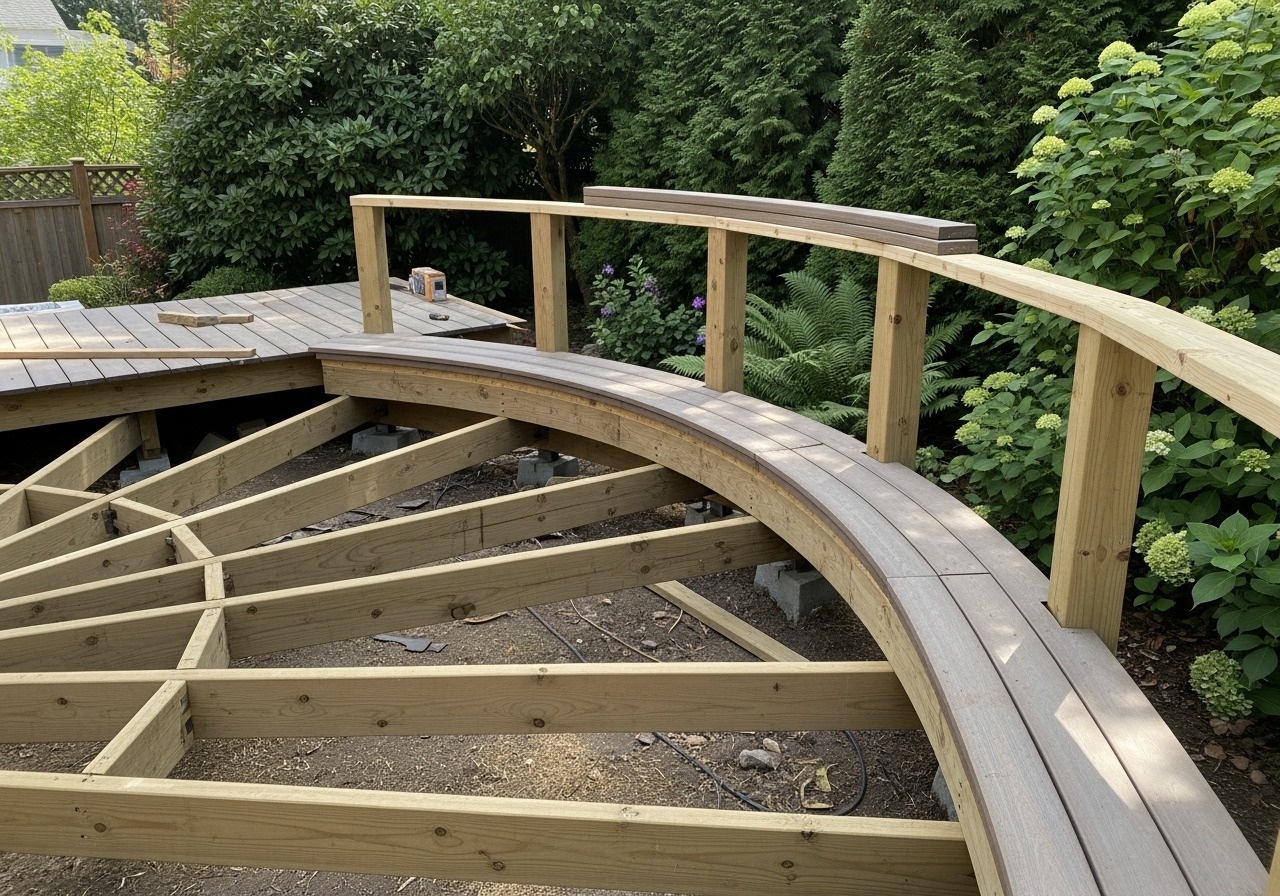
If you have spent any time driving the winding roads that climb east from Issaquah into the Sammamish Plateau, you already understand why building a deck here is not quite the same as building one anywhere else in the greater Seattle area. The land rises sharply, the lots are frequently canopied by Douglas fir and Western red cedar, and the views — whether you are looking west toward Lake Sammamish or east into the Cascade foothills — are genuinely spectacular. Those same landscape features that make Plateau properties so desirable are exactly what make outdoor construction more technically demanding. Clay-heavy soils, steep slopes, high water tables, critical areas buffers near wetlands, and an annual rainfall total that exceeds 38 inches all conspire to make what looks like a simple backyard deck project into something that requires genuine expertise and careful planning.
We have been building decks for Seattle-area homeowners for years, and Sammamish Plateau jobs consistently rank among the most technically interesting — and most frequently misquoted by contractors who do not know the territory. Homeowners in neighborhoods like Plateau Park, East Lake Sammamish, Trossachs, Inglewood Hill, and Klahanie routinely get bids from contractors who have never dealt with an engineered footing requirement, do not account for impervious surface limits, and underestimate the permit timeline from the City of Sammamish's building department. The result is projects that run over budget, stall at the permit counter, or — worst case — get built without proper approvals and create real liability for the homeowner when it comes time to sell.
This guide exists to close that information gap. Whether you are planning a modest ground-level platform off your sliding door or a substantial multi-level deck cantilevered over a slope with a built-in seating area and cable railing, the information here will help you understand what the permit process actually looks like, what realistic costs are in 2026, which materials are going to hold up against the Plateau's wet winters, and what to look for when selecting a contractor who genuinely knows this area.
Why the Sammamish Plateau Is Different: Unique Site Challenges for Deck Builders
Sammamish is often described, a little glibly, as one of the wealthiest zip codes in Washington State. That is true, and it matters for deck building in a practical way: the average Sammamish Plateau lot was graded and developed under suburban housing codes that prioritized fitting as many homes as possible onto terrain that was never entirely cooperative. The Plateau itself is not one geographic feature but several — a series of ridges and valleys carved by glacial action, running roughly between the cities of Redmond to the north and Issaquah to the south, with Sammamish city center and the Sammamish Landing area along the lake's eastern shore.
What this means on the ground, lot by lot, is enormous variability. A home in the Plateau Park neighborhood might sit on a relatively flat lot with loamy soil and straightforward drainage. Half a mile away, in the hillside sections of Inglewood Hill or along the steep western-facing slopes that look down toward Lake Sammamish, you can have grade changes of 10 to 15 feet across a standard backyard — exactly the kind of terrain where a simple ground-level deck becomes physically impossible and an elevated structure with engineered footings becomes the only option.
Clay Soils and the Footing Problem
The Sammamish Plateau sits on top of glacial till — a mixture of clay, sand, and gravel deposited by the Vashon ice sheet roughly 14,000 years ago. In practice, this means that when you dig down to set deck footings, you frequently encounter dense, expansive clay that does not drain well, shifts seasonally with freeze-thaw cycles (mild by Midwest standards but real), and can have significant bearing capacity variability even within a single lot. Expansive clay is the enemy of standard precast concrete deck footings. A footing that works fine in the sandy soils of South King County can heave or settle in Sammamish clay within a few years, creating uneven decking, racking frames, and — in the worst cases — structural failures.
The practical consequence is that many Sammamish Plateau deck projects require either deeper poured-in-place footings that reach below the frost-susceptible zone, helical piers that screw down into more stable strata, or concrete piers that are engineered specifically for the soil conditions on that particular lot. None of these options is cheap. A basic precast footing might cost $30–$60 to install. An engineered poured footing can run $200–$400 each, and a hillside deck with six to ten footings can see that cost add up quickly. Helical piers for challenging soils can run $300–$600 per pier installed.
Important
Seasonal Water Tables and Drainage
The western face of the Sammamish Plateau drains toward Lake Sammamish, and the eastern face drains toward Issaquah Creek and its tributaries. In between, water moves through the landscape in ways that are not always obvious until construction begins. Seasonal high water tables — the point at which groundwater saturates the soil — can reach within 18 to 24 inches of the surface in low-lying areas of the Plateau during wet winters. This matters for deck construction because footings that sit in seasonally saturated soil are subject to frost heave, hydrostatic pressure, and long-term concrete degradation.
Proper drainage planning is not optional on most Sammamish Plateau sites. A well-built deck in this environment typically includes graded drainage away from the structure, sometimes a French drain or gravel drainage layer around footings in wetter areas, and careful attention to how water will shed off the deck surface and move away from the house foundation. Composite decking products with their grooved or gapped profiles actually help here — water moves through the deck surface and down rather than pooling on solid wood planks.
Slope and Grade Changes
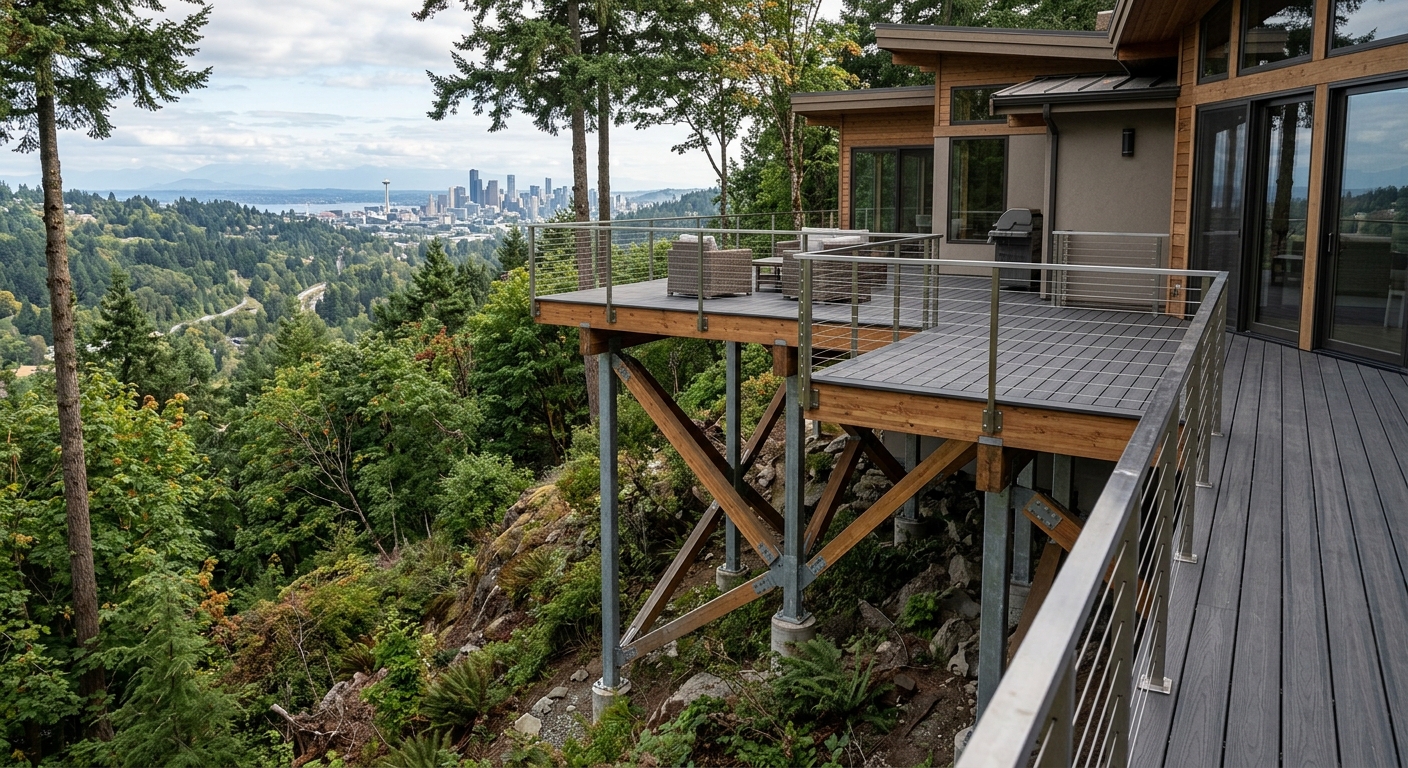
A significant number of Sammamish Plateau lots have usable outdoor space that sits at a different elevation than the main floor of the home. On hillside lots in neighborhoods like Trossachs or along the East Lake Sammamish Parkway corridor, it is common to have a main-floor walkout door that looks out over a slope dropping 8 to 15 feet before reaching a relatively flat area. This creates the classic Plateau deck scenario: an elevated structure that must span the grade change, support significant dead and live loads, and do so in a way that the City of Sammamish's building department will approve.
Elevated decks at these heights are structurally more complex than ground-level platforms. The beams span farther, the posts are taller and require lateral bracing, and the connections between ledger, beams, posts, and footings are under far more stress. The City of Sammamish's deck submittal checklist reflects this: elevated structures require more detailed structural drawings, and decks above a certain height threshold require a Washington State licensed engineer's stamp on the structural documents.
For practical project planning on a sloped Sammamish Plateau lot, this means budgeting for:
- An engineer's fee to stamp structural drawings: $500–$2,000 depending on complexity
- Additional materials for taller posts and longer beams
- Lateral bracing systems (cross-bracing or knee-bracing) at the post level
- More complex staircase designs to navigate the grade change
The 20–40% cost premium that elevated decks carry over flat-lot builds is real and measurable on Plateau properties. A 400-square-foot composite deck that might cost $28,000–$35,000 on a flat Kirkland lot can cost $36,000–$48,000 on a sloped Sammamish Plateau site with similar finishes.
Navigating the City of Sammamish Permit Process Step by Step
The City of Sammamish operates its own building department — separate from King County's Department of Local Services — and follows its own permit intake, review, and inspection process. This is a distinction that matters. Homeowners who have built in unincorporated King County, or who get advice from contractors who primarily work in Seattle or Bellevue, sometimes assume the King County permit system applies. It does not. Sammamish incorporated as a city in 1999, and the city runs its permitting independently through the City of Sammamish Permit Center.
Note
When Is a Permit Required?
Under City of Sammamish regulations, a building permit is required for any deck that meets one or more of the following conditions:
- The deck is attached to the house (including via a ledger board)
- The deck is elevated more than 30 inches above grade at any point
- The deck's total area exceeds 200 square feet
In practice, almost every deck that a homeowner in Sammamish actually wants to build will require a permit. A small, freestanding, ground-level platform under 200 square feet that does not attach to the house sits in the no-permit zone — but that describes a garden feature, not the kind of deck Plateau homeowners are typically building. For anything meaningful, plan for the permit process from day one.
It is worth noting that King County's Department of Local Services handles permits for unincorporated King County areas. If your address is within the Sammamish city limits — which includes the vast majority of the Plateau's residential neighborhoods — you go through the city, not the county. When in doubt, verify your jurisdiction via the city's permit center before submitting anything.
What the Permit Application Requires
The City of Sammamish has published a deck submittal checklist that outlines exactly what needs to be included with a permit application. At a minimum, a complete deck permit submission typically includes:
| Document | Notes |
|---|---|
| Completed permit application | Submitted through MyBuildingPermit.com |
| Site plan | Shows lot lines, existing structures, proposed deck location, setbacks |
| Floor plan / deck plan | Top-down view with dimensions, framing layout, joist spacing |
| Elevation drawings | Side views showing height above grade, railing height, stair configuration |
| Foundation/footing plan | Footing sizes, depths, spacing — may require engineer stamp |
| Structural details | Beam sizes, connection hardware specifications, ledger attachment details |
| Engineer's letter or stamped drawings | Required when deck height or soil conditions trigger engineer review |
For straightforward low-level decks, a competent contractor can prepare these documents from their own knowledge and standard IRC tables. For elevated structures, hillside lots, or unusual configurations, hiring a structural engineer to review and stamp the drawings is not just required by code — it is genuinely the right call for long-term structural safety.
Permit Fees and Timeline
Permit fees in Sammamish are scope-dependent and calculated based on the estimated value of construction. For a typical residential deck project, expect permit fees in the $500–$3,000 range. A simple $15,000 ground-level deck might generate a $500–$800 permit fee. A complex elevated structure valued at $50,000+ could generate a permit fee of $1,500–$3,000.
Current permit processing time at the City of Sammamish for residential deck projects runs approximately 2–8 weeks from a complete submission. "Complete submission" is the key phrase: incomplete applications — missing a site plan, submitting drawings that do not meet the city's format requirements, or leaving out structural details — get kicked back for correction and restart the review clock. Working with a contractor who has submitted Sammamish permits before and knows exactly what the plan reviewer expects is the single biggest time-saver in the process.
Tip
Inspections
Once your permit is approved and construction begins, City of Sammamish building inspectors will conduct inspections at key stages:
- Footing inspection: Before concrete is poured, an inspector verifies that footings are dug to the correct depth and diameter as shown on the approved plans
- Framing inspection: After framing is complete but before any decking is installed, the inspector verifies structural members, connections, and hardware match the approved drawings
- Final inspection: After all work including railings, stairs, and finishes are complete — this is what generates your Certificate of Occupancy or final approval
Failed inspections extend the timeline and can require rework. A good contractor builds inspection scheduling into their project timeline and does not rush through stages in ways that create inspection failures.
How Much Does a Deck Cost in Sammamish in 2026?
Seattle-area deck construction costs run 15–25% above national averages, driven by high local labor rates, the moisture-resistant materials that PNW conditions demand, and the relatively stringent permitting process that adds both fees and time costs to every project. Sammamish specifically tends to run at the higher end of Eastside pricing because of the site challenges described above: sloped lots, clay soils, and the engineering requirements that frequently come with them.
Here is a realistic breakdown of what homeowners on the Sammamish Plateau should expect to budget in 2026:
Installed cost estimates for a standard 400 sq ft deck in Sammamish, WA. Elevated/sloped-lot builds add 20–40% to these figures. Source: The Seattle Decking Company project data and regional market research.
| Category | Value |
|---|---|
| Pressure-Treated Wood | $85 |
| Western Red Cedar | $75 |
| Composite (mid-grade) | $120 |
| Composite (premium) | $155 |
| Ipe / Exotic Hardwood | $145 |
Ground-Level Decks
A ground-level pressure-treated wood deck on a flat Sammamish Plateau lot — the simplest possible version of a deck project — runs $50–$85 per square foot installed for a 400-square-foot structure. That puts a basic 20x20 platform at $20,000–$34,000 including permit, footings, framing, decking, and a code-compliant railing if the deck is elevated enough to require one. Budget the lower end for simple rectangular designs with minimal framing complexity; budget the higher end if the site has any complications or if the homeowner wants upgraded fastening systems, pre-grooved decking, or nicer railing details.
Cedar at the ground level runs slightly higher on materials but lower on long-term maintenance if properly sealed and maintained. A cedar deck in the same configuration runs approximately $60–$90 per square foot installed. For a detailed comparison of these two material paths, see our composite vs. cedar decking Seattle guide.
Elevated Decks on Sloped Lots
This is the signature Sammamish Plateau project: a deck that must span a significant grade change, elevating the living surface to be flush with the main floor of the home while the ground below drops away. At 8 to 12 feet of elevation, these decks require engineered footings, larger structural members, lateral bracing systems, and more complex stair runs to connect the deck level to grade.
At this scale, composite decking is almost always the right call, and the cost reflects it: $100–$180 per square foot installed for a premium composite deck on a sloped lot. A 400-square-foot composite elevated deck on a Sammamish hillside property realistically costs $40,000–$72,000 all in, including engineering, permit, footings, framing, composite decking, cable or glass railings, and stairs. That may feel like a significant number, but the NAR Remodeling Impact Report consistently shows that outdoor living improvements — particularly decks — recover a significant portion of their cost in resale value, and in a market like Sammamish where buyers expect quality outdoor spaces, a well-built elevated deck is a genuine differentiator.
Cost Factors That Move the Number
| Factor | Typical Cost Impact |
|---|---|
| Engineered footings (clay/sloped sites) | +$1,500–$6,000 |
| Engineer's stamp on structural drawings | +$500–$2,000 |
| Premium composite decking (Trex Transcend, TimberTech Legacy) | +$15–$25/sq ft over standard composite |
| Cable railing system | +$150–$250 per linear foot |
| Glass panel railing system | +$200–$350 per linear foot |
| Built-in bench seating | +$1,500–$3,500 per section |
| Built-in planters | +$800–$2,000 each |
| Integrated deck lighting | +$2,000–$5,000 depending on scope |
| Second stair flight | +$1,500–$4,000 per flight |
| Pergola or shade structure | +$6,000–$20,000 depending on style |
For a complete breakdown of Seattle-area deck cost factors, see our deck cost Seattle 2025 guide, which covers the full cost matrix across materials and project types. You can also get a preliminary estimate using our deck cost calculator.
Choosing the Right Decking Material for the Pacific Northwest Climate
No decision in the deck design process has more long-term consequence than material selection — and the Pacific Northwest climate makes this choice particularly consequential. The Sammamish Plateau averages over 38 inches of annual precipitation, most of it falling between October and April in the form of steady, grey drizzle that soaks into wood fibers, promotes mildew growth, and cycles through the wet-dry process that causes splitting, checking, and warping. UV exposure in summer is moderate, but the combination of moisture and some UV is hard on untreated wood surfaces.
Composite Decking: The High-Performance Choice for Plateau Properties
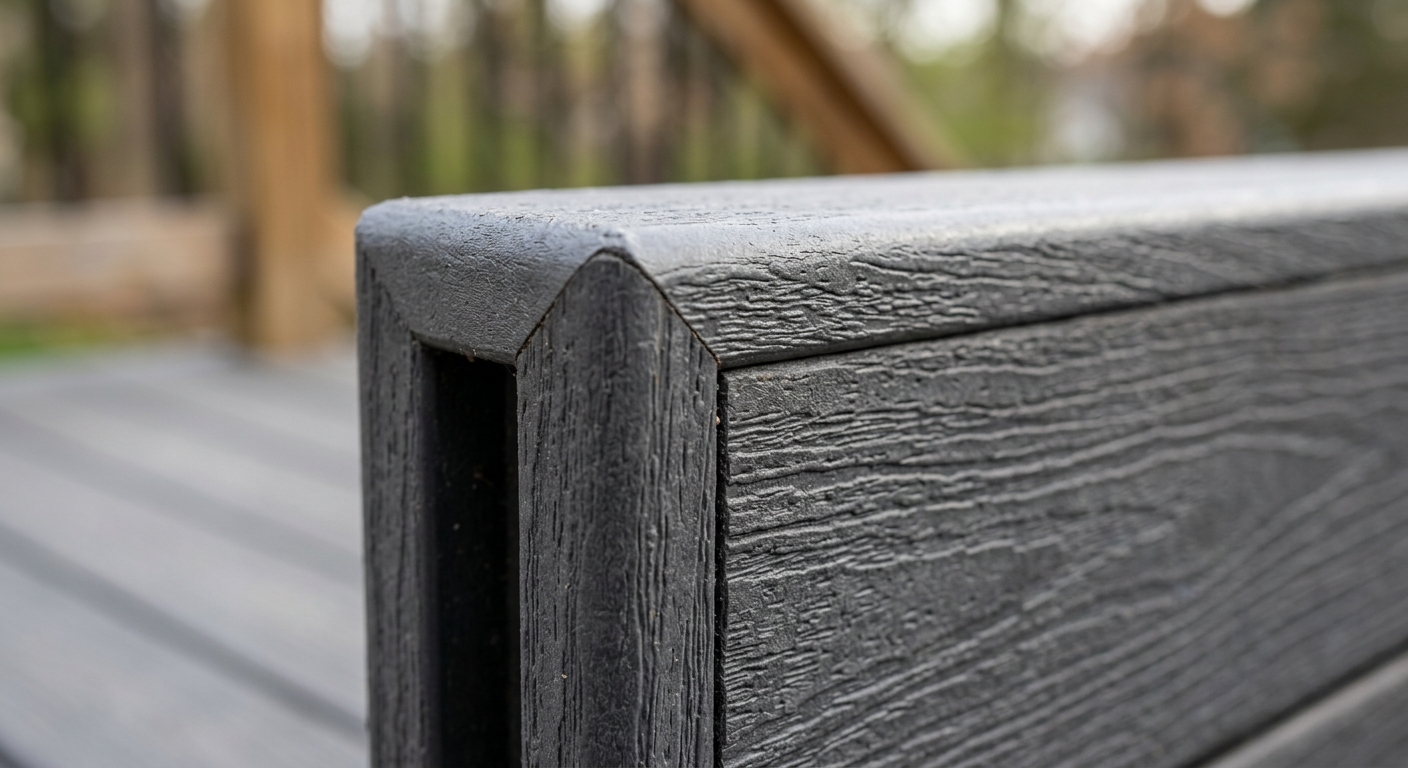
Composite decking — wood fiber and recycled plastic combined and manufactured into boards — has become the dominant material choice for Seattle-area deck projects, and for good reasons that go beyond marketing. Modern composite decking from manufacturers like Trex, TimberTech, Fiberon, and AZEK genuinely resists moisture absorption, does not rot or splinter, holds its color well under UV exposure, and requires dramatically less ongoing maintenance than wood alternatives.
For Sammamish Plateau homeowners specifically, here is what matters about composite:
Moisture resistance: Capped composite boards (the current standard) have a protective polymer shell on all four sides that prevents water penetration into the wood fiber core. In a climate with 38+ inches of annual rain, this is not a luxury — it is the difference between a deck that looks good at year 15 and one that needs a major overhaul at year 7.
Structural stability: Composite boards do not cup, twist, or check the way wood does in response to moisture cycling. This means the deck surface stays flat and the fastener system stays secure over time.
Maintenance simplicity: A composite deck's annual maintenance is essentially a cleaning — a sweep, a wash with mild soap and water, done. No sanding, no staining, no sealing. For busy Sammamish families, this matters.
Warranty coverage: Premium composite products carry 25- to 50-year warranties against staining, fading, and structural defects. Trex's Transcend and TimberTech's Legacy Collections both carry 50-year warranties on the board itself — longer than most homeowners will own the property.
For a detailed comparison of the leading composite brands in the Seattle market, see our Trex vs. Fiberon vs. TimberTech Seattle comparison and our best decking materials Seattle 2026 guide.
Western Red Cedar: The Regional Classic
Western red cedar has been the traditional Pacific Northwest decking material for generations, and for good reason: it grows locally, it has natural oils that resist rot and insects, it machines cleanly, it looks beautiful when freshly milled, and it carries a warmth and authenticity that no composite can fully replicate. On a cedar-shingle-sided craftsman in the Plateau Park neighborhood, a cedar deck looks genuinely right in a way that a grey composite board might not.
The honest case against cedar in the Sammamish climate is maintenance. Cedar requires sealing every 1–3 years to maintain its moisture resistance. Unsealed or improperly sealed cedar in the PNW greys quickly, checks (develops surface cracks along the grain), and can develop mildew and surface rot in persistently wet areas — particularly under furniture, in shaded corners, and anywhere water pools. Done right, with quality penetrating oil sealer applied on schedule, a cedar deck can last 20–30 years. Done wrong — or just neglected by a busy homeowner — the same deck can be in rough shape at year 8 or 10.
See our detailed guide to cedar deck sealing in Seattle for the full maintenance protocol if you are committed to cedar.
Pressure-Treated Wood: The Budget-First Option
Pressure-treated lumber is the structural backbone of most wood decks — it is almost universally used for joists, beams, and posts because of its resistance to ground contact and moisture, regardless of what decking material goes on top. As a decking surface itself, pressure-treated wood (typically Southern Yellow Pine or Hem-Fir treated with ACQ or copper azole preservatives) is functional but not beautiful. It starts greenish from the treatment chemicals, fades to a silvery grey without sealing, and has the same maintenance demands as cedar without the aesthetic payoff. For Sammamish Plateau homeowners investing in a quality outdoor space, pressure-treated decking surfaces are rarely the right choice even when the budget is tight.
PVC Decking: The All-Plastic Alternative
AZEK and similar PVC (polyvinyl chloride) decking products take the moisture resistance argument even further than capped composite — they contain no wood fiber at all, making them essentially impervious to moisture, rot, insects, and mildew. PVC decking costs somewhat more than standard composite and has a different feel underfoot (slightly more hollow-sounding, and can be slipperier when wet without appropriate texturing). For covered deck applications or areas with persistent moisture exposure, PVC is worth serious consideration. For most Sammamish Plateau applications, a premium capped composite is the right balance of performance and feel.
Key insight
Working With Sloped Lots and Steep Terrain on the Plateau
Sloped lots are perhaps the most defining feature of deck construction on the Sammamish Plateau — and the most frequently underestimated by homeowners who get a first quote from a contractor who has not actually visited the site. The grade change on a typical hillside Plateau lot creates a cascade of structural, permitting, and design implications that compound each other in ways that can be surprising if you are not expecting them.
Structural Implications of Elevated Builds
When a deck is elevated 6, 8, or 12 feet above grade, everything in the structural system becomes more demanding. The posts are taller and more susceptible to lateral (sideways) loads from wind and seismic forces — Sammamish sits in a seismically active region, and the Washington State Residential Code requires lateral resistance to be designed into elevated structures. The beams spanning between posts carry more load because the tributary area each beam serves is larger on a wide elevated deck. The ledger connection to the house — the point where the deck frame attaches to the house's rim joist — carries enormous loads and must be engineered with appropriately sized lag screws or through-bolts at code-specified spacing.
Standard practice for elevated decks on sloped Sammamish Plateau lots includes:
- Poured-in-place concrete footings designed to the soil conditions of the specific site
- Post-to-beam connections using appropriately rated metal hardware (Simpson Strong-Tie and similar products)
- Beam-to-post saddle connections rather than toe-nail only connections
- Cross-bracing or knee-bracing at the post level for lateral resistance
- Ledger attachment engineered to the specific rim joist and house framing conditions
All of these elements need to be shown on the structural drawings submitted with the permit application. A plan reviewer at the City of Sammamish's building department who sees a permit application for an elevated hillside deck without these details will issue corrections — which restarts the review clock.
Multi-Level Deck Designs for Grade Changes
One solution to significant grade change that is both functional and aesthetically elegant is the multi-level deck: rather than building one large elevated platform, the design steps down the slope in two or three levels, with each level 2–4 feet lower than the one above. This approach has several advantages on Sammamish Plateau sites:
- The structural spans for each individual level are shorter, reducing beam sizes and structural complexity
- The total height above grade for each level is lower, potentially bringing some levels below the threshold for railing requirements (30 inches)
- The design feels more connected to the landscape rather than hovering above it
- Intermediate levels can serve different functional purposes: dining on the upper level, a lounge area on the middle, a hot tub pad or garden access at the lower level
Multi-level decks are also visually compelling when viewed from inside the house — the stepping form creates visual interest rather than a flat horizontal plane cutting across the view. For inspiration on how these designs work in practice, see our custom curved decks Seattle guide and deck and patio combo Seattle page, which covers the integration of stepped deck levels with grade-level patio areas.
Access and Stair Design
Stairs on elevated Sammamish Plateau decks are more complex than people expect, both structurally and functionally. A deck that is 10 feet above grade requires a stair run of approximately 12–14 feet (at standard 7-inch rise, 11-inch run ratios) to descend to grade — that is a significant amount of yard space. On a sloped lot, the stair landing at the bottom may itself be at a different grade than the surrounding yard, requiring a landing structure or grade work at the base.
Code-compliant deck stairs under the IRC (as adopted by Washington State and Sammamish) require:
- Maximum 7-3/4 inch riser height
- Minimum 10-inch tread depth
- Consistent rise and run throughout the stair flight (within 3/8 inch variance)
- Graspable handrail on at least one side for any stair with four or more risers
- Illumination at the top of the stair
For Plateau properties with 10+ feet of elevation change, a single straight stair run can feel institutional and chews up a lot of yard. Switchback stairs (two flights with a landing in between) or curved stair designs address both the spatial and aesthetic constraints, though at higher cost. A single straight stair flight adds $1,500–$4,000 to a project; a switchback design with a landing can add $4,000–$8,000.
Critical Areas, Setbacks, and Impervious Surface Rules in Sammamish
The City of Sammamish is notably serious about environmental protection — the city's critical areas ordinance reflects the significant amount of environmentally sensitive land on the Plateau, including wetlands, streams, steep slopes, and wildlife corridors. These regulations can affect deck placement in ways that surprise homeowners who have not researched them, and they are worth understanding before you invest in design work.
Critical Areas Buffers
Sammamish's critical areas ordinance establishes buffer zones around wetlands, streams, and steep slopes within which development — including deck construction — is restricted or prohibited. Buffer widths vary depending on the sensitivity category of the critical area and the type of development, but they can range from 25 feet to over 200 feet for high-sensitivity wetlands.
If your Sammamish Plateau property has any of the following features, you need to understand critical areas before designing a deck:
- Any area that stays wet or marshy seasonally
- A stream, drainage ditch, or seasonal watercourse on or adjacent to the property
- Slopes of 40% or greater (roughly 22 degrees)
- Native vegetation areas that have never been disturbed
The City's permit center can tell you whether your property has any mapped critical areas as part of the pre-application consultation process. This is not optional research — building within a critical areas buffer without the required review and mitigation can result in permit denial, required demolition, and significant fines.
Setbacks from Property Lines
Decks are considered structures for zoning purposes and are subject to setback requirements — minimum distances from property lines, easements, and other features. In Sammamish's residential zones, typical setbacks for accessory structures and deck additions include:
| Zone / Feature | Typical Setback Requirement |
|---|---|
| Front yard setback | 20–25 feet from front property line |
| Side yard setback | 5–10 feet depending on zone |
| Rear yard setback | 20–25 feet |
| Wetland buffer | 25–200+ feet depending on category |
| Steep slope buffer | 25–50 feet |
These are general figures — your specific property's zoning designation, lot size, and location within the city will determine the exact setbacks that apply. The site plan required for the permit application must show all setback dimensions, and a permit reviewer will flag any encroachment.
Impervious Surface Limits
Sammamish, like most Eastside cities, limits the total percentage of a lot that can be covered by impervious surfaces — materials that prevent rainwater from infiltrating into the soil. Impervious surface limits exist to manage stormwater runoff, which is a significant environmental concern in the Lake Sammamish watershed.
Decks count toward impervious surface totals in ways that may be counterintuitive. A solid-surface deck with no gaps counts fully as impervious. A gapped deck (like most composite or wood decking with standard spacing between boards) may count as semi-pervious or be excluded from the calculation depending on the treatment of the surface beneath. If your lot is already at or near its impervious surface limit, adding a deck could require removing impervious surface elsewhere on the property or obtaining a stormwater management plan.
For Sammamish Plateau lots that are already developed with a home, driveway, and potentially a patio or outbuilding, the impervious surface question is real. Always check your current lot coverage against the applicable limit before designing a large deck addition.
HOA Architectural Review in Sammamish Plateau Communities
A significant proportion of Sammamish Plateau homes are located within HOA-governed communities. Neighborhoods like Trossachs, Evans Creek Preserve, Klahanie, Pine Lake, and many of the newer developments along Plateau Park Drive have architectural review committees that evaluate proposed improvements against community design standards. Deck additions almost universally require HOA approval in these communities, typically before or alongside the city permit application.
HOA architectural review requirements vary widely by community, but commonly include:
- Submission of design drawings showing deck dimensions, materials, colors, and railing style
- Materials standards (some HOAs restrict or prohibit specific decking colors or materials)
- Height restrictions that may be more conservative than city code
- Timing requirements — HOA approval before breaking ground, with inspections at completion
- Fencing and screen requirements if the deck is visible from common areas or adjacent lots
Getting HOA approval and city permits in parallel is generally the most efficient approach, but confirm with your HOA's CC&Rs (Covenants, Conditions, and Restrictions) whether they require city permit approval before granting HOA approval or vice versa. Some communities have a specific sequence.
Note
How to Choose a Licensed Deck Builder in Sammamish
The Seattle Eastside construction market has no shortage of deck builders — from large remodeling companies to two-person framing crews who picked up decks as a side business during the housing boom. The quality variation is significant, and the Sammamish Plateau's specific technical demands make contractor selection more consequential than it might be in a simpler market.
Here is what to look for when evaluating deck builders for a Sammamish Plateau project.
Washington State Licensing and Insurance
This is the absolute minimum, non-negotiable baseline. Any contractor performing construction work in Washington State must be licensed with the Washington State Department of Labor and Industries. Verify a contractor's license status at the L&I contractor lookup before you go further in the evaluation process. A licensed contractor will have:
- A current contractor registration with L&I
- General liability insurance
- Workers' compensation coverage for employees
Unlicensed contractors sometimes offer lower prices. That price differential represents risk transfer to you — if an unlicensed contractor's worker is injured on your property, your homeowner's insurance may be the only coverage available. If the work fails inspection or causes property damage, your recourse is dramatically limited without a licensed, insured contractor.
Experience With Sammamish Plateau Specifically
General deck building experience is necessary but not sufficient for Plateau projects. You want a contractor who has:
- Pulled permits with the City of Sammamish before and knows the plan reviewer's expectations
- Worked on sloped lots in the area and has real experience with engineered footing systems
- Understands the critical areas framework and knows how to identify potential issues before design work is complete
- Has relationships with local structural engineers who can provide stamped drawings when required
Ask directly: "Have you built decks in Sammamish? On sloped lots? Have you worked with the city's permit department?" A contractor who knows the territory will have specific, detailed answers. A contractor who is vague or who pivots quickly to showing you photos of flat-lot decks in other cities is telling you something important.
References and Completed Projects
Ask for references from Sammamish or Eastside customers specifically — not just Seattle or Snohomish County projects. The terrain and permit environment are different enough that general Seattle experience does not fully translate. When you call references, ask about:
- Did the project come in near the original quote?
- Were there surprises during construction? How were they handled?
- Did the contractor communicate well through the permit process?
- How does the deck look and perform two or three years later?
If you can see a completed project in person — especially a sloped-lot elevated project — do it. You will learn more from walking around an actual completed deck than from a portfolio of carefully staged photos.
The Bid Process
Get at minimum three bids for any Sammamish Plateau deck project. For a project over $40,000, consider getting four or five. The bids will vary — sometimes dramatically — and understanding why they vary is as important as the numbers themselves.
A low bid that does not account for engineered footings, does not include an engineer's fee for stamped drawings, or uses a material grade below what you specified is not a lower cost — it is a hidden cost that will surface during construction or fail inspection. Ask every bidder to break out:
- Material costs (what brand, what product line, what grade)
- Labor costs
- Permit and fees
- Engineering (if applicable)
- Site preparation and drainage
Comparing bids at this level of detail allows you to make meaningful comparisons rather than just picking the lowest number.
Tip
Specific Neighborhoods on the Sammamish Plateau: What to Expect
The Sammamish Plateau is not a monolithic geography. Its neighborhoods each have characteristic lot conditions, typical home styles, and deck design sensibilities that affect what projects look like in practice.
Plateau Park and East Lake Sammamish
The Plateau Park area and the East Lake Sammamish corridor (along East Lake Sammamish Parkway SE and its surrounding streets) feature some of the most dramatic water views on the Plateau — particularly the properties on the western edge with sightlines down to Lake Sammamish. These lots tend to have significant grade change from the home's main level down toward the lake-side of the property, making elevated deck designs almost universal. The typical project here is a 400–600 square foot composite deck with cable railing (to preserve the view corridor) and multi-level stepping. Our cable railing Seattle guide covers the design and code specifics of cable railing systems that make the most of these view properties.
Trossachs
Trossachs is one of the Plateau's more established upscale communities, with large lots, mature trees, and homes that skew toward the high end of the Sammamish market. The community's HOA has an active architectural review committee with specific design standards. Deck projects in Trossachs tend toward premium composite materials (Trex Transcend and TimberTech Legacy are common choices here), glass panel railings, integrated lighting, and pergola or covered structures. Budget expectations in Trossachs generally run toward the upper end of the Sammamish range.
Klahanie
Klahanie is one of the Plateau's largest planned communities, encompassing thousands of homes with a mix of lot types and architectural styles. Klahanie's HOA is well-organized and the architectural review process is established — contractors who know Klahanie know the process. Lots here vary from relatively flat (in the development's older sections) to steeply sloped in the hillside sections. The variety means that project scopes and costs vary widely within the community.
Inglewood Hill and Evans Creek
These neighborhoods occupy some of the steeper terrain on the eastern edge of the Plateau, with lots that can have substantial grade changes and significant tree canopy. Deck projects here frequently involve working around established trees, managing drainage carefully, and dealing with the access challenges that come with steep sites. The mature tree canopy is worth preserving — a deck that destroys the shade trees it was built to sit under is a net loss — so good design work in these neighborhoods often involves tree protection zones and careful post placement.
Pine Lake
The Pine Lake area, on the southern end of the Plateau near the Issaquah city boundary, has a mix of older established homes and newer development. Pine Lake properties near the water have shoreline regulations that layer on top of critical areas requirements — deck projects anywhere near the lake shoreline require careful regulatory review before design work begins.
Deck Railing Options for Sammamish Plateau Properties
Railings are required by code on any deck surface that is 30 inches or more above grade, and the railing choice has enormous visual impact on the finished deck. For Sammamish Plateau properties — many of which have significant views that the homeowner has invested substantially to obtain — the railing system can be the design element that makes or breaks the project.
Cable Railing for View Preservation
Horizontal stainless steel cable railing systems are arguably the most popular premium railing choice on view-oriented Sammamish Plateau properties. They satisfy code requirements (maximum 4-inch clear spacing between cables) while preserving sightlines in a way that traditional picket railings cannot. The aesthetic is clean, modern, and durable — stainless steel cables in this application have essentially indefinite lifespans in PNW conditions with minimal maintenance.
Cable railing does require more structural attention at the posts: the tension in the cable creates significant lateral load on the end and corner posts, which must be sized and anchored accordingly. This is a detail that matters on elevated decks where the posts are tall — a post that is adequate for a glass or aluminum panel railing may not be adequate for cable railing without upsizing.
For a complete guide to cable railing options and costs in the Seattle market, see our cable railing Seattle guide.
Glass Panel Railing
Glass panel railings — either frameless (structural glass) or framed with aluminum posts and channels — offer the maximum view preservation with a distinctly contemporary look. They are more expensive than cable, require more regular cleaning (glass shows water spots in the PNW's mineral-rich precipitation), and the frameless structural glass systems require particular engineering attention. For premium Sammamish Plateau projects where budget is not the primary constraint and the visual result is paramount, glass railing is worth considering.
Aluminum and Composite Railing Systems
Powder-coated aluminum railing systems — available from the same manufacturers that produce composite decking (Trex, TimberTech, and others have integrated railing lines) — offer a durable, attractive, and relatively affordable railing solution. They are warranted against corrosion and fading, require minimal maintenance, and install efficiently. For most Sammamish Plateau projects that want a polished result without paying for cable or glass, a quality aluminum railing system is the right answer. See our complete deck railing options Seattle guide for a full comparison.
Timeline: From Permit Application to First Summer BBQ
One of the questions we hear most often from Sammamish homeowners is: "How long is this actually going to take?" The honest answer depends on several variables, but here is a realistic planning framework for 2026.
| Phase | Typical Duration | Notes |
|---|---|---|
| Design and planning | 2–4 weeks | Site visit, design iterations, drawing preparation |
| HOA submission and review | 2–6 weeks | If applicable — run concurrently with permit prep |
| Permit application preparation | 1–2 weeks | After design is finalized |
| City of Sammamish permit review | 2–8 weeks | Complete, correct applications move faster |
| Material ordering and procurement | 1–3 weeks | Premium composite products sometimes have lead times |
| Construction — foundation and framing | 1–2 weeks | Includes footing inspection |
| Construction — decking and railing | 1–2 weeks | Includes framing inspection |
| Final inspection and punch list | 1 week |
Total from project start to completion: 10–28 weeks, depending on HOA process, permit complexity, material availability, and contractor scheduling. For a homeowner who wants a finished deck by Memorial Day (late May), starting the design process no later than December or early January is a realistic target. Starting in March and expecting a May completion is optimistic in most circumstances.
The biggest variables in this timeline are permit review and HOA review — both are outside the contractor's direct control and both can extend significantly if applications are incomplete or if revisions are required. An experienced contractor who submits complete, code-compliant permit packages and knows the HOA's requirements is your biggest timeline asset.
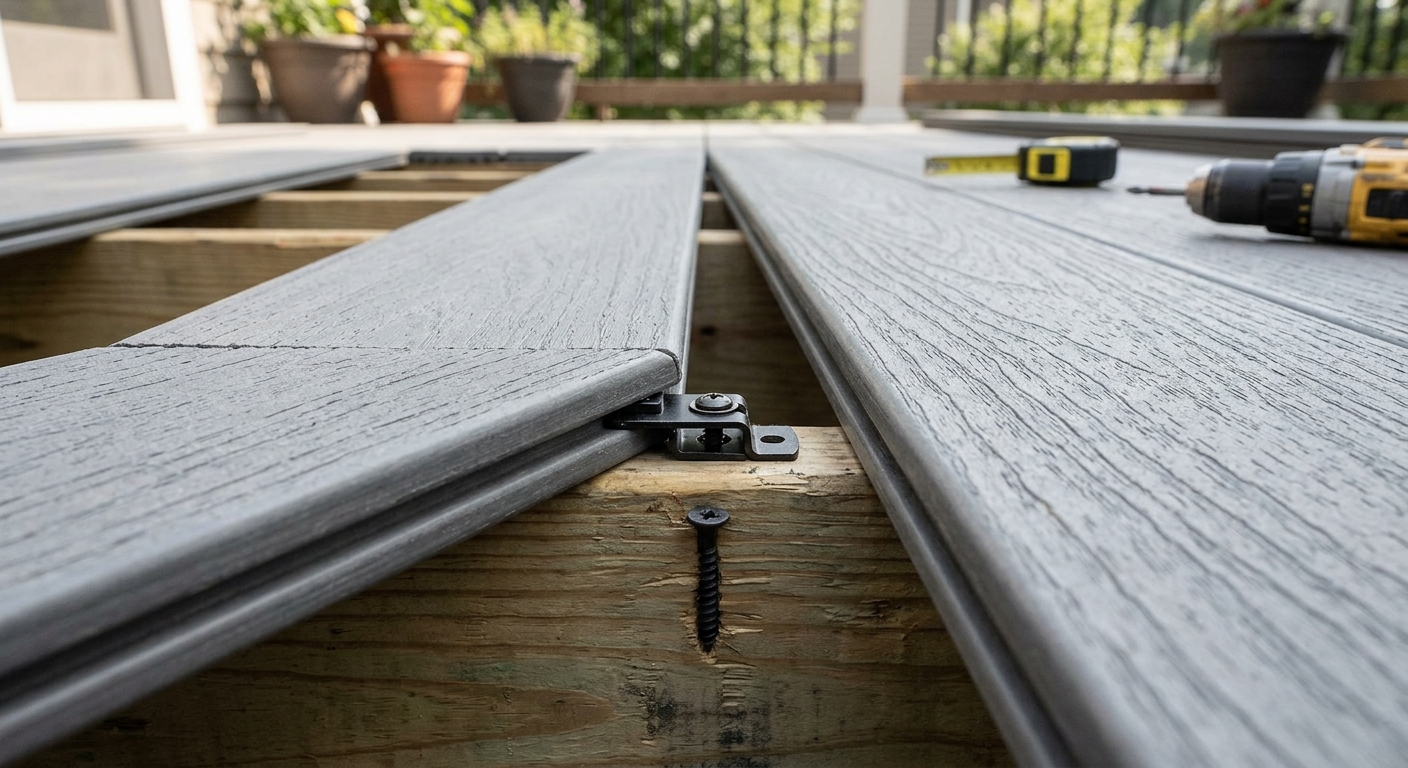
The Long-Term Case for Investing in Your Sammamish Deck
Sammamish Plateau real estate is expensive by any measure. Median home prices in Sammamish consistently rank among the highest in King County, and the buyers who shop in this market have high expectations for both interior and exterior finishes. A well-designed, well-built deck is not just a lifestyle amenity — it is a real estate asset that affects the marketability and price of your home.
The NAR Remodeling Impact Report documents that new wood decks recover approximately 63% of their cost in resale value nationally, with composite and premium outdoor living spaces typically performing better in high-value markets. In Sammamish, where buyers expect outdoor living spaces and frequently make offers contingent on the quality of outdoor amenities, a premium deck can be the factor that drives a faster sale at full price versus a discounted offer from a buyer who wants to negotiate for the future cost of adding outdoor living space.
The NADRA consistently reports that homeowners who build quality decks report extremely high satisfaction rates — not just at completion, but years later. The Plateau climate, for all its rain challenges, actually creates spectacular outdoor living conditions from May through September, and the deck that seemed expensive in April is the most-used room in the house from Memorial Day through Labor Day.
For a deck project that is going to be used hard, in a climate that is hard on materials, in a regulatory environment that requires documentation and engineering — building it right the first time is dramatically cheaper than repairing or replacing a deck that was built wrong.
Why Local Expertise Matters for Sammamish Plateau Deck Projects
There is a meaningful difference between a contractor who has built decks across the Seattle metro generically and one who specifically knows the Sammamish Plateau — the permit department's expectations, the soil conditions in specific neighborhoods, the HOA requirements in communities like Klahanie and Trossachs, and the engineering requirements that come up on hillside lots. That local knowledge translates directly into more accurate bids, fewer permit surprises, and better-built structures.
At The Seattle Decking Company, we build throughout King County including Sammamish, Issaquah, Bellevue, Kirkland, Redmond, and surrounding Eastside communities. We know the City of Sammamish's building department, we have navigated engineered footing requirements on dozens of hillside Plateau lots, and we understand what it takes to design and build a deck that performs in the PNW climate for twenty-plus years.
If you are planning a deck project on the Sammamish Plateau — whether you are in the early thinking stages or ready to start getting bids — we are happy to talk through your site, your goals, and what a realistic project looks like for your specific property. Reach out to us at (425) 675-6259 or visit us at 22722 29th Drive SE, Bothell, WA 98021. You can also request a consultation through our contact page and we will get back to you promptly to schedule a site visit.
For more information on specific aspects of Sammamish and Seattle-area deck building, explore our guides on deck costs in Seattle, composite vs. cedar materials, deck additions in Seattle, and King County permit requirements.
Frequently Asked Questions
Do I need a permit to build a deck in Sammamish, WA?
How long does the City of Sammamish deck permit process take?
How much does a deck cost in Sammamish in 2026?
Does my Sammamish deck project need an engineer's stamp?
What is the best decking material for the Sammamish climate?
How do sloped lots on the Sammamish Plateau affect deck design and cost?
Do I need HOA approval to build a deck in Klahanie, Trossachs, or other Sammamish HOA communities?
What are impervious surface limits and how do they affect my Sammamish deck project?
What railing type is best for a view deck on the Sammamish Plateau?
How long does a complete Sammamish deck project take from start to finish?
Is a deck a good investment for a Sammamish home?
How do I find a reliable deck contractor for a Sammamish Plateau project?
Planning a deck in the Seattle area?
Get an onsite design review and a clear, itemized quote from a licensed local builder.
Request a Free Quote