
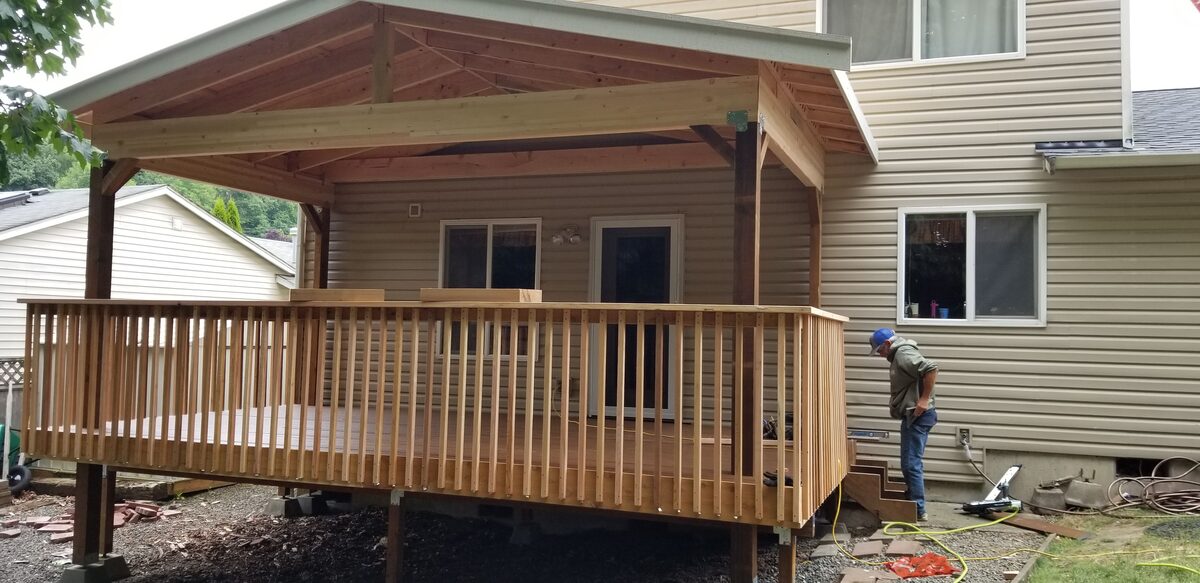
Walk into any home improvement store in Seattle and you'll find the same deck-building guides stacked near the lumber aisle — glossy brochures featuring sun-drenched patios in Arizona, cedar planks aging gracefully under a California sky, and composite boards photographed bone-dry in conditions that bear zero resemblance to what your Bothell or Bellevue backyard actually looks like in November. Those guides are not wrong, exactly. They're just written for somewhere else. And when Seattle homeowners follow them, they end up with decks that rot prematurely, harbor moss colonies, corrode their own hardware from the inside out, and require replacement a decade before they should.
Seattle's climate is genuinely unusual among major American cities. We receive 38 or more inches of rainfall per year, spread across more than 150 wet days annually. Unlike the Bay Area or San Diego, we don't get a true dry season that gives wood time to fully dessicate and recover. Our rain is acidic — falling through Douglas fir pollen in spring, mixing with runoff from cedar trees that are loaded with tannic acid, and pooling in the clay-heavy soils that dominate parcels across King and Snohomish counties. That combination creates conditions that eat standard decking hardware, encourage wet rot rather than the surface-level dry rot you see in drier climates, and make proper drainage not a luxury but a structural requirement. Every single detail of how a deck gets built here needs to account for this. The framing, the fasteners, the ledger connection, the material choices, the slope — all of it changes when you're building in the Pacific Northwest.
This guide is written specifically for Seattle-area homeowners who want to understand why local conditions demand local expertise, what the right materials actually are for our climate, and what separates a deck built to last 30 years in the PNW from one that's going to look tired and unsafe in 10. We build decks in Bothell, Kirkland, Woodinville, Bellevue, Redmond, and throughout greater King and Snohomish counties. We've seen what fails here and why. Here's what you need to know before you build.
Seattle's Climate Is Not Like Anywhere Else — And Your Deck Needs to Reflect That
Most Americans picture Seattle as rainy but mild. That's partially accurate, but it undersells how persistently wet our region actually is and what that wetness does to building materials over time. Portland, Oregon gets about 36 inches of rain per year. Denver gets around 14. Phoenix averages less than 8. Atlanta, one of the Southeast's famously humid cities, gets around 50 inches — but much of that falls in warm, fast-moving summer thunderstorms that allow rapid evaporation. Seattle's rainfall is different in character: it arrives slowly, persistently, and often as mist or light drizzle that saturates surfaces without the quick runoff of heavier storms.
The 150+ Wet Days Problem
When we talk about wet days in Seattle, we're not talking about torrential downpours. We're talking about the kind of low-level moisture that keeps wood surfaces damp for hours or days at a stretch. According to NOAA climate data, the Seattle area averages over 150 days per year with measurable precipitation — meaning nearly half of all days involve some form of moisture exposure. For a wood deck, this translates into perpetually elevated moisture content in the boards, which is exactly the condition that encourages fungal growth, wet rot, and structural deterioration.
Compare this to Los Angeles, which averages fewer than 35 wet days per year, or Sacramento, which gets roughly 60. A cedar deck in Sacramento might go months between significant rain events, giving the wood ample time to dry out, stabilize its moisture content, and resist fungal colonization. A cedar deck in Kenmore or Redmond spends roughly 5 months of the year in near-continuous moisture exposure with no meaningful drying interval. That's not a minor regional difference — it's a fundamentally different use environment that demands fundamentally different building practices.
Acidic Rainfall and Cedar Tannins: The Hardware Killer Nobody Talks About
Here's something that rarely makes it into national deck guides: the combination of acidic Pacific Northwest rainfall and the tannins present in western red cedar creates a corrosive environment that destroys standard zinc-coated hardware far faster than the same hardware would corrode in neutral-pH conditions. Cedar tannins are naturally acidic, with a pH that can drop as low as 3.5 in concentrated form. Pacific Northwest rainfall, filtered through Douglas fir and cedar forests, typically measures between pH 5.0 and 5.6 — notably more acidic than neutral pH 7.0.
When electrochemically incompatible metals contact each other in the presence of this acidic moisture — think standard galvanized screws driven into cedar decking where tannin-laden runoff pools at the connection points — you accelerate galvanic corrosion significantly. We've pulled apart 8-year-old decks in Woodinville where the joist hanger screws had corroded down to thin, fragile stubs that couldn't support any meaningful load. Those decks looked fine from the top. Underneath, they were genuinely dangerous.
The solution isn't complicated but it is non-negotiable: every fastener, joist hanger, post base, ledger bolt, and piece of structural hardware on a PNW deck needs to be either stainless steel (316 grade for coastal proximity, 304 grade minimum for inland sites) or hot-dipped galvanized (HDG) with a coating thickness that meets or exceeds ASTM A153 standards. Standard electroplated galvanized screws — the kind sold in bulk at big-box stores — are not adequate here. This is one of the most common corners cut by out-of-area contractors who don't understand Pacific Northwest conditions, and it's one of the most expensive mistakes a homeowner can make.
Clay Soils, Frost Heave, and Footing Requirements
Seattle-area soils are predominantly glacially derived — heavy clay in many neighborhoods, with relatively poor drainage and a tendency to shift when saturated. This is categorically different from the sandy or loamy soils common in much of California and the Southwest, where deck footings can sometimes be less robust and still perform reliably.
In our region, deck footings need to reach below the frost line (typically 12 to 18 inches in King and Snohomish counties), and they need to be sized to account for soil bearing capacity in clay-heavy conditions, which is typically lower than in well-draining sandy soils. King County Building Division requirements specify minimum footing depths and sizes that reflect local soil conditions — specifications that a national guide written for average conditions won't capture. Undersized footings in clay soil lead to deck movement and settlement, which compromises ledger connections, creates drainage problems, and accelerates hardware failure at every structural joint.
The Capped vs. Uncapped Composite Distinction That Seattle Homeowners Must Understand
If you've been researching composite decking, you've probably encountered the phrase "composite is low maintenance" repeated so many times it starts to feel like gospel. And in the right form, for the right climate, that statement is largely true. But "composite decking" covers an enormous range of products that perform radically differently in Pacific Northwest conditions, and the single most important distinction is whether the boards are capped or uncapped.
What Capping Actually Means
Traditional composite decking — the original generation of composite boards that became popular in the 1990s and early 2000s — consists of a blended core of wood fiber and recycled plastic. That wood fiber is the problem. Wood fiber, even when blended with plastic, retains the ability to absorb moisture. In a dry climate, this is a minor concern. In Seattle, it's catastrophic.
Uncapped composite boards in Pacific Northwest conditions typically begin showing degradation within 3 to 5 years. The mechanism is straightforward: moisture penetrates the board's surface and core, the wood fiber component swells and contracts through repeated wet/dry cycles, and that mechanical stress breaks down the board's structural integrity and surface appearance. You get swelling, checking, surface mold that's nearly impossible to fully eliminate, and eventually structural failure. We've replaced uncapped composite decks in Bellevue and Sammamish that were less than 6 years old — decks that looked acceptable in their first two seasons and then deteriorated rapidly in years three through five.
Capped composite boards solve this problem by encasing the wood-fiber core in a protective polymer shell. That polymer cap — typically PVC or a high-density polyethylene formulation — prevents moisture from reaching the wood fiber core. The board can shed water, resist fungal adhesion, and maintain its dimensional stability through Seattle's relentless wet cycles.
Three-Sided vs. Four-Sided Capping: Why It Matters in the PNW
Not all capped composites are equal. Trex, the most widely recognized composite brand, offers three-sided capping across most of its product lines — the cap wraps the top surface and both side edges, but the underside of the board remains exposed. In moderate climates, three-sided capping performs well. In the Pacific Northwest, where decks are frequently built over moist soil, where underside condensation is common, and where airborne moisture can saturate boards from below during multi-day rain events, three-sided capping leaves a vulnerability.
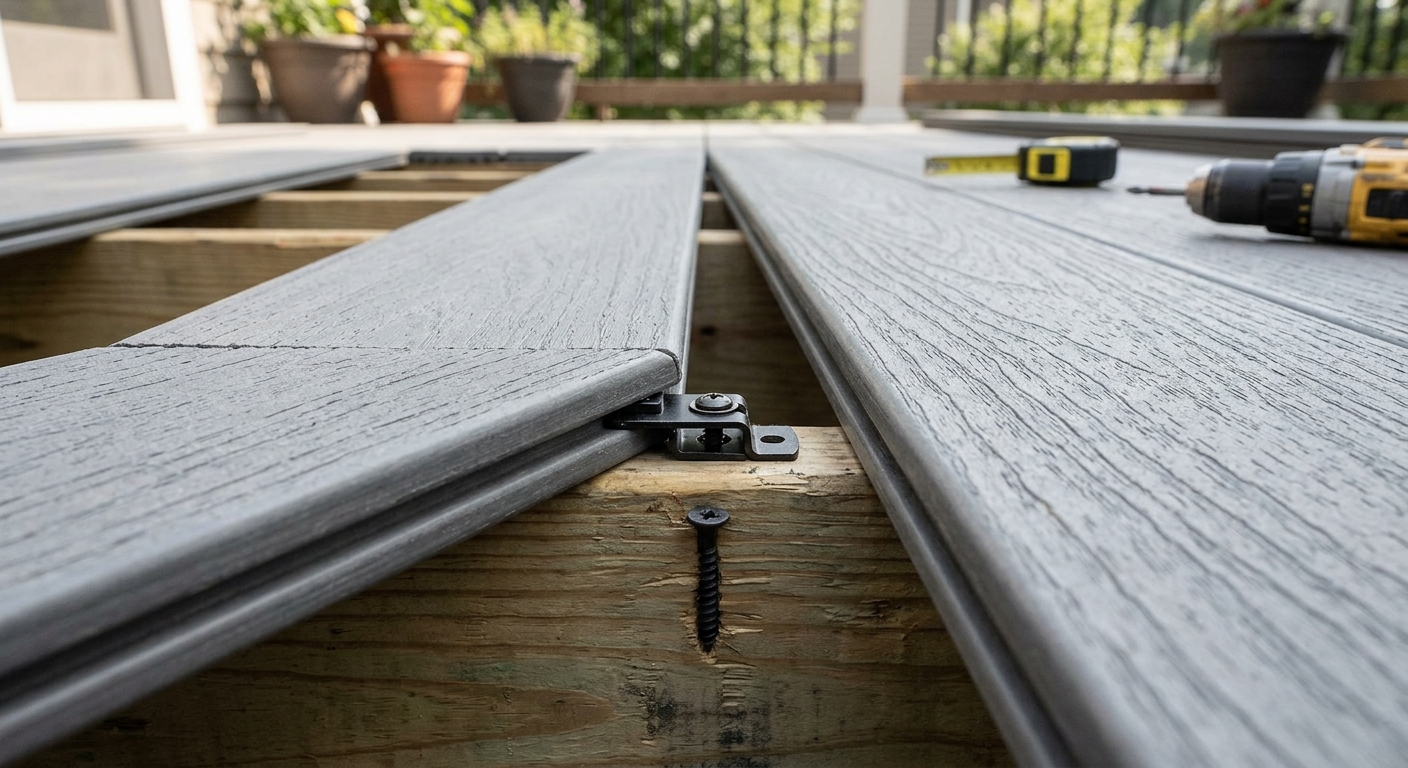
Four-sided capped products — including TimberTech PRO and AZEK lines and Fiberon's Concordia and Promenade series — wrap the polymer cap around all four surfaces including the underside. This provides superior protection against the moisture exposure patterns specific to Seattle conditions. TimberTech's full 4-sided cap, combined with AZEK's all-PVC construction at the premium tier, makes these products particularly well-suited to challenging PNW sites like north-facing lots in Ravenna, elevated decks with high underside exposure in Queen Anne, or waterfront properties in Kenmore or along Lake Washington.
Key insight
PVC Decking: The Maximum-Moisture Option
For sites with truly extreme moisture exposure — decks over water, rooftop applications, north-facing lots in deep shade, or structures where underside drainage is impossible to achieve — PVC decking removes the moisture equation entirely. PVC boards contain zero wood fiber, meaning they cannot absorb moisture, cannot provide substrate for fungal growth, and cannot experience the wet/dry cycling degradation that affects even the best composite boards over time.
PVC decking costs more than composite — typically $130 to $180 per square foot installed in the Seattle market — and it requires careful attention to installation details, particularly around thermal expansion, which is greater in PVC than in composite or wood. But on the right site, PVC's moisture impermeability makes it the most durable choice available, and on a per-year cost basis over a 30-year lifespan, it can be competitive with or superior to lower-cost options that require earlier replacement.
Why National Deck Guides Get Seattle Wrong: Dry Rot vs. Wet Rot, Sun vs. Mold
Pick up any national home improvement magazine and you'll find deck maintenance articles that focus primarily on UV fading, surface checking from sun exposure, and the occasional mention of dry rot at post bases. These are real concerns in most of the country. In Seattle, they're largely secondary to a set of failure mechanisms that rarely get discussed in national media because they're specific to persistently wet climates.
Wet Rot Is Not the Same as Dry Rot
Dry rot — technically the work of Serpula lacrymans and related fungal species — is the classic wood decay that most national guides address. It requires wood moisture content between about 28% and 58%, and it produces the characteristic crumbly, cube-like fracture pattern you see in compromised structural timbers. In drier climates where wood spends most of its life below 19% moisture content, dry rot requires specific conditions to establish: a leak, standing water, chronic shade.
In Seattle, the concern shifts to wet rot caused by Coniophora puteana and related species that thrive in the persistently elevated moisture content of our outdoor wood. Wet rot is more insidious in some ways because it progresses faster in saturated wood, penetrates more deeply into the wood's cellular structure, and is less visually obvious in its early stages. Cedar that looks cosmetically acceptable on its surface can have significant wet rot penetration at framing connections, end grain cuts, and areas where water pools. We've uncovered wet rot in deck joists that showed no visible exterior surface deterioration — the rot was working from moisture-saturated end grain inward, invisible until structural failure was close.
Mold and Moss: The Seattle-Specific Maintenance Reality
In the Pacific Northwest, the practical maintenance challenge for wood decks isn't UV fading — it's biological colonization. Cedar decks in Seattle grow moss. Composite decks, particularly uncapped ones or those installed without adequate drainage, grow surface mold. These aren't aesthetic problems only: moss retains moisture against the deck surface, accelerating deterioration; mold indicates moisture levels that compromise board integrity; and both create slip hazards that are a genuine safety issue on Seattle's frequently wet decks.
Important
Managing moss on a cedar deck in Seattle typically requires annual cleaning with an appropriate biological treatment, followed by reapplication of a penetrating oil stain every 1 to 2 years (not 3 to 5 years as national guides suggest for drier climates). In practice, most Seattle homeowners with cedar decks are spending $800 to $1,500 per year on cleaning and maintenance — costs that national guides typically underestimate because they're calibrated for less frequent treatment cycles.
Capped composite and PVC boards resist moss adhesion significantly better than wood or uncapped composite because their smooth, non-porous surfaces don't provide the substrate that moss spores need to establish. This isn't a maintenance-free situation — periodic cleaning is still required — but the frequency and cost of maintenance drops dramatically, which is a major factor in the 15-year total cost calculation that favors composite in our market.
Sun Fading vs. Mold: A Climate-Dependent Tradeoff
National composite decking reviews frequently focus on fade resistance and UV stability as primary performance metrics. In Seattle, UV exposure is a secondary concern. We average only about 152 sunny days per year — roughly half the number that Albuquerque or Phoenix sees. Fade resistance matters here, but mold resistance matters far more. When you're evaluating composite brands for a Seattle installation, weight the manufacturer's mold and moisture testing data more heavily than their UV fade warranty language.
The Critical Building Details That Change in the Pacific Northwest
Getting the right materials is necessary but not sufficient. The details of how a deck is framed, drained, flashed, and protected matter as much as what the decking boards are made of. Here's where PNW-specific construction practice diverges most significantly from national standard practice.
Positive Drainage Slope: 1/8 Inch Per Foot Is the Minimum
Every deck surface needs to shed water toward its open edges and away from the house. In a dry climate, this is a good practice. In Seattle, it's an absolute requirement — decks built dead flat will hold standing water during our sustained rainfall events, and that standing water is the primary driver of surface mold growth, composite board degradation, and fastener corrosion at every penetration point.
The International Residential Code specifies a minimum slope of 1/8 inch per foot for deck surfaces, and Seattle's Department of Construction and Inspections enforces this. In practice, we often build to 1/4 inch per foot on shadier sites or on decks with complex geometries that can create low spots — the extra margin of drainage significantly reduces maintenance requirements. This slope needs to be designed into the framing from the start, not added as an afterthought by shimming boards at installation.
Joist Tape: Non-Negotiable in the PNW
Joist tape — a self-adhesive butyl or rubberized membrane applied to the top surface of every deck joist before decking installation — is a practice that many contractors outside the Pacific Northwest treat as optional. Here, it's standard. The top surface of a joist, where decking screws penetrate, is the highest-risk zone for moisture intrusion. Each fastener penetration is a potential pathway for water to wick into the joist via capillary action, saturating the wood immediately around the fastener hole and creating ideal conditions for wet rot to begin.
Joist tape seals those penetration points from the outside, redirects water off the top of the joist rather than allowing it to pool, and dramatically extends joist life. On a properly taped deck with capped composite boards, we routinely see structural framing in excellent condition on 15-year-old decks. On untaped framing with uncapped composite or cedar boards, we frequently find compromised joists by year 8 to 10.
Tip
Ledger Flashing: Where Most Deck Failures Begin
The ledger board — the horizontal framing member that connects your deck to your house — is the single most failure-prone component in any deck structure when not properly flashed. Water that infiltrates behind a ledger board enters the rim joist of your house, saturates the band joist, compromises the floor framing, and in severe cases works its way into wall cavities. We've seen ledger failures in Seattle that resulted in $40,000 to $80,000 in house structural repairs beyond the deck itself.
Proper PNW ledger flashing requires a full-width metal flashing (typically galvanized or copper) that extends up behind the siding, over the ledger board, and out past the face of the ledger — creating a continuous moisture barrier at every point where the deck structure contacts the house. Kickout flashing at the ends of the ledger is equally critical: without it, water running down the siding follows the ledger edge into the wall assembly instead of being directed outward.
Note
End Grain Sealing and Its Importance in Wet Climates
End grain — the cross-section of wood exposed when boards are cut — absorbs moisture 10 to 15 times faster than face grain. In dry climates, this is manageable because cut ends dry out relatively quickly. In Seattle, cut ends of cedar boards stay saturated for extended periods, making them the primary entry points for wet rot to establish and work its way along the board.
Every cut end of cedar or pressure-treated lumber on a PNW deck should be sealed with a penetrating end-grain sealer immediately after cutting and before installation. This is a 2-minute step per cut that dramatically reduces the rate of moisture infiltration at the most vulnerable points in the wood. National guides rarely mention this because in drier climates, end-grain moisture is a minor factor. In our region, skipping it meaningfully shortens cedar deck lifespan.
Material-by-Material Comparison for Seattle Conditions
Includes installation, annual maintenance, and estimated repair costs over 15 years. Based on Seattle-area contractor pricing data 2025-2026.
| Category | Value |
|---|---|
| Cedar (PNW-maintained) | $89 |
| Pressure-Treated Pine | $72 |
| Uncapped Composite | $95 |
| Capped Composite (3-side) | $84 |
| Capped Composite (4-side) | $81 |
| PVC Decking | $78 |
Western Red Cedar: The Local Classic With Real Limitations
Cedar is the traditional Pacific Northwest deck material, and there's genuine reason it became the default: western red cedar has natural tannins that provide meaningful resistance to decay, it's regionally abundant, it's beautiful when properly maintained, and it performs reasonably well when installed correctly and maintained rigorously.
The challenge is that "maintained rigorously" in Seattle means something much more demanding than national averages suggest. A cedar deck in Phoenix might need staining every 4 to 5 years. A cedar deck in Seattle, exposed to 150+ wet days per year and the biological pressure of moss and algae, needs cleaning and recoating every 1 to 2 years to maintain adequate protection. That maintenance cycle costs real money — typically $800 to $1,500 per year for a professional cleaning and application on a standard deck — and most homeowners discover after year 3 or 4 that the "lower upfront cost" of cedar has been consumed by accumulated maintenance expenses.
Cedar is still a reasonable choice for homeowners who genuinely enjoy the aesthetic of real wood, are committed to the maintenance schedule, and are building on sites with favorable conditions: south-facing exposure, good drainage, minimal shading. On north-facing lots, heavily shaded sites, or decks with chronic moisture issues, cedar's limitations in Seattle conditions become pronounced within the first decade.
| Feature | Cedar (PNW) | Capped Composite | PVC |
|---|---|---|---|
| Upfront cost (installed) | $34–$50/sq ft | $65–$130/sq ft | $130–$180/sq ft |
| Maintenance interval | 1–2 years | 10+ years | Minimal |
| Wet rot resistance | Moderate | High | Excellent |
| Moss/mold resistance | Low | High (4-side cap) | Excellent |
| Fade from UV | Grays out naturally | Low (varies by brand) | Excellent |
| Hardware requirements | SS or HDG mandatory | SS or HDG mandatory | SS recommended |
| Typical lifespan (PNW) | 15–20 years maintained | 25–30 years | 30–40 years |
| End grain sealing needed | Yes | No | No |
For a deeper comparison of these two primary options, see our guide to composite vs. cedar decking in Seattle.
Capped Composite: The Gold Standard for Most Seattle Decks
For the majority of Seattle homeowners — those who want a deck that performs well, looks good, and doesn't demand annual maintenance attention — four-sided capped composite is the answer. Products like TimberTech PRO, AZEK (all-PVC), Trex Transcend, and Fiberon Concordia offer the combination of moisture resistance, aesthetic quality, and long-term durability that our climate requires.
The upfront cost premium over cedar is real: expect to pay $65 to $130 per square foot installed for quality capped composite versus $34 to $50 for cedar. On a 400 square foot deck, that's potentially a $20,000 to $30,000 difference in initial investment. But when you eliminate 15 years of annual cedar maintenance ($800 to $1,500 per year = $12,000 to $22,500 over 15 years) and account for cedar's likelihood of requiring partial board replacement and structural inspection in years 10 through 15, the 15-year total cost of ownership strongly favors capped composite.
For a detailed brand-by-brand comparison of the major composite manufacturers in the Seattle market, see our guide to Trex vs. Fiberon vs. TimberTech in Seattle.
Pressure-Treated Lumber: For Structure, Not Surfaces
Pressure-treated lumber — typically Southern Yellow Pine or Douglas Fir treated with ACQ (alkaline copper quaternary) or CA (copper azole) preservatives — belongs in the structural framing of Seattle decks, not on the deck surface. As framing material (joists, beams, posts), pressure-treated lumber provides good rot resistance at a cost-effective price point. As decking surface boards, it's problematic: it splinters, it moves significantly through moisture cycles, it requires regular maintenance, and the preservative treatments in modern PT lumber are chemically aggressive toward standard galvanized fasteners (requiring hot-dipped galvanized or stainless steel, same as cedar).
If budget is the primary constraint, pressure-treated decking is a functional choice that outperforms cedar on rot resistance — but plan for a 10 to 15 year replacement timeline in PNW conditions and build the maintenance costs into your budget from the start.
What Seattle Deck Builds Actually Cost in 2025–2026
Understanding regional cost data matters because national averages — typically published at $15 to $35 per square foot — are not relevant to Seattle. Our labor costs are higher, our material costs reflect West Coast supply chain economics, and our building requirements (permits, inspections, ledger specifications, footing depths) add legitimate costs that national guides don't account for.
Based on current Seattle-area contractor pricing data, here's a realistic breakdown of what to expect:
Entry-level cedar deck (300–400 sq ft, single level, ground-level): $18,000 to $28,000. Includes permit, pressure-treated framing, cedar decking, basic railing. Does not include annual maintenance costs going forward.
Mid-range capped composite deck (300–500 sq ft, single level): $28,000 to $45,000. Includes permit, pressure-treated framing with joist tape, 3- or 4-side capped composite decking (Trex Select through Transcend, TimberTech PRO), composite or aluminum railing.
Premium capped composite or PVC deck (400–600 sq ft, elevated or multi-level): $45,000 to $80,000+. Includes premium materials (TimberTech AZEK, Fiberon Concordia), cable or glass railing, detailed stair configuration, and structural engineering where required for elevated builds.
These numbers assume standard site conditions. Complicated sites — steep slopes requiring engineered framing, waterfront lots with access constraints, decks requiring extensive demolition of existing structures — can add $5,000 to $20,000 to any tier.
Note
For a comprehensive breakdown of current Seattle deck pricing by size and material, see our Seattle deck cost guide and our 2026 best decking materials overview.
Moss Prevention, Drainage Design, and Ongoing Maintenance in the PNW
Building the right deck is step one. Designing it so it stays right over decades requires specific attention to drainage, biological management, and structural monitoring that's specific to Pacific Northwest conditions.
Designing for Drainage From the Foundation Up
Proper deck drainage in Seattle starts at the design phase — it cannot be retrofitted successfully. The key elements:
Surface slope: 1/8 inch per foot minimum across all deck surfaces, designed into the framing. On complex multi-level decks or decks with enclosed areas below, consider a drainage membrane system (products like DrySpace or TimberTech DrySpace) that captures water from the upper level and channels it to gutters rather than dripping onto the area below.
Gap spacing: Composite boards need appropriate gap spacing between boards to allow water to drain through. Follow manufacturer specifications — typically 3/16 to 1/4 inch between boards for composite. Boards installed too tight trap moisture and debris, creating the exact conditions that drive mold and biological growth.
Board orientation: Where possible, orient decking boards to run perpendicular to the direction of drainage slope, so water moves toward gaps rather than tracking along board surfaces toward the house.
Gutter integration: On decks adjacent to house walls, ensure that deck drainage doesn't direct water toward foundation walls or toward areas where it can saturate the structure. Extend the deck's drainage to gutters where the geometry allows.
Moss and Mold Management for Long-Term Performance
Even the best capped composite or PVC decking accumulates surface debris — leaf litter, pollen, airborne organic material — that provides substrate for moss and mold to begin establishing. In Seattle's climate, annual cleaning is still advisable even on the most moisture-resistant materials.
The cleaning protocol for composite decks in the PNW: a spring cleaning with a composite-safe cleaner (avoid pressure washing at high PSI, which can damage capped surfaces — stay below 1,500 PSI and use a wide fan tip), removal of any debris accumulation between boards, and inspection of all visible hardware for early corrosion signs. This maintenance takes a few hours annually and prevents the kind of biological buildup that becomes genuinely difficult to reverse if left unaddressed for multiple seasons.
For cedar decks, add a biological treatment step — iron sulfate at 1 ounce per gallon of water is effective against moss without the hardware-corrosion issues of zinc-based products — followed by a penetrating oil stain (not film-forming products, which peel in PNW conditions) once the wood is fully dry.
For detailed guidance on maintenance decisions, see our guide on deck staining vs. going composite in Seattle and our winter deck inspection checklist.
Structural Monitoring: What to Check Every Season
PNW deck owners should do a basic annual structural inspection, ideally in early spring after winter's moisture load has revealed any new issues:
- Ledger board: Look for any separation between the ledger and house, signs of moisture infiltration at the junction, or rust staining that suggests hardware corrosion behind the ledger.
- Post bases: Check for standing water accumulation at post base hardware and early corrosion signs. Post base hardware is a common failure point on older decks with standard galvanized hardware.
- Joist ends at beam connections: Probe with a screwdriver — healthy wood resists the tip. Wood that yields easily indicates wet rot penetration.
- Stair stringers: Stair stringers are often the first structural component to fail in PNW conditions because they're close to grade, frequently contact soil and leaf debris, and have numerous end-grain cuts.
If you're concerned about your existing deck's structural condition, see our deck repair services or our guide on finding a qualified deck builder in Seattle.
Railing Systems, Lighting, and Finishing Details for Seattle Conditions
The moisture-management principles that govern decking material selection apply equally to every other component of a Seattle deck — railings, post caps, lighting fixtures, and decorative hardware all need to be specified with PNW conditions in mind.
Railing Material Selection for the PNW
Wood railings on Seattle decks require the same maintenance as wood decking — annual cleaning, regular staining or sealing, end-grain protection. Given that railings involve numerous horizontal surfaces that collect water (top rails, horizontal balusters) and many end-grain cuts (baluster bottom cuts, post tops), they often deteriorate faster than the deck surface itself.
Aluminum railings have become the dominant choice in the Seattle market for composite and PVC decks. Powder-coated aluminum is effectively immune to moisture, requires no maintenance beyond occasional cleaning, and provides a clean aesthetic that complements capped composite and PVC board colors. Cable railing systems — stainless steel cables with aluminum posts — are an increasingly popular option on decks with view-oriented sites and provide excellent longevity in PNW conditions when specified with marine-grade stainless components.
Glass railing panels offer the clearest sightlines and perform well in our climate, but require regular cleaning to manage water spotting and need careful hardware specification (316 stainless for all connections). See our guide to Seattle deck railing options for detailed material and cost comparisons.
| Railing Type | PNW Suitability | Maintenance | Approx. Cost (linear ft) |
|---|---|---|---|
| Wood (cedar/PT) | Fair | High (annual) | $80–$150 |
| Composite | Good | Low | $100–$180 |
| Aluminum | Excellent | Very low | $120–$200 |
| Cable (SS) | Excellent | Very low | $150–$250 |
| Glass panel | Excellent | Low-moderate | $200–$350 |
Lighting in Seattle's Rainy Conditions
Deck lighting needs to be rated for wet or damp locations — not just splash-proof. In Seattle, deck lights experience sustained moisture exposure, not occasional splashing. Look for fixtures rated IP65 or higher (fully dust-tight and protected against water jets), specified with stainless or marine-grade aluminum housings, and wired with waterproof junction connections.
LED lighting is the standard choice for all new Seattle deck installations — LEDs handle temperature cycling better than incandescent or halogen fixtures, use less energy, and last significantly longer even in high-humidity environments. Avoid economy-grade LED fixtures not designed for outdoor use; the circuit board corrosion in damp conditions renders them unreliable within a few seasons.
Why Hiring a PNW-Specific Deck Builder Matters
Everything in this guide points to a core reality: building a deck in Seattle requires specific knowledge, specific material specifications, and specific construction practices that contractors from drier regions or contractors who handle decks as a side project to general remodeling work frequently don't bring to the job.
The questions that reveal whether a contractor understands Pacific Northwest conditions include: What type of joist tape do you use? Do you specify stainless or HDG hardware for all structural connections? What's your ledger flashing detail — can I see a photo from a recent job? What capped composite products do you recommend, and why four-sided capping specifically for my site? How do you slope the framing for drainage?
A contractor who gives you confident, specific answers to all of those questions has built decks in Seattle's conditions before. A contractor who gives you vague or nationally generic answers — "we follow the manufacturer recommendations," "we use quality hardware," "composite decks drain fine" — may not have the PNW-specific experience your project requires.
Key insight
When you're ready to evaluate contractors, our guides on questions to ask a deck builder and how to read a deck quote will help you differentiate bids effectively.
For financing options to help manage the upfront investment, see our Seattle deck financing guide. For specific material pages, explore our detailed guides to composite decking, cedar decking, and PVC decking.
Frequently Asked Questions
What is the best deck material for the Pacific Northwest?
Why does composite decking fail early in Seattle?
Do I need a permit to build a deck in Seattle?
How often does a cedar deck need to be stained in Seattle?
What hardware should I use for a Seattle deck?
What is joist tape and do I need it in Seattle?
How much does a deck cost in Seattle in 2025-2026?
What is ledger flashing and why is it critical in the Pacific Northwest?
Should I use PVC or composite decking in Seattle?
How do I prevent moss on my Seattle deck?
Do Seattle footings need to be different from other regions?
What's the best way to find a qualified deck builder in Seattle?
Building a Deck That Lasts 30 Years in the Pacific Northwest
The Pacific Northwest is one of the most beautiful places in North America to have an outdoor living space. It's also one of the most demanding environments for deck construction. Getting it right means understanding that the 38+ inches of annual rainfall, the 150+ wet days, the acidic soil and rainfall chemistry, the clay soils, and the biological pressure from moss and mold create a set of requirements that national guides simply don't address.
The principles aren't complicated once you understand why they matter: specify fully capped composite or PVC boards, use stainless or hot-dipped galvanized hardware at every connection point, tape every joist, flash the ledger correctly with kickout at the ends, build in positive drainage slope from the framing up, seal every end grain cut in any wood component, and choose a contractor who can demonstrate that they've built decks that perform in our specific conditions.
Get these details right and a well-built Seattle deck can serve your family for 30 years with minimal maintenance and without the structural surprises that come from cutting corners on moisture management. Get them wrong — as many national-template deck builders do — and you're looking at significant repairs or replacement within a decade.
At The Seattle Decking Company, we build decks specifically for Pacific Northwest conditions. Every project we complete in Bothell, Kirkland, Woodinville, Bellevue, Redmond, and throughout King and Snohomish counties is built to the standards described in this guide — because in our climate, there's no responsible alternative. If you're planning a deck project and want a consultation with a team that understands what building in Seattle actually requires, call us at (425) 675-6259 or contact us online to schedule a site visit.
We're at 22722 29th Drive SE, Bothell, WA 98021, and we're happy to walk you through the specific details that will determine how your deck performs over the next 30 years of Pacific Northwest weather.
Planning a deck in the Seattle area?
Get an onsite design review and a clear, itemized quote from a licensed local builder.
Request a Free Quote