

Kent sits at a crossroads that most Seattle-area homeowners don't think about until they're standing on a deck board that flexes under their feet. South King County's largest city by population — roughly 136,000 residents spread across a geography that climbs from the Green River Valley floor up through West Hill and crests on East Hill — has a housing stock that was built fast during the 1980s and 1990s boom years. Those original pressure-treated pine decks are now 25 to 40 years old. The ledger boards are pulling away from the rim joists. The footings have heaved through a few too many freeze-thaw cycles. The decking boards have gone gray, checked, and in some cases started to delaminate from the inside out.
This isn't a dramatic problem — it's a natural lifecycle. But it's happening at scale across Kent right now, and that means thousands of homeowners are in the market for a deck replacement or a new build at the same time. It also means the local contractor market is active, pricing is competitive, and the permit office at the City of Kent has seen enough deck projects to have developed clear, navigable processes. If you're a Kent homeowner thinking about a deck in 2026, the timing is actually good. You have options, you have competition working in your favor on bids, and you have builders in South King County who know this terrain — literally and figuratively.
What you don't have, if you rely on generic Seattle-area deck guides, is accurate local information. Kent's permit requirements differ from the City of Seattle's. Costs in Kent run materially lower than Seattle proper. The topography of East Hill versus West Hill versus the Green River Valley floor creates genuinely different engineering challenges and different cost profiles. This guide addresses all of that from the ground up — material selection, permit process, site considerations, contractor vetting, and realistic cost ranges for 2026.
Why Kent Is in a Deck Replacement Cycle Right Now
To understand why so many Kent decks are failing at the same time, you have to understand how Kent grew. The city expanded rapidly through the late 1980s and into the 1990s as Boeing employment in the region peaked and South King County became an affordable alternative to closer-in Seattle suburbs. Subdivisions went up fast on East Hill, on the slopes of West Hill, and in the lower-elevation neighborhoods around the Green River Valley. Builders used what was standard practice at the time: pressure-treated lumber, galvanized hardware, and framing designs that met code but weren't engineered for longevity beyond 20 to 25 years.
That lumber is now 30 to 40 years old in many cases. Pressure-treated pine from that era used a chromated copper arsenate (CCA) formulation that is no longer legal for residential use — it was phased out in 2003. CCA-treated wood was effective, but it wasn't eternal. After 30 years of Pacific Northwest rainfall, freeze-thaw cycling, and UV exposure, those boards are checking, splitting, and in some cases showing signs of internal rot that doesn't reveal itself until you push a screwdriver into what looks like solid wood and watch it disappear.
The 1980s–1990s Build Pattern on East Hill
East Hill is Kent's most populous subarea — a broad upland plateau east of State Route 167 that includes neighborhoods like Panther Lake, Benson Hill, and the areas around East Hill Park. The housing stock here skews heavily toward that 1985–1998 construction window. Homes in these neighborhoods typically sit on relatively flat lots but at elevation, which means original decks were often built at or near grade — low-profile structures that didn't require extensive engineering but do require maintenance that many homeowners deferred.
Low-profile decks in Kent's climate are particularly vulnerable to one specific failure mode: moisture trapped between the decking boards and the framing below. When a deck sits close to grade without adequate drainage and airflow, the underside of the decking and the top side of the joists stay wet for extended periods after rainfall. Over decades, this creates rot pathways even in pressure-treated wood. On East Hill, we routinely see replacement projects where the decking boards look marginal but the joists underneath have lost 40–60% of their structural integrity.
West Hill: Slope, Views, and Engineering Complexity
West Hill occupies the elevated terrain west of downtown Kent and the valley floor, roughly between SR-167 and the Interurban Trail corridor. Neighborhoods like Lake Meridian-adjacent areas, Scenic Hill, and the hillside streets above downtown Kent sit on slopes that can be dramatic. Lots here often have significant grade drops from the back of the house toward the rear of the property, or the house itself sits elevated above a terraced backyard.
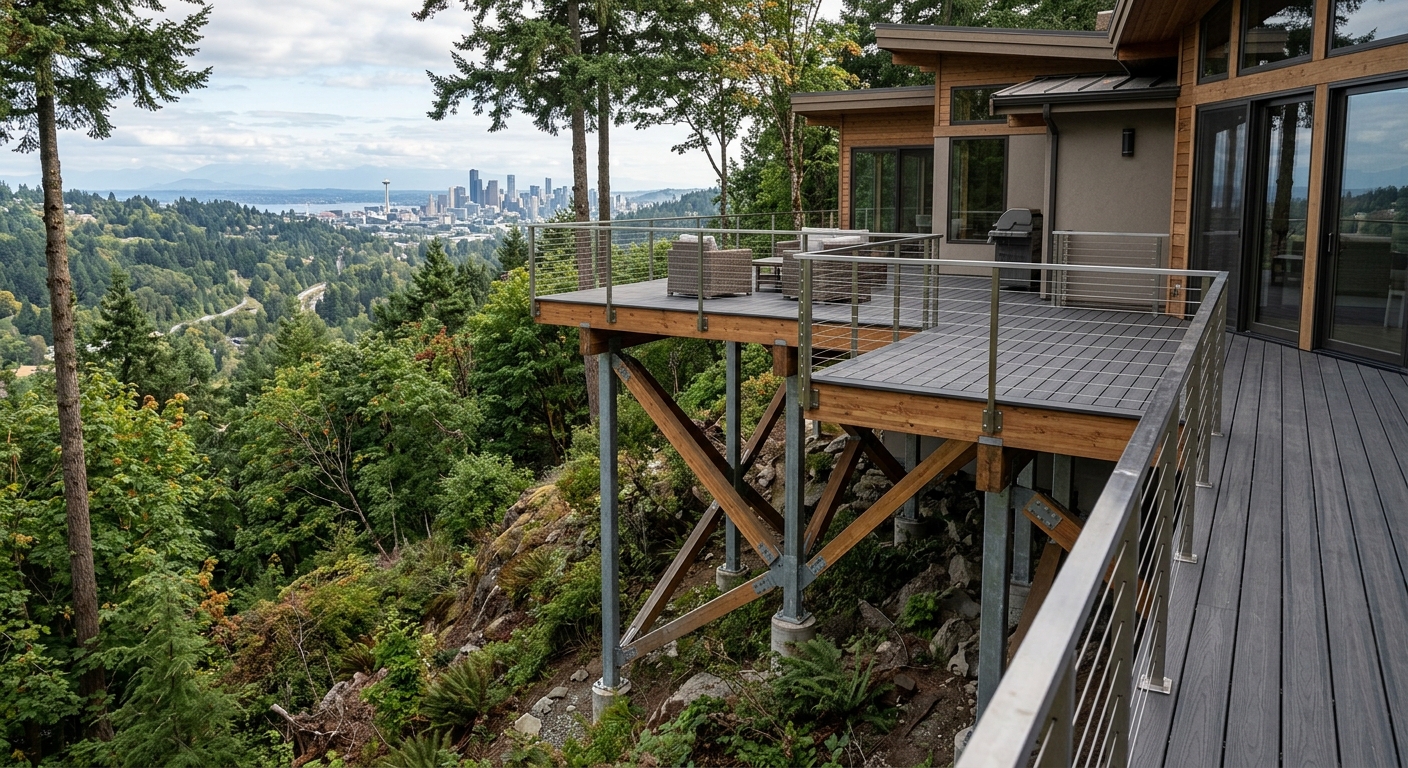
This topography creates a different deck profile than East Hill. West Hill decks frequently need to be elevated — sometimes significantly — to reach usable outdoor living height from the main floor. Elevated decks on sloped lots trigger more substantial engineering requirements, require deeper footings to reach undisturbed soil, and add structural steel or heavy timber to the design. They also cost more. A West Hill deck project on a lot with a 10-foot grade drop from the house to the yard can easily run 25–35% more than a comparable-size flat-lot deck on East Hill, simply due to the structural work required.
Green River Valley: Flat, Wet, and Geotechnically Interesting
The Green River Valley floor — Kent's industrial and commercial core, but also home to residential neighborhoods along its edges — presents a different set of challenges. Lots near the valley floor often have high water tables, softer soils, and in some cases a history of fill or grading that affects footing design. The valley floor area is also in a recognized flood plain in some sections, which introduces FEMA floodplain considerations that can affect deck permitting and design.
For residential decks near the valley floor, engineered footings are often required regardless of deck height, because standard prescriptive footing designs assume soil bearing capacity that may not be present on fill or alluvial soils. If your property shows up in a FEMA Special Flood Hazard Area (SFHA) map, your contractor and permit reviewer will flag this early — and it's better to know going in than to discover it mid-permit.
Kent Deck Permit Requirements: What Triggers a Permit and How to Apply
The City of Kent Building Services division handles residential deck permits through the city's Permit Center. Kent operates independently of unincorporated King County's permit system — if your property is within Kent city limits, you apply through kentwa.gov, not through King County's permit portal. This distinction matters and it's one of the first questions to resolve: confirm whether your address is within Kent city limits or in an unincorporated King County area before you start the permit process.
Note
What Triggers a Permit in Kent
The trigger threshold in Kent aligns with Washington State building code standards and regional norms: any deck with a walking surface more than 18 inches above grade requires a building permit. Additionally, any deck that is structurally attached to the house — regardless of height — typically requires a permit because the attachment affects the structural integrity of the home itself. A freestanding grade-level platform that stays under 18 inches of height and isn't attached to the structure can, in many cases, be built without a permit, but confirm this with Kent Building Services before proceeding.
Beyond the height trigger, permit requirements apply to:
- Decks with any overhead structure (pergola, roof, or cover) regardless of height
- Decks that include electrical work (outlets, lighting circuits, fans)
- Decks that involve alteration to existing permitted structures
- Any deck over 200 square feet in some jurisdictions (confirm with Kent Building Services for current thresholds)
The permit trigger is important not just for legal compliance but for practical reasons. Unpermitted decks create title and insurance complications when you sell the home. Home inspectors routinely flag unpermitted structures. And if an unpermitted deck fails and someone is injured, the homeowner's liability exposure is significant. We've seen Kent homeowners discover unpermitted decks built by previous owners during a sale — it's a headache that's entirely avoidable.
For more context on the Seattle-area permit landscape, the Seattle SDCI deck permit guide provides useful framing even for Kent projects, since the underlying Washington State code is the same.
The Kent Permit Application Process
Kent's process for residential deck permits requires an intake appointment before formal application. You can't simply submit plans over the counter or online without first scheduling through the Permit Center. The intake appointment allows a permit technician to review your project scope, confirm which submittals are required, and identify any special conditions (floodplain, steep slope, HOA overlay) that apply to your parcel.
After intake, the typical residential deck permit goes through two phases:
- Intake and completeness review: Permit technicians verify that your application package includes all required documents — site plan, structural drawings, scope of work description, and contractor license information if applicable.
- Plan review: A plan reviewer examines the structural design against applicable codes (2021 International Residential Code as adopted by Washington State, plus Kent local amendments). For straightforward decks, this can be completed in 2–4 weeks. Complex projects with engineering stamps, steep slopes, or floodplain overlays take longer.
Plan review fees in Kent for residential decks typically range from $800 to $3,000 depending on the project's valuation and complexity. King County publishes a 2026 Building Permit Fee Table that provides a reference framework, though Kent's specific schedule may differ — confirm current fees directly with Kent Building Services.
Our full deck permit King County guide covers the mechanics of permit applications in detail if you want a deeper walk-through of the process.
Structural Engineering Requirements
For decks more than 30 inches above grade, for elevated decks on hillside lots, and for any deck with unusual loading conditions (hot tub, large built-in planters, heavy outdoor kitchen equipment), Kent will typically require stamped engineering drawings from a licensed Washington State structural engineer. Engineering adds $800–$2,500 to project cost depending on complexity, but it also provides the homeowner with documented assurance that the structure is properly designed for its loads and site conditions. On West Hill hillside lots especially, we consider engineering a standard line item, not an optional upgrade.
Important
2026 Deck Cost Guide for Kent WA: Price by Material and Project Size
Deck costs in Kent run noticeably lower than Seattle proper — a function of lower overhead costs for South King County contractors, competitive local market conditions, and the absence of the premium that Seattle builders often charge simply for operating in the city. The gap is real and meaningful. Where a comparable composite deck in Capitol Hill or Ballard might run $45–$55 per square foot installed, the same build in Kent typically lands between $38 and $40 per square foot.
The following price ranges reflect 2026 installed costs for complete deck projects in Kent, including framing, decking, basic railing, stairs, and permit. They do not include optional upgrades like lighting systems, built-in seating, or outdoor kitchen rough-in.
Installed cost per square foot including framing, decking, railing, stairs, and permit. Source: Kent-area contractor pricing, kentdecks.com, and The Seattle Decking Company project data.
| Category | Value |
|---|---|
| Pressure-Treated Pine | $21 |
| Bamboo | $27 |
| Cedar | $34 |
| Composite (Trex/Fiberon) | $39 |
| AZEK PVC | $44 |
Pressure-Treated Pine: $19–$23 Per Square Foot
Pressure-treated lumber remains the baseline option in Kent and represents the majority of replacement deck frames regardless of what the decking surface is made of. A full pressure-treated pine deck — frame and surface — is the most affordable complete build, running $19–$23 per square foot installed. For a typical 300-square-foot Kent deck, that's $5,700–$6,900 in materials and labor before permit fees.
The honest assessment of pressure-treated pine as a decking surface: it's functional but demanding. It requires sealing within the first year, annual or biannual maintenance thereafter, and even with proper maintenance typically shows visible weathering and checking within 10–15 years in PNW conditions. For homeowners on tight budgets who plan to sell within 5–7 years, it's a defensible choice. For anyone planning to stay long-term, the math often favors a composite surface on a pressure-treated frame.
Cedar: $32–$37 Per Square Foot
Western red cedar is the PNW's premium natural wood option for decking surfaces. It's naturally rot-resistant, dimensionally stable compared to pine, and has a warmth and grain character that no composite product fully replicates. Cedar decks in Kent run $32–$37 per square foot installed — roughly 60–70% more than pressure-treated but significantly less than premium composites.
The caveat with cedar in Kent's climate is maintenance. Cedar that isn't sealed and maintained will gray, check, and begin to degrade. Properly maintained cedar — sealed every 2–3 years with a quality penetrating oil or semi-transparent stain — can last 20–25 years and look excellent throughout. Our cedar deck sealing guide for Seattle covers the maintenance protocol in detail. Cedar is particularly common in Kent's older, more established neighborhoods where natural wood aesthetics fit the surrounding landscape.
Composite Decking: $38–$40 Per Square Foot
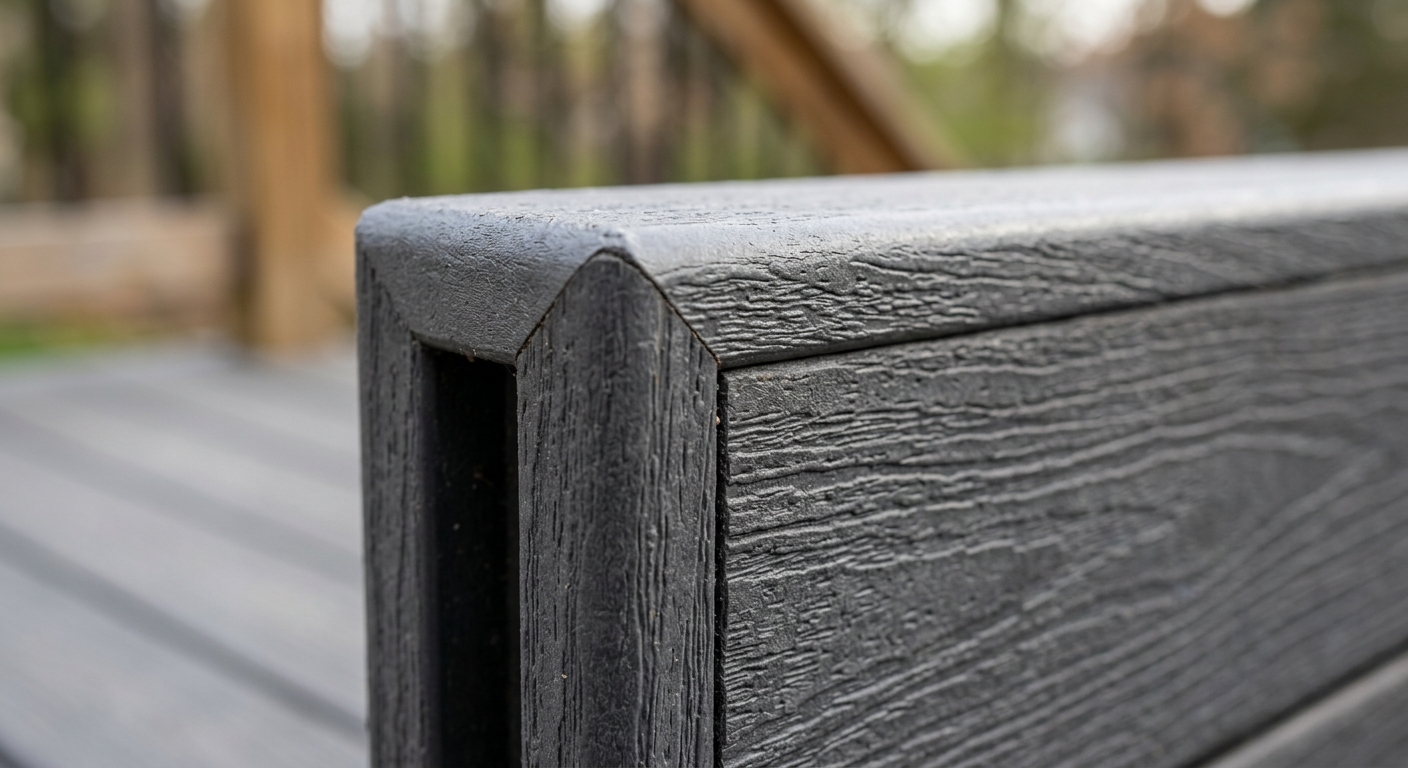
Composite decking — products from Trex, Fiberon, TimberTech, and AZEK — dominates new deck installations in Kent and across the PNW. The value proposition for Kent's climate is strong: composites don't absorb moisture, don't require annual sealing, don't check or splinter, and hold their appearance for 25–30 years with minimal maintenance beyond periodic cleaning.
Trex is particularly dominant in Kent-area installations. Its mid-range Enhance and Select lines hit the $38–$40/sq ft installed price point, while the premium Transcend line adds $4–$8 per square foot to the installed cost. The full breakdown of how these brands compare is covered in our Trex vs. Fiberon vs. TimberTech comparison for Seattle.
Project Size Cost Ranges
| Project Size | Pressure-Treated | Cedar | Composite |
|---|---|---|---|
| Small (150 sq ft) | $2,850–$3,450 | $4,800–$5,550 | $5,700–$6,000 |
| Medium (300 sq ft) | $5,700–$6,900 | $9,600–$11,100 | $11,400–$12,000 |
| Large (500 sq ft) | $9,500–$11,500 | $16,000–$18,500 | $19,000–$20,000 |
| Complex elevated (300 sq ft) | $8,500–$12,000 | $13,000–$16,000 | $15,000–$19,000 |
Note: "Complex elevated" adds engineering, deeper footings, and extended structural framing typical of West Hill hillside builds. Permit fees ($800–$3,000) are not included in the above ranges — budget these separately.
For detailed cost modeling, our deck cost Seattle 2025 guide and the deck cost calculator page provide additional context, though remember Kent costs run somewhat below the Seattle figures in those guides.
Tip
Choosing the Right Decking Material for the Pacific Northwest Climate
Kent receives approximately 38–40 inches of rainfall per year, distributed across a very long wet season that runs from October through April. Summer brings genuine sunshine and heat, but the wet season is long, gray, and relentless. Decking materials that work in drier climates — or that require significant maintenance to stay viable in wet climates — are poor choices for Kent homeowners. Here's how to think through the material decision with PNW conditions as the primary lens.
Moisture Resistance as the Baseline Filter
Any decking material you consider for a Kent project should be evaluated first on its moisture resistance. Materials that absorb water, hold it, and cycle through wet-dry-wet states repeatedly are the ones that fail fastest in this climate. Pressure-treated pine absorbs moisture readily — that's why maintenance is non-negotiable. Cedar absorbs less than pine due to its natural oils but still requires sealing to prevent moisture intrusion. Composite products made from wood-plastic composite (WPC) with a capped exterior shell are the most moisture-resistant option — the cap layer prevents the wood fiber core from absorbing water even through cut ends and fastener holes in most premium products.
The difference between capped and uncapped composite is important. First-generation composite products (early Trex, early Fiberon) didn't have a capped shell and absorbed moisture at the cut ends and through surface scratches. Current-generation capped composites from Trex, Fiberon, TimberTech, and AZEK fully encase the core and perform significantly better in wet climates. If you're comparing bids that specify composite decking, confirm that the spec'd product is a capped composite, not an older uncapped formulation.
Algae, Mold, and Mildew: A Real PNW Consideration
Composite decks in shaded areas — under a tree canopy, under a pergola with limited air circulation, on a north-facing exposure — can develop algae and mildew staining in Kent's climate. This isn't structural damage; it's surface appearance. Most composite products from major manufacturers are cleanable with appropriate deck cleaners and a light scrub. AZEK's full-PVC products have the lowest susceptibility to biological growth because they contain no organic material at all — no wood fiber for mold to colonize.
Cedar in shaded conditions will develop significant mold and mildew without regular sealing and cleaning. If your deck site is heavily shaded, factor in the additional maintenance burden of natural wood or consider a full-PVC product.
Our composite deck maintenance guide for Seattle covers the cleaning and care protocol for Pacific Northwest composite decks in detail.
Thermal Movement in Kent's Climate
Kent's climate swings from summer highs occasionally reaching 95–100°F (and hotter in the rare heat events the region has seen in recent years) to winter temps that occasionally dip below freezing. This temperature range creates thermal expansion and contraction in all decking materials, but particularly in composite and PVC products, which expand and contract more than wood per linear foot. Proper installation — following manufacturer spacing recommendations for the specific climate zone — is essential to prevent boards from buckling in heat or gapping visibly in cold.
This is one reason why manufacturer installation training matters. NADRA (the North American Deck and Railing Association) maintains standards for proper composite installation including thermal gap allowances. Builders who've done significant volume with a specific product know the climate-specific installation adjustments that prevent callbacks.
The Best Materials for Kent by Use Case
| Situation | Recommended Material | Reasoning |
|---|---|---|
| Budget build, plan to sell in 5 yrs | Pressure-treated pine | Lowest upfront cost, acceptable for short term |
| Long-term owner, natural aesthetic | Western red cedar | Premium appearance, manageable maintenance |
| Long-term owner, minimal maintenance | Trex Enhance or Fiberon Goodlife | Best cost-to-longevity ratio in PNW |
| Heavy shade or north exposure | AZEK full-PVC | No organic content, lowest mold susceptibility |
| Elevated deck, premium finish | TimberTech AZEK or Trex Transcend | Dimensional stability, premium cap technology |
| Budget composite | Trex Select | Entry-level capped composite, solid performance |
Site Considerations Unique to Kent: Grade Changes, Setbacks, and Soil
Kent is not a flat city. Even East Hill, which reads as a plateau, has meaningful micro-topography within individual lots. West Hill is dramatically varied. The Green River Valley floor introduces its own set of soil considerations. Understanding how your specific site characteristics affect deck design and cost is essential before you get deep into material selection or contractor conversations.
Grade Change and Its Cost Implications
Grade change is the vertical elevation difference across your deck site. A flat lot has minimal grade change and allows for a simple prescriptive footing design with standard post heights. A lot with a 4-foot grade change from one side of the deck to the other requires varied post heights, potentially stepped framing, and more complex structural connections. A lot with an 8-foot or greater grade drop — common on West Hill — requires engineered framing, elevated beam spans, steel post bases set in engineered concrete piers, and sometimes mid-span lateral bracing.
The cost impact of grade change is linear but steep once you cross certain thresholds:
- 0–18 inches of grade change: Standard prescriptive footings, minimal cost impact
- 18 inches to 4 feet: Standard footings with extended posts; add $2–$5/sq ft to base cost
- 4 to 8 feet: Engineering typically required; add $5–$10/sq ft plus engineering fee
- Over 8 feet: Full engineered solution; add $10–$20/sq ft plus engineering
These aren't arbitrary numbers — they reflect the actual additional labor and material required to handle the structural complexity of elevated framing. A contractor who gives you a flat per-square-foot number without walking your lot and measuring grade change is either estimating incorrectly or hoping you won't notice the gap between estimate and invoice.
Setback Requirements in Kent
All residential decks in Kent must comply with setback requirements — minimum distances between the deck edge and property lines, easements, and other structures. Kent's residential zoning code establishes setbacks that vary by zone designation, but typical single-family residential (SR) zones require:
- Rear setback: 20 feet from property line (structures over 18 inches high)
- Side setback: 5–7 feet depending on lot width and zone
- Front setback: 20 feet (rarely applicable to decks)
Setbacks apply to the deck structure, not just the decking surface. Railings, stairs, and any roof structure associated with the deck must also comply. Decks with stairs that project toward a property line need to be evaluated with the stair landing included in the footprint.
HOA rules in some Kent neighborhoods add restrictions beyond zoning. Several East Hill subdivisions have HOA covenants that restrict deck size, height, material color, or visibility from the street. Check your HOA documents before finalizing a design — HOA approval processes sometimes run parallel to city permits and can add 2–6 weeks to project timelines.
Soil and Footing Design in Kent
The Green River Valley floor is built on alluvial deposits — soils laid down by river action over millennia. These soils can be soft, compressible, and have limited bearing capacity compared to the glacial soils found on the upland areas of East Hill and West Hill. Footings designed for standard soil bearing capacity (1,500 psf, which is the default assumption in many prescriptive designs) may not be appropriate for valley-floor sites.
If your project is on or near the valley floor, expect your contractor to recommend a geotechnical soils report before finalizing footing design. Soils reports cost $800–$2,500 depending on scope but are a legitimate requirement, not an upsell. They provide the actual soil bearing capacity data that allows an engineer to design footings that will support your deck without settlement or movement over time.
For East Hill and West Hill sites, soils are generally better — glacial till and glacial outwash deposits with good bearing capacity — but steep slope areas on West Hill may trigger geotechnical review requirements if the slope exceeds 15–20% gradient within or near the deck footprint.
Key insight
Hiring a Deck Builder in Kent: What to Look For and Questions to Ask
The Kent deck building market has healthy competition. South King County has enough residential construction activity to support a range of contractors, from large remodeling companies with multiple crews to small owner-operated deck specialists who do 20–30 projects per year. Both ends of that spectrum can deliver excellent results, but the vetting criteria are the same regardless of company size.
Licensing and Insurance Verification
Washington State requires all contractors performing residential construction to be licensed with the Department of Labor and Industries (L&I). Contractor license lookup is available at verify.lni.wa.gov — use it. You're looking for:
- Active general contractor license: Required to pull permits in Kent
- Liability insurance: Minimum $1,000,000 general liability; ask for a certificate naming you as additional insured
- Workers' compensation: Active coverage for any employees; verify this separately if the contractor has a crew
Unlicensed contractors operating in South King County are not rare. They offer lower prices because they're not carrying the overhead of insurance and licensing — and they often can't pull permits, which means they're asking you to permit the work yourself (exposing you to liability) or to build without permits (exposing you to significantly more liability). Neither is acceptable.
Local Experience in Kent Specifically
There's a meaningful difference between a contractor who works across the greater Seattle area and one who has built 20+ decks in Kent's specific neighborhoods. Local experience in Kent means:
- Familiarity with Kent Building Services staff and current plan review requirements
- Knowledge of which neighborhoods have HOA overlays
- Experience with Kent's specific soil and topography conditions
- Established relationships with local suppliers for material pricing and availability
Ask specifically: "How many decks have you built in Kent in the last two years? Can you provide references from Kent homeowners?" A contractor who hedges on this or pivots to broader "greater Seattle area" claims may not have the Kent-specific experience you're paying for.
Getting Three Bids: Why the Gap Matters
Research consistently shows that getting bids from at least three licensed contractors before signing is one of the highest-value steps a homeowner can take. In Kent's deck market, the spread between bids for equivalent scope regularly runs 20–30%. That's $4,000–$6,000 on a $20,000 composite deck project.
The gap isn't always about contractor quality — sometimes it reflects legitimate differences in how contractors estimate labor (hourly vs. unit pricing), how they account for contingency, and what markup they apply to materials. Understanding why bids differ is more valuable than simply taking the lowest number. Ask each bidder to break down their quote by: materials (with product specs), labor, permit fees, and contingency. Comparing line items is far more informative than comparing totals.
Our deck addition Seattle guide includes a detailed section on bid comparison methodology that applies equally well to Kent projects.
Red Flags in Kent Deck Contractor Bids
Beyond unlicensed status, watch for:
- Cash-only payment requirements: Legitimate contractors take checks and credit cards
- Permits "handled separately" with no specifics: Means they may not be pulling permits at all
- Vague material specifications: "Composite decking" without brand, product line, and grade is unverifiable
- No written contract for projects over $1,000: Required by Washington State law
- Requests for more than 50% deposit upfront: Industry standard is 10–30% down, remainder on milestone completion
Washington State's contractor registration requirements and consumer protection rules are enforced by the Attorney General's office and L&I — resources are available if you encounter problems, but prevention through proper vetting is far less painful.
Composite vs. Pressure-Treated vs. Cedar: The Kent Homeowner's Decision Guide
The material choice for a Kent deck comes down to three variables: upfront budget, maintenance tolerance, and how long you plan to own the home. Here's an honest framework for working through that decision without the marketing spin.
The 20-Year Cost Model
Deck material decisions look different over a 20-year horizon than they do at the point of sale. Pressure-treated pine is cheapest to build but carries annual maintenance costs and likely a replacement or significant renovation at year 15–20. Cedar requires periodic sealing investment. Composite requires almost no maintenance beyond cleaning.
A rough 20-year total cost model for a 300 sq ft Kent deck:
| Material | Build Cost | 20-Yr Maintenance | Year-15 Renovation | 20-Yr Total |
|---|---|---|---|---|
| Pressure-treated pine | $6,000 | $2,400 (sealant/labor) | $3,500 (partial re-deck) | ~$11,900 |
| Western red cedar | $10,200 | $1,800 (sealant/labor) | $1,500 (board replacement) | ~$13,500 |
| Trex composite | $11,700 | $600 (cleaning supplies) | $0 | ~$12,300 |
The numbers in this table are approximations, not guarantees — your specific maintenance costs will vary with how diligently you maintain a wood deck. But the pattern is consistent: composite decks tend to reach cost parity with pressure-treated builds by year 8–12 and come out ahead over 20 years, particularly for homeowners who apply realistic estimates of their own maintenance discipline.
The Kent-Specific Argument for Composite
Kent's climate specifically argues for composite in a way that's worth stating plainly. The Pacific Northwest's wet season is long. Decks here stay wet for more consecutive days than almost anywhere else in the continental US outside of the Pacific Coast. That sustained moisture exposure is exactly the condition that accelerates wood degradation. Cedar with perfect maintenance can hold up well, but "perfect maintenance" is a standard that most homeowners don't achieve in practice. Composite decking removes the maintenance dependency and performs consistently regardless of how often you get around to cleaning it.
Trex specifically has strong market penetration in Kent for exactly this reason — PNW builders have used it long enough to see how it performs over 15–20 years, and the performance data supports the marketing claims for this climate. Our best decking materials for Seattle 2026 guide ranks materials specifically for Pacific Northwest conditions.
When Cedar Is the Right Answer
Cedar makes sense in Kent when the natural aesthetic is genuinely important to you and you're committed to the maintenance. In neighborhoods like Scenic Hill on West Hill or established East Hill areas with mature tree canopy, a cedar deck looks right in a way that composite, for all its technical advantages, doesn't always match. The warm grain of western red cedar, the way it takes stain and develops character over years of proper maintenance — these aren't trivial aesthetic considerations for homeowners who care about their home's visual integration with its environment.
If you're a homeowner who actually seals and stains your deck, cedar is a legitimate choice in Kent. If you're a homeowner who's already deferred deck maintenance for the past three years (most people), composite is the more realistic option.
Our composite vs. cedar decking comparison for Seattle goes deeper on this decision framework.
Deck Railing Options for Kent Homeowners
Railing selection for a Kent deck is a design decision that affects both aesthetics and budget significantly. Railings typically represent 15–25% of total deck project cost, and the range between a basic pressure-treated wood railing and a glass panel system is dramatic.
Code-Minimum Requirements
Washington State residential code (IRC) requires guardrails on any walking surface more than 30 inches above grade. Railings must be at least 36 inches high for decks under 30 feet above grade and 42 inches for decks over 30 feet. Balusters must be spaced so that a 4-inch sphere cannot pass through (preventing child entrapment). Top rails must be graspable.
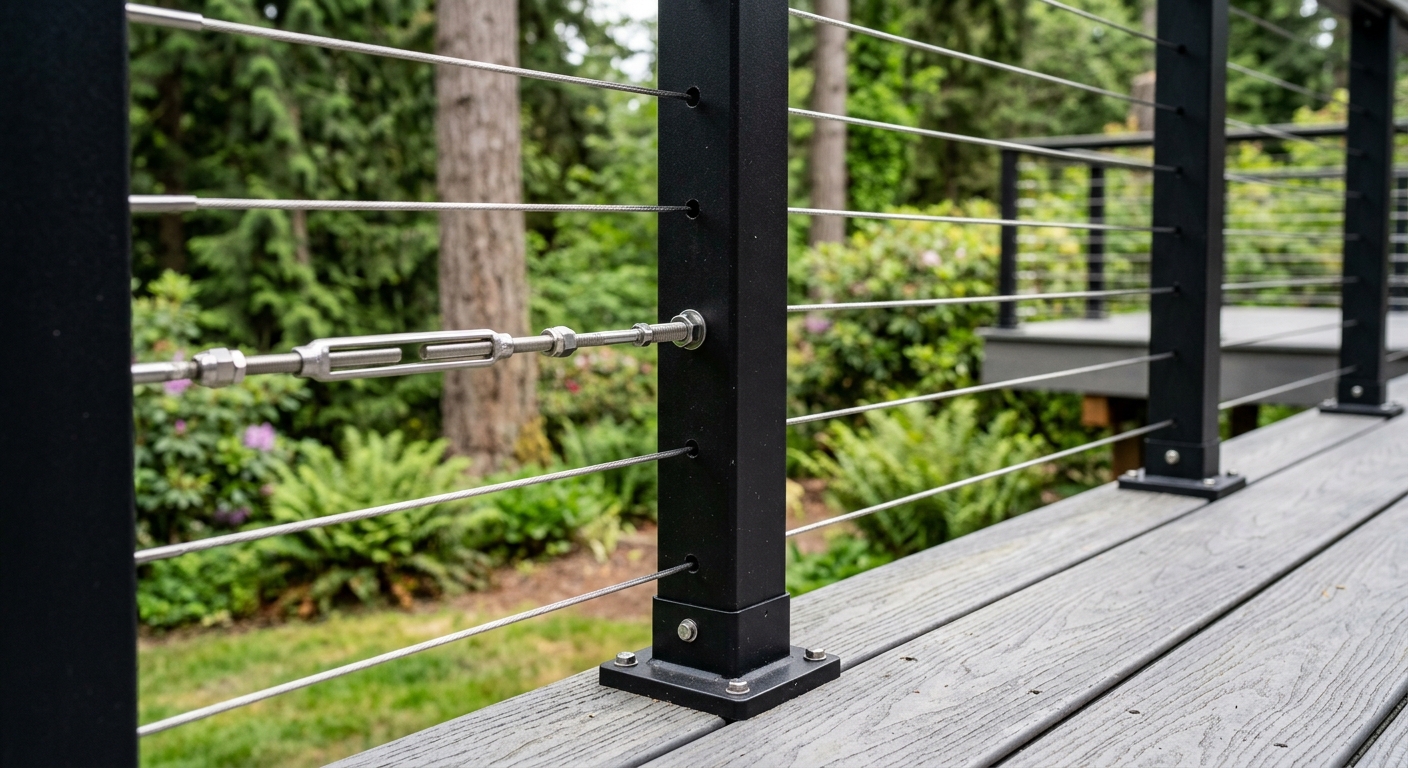
Kent enforces these minimums and plan reviewers check railing specifications during plan review. Don't spec railings without confirming they meet current code requirements — and note that some premium railing systems (particularly cable systems) require specific horizontal spacing calculations to meet the 4-inch sphere rule.
Railing Material Options and Cost
| Railing Type | Cost Range (per linear foot) | Maintenance | Best For |
|---|---|---|---|
| Pressure-treated wood | $30–$50/lf | High | Budget builds |
| Composite/aluminum | $60–$90/lf | Low | Matching composite decks |
| Cable railing | $90–$140/lf | Low | Views, modern aesthetic |
| Glass panel | $120–$200/lf | Medium | Premium, open views |
| Aluminum powder-coat | $70–$100/lf | Very low | Modern, durable |
Cable railing is particularly popular on West Hill sites where the deck captures views across the valley or toward Puget Sound on clear days. Our cable railing Seattle guide covers the installation considerations, including the post sizing requirements that cable tension creates.
For a full overview of railing options in the Seattle area, our deck railing options Seattle guide covers the complete range.
Timeline: How Long Does a Permitted Deck Build Take in Kent WA?
One of the most common frustrations in deck projects is the gap between "I'm ready to start" and "my deck is done." In Kent, that gap is typically 8–14 weeks for a permitted composite deck build — sometimes longer depending on permit workload at Kent Building Services and contractor availability.
Here's how those weeks break down:
Phase 1: Design and Contractor Selection (2–4 weeks)
Getting three bids, reviewing contractor credentials, selecting materials, and finalizing design takes 2–4 weeks if you move efficiently. This phase runs in parallel with nothing — it's pure homeowner decision-making time. Starting this phase before you're emotionally ready to commit is wasteful, but delaying it extends your total timeline linearly.
Phase 2: Permit Application and Review (3–6 weeks)
After signing with your contractor, permit application can be submitted. Kent's current plan review timeline for residential decks is approximately 3–6 weeks from complete application to permit issuance. "Complete application" is the operative qualifier — an incomplete application gets returned, restarting the clock. Experienced local contractors know what a complete Kent permit package looks like and submit correctly the first time.
Factors that extend permit timeline:
- Engineering review required (adds 1–2 weeks)
- Floodplain review required (adds 2–4 weeks)
- HOA approval required (adds 2–6 weeks, and runs in parallel to city permit)
- Incomplete initial submission (resets review clock)
Phase 3: Material Lead Time (1–3 weeks)
Composite decking from Trex, Fiberon, or TimberTech in standard colors and profiles typically ships from regional distributors in 1–2 weeks. Custom colors, premium profiles, or specialty railing systems can take 3–6 weeks. Your contractor should order materials as soon as the permit is issued — not wait until they're ready to start.
Phase 4: Construction (1–3 weeks)
The actual construction phase for a typical 300–500 square foot deck is surprisingly fast — 5–12 working days for an experienced crew. This assumes pre-ordered materials arrive on time and footings cure before framing begins (typically 24–48 hours for concrete footings). Multi-level builds, hillside sites with complex framing, or projects with integrated pergolas and outdoor kitchen rough-in take longer.
Phase 5: Final Inspection (1–2 weeks)
Kent Building Services schedules inspections by request — typically 3–7 business days after request. Inspectors look at footing depth, structural connections, railing height and spacing, stair geometry, and overall compliance with the approved plans. Projects that pass on the first inspection get their permit closed; projects that require corrections go back into the queue.
Total realistic timeline from "ready to start" to "passed final inspection": 8–14 weeks in typical conditions. Start in late January or February if you want a completed deck by Memorial Day. Start in March or April and you're likely looking at a June/July completion.
Tip
Multi-Level Decks and Custom Designs in Kent
Kent's varied topography is actually an opportunity for deck design, not just a complication. West Hill hillside lots that require elevated framing often create natural conditions for multi-level designs — a main deck level off the primary floor, a lower terrace level at grade or near-grade, and perhaps a set of stairs connecting the two. When designed well, this kind of multi-level build turns a challenging sloped lot into a genuine outdoor living sequence.
Multi-level decks cost more. The additional framing, additional railing, additional stairs, and additional engineering stamp add to both material cost and labor. A two-level deck on a West Hill hillside lot might run $20,000–$35,000 where a flat-lot single-level would run $12,000–$18,000. But the livable square footage and the way it handles the grade change often makes the premium worthwhile.
Our custom curved decks Seattle guide explores non-rectangular design options that are particularly effective on odd-shaped lots — a common situation in Kent's older neighborhoods where lot lines don't always follow clean rectangles.
Deck and Patio Combinations
Many Kent homes — particularly in East Hill neighborhoods with flat or gently sloping back yards — benefit from deck-and-patio combinations that combine a wood or composite deck immediately off the house with a paver or concrete patio at grade below. This hybrid approach captures the elevated deck's utility as a transition from the house interior while providing a grade-level outdoor entertaining area that doesn't require stairs every time you move between zones.
Our deck and patio combo Seattle guide covers the design and contractor considerations for these hybrid projects.
ROI: What Does a New Deck Add to a Kent Home's Value?
The NAR Remodeling Impact Report consistently shows deck additions among the highest ROI home improvement projects nationally. The 2022 report cited a 72% cost recovery on wood deck additions nationally, with cost recovery varying by region, material, and market conditions.
In the greater Seattle metro — and specifically in Kent where the market is active — deck additions and replacements tend to perform well on resale for several reasons. South King County buyers expect outdoor living space. A home without a functional deck in a neighborhood where most comparable homes have one is functionally at a disadvantage in a competitive listing situation. The question for Kent homeowners isn't usually "will a deck add value?" but rather "which deck adds the most value for my budget?"
The broad answer: a well-built composite deck in good condition adds more value than a neglected pressure-treated deck in poor condition, even if the pressure-treated build cost less. A deck that needs immediate replacement when a buyer walks through is a price reduction, not an asset. The condition premium matters as much as the material premium in most Kent sale scenarios.
Permit history also affects value. A deck with a closed permit and passed inspections on record at Kent Building Services has a clean title history that buyers' agents can verify. An unpermitted deck creates a title complication and often requires either retroactive permitting (expensive and uncertain) or a price concession. Build with permits — it protects value.
Working With a Local South King County Deck Builder: Why It Matters
The argument for hiring a local deck builder in Kent versus a large general contractor or a Seattle-based company that "also does South King County" comes down to specificity. Kent's permit process, Kent's neighborhoods, Kent's soils, Kent's HOA landscape, Kent's material suppliers — these are things a builder who's done 30 decks in Kent understands at a level that a builder who's done 2 decks in Kent simply doesn't.
That local knowledge shows up in practical ways: a contractor who knows which Kent Building Services plan reviewers are strict about railing specifications will submit drawings that address those details up front, rather than waiting for a correction notice. A contractor who has sources at local lumber yards gets better pricing on framing material than one who orders from distant distributors. A contractor who knows that a specific East Hill subdivision has HOA restrictions on railing color will ask you about it before design finalization rather than after.
The NADRA deck association maintains standards and certifications for deck contractors nationally — membership and NADRA certification is one signal of professional commitment to the trade, though it isn't a substitute for local experience verification.
At The Seattle Decking Company, we've built decks throughout South King County, including throughout Kent's East Hill, West Hill, and valley-floor neighborhoods. We know which soils on the Green River Valley floor require soils reports, which West Hill streets have steep enough grades to trigger automatic engineering review, and how Kent Building Services handles elevated deck permit packages. That knowledge doesn't show up as a line item on a bid, but it shows up in your project's outcome.
Closing: Get Your Kent Deck Right the First Time
Building a deck in Kent in 2026 is an investment that should last 25–30 years with the right materials and construction. The permit process is navigable. The material choices are clearer than they've ever been — composite decking technology has matured to the point where the case for low-maintenance PNW-appropriate materials is compelling for most homeowners. And the local contractor market, while active, is competitive enough that diligent homeowners who get multiple bids and vet credentials properly will find good value.
The decisions that matter most aren't the glamorous ones — they're the boring fundamentals: Is the footing design appropriate for your site's soil conditions? Is the ledger attachment waterproofed correctly? Are the structural connections at each post base installed to manufacturer specs? Is the permit closed with a passed final inspection? These are the questions that separate a deck you'll enjoy for 30 years from one that fails at year 8.
If you're ready to get started on a Kent deck project — whether you're replacing an aging pressure-treated build on East Hill or designing a new multi-level deck on a West Hill hillside lot — The Seattle Decking Company is the call to make. We serve Kent and all of South King County, and we pull permits, use licensed crews, and build decks that pass inspection the first time. Reach us at (425) 675-6259 or through our contact page to schedule a site walkthrough and estimate. We'll walk your lot, measure the grade change, check the setbacks, and give you a complete bid that accounts for your site's specific conditions — no surprises.
Frequently Asked Questions
Do I need a permit to build a deck in Kent WA?
How much does a deck cost in Kent WA in 2026?
What is the best decking material for Kent's wet climate?
How long does it take to build a permitted deck in Kent?
Does a hillside lot in Kent West Hill cost more for a deck?
How much are deck permit fees in Kent WA?
Can I build a deck in Kent without hiring a contractor?
What Kent neighborhoods are best suited for deck projects?
Does my Kent neighborhood HOA affect my deck project?
What is the ROI on a new deck in Kent WA?
How do I verify a deck contractor's license in Kent WA?
What composite decking brands does The Seattle Decking Company recommend for Kent?
Planning a deck in the Seattle area?
Get an onsite design review and a clear, itemized quote from a licensed local builder.
Request a Free Quote